Thanks to Kate for making me aware that the Edinburgh Book Festival was running in hybrid format this year, allowing people hundreds or thousands of miles away to participate. It felt like a return to the good old days of coronavirus lockdown – yes, I know it was very bad for very many people, but one consolation, especially for a thrifty introvert like me, was the chance to attend a plethora of literary and musical events online without leaving my sofa. I donated to live-stream two talks, one by Olivia Laing last week (more on that in an upcoming post on three recent gardening-themed reads) and this one by Richard Holloway on Sunday.
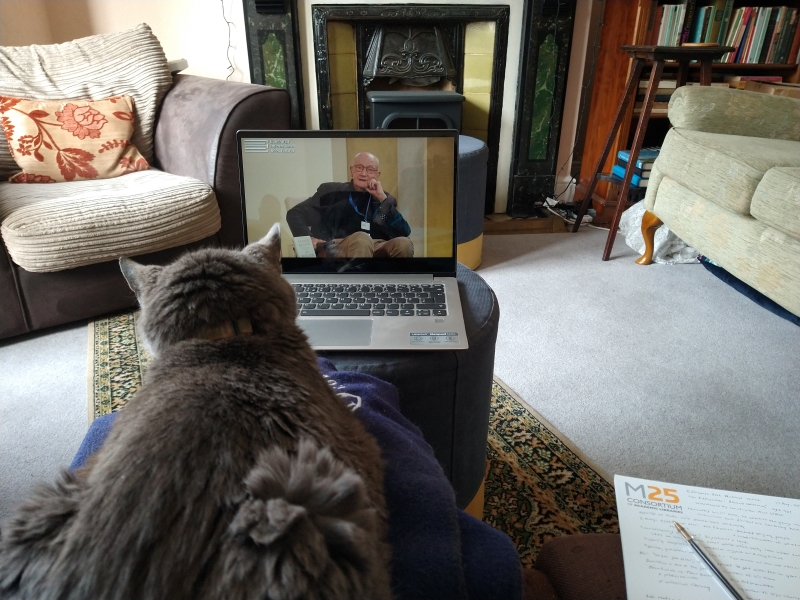
Alfie was rapt, too, of course.
I’ve reviewed several of his books here before (The Way of the Cross, Waiting for the Last Bus and The Heart of Things) and it would be fair to call him one of my most-admired spiritual gurus. At age ninety, he is not just lucid but quick-witted and naughty (I wasn’t expecting two F-bombs from a former bishop). While I have not read his latest book, On Reflection, it sounds like it’s quite similar to The Heart of Things: composed of memories and philosophical musings, with lashings of 20th-century poetry and Scottish history.
Interviewer Alan Little, a broadcaster who is stepping down as Festival chair after a decade, drew Holloway out on topics including faith, poetry, the Scottish reformation, and mortality. Little joked, “as you get older, you’re supposed to get more set in your ways!” while Holloway appears to become ever more liberal. He referred to himself as a “non-believing Christian” who is still steeped in religious culture and language but has adopted a “serene, gracious agnosticism,” which is “as much as the universe affords us.”
Holloway recently reread his first book and, while he admired that young man’s enthusiasm, he disliked the hectoring tone. The opposite of faith isn’t doubt, he remarked, but certainty. Two things prompted him to leave the ministry: the Church’s hatred of gay people and its subordination of women. His guiding principle is simple (reminiscent of Jan Morris’s): let’s be kind to each other and look after one another while we’re here. More existentially, he frames it as: let’s live as if life has meaning, even though he’s not sure that it does. In fact, he theorizes that religion arose from death, because we are the only species that is aware of our mortality and we can’t bear the thought of nothingness.
Holloway seems to live and breathe poetry. He expressed his love for W. H. Auden, whom he described as almost “priestly” in his brokenness, struggles, mysticism, and doing of good by stealth (he cared for war orphans and left them money at his death). Although I sometimes feel that Holloway is overly reliant on quotation in his recent books, I appreciate his fervour for poetry. His summation of what it does for him rang true for me as well: “poetry feeds me because it notices things in a particular way.” He added, “at its best, religion is a kind of realized poetry,” exclaiming, if only we could value it as such and not turn it into doctrine.
I wasn’t as interested in the discussion of John Knox and Scottish Presbyterianism, but obviously it was appropriate for the Edinburgh setting. Holloway said that it saddens him that Scotland is losing “the kirk” – as a tradition and in the form of buildings, many of which stand derelict. He read a long passage about Knox’s unfortunate hatred of images (his movement removed or concealed all sacred paintings) and how that rejection comes from the desert religions, which associate emptiness with otherness and the Transcendent.
During the Q&A time, one audience member said that he was heading to a Handel performance next, and hoped for a transcendent experience – but, he asked, being agnostic like Holloway, “what will I transcend to?” The two men seemed to agree that the experience itself is enough. Culture as transmitted by learning is the most distinctive thing about humans, Holloway observed, and Little also spoke passionately about the arts’ role in reconciliation. Several times, Holloway expressed his enduring wonder at the fact that there is something instead of nothing. It still staggers him not just that we’re here, but that we are capable of pondering the meaning of our own existence through events such as this one. That humility, even after his many decades as a respected public thinker, was beautiful to see.
 Bookish Beck = Rebecca Foster. American transplant to England. Freelance proofreader and book reviewer.
 Bookish Beck
That’s great that there were online events. I’m a massive introvert but sadly I struggle to concentrate on live-streamed stuff, so I stopped booking it after a while.
LikeLike
Would it help if you multitasked, e.g. did something with your hands like cooking or knitting while you listened? Or if you took notes? That helps me stay engaged.
LikeLiked by 1 person
Taking notes definitely helps. I tried to take up knitting for exactly this purpose (I also struggle with films and TV) but I can only knit scarves so there were quickly too many!
LikeLiked by 1 person
Ha ha, yes, there are only so many scarves you can make! I learned to knit in college and in my early twenties I made scarves for my husband and each of his grandparents but that was about the extent of it. When I listened to an audiobook back in November, I had to find loads of things to keep my hands busy: mending, baking, writing cards, wrapping presents. I don’t have a telly and don’t really watch DVDs anymore either, as it just seems to take away from reading time. It’s a wonder I can concentrate on books; I guess it works because I switch between lots of them every 20 pages or so, and I do find it a completely immersive sensory experience. Maybe reluctant readers don’t experience it as such.
LikeLike
What a fascinating talk – he sounds like a very cool person! The gist of his ethos sounds very much like the book I just finished, A Psalm for the Wild-Built by Becky Chambers. The robot essentially says the same thing to the monk, that humans just exist like any other animal and that existence is enough, that we don’t need to chase a purpose or deeper meaning. It reminded me of Mary Oliver’s poem about watching the grasshopper and that being enough for her “wild precious life.”
LikeLiked by 1 person
How cool to find those connections in such different genres — that’s how you know you’re approaching something universal.
LikeLiked by 1 person
It’s such a an interesting topic! I almost can’t stand to think about it, though, because I’m definitely a person who can’t stand the thought of nothingness. I like the thought of being able to watch everyone after I’m gone. And to know all the answers to the secrets of the universe. I’m counting on it. 😉
LikeLiked by 1 person
Well, who knows? There are so many reports of ghost activity and they must have come from somewhere.
LikeLiked by 1 person
True!
LikeLike
Oh, I wish I’d known about this! Like you, I’m a huge Richard Holloway fan, finding him curious, generous spirited and appreciative of beauty in whatever form. It sounds as if (with a it of a blip in the middle) you enjoyed an interesting session.
LikeLiked by 1 person
You can watch it back anytime before the end of the year!
https://www.edbookfest.co.uk/the-festival/whats-on/on-reflection-richard-holloway
LikeLiked by 1 person
Oh thanks for that Rebecca. I certainly will when we’re back home.
LikeLike
I *love* the sound of this book–thank you so much for writing up the talk, Rebecca!
LikeLiked by 1 person
Thanks for reading, Carolyn! It’s always lovely to see you in the comments. I don’t have a sense of how well known Holloway is in the States or if his books are generally available. I know that you would also appreciate how fluent he is in poetry and how readily he applies it to everyday life.
LikeLiked by 1 person
His isn’t a name that I registered as having heard (sorry about the tortured syntax of this phrase . . . yikes), and a quick look in my library system shows a handful of books, but not this one, yet. I’ll check again in a couple months!
LikeLiked by 1 person
That’s cool that you can access some of his books via the library! His Leaving Alexandria is one of my favorite memoirs.
LikeLiked by 1 person
I enjoyed reading this and appreciate the tone and nature in the parts you’ve described and quoted. Whenever you mention attending these events, I lament that I don’t attend more often (or don’t, at least, watch later, “on demand”). Likely, as with other activities I enjoy, like films and TV, I would need to set myself a loose schedule, to make sure there’s a variety; otherwise, I tend to fall into a routine and one activity soon eclipses all the others.
LikeLike
I ended up watching another festival talk on Saturday, too. Watching three things in a month, that must be a record for me! 😉
LikeLike
Do you have a particular notebook for them? Or maybe you wrote this from memory? I bet that would keep me motivated, a dated record, seeing how long it had been since I last attended one. Sometimes I need a clear reminder of how much fun it is to do something that I’ve not made a habit of doing.
LikeLike
I have a notepad I’ve been using for them, then tearing out the page and filing it.
LikeLike
I haven’t attended Edinburgh Book Festival since we left the city and moved to Ireland a decade ago. I wish I knew beforehand that there’s an option to participate via an online platform. Thanks for sharing, and have a good day 😊 Aiva xx
LikeLiked by 1 person
Hi! Thanks for reading. Have a look at their website — most events you can stream for months afterwards.
LikeLiked by 1 person
[…] in late August, I attended another online talk that really chimed with the one by Richard Holloway, this time as part of Greenbelt Festival, a progressive Christian event we used to attend annually […]
LikeLike