Back in late August, I attended another online talk that really chimed with the one by Richard Holloway, this time as part of Greenbelt Festival, a progressive Christian event we used to attend annually but haven’t been to in many years now.
Not just as a Covid holdover but also in a conscious sustainability effort, Greenbelt hosted a “fly-free zone” where overseas speakers appeared on a large screen instead of travelling thousands of miles. So Richard Rohr, who appeared old and frail to me – no wonder, as he is now 81 and has survived five unrelated cancers (doctors literally want to do a genetic study on him) – appeared from the communal lounge of his Center for Action and Contemplation in New Mexico to introduce his upcoming book The Tears of Things, due in March 2025. The title is from the same Virgil quote as Holloway’s The Heart of Things. It’s about the Old Testament prophets’ shift from rage to lamentation to doxology (“the great nevertheless,” he called it): a psychological journey we all must make as part of becoming spiritually mature.
From reading his Falling Upward, I was familiar with Rohr’s central teaching of life being in two halves: the first, ego-led, is about identity and argumentation; the second is about transcending the self to tap into a universal consciousness. “It’s a terrible burden to carry your own judgementalism,” he declared. A God encounter provokes the transformation, and generally it comes through suffering, he said; you can’t take a shortcut. Anger is a mark of “incomplete” prophets such as John the Baptist, he explained. Rage might seem to empower, but it’s unrefined and only gives people permission to be nasty to others, he said. We can’t preach about a wrathful God or we will just produce wrathful people, he insisted; instead, we have to teach mercy.
When Rohr used to run rites of passage for young men, he would tell them that they weren’t actually angry, they were sad. There are tears that come from God, he said: for Gaza, for Ukraine. We know that Jesus wept at least twice, as recorded in scripture: once for Jerusalem (the collective) and once for his dead friend Lazarus (the individual). Doing the “grief work” is essential, he said. A parallel to that anger to sadness to praise trajectory is order to disorder to reorder, a paradigm he takes from the Bible’s wisdom literature. Brian McLaren’s recent work is heavily influenced by these ideas, too.
During the question time, Rohr was drawn out on the difference between Buddhism and Christianity (the latter gives reality a personal and benevolent face, he said) and how he understands hope – it is participation in the life of God, he said, and it certainly doesn’t come from looking at the data. He lauded Buddhism for its insistence on non-dualism or unitive consciousness, which he also interprets as the “mind of Christ.” The love of God is the Absolute, he said, and although he has experienced it throughout his life, he has known it especially when (as now) he was weak and poor.
Non-dualism is the theme that led me to go back to a book that had been on my bedside table, partly read, for months.
The Naked Now: Learning to See as the Mystics See (2009)
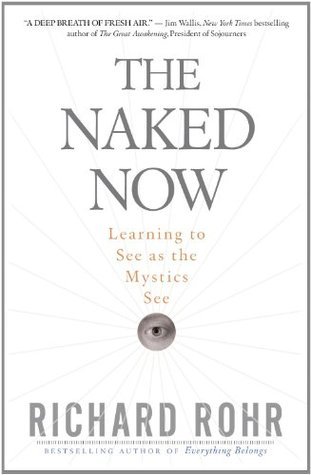 This was my fourth book by Rohr, and as with The Universal Christ, I feel at a loss trying to express how wise and earth-shaking it is. The kernel of the argument is simple. Dualistic thinking is all or nothing, us and them. The mystical view of life involves nonduality; not knowing the right things but “knowing better” through contemplation. It’s an opening of the heart that then allows for a change of mind. And yes, as he said at Greenbelt, it mostly comes about through great suffering – or great love. Jesus embodies nonduality by being not human or divine, but both, as does God through the multiplicity of the Trinity.
The book completely upends the fundamentalist Christianity I grew up with. Its every precept is based on Bible quotes or Christian tradition. It’s only 160 pages long, very logical and readable; I only went through it so slowly because I had to mark out and reread brilliant passages every few pages.
You can tell adult and authentic faith by people’s ability to deal with darkness, failure, and nonvalidation of the ego—and by their quiet but confident joy!
[I’ve met people who are like this.]
If your religious practice is nothing more than to remain sincerely open to the ongoing challenges of life and love, you will find God — and also yourself.
[This reminded me of “God is change,” the doctrine in Parable of the Sower by Octavia E. Butler.]
If you can handle/ignore a bit of religion, I would recommend Rohr to readers of Brené Brown, Susan Cain (thinking of Bittersweet in particular) and Anne Lamott, among other self-help and spirituality authors – e.g., he references Eckhart Tolle. Rohr is also known for being one of the popularizers of the Enneagram, a personality tool similar to the Myers-Briggs test but which in its earliest form dates back to the Desert Father Evagrius Ponticus. 
 Bookish Beck = Rebecca Foster. American transplant to England. Freelance proofreader and book reviewer.

I started reading Rohr’s A Spring Within Us as a form of morning meditation during the lockdown, and it felt so transformative—I never got all the way through it, but it was the start of a period of really intense reorientation of myself that has continued on into therapy and been facilitated by a healthy romantic relationship. Everything he says does feel wise, and not in a sententious manner either. I’d love to read more of him, and The Naked Now sounds like a great one.
LikeLiked by 1 person
I’d not heard of that one; he’s prolific! I’m so glad to hear that you’ve benefited from his wisdom as well. Often I’m like ‘pah, there’s nothing to this supernatural lark’, but I can’t deny the hold that the religious tradition has on me, and when it works well — if it actually contributes to transforming people and society — then it seems worth keeping.
LikeLiked by 1 person
My mom was a big Rohr fan, which is probably why I’ve never tried him. Stubborn child that I was. That one sounds like a good place to start.
LikeLiked by 1 person
Your mom knew what she was on about 😉 Falling Upward is a great introduction to him, especially as one reaches middle age; I think I was too young when I first read it.
LikeLiked by 1 person
I’m definitely there! Putting Falling Upward on my TBR–thanks, Rebecca!
LikeLiked by 1 person
I’m not sure what to think about someone who identifies as a member of one religion interpreting another religion; part of me thinks they are perfectly positioned to reflect on it (particularly when they come to religion as an adult, as a seeker) and part of me thinks they should speak to their own experience. But I can see where it could spark thoughts about deeper matters and everyone finds their own way to that place (at least that’s how I see it, more as an individual journey). The idea of how one copes with darkness (and failure, etc.) being a defining factor does resonate with me.
LikeLiked by 1 person
Without Buddha I Could Not be a Christian by Paul F. Knitter is one of the most profound books of religious dialogue I’ve read. Although Christianity is the tradition I know and grew up in, I’m now very much of the opinion that all faiths are fingers pointing to the same moon.
LikeLike
I heard Rohr on an episode of the podcast On Being a few years ago and I remember thinking he was someone I should read.
LikeLiked by 1 person
I would recommend it for sure!
LikeLiked by 1 person