Two literary events I attended recently…
On Friday afternoon I volunteered on stewarding and refreshments for an author chat held at my local public library. It was our first such event since before Covid! I’d not heard of Eve Smith, who is based outside Oxford and writes speculative – not exactly dystopian, despite the related display below – novels inspired by scientific and medical advancements encountered in the headlines. Genetics, in particular, has been a recurring topic in The Waiting Rooms (about antibiotic resistance), Off Target (gene editing of embryos), One (a one-child policy introduced in climate-ravaged future Britain) and The Cure (forthcoming in April 2025; transhumanism or extreme anti-ageing measures).


Smith used to work for an environmental organization and said that she likes to write about what scares her – which tends not to be outlandish horror but tweaked real-life situations. Margaret Atwood has been a big influence on her, and she often includes mother–daughter relationships. In the middle of the interview, she read from the opening of her latest novel, One. I reckon I’ll give her debut, The Waiting Rooms, a try. (I was interested to note that the library has classed it under Science Fiction but her other two novels with General Fiction.)
Then last night we went to see my husband’s oldest friend (since age four!) in his community theatre group’s production of Absurd Person Singular, a 1972 play by Alan Ayckbourn. I’ve seen and read The Norman Conquests trilogy plus another Ayckbourn play and was prepared for a suburban British farce, but perhaps not for how dated it would feel.
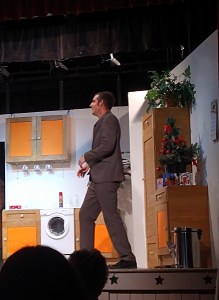 The small cast consists of three married couples. Ronald Brewster-Wright is a banker with an alcoholic wife, Marion. Sidney Hopcroft (wife: Jane) is a construction contractor and rising property tycoon and Geoffrey Jackson is a philandering architect with a mentally ill wife, Eva. Weaving all through is the prospect of a business connection between the three men: “you scratch my back, I’ll scratch yours,” as Sidney puts it to Ronald several times. After one of Geoffrey’s buildings suffers a disastrous collapse, he has to consider humbling himself enough to ask Sidney for work.
The three acts take place in each of their kitchens on subsequent Christmas Eves; the period kitchen fittings and festive decorations were a definite highlight. First, the Hopcrofts stress out over hosting the perfect cocktail party – which takes place off stage, with characters retreating in twos and threes to debrief in the kitchen. The next year, the jilted Eva makes multiple unsuccessful suicide attempts while her oblivious friends engage in cleaning and DIY. Finally, we’re at the Brewster-Wrights’ and the annoyingly cheerful Hopcrofts cajole the others, who aren’t in the Christmas spirit at all, into playing a silly musical chairs-like game.


With failure, adultery, alcoholism and suicidal ideation as strong themes, this was certainly a black comedy. Our friend Dave decided not to let his kids (10 and 7) come see it. He was brilliant as Sidney, not least because he genuinely is a DIY genius and has history of engaging people in dancing. But the mansplaining, criticism of his poor wife, and “Oh dear, oh dear” exclamations were pure Sidney. The other star of the show was Marion. Although the actress was probably several decades older than Ayckbourn’s intended thirtysomething characters, she brought Norma Desmond-style gravitas to the role. But it did mean that a pregnancy joke in relation to her and the reference to their young sons – the Brewster-Wrights are the only couple with children – felt off.
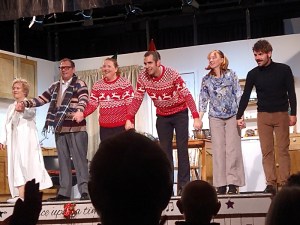 The director chose to give a mild content warning, printed in the program and spoken before the start: “Please be aware that this play was written in the 1970s and reflects the language and social attitudes of its time and includes themes of unsuccessful suicide attempts.” So the play was produced as is, complete with Marion’s quip about the cycles on Jane’s new washing machine: “Whites and Coloreds? It’s like apartheid!” The depiction of mental illness felt insensitive, although I like morbid comedy as much as the next person.
I can see why the small cast, silliness, and pre-Christmas domestic setting were tempting for amateur dramatics. There was good use of sound effects and the off-stage space, and a fun running gag about people getting soaked. I certainly grasped the message about not ignoring problems in hopes they’ll go away. But with so many plays out there, maybe this one could be retired?
 Bookish Beck = Rebecca Foster. American transplant to England. Freelance proofreader and book reviewer.
 Bookish Beck
Back in the day, I used to enjoy seeing an Alan Ayckbourn or two. But I’ve not felt at all like going lately, feeling certain I’d find his plays embarrassingly dated. Phew! You seem to have convinced me my hunch was right!
LikeLiked by 1 person
I think it was 2006 that I saw The Norman Conquests. I probably wouldn’t have noticed back then if they had dated/dodgy stuff in.
LikeLiked by 1 person
I’ve seen Eve Smith’s novels about but not tried any, though I like the premises.
LikeLiked by 1 person
Strange that I’d never come across them in any way. I’ll try the most medical one and see how I like her writing.
LikeLiked by 1 person
I remember seeing Eve Smith’s novels somewhere, and being interested by them. The Waiting Rooms or Off Target appeal to me most. Cool that you got to see her at your local library; I don’t think ours ever hosts authors. Shame about the datedness of the Ayckbourn, a playwright I have zero experience with; it does sound well suited for talented amateur production—and like your husband’s friend and his troupe did the play justice—but unfortunate about the mental illness being played for laughs (unless I’ve got that wrong?)
LikeLiked by 1 person
We used to host a lot of stuff — we’re the biggest library in the county — but Covid put a stop to all that. Actually, a book club friend and I were booked in to see Gill Hornby (who lives fairly locally) speak about her first Jane Austen-themed novel in April 2020 and the event was first postponed and then cancelled. Then nothing at all until last week!
Yeah, I would say the mental health theme was not handled well. But I put that down to Ayckbourn and his times. The Norman Conquests was hilarious in my memory, but because I saw it over 18 years ago, I probably wouldn’t have been picking up on any offensive content.
LikeLike
Well, it’s nice to see the library trying to bring back an events programme!
LikeLike
The author event looks like a nice, intimate chat! How fun.
LikeLiked by 1 person
I’m sorry for her sake that we didn’t get more than 10 guests (the rest are staff and volunteers), but she spoke very well and people were engaged and asked questions as she went along.
LikeLiked by 1 person
Well, the volunteers and staff still count! You could have stayed home; they could have hidden in a supply closet! 🙂
I know what you mean with wondering how much remains of value in certain works being performed in public. At the very least, it creates the opportunity to discuss it.
LikeLiked by 1 person
It’s true. We bulked out the audience and the coordinator encouraged volunteers to ask questions and buy books (others did, though I didn’t).
I suppose it’s a good thing that they gave the content warning at least. Most of the audience were ‘of a certain age’ so that wasn’t a guarantee.
LikeLike
[…] mentioned that my library has recently started running author events again, for the first time since Covid. […]
LikeLike