Later this evening, the Carol Shields Prize will be announced at a ceremony in Chicago. I’ve managed to read two more books from the shortlist: a sweet, delicate story about the women who guarded Emily Dickinson’s poems until their posthumous publication; and a sui generis work of autofiction that has become so much a part of popular culture that it hardly needs an introduction. Different as they are, they have themes of women’s achievements, creativity and desire in common – and so I would be happy to see either as the winner (more so than Liars, the other one I’ve read, even though that addresses similar issues). Both: 
Pale Shadows by Dominique Fortier (2022; 2024)
[Translated from French by Rhonda Mullins]
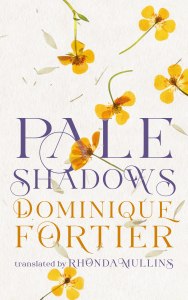 This is technically a sequel to Paper Houses, which is about Emily Dickinson, but I had no trouble reading this before its predecessor. In an Author’s Note at the end, Fortier explains how, during the first Covid summer, she was stalled on multiple fiction projects and realized that all she wanted was to return to Amherst, Massachusetts – even though her subject was now dead. The poet’s presence and language haunt the novel as the characters (which include the author) wrestle over her words. The central quartet comprises Lavinia, Emily’s sister; Susan, their brother Austin’s wife; Mabel, Austin’s mistress; and Millicent, Mabel’s young daughter. Mabel is to assist with editing the higgledy-piggledy folder of handwritten poems into a volume fit for publication. Thomas Higginson’s clear aim is to tame the poetry through standardized punctuation, assigned titles, and thematic groupings. But the women are determined to let Emily’s unruly genius shine through.
The short novel rotates through perspectives as the four collide and retreat. Susan and Millicent connect over books. Mabel considers this project her own chance at immortality. At age 54, Lavinia discovers that she’s no longer content with baking pies and embarks on a surprising love affair. And Millicent perceives and channels Emily’s ghost. The writing is gorgeous, full of snow metaphors and the sorts of images that turn up in Dickinson’s poetry. It’s a lovely tribute that mingles past and present in a subtle meditation on love and legacy.
Some favourite lines:
“Emily never writes about any one thing or from any one place; she writes from alongside love, from behind death, from inside the bird.”
“Maybe this is how you live a hundred lives without shattering everything; maybe it is by living in a hundred different texts. One life per poem.”
“What Mabel senses and Higginson still refuses to see is that Emily only ever wrote half a poem; the other half belongs to the reader, it is the voice that rises up in each person as a response. And it takes these two voices, the living and the dead, to make the poem whole.”
With thanks to The Carol Shields Prize Foundation for the free e-copy for review.
All Fours by Miranda July (2024)
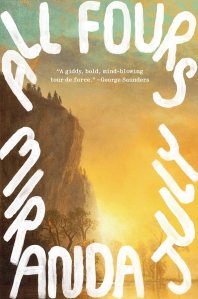 Miranda July’s The First Bad Man is one of the first books I ever reviewed on this blog back in 2015, after an unsolicited review copy came my way. It was so bizarre that I didn’t plan to ever read anything else by her, but I was drawn in by the hype machine and started this on my Kindle in September, later switching to a library copy when I got stuck at 65%. The narrator sets off on a road trip from Los Angeles to New York to prove to her husband, Harris, that she’s a Driver, not a Parker. But after 20 minutes she pulls off the highway and ends up at a roadside motel. She blows $20,000 on having her motel room decorated in the utmost luxury and falls for Davey, a younger man who works for a local car rental chain – and happens to be married to the decorator. In his free time, he’s a break dancer, so the narrator decides to choreograph a stunning dance to prove her love and capture his attention.
I got bogged down in the ridiculous details of the first two-thirds, as well as in the kinky stuff that goes on (with Davey, because neither of them is willing to technically cheat on a spouse; then with the women partners the narrator has after she and Harris decide on an open marriage). However, all throughout I had been highlighting profound lines; the novel is full to bursting with them (“maybe the road split between: a life spent longing vs. a life that was continually surprising”). I started to appreciate the story more when I thought of it as archetypal processing of women’s life experiences, including birth trauma, motherhood and perimenopause, and as an allegory for attaining an openness of outlook. What looks like an ending (of career, marriage, sexuality, etc.) doesn’t have to be.
Whereas July’s debut felt quirky for the sake of it, showing off with its deadpan raunchiness, I feel that here she is utterly in earnest. And, weird as the book may be, it works. It’s struck a chord with legions, especially middle-aged women. I remember seeing a Guardian headline about women who ditched their lives after reading All Fours. I don’t think I’ll follow suit, but I will recommend you read it and rethink what you want from life. It’s also on this year’s Women’s Prize shortlist. I suspect it’s too divisive to win either, but it certainly would be an edgy choice. (NetGalley/Public library)
(My full thoughts on both longlists are here.) The other two books on the Carol Shields Prize shortlist are River East, River West by Aube Rey Lescure and Code Noir by Canisia Lubrin, about which I know very little. In its first two years, the Prize was awarded to women of South Asian extraction. Somehow, I can’t see the jury choosing one of three white women when it could be a Black woman (Lubrin) instead. However, Liars and All Fours feel particularly zeitgeist-y. I would be disappointed if the former won because of its bitter tone, though Manguso is an undeniable talent. Pale Shadows? Pure literary loveliness, if evanescent. But honouring a translation would make a statement, too. I’ll find out in the morning!
 Bookish Beck = Rebecca Foster. American transplant to England. Freelance proofreader and book reviewer.
 Bookish Beck
Both you and Laura have been pleasantly surprised by All Fours—I’m still pretty sure it won’t make it to the top of my interest list, but it’s nice to know there are some hidden depths. (Turns out Lubrin did win the CSP! Code Noir looks to be unavailable in the UK as yet; hopefully that’ll change.)
LikeLiked by 1 person
It seems to be one of those books where to appreciate it most you need to be square in the right demographic; Laura and I are on the young side for it, but I do see that perimenopause cliff coming.
I hope we’ll have a chance to read Code Noir.
LikeLiked by 1 person
Ah, I’m really pleased that you felt more warmly towards All Fours by the end. I think you’ve absolutely nailed why it worked for me – it’s the earnestness and honesty. She really wants to convey an experience rather than being deliberately clever or shocking. Thanks for the warning about The First Bad Man, though!
I wasn’t surprised to see Lubrin take the CSP and it does sound interesting – a shame we can’t easily get hold of it!
LikeLiked by 1 person
It’s lovely when you feel that a writer is completely genuine. I thought the same when seeing Robin Ince speak yesterday evening.
I don’t want to sound cynical, like Lubrin only won because she’s Black; I’m sure the book is a worthy winner. But I do have to wonder, after these first three years, what it would take for a white author to win! I guess they’re setting out their stall and supporting authors of colour as much as they can. I would also expect a nonbinary or trans author to win in future. (The first winner was queer as well as South Asian.)
I’ve asked the Prize administrator about a review PDF of Code Noir. I can let you know what she says.
LikeLiked by 1 person
Thank you! That would be great. (PDFs seem to be a lot more functional on Kindle these days.)
LikeLike
She sent me a PDF no problem. It’s Emily Kellogg: emily@carolshieldsprizeforfiction.com
LikeLike
I’m so happy you enjoyed Fortier’s novel. I think you would really love the first one then. (Although it’s interesting that you liked this one as well as you did, because I just wasn’t sure how that would work out.) And, well, everything she’s written. hehe
Even though I said this shortlisting would translate into my finally over-coming my initial not-thrilled-ness with Miranda July’s fiction, I leafed through at the library a couple weeks ago and still thought, Nope, Not Today. But your experience is encouraging. Eventually, I will get there, I know.
Lubrin just seemed like the perfect choice given the previous two winners, once it came down to the shortlist. My reading just went in entirely different directions the past couple months, but I hope to catch up with the prize longlisters before too long.
LikeLiked by 1 person
I would be glad to read more by Fortier if it became available to me.
I have the Lubrin in PDF now so will try to catch up with it at some point.
LikeLike
I’m absolutely in the right demographic for All Fours and I am absolutely not keen to read it!
LikeLiked by 1 person
Yeah, it doesn’t really seem like a book for you! I just sent my sister photos of three pages, though.
LikeLiked by 1 person
[…] are ones I’ve already covered on the blog (links to my reviews): The Most by Jessica Anthony, Pale Shadows by Dominique Fortier and Three Days in June by Anne Tyler; and, in nonfiction, Mornings without Mii […]
LikeLike