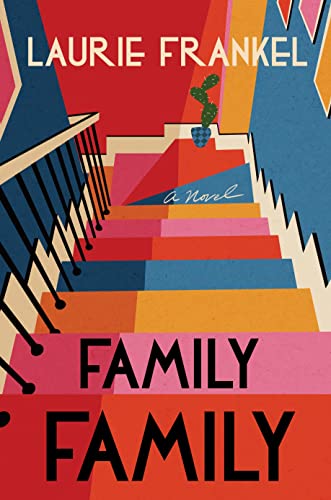
In case you missed the announcement, “The Marriage Plot” is the new name for the online book club formerly known as “Literary Wives.” Part of our reasoning behind the rebrand was to be more inclusive in our thinking about love and roles in long-term partnerships. But even from that wider perspective, Laurie Frankel’s fifth novel, Family Family, ended up being an outlier, because there’s no central marriage or core partners. Instead, the book makes the point that “families get formed in all sorts of ways” and “look all sorts of ways and are made up of all sorts of people and still count as family.” Specifically, Frankel – and her flamboyant actress protagonist, India Allwood – want to counter traumatic adoption stories by showing that placing for adoption and/or adopting can be a first choice rather than a last resort.

{BEWARE SPOILERS IN THE REST!}
There are two narrative threads, one set across eight days in 2020 and another advancing in fits and starts from 1998 to meet up with it. In the former, India is in trouble with her agent and television studio for badmouthing the last movie she made because she felt it promulgated tired, negative stories about adoptees. One of her adopted Korean American twins, 10-year-old Fig, decides to come to her mother’s defense by locating the two children India gave up for adoption (Rebecca and Lewis), their biological fathers (Robbie and Davis), and the adoptive parents (Camille and the Andrews). En route to a big, messy, unlikely family reunion, alternating chapters fill in India’s career – from high school dramatics to her current superhero hit, Val Halla – and unconventional decisions about motherhood.
 In terms of our club reads, this reminded me most of Lessons in Chemistry for how the protagonists resist marriage and prioritize independent vocations. All of the mothers on display are single parents: Camille and India, yes, but also India’s mother before her, who tells her, when she is first pregnant at 16, “having a baby has nothing to do with having a husband.” When India again falls pregnant unintentionally at age 20 (which does rather strain belief), she reminds herself, “parenting need not have anything to do with partnering.”
Long before I ever read a novel by Frankel, I’d come across a first-person piece she wrote for the Guardian about adopting a child from Korea. The experience of having a transgender child then led to her third novel, This Is How It Always Is (2017). I read that from the library because it had been a hit with my book club before I joined. There’s no denying the agenda behind either, but it was subtler in that earlier case. The characters here are quirky and their interactions amusing, but Frankel seems rather too pleased with her own wit. In addition, India is A Bit Much and Fig is on the verge of annoyingly precocious. Although the story bops along nicely, I would probably cut the page length by a third or more. So this was good-hearted fun, if overlong and moralistic. I’ll read more by Frankel, though, and I fancy appropriating India’s habit of keeping torn-up index cards in her pockets in case she needs confetti for an impromptu celebration. (Secondhand – Better World Books) 
(Be sure to check out the reviews by Becky, Kate, Kay, and Marianne, too!)
The club’s next read will be The Eden Test by Adam Sternbergh, in December. I’m skipping this one as a) I couldn’t find an affordable copy and b) I didn’t fancy it. So the next read for me will be Wedded Wife by Rachael E. Lennon (March 2027) – I’m looking forward to it, as it will make a change for being nonfiction, and from a queer author.
 Bookish Beck = Rebecca Foster. American transplant to England. Freelance proofreader and book reviewer.
 Bookish Beck
I think ‘precocious’ applies to a few of the characters!
If I had taken more time to think about our theme of partnerships, I would have looked more closely at the men (or boys!) she had her unplanned pregnancies with – both seemed reluctant about adoption but had to stress that it was India’s decision because it was her body. This was one aspect of the story that I think Frankel glossed over a little.
LikeLiked by 1 person
‘Precious’ as well, methinks.
It’s interesting to compare what Robbie and Davis went on to do: Robbie had five kids but got divorced (am I remembering correctly?), while Davis stayed single. Almost as if both of them were looking for a perfect family and either tried to create one or decided it wasn’t possible.
LikeLike
Precious. That’s a real zinger! You’re making me rethink how much I liked the book.
I like the comparison to Lessons in Chemistry. The moralistic part of it didn’t really hit me, probably because I was invested in the characters, but now that you mention it, I get it.
LikeLiked by 1 person
I wonder if I would have felt differently about the novel if it was in first person — because then India would have had to admit to doubts and insecurities. She seemed a little too ‘Superwoman’ to me.
I’m glad you enjoyed it! I mostly did, too. I found it a very easy book to get through and I will read more from Frankel. Her being so personally invested in the subject did show, though.
LikeLike
‘Too pleased with her own wit’, and a comparison with Lessons in Chemistry? You’ve lost me. It’s not on the list. However. You’ll be pleased to know I suddenly have 2 collections of short stories from the library to read: Heart Lamp, and Islanders. Making up for lost time.
LikeLiked by 1 person
Terrific! That’s the second mention of Heart Lamp for Short Story September.
LikeLiked by 1 person
👍
LikeLike
I don’t think I’ll read this one but I’m predisposed to like a character who wants always to be prepared for a celebration!
LikeLiked by 1 person
She’s a perfectionist about preparing for everything, including her acting roles, by writing notes on index cards. Then keeps the unwanted ones for confetti!
LikeLiked by 1 person
The content sounds interesting but from your review, too overdone/on the nose.
LikeLike
Interesting thoughts, some of them came to me only after reading your post which is the best part of this group.
I thought most about how different the adoptions were, why every single child ended up with another parent.
Same as India, I’m a big fan of lists. Though, I’ve never made confetti of them.
LikeLike