It’s been several years since I last participated in Kate’s Six Degrees meme. I’m not sure why I fell out of the habit, after posting pretty faithfully from February 2020 until August 2023. This month I was drawn back by the individualized starting point: your book club’s current read. (See Kate’s opening post.)
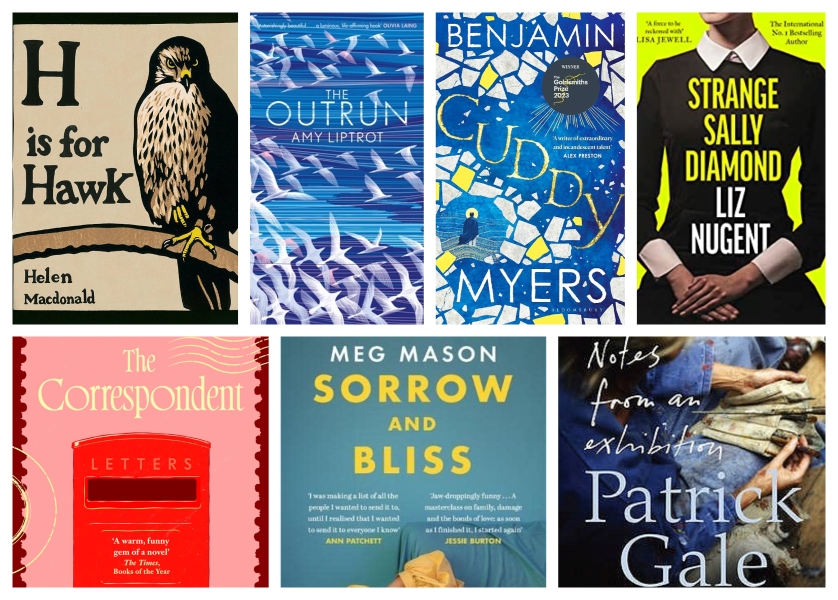
 So I start with Helen Macdonald’s H Is for Hawk, which I look forward to rereading for our next meeting in early October, and every link that follows is (or is connected to) a book we’ve read in book club.
 #1 H Is for Hawk was a vanguard of a new trend in nature writing that came to dominate the Wainwright Prize list in the UK: blending a hard/sad personal story with a quest that involves travel and/or communion with the natural world. In the case of Macdonald (who now uses they/them pronouns), they work through grief for their father by taking up falconry and training a goshawk.
I went with some members of my book club to see the excellent film starring Claire Foy, followed by a Q&A with the author, earlier this year. Another early example of the misery memoir-meets-nature book vogue was The Outrun by Amy Liptrot (a Wainwright winner), which combines her struggle with alcoholism with her return to the Orkney Islands and her work for the RSPB surveying endangered corncrakes. Another link: I saw the film version with Saoirse Ronan, which probably surpassed the book, with a book club friend. We then tried to get the others interested in rereading it with us, but it only got a few votes.
 #2 Liptrot lives in Hebden Bridge, Yorkshire, which is famous for its hippie artists and inclusivity (a Brighton of the North?). Among the other nearby residents (in the village of Mytholmroyd) is Benjamin Myers, whose experimental historical novel about Saint Cuthbert, Cuddy, we discussed in book club a year ago. I had skimmed it when it was first published, and enjoyed it in parts but thought it more pretentious than readable. It was not very well received by most members…
 #3 …unlike the quirky and suspenseful Strange Sally Diamond by Liz Nugent, which we’d read the year before and was a hit with almost everyone. Cuddy is set in Northumberland, and I associate Sally with that county because I read it on holiday there.
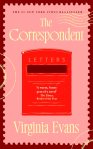 #4 Sally Diamond has some autistic-like traits, in terms of her lack of understanding of social conventions. We questioned whether this was an attempt by the author to reproduce the effects of trauma. The same book club member brought this up in relation to Sybil Van Antwerp, the protagonist of the most recent Women’s Prize winner, The Correspondent by Virginia Evans, which was our September read. I’d picked up on the characterization of her young friend Harry Landy as autistic, but Sybil herself? That hadn’t occurred to me. It just goes to show how discussing books in a group turns up fresh ideas about them.
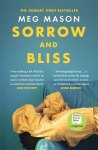 #5 We had also talked diagnoses with one of our previous reads, Sorrow and Bliss by Meg Mason, who scrupulously avoided naming her protagonist’s mental health condition, though it seemed pretty clear to us that it was meant to be bipolar. Another connection: we read that novel as part of our official Women’s Prize shadowing in 2022.
 #6 The Correspondent, Sorrow and Bliss, and Patrick Gale’s Notes from an Exhibition, which shares the theme of mental illness, are all among our top 10 reads of all time, with a score of 18.5/20. We’ve read two Gale novels now and he’s a reliable author for us.
 Bookish Beck = Rebecca Foster. American transplant to England. Freelance proofreader and book reviewer.

Welcome back to 6 Degrees! I did wonder at your not being part of the regulars with your wealth of reaing to help you along. And this time, there’s only one book I haven’t read from your choices – the Liz Nugent. Cuddy however, got a rare 5 star rating from me, and it’s one I promised myself I’d re-read because there were so many themes to enjoy, think about and digest.
LikeLiked by 1 person
I guess one month I forgot, or didn’t fancy the starting book, or just felt that it had gotten stale. Perhaps I’ll resume!
One of our members was very keen on Cuddy. Like me, she particularly enjoyed the hybrid poetry bits. Unfortunately, most others didn’t get on with it at all.
LikeLike
That’s a shame. Well, luckily we’re all different and there are boks for all of us. I took a blogging break from 6 degrees recently too. I was getting stale … but after a couple of months, I really missed it and started again.
LikeLike
Other than Margaret21, I have only read only of your books, The Correspondent. It was our recent local book club read.
I really like your chain. Thanks for that. Here is mine.
LikeLiked by 1 person
Nice set of islands!
LikeLike
Thanks.
LikeLike
Good to see you at 6 Degrees again! Your book club makes some interesting choices. How do you decide?
LikeLiked by 1 person
I keep a file of ongoing ideas and add and subtract to it all year long as people mention things. We’ll have a big push to gather suggestions October-November and then at our holiday social in December we’ll vote on the options and set at least the first half of the next year’s reads, provided they’ve gotten the nod from over half of us.
LikeLiked by 1 person
Notes from an Exhibition is the only Patrick Gale book I’ve read, but I loved it – I don’t know why I haven’t just read everything else he’s written, weird. I haven’t read The Outrun but absolutely loved the film and H is for Hawk was a fabulous film wasn’t it? ( I did like the book too!)
LikeLiked by 1 person
I definitely need to read more Gale on my own time.
I did mean to reread The Outrun but I fear it won’t live up to the film now.
LikeLiked by 1 person
Great chain – I like the link between Strange Sally Diamond and The Correspondent!
LikeLiked by 1 person
Thanks!
LikeLike
Hm… a mental illness chain. That’s difficult. But you included the first book I read by Gale and that’s how I fell in love with his books. His more recent ones focus on his own homosexuality as well as the way society treated those who were homosexual in the past. He’s a marvelous writer, so I hope you get to read more by him.
LikeLike
Only the last two books share that theme.
The other novel of his we read in book club was A Place Called Winter, which has that family history aspect you touched on. We also went to see him speak at Marlborough Literature Festival when he’d just released Mother’s Boy.
LikeLike
There’s a sequel to A Place Called Winter called Love Lane. Not as good as Winter, but with some very interesting bits to it. Mother’s Boy was excellent, but aside from Notes, I think my favorite of his now is Take Nothing With You which is very much autobiographic. Marvelous book!
LikeLiked by 1 person
I heard about Love Lane but concluded I didn’t need to read a sequel. Unfortunately, Mother’s Boy was a DNF for me — I lost interest 1/3 of the way through.
LikeLike
welcome back to 6 degrees of separation!Nice links!I have only read H is For Hawk. Loved it. I also highly recommend her Vespers Flight.
Here is my chain: https://wordsandpeace.com/2026/09/05/six-degrees-of-separation-initials/
LikeLiked by 1 person
I’ve read a couple of her other books. Vesper Flights was amazing.
LikeLiked by 1 person
It’s funny how quickly we can lose reading-related habits, and, also, how remarkable the amount of time that has passed, when in your mind, it doesn’t seem “that long” since you were doing X as a regular event. Maybe the spark will return for you here, now.
LikeLiked by 1 person
I’ll try to be at least an occasional participant, as I like making these sorts of connections.
LikeLike
Lovely chain. Well done. I too loved the film of The Outrun more than the book. The book was shortlisted for the Wellcome Prize in 2016, and I got to go to a ‘Blogger’s Brunch‘ with her there talking about it. I read Strange Sally Diamond this summer – very dark but rather brilliant.
LikeLiked by 1 person
Wow, that must have been before my prize shadowing days. What a brilliant event!
LikeLiked by 1 person
I have Strange Sally Diamond checked out right now – haven’t read it yet, though!
LikeLiked by 1 person
I think you’ll like it!
LikeLike