Library Checkout, March 2021
Loads of my reservations came in all at once this month, so I’ve had to put some effort into finishing the in-demand new releases so I can relinquish them to the next in line. I’m sorry/not sorry that a few much-hyped books ended up not being for me so that I could put them down and move on to other things (like requesting novels that made it onto the Women’s Prize longlist). On the other hand, some recent novels that I picked up more than lived up to my expectations, giving me the first few entries on my Best of 2021 list.
I resumed my regular volunteering hours at the library last week, and the building will reopen to the public on April 12th. It’s great to be back!
I would be delighted to have other bloggers – not just book bloggers – join in with this meme. Feel free to use the image above and leave a link to your blog in the comments if you’ve taken part in Library Checkout (on the last Monday of each month), or tag me on Twitter/Instagram: @bookishbeck / #TheLibraryCheckout & #LoveYourLibraries.
READ
- Can Bears Ski? by Raymond Antrobus (a children’s book)

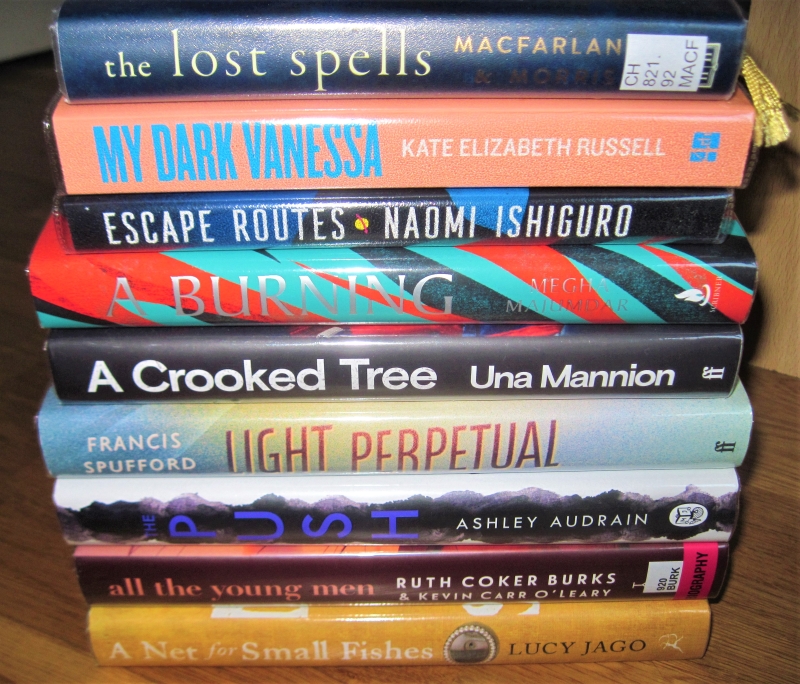
- The Push by Ashley Audrain

- The Air Year by Caroline Bird (poetry)

- A Lie Someone Told You About Yourself by Peter Ho Davies

- The Living Sea of Waking Dreams by Richard Flanagan
- The Prophets by Robert Jones, Jr.

- No One Is Talking About This by Patricia Lockwood
- The Lost Spells by Robert Macfarlane and Jackie Morris
- My Dark Vanessa by Kate Elizabeth Russell
SKIMMED
- All the Young Men: How One Woman Risked It All to Care for the Dying by Ruth Coker Burks
- Begin Again: James Baldwin’s America and Its Urgent Lessons for Today by Eddie S. Glaude, Jr.
- Maybe You Should Talk to Someone: A Therapist, Her Therapist, and Our Lives Revealed by Lori Gottlieb
- A Promised Land by Barack Obama
- Light Perpetual by Francis Spufford
- Square Haunting: Five Women, Freedom and London between the Wars by Francesca Wade
CURRENTLY READING
- Parable of the Talents by Octavia E. Butler
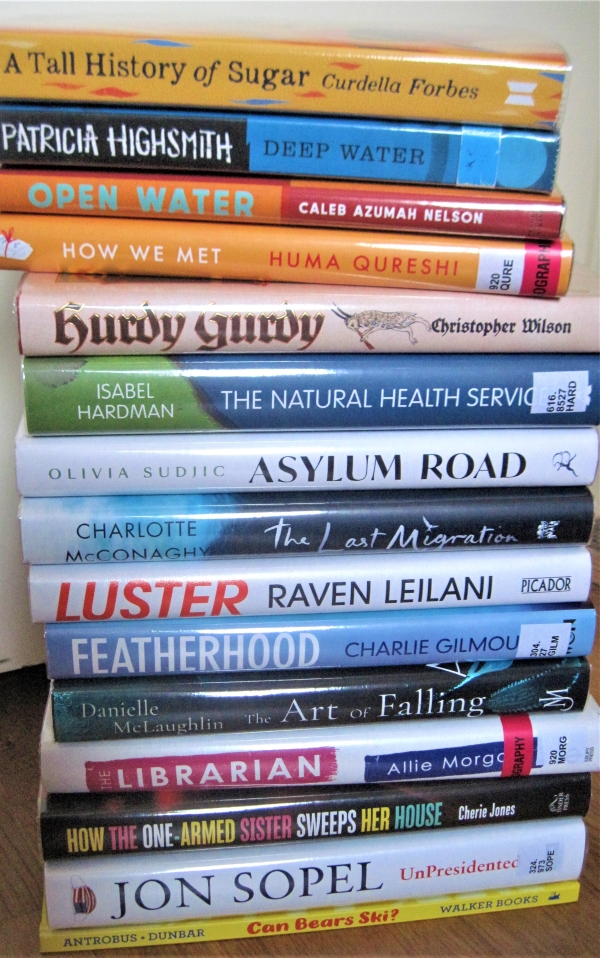
- Luster by Raven Leilani
- The Art of Falling by Danielle McLaughlin
- Becoming a Man: Half a Life Story by Paul Monette
- You’re Not Listening: What You’re Missing and Why It Matters by Kate Murphy
- How We Met: A Memoir of Love and Other by Huma Qureshi
- UnPresidented: Politics, Pandemics and the Race that Trumped All Others by Jon Sopel
- Asylum Road by Olivia Sudjic
- When God Was a Rabbit by Sarah Winman
CURRENTLY SKIMMING
- The Natural Health Service: What the Great Outdoors Can Do for Your Mind by Isabel Hardman
- The Librarian by Allie Morgan
CHECKED OUT, TO BE READ
- A Tall History of Sugar by Curdella Forbes
- Featherhood: On Birds and Fathers by Charlie Gilmour
- Deep Water by Patricia Highsmith
- Escape Routes by Naomi Ishiguro
- The Last Migration by Charlotte McConaghy
- Open Water by Caleb Azumah Nelson
IN THE RESERVATION QUEUE
- Who Is Maud Dixon? by Alexandra Andrews
- Under the Blue by Oana Aristide
- Espedair Street by Iain Banks
- Small Pleasures by Clare Chambers
- Heavy Light: A Journey through Madness, Mania and Healing by Horatio Clare
- Ten Days by Austin Duffy
- Lakewood by Megan Giddings
- After: A Doctor Explores What Near-Death Experiences Reveal about Life and Beyond by Bruce Greyson
- The Absolute Book by Elizabeth Knox
- Birdsong in a Time of Silence by Steven Lovatt
- Consent by Annabel Lyon
- Nothing but Blue Sky by Kathleen MacMahon
- His Only Wife by Peace Adzo Medie
- Skylarks with Rosie: A Somerset Spring by Stephen Moss
- Hot Stew by Fiona Mozley
- Acts of Desperation by Megan Nolan
- Life Sentences by Billy O’Callaghan
- The Ministry of Bodies: Life and Death in a Modern Hospital by Seamus O’Mahony
- Detransition, Baby by Torrey Peters
- Many Different Kinds of Love: A Story of Life, Death and the NHS by Michael Rosen
- How to Be Sad: Everything I’ve Learned about Getting Happier, by Being Sad, Better by Helen Russell
- I Belong Here: A Journey along the Backbone of Britain by Anita Sethi
- Double Blind by Edward St. Aubyn
RETURNED UNFINISHED
- A Burning by Megha Majumdar – I read the first 34 pages. Interesting enough story, but shaky writing. Incessant use of the present continuous tense was going to drive me mad.
- A Crooked Tree by Una Mannion – The 1980s Philadelphia setting was promising; I read the first 28 pages and didn’t feel connected enough to any of the characters to keep going.
RETURNED UNREAD
- A Net for Small Fishes by Lucy Jago – The font and large cast list put me off. Maybe another time.
- How the One-Armed Sister Sweeps Her House by Cherie Jones – Women’s Prize longlisted. I knew to expect bleakness, but the writing didn’t draw me in.
- Death in Her Hands by Ottessa Moshfegh – Sounds too similar to Tokarczuk’s Drive Your Plow…
- Hurdy Gurdy by Christopher Wilson – I can’t remember now how I heard about this or why I thought it would be for me. Medieval settings are so not my thing!
What appeals from my stacks?
Book Serendipity, Early 2021
I call it Book Serendipity when two or more books that I read at the same time or in quick succession have something pretty bizarre in common. Because I have so many books on the go at once (usually 20‒30), I suppose I’m more prone to such incidents.
Josh Cohen’s How to Live. What to Do, a therapist’s guide to literature, explains why this might happen:
More than one writer – the French poet Stéphane Mallarmé, the Argentinian writer Jorge Luis Borges – has advanced the exhilarating idea that each book is an infinitesimally small piece of one single, endless Book. I’ve always felt that this idea, unlikely as it might sound, makes perfect sense if you read enough novels [also nonfiction, for me]. The incidents, descriptions, phrases and images in the book you’re reading will always recall the incidents in another, and those in turn will call up the incidents in another, so that even as you’re reading one book, you’re reading countless others.
The following are in roughly chronological order.
- Mother‒baby swimming sessions in Some Body to Love by Alexandra Heminsley and The Still Point of the Turning World by Emily Rapp.

- [I think it would be a spoiler to even name them, but two novels I read simultaneously in January featured 1) a marriage / close relationship between a man and a woman – even though the man is gay; and 2) a character who beat his wife and then died in a convenient ‘accident’. One was published in 1997 and the other in 2020.]
- Stomas appeared in Dazzling Darkness by Rachel Mann and First Time Ever by Peggy Seeger late in my 2020 reading, and then in early 2021 in Pain: The Science of the Feeling Brain by Abdul-Ghaaliq Lalkhen and Love’s Work by Gillian Rose.
- An account of the author’s experience of ovarian hyperstimulation syndrome in Hormonal by Eleanor Morgan and I Miss You when I Blink by Mary Laura Philpott.
- Salmon fishing takes place in Snow Falling on Cedars by David Guterson and Kings of the Yukon by Adam Weymouth.


- The medical motto “see one, do one, teach one” appears in Breathtaking by Rachel Clarke and Complications by Atul Gawande.
- Filipino medical staff feature in America Is Not the Heart by Elaine Castillo and Breathtaking by Rachel Clarke.
- Twin Peaks is mentioned in The Fragments of My Father by Sam Mills and the anthology Trauma: Essays on Art and Mental Health; a different essay in the latter talks about Virginia Woolf’s mental health struggle, which is a strand in the former.
- St. Teresa of Ávila is mentioned in Heart by Gail Godwin and Sanatorium by Abi Palmer.

- The same Rachel Long poem appears in her debut collection, My Darling from the Lions, and The Emma Press Anthology of Love – but under different titles (“Portent” vs. “Delayed Gratification”).
- There’s a matriarch named Dot in Unsettled Ground by Claire Fuller and The Magician’s Assistant by Ann Patchett.
- There’s an Alaska setting in The Quality of Silence by Rosamund Lupton and Kings of the Yukon by Adam Weymouth.
- Becoming a mother is described as a baptism in Sanctuary by Emily Rapp Black and The Fragments of My Father by Sam Mills.


- While reading America Is Not the Heart by Elaine Castillo, I saw Castillo mentioned in the Acknowledgements of My Darling from the Lions by Rachel Long.
- Polar explorers’ demise is discussed in Ex Libris by Anne Fadiman and The Still Point by Amy Sackville.
- “Butterfingers” / “butter-fingered” is used in America Is Not the Heart by Elaine Castillo and The Clock Winder by Anne Tyler.
- There’s a mention of someone eating paper torn from books (the horror!) in Ex Libris by Anne Fadiman and The Clock Winder by Anne Tyler.
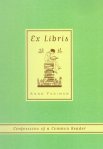
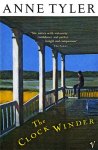
- I was reading three pre-releases at once, each of 288 pages: Milk Fed by Melissa Broder, Unsettled Ground by Claire Fuller, and A Town Called Solace by Mary Lawson.
- The Jewish golem myth is the overarching metaphor of Milk Fed by Melissa Broder and Golem Girl by Riva Lehrer.
- There’s a ceremony to pay respects to those who donated their bodies for medical school dissection in Maybe You Should Talk to Someone by Lori Gottlieb and Golem Girl by Riva Lehrer.
- An old woman with dementia features in The Living Sea of Waking Dreams by Richard Flanagan, Keeper by Andrea Gillies, and The Clock Winder by Anne Tyler.


- A mother dies of cancer on Christmas Day in This Party’s Dead by Erica Buist and The Fragments of My Father by Sam Mills.
- The main character does stand-up comedy in Milk Fed by Melissa Broder and This Party’s Dead by Erica Buist.
- Winning a goldfish at a carnival in The Air Year by Caroline Bird, A Feather on the Breath of God by Sigrid Nunez, and Anna Vaught’s essay in the Trauma anthology.
- ECT (electroconvulsive therapy) is mentioned in Adventures in Human Being by Gavin Francis and Woman on the Edge of Time by Marge Piercy.


- There’s a father who is non-medical hospital staff in The Push by Ashley Audrain (a cleaner) and A Feather on the Breath of God by Sigrid Nunez (a kitchen worker).
- There’s a character named Hart in The Wild Laughter by Caoilinn Hughes and The Birth House by Ami McKay.
- Cannibalism is a point of reference, a major metaphor, or a (surreal) reality in Mother for Dinner by Shalom Auslander, Eat or We Both Starve by Victoria Kennefick, and Light Perpetual by Francis Spufford.
- Infertility and caring for animals were two big themes shared by Brood by Jackie Polzin and Catalogue Baby by Myriam Steinberg. This became clearer when I interviewed both authors in February. Also, both women have shocks of pink hair in their publicity photos!


- A young woman works at a hotel in The Distance between Us by Maggie O’Farrell and My Dark Vanessa by Kate Elizabeth Russell (and The Glass Hotel by Emily St. John Mandel, which I read late last year).
What’s the weirdest reading coincidence you’ve had lately?
Library Checkout, February 2021
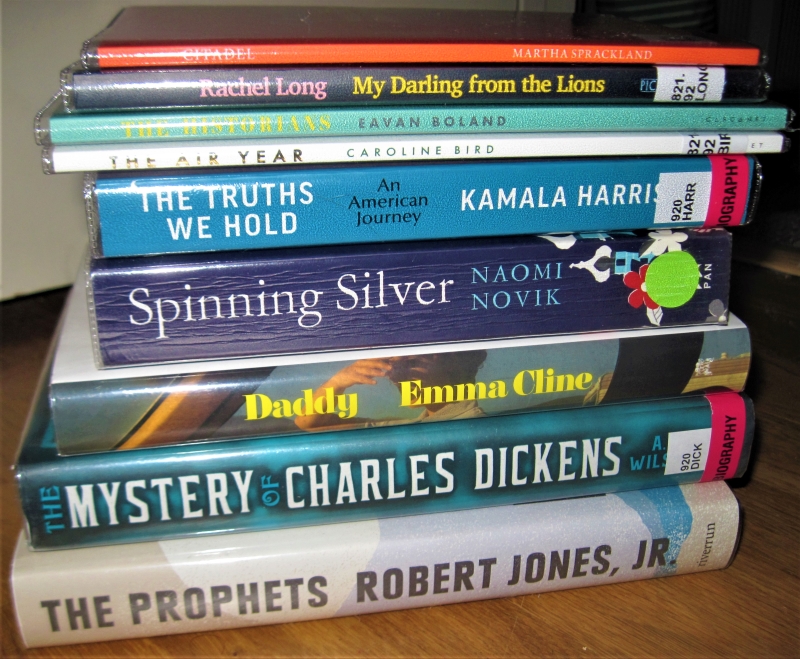
I felt a strange compulsion to clear the decks, so I ended up returning a lot of my backlist library loans unread and will get them out another time (or not). I haven’t even listed them below, though you can see a few in the first photo. For now I’m focusing on the brand new releases. Highlights: most the Costa Award poetry shortlist (I would have chosen a different winner from the judges!) and the memoir by the new U.S. Vice President. I’m grateful that, even though the building is closed to the public and volunteering has paused during lockdown, my library is still allowing people to collect their reservations.
I would be delighted to have other bloggers – not just book bloggers – join in this meme. Feel free to use the image above and leave a link to your blog in the comments if you’ve taken part in Library Checkout (on the last Monday of every month), or tag me on Twitter and/or Instagram: @bookishbeck / #TheLibraryCheckout.
READ
- The Historians by Eavan Boland (poetry)
- The Great Gatsby by F. Scott Fitzgerald

- The Truths We Hold: An American Journey by Kamala Harris
- My Darling from the Lions by Rachel Long (poetry)

- Love After Love by Ingrid Persaud
- Citadel by Martha Sprackland (poetry)
CURRENTLY READING
- The Air Year by Caroline Bird (poetry)
- A Lie Someone Told You about Yourself by Peter Ho Davies
- The Living Sea of Waking Dreams by Richard Flanagan
- The Prophets by Robert Jones, Jr.
- City of Departures by Helen Tookey (poetry)
CURRENTLY SKIMMING
- Maybe You Should Talk to Someone: A Therapist, Her Therapist, and Our Lives Revealed by Lori Gottlieb
- A Promised Land by Barack Obama
- Square Haunting: Five Women, Freedom and London between the Wars by Francesca Wade
CHECKED OUT, TO BE READ
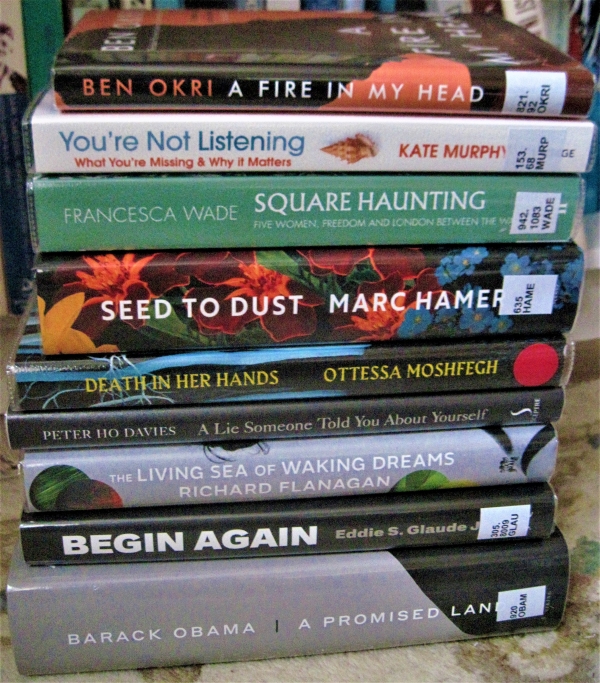
- Begin Again: James Baldwin’s America and Its Lessons for Today by Eddie S. Glaude, Jr.
- Seed to Dust: A Gardener’s Story by Marc Hamer
- Death in Her Hands by Ottessa Moshfegh
- You’re Not Listening: What You’re Missing and Why It Matters by Kate Murphy
ON HOLD, TO BE PICKED UP
- The Push by Ashley Audrain
- All the Young Men by Ruth Coker Burks
- Escape Routes by Naomi Ishiguro
- A Net for Small Fishes by Lucy Jago
- The Lost Spells by Robert Macfarlane and Jackie Morris
- A Burning by Megha Majumdar
- A Crooked Tree by Una Mannion
- My Dark Vanessa by Kate Elizabeth Russell
IN THE RESERVATION QUEUE
- Can Bears Ski? by Raymond Antrobus
- Espedair Street by Iain Banks
- Ten Days by Austin Duffy
- The Natural Health Service: What the Great Outdoors Can Do for Your Mind by Isabel Hardman
- The Last Migration by Charlotte McConaghy
- The Art of Falling by Danielle McLaughlin
- The Librarian by Allie Morgan
- Liquid Gold: Bees and the Pursuit of Midlife Honey by Roger Morgan-Grenville
- Hot Stew by Fiona Mozley
- The Ministry of Bodies: Life and Death in a Modern Hospital by Seamus O’Mahony
- How We Met: A Memoir of Love and Other by Huma Qureshi
- The Mermaid of Black Conch by Monique Roffey
- How to Be Sad: Everything I’ve Learned about Getting Happier, by Being Sad, Better by Helen Russell
- UnPresidented: Politics, Pandemics and the Race that Trumped All Others by Jon Sopel
- Light Perpetual by Francis Spufford
- Asylum Road by Olivia Sudjic
- Hurdy Gurdy by Christopher Wilson
RETURNED UNFINISHED
- The Dickens Boy by Thomas Keneally
- A Fire in My Head by Ben Okri (poetry)
What appeals from my stacks?
Ex Libris x 2: Who Wears It Better, Anne Fadiman or Michiko Kakutani?
When I heard about the new book by Michiko Kakutani, former chief book critic of the New York Times, I rushed to put it on my wish list – though I ended up accessing it via the library instead. I also felt a hankering to reread Anne Fadiman’s essay collection by the same title, so I ordered myself a secondhand copy earlier this year. Both books are by (more or less) famous New York City bibliophiles and take old-fashioned bookplate designs as an inspiration. Here’s how the two fared in a head-to-head battle.
Ex Libris: Confessions of a Common Reader by Anne Fadiman (1998)
Like many a bibliophile, I have a soft spot for books about books. However, I’m also a real stickler about them, because all too often they make common mistakes: they’re too generic or too obscure in their points of reference, they slip into plot summary and include spoilers, or they alienate the reader by presenting the author as being on another echelon.
Fadiman, though, is a very relatable narrator in these expanded versions of 18 essays originally written for publication in Civilization, the Library of Congress magazine published from 1994 to 2000. (Can you imagine, your own bookish column in which you could write whatever you like?!) Her father was the well-known intellectual Clifton Fadiman. Theirs was a family of book-obsessed, vocabulary-loving, trivia-spouting readers, and she was also crafting her own with her husband and two young children.
 I saw my family – especially my mother and me – in a number of these pieces: in “The Joy of Sesquipedalians,” about the love of obscure words and word games played on a board or along with the TV (I was a spelling bee champion, and we’re all Scrabble fiends to a greater or lesser extent), in “Insert a Caret [Inset a Carrot],” about compulsive proofreading, in “The Catalogical Imperative,” about a build-up of print catalogues and the different selves one can imagine using the products therein, and in “Secondhand Prose,” about collecting used books.
There’s one respect in which I differ from the Fadiman family, though. Tom Mole’s The Secret Life of Books had reminded me of Fadiman’s division of readers into “courtly” and “carnal” lovers of books: the courtly ones keep a book pristine, while the carnal ones use and abuse them however they wish. She introduces this piece with an episode from a family trip to Copenhagen when she was a teenager. Her brother left a book open, facedown, on the bedside table at their hotel and the next day they found that the chambermaid had carefully put a marker at the right page, closed the book, and set a note on top reading, “Sir, you must never do that to a book.” I wholeheartedly agree. While I always say “your books, your rules” to other readers, I would have to suppress a cringe if I witnessed dog-earing, reading in the bath, cracking the spine, tearing out pages, doodling in the margins, and so on.
What I can get on board with, though, is the love of books as both narratives and physical objects. In the former camp, you get essays on books about polar exploration, sonnets, outdated guides to femininity, food literature, and reading aloud. On the latter, you’ll hear about her New York City apartment groaning with books absorbed from her husband’s and father’s collections, the good and bad of inscriptions, and Prime Minister William Gladstone’s tips for storing books.
Two essays have not aged well: one on a beloved pen (though she acknowledges that this was already multiply outdated by that time, by the typewriter and then by the computer she now uses for composition) and especially one on the quandary of gender-neutral pronouns (as opposed to “every man for himself” types of constructions) – nowadays we have no qualms about employing “them” for the unknown and the nonbinary.
My favorite essay overall was “You Are There,” about the special joy of reading on location. Additional irony points for Joe Biden being mentioned in the piece on plagiarism! I’d read this from a library some years before. I enjoyed it just as much the second time around, and certain essays will reward additional future rereadings, too.
My original rating (c. 2008):
My rating now:
Ex Libris: 100+ Books to Read and Reread by Michiko Kakutani (2020)
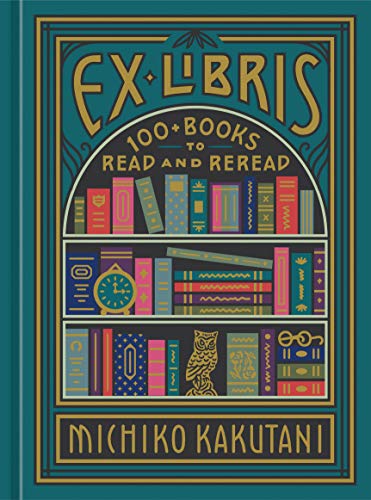
In my more morbid moments, when I imagine how I would approach the remainder of my life if I knew that I was going to die young of a terminal illness, I think about self-publishing a selection of my best blog posts and book reviews. A personal greatest hits, if you would, and anyone could forgive the self-indulgence because, hey, she’s probably going to die soon. But then I open a book like this and realize that a collection of book reviews can actually be pretty tedious, even when written by one of the greats.
“Like all lists and anthologies, the selections here are subjective and decidedly arbitrary,” Kakutani warns in her introduction. What this means in practice is that: a) if I’d read a particular book, I didn’t need to read a ~1000-word review of it; b) if I hadn’t read the book but wanted to, I avoided the essay in fear of spoilers (e.g. she does reveal some specific incidents from Mary Karr’s The Liars’ Club, which I have on the shelf and was looking forward to; I’ll just wait until I’ve forgotten); and c) if I hadn’t read the book and didn’t want to (there is LOTS of history and politics here, with plenty of Trump jabs shoehorned in; you do know her only previous book was a diatribe against Trump, right?), I wasn’t interested. So, while there were a few pieces I appreciated, such as one on the enduring appeal of The Great Gatsby, which I recently read a third time for book club, not many caught my eye as I skimmed the book.
In any case, it’s not a book for reading all the way through but one for having on the coffee table to read the occasional essay. It is gorgeously put together, what with Dana Tanamachi’s illustrations in the style of vintage bookplates, so would still be a lovely reference book to have around. Think of it as a collection of amuse-bouches to whet your appetite to read the books you’ve always meant to pick up but haven’t managed yet (for me, that would be As I Lay Dying and Mason & Dixon). See Susan’s more judicious review here.
My rating:
 I found plenty of other books on Goodreads with the title Ex Libris, such as this one, a compendium of library-themed fantasy and science fiction stories. (Yes, really.)
Have you read one of these? Which did you prefer?
Library Checkout, January 2021
I’m grateful that, even though the building is closed to the public and volunteering has paused during lockdown, my library is still allowing people to collect their reservations. I’ve got a ton of new books on request! Some are available for me to pick up on Wednesday. So, in the near future, I’m looking forward to reading the whole Costa Award poetry shortlist, and the memoir by the new U.S. Vice President.
I would be delighted to have other bloggers – not just book bloggers – join in this meme. Feel free to use the image above and leave a link to your blog in the comments if you’ve taken part in Library Checkout (on the last Monday of every month), or tag me on Twitter and/or Instagram: @bookishbeck / #TheLibraryCheckout.
READ
- Leonard and Hungry Paul by Rónán Hession (a buddy read with Annabel)
SKIMMED
- Things I Learned on the 6.28: A Commuter’s Guide to Reading by Stig Abell
- Livewired: The Inside Story of the Ever-Changing Brain by David Eagleman
- The Marriage of Opposites by Alice Hoffman (for January book club)
- Ex Libris by Michiko Kakutani
- Hormonal: A Conversation about Women’s Bodies, Mental Health and Why We Need to Be Heard by Eleanor Morgan
- The Invention of Surgery: A History of Modern Medicine: From the Renaissance to the Implant Revolution by David Schneider, MD
CURRENTLY READING
- The Great Gatsby by F. Scott Fitzgerald (rereading for book club)
- The Dickens Boy by Thomas Keneally
- Love After Love by Ingrid Persaud
CHECKED OUT, TO BE READ
- Mama’s Boy: A Memoir by Dustin Lance Black
- In the Woods by Tana French
- Maybe You Should Talk to Someone: A Therapist, Her Therapist, and Our Lives Revealed by Lori Gottlieb
- In Our Mad and Furious City by Guy Gunaratne
- How to Do Nothing: Resisting the Attention Economy by Jenny Odell
- Country Doctor: Hilarious True Stories from a Country Practice by Michael Sparrow
- How Much of These Hills Is Gold by C. Pam Zhang
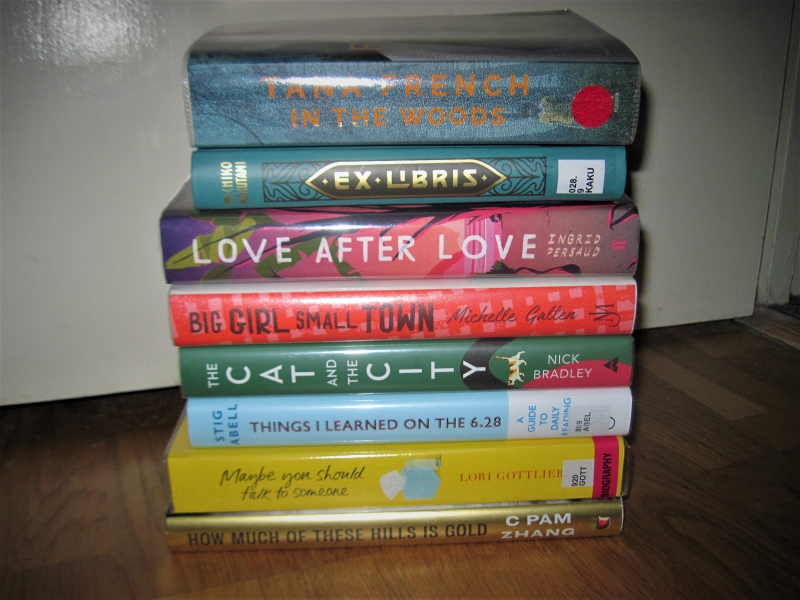
ON HOLD, TO BE PICKED UP
- The Air Year by Caroline Bird (poetry)
- The Historians by Eavan Boland (poetry)
- Daddy by Emma Cline
- The Truths We Hold: An American Journey by Kamala Harris
- My Darling from the Lions by Rachel Long (poetry)
- Citadel by Martha Sprackland (poetry)
- The Mystery of Charles Dickens by A.N. Wilson
IN THE RESERVATION QUEUE
- A Biography of Loneliness: The History of an Emotion by Fay Bound Alberti
- Can Bears Ski? by Raymond Antrobus
- All the Young Men by Ruth Coker Burks
- A Lie Someone Told You about Yourself by Peter Ho Davies
- The Living Sea of Waking Dreams by Richard Flanagan
- Begin Again by Eddie S. Glaude, Jr.
- A Net for Small Fishes by Lucy Jago
- The Prophets by Robert Jones, Jr.
- A Burning by Megha Majumdar
- A Crooked Tree by Una Mannion
- Liquid Gold: Bees and the Pursuit of Midlife Honey by Roger Morgan-Grenville
- You’re Not Listening: What You’re Missing and Why It Matters by Kate Murphy
- Spinning Silver by Naomi Novik
- A Promised Land by Barack Obama
- The Ministry of Bodies: Life and Death in a Modern Hospital by Seamus O’Mahony
- How We Met: A Memoir of Love and Other by Huma Qureshi
- My Dark Vanessa by Kate Elizabeth Russell
- UnPresidented: Politics, Pandemics and the Race that Trumped All Others by Jon Sopel
- Light Perpetual by Francis Spufford
- Asylum Road by Olivia Sudjic
- Square Haunting: Five Women, Freedom and London between the Wars by Francesca Wade
RETURNED UNFINISHED
- Village Christmas and Other Notes on the English Year by Laurie Lee – I looked at the few short Christmas pieces over the holidays, but didn’t realize that the rest of the book would be set in other seasons.
RETURNED UNREAD
- The Cat and the City by Nick Bradley – Requested after me; I’ll get it out another time. There’s a section in manga style!
- Big Girl, Small Town by Michelle Gallen – I knew from the first page that this wasn’t going to be a book for me. Did you love Milkman and The Glorious Heresies? If so, you’ll probably like this, too.
What appeals from my stacks?
Some Bookish Pet Peeves
 Happy Feast of the Inauguration!
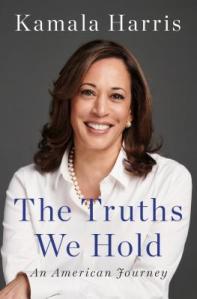
This is a feast day we made up simply because 2021 needs as many excuses for celebration as it can get. (Our next one will be in mid-February: Victoriana Fest, to celebrate the birthdays of a few of our Victorian heroes – Charles Darwin, Charles Dickens, and Abraham Lincoln. Expect traditional, stodgy foods.) Later tonight we’ll be having an all-American menu of veggie burgers, sweet potato fries, random Californian beers we found at Waitrose, and pecan pie with ice cream. And Vice President Kamala Harris’s autobiography is on hold for me at the library to pick up later this month.
Since I still don’t have any new book reviews ready (though I have now finished seven books in 2021, which is something), here’s some more filler content based on annoying book traits I’ve been reminded of recently.
Some of My Bookish Pet Peeves
Long excerpts from other books, in the text or as epigraphs
I often skip these. I am reading this book to hear from you, the author, not the various philosophers and poets you admire. I want to learn from your expertise and thought processes, not someone else’s.
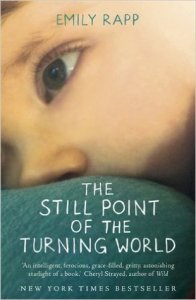 Exceptions: Tim Dee’s books are good examples since he weaves in copious quotations and allusions while still being eloquent in his own right. Emily Rapp’s The Still Point of the Turning World includes a lot of quotes, especially from poems, but I was okay with that because it was true to her experience of traditional thinking failing her in the face of her son’s impending death. Her two bereavement memoirs are thus almost like commonplace books on grief.
Long passages in italics
I sometimes see these used to indicate flashbacks in historical fiction. They are such a pain to read. I am very likely to skim these sections, or skip them altogether.
An exception: Thus far, the secondary storyline about the mice in The Charmed Wife by Olga Grushin, delivered all in italics, has been more compelling than the main storyline.
Huge jumps forward in time
These generally feel unnatural and sudden. Surely there’s a way to avoid them? And if they are truly necessary, I’d rather they were denoted by a new section with a time/date stamp. I’m not talking about alternating storylines from different time periods, as these are usually well signaled by a change of voice, but, e.g., a chapter picking up 15 years in the future.
Not being upfront about the fact that a book is ghostwritten
I have come to expect ghostwriters for political memoirs (Barack Obama’s being a rare exception), but in the last two years I’ve also come across a botanist’s memoir and a surgeon’s memoir that were ghostwritten but not announced as such – with the former I only found out via the acknowledgments at the end, and with the latter it was hidden away in the copyright information. I’d rather the title page came right out and said “by So and So” with “Ghostwriter Name.” (Anyone know whether Kamala had a ghostwriter?)
Matte covers or dustjackets that show fingerprints
Back in 2017 I wrote a whole post on the physical book features that I love or loathe. It was a good way of eliciting strong opinions from blog readers! (For example, some people hate deckle edge, whereas I love it.)
Something that bothers other readers but doesn’t faze me at all is a lack of speech marks, or the use of alternative indicators like dashes or indented paragraphs. I’m totally used to this in literary fiction. I even kind of like it. I’m also devoted to rarer forms of narration like the second person and the first person plural that might be a turn-off for some.
[Added later]
No, or very few, paragraphs, chapters, or other section breaks
How am I supposed to know where to stop reading and put my bookmark in?!
Whom is dead
Not just in books; in written English in general. And, even if this is inevitable, it still makes me sad.
Any pet peeves making you a grumpy reader these days?
A Reading Malady, a Book Haul, a Book Launch, and a TBR Challenge
A bit of a miscellany today, as a placeholder until I finally have some more reviews to share.
Stuck in the Middle
 I’ve been reading up a storm in 2021, of course, but I’m having an unusual problem: I can’t seem to finish anything. Okay, I’ve finished three books so far – Intensive Care, my first read and only proper review so far of the year; In These Days of Prohibition by Caroline Bird, a surprising and funny poetry collection about mental illness and the crutches people turn to, including drugs and sex; and one more poetry book, a recent release I’ll round up later in the month – but compare that to January 2020, when I’d finished 11 books within the first 11 days. Half a month gone and I’m way behind on my Goodreads challenge already.
Most of you know that I take multi-reading to an extreme: I currently have nearly 30 books on the go, plus piles of set-aside and occasional-reading titles that I try to reintroduce a few at a time. All in all, that’s nearly 60 books I’m partway through, whether by a mere 10 pages or over 200. These stacks represent thousands of pages read, but no finished books. By the end of this month, I will at least have finished and reviewed the five more January releases, but it’s still an awfully slow start to the year for me. Maybe I’ve spread myself too thin.
Current Stars
I often stretch the definition of “currently reading” in that most days I don’t sit with every book on my stack; instead, I end up spending time with a changing subset of 10‒15. Some books I have barely touched since Christmas. But there are others that consistently hold my attention and that I look forward to reading 20 or more pages in each day. Here are some of the highlights on the pile:
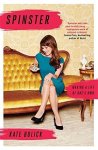 Spinster by Kate Bolick: Written as she was approaching 40, this is a cross between a memoir, a social history of unmarried women (mostly in the USA), and a group biography of five real-life heroines who convinced her it was alright to not want marriage and motherhood. First was Maeve Brennan; now I’m reading about Neith Boyce. The writing is top-notch.
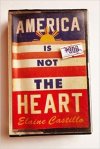 America Is Not the Heart by Elaine Castillo: Set in the 1990s in the Philippines and in the Filipino immigrant neighborhoods of California, this novel throws you into an unfamiliar culture and history right at the deep end. The characters shine and the story is complex and confident – I’m reminded especially of Chimamanda Ngozi Adichie’s work.
 Some Body to Love by Alexandra Heminsley: Finally pregnant after a grueling IVF process, Heminsley thought her family was perfect. But then her husband began transitioning. This is not just a memoir of queer family-making, but, as the title hints, a story of getting back in touch with her body after an assault and Instagram’s obsession with exercise perfection.
 The Light Years by Elizabeth Jane Howard: We’re reading the first volume of The Cazalet Chronicles for a supplementary book club meeting. I can hardly believe it was published in 1990; it’s such a detailed, convincing picture of 1937‒8 for a large, wealthy family in London and Sussex as war approaches. It’s so Downton Abbey; I love it and will continue the series.
 Outlawed by Anna North: After Reese Witherspoon chose it for her book club, there’s no chance you haven’t heard about this one. I requested it because I’m a huge fan of North’s previous novel, The Life and Death of Sophie Stark, but I’m also enjoying this alternative history/speculative take on the Western. It’s very Handmaid’s, with a fun medical slant.
 Love After Love by Ingrid Persaud: It was already on my TBR after the Faber Live Fiction Showcase in November, but my interest was redoubled by this recently winning the Costa First Novel Award. Set in Trinidad, it’s narrated, delightfully, in turn by Betty, a young widow; Solo, her teenage son; and Mr. Chetan, their lodger. Perfect for fans of Mr Loverman.
Acquiring More
Last week I ordered 21 books in one day. (In my defense, only 18 of them were for me.) It started like this: “Ah, must find a clearance 2021 calendar. Waterstones had a good selection last year…” And indeed, I found the perfect calendar, for half price. But then I continued browsing the online sale items and before I knew it there were also seven books in my basket. While I was at it, I went onto Awesomebooks.com and put together an order of secondhand books by authors I’ve been wanting to try or read more by. Add to that a couple more review books coming through the door and a couple of giveaways from neighbors (the Nicolson in the first photo, and Stoner for me to reread) and it’s been a big week for book acquisitions.


Attending a Book Launch
My fifth book launch since March 2020; my first to take place on Instagram. Hosted by Damian Barr, who runs a literary salon, it was for one I’ve already mentioned, Some Body to Love by Alexandra Heminsley, which came out on the 14th. (Barr and his husband are the book’s dedicatees.) “I am not ashamed of what happened,” she said about how her family has changed, adding that writing about such recent events has been a way of solidifying how she felt about them. Her ex has not read the book but wrote to Chatto & Windus saying she completely trusted Heminsley and consented to the publication. Some of her offers were for a more mass-market memoir about the marriage, whereas the book ended up being more diffuse, including other medical experiences and challenges to self-belief. It was amusing to hear that after the BLM movement her manuscript went through a “Karen edit” to make sure she hadn’t taken her privilege for granted.
A New TBR Challenge
“Hands. Face. Space.” is a current UK public health campaign slogan. It inspired me to trawl through my TBR shelves for appropriate covers and titles. I don’t know if I’m actually serious about reading these particular books I selected (I could have chosen any of dozens for the Face covers), but it was fun to put together the photo shoot. I had two replies from people on Twitter who came up with their own trio of titles.


And to cap off this miscellany, something non-book-related…
Top 5 albums from 2020
I originally wrote this little note for Facebook.
 Banana Skin Shoes, Badly Drawn Boy – His best since his annus mirabilis of 2002. Funky pop gems we’ve been caught dancing to by people walking past the living room window … oops! A track to try: “Is This a Dream?” (psychedelic music video)!
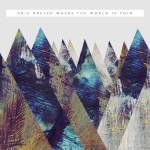 Where the World Is Thin, Kris Drever – You may know him from Lau. Top musicianship and the most distinctive voice in folk. Nine folk-pop winners, including a lockdown anthem. A track to try: “I’ll Always Leave the Light On.”
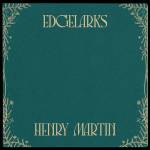 Henry Martin, Edgelarks – Mention traditional folk and I’ll usually run a mile. But the musical skill and new arrangements, along with Hannah Martin’s rich alto, hit the spot. A track to try: “Bird in a Cage.”
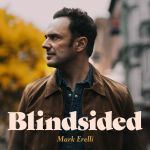 Blindsided, Mark Erelli – We saw him perform the whole of his new folk-Americana album live in lockdown. Love the Motown and Elvis influences; his voice is at a peak. A track to try: “Rose-Colored Rearview.”
 American Foursquare, Denison Witmer – A gorgeous ode to family life in small-town Pennsylvania from a singer-songwriter whose career we’ve been following for upwards of 15 years. A track to try: “Birds of Virginia.”
How is your 2021 reading going?
Book Serendipity, Late 2020 into 2021
I call it Book Serendipity when two or more books that I read at the same time or in quick succession have something pretty bizarre in common. Because I have so many books on the go at once (20+), I suppose I’m more prone to such incidents than some. I also list some of my occasional reading coincidences on Twitter. The following are in chronological order.
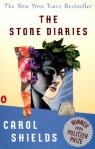
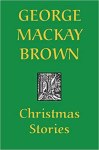
- The Orkney Islands were the setting for Close to Where the Heart Gives Out by Malcolm Alexander, which I read last year. They showed up, in one chapter or occasional mentions, in The Frayed Atlantic Edge by David Gange and The Stone Diaries by Carol Shields, plus I read a book of Christmas-themed short stories (some set on Orkney) by George Mackay Brown, the best-known Orkney author. Gavin Francis (author of Intensive Care) also does occasional work as a GP on Orkney.

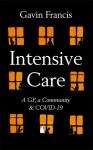
- The movie Jaws is mentioned in Mr. Wilder and Me by Jonathan Coe and Landfill by Tim Dee.
- The Sámi people of the far north of Norway feature in Fifty Words for Snow by Nancy Campbell and The Mercies by Kiran Millwood Hargrave.
- Twins appear in Mr. Wilder and Me by Jonathan Coe and Tennis Lessons by Susannah Dickey. In Vesper Flights Helen Macdonald mentions that she had a twin who died at birth, as does a character in Miss Benson’s Beetle by Rachel Joyce. A character in The Light Years by Elizabeth Jane Howard is delivered of twins, but one is stillborn. From Wrestling the Angel by Michael King I learned that Janet Frame also had a twin who died in utero.
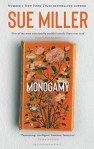
- Fennel seeds are baked into bread in The Mercies by Kiran Millwood Hargrave and The Strays of Paris by Jane Smiley. Later, “fennel rolls” (but I don’t know if that’s the seed or the vegetable) are served in Monogamy by Sue Miller.


- A mistress can’t attend her lover’s funeral in Here Is the Beehive by Sarah Crossan and Tennis Lessons by Susannah Dickey.
- A sudden storm drowns fishermen in a tale from Christmas Stories by George Mackay Brown and The Mercies by Kiran Millwood Hargrave.
 Silver Spring, Maryland (where I lived until age 9) is mentioned in one story from To Be a Man by Nicole Krauss and is also where Peggy Seeger grew up, as recounted in her memoir First Time Ever. Then it got briefly mentioned, as the site of the Institute of Behavioral Research, in Livewired by David Eagleman.
- Lamb is served with beans at a dinner party in Monogamy by Sue Miller and Larry’s Party by Carol Shields.
- Trips to Madagascar in Landfill by Tim Dee and Lightning Flowers by Katherine E. Standefer.
 Hospital volunteering in My Year with Eleanor by Noelle Hancock and Leonard and Hungry Paul by Ronan Hession.
- A Ronan is the subject of Emily Rapp’s memoir The Still Point of the Turning World and the author of Leonard and Hungry Paul (Hession).
- The Magic Mountain (by Thomas Mann) is discussed in Scattered Limbs by Iain Bamforth, The Still Point of the Turning World by Emily Rapp, and Snow by Marcus Sedgwick.
- Frankenstein is mentioned in The Biographer’s Tale by A.S. Byatt, The Still Point of the Turning World by Emily Rapp, and Snow by Marcus Sedgwick.


- Rheumatic fever and missing school to avoid heart strain in Foreign Correspondence by Geraldine Brooks and Unsettled Ground by Claire Fuller. Janet Frame also had rheumatic fever as a child, as I discovered in her biography.
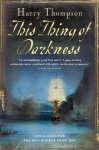
- Reading two novels whose titles come from The Tempest quotes at the same time: Owls Do Cry by Janet Frame and This Thing of Darkness by Harry Thompson.

- A character in Embers by Sándor Márai is nicknamed Nini, which was also Janet Frame’s nickname in childhood (per Wrestling the Angel by Michael King).
- A character loses their teeth and has them replaced by dentures in America Is Not the Heart by Elaine Castillo and The Light Years by Elizabeth Jane Howard.
Also, the latest cover trend I’ve noticed: layers of monochrome upturned faces. Several examples from this year and last. Abstract faces in general seem to be a thing.


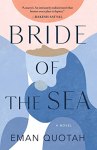


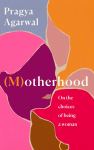
What’s the weirdest reading coincidence you’ve had lately?
Final 2020 Statistics and Retrospective / 2021 Reading Goals
In 2020…
My mother was supposed to visit us in May – my first visit from family in 13 years – and we were meant to be in the States for Christmas. These planned trips had to be cancelled, of course, and many gigs and regular events we would have attended in London and elsewhere couldn’t go ahead.
We managed two mini-breaks, one to Dorset and Devon and one to Hay-on-Wye, as well as a daytrip to Avebury and Silbury Hill, a night out at an Oxford comedy club, a few meals out, and some outdoor meet-ups with family and friends.
It was also the year we finally started doing video chats with family in America, and we kept up with certain friends better than ever thanks to Zoom meetings.
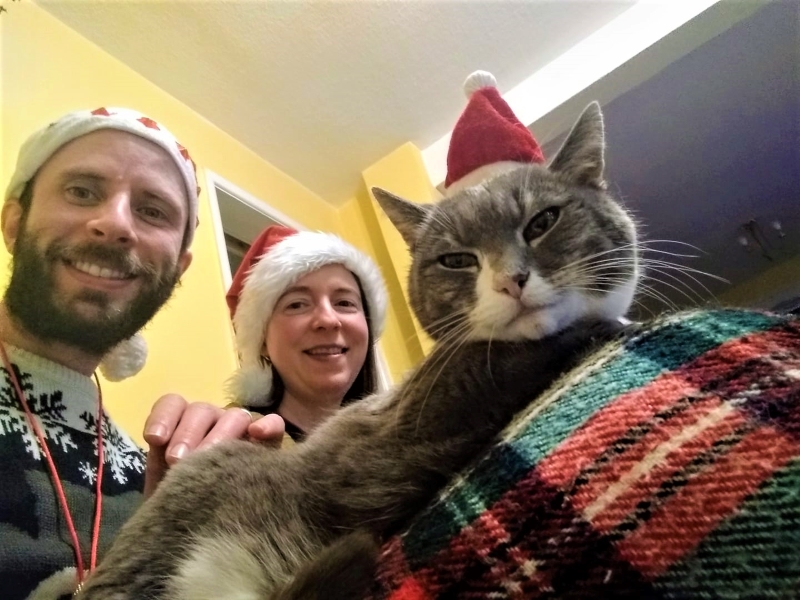
All told, I have no grounds for complaint about the year that has just passed. I know we are lucky to have had good health, stable employment and a wonderful town and community.
Moreover, I was spoiled for choice with online bookish and musical content last year:
- 45 livestreamed gigs (28+ Bookshop Band, 4 Duke Special, 3 Edgelarks and Megson, 2 Switchfoot, and 1 each by Bellowhead, Krista Detor, Lau, Mark Erelli and Nerina Pallot)
- 8 neighborhood book club meetings
- 8 literary festival events
- 8 quizzes (mostly general trivia; 1 bookish, run by Penguin – I did well among the hundreds of entries!)

- 6 literary prize announcements
- 4 festivals, mostly of folk music
- 4 book launch events
- 3 book club/preview events
- 2 conferences (mostly book-related)
I’m also lucky that, unlike many, my reading was not affected by a stressful year. My reading total was very close to the previous year’s (343), which means that after five years above 300 and climbing, I’ve now figured out what my natural limit is. Next year I will aim for 340 again.

Some interesting additional statistics, courtesy of Goodreads:

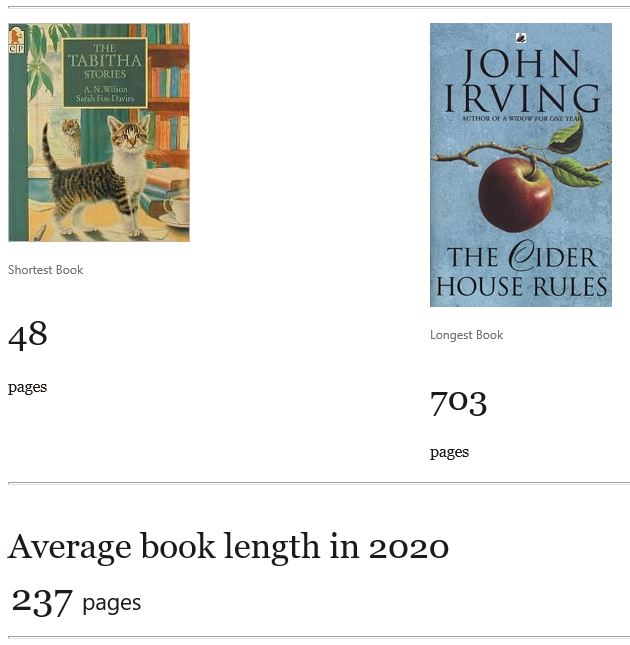

First read of the year: Last read of the year:
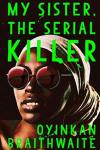
This was my Christmas book haul thus far (I have a feeling more may be marooned at my in-laws’ house), including money to spend the next time I can get to Bookbarn. I started a few of them right away.

My husband reads between one-fifth and one-quarter of what I do in a year, but by anyone’s accounting, 76 books is a lot in a year, especially considering that he has a busy full-time university lecturer job, is a town councillor, and is on lots of other voluntary committees. We overlap in some of our reading tastes (nature and travel writing, and some literary fiction) and I pass a lot of my review copies or library books his way, but he’s less devoted to new books and more likely to pick up books with heavier historical, political, or scientific content. If you’re interested, his rundown of his reading, including his top 3 reads of the year, is here.
2021 Reading Goals
My immediate priorities are to clear my set-aside pile (20 books) and everything I’m currently reading, start some January releases, and get back into some university library books to last me while I have limited access to our public library.
These are the 2021 proofs and finished copies I have received thus far:
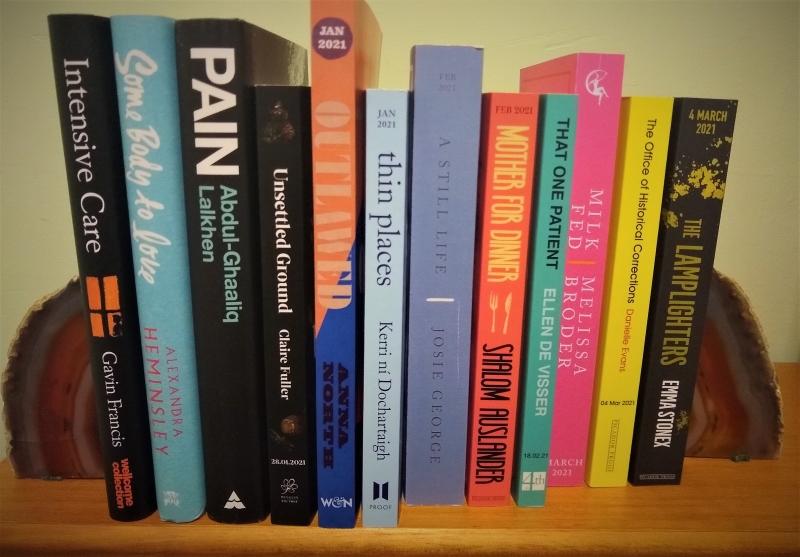
Looking further ahead, I plan to continue and/or participate in many of 2020’s reading challenges again, as well as join in Liz’s Anne Tyler readalong for the novels I own and haven’t read yet. (The first one for me will be The Clock Winder in mid- to late February.)
Genres in which my achievement often lags far behind my intentions include literature in translation, biographies, and travel books. To address the first one, I’m going to set up a shelf in my house for unread works in translation, as a visual reminder and area to select from. I’ll start with the one below left as part of my “M” 4-in-a-Row.

I would be happy to read even one biography this year, since they often take me many months to read. I’m going to make it the one above, of Janet Frame. Standard travel narratives intimidate me for some reason; I get on with them much better if they are in essays or incorporate memoir and/or nature writing. We have a whole shelf of unread travel books, many of which are of the more traditional going somewhere and reporting on what you see type. I want to clear the shelf to give them to my father-in-law, who expressed interest in reading more travel books. I’ll start with the 2018 Young Writer of the Year Award winner, above.
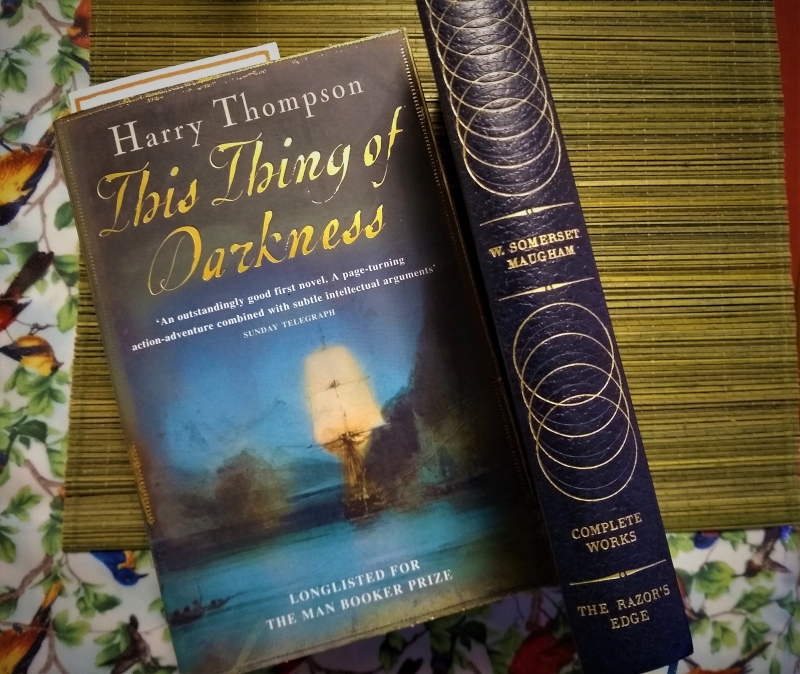
A “Classic of the Month” and “Doorstopper of the Month” are regular features on my blog, yet I don’t always manage to complete one each month. My aim will be to have at least one classic and one doorstopper on the go at all times, and hope that that translates to one a month as much as possible. Here’s my first pair:
I can see that lots of other book bloggers are prioritizing doorstoppers and backlist reading in 2021. Apart from the modest goals I’ve set here, I expect my reading to be as varied and over-the-top as ever. I know I’ll read lots of 2021 releases, but backlist books are often more memorable, so I’ll try to arrange my stacks and choose my challenges so as to let them shine.
What are some of your reading goals for 2021?
Random 2020 Superlatives and Statistics
My top ‘discoveries’ of the year: Chimamanda Ngozi Adichie (4 books), Octavia E. Butler, Tim Dee (3 books each, read or in progress), and Louise Erdrich (2 books, one in progress).


Also the publisher Little Toller Books: I read four of their releases this year and they were fantastic.
The authors I read the most by this year: Carol Shields tops the list at 6 books (3 of these were rereads) thanks to my buddy reads with Buried in Print, followed by Paul Auster with 5 due to Annabel’s reading week in February, then Chimamanda Ngozi Adichie with 4, and finally Anne Lamott with 3 comfort rereads.


Debut authors whose next work I’m most looking forward to: Naoise Dolan, Bess Kalb, Dara McAnulty, Mary South, Brandon Taylor, and Madeleine Watts
My proudest reading achievement: 16 rereads, which must be a record for me. Also, I always say I’m not really a short story person … and yet somehow I’ve read 19 collections of them this year (and one stand-alone story, plus another collection currently on the go)!
My proudest (non-reading) bookish achievement: Conceiving of and coordinating the Not the Wellcome Prize blog tour.
Five favorite blog posts of the year: Love, Etc. – Some Thematic Reading for Valentine’s Day; Polio and the Plague: Epidemics in Fiction; Thinking about the Future with David Farrier & Roman Krznaric (Hay Festival); Three Out-of-the-Ordinary Memoirs: Kalb, Machado, McGuinness; Asking What If? with Rodham by Curtis Sittenfeld (I had a lot of fun putting the current post together, too!)
The bookish experience that most defined my year: Watching the Bookshop Band’s live shows from their living room. Between their Friday night lockdown performances and one-offs for festivals and book launches, I think I saw them play 33 times in 2020!

Biggest book read this year: Going by dimensions rather than number of pages, it was the oversize hardback The Lost Words by Robert Macfarlane and Jackie Morris.
vs.
Smallest book read this year: Pocket-sized and only about 60 pages: No One Is Too Small to Make a Difference by Greta Thunberg.
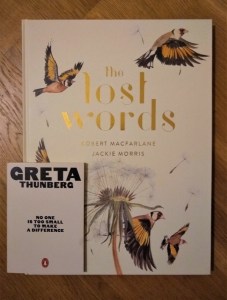
Oldest author read this year: Peggy Seeger was 82 when her memoir First Time Ever was published. I haven’t double-checked the age of every single author, but I think second place at 77 is a tie between debut novelist Arlene Heyman for Artifact and Sue Miller for Monogamy. (I don’t know how old Michael McCarthy, Jeremy Mynott and Peter Marren, the joint authors of The Consolation of Nature, are; Mynott may actually be the oldest overall, and their combined age is likely over 200.)
vs.
 Youngest author read this year: You might assume it was 16-year-old Dara McAnulty with Diary of a Young Naturalist, which won the Wainwright Prize (as well as the An Post Irish Book Award for Newcomer of the Year, the Books Are My Bag Reader Award for Non-Fiction, and the Hay Festival Book of the Year!) … or Thunberg, above, who was 16 when her book came out. They were indeed tied for youngest until, earlier in December, I started reading The House without Windows (1927) by Barbara Newhall Follett, a bizarre fantasy novel published when the child prodigy was 12.
Most As on a book cover: Americanah by Chimamanda Ngozi Adichie
vs.
Most Zs on a book cover: The Hiding Place by Trezza Azzopardi. I haven’t read it yet, but a neighbor passed on a copy she was getting rid of. It was nominated for both the Booker Prize and the Orange Prize.

 The book that made me laugh the most: Kay’s Anatomy by Adam Kay
Books that made me cry: Writers and Lovers by Lily King, Monogamy by Sue Miller, First Time Ever by Peggy Seeger, and Catalogue Baby: A Memoir of (In)fertility by Myriam Steinberg (coming out in March 2021)
 The book that put a song in my head every single time I looked at it, much less read it: I Am an Island by Tamsin Calidas (i.e., “I Am a Rock” by Simon and Garfunkel, which, as my husband pointed out, has very appropriate lyrics for 2020: “In a deep and dark December / I am alone / Gazing from my window to the streets below … Hiding in my room / Safe within my womb / I touch no one and no one touches me.”)
Best book club selections: Notes from an Exhibition by Patrick Gale and The Wife by Meg Wolitzer tied for our highest score ever and gave us lots to talk about.

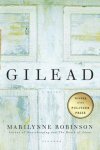 Most unexpectedly apt lines encountered in a book: “People came to church wearing masks, if they came at all. They’d sit as far from each other as they could.” (Gilead by Marilynne Robinson. Describing not COVID-19 times but the Spanish flu.)
 Most ironic lines encountered in a book: “September 12—In the ongoing hearings, Senator Joseph Biden pledges to consider the Bork nomination ‘with total objectivity,’ adding, ‘You have that on my honor not only as a senator, but also as the Prince of Wales.’ … October 1—Senator Joseph Biden is forced to withdraw from the Democratic presidential race when it is learned that he is in fact an elderly Norwegian woman.” (from the 1987 roundup in Dave Barry’s Greatest Hits – Biden has been on the U.S. political scene, and mocked, for 3.5+ decades!)
 Best first line encountered this year: “And then there was the day when Addie Moore made a call on Louis Waters.” (Our Souls at Night by Kent Haruf)
Best last lines encountered this year:
- “my childhood falls silently to the bottom of my memory, that library of the soul from which I will draw knowledge and experience for the rest of my life.” (Childhood by Tove Ditlevsen)
- “What I want to say is: I misremember all this so vividly it’s as if it only happened yesterday.” (Other People’s Countries: A Journey into Memory by Patrick McGuinness)
- “these friends would forever be her stitches, her scaffold, her ballast, her home.” (The Dearly Beloved by Cara Wall)
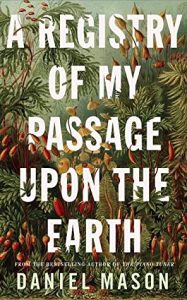
My favorite title and cover combo of the year: A Registry of My Passage Upon the Earth by Daniel Mason
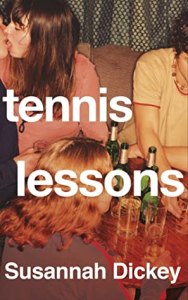
The book I wish had gotten a better title and cover: Tennis Lessons by Susannah Dickey – I did enjoy this second-person novel about a young woman who is her own worst enemy, to the tune of 3.5 stars, but the title says nothing about it and the cover would have been a turnoff had I not won a signed copy from Mslexia.
The most unfortunate typos I found in published works: In English Pastoral by James Rebanks, “sewn” where he meant “sown” (so ironic in a book about farming!) versus, in Mr Wilder & Me by Jonathan Coe, “sown” in place of “sewn.” Also “impassible” where it should read “impassable” in Apeirogon by Colum McCann. This is what proofreaders like myself are for. We will save you from embarrassing homophone slips, dangling modifiers, and more!
The 2020 books that everybody else loved, but I didn’t: The Mirror and the Light by Hilary Mantel, Hamnet by Maggie O’Farrell, and Shuggie Bain by Douglas Stuart
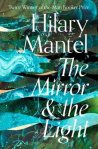


The year’s biggest disappointments: I don’t like to call anything “worst” (after all, I didn’t read anything nearly as awful as last year’s Jonathan Livingston Seagull), but my lowest ratings went to A Traveller at the Gates of Wisdom by John Boyne and At Hawthorn Time by Melissa Harrison, and I was disappointed that When the Lights Go Out by Carys Bray was misleadingly marketed.
 The downright strangest books I read this year: Enter the Aardvark by Jessica Anthony, A Traveller at the Gates of Wisdom by John Boyne, The House Without Windows by Barbara Newhall Follett, and The Child in Time by Ian McEwan
The people and themes that kept turning up in my reading: Rachel Carson and Henry David Thoreau; curlews and plagues; how we define and relate to history; childhood memoirs (seven of them).

Some of my 2020 curlew reading. (Two more books with curlews on the cover were borrowed from the library.)
Some statistics on my 2020 reading:
Fiction: 57.2%
Nonfiction: 36.8%
Poetry: 6%
(Fiction reigned supreme this year! Last year my F:NF ratio was roughly 1:1. Poetry was down by ~5% this year compared to 2019.)
Male author: 34.1%
Female author: 63.8%
Nonbinary author: 0.3% (= 1 author, Jay Bernard)
Multiple genders (anthologies): 1.8%
(Women dominated by an extra ~5% this year over 2019. I’ve said this for four years now: I find it intriguing that female authors significantly outweigh male authors in my reading because I have never consciously set out to read more books by women; it must be a matter of being interested in the kinds of stories women tell and how they capture their experiences in nonfiction.)
E-books: 10.6%
Print books: 89.4%
(Almost exactly the same as last year. My e-book reading has been declining, partially because I’ve cut back on the reviewing gigs that involve only reading e-books and partially because I’ve done less traveling. Increasingly, I prefer to sit down with a big stack of print books.)
Books by BIPOC: 14.7%
Literature in translation: 6.6%
(Down from last year’s 7.2%; how did this happen?! This will be something to address in 2021.)
Where my books came from for the whole year:
- Free print or e-copy from publisher: 25.6%
- Public library: 25.6%
- Free (giveaways, The Book Thing of Baltimore, the free mall bookshop, etc.): 14.9%
- Secondhand purchase: 11.6%
- Downloaded from NetGalley, Edelweiss or Project Gutenberg: 6.7%
- New purchase (sometimes at a bargain price): 6.3%
- Gifts: 5.5%
- University library: 3.8%
I promised to scale back on review copies this year, and I did: last year they accounted for nearly 37% of my reading. My library reading was higher than last year’s, despite the challenges of lockdowns; my e-book reading decreased in general. I bought more than twice as many new books as usual this year, and read lots that I either bought secondhand or got for free.
Number of unread print books in the house: 435
At the end of last year this figure was at 440 after lots of stock-ups from the free mall bookshop, which has since closed. So even though it might look like I have only read five books of my own, I have in fact read loads from my shelves this year … but also acquired many more books, both new and secondhand.
In any case, the overall movement has been downward, so I’m calling it a win!
 Bookish Beck = Rebecca Foster. American transplant to England. Freelance proofreader and book reviewer.
