Books in Brief: Five I Loved Recently
Ironically, Tuesday’s post on all the books I’ve abandoned so far in 2017 was my most popular in ages; it received nearly twice as many views as most of my recent posts. I think readers must find it reassuring that they’re ‘allowed’ to give up on a book rather than struggle through to the end of something they’re really not enjoying. However, I unwittingly stirred up some controversy when I shared the post on a Facebook group for book bloggers and authors and got a few replies along the lines of “I would never write about a book I didn’t like or didn’t finish. It’s not fair to the author.” Hmmm.
Anyway, today I have five pretty much unreserved recommendations instead. An original take on the American Civil War, a retelling of a Shakespearean tragedy, a highly unusual travel book, a creative blending of poems and recipes, and a wonderful book about sisters and betrayal from a Canadian author new to me. I hope you’ll find something here to enjoy.
Days Without End
By Sebastian Barry
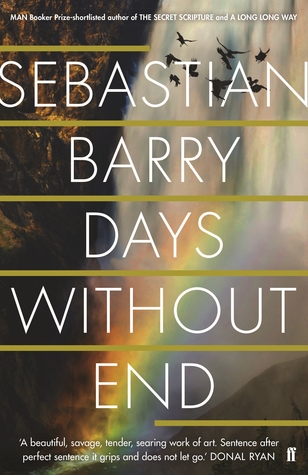 An entirely believable look at the life of the American soldier in the 1850s and 1860s, this novel succeeds due to its folksy dialect and a perfect balance between adventuresome spirit and repulsion at wartime carnage. While it shares some elements with Westerns and Civil War fiction, it’s unique in several ways. Though thrilling and episodic, it’s deeply thoughtful as well. Thomas writes semi-literate English but delivers profound, beautiful statements all the same. Lovely metaphors and memorable turns of phrase abound. Finally, this book is the most matter-of-fact consideration of same-sex relationships I’ve ever encountered in historical fiction. Heart-breaking, life-affirming, laugh-out-loud: these may be clichés, but here’s one novel that is all these things and more. Truly unforgettable. (See my full review at BookBrowse. See also my related article on the Native American practice of cross-dressing, known as winkte or berdache.)
My rating: 
New Boy: Othello Retold
By Tracy Chevalier
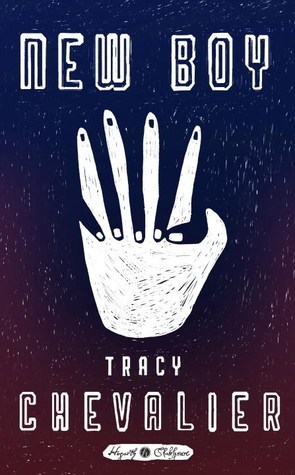 (My second favorite in the Hogarth Shakespeare series, after Margaret Atwood’s Hag-Seed.) Chevalier is known for historical fiction, but here she gives Othello a near-contemporary situation and a backdrop much closer to home: her native Washington, D.C. Spring 1974: it’s Ghanaian diplomat’s son Osei Kokote’s first day at a new school. Fortunately, he’s taken under the wing of one of the most popular sixth grade girls, Dee, and they’re soon inseparable. The novel takes place all in one day, divided into discrete sections by recess periods and a lunch break. Jump rope rhymes, jungle gyms, kickball games, arts and crafts, and a typical cafeteria meal of Salisbury steak and tater tots: it’s impressive how Chevalier takes ordinary elements and transforms them into symbols of a complex hierarchy and shifting loyalties. The language of possession and desire felt overly dramatic to me when applied to eleven-year-olds. However, it’s a remarkable exploration of the psyche of a boy isolated by his race. (Full review forthcoming at the Pittsburgh Post-Gazette website.)
My rating:  (maybe more like 3.75)
Tragic Shores: A Memoir of Dark Travel
By Thomas H. Cook
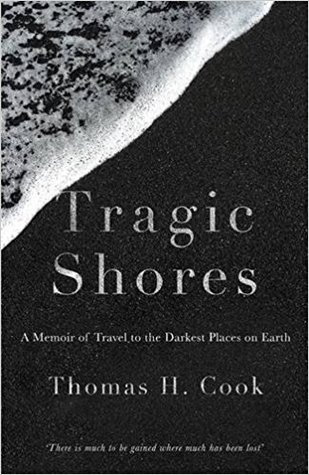 Cook is a crime writer. In this out-of-the-ordinary travel memoir he blends personal experience and history to tell of the ‘dark places’ he’s drawn to visiting. In 28 chapters that jump around in chronological order, he chronicles journeys he’s made to places associated with war, massacres, doomed lovers, suicides and other evidence of human suffering. Some are well known – Lourdes, Auschwitz, Verdun and Ground Zero – while others, like a Hawaiian leper colony and the hideaway of a fifteenth-century serial killer, require more background. A section on Okinawa and Hiroshima is among the book’s highlights: excellent descriptions of the mass suicide rooms where the Japanese retreated as the Americans approached and the atomic bomb drop itself bring history to life. But the most memorable chapter of all is one in which suffering touches Cook in a personal way. A meditative and often melancholy picture of humanity at its best and worst. (See my full review at Nudge.)
My rating: 
Eat This Poem: A Literary Feast of Recipes Inspired by Poetry
By Nicole Gulotta
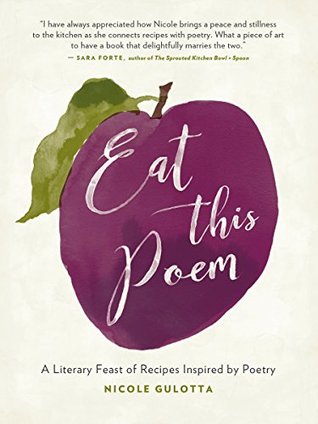 This arose from Gulotta’s blog of the same title. It’s a luscious mix of food-themed poems – none of which I’d ever encountered before, even if certain of the poets were familiar to me (like Mary Oliver, Sharon Olds and Wendell Berry) – commentary, personal anecdote and recipes that manage to hit the sweet spot in a Venn diagram between trendy, frugal, simple and indulgent. I could see myself making and eating any of these recipes, but my eye was particularly drawn to baked sweet potatoes with maple yogurt, vanilla-pear crumble, butternut squash macaroni and cheese, olive oil pumpkin bread, and cornmeal waffles. It might seem like this is a book that would only have niche appeal, but I don’t think that’s the case. Whether you like to cook or just like to eat, whether you love poetry or struggle to understand it, I’d recommend this for pleasant occasional reading. It only misses out on five stars because some of the observations are fairly obvious; these poems mostly speak for themselves.
My rating:
A Student of Weather
By Elizabeth Hay
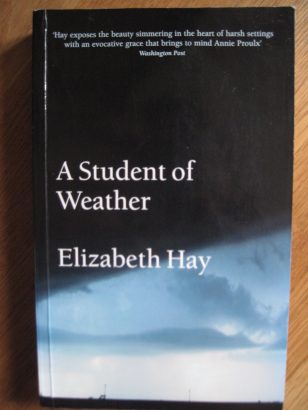 Set between the 1930s and 1970s, Hay’s debut (shortlisted for Canada’s Giller Prize in 2000) focuses on a pair of sisters, Norma Joyce and Lucinda Hardy, and the frostbitten young weather researcher who stumbles upon their Saskatchewan farmhouse one January evening in 1938. “Two sisters fell down the same well, and the well was Maurice Dove.” Seventeen-year-old Lucinda became the capable family housekeeper after their mother’s death. Norma Joyce is a precocious, sneaky eight-year-old. On each of Maurice’s visits, and in the years to come, they quietly jostle for his attention. Despite the upheaval of war and a move to Ontario, some things never change. Hay lends her story allusive depth by referencing biblical pairs of opposites: Jacob and Esau, Mary and Martha, and the Prodigal Son and his jealous older brother. My favorite parts were when the sisters were together in Canada; once Norma Joyce moves to New York, the book starts drifting a bit. However, there are such astute observations about what goes on in family and romantic relationships, and many perfect sentences. I thoroughly enjoyed reading this slowly over the course of a month, and I’d gladly read anything else from Hay.
My rating:
Have you read any of these? Which one takes your fancy?
All the Books I’ve Abandoned So Far This Year
Last year’s abandoned books posts were popular ones – strangely so considering that, instead of giving recommendations like usual, I was instead listing books I’d probably steer you away from. This is such a subjective thing, though; I know that at least a few of the books I discuss below (especially the Mervyn Peake and Rachel Cusk) have admirers among my trusted fellow bloggers. So consider this a record of some books that didn’t work for me: take my caution with a grain of salt, and don’t let me put you off if you think there’s something here that you’d really like to try. (For some unfinished books I give ratings, while for others where I haven’t read far enough to get a good sense of the contents I refrain from rating. This list is in chronological order of my reading rather than alphabetical by title or author.)
 Titus Groan by Mervyn Peake: Vivid scene setting and amusingly exaggerated characters, but I couldn’t seem to get anywhere. It takes over 50 pages for one servant to tell another that the master has had a son?! Hearing that the book only lasts until Titus’s second birthday made me fear the next 400+ pages would just be more of the same. I bought the whole trilogy secondhand, so I hope I’ll be successful on a future attempt. (Set aside at page 62.)
 Seven Seasons in Siena: My Quixotic Quest for Acceptance among Tuscany’s Proudest People, by Robert Rodi: I read the first 49 pages but found the information about the city’s different districts and horse races tedious. Favorite passage: “it’s what’s drawn me to Italians in general—their theatricality, their love of tradition, their spirit. Ever since my first trip to Rome, some ten years ago, I’ve found the robustness of the Italians’ appetites (for food, for music, for fashion) to be a welcome antidote to the dismaying anemia of modern American culture.”
A Book about Love by Jonah Lehrer: Read the first 31% of the Kindle book. Featured in my Valentine’s Day post about “Love” titles. 
 Pondlife: A Swimmer’s Journal by Al Alvarez: I read the first 57 pages but found the entries fairly repetitive. The book spans nine years, but up to that point it was all set in 2002, when Alvarez was 73, and he reported so frequently that the conditions (weather, etc.) at the Hampstead Heath ponds didn’t differ enough to keep this interesting. Unless he’s traveling, you can count on each entry remarking on the traffic getting there, the relative scarcity or overabundance of fellow swimmers at the pond, the chilly start and the ultimately invigorating, calming effect of the water. Impressive that he’d been taking early-morning swims there since age 11, though. Favorite line (from a warm, late June day): “the water is like tepid soup – duck soup with swan-turd croutons.”
 The Best of Adam Sharp by Graeme Simsion: I read the first 36 pages of a library copy and gave up in grave disappointment. Compared to the two Rosie books, this felt like it had no spark. It’s just lots of name-dropping of 1960s and ’70s songs. I felt no connection to either Adam’s current life in England or his memories of his nascent relationship with soap actress Angelina back in Australia.
 The Wild Other: A Memoir by Clover Stroud: Normally I love memoirs that center on bereavement or major illness, but there’s so much going on in this book that drowns out the story of her mother falling off her horse and suffering a TBI when Stroud was 16. For instance, there’s a lot about the blended family she grew up in, embarrassing detail about her early sexual experiences, and an account of postnatal depression that plunges her back into memories of her mother’s accident. “Horses are the source of powerful magic that’s changed my life,” Stroud asserts, so she talks a lot about both real horses and chalk figures of them, but that’s not the same as affirming the healing power of nature, which is how this book has been marketed. Well written, yet I couldn’t warm to the story of a posh Home Counties upbringing, which means I never got as far as the more tantalizing contents set in Ireland and Texas. (Read the first 78 pages.)
 The Evening Road by Laird Hunt: I read about the first 50 pages, skimmed the rest of the first part, and barely glanced at the remainder. Hunt’s previous novel, Neverhome, was a pretty unforgettable take on the Civil War narrative. This latest book is trying to do something new with Jim Crow violence. In the 1920s–30s history Hunt draws on, lynchings were entertainment in the same way other forms of execution were in previous centuries; buses have even been put on to take people to “the show” up at Marvel, Indiana. Hateful Ottie Lee narrates the first half of the novel as she rides with her handsy boss Bud Lancer and her unappealing husband Dale to see the lynching. Their road trip includes a catfish supper, plenty of drinking, and a stop at a dance hall. It ends up feeling like a less entertaining The Help. A feel-good picaresque about a lynching? It might work if there were a contrasting tone, a hint that somewhere in this fictional universe there is an appropriate sense of horror about what is happening. I think Hunt’s mistake is to stick with Ottie Lee the whole time rather than switching between her and Calla Destry (the black narrator of the second half) or an omniscient narrator. I’d long given up on the novel by the time Calla came into play.
 Outline by Rachel Cusk: I read the first 66 pages before setting this aside. I didn’t dislike the writing; I even found it quite profound in places, but there’s not enough story to peg such philosophical depth on. This makes it the very opposite of unputdownable. Last year I read the first few pages of Aftermath, about her divorce, and found it similarly detached. In general I just think her style doesn’t connect with me. I’m unlikely to pick up another of her books, although I have had her memoir of motherhood recommended. Lines I appreciated: “your failures keep returning to you, while your successes are something you always have to convince yourself of”; “it’s a bit like marriage, he said. You build a whole structure on a period of intensity that’s never repeated. It’s the basis of your faith and sometimes you doubt it, but you never renounce it because too much of your life stands on that ground.”
Last but not least, Our Mutual Friend by Charles Dickens, in which I barely made it a few chapters.
Only nine in five months – not too shabby? There’s also a handful of other books that I decided to skim instead of read in their entirety, though.
I’ll be interested to hear if you’ve read any of these books – or plan to read them – and believe that they are worth persisting with.
Two Mother–Daughter Author Pairs for Mother’s Day
This coming Sunday is Mother’s Day in the USA. (Mothering Sunday generally falls in March here in the UK, so every year I have to buy a card early to send to my mother back in the States, but I still associate Mother’s Day with May.) Earlier in the year I got over halfway through a Goodreads giveaway book, Beyond the Pale by Emily Urquhart, before I realized its author was the daughter of a Canadian novelist I’d read before, Jane Urquhart. That got me thinking about other mother–daughter pairs that might be on my shelves. I found one in the form of Sue Monk Kidd’s The Secret Life of Bees plus an advance e-copy of her daughter Ann Kidd Taylor’s upcoming debut novel, The Shark Club. (I’ve previously reviewed their joint memoir, Traveling with Pomegranates.) And, as a bonus, I have a mini-review of Graham Swift’s novella Mothering Sunday: A Romance.
The Whirlpool, Jane Urquhart
 From 1986, this was Urquhart’s first novel. Overall it reminded me of A. S. Byatt (especially The Virgin in the Garden) and John Fowles’s The French Lieutenant’s Woman. Set in 1889 on the Canadian side of Niagara Falls, it features characters who, each in their separate ways, are stuck in the past and obsessed with death and its symbolic stand-in, the whirlpool. Maud Grady, the local undertaker’s widow, takes possession of the corpses of those who’ve tried to swim the Falls. Her creepy young son starts off mute and becomes an expert mimic. Major David McDougal is fixated on the War of 1812, while his wife Fleda camps out in a tent reading Victorian poetry, especially Robert Browning, and awaiting a house that may never be built. Local poet Patrick sees Fleda from afar and develops romanticized ideas about her.
Each of these narratives is entertaining, but I was less convinced by their intersections – except for the brilliant scenes when Patrick and Maud’s son engage in wordplay. In particular, I was unsure what the prologue and epilogue (in which Robert Browning, dying in Venice, is visited by images of Shelley’s death by drowning) were meant to add. This is the second Urquhart novel I’ve read, after Sanctuary Line. I admire her writing but her plots don’t always come together. However, I’m sure to try more of her work: I have a copy of Away on the shelf, and Changing Heaven (1990) sounds unmissable – it features the ghost of Emily Brontë! [Bought from a Lambeth charity shop for 20p.]
My rating: 
Beyond the Pale: Folklore, Family and the Mystery of Our Hidden Genes, Emily Urquhart
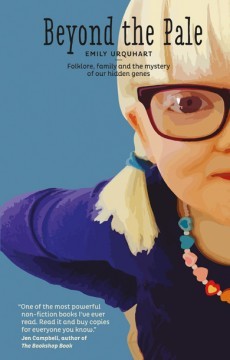 In December 2010, the author’s first child, Sadie, was born with white hair. It took weeks to confirm that Sadie had albinism, a genetic condition associated with extreme light sensitivity and poor eyesight. A Canadian folklorist, Urquhart is well placed to trace the legends that have arisen about albinos through time and across the world, ranging from the Dead Sea Scroll story of Noah being born with blinding white skin and hair to the enduring superstition that accounts for African albinos being maimed or killed to use their body parts in folk medicine.
She attends a NOAH (America’s National Organization for Albinism and Hypopigmentation) conference, discovers potential evidence of a family history of albinism, and even makes a pilgrimage to Tanzania to meet some victims. It’s all written up in as engaging present-tense narrative of coming to terms with disability: to start with Urquhart is annoyed at people reassuring her “it could be worse,” but by the end she’s ever so slightly disappointed to learn that her second child, a boy, will not be an albino like his sister. [Goodreads giveaway copy]
My rating:
The Secret Life of Bees, Sue Monk Kidd
 It’s hard to believe it was 15 years ago that this debut novel was an It book, and harder to believe that I’d never managed to get around to it until now. However, in some ways it felt familiar because I’d read a fair bit of background via Kidd’s chapter in Why We Write about Ourselves and Traveling with Pomegranates, in which she and her daughter explored the Black Madonna tradition in Europe.
It joins unusual elements you wouldn’t expect to find in fiction – beekeeping and the divine feminine – with more well-trodden territory: the Civil Rights movement in the South in the 1960s, unhappy family relationships, secrets, and a teenage girl’s coming of age. Fourteen-year-old Lily is an appealing narrator who runs away from her memories of her mother’s death and her angry father, peach farmer T. Ray. You can’t help but fall in love with the rest of her new African-American, matriarchal clan, including their housekeeper, Rosaleen, who scandalizes the town by registering to vote, and the bee-keeping Boatwright sisters, August, June, and May, who give Lily and Rosaleen refuge when they skip town.
Although this crams in a lot of happenings and emotional ups and downs, it’s a charming story that draws you into the brutal heat of a South Carolina summer and keeps you hoping Lily will forgive herself and slip into the rhythms of a purposeful life of sisterhood. [Secondhand purchase in America]
A favorite line: “The way people lived their lives, settling for grits and cow shit, made me sick.”
My rating:
The Shark Club, Ann Kidd Taylor
 Dr. Maeve Donnelly loves sharks even though she was bitten by one as a child. She’s now a leading researcher with a Florida conservancy and travels around the world to gather data. Her professional life goes from strength to strength, but her personal life is another matter. Aged 30, she’s smarting from a broken engagement to her childhood sweetheart, Daniel, and isn’t ready to open her heart to Nicholas, a British colleague going through a divorce.
Things get complicated when Daniel returns to their southwest Florida island to work as the chef at her grandmother’s hotel – with his six-year-old daughter in tow. Maeve is soon taken with precocious Hazel, who founds the title club (pledge: “With this fin, I do swear. To love sharks even when they bite. When they lose their teeth, I will find them. When I catch one, I will let it go”), but isn’t sure she can pick up where she left off with Daniel. Meanwhile, evidence has surfaced of a local shark finning operation, and she’s determined to get to the bottom of it.
This is a little bit romance and a little bit mystery, and Taylor brings the Florida Keys setting to vibrant life. It took a while to suspend disbelief about Maeve’s background – an orphan and a twin and a shark bite survivor and a kid brought up in a hotel? – but I enjoyed the sweet yet unpredictable story line. Nothing earth-shattering, but great light reading for a summer day at the beach. Releases June 6th from Viking. [Edelweiss download]
My rating:
Mothering Sunday: A Romance, Graham Swift
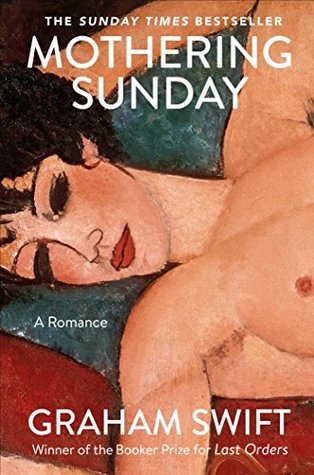 If you’re expecting a cozy tale of maternal love, let the Modigliani nude on the U.K. cover wipe that notion out of your mind. Part of me was impressed by Swift’s compact picture of one sexy, fateful day in 1924 and the reverberations it had for a budding writer even decades later. Interesting class connotations, too. But another part of me thought, isn’t this what you would get if Ian McEwan directed a middling episode of Downton Abbey? It has undeniable similarities to Atonement and On Chesil Beach, after all, and unlike those novels it’s repetitive; it keeps cycling round to restate its main events and points. There’s some good lines, but overall this felt like a strong short story stretched out to try to achieve book length. [Library read]
My rating: 
How to Be Human and Strange Heart Beating
I’m mostly grouping these two debut novels by women authors together for my scheduling convenience, but they do have things in common. For starters, both center on an encounter with another species that determines much of what follows. For another thing, they pivot on the end of one relationship and the potential beginning of another. And in the end they’re about how we retain our humanity in the face of loss – despite the strong temptation to give into madness. Although they are both notable and surprising books, I felt that one was significantly more successful than the other; read on to discover which I favor.
How to Be Human by Paula Cocozza
Thirty-four-year-old Mary Green is adrift after her long-term fiancé, Mark, moves out of their East London home. She works in university HR but hates her job and can never manage to show up to it on time. Though she and Mark broke up in part because she didn’t feel ready to commit to having children, she’s inordinately fond of the next-door neighbors’ baby, Flora. Most of all, she’s trying to reorient herself to the presence of a fox who slips in from the surrounding edgeland to visit her back garden each evening. He leaves presents: boxers, a glove, an egg, and – one disorienting evening – Flora herself, a live bundle on the back steps.
 Whereas the neighbors are horrified at the thought of a fox infestation and ready to go on the attack if necessary, Mary is enraptured by this taste of wildness. Before long the novel is using almost erotic vocabulary to describe her encounters with ‘her’ fox; Mary even allows the neighbors and her ex to get the idea that she’s ‘seeing someone’ new. Yet even as Mary’s grasp on reality grows feebler, it’s easy to empathize with her delight at the unexpectedness of interspecies connection: “At the end of her garden she had found a friend. … His wildness was a gift. … He was an escape artist, she thought admiringly. Maybe he could free her too.”
I love this novel for what it has to say about trespass, ownership and belonging. Whose space is this, really, and where do our loyalties lie? Cocozza sets up such intriguing contradictions between the domestic and the savage, the humdrum and the unpredictable. The encounter with the Other is clarifying, even salvific, and allows Mary to finally make her way back to herself. There’s something gently magical about the way the perspective occasionally shifts to give the fox’s backstory and impressions as a neologism-rich stream (“Come fresh to stalk around the human Female with sly feet and rippety eyes. Spruckling toadsome”). Memorable lines abound, and a chapter set at the neighbors’ barbecue is brilliant, as are the final three chapters, in which Mary – like James Darke – holes up in her house in anticipation of a siege.

Detail from the cover.
As much as this is about a summer of enchantment and literal brushes with urban wildlife, it’s also about women’s lives: loneliness, choices we make and patterns we get stuck in, and those unlooked-for experiences that might just liberate us. The character Mary is my near contemporary, so I could relate to her sense of being stuck personally and professionally, and also of feeling damned if you do, damned if you don’t regarding having children. “Some part of her was made for a bigger, wilder, freer life.” One of my favorite books of 2017 so far.
Paula Cocozza is a feature writer for the Guardian. How to Be Human was published in the UK by Hutchinson on April 6th. My thanks to the publisher for the free copy for review.
My rating: 
If you’re in the London area, you may be interested in this animal-themed Faber Social event, also featuring Lucy Jones, author of Foxes Unearthed. I’ll be in America at the time or else I surely would have gone!
I also enjoyed these two articles by Paula Cocozza: one on the depiction of foxes in popular culture, and the other about a life-changing encounter she had with a wild fox.
Strange Heart Beating by Eli Goldstone
 No doubt about it: the cover and title – from W. B. Yeats’s “Leda and the Swan” – can’t be beat. One day in late March this book showed up on my Twitter, Goodreads and Instagram feeds, and the cover lured me into requesting a copy right away. The elevator pitch is a winner, too: Seb’s artist wife, Leda, was killed by a swan. To be precise, she was boating in a London park and got too close to some cygnets; the parent bird upturned the boat and Leda drowned. The novel is narrated by Seb, an art history professor realizing just how little he knew about the woman he loved. When he takes a break from work to travel to Leda’s native Latvia in search of answers, he even learns that she was known by another name, Leila.
It’s as if Seb is running both towards and away from his sorrow:
What can I do to find some way back to Leda? I seek for meaning in every miserable glint and shadow … I felt I was starting to lose myself as well. Grief is the aggressive displacement of the self from a known universe to another … I want to bury myself neck-deep in the quicksand of grief.
When he gets to Latvia he stays at a guesthouse and communicates with the landlady in Russian. For a week running he meets Leda’s cousin Olaf at his clubhouse each night to drink and play cards, and later bags a boar with Olaf and his hunting buddies. While viewing a fresco in a picturesque church he meets Ursula, who is looking to build an eco-friendly resort to boost the country’s tourism industry. She soon emerges as a potential love interest for Seb.
As best I could make out, this is set roughly a decade ago. Interspersed between Seb’s rather aimless travels are passages from Leda’s diary between 1988 and 2005. These reveal her to have been a lonely, bullied youth who took refuge in art and music. If you’re familiar with the myth of Leda and the Swan, you’ll be expecting the trauma in her past. It’s a shame this has to be spelt out in Leda’s final diary entry; it was sufficiently foreshadowed, I think.
Ultimately I felt this book had a promising setup but didn’t particularly go anywhere. It struck me as an excellent short story idea that got expanded and lost a good bit of its power along the way. This is a shame, as I was initially reminded of several excellent debut novels with Eastern European elements, especially in the excellent opening sequence about how Leda’s various female ancestors perished (Jonathan Safran Foer’s Everything Is Illuminated, Rebecca Dinerstein’s The Sunlit Night, and Jaroslav Kalfař’s Spaceman of Bohemia). There could have been a quirky family saga in there had Goldstone chosen to go in that direction.
By the end we’ve learned next to nothing about Seb despite his first-person narration, and little of interest about Leda either. I can see how this is meant to reinforce a central message about the unknowability of other people, even those we think we know best, but it creates distance between reader and narrator. You could easily read this 194-page paperback in an afternoon. If you do and find yourself, like me, a mite dissatisfied, never fear – Goldstone is so young and writes so well; I’m confident she will only improve in the years to come.
Eli Goldstone has a City University Creative Writing MA. Strange Heart Beating is published in the UK by Granta today, May 4th. My thanks to the publisher for the free copy for review.
My rating:
Four Recommended May Releases
Here are four enjoyable books due out next month that I was lucky enough to read early. The first two are memoirs, the third is an audacious poetry book by an author new to me, and the last is the sophomore novel from an author I’ve loved before. I’ve pulled 250-word extracts from my full reviews and hope you’ll be tempted by one or more of these.
Last Things: A Graphic Memoir of Loss and Love by Marissa Moss
(Coming from Conari Press on May 1st [USA]; June 8th in UK)
 “You’re not aware of last things,” Moss, a children’s book author/illustrator, writes in this wrenching memoir of losing her husband to ALS. We look forward to and celebrate all of life’s firsts, but we never know until afterwards when we’ve experienced a last. The author’s husband, Harvey Stahl, was a medieval art historian working on a book about Louis IX’s prayer book. ALS is always a devastating diagnosis, but Harvey had the particularly severe bulbar variety, and his lungs were quick to succumb. His battery-powered ventilator led to many scares – one time Moss had to plug him into the wall at a gas station and rush home for a spare battery – and he also underwent an emergency tracheotomy surgery.
This is an emotionally draining read. It’s distressing to see how, instead of drawing closer and relying on each other, Marisa and Harvey drifted apart. Harvey pushed everyone away and focused on finishing his book and returning to his academic duties. He refused to accept his limitations and resisted necessary medical interventions. Meanwhile, Moss struggled with the unwanted role of caregiver while trying not to neglect her children and her own career.
I’ve read several nonfiction books about ALS now. Compared to the other two, Moss gets the tone just right. She’s a reliable witness to a medical and bureaucratic nightmare. At the distance of years, though, she writes about the experience without bitterness. I can see this graphic novel being especially helpful to older teens with a terminally ill parent.
My rating: 
My Life with Bob: Flawed Heroine Keeps Book of Books, Plot Ensues by Pamela Paul
(Coming from Henry Holt on May 2nd [USA]; June 13th in UK)
 I hold books about books to high standards and won’t stand for the slightest hint of plot summary, filler or spoilers. It’s all too easy for an author to concentrate on certain, often obscure books that mean a lot to him/her, dissecting the plots without conveying a sense of the wider appeal. The trick is to find the universal in the particular, and vice versa.
Pamela Paul, editor of the New York Times Book Review, does this absolutely perfectly. In 1988, as a high school junior, she started keeping track of her reading in a simple notebook she dubbed “Bob,” her Book of Books. In this memoir she delves into Bob to explain how her reading both reflected and shaped her character. The focus is unfailingly on books’ interplay with her life, such that each one mentioned more than earns its place.
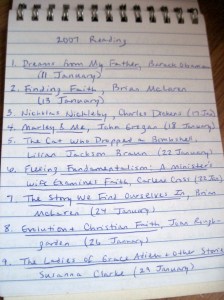
A page from my 2007 reading diary. Lots of mid-faith-crisis religion titles there. Starting in 2009, I think, I’ve kept this information in an annual computer file instead.
So whether she was hoarding castoffs from her bookstore job, obsessing about ticking off everything in the Norton Anthology, despairing that she’d run out of reading material in a remote yurt in China, or fretting that her husband took a fundamentally different approach to the works of Thomas Mann, Paul always looks beyond the books themselves to interrogate what they say about herself.
This is the sort of book I wish I had written. If you have even the slightest fondness for books about books, you won’t want to miss this one. I’ve found a new favorite bibliomemoir, and an early entry on the Best of 2017 list.
My rating: 
Nature Poem by Tommy Pico
(Coming on May 9th from Tin House Books)
 Tommy “Teebs” Pico is a Native American from the Kumeyaay nation and grew up on the Viejas Indian reservation. This funny, sexy, politically aware multi-part poem was written as a collective rebuttal to the kind of line he often gets in gay bars, something along the lines of ‘oh, you’re an Indian poet, so you must write about nature?’ Au contraire: Pico’s comfort zone is the urban, the pop cultural, and the technologically up-to-date – his poems are full of textspeak (“yr,” “bc” for because, “rn” for right now, “NDN” for Indian), an affectation that would ordinarily bother me but that I tolerated here because of Pico’s irrepressible sass: “I wd give a wedgie to a sacred mountain and gladly piss on the grass of / the park of poetic form / while no one’s lookin.”
Some more favorite lines:
“How do statues become more galvanizing than refugees / is not something I wd include in a nature poem.”
“Knowing the moon is inescapable tonight / and the tuft of yr chest against my shoulder blades— / This is a kind of nature I would write a poem about.”
“I can’t write a nature poem bc English is some Stockholm shit, makes me complicit in my tribe’s erasure”
“It’s hard to unhook the heavy marble Nature from the chain around yr neck / when history is stolen like water. // Reclamation suggests social / capital”
My rating:
The Awkward Age by Francesca Segal
(Coming on May 4th from Chatto & Windus [UK] and May 16th from Riverhead Books [USA])
 I adored Segal’s first novel, The Innocents, a sophisticated remake of Edith Wharton’s The Age of Innocence set in a contemporary Jewish community in London. I wasn’t as fond of this second book, but in her study of an unusual blended family the characterization is nearly as strong as in her debut. Julia Alden lost her husband to cancer five years ago. A second chance at happiness came when James Fuller, a divorced American obstetrician, came to her for piano lessons. He soon moved into Julia and sixteen-year-old Gwen’s northwest London home, and his seventeen-year-old son, Nathan, away at boarding school, came on weekends.
Julia is as ill at ease with Nathan as James is with Gwen, and the kids seem to hate each other. That is until, on a trip to Boston for Thanksgiving with James’s ex, Gwen and Nathan fall for each other. Awkward is one way of putting it. They’re not technically step-siblings as James and Julia aren’t married, but it doesn’t sit right with the adults, and it will have unexpected consequences.
The first third or so of the book was my favorite, comparable to Jonathan Safran Foer or Jonathan Franzen. Before long the romantic comedy atmosphere tips into YA melodrama, but for me the book was saved by a few things: a balance of generations, with Gwen’s grandparents a delightful background presence; the eye to the past, whether it be Gwen’s late father or the occasional Jewish ritual; the Anglo-American element; and a realistic ending.
My rating:
Have you read any May releases that you would recommend? Which of these do you fancy?
Show Her a Flower, a Bird, a Shadow by Peg Alford Pursell
Northern California’s Peg Alford Pursell is the founder of Why There Are Words, a Bay Area series of public literary readings, and the independent publishing house WTAW Press. Her short fiction has been shortlisted for the Flannery O’Connor Award.
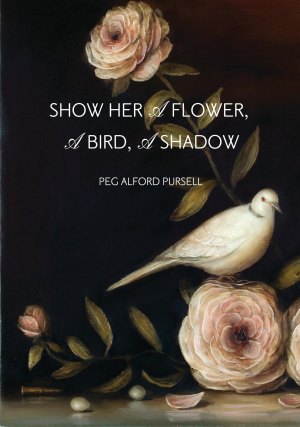
The lovely cover image is from White Dove and Roses by David Kroll.
Her debut work, Show Her a Flower, a Bird, a Shadow, is a collection of flash fictions, ranging in length from a few lines to a few pages, many of which have been previously published in literary journals or anthologies. They often read like poems, with the alliteration, colors and imagery lending more resonance to the prose than you usually find in short stories. First and last lines are especially incisive, like the phrase that opens “Petal, Feather, Particle,” about a single mother on her way to a hotel to calm her daughter down: “Show her a flower, a bird, a shadow, and she will show you what is simultaneously forming and falling apart.”
Plot is incidental and largely secondary to language and emotion here, but many of the pieces share a topic of shaky relationships, and the bonds that last in life versus the ones that fade away. Young female first-person narrators frequently alternate with third-person stories about older women, but a recurring theme throughout is how others view you versus how you see yourself. Especially in the context of long-term relationships, these characters have to keep life from going stagnant by staying in motion and living mindfully:
Just as in marriage. He didn’t believe in stopping, resting, or pausing. Drive was everything. Look at the fat bumblebee busy on the flower stalk: the creature anything but in repose, gathering nectar for all it’s worth before moving on to the next. That was how to be in the world. (from “At the Flower”)
Likewise, “This is what familiarity demands: that I examine every detail again as if new clues will present themselves,” a woman thinks while looking at photographs of her daughter (in “The Girl in the Picture”).
A few of my favorite stories were “Day of the Dead,” which mixes Mexican traditions with the narrator’s own bereavements; “Girl on a Hobby Horse,” in which a woman meditates with her Buddhist daughter after her own 14-year relationship breaks down; and “A Weak Light Shining through the High Small Window,” about a woman visiting her brain-injured husband in the hospital and imagining their future together.
The final piece, “Inscription of Time,” reminded me most of Margaret Drabble’s The Dark Flood Rises with its picture of a woman who has lost many family members and friends yet gains a necessary sense of closure when a former lover, a race car driver who once had an accident that left him in a temporary coma, invites her to his apartment to say a proper goodbye. “It was as if he’d understood what she hadn’t known until that moment. That she needed an ending.”
It may be only 70 pages long, but this book packs a poetic punch. Its images and lines linger, and it deserves to be read slowly and mulled over. I’d recommend it to readers of Tessa Hadley and Desiree Cooper, and fans of flash fiction in general.
Show Her a Flower, a Bird, a Shadow was released by ELJ Editions on March 31st. My thanks to the author for sending a PDF copy for review.
My rating:
A Jest of God by Margaret Laurence
A Jest of God (1966) is the second in Margaret Laurence’s five-novel Manawaka sequence; it followed The Stone Angel (1964), which I reviewed here back in December. Recently reissued as part of the Apollo Classics imprint from Head of Zeus Books, these two books have been a wonderful opportunity for me to further my knowledge of Canadian literature.
Although Rachel Cameron, the narrator of A Jest of God, is a 34-year-old second-grade teacher who still lives with her mother, she has attributes in common with 90-year-old Hagar Shipley, the unforgettable central character of The Stone Angel. Both have a history of sexual hang-ups – Rachel’s in the form of erotic dreams – and experience temporary losses of self-control. The most striking example is when Rachel reluctantly accepts her fellow teacher Calla’s invitation to her Pentecostal church and, though she is mortified at hearing others speaking in tongues, involuntarily enters in herself with hysterical crying.
I loved this sequence. The Tabernacle of the Risen and Reborn provides such a contrast to Rachel’s mother’s staid church tradition, and it’s a perfect introduction to Rachel’s patterns of pride and embarrassment (another link to Hagar). Although Rachel frequently issues stern orders to herself – “Now, then. Enough of this. The main thing is to be sensible, to stop thinking and to go to sleep” – she can’t seem to stop worrying and second-guessing. This applies to her career as well as to her personal relationships. With her principal’s support, she takes surprisingly stern action against her favorite pupil when he starts playing truant.

It’s hard to say much more about the plot without giving too much away. Do I emulate the vagueness of the back cover blurb and simply explain that Rachel unexpectedly “falls in love for the first time, and embarks upon an affair that will change her life in unforeseen ways”? I’d prefer to go into a bit more depth, so if you want to avoid learning what happens I suggest skipping over my next few paragraphs.
To start with it seems Rachel’s best romantic prospect is Calla, who’s certainly interested. But about a third of the way into the novel, as the boredom of the long summer vacation is setting in, Nick Kazlik returns to town. He was the milkman’s son and Rachel’s childhood acquaintance, and is now a high school teacher in another town. They go out to a movie and share a kiss, and from there their relationship progresses rapidly. Rachel loses her virginity to him out in a field, and the more sex they have the more she’s seized with a belated terror of pregnancy. No doubt her anxiety about motherhood is colored by her passive-aggressive relationship with her own mother, whose dodgy heart leaves her utterly dependent on Rachel.
The novel reminded me most of Margaret Drabble’s The Millstone and Carrie Snyder’s Girl Runner. Like the protagonists of those novels, Rachel’s options seem stark: acquiring a secret abortion, or changing her life irrevocably by having a child out of wedlock. As the title phrase suggests, Rachel feels God is laughing at her presumptuousness: first for believing she might be loved in proportion to her own passion, and then for thinking she could become a mother. I wasn’t fond of the way the book backtracked on this main source of tension at the end. A retreat from calamity might seem fitting given Rachel’s usual overthinking, but the resolution felt to me like too much of a deus ex machina reprieve.
Ultimately, I found Nick and Rachel’s affair the least interesting element of this novel. Compared with the friendship with Calla, the startling religious experience, the interactions with pupils and the school principal, the troubled mother–daughter relationship, and an odd late-night encounter with the new owner of her late father’s funeral parlor, what’s a bit of sex? We’re meant to rejoice at Rachel’s chance at romance, I think, but also to recognize it as a fleeting but necessary spur to an altered life.
Two aspects of this reprint edition deserve a mention. There’s a terrific afterword from Margaret Atwood recalling meeting Laurence, her literary idol, at the Governor General’s Awards ceremony in 1967 (Atwood won for poetry and Laurence won for fiction with this novel). Apollo Classics have also chosen an excellent cover image: a 1960 photograph by Rosemary Gilliat Eaton entitled Woman preparing paint for an art class, Frobisher Bay.

The Margaret Laurence House in Neepawa, Manitoba, Canada. By Amqui (Own work) [CC BY-SA 3.0 (http://creativecommons.org/licenses/by-sa/3.0)%5D, via Wikimedia Commons.
With thanks to Blake Brooks at Head of Zeus/Apollo Classics for the free copy for review.
My rating:
The Devil and Webster by Jean Hanff Korelitz
It’s hard to resist a campus novel. The Devil and Webster, the sixth novel by Jean Hanff Korelitz, is unusual in focusing more on the administration than the students of a fictional American college. Webster College, Massachusetts was founded as a Native American training academy in the eighteenth century by missionary Josiah Webster. Now it rivals Harvard and other Ivy League schools, attracting liberal students with its enlightened gender and racial politics. (I had Swarthmore and Oberlin in mind as models.)
Yet Naomi Roth, Webster’s first female president, soon finds that racial and sexual tension still bubble under the surface here. A decade ago, her first major challenge as president was dealing with the uproar when Nell Jones-Givens, who lived in female-only Radclyffe Hall, began transitioning to become Neil. But now she faces an even stickier problem: A group of students have set up an Occupy-style camp in the center of the quad to protest the decision to deny tenure to Nicholas Gall, a popular African-American anthropology professor.
 The protest is spearheaded by Omar Khayal, a charismatic Palestinian refugee who wowed Naomi’s closest friend, Dean of Admissions Francine Rigor, with his application essay about growing up in the midst of conflict and surviving the death of his entire family. What Omar and these other outraged students don’t know – and Naomi can’t reveal because of the confidentiality of the process – is that Gall has a negligible publication record and was also found guilty of plagiarism. They instead presume that this is all because he is black.
What starts off as manageable dissent thus morphs into unpleasant, racially motivated retribution. “Webster is not a city on a hill. Webster is still the reactionary place it was before,” Omar declares in a media interview. In this context, Naomi’s upcoming Native American conference, though planned long ago, seems like a pathetic attempt at placation.
Throughout, the third-person narration sticks close to Naomi, a compelling protagonist not least because she’s a single mother and her daughter Hannah is also a protesting Webster student. By documenting Naomi’s thoughts (often in italics) versus what she says, Korelitz emphasizes the difficult position she’s in, always having to hold her tongue and speak diplomatically, as when addressing the protest camp:
“My only interest is in learning more about your concerns and your intentions. We share this community, and I’m sure we all want the best for it. If there are problems to be identified, issues to be discussed, changes to be made…whatever. It won’t happen if you won’t…” Talk, she wanted to say. Open your fucking mouths with their years of orthodontia and use those expensively educated voices to articulate your pathetic complaints about this…this halcyon, evolved, rarified, creative, and intellectual college campus, where you are free to learn and nap and make things and have sex and get high and change your fucking gender even, and clean water comes out of the tap and you wave your school ID under a scanner to help yourself to smorgasbords of food (meat! meat alternative! vegan! lactose-sensitive! nut-free! gluten-free!) and all we expect of you is that you pass your classes and don’t hurt anyone else. But she didn’t say these things. Of course she didn’t say them.
Naomi has her own background in feminist activism, but now, instead of being in a position to ‘speak truth to power,’ she has to realize that, as Francine reminds her, she is the power.
This is an interesting book about appearances and assumptions. Again and again characters make ethical compromises, proving how difficult it is to find and maintain the moral high ground. As the college’s historian points out to Naomi, from its very beginnings Webster has had a tendency towards capitulation. He plans to write up this story in a book called The Devil and Webster – which is also a reference to “The Devil and Daniel Webster,” the 1936 O. Henry Award-winning, Faustian short story by Steven Vincent Benét. I haven’t read the story, but looking at a synopsis I can see that it’s relevant in that it touches on themes of race, patriotism and the treatment of Native Americans.
The story line feels fresh and surprising, if at times melodramatic. My problem was more with the author’s style, which seemed to me old-fashioned and belabored. Korelitz has a habit of minutely describing everything: a house, a room, the food, the hairstyles, and so on. There are four pages on Naomi’s presidential wardrobe, and we get not just a passing reference to her PhD thesis but three pages on it. This means that it feels like it takes forever for the plot to get going. Much of modern fiction is more minimalist, I think, or would more naturally weave in its short bits of backstory. I even wondered if this book would have been better off as a collection of linked short stories from different points in Naomi’s or the college’s past.
This is all a shame, because while I liked the characters, dialogue and setting and enjoyed many of the turns of phrase (e.g. “filling in the spousal synapses” and “Garrison Keillor’s voice had a narcotic vocal element that always made her feel sleepy, each word a nepenthe puff”), I found the book tiresome overall, and can’t imagine myself picking up another one from Korelitz any time soon.
The Devil and Webster was published in the UK by Faber & Faber on April 6th and in the USA by Grand Central Publishing on March 21st. My thanks to Josh Smith for the review copy.
My rating:
What are your favorite campus novels?
Besides Donna Tartt’s The Secret History, I’ve loved Kingsley Amis’s Lucky Jim, Chad Harbach’s The Art of Fielding, Julie Schumacher’s Dear Committee Members, and many of David Lodge’s books. See also my review of Bradstreet Gate by Robin Kirman.
Wellcome Prize Shortlist, Pt. 2: The Tidal Zone by Sarah Moss
This is Sarah Moss’s third consecutive appearance on the Wellcome Book Prize shortlist, after Bodies of Light in 2015 and Signs for Lost Children in 2016, a pair of linked novels about a female doctor in the nineteenth century. The Tidal Zone, on the other hand, is a contemporary story of how a sudden, strange illness shakes up one middle-class family.
It’s a clichéd image from television and films: new parents tiptoe into their baby’s room every night to make sure he or she is still breathing. But 15 years later, narrator Adam Goldschmidt starts doing the same thing for his teenage daughter, Miriam, after she collapses on her school’s sports field and stops breathing for a few minutes. Thanks to a teacher’s quick thinking, CPR and paramedics soon see her stable again, but for Adam and his wife Emma, herself a GP, this is like a biblical loss of innocence: for the first time they realize that something calamitous could happen to Miriam or their eight-year-old, Rose, at any moment. Adam feels himself part of a global web of suffering parents, including those whose children are bombed in the Middle East or shot by police in America. All he sees are potential Pietàs.
It comforts me to think that most parents in most of time and most of the world have lived with this fear as a matter of course. It comforts me to think that while I have little fellowship in my fear with the parents at the school gate, the massed ghosts of England and the majority of parents living in the world now are with me. Although it turns out, of course, once people have a reason to tell you, that more of the school-gate parents than you used to imagine live in the overlap between ordinary life and tragedy.
Miriam is a delightfully sarcastic kid, lefty and socially engaged. I love her banter with the rest of the family. She was never going to be a meek angel in a hospital bed. Still, she’s ready to resume regular life long before Adam and Emma are ready to let her out of their sight for more than an hour or two. Meanwhile, Adam has to keep things ticking over at home. A stay-at-home dad in Coventry, he teaches the occasional art history class at the local university and is slowly writing a book about Coventry Cathedral, which was bombed to destruction during World War II and later rebuilt. Occasional chapters about the cathedral’s history make the narrative arc even clearer: this is all about catastrophe and reconstruction. How does a family, or a city, bounce back from what looked like the end?
Eventually a diagnosis and suggested treatment arrive, but the mystery remains of what caused Miriam’s cardiac arrest in the first place. What combination of factors – what she’d eaten, how much she’d exercised, what was in the air – could account for a failure to keep breathing? And could there be a genetic aspect to this condition that could link back to Adam’s mother’s unexpected death when he was nine?
It’s from Adam’s early memories of his mother that the title comes: when he was a boy they explored the tidal zone at the Cornwall coast, looking for creatures in the rock pools. Just as tidal pools mark the boundary between the land and the sea, this novel probes the liminal space between survival and death. But it also recognizes that even in that crucial gap, daily activities continue: hanging up the laundry, emptying the dishwasher, fielding pleas for a cat, and carping about NHS and university bureaucracy. Moss writes so well about normal life – something I also noticed in Night Waking, the other novel of hers that I’ve read, which is narrated by a mother of young children (and a character who’s briefly mentioned here, as Adam’s friend) – she lends correct weight to the everyday without overlooking epiphanies and moments of timelessness.

I love this striking cover: Eliza (2015) by Michael Gaskell. It’s an acrylic portrait on board of his niece and won second prize in that year’s BP Portrait Awards – but it’s so amazingly crisp I would have sworn it was a photograph!
I admired many things about the novel, particularly how easily Moss writes from a male viewpoint and the ways in which she reflects on the storytelling impulse. The extraordinary first chapter opens with “Once upon a time” and narrates the quotidian miracles of conception, pregnancy, birth and child development before making this personal, proceeding from “the girl” to “you” and finally to “I” in the second chapter. On several (perhaps one too many) occasions Moss repeats that fairytale opener to tell about Miriam’s medical journey or explain how Adam’s mother and American-born father met at a commune. This emphasizes the way we construct narratives around everything from our origins to our health.
A plan is a story about the future … a diagnosis is a story, brings a story’s promise of safe conduct through time and place to an anticipated ending.
I felt a bit too much time was spent on Adam’s father, and in the back of my mind was the niggling thought that this First World family is never facing true disaster because they have all kinds of safety nets in place; Moss’s is a very middle-class vision. I also think some readers could struggle with the slight aimlessness of the plot, though by the end you do get the sense that the characters are looking to the future in simple ways.
However, I don’t think those small complaints detract from the novel’s power. It’s a sobering but ultimately reassuring story with a simple message: we are all fragile, and we must appreciate life and health while we can.
You can’t go round not loving things because they’ll die.
May we forget. It is a pity that the things we learn in crisis are all to be found on fridge magnets and greetings cards: seize the day, savour the moment, tell your love—May we live long enough to despise the clichés again, may we heal enough to take for granted sky and water and light, because the state of blind gratitude for breath and blood is not a position of intelligence.
My rating:
My gut feeling: Moss’s fiction shows true commitment to probing issues of health and medicine, and she’s an underrated author in general. Glancing back at the description of the books the Wellcome Prize panel is looking for (“At some point, medicine touches all our lives. … The subjects these books grapple with might include birth and beginnings, illness and loss, pain, memory, and identity”), I think this novel is a very strong contender indeed.
More reviews:
Clare’s at A Little Blog of Books
Eleanor’s at Elle Thinks
Eric’s at Lonesome Reader
Shortlist strategy:
Currently reading: I Contain Multitudes, Ed Yong’s (surprisingly?) enjoyable book about microbial life – I’m nearly halfway through and have taken it with me on our mini-holiday. Also The Gene by Siddhartha Mukherjee, a daunting 500+-page history of genetics, but I’ve loved this author’s work before (The Emperor of All Maladies).
I’m away in Hay-on-Wye through Thursday the 6th but will be back and responding to comments on Friday the 7th.
Wellcome Prize Shortlist, Part 1: de Kerangal and Kalanithi
I’m delighted to announce the final members of our Wellcome Book Prize 2017 shadow panel:
Ruby blogs at My Booking Great Blog.
GrrlScientist is an ornithologist and science journalist who was on the judging panel for the 2016 Royal Society Insight Investment Science Book Prize.
Along with Paul and Amy, this brings us up to five people – the same number as the official judging panel.
Luckily, I’ve already read two of the shortlisted titles, one quite recently and one nearly a year and a half ago. Here are the reviews I published on Goodreads at the time. I’ll be getting both books back out of the library soon to have another look before we choose our winner.
Mend the Living by Maylis de Kerangal
(translated from the French by Jessica Moore; published in the USA as The Heart)
[This is the French author’s second novel to be translated into English. It has been made into a film and won the Prix Orange du Livre and the Grand prix RTL du livre. It was also recently shortlisted for the Albertine Prize, an American readers’ choice award for contemporary French fiction. If you’re based in the States, feel free to vote by April 30th!]
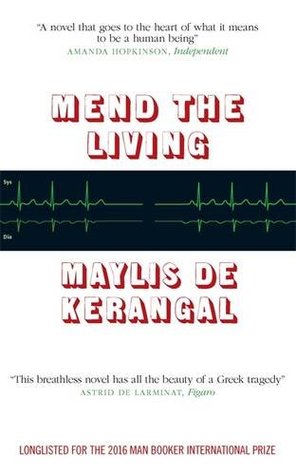 Nineteen-year-old Simon Limbeau is declared brain dead in a French hospital after a car accident, but his heart lives on: metaphorically through the love of his parents, sister, friends, and girlfriend; but also literally, in the recipient of his organ donation. Again and again de Kerangal makes a distinction between the physical reality of organs and what they represent: “Simon’s eyes are not just his nervous retina, his taffeta iris, his pupil of pure black in front of the crystalline – they are also his gaze; his skin isn’t just the threaded mesh of his epidermis, his porous cavities – it’s his light and his touch, the living sensors of his body.”
The novel spends time with Simon’s family, especially his mother, but also with the transplant coordinator, the surgeons, the nurse, and so on. I was reminded of ER as well as the French TV show The Returned – this would work really well on screen, and would be a way of avoiding the more off-putting aspects of the author’s style. She writes long, run-on sentences: sometimes half a page, sometimes even stretching to two pages, and stuffs her prose with abstruse vocabulary (or at least that’s how the translator has rendered it), a lot of it medical but some of it simply inaccessible: “emollient conjugality” plus at least a dozen English words I’d never encountered (e.g. abulic, tumid, atony, claudicant, auscultation, precellence, torticollis, naevi, scialytic).
The worst example of the unnecessary opacity is “the digitigrade gait of the sardana dancer when he’s nearing a quintal, the corpulence of an ex-obese man calibrating him in thickness, in fullness, but without visible excrescence” – in plain English, the guy is stocky.
Read in November 2016.
My rating: 
My gut feeling: The novel gives a vivid sense of the fragility of life and imbues parts of the body with metaphorical meaning. However, I think the style makes it too inaccessible and I can’t see its appeal ever being more than niche.
More reviews:
Annabel’s at Shiny New Books
Carolyn’s at Rosemary and Reading Glasses
When Breath Becomes Air by Paul Kalanithi
[The first posthumous nominee for the Wellcome Book Prize. I’ll be interested to see what I make of this one when I revisit it.]
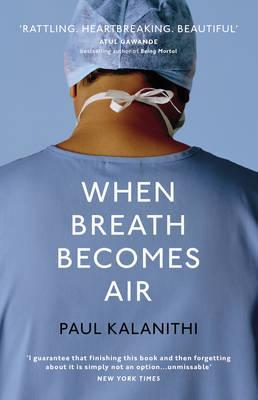 Paul Kalanithi was 36 and just completing his neurosurgery residency in Stanford, California when he was diagnosed with advanced lung cancer that did not respond well to treatment. It came as a complete surprise to this non-smoker, and set his life on a new course. He and his coterie of doctors managed his symptoms so he could operate for as long as possible, but when the time came he knew he wanted to devote his last year to writing this memoir. In addition, he would get a brief, sweet taste of fatherhood: he and his wife Lucy, also in the medical field, decided to have a child, a daughter named Cady.
Kalanithi grew up the son of Indian immigrants in Arizona. “I was driven less by achievement than by trying to understand, in earnest: What makes human life meaningful?” he recalls. Degrees in English literature and human biology were disparate attempts to find an answer. Like Henry Marsh (Do No Harm), he has a surgeon’s knowledge of the anatomy of reasoning, but realizes that does not provide the full picture. He recognizes the responsibility of holding others’ lives in the balance, and regrets occasional failures of empathy.
Those burdens are what make medicine holy and wholly impossible: in taking up another’s cross, one must sometimes get crushed by the weight.
It’s intriguing to see religious language in that statement – indeed, Kalanithi saw his work as a calling, and one with moral connotations. Christian imagery shows up repeatedly:
Instead of being the pastoral figure aiding a life transition, I found myself the sheep, lost and confused.
Openness to human relationality does not mean revealing grand truths from the apse; it means meeting patients where they are, in the narthex or nave, and bringing them as far as you can.
When’s the last time you encountered the word “narthex”?! The vocabulary is striking throughout, as in another favorite passage: “A tureen of tragedy was best allotted by the spoonful. Only a few patients demanded the whole at once; most needed time to digest.”
Kalanithi died in March 2015. In addition to the foreword by Abraham Verghese, there’s a lovely epilogue from his widow, who’s more than competent to carry on his legacy.
I appreciate stories lived on the knife edge of life and death, but I would recommend this to those who don’t normally choose to read illness narratives, simply for the beauty of its prose – a fine blend of literature and medicine – and the wholehearted picture of a life cut short.
Read in October 2015 (Random House were looking for early readers via NetGalley).
My rating: 
My gut feeling: I suspect this is by far the most popular and best-selling title on this year’s shortlist. So many people have taken it to their hearts. It will take a truly special book to knock it from the top spot.
More reviews:
Shadow panelist Paul’s at Nudge
Shadow panelist Ruby’s at My Booking Great Blog
Susan’s at A life in books
Shortlist strategy:
Currently reading: The Tidal Zone by Sarah Moss – about halfway through.
Up next: Whichever of the remaining nonfiction titles turns up to the library for me first!
I’ve also sent off an emergency e-mail to Bodley Head asking for a copy of Ed Yong’s I Contain Multitudes; it’s on loan through my library system until April 19th, which gives me no time to read it even if it comes back on time.
 Bookish Beck = Rebecca Foster. American transplant to England. Freelance proofreader and book reviewer.
 Bookish Beck