Books in Brief: Five I Loved Recently
Feminist social history, visits with the world’s bees, a novel about a peculiar child and his reclusive writer mother, witty notes on Englishness, and tips on surviving heartbreak: five very different books, but I hope one or more of them is something that you’d enjoy.
Flâneuse: Women Walk the City in Paris, New York, Tokyo, Venice and London
By Lauren Elkin
 Raised in New York and now a Paris resident, Lauren Elkin has always felt at home in cities. Here she traces how women writers and artists have made the world’s great cities their own, blending memoir, social history and literary criticism. In a neat example of form flowing from content, the book meanders from city to city and figure to figure. My interest waned during later chapters on protesting (‘taking to the streets’) and the films of Agnès Varda. However, especially when she’s musing on Martha Gellhorn’s rootlessness, Elkin captures the angst of being a woman caught between places and purposes in a way that expatriates like myself will appreciate. It’s in making the history of the flâneuse personal that Elkin opens her book up to a wider swathe of readers than just the feminist social historians and literary critics who might seem like her natural audience. I would particularly recommend this to readers of Rebecca Solnit and Olivia Laing. (See my full review at The Bookbag.)
My rating: 
Bee Quest: In Search of Rare Bees
By Dave Goulson
 Goulson grows more like Bill Bryson and Gerald Durrell with each book. Although the topic of this, his third nature book (all of them are broadly about insects), is probably of least personal interest to me, there are plenty of wonderful asides and pieces of trivia that make it worth journeying along with him from Poland to Ecuador in the search for rare bees. For as close-up as his view often is, he also sees the big picture of environmental degradation and species loss. I learned some fairly dismaying facts: gold mining is extremely destructive to the environment, producing 20 tons of toxic material per ring; and it takes five liters of water to produce one almond in California. As for a more hopeful statistic: the billions of dollars it would take to set up conservation efforts for all the world’s species would still only equate to cutting world Coke consumption by 20%. It’s all a matter of priorities.
A favorite line:
“As is often the case in entomology, in the end it all comes down to the genitals.”
My rating:
Be Frank with Me
By Julia Claiborne Johnson
 Alice, a young publishing assistant, is sent from New York City to Los Angeles to encourage one-hit wonder and Harper Lee type M.M. Banning to produce her long-delayed second novel. But when she arrives she discovers her most pressing duty is keeping an eye on Mimi’s oddball son, nine-year-old Frank. I doubt you’ve ever met a character quite like Frank. (I appreciated how, although he is clearly on what would be termed the autistic spectrum, Johnson avoids naming his condition.) Alice narrates the whole book in the first person. She finds herself caught in a four-person battle of wits – Alice, Mimi, Frank, and “itinerant male role model” Xander – inside Mimi’s big glass-fronted fishbowl of a house. There were a couple moments when I wondered where this madcap plot could be going. In particular, we have to wait a long time to find out whether Mimi is actually going to deliver another book. But the payout is worth waiting for. (See my full review at The Bookbag.)
My rating:
How to Be an Alien
By George Mikes
 (The first volume in the How to Be a Brit omnibus; originally published in 1946.) You can draw a straight line from this through Bill Bryson’s Notes from a Small Island to the “Very British Problems” phenomenon. Mikes (that’s “mee-cash” – he was a Hungarian journalist who accidentally moved to England permanently when he was sent to London as a correspondent just before World War II) made humorous observations that have, in general, aged well. The mini-essays on tea, weather, and queuing struck me as particularly apt. I’d heard this line before, though I can’t remember where: “An Englishman, even if he is alone, forms an orderly queue of one.”
Another favorite passage:
“It is all right to have central heating in an English home, except the bath room, because that is the only place where you are naked and wet at the same time, and you must give British germs a fair chance.” [This reminds me of when my mother made her first trip to England in 2004 to visit me during my study abroad year; in her family newsletter reporting on the experience, one of her key observations was, “British bathrooms are antiquated.” My husband and I still quote this to each other regularly.]
My rating:
A Manual for Heartache
By Cathy Rentzenbrink
 This is a follow-up to Rentzenbrink’s memoir, The Last Act of Love, which was about the accident that left her brother in a vegetative state for eight years and the legal battle she and her parents fought to be able to end his life. The first quarter of this book contains fairly generic advice for people who have been through family tragedy, illness or some other hardship. It’s when Rentzenbrink makes things personal, talking about her own struggles with PTSD and depression and strategies that have helped her over the years, that the book improves, and it maintains a pretty high standard therafter. Although you wouldn’t really call anything in here groundbreaking, it’s a slim and accessible volume that I could see being helpful for anyone who’s grieving, even someone who’s not usually a reader or has a short attention span. (I won a copy in a Goodreads giveaway.)
A couple favorite passages:
“Experiencing grief for the first time is like the dark twin of falling in love. It feels a bit crazy, and we don’t think anyone has ever felt exactly as we do. But of course they have.”
“We don’t need to be unbroken. Our first step is simply to stop trying to hide our scars. Heartache is human.”
My rating: 
Have you read any of these? Which one takes your fancy?
Doorstopper of the Month: Theft by Finding by David Sedaris
I’ve read six of David Sedaris’s humorous collections of personal essays. A college friend first recommended him to me in 2011, and I started with When You Are Engulfed in Flames – which I still think is his best book, though Me Talk Pretty One Day is also very good. Sedaris can be riotously funny, and witty and bittersweet the rest of the time. From Raleigh, North Carolina, he has lived in New York, London, Paris, Normandy and Tokyo. Many of his essays stem from minor incidents in his travels. His kooky Greek-American family members and longsuffering partner, Hugh Hamrick, are his stock characters, and his pieces delight in cultural and linguistic misunderstandings and human obstinacy versus openheartedness.
When I heard Sedaris was publishing his selected diaries, I wasn’t sure I’d read them. I knew many of his essays grow out of episodes recorded in the diary, so would the entries end up seeming redundant? I’d pretty much convinced myself that I was going to give Theft by Finding a miss – until I won a proof copy in a Goodreads giveaway. This is the first volume, covering 1977 to 2002; a second volume from 2003 onwards is planned.
 What I most liked about this book is the sense you get of the sweep of the author’s life: from living in his North Carolina hometown and doing odd construction jobs, hitchhiking and taking drugs to producing plays, going on book tours and jetting between Paris and New York City, via an interlude in Chicago (where he attended art school and taught writing). Major world events occasionally make it in – the Three Mile Island disaster, Princess Diana’s death, the Bush/Gore election, 9/11 – but for the most part this is about daily nonevents. It’s a bit of a shock to come across a serious moment, like his mother’s sudden death in 1991.
One thing that remains constant is Sedaris’s fascination with people’s quirks. For instance, nearly every night for nine years he visited his local IHOP for coffee, cigarettes and people-watching. He seems to meet an inordinately large number of homeless, hard-up and crazy types; perhaps, thanks to his own years-long penury (October 6, 1981: “I’ve paid my rent and my phone bill, leaving me with 43 cents”) and addictions (he didn’t quit alcohol and marijuana until 1999), he feels a certain connection with down-and-outs.
By the last few years of the diary, though, he’s having dinners with Mavis Gallant, Susan Sontag, and Merchant & Ivory. This isn’t obnoxious name-dropping, though; I appreciated how Sedaris maintains a kind of bemused surprise about his success rather than developing a feeling of entitlement. He acts almost guilty about his wealth and multiple properties (“I’ve fallen deeper into the luxury pit”). Time spent abroad keeps him humble about his linguistic abilities and gives him a healthy measure of doubt about the American lifestyle; I especially liked his reaction to a Missouri Walmart.
The problem with the book, though, is that the early entries are really quite dull. Things picked up a bit by the early 1980s, but it wasn’t until the late 1990s that I realized I was actually finding the entries laugh-out-loud funny like I expect from Sedaris. The book as a whole is too long and inclusive; Simon Cowell would surely call it indulgent. I tried to imagine what would have resulted if an outsider had reduced the complete diaries to a one-volume selection. A cast list and photographs of Sedaris and his family over the years would also be helpful; I’d be interested to know if any supplementary material was added to the final product that did not appear in my proof.
Ultimately I think this is only for the most die-hard of Sedaris fans. I will certainly read the second volume as I expect it to be funnier and better written overall. But if – as appears to be the case from the marketing slogans in my proof – the publishers are hoping this will introduce Sedaris to new readers, I think they’ll be let down. If you’ve not encountered him before, I suggest picking up Me Talk Pretty One Day or trying one of his radio programs.
Some favorite passages:
October 26, 1985; Chicago: In the park I bought dope. There was a bench nearby, so I sat down for a while and took in the perfect fall day. Then I came home and carved the word failure into a pumpkin.
October 5, 1992; New York: The new Pakistani cashier at the Grand Union is named Dollop.
October 5, 1997; New York: Making it worse, I had to sit through another endless preview for Titanic. Who do they think is going to see that movie?
June 18, 1999; Paris: Today I saw a one-armed dwarf carrying a skateboard. It’s been ninety days since I’ve had a drink.
October 3, 1999; Paris: I said to the clerk, in French, “Hello. Sometimes my clothes are wrinkled. I bought a machine anti-wrinkle, and now I search a table. Have you such a table?” The fellow said, “An ironing board?” “Exactly!”
My rating: 
Have you read (or heard) anything by David Sedaris? Are you a fan?
A Recommendation for August
Each month I aim to preview two to four books to be released in the next month that I have already read and can recommend. It’s looking thin on the ground for August because two of my most anticipated reads of the year were disappointments, and another August release I left unfinished; I give mini write-ups of these below. However, I’ve very much enjoyed What It Means When a Man Falls from the Sky, the debut story collection by Lesley Nneka Arimah, which came out in America in April but releases on the 24th over here; I’ll be reviewing it for Shiny New Books shortly. Also, I’m 20% into The Education of a Coroner by John Bateson (releases August 15th), a fascinating set of sometimes gory true crime case studies.
As for the one August book I’m currently able to wholeheartedly recommend, that is…
The Futilitarians: Our Year of Thinking, Drinking, Grieving, and Reading by Anne Gisleson
(Coming from Little, Brown and Company on the 22nd)
 One for angsty, bookish types. In 2012 Anne Gisleson, a New Orleans-based creative writing teacher, her husband, sister and some friends formed an Existential Crisis Reading Group (which, for the record, I think would have been a better title). Each month they got together to discuss their lives and their set readings – both expected and off-beat selections, everything from Kafka and Tolstoy to Kingsley Amis and Clarice Lispector – over wine and snacks.
One of their texts, Arthur Koestler’s The Act of Creation, proposed the helpful notion of the Trivial and Tragic Planes. The Trivial is where we live everyday; the Tragic is where we’re transported when something awful happens. Gisleson had plenty of experience with the latter: not just the suicides of her younger twin sisters, a year and a half apart, and her father’s death from leukemia, but also the collective loss of Hurricane Katrina. She returns again and again to these sources of grief in her monthly chapters structured around the book group meetings, elegantly interweaving family stories and literary criticism.
I found the long quotes from the readings a little much – you probably shouldn’t pick this up if you haven’t the least interest in philosophy and aren’t much troubled by life’s big questions – but in general this is a fascinating, personal look at what makes life worth living when it might be shattered any second. I particularly loved the chapter in which the book club members creatively re-enact the Stations of the Cross for Easter and the sections about her father’s pro bono work as an attorney for death row inmates at Angola prison. Sometimes it really is a matter of life and death.
Favorite passage:
“Generations of parents have put their children to bed in this house and even if I haven’t quite figured out the why and the how of living, others have found reasons to keep moving things forward. In quiet moments I can feel the collective push of these ghost-hands on my back, nudging me on.”
My rating:
And now for the ones I’m closer to lukewarm on…
(Reviews in the order in which I read the books.)
Mrs. Fletcher by Tom Perrotta
(Coming from Scribner on the 1st)
 I enjoy Tom Perrotta’s novels: they’re funny, snappy, current and relatable; it’s no surprise they make great movies. I’ve somehow read seven of his nine books now, without even realizing it. Mrs. Fletcher is more of the same satire on suburban angst, but with an extra layer of raunchiness that struck me as unnecessary. It seemed something like a sexual box-ticking exercise. But for all the deliberately edgy content, this book isn’t really doing anything very groundbreaking; it’s the same old story of temptations and bad decisions, but with everything basically going back to a state of normality by the end. If you haven’t read any Perrotta before and are interested in giving his work a try, let me steer you towards Little Children instead. That’s his best book by far.
My rating: 
Sour Heart by Jenny Zhang
(Coming from Lenny Books on the 1st [USA] and Bloomsbury Circus on the 10th [UK])
 I read “We Love You Crispina” (13%), about the string of awful hovels a family of Chinese immigrants is forced to move between in early 1990s New York City. You’d think it would be unbearably sad reading about cockroaches and shared mattresses and her father’s mistress, but Zhang’s deadpan litanies are actually very funny: “After Woodside we moved to another floor, this time in my mom’s cousin’s friend’s sister’s apartment in Ocean Hill that would have been perfect except for the nights when rats ran over our faces while we were sleeping and even on the nights they didn’t, we were still being charged twice the cost of a shitty motel.” Perhaps I’m out of practice in reading short story collections, but after I finished this first story I felt absolutely no need to move on to the rest of the book.
My rating:
Forest Dark by Nicole Krauss
(Coming on the 24th from Harper [USA] and Bloomsbury [UK])
 Impressive in scope and structure, but rather frustrating. If you’re hoping for another History of Love, you’re likely to come away disappointed: while that book touched the heart; this one is mostly cerebral. Metafiction, the Kabbalah, and some alternative history featuring Kafka are a few of the major elements, so think about whether those topics attract or repel you. Looking a bit deeper, this is a book about Jewish self-invention and reinvention. Now, when I read a novel with a dual narrative, especially when the two strands share a partial setting – here, the Tel Aviv Hilton – I fully expect them to meet up at some point. In Forest Dark that never happens. At least, I don’t think so.* I sometimes found “Nicole” (the author character) insufferably clever and inward-gazing. All told, there’s a lot to think about here: more questions than answers, really. Interesting, for sure, but not the return to form I’d hoped for.
*Hop over to my Goodreads review to read the marked spoilers and chip in with comments!
My rating:
What August books do you have on the docket?
Have you already read any that you can recommend?
Britain’s Bounty: Land of Plenty by Charlie Pye-Smith
Charlie Pye-Smith is a farming and environmental commentator with many previous titles to his name. To research this survey of modern food production, he spent a year traveling around the British countryside in a motor home, interviewing farmers and manufacturers and learning how things are likely to change when Brexit takes effect. In the face of surpluses and falling profits, he suggests that in the future farmers will need to diversify. Questioning received wisdom, he also proposes that animal welfare might be more achievable in larger-scale operations and that environmentally friendly techniques like crop rotation might actually lead to higher yields.
 Many of the farms the author visits have survived due to their adaptability. For instance, the Belchers of Leicestershire found they could double their profits if they processed their cattle, pigs and lambs themselves and sold the meat at farmer’s markets. Likewise, the Blands, dairy farmers in Cumbria, branched out after they lost their whole herd to foot-and-mouth disease in 2001: Now they produce ice cream from their Jersey cows and run a successful tea room. On the other hand, specializing in a heritage product can also be an effective strategy. In Yorkshire, the author meets farmers who have been raising sheep locally for centuries. “It’s all about eating the view … linking Swaledale sheep to a beautiful upland landscape. Eat our lamb and you’re helping to protect the Dales,” is the message.
Pye-Smith also looks into pig welfare and plowing techniques for cereal crops. In a chapter on fruit, he tells the recent story of apples and strawberries through cider and jam production, respectively. A section on vegetables centers on potatoes. I learned a number of facts that surprised me:
- Over half Britain’s potatoes are turned into crisps and chips
- “Outdoor-reared” pork is not necessarily the ideal because cold, wet winters are tough on piglets and sows
- Cider coming into fashion over the last 10–15 years is largely thanks to Magners’ advertising campaigns
- Nowadays the average Briton spends just 10% of their income on food, as opposed to 33% in the 1950s.
The book strikes an appropriate balance between the cutting-edge and the traditional, and between caution and optimism. Although Brexit will lead to a total loss of farmers’ EU subsidies and a drop in the number of Eastern Europeans coming over to pick produce, there may be potential benefits too. As one large-scale vegetable farmer opines, “we should see Brexit as a great opportunity to promote home-grown food production.” I appreciated how open the author is to organic and conservation agriculture, but he also doesn’t present them as magical solutions. For the most part, I sensed no hidden agenda, though he is perhaps pro-grouse shooting and seems dismissive of city journalists like George Monbiot who claim to know better than the real countryside experts.
This is most like a condensed, British version of Michael Pollan’s The Omnivore’s Dilemma; Pye-Smith makes the same sort of investigations into food production methods, including tiny snippets from his own life along the way. Crucially, the book is readable throughout, never sinking into tedious statistics or jargon. The author’s black-and-white photographs, three to five per chapter, are a nice addition. In essence this is a collection of stories about a way of life that faces challenges but is not doomed. I was reassured to hear that people increasingly care about where their food comes from. Martin Thatcher of Thatchers cider says “People have become more discriminating. They are now much more interested in what they’re eating and drinking than they were in the past, and how it’s produced.” If you, too, are interested in how food gets to you in Britain, be sure to pick up this book.
My rating:
Land of Plenty is published today, July 27th, by Elliott & Thompson. Thanks to Alison Menzies for arranging my free copy for review.
Classic of the Month: Father and Son by Edmund Gosse
I can’t believe how long it’s taken me to get to this splendid evocation of 1850s–60s family life in an extreme religious sect. I’d known about Edmund Gosse’s Father and Son (1907) for ages, and even owned a copy. Two of its early incidents – the son’s anticlimactic birth announcement in the father’s diary, and the throwing out of a forbidden Christmas pudding – were famously appropriated by Peter Carey for creating Oscar’s backstory in his Booker Prize-winning novel Oscar and Lucinda (1988), which I read in 2008 but didn’t much like. I was reminded of that literary debt when I worked for King’s College London’s library system and did a summer placement in the Special Collections department in 2011. For my “In the Spotlight” article about a book in particular need of conservation, I chose Philip Henry Gosse’s Omphalos, his well-meaning but half-baked contribution to the Victorian science versus religion debate, and did a lot of secondary reading about the Gosses and their milieu.
The book’s subtitle, “A Study of Two Temperaments,” gives an idea of the angle Gosse takes here: this is not a straightforward biography (after all, he’d already written his father’s life story in 1890) or a comprehensive memoir, but a snapshot of his early years and an emotional unpicking of the personality clash that results from fundamentally different approaches to life. While Gosse père (1810–88) was a devoted naturalist as well as a dogged believer in the literal truth of the Bible, even in adolescence his son (1849–1928) was a literature aficionado and troubled skeptic. Philip Gosse was a minister with the Plymouth Brethren and married late, at 38; his wife was 42, very late for contemplating motherhood in those days. Like Thomas Hardy, the infant Edmund was presumed dead at birth and set aside, so it’s thanks to keen-eyed nurses that we have these two late Victorians’ significant literary output today.
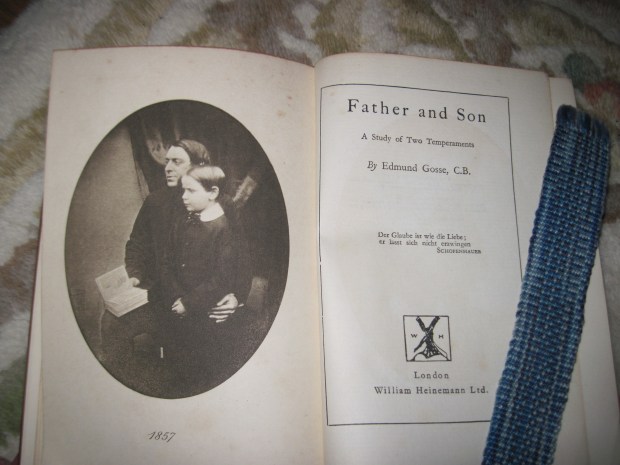
Although his first word was “book” and he could read by age four, Edmund was initially forbidden to read fiction. His mother quashed her own love of making up stories because she believed fiction was in some way sinful. It was always taken for granted that Edmund would follow his father into the ministry, and early on he had a sense of a split self: the external persona he put on to please his parents, and the deeper self that struggled to divine its purpose. He would cheekily test the limits of his familial faith by petitioning the Almighty for an expensive toy that he ‘needed’ and praying to a wooden chair to see if he’d be struck down for idolatry. The absurdity of such scenes is a welcome foil to the sadness of his mother’s death when Gosse was just seven. A year later the boy and his father moved from London to Devon, where both were captivated by the sea. (Indeed, if Philip Gosse is remembered as a natural historian today, it’s largely for his work on marine life – he discovered a new genus of sea anemones in 1859.) After Philip remarried, Edmund began attending a weekday boarding school and fell in love with literature, especially Shakespeare and the Romantic poets.
There’s a stretch of the book at about the two-thirds point that I found less compelling; much of it describes the other members of his father’s congregation (“the saints”) and the tedium of Sundays. It’s also a shame there isn’t a brief afterword that continues the story through to his father’s death. But for much of its length this is a riveting investigation of how the conflict between reason and religion plays out both within individual souls and between family members. The purpose here is to chart the course that led him out of religion and made the supernatural rift between him and his father permanent by the time he was 15 or so, and Gosse fulfills that aim admirably. In doing so he maintains a delicately balanced tone: Although he vividly recreates funny moments from his childhood, he also makes clear-eyed, scathing assessments of a religion that is ostensibly based on love but all too often veers towards judgment instead:
Here was perfect purity, perfect intrepidity, perfect abnegation; yet here was also narrowness, isolation, an absence of perspective, let it be boldly admitted, an absence of humanity. And there was a curious mixture of humbleness and arrogance; entire resignation to the will of God and not less entire disdain of the judgment and opinion of God.
[H]e allowed the turbid volume of superstition to drown the delicate stream of reason.
He who was so tender-hearted that he could not bear to witness the pain or distress of any person, however disagreeable or undeserving, was quite acquiescent in believing that God would punish human beings, in millions, for ever, for a purely intellectual error of comprehension.
Even so, this is a loving portrait, as well as a nuanced one, and a model of how to write family memoir. I enjoyed it immensely, and will no doubt read it again.
My rating: 
Further reading:
- Glimpses of the Wonderful: The Life of Philip Henry Gosse 1810–1888 by Ann Thwaite
- In the Days of Rain, Rebecca Stott’s memoir of growing up in the Plymouth Brethren in the 1960s
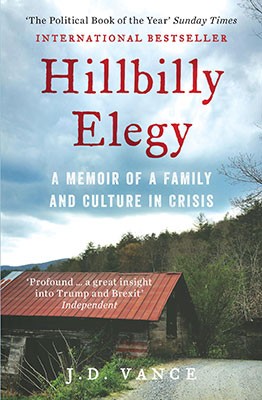
Review: Hillbilly Elegy by J.D. Vance
“Americans call them hillbillies, rednecks, or white trash. I call them neighbors, friends, and family.”
This is one of those books I’d heard high praise about from America but never thought I’d be able to get hold of in the UK. I looked into borrowing it from the public library on my last trip to the States, but even nearly a year after its publication the reservation list was still a mile long. So I was delighted to hear that Hillbilly Elegy was being released in paperback in the UK last month. For British readers, it will provide a welcome window onto a working-class world that is easily caricatured but harder to understand in a nuanced way.
J.D. Vance knows hillbilly America from the inside but also has the necessary distance to be able to draw helpful conclusions about it: born in the “Rust Belt” of Ohio to parents who didn’t complete high school, he served in the Marine Corps in Iraq, attended Ohio State University and Yale Law School, and became a successful investor with a venture capital firm. He was one of the lucky ones who didn’t give into lower-middle-class despair and widespread vices like alcoholism and hard drugs, even though his mother was an addict and installed a “revolving door of father figures” in his life after his father abandoned them.
 Vance attributes his success to the stability provided by his grandparents, his beloved Mamaw and Papaw. They were part of a large wave of migration from Kentucky to Ohio, where they moved so Papaw could work in the Armco Steel mill. Prejudice assaulted the couple from both sides: Kentucky folk thought they’d grown too big for their britches, while in Ohio they were maligned as dirty hillbillies. Mamaw, in particular, is a wonderful character so eccentric you couldn’t make her up, with her fierce love backed up by a pistol.
The book is powerful because it gives concrete, personal examples of social movements: it’s no dry history of how the Scots-Irish residents of Appalachia switched allegiance from the Democratic Party to the Republican after Richard Nixon, though Vance does fill in these broad brushstrokes, but a family memoir that situates Mamaw and Papaw’s experience, and later his own, in the context of the history of the region and the whole country.
I most appreciated the author’s determined use of the first-person plural, especially later in the book: he includes himself in the hillbilly “we” such that he’s not some newly gentrified snob denouncing welfare queens: he knows these people and this lifestyle and recognizes its contradictions; he also knows that but for the grace of God he could have slipped into the same bad habits.
Jackson [Kentucky] is undoubtedly full of the nicest people in the world; it is also full of drug addicts and at least one man who can find the time to make eight children but can’t find the time to support them. It is unquestionably beautiful, but its beauty is obscured by the environmental waste and loose trash that scatters the countryside. Its people are hardworking, except of course for the many food stamp recipients who show little interest in honest work.
At Yale Law School Vance felt out of place for the first time in his life. One of the most important things he learned from professors like Amy Chua was the value of social capital: in his new world of lawyers, senators and judges it really was all about who you know. At law firm interviews, he had no idea what cutlery to use in restaurants and had to text his girlfriend for help. For as much as he’s adapted to non-hillbilly life in the intervening years, he still notices in himself the hallmarks of a stressful, impoverished upbringing: a fight or flight approach to conflict and an honor culture that makes him prone to nurturing feuds.
Although I enjoyed it simply as a memoir, I can see this book especially appealing to people who are interested in the politics and psychology of the lower middle class (perhaps an American equivalent to Owen Jones’s Chavs, a book I never got through). British readers will, I think, be surprised to learn that Vance is on the conservative end of the spectrum and has political aspirations. Essentially, he doesn’t think the government can fix things for struggling country folk, though certain social policies might help. He seems to think it’s more a question of personal responsibility – and also that churches have a major role to play.
There is a cultural movement in the white working class to blame problems on society or the government, and that movement gains adherents by the day.
Mamaw always had two gods: Jesus Christ and the United States of America. I was no different, and neither was anyone else I knew.
(These strike me as alien ideas in the UK, apart from short-lived strategies like David Cameron’s “Big Society” – except, perhaps, if one goes all the way back to Thatcherism.)
Much has been made in the British press about this book’s ability to explain the rise of Donald Trump. This is an overstatement, and perhaps even misleading, when you consider the author’s conservatism; he never mentions Trump, and never engages in any specific political discussions. But what it is helpful for is exposing a mindset of rugged, defiant individualism that often shades into hopelessness. I have my own share of redneck relatives, and though I feel far removed from the world Vance depicts, I can see its traces in my family tree. I’m glad he had the guts to draw on his experience and write this hard-hitting book.
My rating:
Hillbilly Elegy: A Memoir of a Family and Culture in Crisis was first published in the UK by William Collins in September 2016. My thanks to Katherine Patrick for sending a free paperback for review.
Note: Ron Howard is to direct and produce a movie version of the book.
I Found My Tribe by Ruth Fitzmaurice
Ruth Fitzmaurice’s husband, a filmmaker named Simon, was diagnosed with motor neurone disease in 2008. Like Stephen Hawking, he is wheelchair-bound and motionless, communicating only through the mechanical voice of an eye gaze computer.
My husband is a wonder to me but he is hard to find. I search for him in our home. He breathes through a pipe in his throat. He feels everything but cannot move a muscle. I lie on his chest counting mechanical breaths. I hold his hand but he doesn’t hold back. His darting eyes are the only windows left. I won’t stop searching.
Between their five children under the age of 10 (including twins conceived after Simon’s diagnosis), an aggressive basset hound, and Simon’s army of nurses coming and going 24 hours a day, this is one chaotic household. The recurring challenge is to find pockets of stillness – daydreaming, staring at trees outside her window – and to learn what things can bring her back from the brink of despair, again and again.
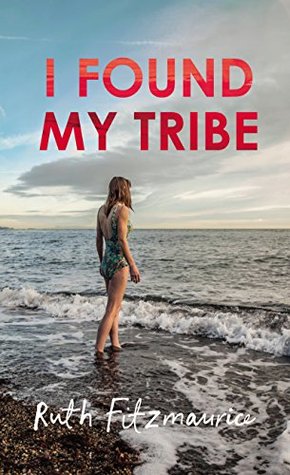 Often these are outdoor experiences: a last hurrah of a six-month holiday in Australia, running, and especially plunging into the Irish Sea with her “Tragic Wives’ Swimming Club” – a group that includes her friend Michelle, whose husband is also in a wheelchair after a motorbike crash, and her favorite of Simon’s nurses, Marian, who has a serious car accident.
Rather than a straight chronological narrative, this is a set of brief thematic essays with titles like “Dancing,” “Fear,” “Twins” and “Holidays.” Fitzmaurice’s story is one you piece together through vivid vignettes from her home life. Her prose is generally composed of short, simple phrases; as with Cathy Rentzenbrink’s The Last Act of Love, you can tell there is deep emotion pulsing under the measured sentences. With such huge questions in play – How much can one person take? What would losing one’s mind look like? – there’s no need for added drama, after all. Instead, the author turns to whimsy, toying with the superhero cliché for caregivers and wondering what magic might be at work in her situation.
I was particularly impressed by how Fitzmaurice holds the past and present in her mind, and by how she uses an outsider’s perspective to imagine herself out of her circumstances. At times she uses the third person for these visions of herself as a younger woman newly in love:
The young wife at her kitchen table knows about deep magic. But I know her future. Life is going to push and pull her like a wave. She doesn’t have a choice and neither do I. Come with me, dear girl, sit at my tablecloth. The journey is upon us and to survive it, you can’t just ride the wave, you have to become one. Can we do this? Let’s go. Becoming a wave just might be the deepest magic of them all.
There are so many poignant moments in this book: memories of their determinedly vegetarian wedding; pulling out all the stops for Simon’s fortieth birthday with customized art installations to brighten his view; leaving the marital bed – now a “hospital contraption” – after six years of MND being a part of their lives; a full moon swim with the Tragic Wives on her and Simon’s anniversary. But all the quiet, everyday stuff has power too, especially her interactions with her precocious children, who are confused about why Dadda is like this.
If I had one tiny complaint, it’s that Simon feels like something of a shadowy figure. In flashbacks we get a real sense of his forceful personality, but this new, silent Simon in the wheelchair is a mystery. Only once or twice does she record words he ‘says’ to her via his computer. Perhaps this is inevitable given how locked into himself he’s become. However, he was still capable of becoming the first person with MND to direct a feature film, on location in County Wicklow (My Name Is Emily). He has told his own story elsewhere; in his wife’s telling, their ventures now seem so separate that they rarely appear as equal partners.
It’s my tenth wedding anniversary tomorrow; as I was reading this I kept thinking that, for as much as I complain (to myself) about how hard marriage is, I’ve had it so easy. The stresses a couple face when caregiving of one partner is involved are immense. Fitzmaurice has found herself part of a tribe she probably never wanted to join: the walking wounded, with pain behind their eyes and worry never far from their minds. But in the midst of it she’s also found the band of family and friends who help her pull through each time. Her lovely book – wry, wise, and realistic – will strike a chord with anyone who has faced illness and family tragedy.
My rating:
I Found My Tribe is published in the UK today, July 6th, by Chatto & Windus. My thanks to the publisher for the review copy.
Note: Fitzmaurice got her book deal on the strength of a series of pieces she wrote for the Irish Times. You can read an extract from the book here. Film rights to her story have been sold to Element Pictures; more details are here. A documentary about Simon’s life, It’s Not Yet Dark, based on his memoir of the same title, has recently been released. For more information see here (this article also showcases multiple family photos).
Update: Simon Fitzmaurice died on October 26, 2017, aged 43.
The Best Books from the First Half of 2017
Believe it or not, but the year is almost half over already. A look back at the “Best of 2017” shelf I’ve started on Goodreads has revealed the eight releases that have stood out most clearly for me so far. All but one of these I have already featured on the blog in some way; links are provided. I’ve also included short excerpts from my reviews to show what makes each of these books so special.
 How to Be Human by Paula Cocozza: There’s something gently magical about the way the perspective occasionally shifts to give a fox’s backstory and impressions as a neologism-rich stream. As much as this is about a summer of enchantment and literal brushes with urban wildlife, it’s also about a woman’s life: loneliness, the patterns we get stuck in, and those unlooked-for experiences that might just liberate us. Cocozza sets up such intriguing contradictions between the domestic and the savage, the humdrum and the unpredictable.
 Swimming Lessons by Claire Fuller: This isn’t a happy family story. It’s full of betrayals and sadness, of failures to connect and communicate. Yet it’s beautifully written, with all its scenes and dialogue just right, and it’s pulsing with emotion. One theme is how there can be different interpretations of the same events even within a small family. The novel is particularly strong on atmosphere, reminding me of Iris Murdoch’s The Sea, The Sea and Diane Setterfield’s The Thirteenth Tale. Fuller also manages her complex structure very well.
 In Every Moment We Are Still Alive by Tom Malmquist: Malmquist does an extraordinary job of depicting his protagonist’s bewilderment at the sudden loss of his partner and his new life as a single father. While it’s being marketed as a novel, this reads more like a stylized memoir. Similar to Karl Ove Knausgaard’s books, it features the author as the central character and narrator, and the story of grief it tells is a highly personal one. This is a book I fully expect to see on next year’s Wellcome Book Prize shortlist.
 My Life with Bob by Pamela Paul: I’ve found a new favorite bibliomemoir. Whether she was hoarding castoffs from her bookstore job, obsessing about ticking off everything in the Norton Anthology, despairing that she’d run out of reading material in a remote yurt in China, or fretting that her new husband took a fundamentally different approach to the works of Thomas Mann, Paul (editor of the New York Times Book Review) always looks beyond the books themselves to ask what they say about her. Just the sort of book I wish I had written.
 My Jewish Year by Abigail Pogrebin: This bighearted, open-minded book strikes me as a perfect model for how any person of faith should engage with their tradition: not just offering lip service and grudgingly showing up to a few services a year, but knowing what you believe and practice, and why. From September 2014 to September 2015, Pogrebin celebrated all the holidays in the Jewish calendar. I was consistently impressed by how she draws thematic connections and locates the resonance of religious ritual in her daily life.
 The Bright Hour by Nina Riggs: Beautiful prose enhances this literary and philosophical approach to terminal cancer. Riggs was a great-great-great-granddaughter of Ralph Waldo Emerson, and she quotes from her ancestor’s essays as well as from Michel de Montaigne’s philosophy of life to put things in perspective. She’s an expert at capturing the moments that make life alternately euphoric and unbearable – sometimes both at once. A wonderful book, so wry and honest, with a voice that reminds me of Anne Lamott and Elizabeth McCracken.
 Fragile Lives by Stephen Westaby: This is a vivid, compassionate set of stories culled from the author’s long career in heart surgery. Westaby conveys a keen sense of the adrenaline rush a surgeon gets while operating with the Grim Reaper looking on. I am not a little envious of all that he has achieved: not just saving the occasional life despite his high-mortality field – as if that weren’t enough – but also pioneering various artificial heart solutions and a tracheal bypass tube that’s named after him.
 The Animators by Kayla Rae Whitaker: Though it seems lighthearted on the surface, there’s a lot of meat to this story of the long friendship between two female animators. The cartooning world and the Kentucky–New York City dichotomy together feel like a brand new setting for a literary tragicomedy. I appreciated how Whitaker contrasts the women’s public and private personas and imagines their professional legacy. Plus I love a good road trip narrative, and this novel has two.
And here’s five more 4.5- or 5-star books that I read this year but were not published in 2017:
Days Without End by Sebastian Barry
Homegoing by Yaa Gyasi
When Breath Becomes Air by Paul Kalanithi
The Wind-Up Bird Chronicle by Haruki Murakami
To Say Nothing of the Dog by Connie Willis
What are some of the best books you’ve read so far this year?
What 2017 releases do I need to catch up on right away?
First Encounter: Maggie Nelson
Maggie Nelson is the author of four volumes of poetry and five wide-ranging works of nonfiction that delve into the nature of violence and sexuality. From what I’d heard about her writing, I knew to expect an important and unconventional thinker with a distinctive, lyrical style. As of early June, Vintage has made some of her backlist, including The Red Parts: Autobiography of a Trial and Bluets, available for the first time in the UK.
I read The Red Parts for The Bookbag. Here’s an excerpt from my full review:
 Nelson’s aunt was murdered in Michigan in 1969. Thirty-five years later, just as Nelson had completed writing a poetry collection about her, the case was reopened when new DNA evidence emerged. Most authors would quickly zero in on the trial itself, giving a blow-by-blow of the lawyers’ questioning and witnesses’ statements. Although Nelson does document important developments in the month-long trial, and describes autopsy photographs in blunt detail, her account is much more diffuse than one might expect. Interspersed with Jane’s history are other dark memories: Nelson’s father’s sudden death, her sister’s wild years, aborted love affairs. The title phrase tangentially refers to the words of Jesus in the New Testament, traditionally printed in red, so it has a sort of dual meaning: this is a (futile) search for the gospel truth about her aunt’s death, and also a conscious dive into the parts of life that frighten us. This fluid, engrossing narrative is no ordinary true crime story, but a meditative reflection on loss and identity.
My rating: 
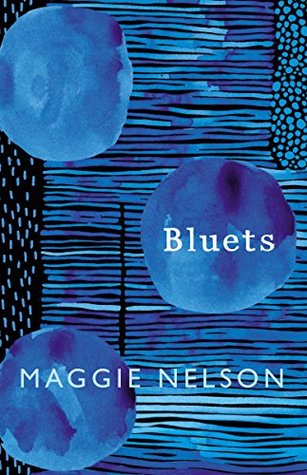 Bluets is a fragmentary record of Nelson’s arbitrary obsession with the color blue. It’s composed of 240 short numbered essays of about a paragraph each; some are just one or two sentences. At one point Nelson refers to these as “propositions,” but really they are more like metaphorical musings. Blue takes on so many meanings: with the connotation of “depressed”, it applies to her loneliness and sense of loss after the breakdown of a relationship (she continues addressing her former partner as “you” here) and a friend’s serious accident:
Loneliness is solitude with a problem. Can blue solve the problem, or can it at least keep me company within it?
Mostly I have felt myself becoming a servant of sadness. I am still looking for the beauty in that.
Then there’s blues music (Billie Holiday), seedy sex (“blue movies”), Joan Mitchell’s 1973 abstract painting Les Bluets, Novalis’ blue flower (which gives the title to a Penelope Fitzgerald novel), and so on. Nelson likens herself to a male bowerbird lining her nest with blue – sometimes literally, as with the collection of “blue amulets” that she keeps on a windowsill so sunlight can pass through the glass and illuminate the stones. I recalled that Sarah Perry lists Bluets as one inspiration for The Essex Serpent, in which the character Stella is fascinated with the color blue and keeps a similar trove of trinkets.
Bluets is a difficult work to characterize, but it seems closest in style to Jenny Offill’s Dept. of Speculation, which is also built on loosely linked aphorisms. The problem with books like these is that individual lines may stand out as profound but don’t contribute to an overall story line or argument. Moreover, Nelson’s forthrightness about sex, which edges towards crassness and feels out of place in this dreamily academic text, took me some getting used to.
Two more favorite lines:
I walked around Brooklyn and noticed that the faded periwinkle of the abandoned Mobil gas station on the corner was suddenly blooming.
If I were today on my deathbed, I would name my love of the color blue and making love with you as two of the sweetest sensations I knew on this earth.
My rating: 
Many thanks to Cat Mitchell of Penguin Random House for the free review copy.
The Red Parts was the more straightforward and satisfying read of this pair, but Bluets is certainly an original and artful bedside book. I would certainly read more by Nelson; I’m particularly interested in The Argonauts (2015), a memoir about forming her unconventional family – her partner, Harry Dodge, is transgender.
Have you read anything by Maggie Nelson? Do her books appeal?
Four Recommended June Releases
Here are four enjoyable books due out next month that I was lucky enough to read in advance. The first is the sophomore novel from an author whose work I’ve enjoyed before, the second is a highly anticipated memoir from an author new to me, and the third and fourth – both among my favorite books of 2017 so far – strike me as 2018 Wellcome Book Prize hopefuls: one is a highly autobiographical novel about bereavement, and the other is a courageous memoir about facing terminal cancer. I’ve pulled 250-word extracts from my full reviews and hope you’ll be tempted by one or more of these.
The Gypsy Moth Summer by Julia Fierro
(Coming from St. Martin’s Press on June 6th)
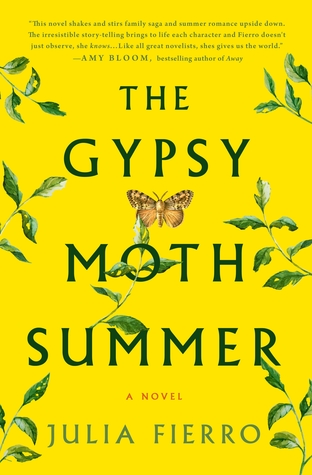 It’s the summer of 1992 and a plague of gypsy moth caterpillars has hit Avalon Island, a community built around Grudder Aviation. The creatures are just one of many threats to this would-be fairy tale world. For Maddie Pencott LaRosa, it’s no simple Sweet Sixteen time of testing out drugs and sex at parties. Her grandfather, Grudder’s president, is back in town with her grandmother, Veronica, and they’re eager to hide the fact that he’s losing his marbles. Also recently returned is Leslie Day Marshall, daughter of the previous Grudder president; she’s inherited “The Castle” and shocked everyone with the family she brought back: Jules, an African-American landscape architect, and their two mixed-race children.
Depending on when you were born, you might not think of the 1990s as “history,” but this novel does what the best historical fiction does: expertly evoke a time period. Moving between the perspectives of six major characters, the novel captures all the promise and peril of life, especially for those who love the ‘wrong’ people. I especially loved small meetings of worlds, like Maddie and Veronica getting together for tea and Oprah.
My main criticism would be that there is a lot going on here – racism, domestic violence, alcohol and prescription drug abuse, cancer, teen sex (a whole lotta sex in general) – and that can make things feel melodramatic. But in general I loved the atmosphere: a sultry summer of Gatsby-esque glittering parties and garden mazes, a time dripping with secrets, sex and caterpillar poop.


[It felt like I kept seeing references to gypsy moths in the run-up to reading this book, like a passage from Amy Poehler’s Yes Please, and a random secondhand book I spotted in Hay-on-Wye (though in that case it’s actually the name of a ship and is a record of a sea voyage).]
Read-alike: The Seed Collectors by Scarlett Thomas
My rating:
Hunger: A Memoir of (My) Body by Roxane Gay
(Coming from HarperCollins on June 13th [USA] and from Corsair on August 3rd [UK])
 I’d never read anything by Roxane Gay before, but somehow already knew the basics of her story: the daughter of Haitian immigrants to the American Midwest, she was gang raped at age 12, and to some extent everything she’s done and become since then has been influenced by that one horrific experience. Not least her compulsive overeating: “I ate and ate and ate to build my body into a fortress,”she writes. At her heaviest Gay was super morbidly obese according to her BMI, a term that “frames fat people like we are the walking dead.”
Though presented as a memoir, this is more like a collection of short autobiographical essays (88 of them, in six sections). The portions that could together be dubbed her life story take up about a third of the book, and the rest is riffs around a cluster of related topics: weight, diet, exercise and body image. The writing style is matter-of-fact (e.g. “My body is a cage of my own making”), which means she never comes across as self-pitying. I appreciate how she holds opposing notions in tension: she doesn’t know how she developed such an “unruly” body; she knows exactly how it happened.
The structure of the book made it a little repetitive for me, but I think what Gay has written will be of tremendous value, not just to rape victims or those whose BMI is classed as obese, but to anyone who has struggled with body image – so pretty much everyone, especially women.
Read-alike: I Know Why the Caged Bird Sings by Maya Angelou
My rating:
In Every Moment We Are Still Alive by Tom Malmquist
(Coming on from Sceptre on June 1st [UK] and from Melville House on February 6, 2018 [USA])
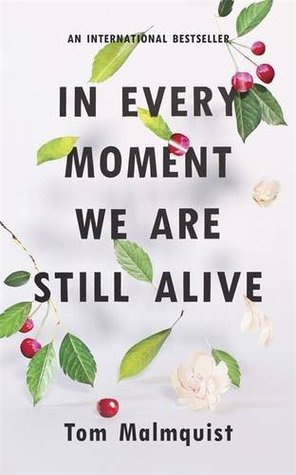 In this autobiographical novel from a Swedish poet, Tom faces the loss of his partner and his father in quick succession. The novel opens in medias res at Söder hospital, where Tom’s long-time girlfriend, Karin, has been rushed for breathing problems. Doctors initially suspect pneumonia or a blood clot, but a huge increase in her white blood cells confirms leukemia. This might seem manageable if it weren’t for Karin, 33, being pregnant with their first child. The next morning she’s transferred to another hospital for a Cesarean section and, before he can catch his breath, Tom is effectively a single parent to Livia, delivered six weeks early.
Malmquist does an extraordinary job of depicting Tom’s bewilderment. He records word for word what busy doctors and jobsworth nurses have to say, but because there are no speech marks their monologues merge with Tom’s thoughts, conversations and descriptions of the disorienting hospital atmosphere to produce a seamless narrative of frightened confusion. There is an especially effective contrast set up between Karin’s frantic emergency room treatment and the peaceful neonatal ward where Livia is being cared for.
While it’s being marketed as a novel, this reads more like a stylized memoir. Similar to Karl Ove Knausgaard’s books, it features the author as the central character and narrator, and the story of grief it tells is a highly personal one.With its frank look at medical crises, this is a book I fully expect to see on next year’s Wellcome Book Prize shortlist.
Read-alike: Mend the Living by Maylis de Kerangal
My rating: 
The Bright Hour: A Memoir of Living and Dying by Nina Riggs
(Coming on June 6th from Simon & Schuster [USA] and from Text Publishing on August 3rd [UK])
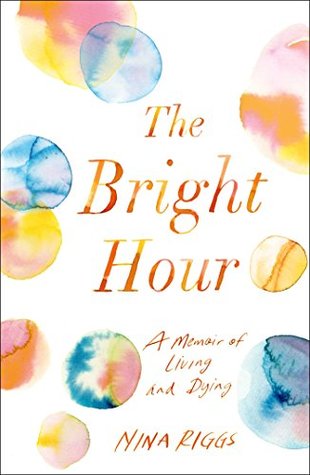 You’re going to hear a lot about this one. It’s been likened to When Breath Becomes Air, an apt comparison given the beauty of the prose and the literary and philosophical approach to terminal cancer. It’s a wonderful book, so wry and honest, with a voice that reminds me of Anne Lamott and Elizabeth McCracken.
It started with a tiny spot of cancer in the breast. “No one dies from one small spot,” Nina Riggs and her husband told themselves. Until it wasn’t just a spot but a larger tumor that required a mastectomy. And then there was the severe back pain that alerted them to metastases in her spine, and later in her lungs. Riggs was a great-great-great-granddaughter of Ralph Waldo Emerson, and she quotes from her ancestor’s essays as well as from Michel de Montaigne’s philosophy of life to put things in perspective.
Riggs started out as a poet, and you can tell. She’s an expert at capturing the moments that make life alternately euphoric and unbearable – sometimes both at once. Usually these moments are experienced with family: her tough mother, who died after nine years with multiple myeloma, providing her with a kind of “morbid test drive” for her own death; and her husband and their two precocious sons. Whether she’s choosing an expensive couch, bringing home a puppy, or surprising her sons with a trip to Universal Studios, she’s always engaged in life. You never get a sense of resignation or despair.
Some of my favorite lines:
“inside the MRI machine, where it sounded like hostile aliens had formed a punk band”
“my pubic hair all falls out at once in the shower and shows up like a drowned muskrat in the drain.”
“My wig smells toxic and makes me feel like a bank robber. But maybe it is just a cloak for riding out into suspicious country.”
“‘Merry Christmas,’ says a nurse who is measuring my urine into a jug in the bathroom. ‘Do you want some pain meds? Do you want another stool softener?’”
(Nina Riggs died at age 39 on February 23, 2017.)
Read-alike: A Series of Catastrophes and Miracles by Mary Elizabeth Williams
My rating: 
 Bookish Beck = Rebecca Foster. American transplant to England. Freelance proofreader and book reviewer.
 Bookish Beck