Madness Is Better than Defeat by Ned Beauman
I’ve been a Ned Beauman fan ever since I read his debut, Boxer, Beetle, in 2011. Born in 1985, the Londoner is now the author of four novels and was named one of Granta’s 20 best British novelists under the age of 40. His books are madcap and complex; three out of four have historical settings (all broadly in the World War II era), but this is definitely not historical fiction as we know it. If I tell you that some common elements in his work are Nazis, pharmaceuticals and gay sex, and that his first two books reminded me most of Nick Harkaway, you’ll get some idea of the niche he’s working in.
 Madness Is Better than Defeat takes its title from a line in Orson Welles’s never-filmed screenplay of Heart of Darkness. We open in 1959 with Zonulet, a 43-year-old alcoholic CIA officer, writing a tell-all memoir about what happened when two parties set out to find a Mayan temple in Honduras in 1938. Sadistic business magnate Elias Coehorn, Sr. sent his feckless son, Elias Jr., to dismantle the temple and bring it back to New York City, while Arnold Spindler, chairman of Kingdom Pictures, tasked Jervis Whelt with directing a movie on location at the temple: Hearts in Darkness, a comedy about a spoiled society boy who’s sent on an archaeological dig to a Mayan temple and opens a nightclub when he gets there.
The scene is set for a clash of cultures: the New York faction bent on destruction versus the Los Angeles crew intent on creation. They’re joined by Joan Burlingame, a stuffy Cambridge anthropologist, and Leland Trimble, a gossip journalist who was formerly Zonulet’s colleague at the New York Evening Mirror. To start with the screwball plot is uncannily similar to that of Hearts in Darkness itself, and it seems the stalemate between the two groups will be mined purely for comic potential. But as the years pass and the deadlock continues, this becomes more of a psychological study of a community in isolation, rather like The Lord of the Flies or T.C. Boyle’s The Terranauts.
Alliances are formed and broken based on blackmail over the characters’ past and present indiscretions; routines and workarounds are developed (though an attempt to recreate Bloody Marys and Eggs Benedict fails); soon a whole new generation is being raised with little knowledge of what’s happened outside this jungle for more than a decade; all they have to go on is false information about the outcome of World War II conveyed by an ex-Nazi.
They spoke in American accents and they had all been taught a sort of eschatology in which they would one day return with their parents to Hollywood or New York. But they belonged to the rainforest and to the temple. And the geometry of the latter … was so primal to them that any talk of disassembly or reassembly struck them as abstract, almost paradoxical.
One of the hardest things to believe about the story line – so you’ll simply have to suspend your disbelief – is that no one was overly concerned when these two groups failed to reappear after assignments that were meant to last only a matter of weeks. Not until Zonulet gets to Honduras in 1956 to learn more about a secret CIA guerrilla training camp in the area is there sustained interest in what became of these exiled Americans, and it’s another two years before their jungle idyll comes to an explosive end.
What we have here is a twist on the Mummy’s Curse trope, with the temple causing many to lose their minds or their lives. I wish the novel could have retained its initial screwball charm without going quite so dark and strange, but that’s Beauman for you. I also thought that this was a good 100–150 pages too long, with many more secondary characters, subplots and asides than necessary. Ironically, even after nearly 500 pages, its conclusion left me wondering about some loose ends. But the writing is consistently amusing, particularly the voices captured in letters or diaries and the wacky metaphors:
- “The sky in the west was mixing an Old-Fashioned”
- “All her blood had thickened in her head like the last of the catsup”
- “They were so slathered in mulch that their two bodies together might have been some octopod newly burped from a mudpot.”
- “To describe the truck as temperamental would have been condescending; rather, I had the impression it had been earnestly wrestling with a deep crisis of personal faith about the very principle of internal combustion as a motive power.”
If you’re new to Ned Beauman, I’d suggest starting with The Teleportation Accident, my favorite of his novels. From there you could move on to Boxer, Beetle or Glow; this one can wait until you’re a confirmed admirer.
My rating: 
Madness Is Better than Defeat is published in the UK today, August 24th, by Sceptre and will be available in the USA in February. With thanks to Ruby Mitchell for the free review copy.
The Booker Dark Horse: Elmet by Fiona Mozley
The dark horse in this year’s Man Booker Prize race is Elmet, a brilliant, twisted fable about the clash of the land-owning and serf classes in contemporary England. I’d love to see this win the Booker, or make the shortlist at the very least. You’d hardly believe it’s a debut novel, or that it’s by a 29-year-old PhD candidate in medieval history. The epigraph from Ted Hughes defines “Elmet” as an ancient Celtic kingdom encompassing what is now West Yorkshire. The word still appears in a few Yorkshire place names today. Metaphorically, Hughes notes, the region was a “‘badlands’, a sanctuary for refugees from the law.” That’s an apt setting for Mozley’s central characters: a family living on the edge of poverty and respectability – off-grid and not quite legal.
 Daniel and Cathy Oliver – 14 and 15, respectively – live with their father, John Smythe, in a simple house he built with his own hands in a copse. They mostly eat whatever they can hunt. Daddy is a renowned pugilist not above beating people up when they owe his friends money. Feisty Cathy is bullied by boys at school; when teachers don’t believe her, she has no choice but to hit back. There’s a strong us-against-the-world ethos to the novel, but underneath that defensiveness there’s a sense of unease: Daniel, the narrator, isn’t a fighter like his father and sister. He’s a sensitive soul who’s happiest cooking and playing with his dogs.
Like the reader, Daniel watches in grim fascination as Mr. Price, a powerful local landlord, starts issuing threats. Price warns Daddy that his family is trespassing. If they don’t leave he’ll make life difficult for them. A group of tenants, many of them just out of prison and barely getting by, bands together to take revenge on Price, planning to withhold rent and farm labor until conditions improve. No longer will they accept £20 payments for 10-hour work days. At first it seems their fight for rights might be successful, but Price and his goons retrench. Things come to a head when Price promises to sign their plot of land over to Daniel – if Daddy agrees to call off the strike and fight one last climactic match in the woods.
The final 70 pages of Elmet blew me away: a crescendo of fateful violence that reaches Shakespearean proportions. This knocks all those Hogarth remakes (which generally, with the exception of Hag-Seed, adhere too slavishly to the plots and so fail to channel the spirit) into a cocked hat. Though oddly similar to two other novels on the Booker longlist that unearth disturbing doings in a superficially pastoral England – Reservoir 13 by Jon McGregor and Autumn by Ali Smith – Elmet achieves the better balance between lush nature writing and Hardyesque pessimism. Mozley’s countryside is no idyll but a fallen edgeland:
And if the hare was made of myths then so too was the land at which she scratched. Now pocked with clutches of trees, once the whole county had been woodland and the ghosts of the ancient forest could be marked when the wind blew. The soil was alive with ruptured stories that cascaded and rotted then found form once more and pushed up through the undergrowth and back into our lives.
The characters usually speak in Yorkshire dialect, but where many authors would render the definite article as “t’,” Mozley simply elides it. For instance, here’s John shaking his head over the injustice of land ownership:
It’s idea a person can write summat on a bit of paper about a piece of land that lives and breathes, and changes and quakes and floods and dries, and that that person can use it as he will, or not at all, and that he can keep others off it, all because of a piece of paper. That’s part which means nowt to me.
The author is not entirely consistent with the transcription of dialect, though, and sometimes her use of spoken language is off: too ornate to be believable in certain characters’ mouths, like Cathy or a man who comes to the door to deliver bad news late on. These are such minor lapses of authorial control that I barely think them worth mentioning, but take it as proof that Mozley will only get better in the years to come. This is a gorgeous, timeless tale of the determination to overcome helplessness by facing down those who might harm the body but cannot destroy the spirit.
My rating: 
Elmet was published in the UK by JM Originals on August 10th. With thanks to Yassine Belkacemi and Katherine Burdon at John Murray Press for the free review copy.
Blog Tour: The Floating Theatre by Martha Conway (Review & Excerpt)
The Floating Theatre, Martha Conway’s fourth novel, opens with a bang – literally. April 1838: twenty-two-year-old seamstress May Bedloe and her cousin, the actress Comfort Vertue, are on the St. Louis-bound steamboat Moselle when its boilers explode (a real-life disaster) and they must evacuate posthaste. Afterwards Comfort accepts a new role giving abolitionist speeches; May takes her sewing skills on board Captain Hugo Cushing’s Floating Theatre, where she will be a Jill of all trades: repairing costumes, printing tickets, publicizing the show in towns along the Ohio River where they moor for performances, and so on.
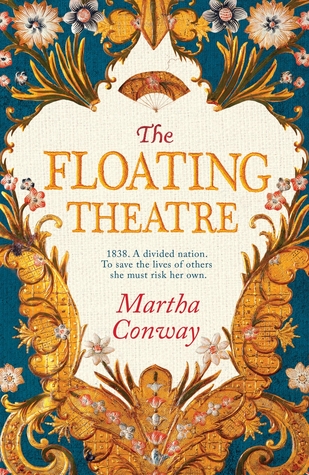 Conway gives a vivid sense of nineteenth-century theater life, both off-stage and on-, including just the right amount of historical detail so you can picture everything that’s going on. May is a delightfully no-nonsense narrator – she’d probably be diagnosed with Asperger’s nowadays for her literal approach and her initial inability to lie – and she’s supported by a wonderfully Dickensian cast of actors and crew members. The gripping plot takes on a serious dimension as May, too, gets drawn into the abolition movement: soon she’s helping to deliver runaway slaves from one side of the river to freedom on the other.
In America this was published as The Underground River, more clearly advertising its Underground Railroad theme. As it happens, I prefer this to Colson Whitehead’s The Underground Railroad, a novel to which it will inevitably be compared. (For one thing, Conway has a much more nuanced slave catcher character.) This is terrific historical fiction I can heartily recommend.
My rating: 
The Floating Theatre was released in the UK by Zaffre, an imprint of Bonnier Publishing, on June 15th. My thanks to Imogen Sebba for the free copy for review.
An exclusive extract from The Floating Theatre:
Two figures were standing on the lower deck at the stern of the boat. One of them might have been Hugo, but as I got closer I saw that the other one was certainly not Helena—it was Thaddeus Mason, eating popcorn from a red-and-white striped bag.
“What ho, May!” Thaddeus called out when he saw me, as if he were practicing for a nautical part. I noticed he no longer wore his arm in a sling. The other man turned as I came up the gangplank; like Thaddeus, he wore his hair long, but his coloring was darker and he was half a head taller. There was a band of black crepe around his straw hat, and his shirtsleeves were rolled up past his elbows. Thaddeus introduced me.
“Captain Hugo Cushing,” the man said in a British accent, touching his hat.
“May and I were on the Moselle together,” Thaddeus told him—was that to be his introduction for me from now on? But he went on to say that Hugo’s sister Helena had been on the Moselle, too. “Do you remember the singer at dinner? Helena Cushing, of Hugo and Helena’s Floating Theatre?” Thaddeus took off his hat. “Sadly, she was not as fortunate as we were.”
I looked at Hugo and tried to think of something kind to say. I remembered the singer in her pink dress with the light shining behind her.
“The captain let her on to perform,” Hugo said. “We often made a few extra dollars this way. She was going to get off at the stop after Fulton. I was just pushing off to meet up with her there when the sky broke up with the explosion.”
“Oh,” I said. “That is—that’s very bad…” I trailed off awkwardly, but Thaddeus came in with a string of platitudes, which he spoke with great conviction and aplomb—a terrible disaster, an immense misfortune, the captain was a dastardly fellow.
“Where do you go?” I asked Hugo when Thaddeus finished. “Or do you stay here?”
He looked at me blankly.
“On this boat. Your theatre. Where do you perform?”
“Oh, well then, down along the Ohio, of course. We dock at a different town every day, put on a show, and then the next morning pull up and head for the next town. We go all the way to the Mississippi playing towns until the weather turns. Then we get pushed back up the river—I hire a steamer.” I could see that his boat, a flatboat, had no steam power of its own. “Fourth year at it,” he told me. “My sister and I put it all together. But now…” He made a gesture which I took to understand that for him, like me, his old partnership was over.
“And if that weren’t enough, his boat was damaged by the explosion,” Thaddeus added. “The captain was just telling me. Part of the Moselle’s paddle box shot in like a cannonball.”
“Even worse, my leather boat pump got punctured,” Hugo said. “Don’t know how I’m going to fix it, and a new one costs twenty dollars more than I have.”
“How much does a new one cost?” I asked.
He looked at me as if I were a fool. “Twenty dollars.”
“Where is your company?” Thaddeus asked him. “Maybe you could take up a collection.”
“They skittered off into town. Probably drinking their way into even more uselessness. Damn actors. Excuse me,” he said, but I wasn’t sure he meant the apology for me since he was looking out at the river. I wasn’t offended in any case. I had seen actors humiliate themselves in a variety of ways over the years.
I was delighted to be asked to participate in the blog tour for The Floating Theatre. See below for details of where other reviews and features have appeared.

Some Accidental Thematic Overlaps in My Recent Reading
Five of the books I’ve read recently (most of them while traveling to and from the States) have shared an overarching theme of loss, with mental illness, alcoholism, suicide, and dogs as subsidiary topics running through two or more of them. I hadn’t deliberately chosen these books for their commonalities, so it was uncanny to see the same elements keep popping up. I wanted to come up with some kind of impressively complex Venn diagram to show off these unexpected connections but couldn’t quite manage it, so you’ll have to imagine it instead.
Mental Illness
The Archivist by Martha Cooley
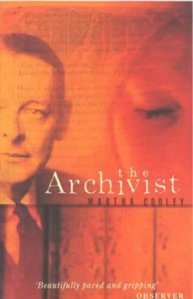 Matthias Lane is the archivist of the Mason Room, a university collection of rare books and literary papers. One of its treasures is a set of letters that passed between T.S. Eliot and his friend Emily Hale (held at Princeton in real life). Matt is haunted by memories of his late wife, Judith, a poet incarcerated in a mental hospital for over five years. A reckoning comes for Matt when he’s approached by Roberta Spire, a graduate student determined to view the Eliot–Hale letters even though they’re legally sealed until 2020. The more time Matt spends with Roberta, the more similarities start to arise between her and Judith; and between his situation and Eliot’s when the latter also put his wife away in a mental hospital. The novel asks what we owe the dead: whether we conform to their wishes or make our own decisions.
The Summer without Men by Siri Hustvedt
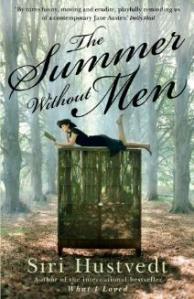 Thirty years on, poet Mia Fredricksen’s husband Boris asks her for a pause in their marriage so he can explore his feelings for his young French lab assistant. First things first: Mia goes crazy and ends up in a mental hospital for a short time. But then she sucks it up and goes back to her Minnesota hometown to teach poetry writing to teen girls for a summer, getting sucked into a bullying drama. This is a capable if not groundbreaking story of the shifts that occur in a long marriage and the strange things we all do as we face down the possibility of death. There are also wry comments about the unappreciated talents of the female artist. However, compared to the other two novels I’ve read from Hustvedt, this seemed feeble. Still, a quick and enjoyable enough read.
The Dogs of Babel by Carolyn Parkhurst
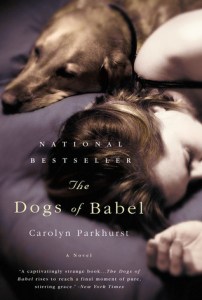 A delicious debut novel intellectual enough to bypass labels like ‘women’s fiction’ and ‘mystery’. One thing that sets it apart is how successfully Parkhurst writes from the perspective of a male narrator, Paul Iverson, who’s been knocked for six by the sudden death of his wife Lexy, a mask designer. While he was at the university where he teaches linguistics, she climbed to the top of the apple tree in their backyard and – what? fell? or jumped? The only ‘witness’ was their Rhodesian Ridgeback, Lorelei; in his grief Paul uses his sabbatical to research efforts to teach dogs to communicate, hoping one day Lorelei might tell all. Woven through are scenes from Paul and Lexy’s courtship and marriage; though Lexy occasionally struggled with her mental health, their dialogue is fun and zippy, like you might hear on The Gilmore Girls.
Suicide
The Archivist by Martha Cooley & The Dogs of Babel by Carolyn Parkhurst


Alcoholism
Don’t Let’s Go to the Dogs Tonight by Alexandra Fuller
 A classic memoir that conjures up all the sights, sounds, smells and feelings of Africa on the cusp of a colonial to postcolonial transition. Fuller’s family were struggling tobacco and cattle farmers in Rhodesia (Zimbabwe), Malawi and Zambia. She had absorbed the notion that white people were there to benevolently shepherd the natives, but came to question it when she met Africans for herself. While giving a sense of the continent’s political shifts, she mostly focuses on her own family: the four-person circus that was Bobo (that’s her), Van (older sister Vanessa), Dad, and Mum (an occasionally hospitalized manic-depressive alcoholic who lost three children) – not to mention an ever-changing menagerie of horses, dogs and other pets. This really takes you away to another place and time, as the best memoirs do, and the plentiful black-and-white photos are a great addition.
Let’s Take the Long Way Home by Gail Caldwell
 If you loved Ann Patchett’s Truth and Beauty, pick this up immediately. It’s a similar story of best friends: one who dies and one who survives. Caldwell’s best friend was Caroline Knapp (author of Drinking: A Love Story, among other nonfiction), whom she met via puppy ownership in Cambridge, Massachusetts. They were both single and childless, full-time authors with a history of alcoholism. Besides long walks with their dogs, they loved swimming and rowing together. In 2002 Caroline was diagnosed with stage-four lung cancer, inoperable and already metastasized. Despite all their proactive optimism, she was dead a matter of weeks later. In this moving and accessible short memoir, Caldwell drifts through her past, their friendship, Caroline’s illness, and the years of grief that followed the loss of Caroline and then her beloved Samoyed, Clementine, sharing what she learned about bereavement.
Dogs
The Dogs of Babel, Don’t Let’s Go to the Dogs Tonight & Let’s Take the Long Way Home


Do you ever find coincidental thematic connections in your reading?
Am I a (Book) Hoarder?
When I was a kid my parents and sister deemed me a pack rat, and over the years I’ve been a collector of many different things: stamps, coins, figurines, tea sets, shells, fossils, feathers, anything featuring puffins or llamas, and so on. At this point my only active collection is of books, but the others are all still in evidence in my old closet. I had a few good reasons to contemplate my belongings recently: first, I read a book about decluttering; then, on my recent trip back to the States, I helped my sister pack as she prepares to move out of her home of 12 years, and co-hosted a yard sale at my parents’ house to get rid of some of ye olde stuff.
Year of No Clutter, Eve O. Schaub
 Schaub faces the possibility that she has inherited a family tendency to hoarding and tackles her house’s clutter-filled “Hell Room.” From one February to the next she enlisted her daughters’ help sorting things into piles and came up with a regular route of consignment shops, thrift stores, and libraries where she could drop off carloads of donations. Bigger projects included a photo book of 100 of her daughter’s artworks and a rag rug incorporating many beloved articles of clothing.
I enjoyed the nitty-gritty details of how this family organized and got rid of things because I like big tidying projects and putting everything in its rightful place, whether that be the recycling bin, a crate in the attic, or a charity bag. But what I most appreciated was how sensitive Schaub is to all the issues that can be tied up with our stuff, especially OCD, nostalgia, and indecision. “Although Marie Kondo disapproves, I’m not about to stop collecting my own life,” she writes. “It has been a source of pleasure for me ever since I can remember; it helps define me.”
Helping Out
My sister is very much of the Marie Kondo school of de-cluttering. She strives for minimalism in her décor, and is constantly going back through her sons’ clothes and toys to see what she can get rid of. All the same, 12 years of living in the same house has spelled a lot of accumulation. As she did her last-minute wedding preparations in early August, I was let loose on the packing and soon got all the easy stuff – like books and decorations – boxed up. But I quickly became overwhelmed by what remained, such as the boys’ toy room, DIY supplies, and stacks upon stacks of framed art and photographs plus photo albums.

Nephew #2 “helps” with packing.
As I was packing I couldn’t keep myself from peeking into the albums and tearfully marvelling that the whole life she built with her first husband – who died of brain cancer in January 2015 – is over. Death is so simple and final, right? Yet even these many months later I have a hard time getting my head around how the huge personality and web of connections that was my brother-in-law could be gone. And this even though I couldn’t be happier that my sister has found love again and gained two terrific step-kids.
When she and her husband move into their new-build home later in the year and get all this stuff back out of storage, she’s going to have quite the job sorting through everything and deciding what of her old life to keep on display, or keep at all. How to honor the years that are gone without having them intrude on the new family that she’s made?
Making It Personal
Mementoes, including travel souvenirs and special cards and letters I’ve received, are particularly hard for me to cull. There are four or five sizable boxes full of mementoes in my closet in the States, and another couple in our attic here. Getting rid of correspondence just feels wrong to me; I’ve probably rarely deleted a personal e-mail in the last 20 years. It’s like I need that physical proof of the relationships and events that have meant the most to me.
I’m much less sentimental when it comes to most other objects. The yard sale my mom and I had last weekend was a great opportunity to get rid of things that had been sitting around for a decade or more and were just never going to join me in the UK, including lamps, cushions, a clock, a CD player, a jewelry box, a formal dress, a shoe rack, and various figurines and framed prints. I only made $37, and a lot remained to be picked up the Salvation Army (including a whole box of VHS films I found at the bottom of the closet), but it was good to shed some stuff – and I at least earned enough to cover my book and maple syrup shopping on this trip!


Now, even though there are 25–30 (smallish) boxes of books remaining in that closet, I can definitively say that I’m not as much of a book hoarder as I once was – back in high school, say. On this trip I went back through all of the boxes to consolidate them and pulled out another 50+ books to give away or resell on a future visit. I looked back with fondness through three boxes of books from my childhood, but then promptly handed them over to my mom to share with my nephews or give away, as she chooses.


Back in the UK, I keep on top of my book collection by considering carefully every time I read a book whether I want to keep it: Is it a favorite? Will I read it again, refer to it or lend it to others? If not, I might give it away to a friend, check the resale prices on Amazon, WeBuyBooks or Ziffit, or donate it to a charity shop. This keeps the review copies from piling up, and means that my shelves are always full but generally not overfull.
Are you brutal or sentimental when it comes to books and other possessions? When’s the last time you had a big clear-out?
Books in Brief: Five I Loved Recently
Feminist social history, visits with the world’s bees, a novel about a peculiar child and his reclusive writer mother, witty notes on Englishness, and tips on surviving heartbreak: five very different books, but I hope one or more of them is something that you’d enjoy.
Flâneuse: Women Walk the City in Paris, New York, Tokyo, Venice and London
By Lauren Elkin
 Raised in New York and now a Paris resident, Lauren Elkin has always felt at home in cities. Here she traces how women writers and artists have made the world’s great cities their own, blending memoir, social history and literary criticism. In a neat example of form flowing from content, the book meanders from city to city and figure to figure. My interest waned during later chapters on protesting (‘taking to the streets’) and the films of Agnès Varda. However, especially when she’s musing on Martha Gellhorn’s rootlessness, Elkin captures the angst of being a woman caught between places and purposes in a way that expatriates like myself will appreciate. It’s in making the history of the flâneuse personal that Elkin opens her book up to a wider swathe of readers than just the feminist social historians and literary critics who might seem like her natural audience. I would particularly recommend this to readers of Rebecca Solnit and Olivia Laing. (See my full review at The Bookbag.)
My rating:
Bee Quest: In Search of Rare Bees
By Dave Goulson
 Goulson grows more like Bill Bryson and Gerald Durrell with each book. Although the topic of this, his third nature book (all of them are broadly about insects), is probably of least personal interest to me, there are plenty of wonderful asides and pieces of trivia that make it worth journeying along with him from Poland to Ecuador in the search for rare bees. For as close-up as his view often is, he also sees the big picture of environmental degradation and species loss. I learned some fairly dismaying facts: gold mining is extremely destructive to the environment, producing 20 tons of toxic material per ring; and it takes five liters of water to produce one almond in California. As for a more hopeful statistic: the billions of dollars it would take to set up conservation efforts for all the world’s species would still only equate to cutting world Coke consumption by 20%. It’s all a matter of priorities.
A favorite line:
“As is often the case in entomology, in the end it all comes down to the genitals.”
My rating:
Be Frank with Me
By Julia Claiborne Johnson
 Alice, a young publishing assistant, is sent from New York City to Los Angeles to encourage one-hit wonder and Harper Lee type M.M. Banning to produce her long-delayed second novel. But when she arrives she discovers her most pressing duty is keeping an eye on Mimi’s oddball son, nine-year-old Frank. I doubt you’ve ever met a character quite like Frank. (I appreciated how, although he is clearly on what would be termed the autistic spectrum, Johnson avoids naming his condition.) Alice narrates the whole book in the first person. She finds herself caught in a four-person battle of wits – Alice, Mimi, Frank, and “itinerant male role model” Xander – inside Mimi’s big glass-fronted fishbowl of a house. There were a couple moments when I wondered where this madcap plot could be going. In particular, we have to wait a long time to find out whether Mimi is actually going to deliver another book. But the payout is worth waiting for. (See my full review at The Bookbag.)
My rating:
How to Be an Alien
By George Mikes
 (The first volume in the How to Be a Brit omnibus; originally published in 1946.) You can draw a straight line from this through Bill Bryson’s Notes from a Small Island to the “Very British Problems” phenomenon. Mikes (that’s “mee-cash” – he was a Hungarian journalist who accidentally moved to England permanently when he was sent to London as a correspondent just before World War II) made humorous observations that have, in general, aged well. The mini-essays on tea, weather, and queuing struck me as particularly apt. I’d heard this line before, though I can’t remember where: “An Englishman, even if he is alone, forms an orderly queue of one.”
Another favorite passage:
“It is all right to have central heating in an English home, except the bath room, because that is the only place where you are naked and wet at the same time, and you must give British germs a fair chance.” [This reminds me of when my mother made her first trip to England in 2004 to visit me during my study abroad year; in her family newsletter reporting on the experience, one of her key observations was, “British bathrooms are antiquated.” My husband and I still quote this to each other regularly.]
My rating:
A Manual for Heartache
By Cathy Rentzenbrink
 This is a follow-up to Rentzenbrink’s memoir, The Last Act of Love, which was about the accident that left her brother in a vegetative state for eight years and the legal battle she and her parents fought to be able to end his life. The first quarter of this book contains fairly generic advice for people who have been through family tragedy, illness or some other hardship. It’s when Rentzenbrink makes things personal, talking about her own struggles with PTSD and depression and strategies that have helped her over the years, that the book improves, and it maintains a pretty high standard therafter. Although you wouldn’t really call anything in here groundbreaking, it’s a slim and accessible volume that I could see being helpful for anyone who’s grieving, even someone who’s not usually a reader or has a short attention span. (I won a copy in a Goodreads giveaway.)
A couple favorite passages:
“Experiencing grief for the first time is like the dark twin of falling in love. It feels a bit crazy, and we don’t think anyone has ever felt exactly as we do. But of course they have.”
“We don’t need to be unbroken. Our first step is simply to stop trying to hide our scars. Heartache is human.”
My rating:
Have you read any of these? Which one takes your fancy?
Doorstopper of the Month: Theft by Finding by David Sedaris
I’ve read six of David Sedaris’s humorous collections of personal essays. A college friend first recommended him to me in 2011, and I started with When You Are Engulfed in Flames – which I still think is his best book, though Me Talk Pretty One Day is also very good. Sedaris can be riotously funny, and witty and bittersweet the rest of the time. From Raleigh, North Carolina, he has lived in New York, London, Paris, Normandy and Tokyo. Many of his essays stem from minor incidents in his travels. His kooky Greek-American family members and longsuffering partner, Hugh Hamrick, are his stock characters, and his pieces delight in cultural and linguistic misunderstandings and human obstinacy versus openheartedness.
When I heard Sedaris was publishing his selected diaries, I wasn’t sure I’d read them. I knew many of his essays grow out of episodes recorded in the diary, so would the entries end up seeming redundant? I’d pretty much convinced myself that I was going to give Theft by Finding a miss – until I won a proof copy in a Goodreads giveaway. This is the first volume, covering 1977 to 2002; a second volume from 2003 onwards is planned.
 What I most liked about this book is the sense you get of the sweep of the author’s life: from living in his North Carolina hometown and doing odd construction jobs, hitchhiking and taking drugs to producing plays, going on book tours and jetting between Paris and New York City, via an interlude in Chicago (where he attended art school and taught writing). Major world events occasionally make it in – the Three Mile Island disaster, Princess Diana’s death, the Bush/Gore election, 9/11 – but for the most part this is about daily nonevents. It’s a bit of a shock to come across a serious moment, like his mother’s sudden death in 1991.
One thing that remains constant is Sedaris’s fascination with people’s quirks. For instance, nearly every night for nine years he visited his local IHOP for coffee, cigarettes and people-watching. He seems to meet an inordinately large number of homeless, hard-up and crazy types; perhaps, thanks to his own years-long penury (October 6, 1981: “I’ve paid my rent and my phone bill, leaving me with 43 cents”) and addictions (he didn’t quit alcohol and marijuana until 1999), he feels a certain connection with down-and-outs.
By the last few years of the diary, though, he’s having dinners with Mavis Gallant, Susan Sontag, and Merchant & Ivory. This isn’t obnoxious name-dropping, though; I appreciated how Sedaris maintains a kind of bemused surprise about his success rather than developing a feeling of entitlement. He acts almost guilty about his wealth and multiple properties (“I’ve fallen deeper into the luxury pit”). Time spent abroad keeps him humble about his linguistic abilities and gives him a healthy measure of doubt about the American lifestyle; I especially liked his reaction to a Missouri Walmart.
The problem with the book, though, is that the early entries are really quite dull. Things picked up a bit by the early 1980s, but it wasn’t until the late 1990s that I realized I was actually finding the entries laugh-out-loud funny like I expect from Sedaris. The book as a whole is too long and inclusive; Simon Cowell would surely call it indulgent. I tried to imagine what would have resulted if an outsider had reduced the complete diaries to a one-volume selection. A cast list and photographs of Sedaris and his family over the years would also be helpful; I’d be interested to know if any supplementary material was added to the final product that did not appear in my proof.
Ultimately I think this is only for the most die-hard of Sedaris fans. I will certainly read the second volume as I expect it to be funnier and better written overall. But if – as appears to be the case from the marketing slogans in my proof – the publishers are hoping this will introduce Sedaris to new readers, I think they’ll be let down. If you’ve not encountered him before, I suggest picking up Me Talk Pretty One Day or trying one of his radio programs.
Some favorite passages:
October 26, 1985; Chicago: In the park I bought dope. There was a bench nearby, so I sat down for a while and took in the perfect fall day. Then I came home and carved the word failure into a pumpkin.
October 5, 1992; New York: The new Pakistani cashier at the Grand Union is named Dollop.
October 5, 1997; New York: Making it worse, I had to sit through another endless preview for Titanic. Who do they think is going to see that movie?
June 18, 1999; Paris: Today I saw a one-armed dwarf carrying a skateboard. It’s been ninety days since I’ve had a drink.
October 3, 1999; Paris: I said to the clerk, in French, “Hello. Sometimes my clothes are wrinkled. I bought a machine anti-wrinkle, and now I search a table. Have you such a table?” The fellow said, “An ironing board?” “Exactly!”
My rating: 
Have you read (or heard) anything by David Sedaris? Are you a fan?
A Recommendation for August
Each month I aim to preview two to four books to be released in the next month that I have already read and can recommend. It’s looking thin on the ground for August because two of my most anticipated reads of the year were disappointments, and another August release I left unfinished; I give mini write-ups of these below. However, I’ve very much enjoyed What It Means When a Man Falls from the Sky, the debut story collection by Lesley Nneka Arimah, which came out in America in April but releases on the 24th over here; I’ll be reviewing it for Shiny New Books shortly. Also, I’m 20% into The Education of a Coroner by John Bateson (releases August 15th), a fascinating set of sometimes gory true crime case studies.
As for the one August book I’m currently able to wholeheartedly recommend, that is…
The Futilitarians: Our Year of Thinking, Drinking, Grieving, and Reading by Anne Gisleson
(Coming from Little, Brown and Company on the 22nd)
 One for angsty, bookish types. In 2012 Anne Gisleson, a New Orleans-based creative writing teacher, her husband, sister and some friends formed an Existential Crisis Reading Group (which, for the record, I think would have been a better title). Each month they got together to discuss their lives and their set readings – both expected and off-beat selections, everything from Kafka and Tolstoy to Kingsley Amis and Clarice Lispector – over wine and snacks.
One of their texts, Arthur Koestler’s The Act of Creation, proposed the helpful notion of the Trivial and Tragic Planes. The Trivial is where we live everyday; the Tragic is where we’re transported when something awful happens. Gisleson had plenty of experience with the latter: not just the suicides of her younger twin sisters, a year and a half apart, and her father’s death from leukemia, but also the collective loss of Hurricane Katrina. She returns again and again to these sources of grief in her monthly chapters structured around the book group meetings, elegantly interweaving family stories and literary criticism.
I found the long quotes from the readings a little much – you probably shouldn’t pick this up if you haven’t the least interest in philosophy and aren’t much troubled by life’s big questions – but in general this is a fascinating, personal look at what makes life worth living when it might be shattered any second. I particularly loved the chapter in which the book club members creatively re-enact the Stations of the Cross for Easter and the sections about her father’s pro bono work as an attorney for death row inmates at Angola prison. Sometimes it really is a matter of life and death.
Favorite passage:
“Generations of parents have put their children to bed in this house and even if I haven’t quite figured out the why and the how of living, others have found reasons to keep moving things forward. In quiet moments I can feel the collective push of these ghost-hands on my back, nudging me on.”
My rating:
And now for the ones I’m closer to lukewarm on…
(Reviews in the order in which I read the books.)
Mrs. Fletcher by Tom Perrotta
(Coming from Scribner on the 1st)
 I enjoy Tom Perrotta’s novels: they’re funny, snappy, current and relatable; it’s no surprise they make great movies. I’ve somehow read seven of his nine books now, without even realizing it. Mrs. Fletcher is more of the same satire on suburban angst, but with an extra layer of raunchiness that struck me as unnecessary. It seemed something like a sexual box-ticking exercise. But for all the deliberately edgy content, this book isn’t really doing anything very groundbreaking; it’s the same old story of temptations and bad decisions, but with everything basically going back to a state of normality by the end. If you haven’t read any Perrotta before and are interested in giving his work a try, let me steer you towards Little Children instead. That’s his best book by far.
My rating: 
Sour Heart by Jenny Zhang
(Coming from Lenny Books on the 1st [USA] and Bloomsbury Circus on the 10th [UK])
 I read “We Love You Crispina” (13%), about the string of awful hovels a family of Chinese immigrants is forced to move between in early 1990s New York City. You’d think it would be unbearably sad reading about cockroaches and shared mattresses and her father’s mistress, but Zhang’s deadpan litanies are actually very funny: “After Woodside we moved to another floor, this time in my mom’s cousin’s friend’s sister’s apartment in Ocean Hill that would have been perfect except for the nights when rats ran over our faces while we were sleeping and even on the nights they didn’t, we were still being charged twice the cost of a shitty motel.” Perhaps I’m out of practice in reading short story collections, but after I finished this first story I felt absolutely no need to move on to the rest of the book.
My rating:
Forest Dark by Nicole Krauss
(Coming on the 24th from Harper [USA] and Bloomsbury [UK])
 Impressive in scope and structure, but rather frustrating. If you’re hoping for another History of Love, you’re likely to come away disappointed: while that book touched the heart; this one is mostly cerebral. Metafiction, the Kabbalah, and some alternative history featuring Kafka are a few of the major elements, so think about whether those topics attract or repel you. Looking a bit deeper, this is a book about Jewish self-invention and reinvention. Now, when I read a novel with a dual narrative, especially when the two strands share a partial setting – here, the Tel Aviv Hilton – I fully expect them to meet up at some point. In Forest Dark that never happens. At least, I don’t think so.* I sometimes found “Nicole” (the author character) insufferably clever and inward-gazing. All told, there’s a lot to think about here: more questions than answers, really. Interesting, for sure, but not the return to form I’d hoped for.
*Hop over to my Goodreads review to read the marked spoilers and chip in with comments!
My rating:
What August books do you have on the docket?
Have you already read any that you can recommend?
Catching Up on Prize Winners: Alderman, Grossman & Whitehead
Sometimes I love a prize winner and cheer the judges’ ruling; other times I shake my head and puzzle over how they could possibly think this was the best the year had to offer. I’m late to the party for these three recent prize-winning novels. I’m also a party pooper, I guess, because I didn’t particularly like or dislike a one of them. (Reviews are in the order in which I read the books. My rating for all three = )
A Horse Walks into a Bar by David Grossman
(Winner of the Man Booker International Prize)
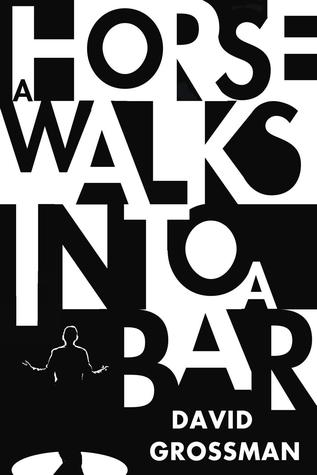 “Why the long face? Did someone die? It’s only stand-up comedy!” Except that for the comedian himself, Dovaleh Greenstein, this swan song of a show in the Israeli town of Netanya devolves into the story of the most traumatic day of his life. Grossman has made what seems to me an unusual choice of narrator: Avishai Lazar, a widower and Supreme Court justice, and Dov’s acquaintance from adolescence – they were in the same military training camp. Dov has invited him here to bear witness, and by the end we know Avishai will produce a written account of the evening.
Although it could be said that Avishai’s asides about the past, and about the increasingly restive crowd in the club, give us a rest from Dov’s claustrophobic monologue, in doing so they break the spell. This would be more hard-hitting as a play or a short story composed entirely of speech; in one of those formats, Dov’s story might keep you spellbound through a single sitting. Instead, I found that I had to force myself to read even five or 10 pages at a time. There’s no doubt Grossman can weave a clever tale about loss, and there are actually some quite funny jokes in here too, but overall I found this significantly less powerful than the author’s previous work, Falling Out of Time.
The Underground Railroad by Colson Whitehead
(Winner of the Pulitzer Prize, National Book Award and Arthur C. Clarke Award; longlisted for the Man Booker Prize)
 Following Cora on her fraught journey from her Georgia plantation through the Carolinas and Tennessee to Indiana is enjoyable enough, with the requisite atrocities like lynchings and rapes thrown in to make sure it’s not just a picaresque cat-and-mouse battle between her and Arnold Ridgeway, the villainous slavecatcher. But I’m surprised that such a case has been made for the uniqueness of this novel based on a simple tweak of the historical record: Whitehead imagines the Underground Railroad as an actual subterranean transport system. This makes less of a difference than you might expect; if anything, it renders the danger Cora faces more abstract. The same might be said for the anachronistic combination of enlightened and harsh societies she passes through: by telescoping out to show the range of threats African-Americans faced between the Civil War and the 1930s, the novel loses immediacy.
Ultimately, I felt little attachment to Cora and had to force myself to keep plodding through her story. My favorite parts were little asides giving other characters’ backstories. There’s no doubt Whitehead can shape a plot and dot in apt metaphors (I particularly liked “Ajarry died in the cotton, the bolls bobbing around her like whitecaps on the brute ocean”). However, I kept thinking, Haven’t I read this story before? (Beloved, Ruby, The Diary of Anne Frank; seen on screen in Twelve Years a Slave, Roots and the like.) This is certainly capably written, but doesn’t stand out for me compared to Homegoing, which was altogether more affecting.
The Power by Naomi Alderman
(Winner of the [Bailey’s] Women’s Prize)
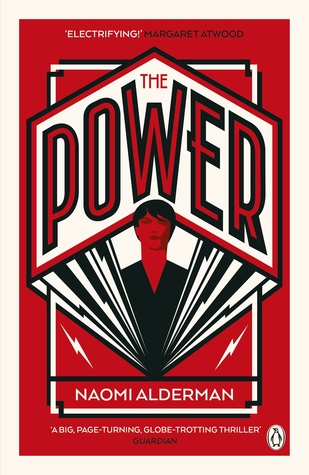 I read the first ~120 pages and skimmed the rest. Alderman imagines a parallel world in which young women realize they wield electrostatic power that can maim or kill. In an Arab Spring-type movement, they start to take back power from their oppressive societies. You’ll cheer as women caught up in sex trafficking fight back and take over. The movement is led by Allie, an abused child who starts by getting revenge on her foster father and then takes her message worldwide, becoming known as Mother Eve.
Alderman has cleverly set this up as an anthropological treatise-cum-historical novel authored by “Neil Adam Armon” (an anagram of her own name), complete with documents and drawings of artifacts. “The power to hurt is a kind of wealth,” and in this situation of gender reversal women gradually turn despotic. They are soldiers and dictators; they inflict genital mutilation and rape on men.
I enjoyed the passages mimicking the Bible, but felt a lack of connection with the characters and didn’t get a sense of years passing even though this is spread over about a decade. This is most like Margaret Atwood’s MaddAddam trilogy – Alderman’s debt to Atwood is explicit, in the dedication as well as the acknowledgments – so if you really like those books, by all means read this one. My usual response to such speculative fiction, though, even if it describes a believable situation, is: what’s the point? As with “Erewhon,” the best story in Helen Simpson’s collection Cockfosters, the points about gender roles are fairly obvious.
I’d be interested to hear if you’ve read any of these books – or plan to read them – and believe they were worthy prize winners. If so, set me straight!
Britain’s Bounty: Land of Plenty by Charlie Pye-Smith
Charlie Pye-Smith is a farming and environmental commentator with many previous titles to his name. To research this survey of modern food production, he spent a year traveling around the British countryside in a motor home, interviewing farmers and manufacturers and learning how things are likely to change when Brexit takes effect. In the face of surpluses and falling profits, he suggests that in the future farmers will need to diversify. Questioning received wisdom, he also proposes that animal welfare might be more achievable in larger-scale operations and that environmentally friendly techniques like crop rotation might actually lead to higher yields.
 Many of the farms the author visits have survived due to their adaptability. For instance, the Belchers of Leicestershire found they could double their profits if they processed their cattle, pigs and lambs themselves and sold the meat at farmer’s markets. Likewise, the Blands, dairy farmers in Cumbria, branched out after they lost their whole herd to foot-and-mouth disease in 2001: Now they produce ice cream from their Jersey cows and run a successful tea room. On the other hand, specializing in a heritage product can also be an effective strategy. In Yorkshire, the author meets farmers who have been raising sheep locally for centuries. “It’s all about eating the view … linking Swaledale sheep to a beautiful upland landscape. Eat our lamb and you’re helping to protect the Dales,” is the message.
Pye-Smith also looks into pig welfare and plowing techniques for cereal crops. In a chapter on fruit, he tells the recent story of apples and strawberries through cider and jam production, respectively. A section on vegetables centers on potatoes. I learned a number of facts that surprised me:
- Over half Britain’s potatoes are turned into crisps and chips
- “Outdoor-reared” pork is not necessarily the ideal because cold, wet winters are tough on piglets and sows
- Cider coming into fashion over the last 10–15 years is largely thanks to Magners’ advertising campaigns
- Nowadays the average Briton spends just 10% of their income on food, as opposed to 33% in the 1950s.
The book strikes an appropriate balance between the cutting-edge and the traditional, and between caution and optimism. Although Brexit will lead to a total loss of farmers’ EU subsidies and a drop in the number of Eastern Europeans coming over to pick produce, there may be potential benefits too. As one large-scale vegetable farmer opines, “we should see Brexit as a great opportunity to promote home-grown food production.” I appreciated how open the author is to organic and conservation agriculture, but he also doesn’t present them as magical solutions. For the most part, I sensed no hidden agenda, though he is perhaps pro-grouse shooting and seems dismissive of city journalists like George Monbiot who claim to know better than the real countryside experts.
This is most like a condensed, British version of Michael Pollan’s The Omnivore’s Dilemma; Pye-Smith makes the same sort of investigations into food production methods, including tiny snippets from his own life along the way. Crucially, the book is readable throughout, never sinking into tedious statistics or jargon. The author’s black-and-white photographs, three to five per chapter, are a nice addition. In essence this is a collection of stories about a way of life that faces challenges but is not doomed. I was reassured to hear that people increasingly care about where their food comes from. Martin Thatcher of Thatchers cider says “People have become more discriminating. They are now much more interested in what they’re eating and drinking than they were in the past, and how it’s produced.” If you, too, are interested in how food gets to you in Britain, be sure to pick up this book.
My rating:
Land of Plenty is published today, July 27th, by Elliott & Thompson. Thanks to Alison Menzies for arranging my free copy for review.
 Bookish Beck = Rebecca Foster. American transplant to England. Freelance proofreader and book reviewer.
