Wellcome Book Prize Shortlist: Stay with Me by Ayobami Adebayo
“Women manufacture children and if you can’t you are just a man. Nobody should call you a woman.”
On balance, I’m glad that the Wellcome Book Prize shortlist reading forced me to go back and give Stay with Me another try. Last year I read the first 15% of this debut novel for a potential BookBrowse review but got bored with the voice and the story, rather unfairly dismissing it as a rip-off of Chimamanda Ngozi Adichie. I also doubted that the health theme was strong enough for it to make the Wellcome shortlist, but that’s because I hadn’t read far enough to realize just how many medical conditions come up for consideration: it’s not just infertility, but also false pregnancy, cot death (or SIDS), sickle cell disease, and impotence.
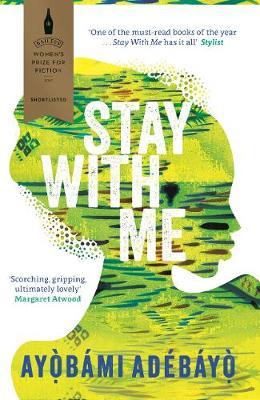 This time around I found Yejide a more sympathetic character. The words that open this review are cruel ones spoken by her mother-in-law. Her desperation to become and stay a mother drives her to extreme measures that also give a window onto indigenous religion in Nigeria: ‘breastfeeding’ a goat on the Mountain of Jaw-Dropping Miracles, and allowing an act of ritual scarification to prevent the return of an abiku, or spirit child (I’ve heard that one narrates Ben Okri’s Booker Prize-winning 1991 novel, The Famished Road).
Polygamy is another Nigerian custom addressed in the novel. Yejide’s husband, Akinyele Ajayi, allows himself to be talked into taking another wife, Funmilayo, when Yejide hasn’t produced a child after four years. There’s irony in the fact that polygyny is considered a valid route to pregnancy while polyandry is not, and traditional versus Western values are contrasted in the different generations’ reactions to polygamy: does it equate to adultery?
There are some welcome flashes of humor in the novel, such as when Yejide deliberately serves a soup made with three-day-old beans and Funmi gets explosive diarrhea. I also enjoyed the ladies’ gossip at Yejide’s hair salon. However, the story line tends towards the soap operatic, and well before halfway it starts to feel like just one thing after another: A lot happens, but to no apparent purpose. I was unconvinced by the choices the author made in terms of narration (split between Yejide and Akin, both in first person but with some second person address to each other) and structure (divided between 2008 and the main action starting in the 1980s). We see certain scenes from both spouses’ perspective, but that doubling doesn’t add anything to the overall picture. The writing is by turns maudlin (“each minute pregnant with hope, each second tremulous with tragedy”) and uncolloquial (“afraid that my touch might … careen him into the unknown”).
Things that at first seemed insignificant to me – the 1993 election results, what happens to Funmi, the one major scene set in 2008 – do eventually take on more meaning, and there is a nice twist partway through as well as a lovely surprise at the end. I did feel the ache of the title phrase as it applies to this couple’s children and marriage, so threatened by “all the mess of love and life that only shows up as you go along.” It all makes for truly effortless reading that I gobbled up in chunks of 50 or 100 pages – which indicates authorial skill, of course – yet this seems to me a novel more interesting for the issues it addresses than for its story and writing.
My rating:
See also:
My gut feeling: I would be very surprised if a novel won two years in a row. While the medical situations examined here are fairly wrenching, Stay with Me isn’t strong enough to win. Its appearance on the shortlist (for the Women’s Prize, too) is honor enough, I think.
Shortlist strategy:
- I’m one-third through The Vaccine Race by Meredith Wadman but have started skimming because it’s dense and not quite as laymen-friendly as The Immortal Life of Henrietta Lacks and The Emperor of All Maladies, the two books its subject matter is most reminiscent of for me.
- On Friday I started To Be a Machine by Mark O’Connell, which I’m also one-third through and have taken away on our mini-holiday. This is the shortlisted book whose topic appealed to me the least, so I’m pleasantly surprised to be enjoying it so much. It helps that O’Connell comes at the science as an outsider – he’s a freelance writer with a literature background, and he’s interested in the deeper philosophical questions that transhumanism raises.
- I’m awaiting a review copy of Mayhem by Sigrid Rausing, which I’ll be featuring as part of the official Wellcome Book Prize shortlist blog tour.
Dubiously Thematic Easter Reading
In 2015 and 2017 I came up with some appropriately theological reading recommendations for Easter. This year I’m going for a more tongue-in-cheek approach, as befits the unfortunate conjunction of Easter with April Fools’ Day.
Currently reading or reviewing:
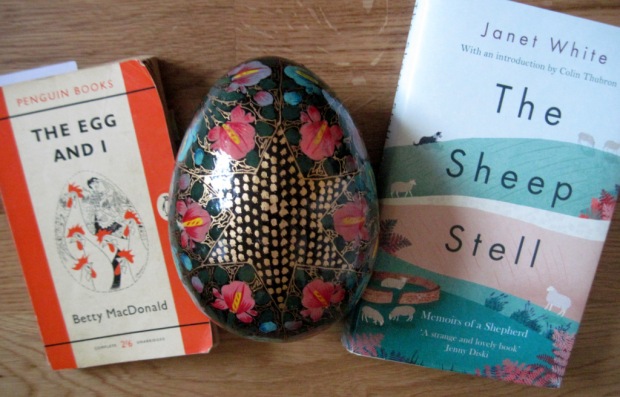
The Egg and I by Betty MacDonald
I bought this on a whim from a local charity shop, based on the title, cover and blurb. I’m about one-third of the way through so far. MacDonald and her husband started a chicken farm in a mountainous area of the Pacific Northwest in the 1940s. Her account of her failure to become the perfect farm wife is rather hilarious. My only hesitation is about her terrible snobbishness towards rednecks and “Indians.”


A representative passage: “Gathering eggs would be like one continual Easter morning if the hens would just be obliging and get off the nests. Co-operation, however, is not a chickenly characteristic and so at egg-gathering time every nest was overflowing with hen, feet planted, and a shoot-if-you-must-this-old-grey-head look in her eye.”
The Sheep Stell by Janet White
 I’m reviewing this reissued memoir for the TLS. It’s a delightful story of finding contentment in the countryside, whether on her own or with family. White, now in her eighties, has been a shepherd for six decades in the British Isles and in New Zealand. While there’s some darker material here about being stalked by a spurned suitor, the tone is mostly lighthearted. I’d recommend it to anyone who’s enjoyed books by Gerald Durrell, James Herriot and Doreen Tovey.
Representative passages: “Shepherding is a strange mixture of tremendous physical work alternating with periods of calm, quiet indolence.” & “A dare, a dream and a challenge. I could have hunted the whole world over and never in a lifetime found anywhere so right: warm, high, pastoral and severed by the sea.”
Read recently:
The Trouble with Goats and Sheep by Joanna Cannon
 Mrs. Creasy disappears one Monday in June 1976, and ten-year-old Grace Bennett and her friend Tilly are determined to figure out what happened. I have a weakness for precocious child detectives (from Harriet the Spy to Flavia de Luce), so I enjoyed Grace’s first-person sections, but it always feels like cheating to me when an author realizes they can’t reveal everything from a child’s perspective so add in third-person narration and flashbacks. These fill in the various neighbors’ sad stories and tell of a rather shocking act of vigilante justice they together undertook nine years ago.
Sheep are a metaphor here for herd behavior and a sense of belonging, but also for good versus evil. Grace and Tilly become obsessed with a Bible passage the vicar reads about Jesus separating the sheep from the goats. But how can he, or they, know who’s truly righteous? As Grace says, “I think that’s the trouble, it’s not always that easy to tell the difference.” It’s a simplistic message about acknowledging the complexity of other lives and situations rather than being judgmental, and matches the undemanding prose.
Reminiscent of Rachel Joyce, but not as good.
My rating:
Vita Nova by Louise Glück
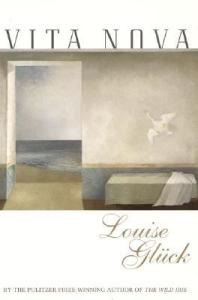 My first collection from the prolific Pulitzer winner. Some of the poems are built around self-interrogation, with a question and answer format; several reflect on the myth of Orpheus and Eurydice. The first and last poems are both entitled “Vita Nova,” while another in the middle is called “The New Life.” I enjoyed the language of spring in the first “Vita Nova” and in “The Nest,” but I was unconvinced by much of what Glück writes about love and self-knowledge, some of it very clichéd indeed, e.g. “I found the years of the climb upward / difficult, filled with anxiety” (from “Descent to the Valley”) and “My life took me many places, / many of them very dark” (from “The Mystery”).
Best lines about spring:
“The spring of the year; young men buying tickets for the ferryboats. / Laughter, because the air is full of apple blossoms.” (from “Vita Nova”)
“Spring / descended. Or should one say / rose? … yellow-green of forsythia, the Commons / planted with new grass— // the new / protected always” (from “Ellsworth Avenue”)
My rating:
Plucked off the shelf for their dubious thematic significance!

To Rise Again at a Decent Hour by Joshua Ferris
Animal, Vegetable, Miracle by Barbara Kingsolver
Wise Blood by Flannery O’Connor
So You’ve Been Publicly Shamed by Jon Ronson
The Resurrection of Joan Ashby by Cherise Wolas
Happy Easter to all those who mark it, and have a good week. I have a few review-based posts scheduled for while we’re in Wigtown, a trip I hope to report on next Monday, when I will also attempt to catch up on blogs and comments.
What to Look Out for in April
April will be a busy month on the blog what with four Wellcome Book Prize shortlist reviews plus posts on our shadow panel decision and the awards ceremony, three blog tours within a week, and various other review books jostling for my attention.

To be reviewed at any time.
April 5th seems to be a huge day for new releases. I own four print books that are all coming out on that day; alas, the only one I’ve been able to start is Elizabeth J. Church’s All the Beautiful Girls, for an upcoming Shiny New Books review. I’m approaching the one-quarter point. The others may well have to wait for a quieter time.
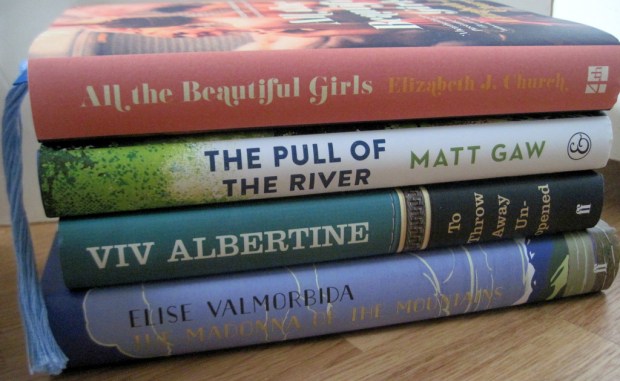
April 5th releases.
 I started another April 5th release on my Kindle a couple of weeks ago, Things Bright and Beautiful by Anbara Salam. It’s about a missionary couple whose lives are disrupted by the return of an older missionary. I was thinking of abandoning it until I got to the last line of the prologue, which threw in a pretty great twist. So maybe I’ll go back to it.
For now, I can recommend the one April 5th release I actually managed to finish:
Dear Mrs. Bird by A.J. Pearce
 If you loved The Guernsey Literary and Potato Peel Pie Society, I have just the book for you: another feel-good World War II-set novel with characters you’ll cheer for. December 1940, London: Twenty-two-year-old Emmeline Lake dreams of being a Lady War Correspondent, but for now she’ll start by typing up the letters submitted to Henrietta Bird’s advice column in Woman’s Friend. All too quickly, though, the job feels too small for Emmy. Mrs. Bird refuses to print letters on Unpleasant subjects, which could include anything from an inappropriate crush to anxiety. She thinks cowardly readers bring their troubles on themselves and need to buck up instead of looking to others for help. But Emmy can’t bear to throw hurting people’s missives away. Perhaps she could send some advice of her own?
Emmy shares a flat with her best friend Bunty, and they each have a fiancé who is part of the war effort. As a volunteer for the Fire Brigade, Emmy sees the effects of Luftwaffe bombings up close. But it’s only after heartache hits home for both of these young women that they really understand how much is at stake in the war. The novel got a little melodramatic for me in its last quarter, but it’s overall a charming “Keep Calm and Carry On” and Stick It to Hitler-style story that never strays far from jollity for too long.
Other readalikes: My Salinger Year by Joanna Rakoff and The Night Watch by Sarah Waters
Some favorite lines:
“I told myself we could all get blown up by tomorrow so we might just as well enjoy ourselves.”
“Granny didn’t spend half her life chaining herself to railings for today’s woman to moon around waiting for some chap to look after her.”
My rating:
 On Monday we’re off to Wigtown, Scotland’s Book Town, for five days. Though we’ve been to Hay-on-Wye, Wales six times, we’ve never been to Wigtown despite meaning to for years. When I read Shaun Bythell’s Wigtown bookselling memoir last autumn, it felt like a sign that it was time. Did you see his The Diary of a Bookseller has been described in French as le quotidien d’un libraire misanthrope écossais (literally, “the daily life of a misanthropic Scottish bookseller”)?
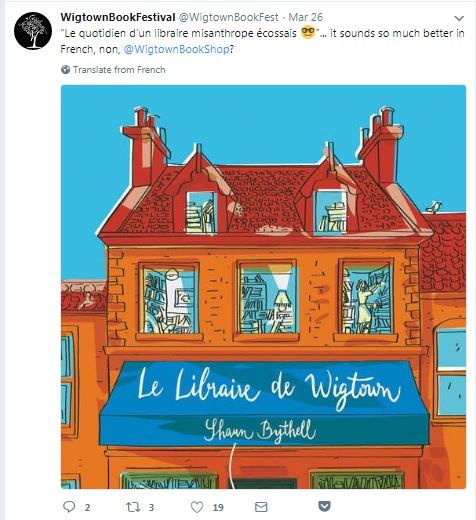
That’s too good! If only it were the official French title. I will of course be visiting his shop, and asking for a signature on my proof copy if I can pluck up the nerve. We’ll strive to be model customers lest we become the subject of a grumpy Tweet or Facebook post.
Coals to Newcastle and all that, but here’s the pile I’ve packed for Wigtown.
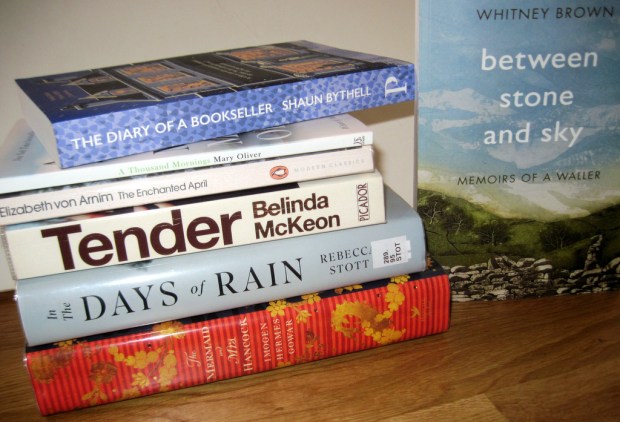
This is mostly for the six-hour car rides there and back. During the days we’ll be busy with outings to the surrounding countryside plus book shopping and café visits, but I daresay there will be some time for reading at the B&B in the afternoons and evenings.
For once I haven’t scoured my shelves for place-appropriate books; I don’t think I own any particularly Scottish reads, unless Michel Faber’s Under the Skin counts (ah wait, I also have an Ali Smith novel on the shelf).
Anyway, this time I’ve really just put together a pile of books I’ve been wanting to read for ages. The only ‘work’-related one is Between Stone and Sky, for a TLS review; otherwise I’m giving myself from Easter through the 6th off. I’m not even sure I’ll take my Kindle, except as a backup – that kind of thing could get you (or, rather, your Kindle) shot in this town. If I do, I’ll be sure to leave it behind in the B&B room or the glove box when we go into town for the day!
What are you up to in April?
Iris Murdoch Readalong: A Severed Head
A strange but very readable satire on who you’re supposed to love versus who you actually do. My sixth Murdoch novel, and a very good one for book clubs or for newcomers to start with, I think, given how much it tackles in its just over 200 pages.
Love Triangle
As in Under the Net, we have a male narrator; here it’s Martin Lynch-Gibbon, 41, a wine merchant’s son who’s writing a work of military history. He’s been married to Antonia, five years his senior, for 11 years now. Martin also has a mistress, 26-year-old Georgie Hands. The thrill of the illicit, of possessing both these appealing women, is too much to resist, but he has a sense of being on the cusp – his delicately balanced life is about to go up in flames.
Love Quadrilateral
Antonia gets home from her psychoanalysis appointment and appears to be acting strangely. She soon confesses to Martin that she’s madly in love with her therapist, Palmer Anderson, who is half-American and has been Martin’s friend for years. They amicably agree to part. Martin goes to talk with Palmer, who lays on the Freudian patter and convinces Martin that Antonia is more of a mother figure for him because of their age gap. It’s all very civilized.
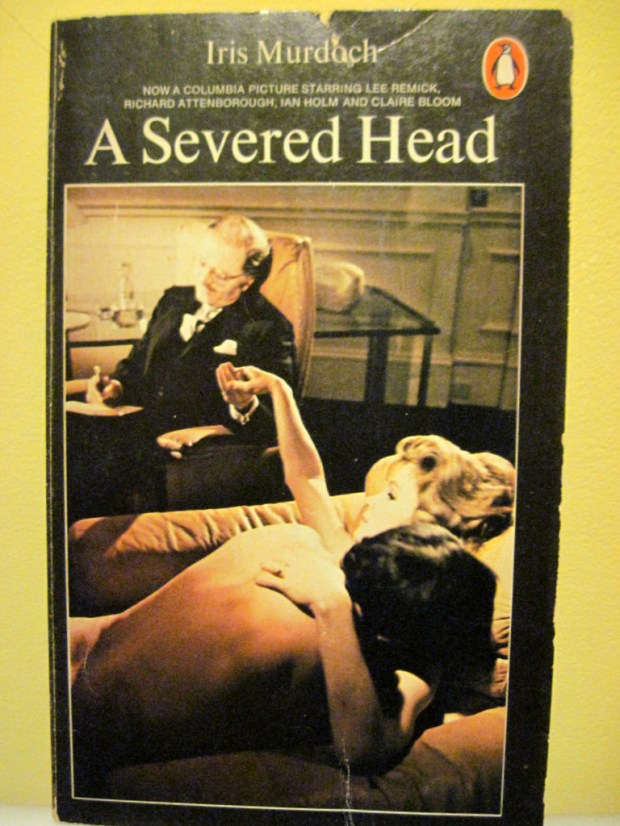
This awful cover image is a still from the 1970 film, presumably portraying Martin and Antonia in flagrante on Palmer’s therapy couch? Starring Lee Remick, Richard Attenborough and Ian Holm.
Love Hexagon?
We meet Martin’s brother Alexander and sister Rosemary when he goes to Rembers, the family estate in the Cotswolds, for the Christmas holidays. It seems Alexander’s always been somewhat in love with Antonia – he even sculpted her head. After lovely scenes of the snow seen from the train via Reading and a Christmas spent en famille, another player comes onto the scene: Palmer’s sister, Honor Klein, whom Martin picks up from Liverpool Street station. She’s cool and a bit domineering, and a dab hand with a samurai sword. Martin is smitten. But just wait until he goes to visit her in Cambridge…
As the members of this small group fall in and then out of love with each other, Murdoch explores any number of weighty ideas and themes. With a samurai sword around (as pictured on a couple of more recent Penguin covers), you have to wonder if, like Chekhov’s gun, it’s bound to be used in a violent way. At the very least it’s a phallic symbol, turning up in dreams along with blood, which itself is symbolized by the red wine so frequently consumed and sometimes spilled in the novel. I thought of the title as asking what happens when the mind and body become detached from each other and want different things. There are also plentiful references to ancient superstitions and taboos: the cuckold’s horns, the Oedipal impulse, and the rituals surrounding the oracular voice.
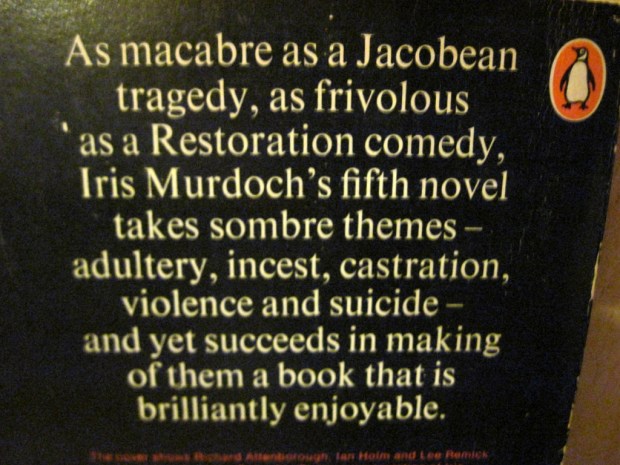
My back cover blurb. Sorry if you consider anything here a spoiler…
What with all the scenes of people bursting into a room and declaring their love for someone else now, and Martin moving his belongings back and forth, this is something like a comic play. It’s one of the few Murdoch novels to have been adapted for the theatre or cinema (it has also been a radio play), and you can see why: it has a theatrical, quick-moving story line, and Murdoch even deliberately references “actors in a play” and “the drama.” Martin’s sense of helplessness is also likened to feeling destined to play one role in life, whether he likes it or not. It’s a very visual novel, too, with objects (like the Audubon prints and the Meissen cockatoos decorating the Lynch-Gibbons’ place, or “we sat enlaced like a beautiful netsuke”) and colors taking on significance in a way that I’m sure must have influenced A.S. Byatt.
A couple of small things bothered me: the overkill in describing Honor’s features as Jewish, and the overall short shrift given to Georgie. But on the whole I really enjoyed this one, especially Martin’s three (increasingly informal and defensive) versions of the same apology letter, and the fact that Palmer almost always appears in his dressing gown. In one 2017 year-end recommendation for Sally Rooney’s Conversations with Friends, I saw it compared with A Severed Head, and I guess I can see why: the love quadrilateral, the blend of tragic and comic themes, and the perhaps recklessly optimistic ending. Both are well worth reading.
My favorite snippet of dialogue:
(Martin) “‘We’ve been happy. I want to go on being happy.’
‘Happy, yes,’ said Antonia. ‘But happiness is not the point. We aren’t getting anywhere. You know that as well as I do.’
‘One doesn’t have to get anywhere in a marriage. It’s not a public conveyance.’”
My rating:
I’m participating on and off in Liz Dexter’s two-year Iris Murdoch readalong project to get through some of the paperbacks I already own. See also her very interesting introductory post on A Severed Head. I have several more of the readalong books lined up for later in the year: The Italian Girl in June, The Nice and the Good in September, and An Accidental Man in December. Join us for one or more!
Have you read this or anything else by Iris Murdoch?
Reading Ireland Month 2018: Seamus Deane and Edna O’Brien
It’s my first time participating in Reading Ireland Month, run each March by Cathy of 746 Books and Niall of The Fluff is Raging. I enjoyed scouring my shelves for Irish reads – though in the end I only had time for two.

Reading in the Dark by Seamus Deane (1996)
I don’t recall how I first heard about this book, but its title was familiar to me when I picked it up for a matter of pence at a charity shop last year. When I saw it on Cathy’s recent list of her top five Irish books of all time, I knew I was in for something special. These vivid vignettes of childhood and young adulthood are so convincing that I could have been fooled into believing I was reading a memoir. Indeed, this debut novel has generally been interpreted as heavily autobiographical, with the anonymous narrator, the third of seven children born to Catholic parents in Derry, Northern Ireland, taken to be a stand-in for Deane.
 Ireland’s internecine violence is the sinister backdrop to this family’s everyday sorrows, including the death of a child and the mother’s shaky mental health. The narrator also learns a family secret from his dying maternal grandfather that at first thrills him – he knows something his father doesn’t! – but later serves to drive him away from his parents. The short chapters take place between 1945 and 1971: starting when the boy is five years old and encountering a household ghost on the stairs and ending as, in his early thirties, he lays his father to rest in the midst of the Troubles.
The Irish have such a knack for holding humor and tragedy up side by side – think John Boyne, James Joyce and Frank McCourt. The one force doesn’t negate the other, but the juxtaposition reminds you that life isn’t all gloom or laughs. There are some terrifically funny incidents in Reading in the Dark, like the individual sex ed. chat with Father Nugent (“And semen is the Latin for seed. Do you have to know Latin to do this?”) and going to investigate the rumor of a brothel by the football ground. But there is also perhaps the best ghost story I’ve ever read, an eerie tale of shape-shifting children he hears from his aunt.
This book captures all the magic, uncertainty and heartache of being a child, in crisp scenes I saw playing out in my mind. If I have one small, strange complaint, it’s that there’s too much plot – most of the chapters function perfectly well as stand-alone short stories, so, particularly in the last third, the growing obsession with the family secret feels like an unnecessary attempt to tie everything together. That plus the slight irrelevance of the title are the only reasons this misses out on 5 stars from me.
Still, I’d agree with Cathy: this is probably one of my favorite Irish reads, along with Boyne’s The Heart’s Invisible Furies, Mary Costello’s Academy Street, Anne Enright’s The Green Road, and Joyce’s A Portrait of the Artist as a Young Man. It’s no wonder Deane won so many prizes for this: the Irish Times International Fiction Prize, the Guardian Fiction Prize, and the Irish Literature Prize; he was also shortlisted for the 1996 Booker Prize.
Favorite lines:
“Child, she’d tell me, I think sometimes you’re possessed. Can’t you just let the past be the past?”
“He looked up at me, smiling, to say: ah well, it was all blood under the bridge now”
“Politics destroyed people’s lives in this place, he said. People were better not knowing some things”
My rating: 
Mother Ireland by Edna O’Brien (1976)
 This slim volume combines travel writing, history and memoir, with plentiful black and white photographs (by Fergus Bourke) along the way. Often, even where O’Brien is clearly drawing on autobiographical material, she resists saying “I”, instead opting for “one,” “you,” or “we.” I think she was aiming at the universalities of the Irish experience, but instead it ends up coming off as generic. That and a long opening chapter on Ireland’s history set me to skimming. (Also, the book is maddeningly underpunctuated, and the photos in particular seem very dated.) By far my favorite of the seven essays was the last, “Escape to England.” In just three pages, she explains what it’s like to start a new life in another country and how the experience allowed her to appreciate home all the more. Should I try O’Brien’s fiction?
Favorite lines:
“Irish people do not like to be contradicted. Foiled again and again[,] they have in them a rage that comes at you unawares like a briar jutting out of a hedge.”
“You are Irish[,] you say lightly, and allocated to you are the tendencies to be wild, wanton, drunk, superstitious, unreliable, backward, toadying and prone to fits, whereas you know that in fact a whole entourage of ghosts resides in you, ghosts with whom the inner rapport is as frequent, as perplexing, as defiant as with any of the living.”
My rating:
No time for these this year – maybe next year, if not sooner?

Library Checkout: March 2018
Last month I rejoiced that reservations would once again be free through my library system. On the very day the policy came into effect, what did I do? Went into the online catalogue and placed 15 reservations (the maximum). And then when some of those arrived for me, I placed more to get back up to 15. And then when some of those arrived… You get the picture. Why this compulsive placing of holds when I already have massive stacks of books to read? I have nothing to say in my defense. At least books are a benign addiction, right?
This month I also resumed using a library system I haven’t used in several years. I had a few hours to kill in Reading town center before a routine hospital appointment, so decided to take advantage of the library’s stock, which seems to be particularly good on memoirs by women.
So as not to overwhelm you, and because so many books are still hanging on from previous months, I’ll only feature the new to-be-read arrivals since last month’s Library Checkout post, and in photo form. As usual, I’ve added in star ratings and links to Goodreads reviews of books I haven’t already featured on the blog.
LIBRARY BOOKS READ
- Little Women by Louisa May Alcott (a re-read for me)
- Herzog by Saul Bellow
- Harmless Like You by Rowan Hisayo Buchanan
- Mean Time by Carol Ann Duffy [poetry]
- The Book of Forgotten Authors by Christopher Fowler
- Vita Nova by Louise Glück [poetry]
- Plot 29: A Memoir by Allan Jenkins
- This Is Going to Hurt: Secret Diaries of a Junior Doctor by Adam Kay
- There Is an Anger that Moves by Kei Miller [poetry]
- Somebody I Used to Know by Wendy Mitchell with Anna Wharton
- And When Did You Last See Your Father? by Blake Morrison

- Lots of Candles, Plenty of Cake by Anna Quindlen
- Spirals in Time: The Secret Life and Curious Afterlife of Seashells by Helen Scales
- Probably Nothing: A diary of not-your-average nine months by Matilda Tristram [graphic novel]
SKIMMED ONLY
- With the End in Mind: Dying, Death and Wisdom in an Age of Denial by Kathryn Mannix – I now own a copy that I will revisit for the Wellcome Book Prize shadow panel.
CURRENTLY READING
- To the Is-Land: An Autobiography by Janet Frame
- Life in the Garden by Penelope Lively
- Never Mind by Edward St. Aubyn
- The Vaccine Race by Meredith Wadman
- Island Home: A Landscape Memoir by Tim Winton
CHECKED OUT, TO BE READ


(Cut off in middle photo: Cold Earth by Sarah Moss and The Mermaid and Mrs. Hancock by Imogen Hermes Gowar)
IN THE RESERVATION QUEUE
- The Grave’s a Fine and Private Place by Alan Bradley
- The Wonder Down Under: A User’s Guide to the Vagina by Dr. Nina Brochmann and Ellen Støkken Dahl
- Anecdotal Evidence by Wendy Cope
- The Lie of the Land by Amanda Craig
- Take Courage: Anne Brontë and the Art of Life by Samantha Ellis
- The Woman in the Window by A.J. Finn
- Other Minds: The Octopus and the Evolution of Intelligent Life by Peter Godfrey-Smith
- Leap In: A Woman, Some Waves, and the Will to Swim by Alexandra Heminsley
- Morning: How to Make Time: A Manifesto by Allan Jenkins
- The Wood: The Life and Times of Cockshutt Wood by John Lewis-Stempel
- The Executor by Blake Morrison
- To Be a Machine: Adventures among Cyborgs, Utopians, Hackers, and the Futurists Solving the Modest Problem of Death by Mark O’Connell
- Brainstorm: Detective Stories from the World of Neurology by Suzanne O’Sullivan
- Into the Gray Zone: A Neuroscientist Explores the Border between Life and Death by Adrian Owen
- Home Fire by Kamila Shamsie
- Tin Man by Sarah Winman
- Not that Kind of Love by Clare Wise and Greg Wise
RETURNED UNREAD
- Testosterone Rex: Myths of Sex, Science, and Society by Cordelia Fine – I lost interest and have plenty of other medical-themed reads on the pile thanks to the Wellcome Book Prize shortlist.
RETURNED UNFINISHED
- The Secret Life of Cows by Rosamund Young – I read the first 33 pages out of 137. I had two problems with the book: the twee anthropomorphism (“almost every day, we see daughters consulting their mothers about impending confinements, or maybe just discussing the weather”), and the fact that the author, a family farmer, can be compassionate enough to call intensive animal-rearing “iniquitous criminality” yet raises animals and lovingly observes their behavior only to see them killed.
What have you been reading from your local libraries? Does anything appeal from my stacks?
Blog Tour: The Long Forgotten by David Whitehouse
Have you noticed how many botanical titles and covers are out there this year? If you appreciate this publishing trend as much as I do, and especially if you enjoyed Susan Orlean’s The Orchid Thief, I can highly recommend The Long Forgotten. David Whitehouse’s third novel features plant hunting everywhere from Chile to Namibia, but it opens underwater: Professor Jeremiah Cole is in a submersible 200 miles west of Perth, Australia. He’s running out of oxygen down there when he collides with a goose-beaked whale that pulls his craft to the surface. The injured whale soon dies, and when the professor’s crew brings its corpse on board to perform an autopsy, they discover in its belly the black box of Flight PS570, lost on its way from Jakarta to London 30 years ago and dubbed “The Long Forgotten.”
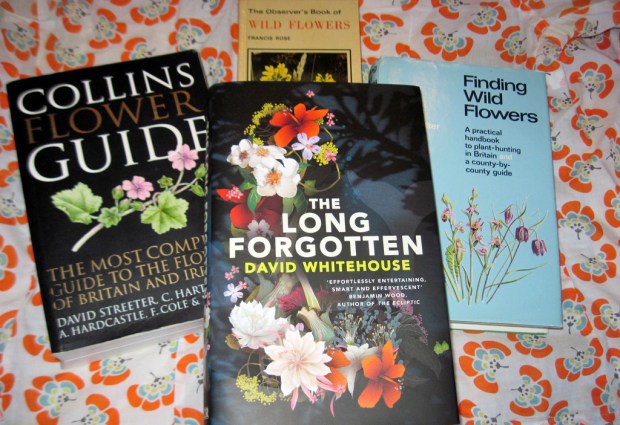
Whitehouse’s inspiration for the novel was the Malaysian Airlines flight that went missing in 2014, along with a story he read about the Rafflesia “corpse flower” 15 years ago. After the curious incident with the whale, more gentle magic is to come as we meet Dove, a lonely young man who works as an ambulance dispatcher in present-day London and starts tuning into the memories of Peter Manyweathers. In 1980s New York City, Peter gave up cleaning the houses of the dead to chase after the exotic plants mentioned in a love letter he found in an encyclopedia. Through a local botanical etching club he met Dr. Hens Berg, a memory researcher from Denmark, who encouraged him in the quest. Soon Peter was off to China and Gibraltar to find rare plants under a washing machine or along a steep cliff face. Along the way he fell in love and had to decide whom to trust and what was of most value to him.
How Peter and Dove are connected is a mystery whose unspooling is a continual surprise. I found it quite unusual that this novel ends with the plane crash; I can think of books that start with one, like Before the Fall by Noah Hawley, but no others that end on one. This late flashback to the crash, followed by a memorial service delivered by Prof. Cole, proves that the flight’s victims are far from forgotten. The mixture of genres, including magic realism, made me think of Haruki Murakami, and Whitehouse’s style is also slightly reminiscent of Joshua Ferris and Mark Haddon. Themes of memory and family, along with vivid scenes set around the globe and bizarre plants that trap sheep or reek of death, make this book stand out. If any of these elements even vaguely appeal to you, it’s well worth taking a chance on it.
A favorite passage:
“There on a ledge no bigger than an upturned hand was the Gibraltar campion. It was about forty centimeters high, with sun-kissed green leaves, no more interesting to the casual observer than any houseplant, quite ugly even. But nestled amongst the leaves, swaying, Peter found a small and beautifully detailed bilobed flower. White from a distance, up close an ethereal explosion of colour washed across the petals, from pink to purple. Elegant and soft, but surviving here, battered like a lighthouse by the wind and waves, a candle lit inside a tempest.
Peter was overcome by the sheer unlikeliness of its existence, and felt a kinship with the flower that seemed to distort him for a second. Above them, an infinite number of galaxies, planets and possibilities. Unknowns of a number that cannot be expressed. Yet here, on a protruding ledge and at the end of a rope, endless variables had colluded to bring him and the flower together.”
My rating:
The Long Forgotten was published by Picador on March 22nd. My thanks to the publisher for the free copy for review, and to Anne Cater for inviting me on the blog tour.
Quick Reactions to the Wellcome Book Prize Shortlist
From 12, we are now down to six. The 2018 Wellcome Book Prize shortlist is here!

Some quick thoughts:
I sort-of predicted three out of the six in yesterday’s post: The Butchering Art by Lindsey Fitzharris, With the End in Mind by Kathryn Mannix, and To Be a Machine by Mark O’Connell.
I’m relieved that I’d already gotten to two of the shortlisted titles (Fitzharris and Mannix), so I can focus on reading the other four over the next 5+ weeks, and will briefly revisit those first two on my Kindle when it’s decision time.
I am pretty shocked that Maggie O’Farrell’s I Am, I Am, I Am did not advance to the shortlist. Mayhem will have to be a truly amazing memoir to outdo it; I wanted to read it anyway, but now I’m particularly keen – it would be a good one for me to feature on the official blog tour if that happens to work out.
I’m not feeling very cheerful about having to start Stay with Me again (I DNFed it last year), but I’ll try to approach it with an open mind.
To Be a Machine is currently on shelf at my local library (fingers crossed that it’s still there when I go on Friday) and I’ve reserved The Vaccine Race from another branch. I’ll start with one of those.
I’ve also been promised two review copies at random in the post – let’s hope it’s not the two I’ve already read!
(See also Laura’s initial thoughts.)
Feel like joining the shadow panel in reading one or more of these six books?
One More Wellcome Longlist Review & Shortlist Predictions
Tomorrow the six titles on the Wellcome Book Prize shortlist will be revealed. I’ve managed to read one more from the longlist since my last batch.
The Butchering Art: Joseph Lister’s Quest to Transform the Grisly World of Victorian Medicine by Lindsey Fitzharris
 Surgery was a gory business with a notably high fatality rate well into the nineteenth century. Surgeons had the fastest hands in the West, but their victims were still guaranteed at least a few minutes of utter agony as they had a limb amputated or a tumor removed, and the danger wasn’t over after they were sewn up either: most patients soon died from hospital infections. The development of anesthetics and antiseptic techniques helped to change all that.
Fitzharris opens with the vivid and rather gruesome scene of a mid-thigh amputation performed by Robert Liston at University College Hospital in London in 1846. This surgery was different, though: it only took 28 seconds, but the patient felt nothing thanks to the ether he had been administered. He woke up a few minutes later asking when the procedure would begin. In the audience that day was Joseph Lister, who would become one of Britain’s most admired surgeons.
Lister came from a Quaker family and, after being educated at University College London, started his career in Edinburgh. Different to many medical professionals of the time, he was fascinated by microscopy and determined to find out what caused deadly infections. Carbolic acid and catgut ligatures were two of Lister’s main innovations that helped to fight infection. In fact, whether we realize it or not, his legacy is forever associated with antiseptics: Listerine mouthwash (invented in 1879) is named after him, and the Johnson brothers of Johnson & Johnson fame started their business mass-producing sterile surgical dressings after attending one of Lister’s lectures.
My interest tailed off a bit after the first third, as the book starts going into more depth about Lister’s work and personal life: he married his boss’s daughter and moved from Edinburgh to Glasgow and then back to London. However, the best is yet to come: the accounts of the surgeries he performed on his sister (a mastectomy that bought her three more years of life) and Queen Victoria (removing an orange-sized abscess from under her arm) are terrific. The chapter on treating the queen in secret at Balmoral Castle in 1871 was my overall favorite.

It probably wasn’t the best idea to start this book over my lunch one day!
I was that kid who loved going to Civil War battlefields and medical museums and looking at all the different surgical saws and bullet fragments in museum cases, so I reveled in the gory details here but was not as interested in the biographical material. Do be sure you have a strong stomach before you try reading the prologue over a meal. This is a comparable read to The Remedy, about the search for a cure to tuberculosis.
My rating:
Shortlist Predictions
Now, I’ve still only read half of the longlisted titles so far, so it’s hard to make any solid guesses. However, the below fall somewhere between wishes and informed predictions:
- In Pursuit of Memory by Joseph Jebelli: A definitive treatment of an epidemic of our time, Alzheimer’s disease. The neuroscientist author achieves the right balance between history and research on the one hand and personal stories readers can relate to on the other.
- The White Book by Han Kang: The only fiction title from the longlist that I haven’t read at least part of. This is also on this year’s Man Booker International Prize longlist and has been well received. From what I can tell, the health theme seems stronger than that of Stay with Me or Midwinter Break, and it would also be nice for one title in translation to make the shortlist.
- With the End in Mind by Kathryn Mannix: As I said in my review last week, this is an excellent all-round guide to preparation for death, based around touching patient stories plus the author’s experience in palliative care and CBT. Practical, compassionate and helpful.
- I Am, I Am, I Am by Maggie O’Farrell: For me, this book stands out as the one that most clearly illuminates the effects of illness, medical treatment, and other threats to life and limb in the course of an ordinary existence. I’d be very happy to see it win the whole thing.
- EITHER The Butchering Art by Lindsey Fitzharris OR The Vaccine Race by Meredith Wadman: I reckon one history of science title deserves to be on there; I think Wadman might have the slight edge.
- EITHER To Be a Machine by Mark O’Connell OR Behave by Robert Sapolsky: The Wellcome Prize loves big books investigating human tendencies and possibilities. I find the thought of either of these daunting, but I know they would also be illuminating. I’d prefer to read the O’Connell, but I’d give the edge to Sapolsky.
Any predictions of your own to make?
Because We Are Bad: OCD and a Girl Lost in Thought by Lily Bailey
“For as long as I could remember, I wasn’t me, I was we.” Lily Bailey, a British writer and model, had a sort of imaginary friend while she was growing up, but instead of a comforting presence it was a critical voice pushing her to be ultra-conscious of how her behavior appeared to others. She couldn’t stop thinking about how she might be perceived – everything from body odor to inadvertently acting snobby or selfish. Every imagined transgression was tallied up and given a letter abbreviation to remember it by. It got to the point that after any length of time spent around other people she’d have to retreat to write down and mull over her inventory of errors.
 This went on for years at boarding school until Bailey was finally diagnosed with severe Obsessive Compulsive Disorder. As she explained to her mother, “I make lists in my head of everything I’ve done that might be wrong. Then I repeat them over and over again and analyse them. I have to be perfect. I feel like if I do this enough, then one day I will be.” But diagnosis was not the end to the struggle; far from it. Despite Prozac and CBT, Bailey later landed in a psychiatric unit. She captures her inpatient stay at Chesbury Hospital with great verve, recalling the chorus of the other patients’ voices and the different nurses’ strategies.
Because We Are Bad tracks Bailey’s life up until age 20, by which time she had moved past the worst of her mental health crisis and was making encouraging strides in her personal and professional life. There’s a bit of a pat ending; I thought the book would probably benefit from more hindsight – it had a small release in 2016, when Bailey was 24, and is now being given a full-blown re-release. However, like Elizabeth Wurtzel and Zack McDermott, Bailey gives a vivid sense of what it’s like to feel your mind working against you. Her recreation of childhood and the first-person plural sections are especially strong. I can recommend this to anyone who’s interested in learning more about OCD and mental health issues in general.
My rating:
Because We Are Bad: OCD and a Girl Lost in Thought is published by Canbury Press today, March 15th. It will be published by Harper Collins US in April. My thanks to publicist Emma Finnigan for the review copy.
 Bookish Beck = Rebecca Foster. American transplant to England. Freelance proofreader and book reviewer.
