April Releases by Victoria Bennett, Ben Lerner and Barbara Yelin
A memoir of gardening to come to terms with midlife and a new island home, a work of autofiction about memory and technology, and an arresting graphic novel tracing the life of a child Holocaust survivor: it was a real variety last month. (But then again, I say that every month, don’t I?)
The Apothecary by the Sea: A Year in an Orkney Garden by Victoria Bennett
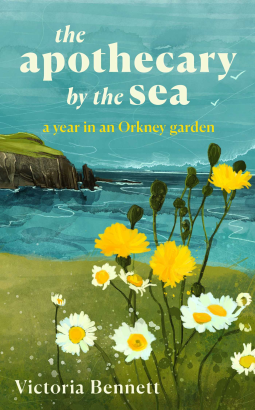 I’ve been hankering to get back to the Orkney Islands after two decades but haven’t managed it yet; reading about it was the next-best thing. There’s a similar make-do attitude to Bennett’s second book, which is about adapting to the unexpected and being in tune with nature. After being forced out of their rented home in Cumbria (and, disastrously, having to raze the abundant garden they’d made there), Bennett and her husband and son resettled in South Ronaldsay. Moving to Orkney was a long-held dream that allowed the couple to become property owners for the first time in their fifties. Chronic illness restricts what she can do, but over the course of a little over a year, she slowly, steadily turns their little outdoor space into a bountiful apothecary garden when not out exploring a new landscape.
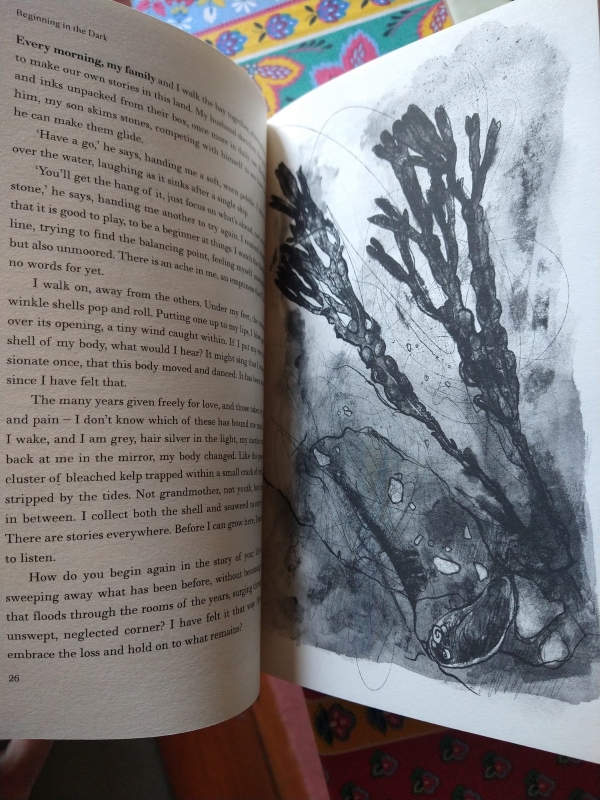
I loved Bennett’s 2023 debut memoir, All My Wild Mothers. Both employ a similar structure of short chapters named after plants with medicinal uses. However, the first book is a lot richer, distilling as it does the experiences and wisdom of an entire life. The format is fresh there, whereas this sequel needed new strategies to set it apart. It’s so short – with sections of gardening tips, further plant rundowns, and recipes for padding – that I suspected the author and publisher were scratching around for enough material to fill a book. The editing is also lacking this time around; dangling modifiers and minor typos abound. This could have been more substantial had Bennett waited a few more years to develop an intimate knowledge of Orkney and make connections with people to draw on. Still, there are reassuring sentiments about accepting one’s limitations, welcoming the changes of age, and setting humble goals (“The garden, like life, is not perfect. Start with what you have”), and the black-and-white illustrations by Bennett’s husband, Adam Clarke, are gorgeous. Though it’s fairly niche, I can, offhand, think of several people to whom I would recommend Bennett’s work.
Written while listening to Doing This for Love, the fab new album by Kris Drever, everyone’s favourite Orkney singer.
With thanks to Elliott & Thompson for the free copy for review.
{SPOILERS IN THE NEXT TWO}
Transcription by Ben Lerner
The UK cover
You know what you’re in for with a Ben Lerner work, in much the same way as when you pick up something by Rachel Cusk, Katie Kitamura or Deborah Levy. The narrator resembles Lerner in that he is a 45-year-old writer who graduated from Brown University and has spent significant time in Madrid. The novella opens with him on a train to Providence, Rhode Island to write a long profile of his mentor, a German writer named Thomas. Thomas is turning 90 and there is a sense that this is to be his “exit interview” – yet he’s as sharp as ever, describing his early life as if composed of film scenes.
There is a strong emphasis on the visual here, but also on the oral. Thomas’s first memory is of hearing Hitler’s voice on the radio, and the narrator fully intended to record this conversation, but dropped his phone in the sink at the hotel and now it won’t turn on. He decides this evening will just be a pre-chat, and tomorrow they’ll get into things properly. For some reason, though, he can’t admit his technological failure to Thomas and instead brings his dead phone out, puts it face down on the table, and pretends that this is all on the record.
I prefer the U.S. cover, as per usual!
The book is in three long sections, named after different hotels. The second is set in Madrid, where, a few years later, the narrator gives a talk as part of a Festschrift for Thomas. He’s turned the story about his phone into a self-deprecating joke, but it turns out that his conference co-organizer, Rosa, is not the only one angry with him for what she perceives as falsifying Thomas’s last testament. This causes him to second-guess himself.
The third section is, ostensibly, a conversation between the narrator and Thomas’s son, Max – except the former can hardly get a word in edgewise (as was the case with Thomas, too), so it’s really more of a monologue. And, strangely, the subject is Max’s young daughter Emmie’s extreme food issues: a sort of pre-anorexia. Except Thomas would philosophize his granddaughter’s struggle, or query her screen time. Max remembers that when Thomas was hospitalized with Covid, apparently near death, he poured out many warm words to his father. Then Thomas recovered. On their first post-Covid visit, Max recorded his father’s speech without telling him he was doing so – an ironic counterpart to the narrator’s actions.
The themes drew me in, and the writing is addictively lucid. But what does it all mean? Lerner’s repeated references to father-and-son glassmakers and their beautiful glass flowers indicate his interest in questions of talent, (metaphorical) inheritance and legacy. The narrator’s version of Thomas’s memories being presented as gospel raises the question of whether fiction is the more appropriate vehicle for biography. There is also a message about overreliance on technology. The narrator feels helpless without his phone, even for one night: He can’t communicate with his family or confirm his walking route with online maps. But I wasn’t sure how Max’s daughter fits in, except perhaps as an emblem of multigenerational mental health struggles. This was an odd little book that I might like to discuss in a book club but found stubbornly unsatisfying to ponder on my own. (Read via Edelweiss)
Emmie Arbel: The Colour of Memory by Barbara Yelin (2023; 2026)
[Translated from German by Helge R. Dascher]
Edited by Charlotte Schallié and Alexander Korb
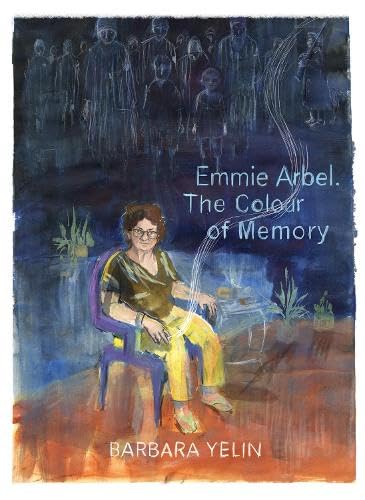 Barbara Yelin’s Irmina was the subject of an early review on my blog (just over 10 years ago!); I called it “one of the most visually stunning graphic novels I’ve ever come across” and noted that it was “based on a fascinating family story.” Such is even truer of this illustrated biography of a child Holocaust survivor. Yelin met Emmie Arbel at Ravensbrück Memorial in 2019 and over the next several years they had many conversations in person and online, which Yelin has memorialized in this solemn, powerful graphic novel. Emmie was born in the Netherlands in 1937 and first sent to a transport camp at age five. She then spent time in Ravensbrück and Bergen-Belsen, where her mother died. After the war, she and her brothers were displaced persons in Sweden before returning to the Netherlands to live with a foster family. Since then she has had a career, raised three daughters, divorced, retired early, lost a daughter, and traveled extensively but mostly lived in Israel. Yelin recreates scenes from Emmie’s life but mostly recounts recent conversations (and so is herself a repeated presence in the book). The narrative moves back and forth in time in imitation of memory. Emmie’s ever-present cigarette is a crutch as she tries to find words for the unspeakable.
A key motivation for this book is to face the facts that survival is not a one-time event and that trauma is complex and ongoing. In Emmie’s case, her foster father (himself a Holocaust survivor) molested her for years. The memory of rape remained locked inside until a breakdown in 1977, when she started seeing a therapist – which, she insists, saved her life.
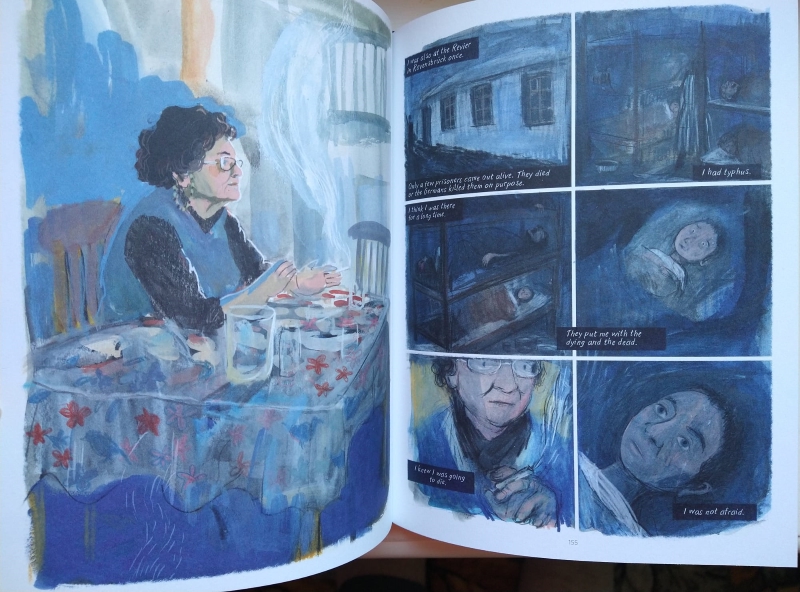
The colour palette is appropriately sombre: lots of dark blue and grey shading into black, which is the colour of memory for Emmie. And yet there is vibrant colour in the depiction of Emmie’s home and garden in Tiv’on, and in her interactions with her children and grandchildren. I can’t revisit particular spreads of this book without crying. One is the final few pages before the epilogue, in which Emmie remembers lying in a camp with typhus.
“They put me with the dying and the dead. I knew I was going to die. I was not afraid. I think I remember how it felt to be dying. It was a good feeling. There was no pain, no hunger, no noise. Nothing. It was quiet and good. But I live.”
This is a work of real courage, of speaking out in spite of a suspicion that all is bleak and meaningless.
“Humiliation. I was not a human being. I was a number, you know. I feel like no one can understand what I’m feeling. But if I don’t talk about it, the others can’t understand. They can’t understand what happened. And it must not happen again. And that’s why I have to speak.”
With thanks to SelfMadeHero for the free copy for review.
Three on a Theme: Works of (Auto)biography by Susie Boyt, Sarah Laing and Jenn Shapland
“If biography is peering through the windows of someone’s house and describing what you see … [then] memoir is peeking into the windows of your own life. A voyeurism of the self. An interior looting.”
~Jenn Shapland
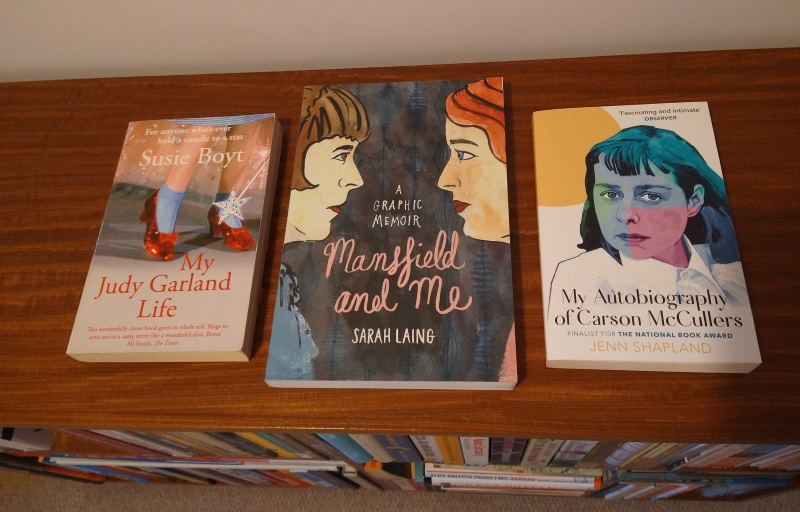
This thematic trio has been in the works for an awfully long time: I read the Laing in 2022 and also started the Shapland that year but took an inexplicable pause and didn’t finish it until a couple of days ago. All three are about understanding the self by way of an obsession with a particular woman from history. Sometimes it’s also a matter of coming to terms with one’s sexuality. In each case, the premise is biographical but the pursuit and reflections end up being equally autobiographical. These are beautifully introspective works with such an appealing approach that they made me ponder who I would pinpoint as my (auto)biographical muse. All: 
My Judy Garland Life by Susie Boyt (2008)
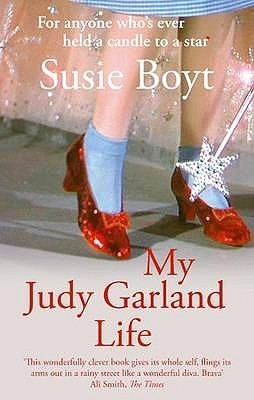 After discovering Boyt through her brilliant latest novel, Loved and Missed, I was keen to try more from her. This Ackerley Prize-shortlisted memoir was just as fascinating as it sounded. Seeing The Wizard of Oz turned Boyt into a Garland mega-fan.
A daughter of Lucian Freud raised by a single mother, Boyt was a sensitive, earnest and lonely child who harboured hopeless dreams of being on the stage herself. She admires Garland’s talent, pluck, hard work and grit. After all, Garland remained the ‘world’s greatest entertainer’ despite struggling with mental illness and prescription drug dependency for three decades.
When I begin to listen to Judy Garland there is no joy or wound from the story of my life that isn’t with me. … Her central credo, and it always always comes to me as her voice begins to swell, is that to be the person with the strongest feelings in life is to be the best. This is an instinct I am quite sure I was born with.
Boyt meets fellow Garland mega-fans in person and online, and visits her hero’s Birthplace Home and Museum (in Grand Rapids, Minnesota) and mausoleum (then in Hartsdale, New York). She draws distinctions between “bad fans” with a morbid eye to Garland’s struggles (they memorise her suicide notes, for instance), “good fans” like herself who acknowledge she was no saint but choose to focus on her successes, and the “crazy-good fans” who won’t hear a word said against her. It’s reassuring that Boyt recognises ambiguity.
“I don’t claim to know Judy Garland, of this I am sure. I feel very close to her, I love her, but I don’t understand. Perhaps I never will. I accept there are layers and layers of things.”
I don’t retain a lot of the detail of this book after over a year (and no notes, silly me!), but I do remember that I felt it blends biography and memoir skilfully and incorporates illuminating discussions of addiction, mental health, celebrity, fandom and the search for love – Garland married five times. (Secondhand – Awesomebooks.com)
Mansfield and Me: A Graphic Memoir by Sarah Laing (2016)
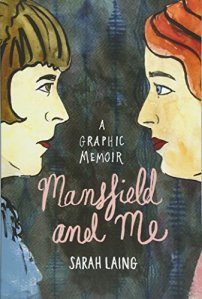 (I’ve added a few lines to my original review from 2022.) Growing up in Aotearoa New Zealand an aspiring writer, Laing looked to Katherine Mansfield as one of her idols. Here she alternates between vignettes from her own past in vivid colour and scenes from Mansfield’s short life in black and white. The Mansfield material is drawn from her letters and notebooks as well as various biographies. Mansfield was friendly with the Bloomsbury Group and lost a brother in the First World War. Laing uses a few Mansfield story titles as chapter headings, has Mansfield’s ghost turn up to comment on her authorial choices, and compares and contrasts their careers and love lives. Laing published her first short story collection at 34 – the age at which Mansfield died of tuberculosis. They share a bisexual identity. Mansfield married twice and miscarried her only pregnancy by a lover; by the end of this book Laing is married and a mother of three. This made me want to read more of Mansfield’s stories; I’ve only read a few thus far. “Katherine’s stories were full of … little lamps – moments of illumination, flashes of truth. I don’t need to be famous, but I would like someone to really see me,” Laing concludes. I’ve also reviewed her Let Me Be Frank. (New purchase – Waterstones sale)


My Autobiography of Carson McCullers by Jenn Shapland (2020)
When Shapland was an intern at the Harry Ransom Center of the University of Texas, Austin (a famous literary archive), someone requested the letters sent by Annemarie Clarac-Schwarzenbach to the writer Carson McCullers. To Shapland’s surprise, these were basically love letters. “I had received letters like these,” she writes. “I had written letters like these to the women I’d loved. It was very little to go on, and yet I felt an utter certainty: Carson McCullers had loved women.” The discovery sparked a quest to know all there was to know about McCullers (she archived the writer’s clothing as part of the internship, too). It also, somehow, liberated Shapland to fully accept her lesbian identity. She was, by this point, in her mid-twenties and had been dating a fellow female student for six years, yet had been semi-closeted the whole time. The letters were, she acknowledges, “a turning point.”
Shapland later spent a month in McCullers’s childhood home in Columbus, Georgia* and worked through her archive at the state university there. Annemarie was by no means the only same-sex entanglement; Shapland lists another 21 possible girlfriends, with McCullers’s correspondence with her therapist, Dr. Mary Mercer, being particularly suggestive. But Shapland had hardly found some lesbian role model: McCullers married the same man, Reeves McCullers, twice, and called her special women “imaginary friends.” (Not to mention that she was an alcoholic, and struggled with chronic illness until her death at age 50.)
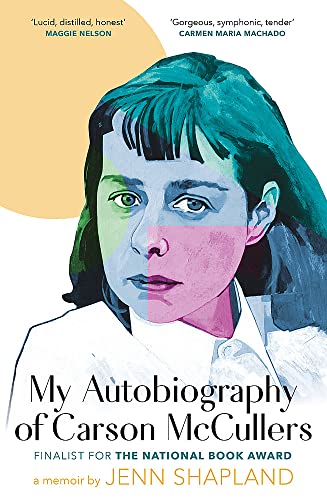
Dogged in her own search for evidence, Shapland nonetheless decries unjust expectations: “Historians demand proof from queer love stories that they never require of straight relationships.” How to prove happiness? she wonders. “Love … lives in the mundane, the moment-to-moment exchanges, and can so easily become invisible after the people who shared it are no longer alive. But, of course, it leaves traces.” I thought Shapland was perhaps too insistent on the word “lesbian” – only once entertaining the possibility that McCullers was bisexual, and never seriously considering fluidity or a change of sexuality. “I prefer the idea that we are all part lesbian, that we are lesbian to one degree or another,” she insists. “Is this semantics?” True to her dual vocation as author and archivist, Shapland continually interrogates how language and objects don’t just reflect reality, but create it. I was impressed by her willingness to call herself out on how she might be “shellacking, setting [McCullers] on my terms despite my desire to give her space in her own words.”
This debut work, a Lambda Literary Award winner and finalist for the National Book Award, is in titled sections that range in length from one paragraph to several pages. Shapland drifts back and forth in time and between her own life and McCullers’s, following thought and memory in loose loops but still conveying the sense of a chronological investigation. She doesn’t devote a lot of space to McCullers’s oeuvre– this is definitely not a work of literary appreciation or criticism – but I’m intrigued enough by the writer’s life and even a bare outline of the recurring themes and elements in her fiction to try her soon. Meanwhile, I have Shapland’s second book, the essay collection Thin Skin, on my e-reader. Her final plea for queer visibility here may be more for her own sake than for the historical McCullers, but either way it persuaded me. “Call it love.”
*I’ve not read McCullers but have always meant to, not least because my father is from Columbus, Georgia. His wasn’t a bookish family and I was never aware of the McCullers connection, though when I mentioned this book to my dad a few years ago he did know her name.
With thanks to Virago for the free copy for review.
20 Books of Summer, 5: A House Full of Daughters by Juliet Nicolson
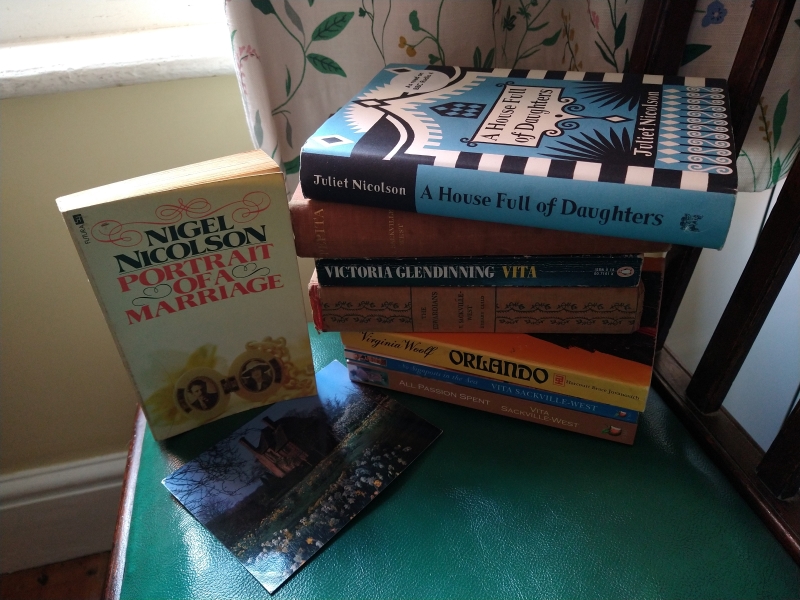
Journalist and popular historian Juliet Nicolson is Vita Sackville-West’s granddaughter and one of the few remaining guardians of her living memory. This 2015 family memoir chronicles the lives of seven (eight, really) generations of women and travels from Malaga in the 1830s to present-day England. Nicolson acknowledges the inherited privilege that has typified this clan since the time of Vita’s grandmother but prefers to emphasize the roles that place and talent have played. It is enough of a biography of Vita to have won a Bisexual Book Award but, even though Vita only had sons, the focus is on mother–daughter bonds and how values and experiences have recurred across nearly two centuries.
First came Pepita, who rose from poverty in southern Spain to be a legendary dancer (“the Beyoncé of her day,” Nicolson quipped at an online event I attended – see below) and catch the eye of an English diplomat, Lionel Sackville-West, at a performance in Paris. Although Pepita was already married to her dancing teacher, she shook off her controlling mother and became Sackville-West’s longtime mistress, bearing him seven children. They could all have been disinherited for illegitimacy, however, had Pepita’s daughter Victoria not secured the link – and access to the family estate, Knole – by marrying her cousin, young Lionel Sackville-West. Vita wrote in Pepita, her joint biography of her mother and grandmother, “My mother appears to have been born with the faculty of attracting the most peculiar and improbable happenings,” such as a proposal of marriage from the recently widowed U.S. president, Chester Arthur, when she accompanied her father to Washington, DC.

Vita is the book’s presiding spirit and pivot point, but I already knew a lot about her from reading Victoria Glendinning’s biography plus two of her novels, so this material was too familiar. The fact that we then leap from daughters to a daughter-in-law (Nicolson’s mother, Philippa Tennyson-d’Eyncourt – these figures are all posher than posh!) is unfortunate as it dilutes the theme. However, Nicolson gives a behind-the-scenes look at Sissinghurst and the marriages between Vita and Harold, loving but also a cover for same-sex relationships for both of them; and Nigel and Philippa, which was a disaster almost from the start. Nicolson is also brave to admit the alcoholism that she subconsciously received from her mother. Philippa died at 58, but by admitting she had a problem Nicolson was able to get help and turn things around. Two generations followed: her two daughters and one granddaughter, who is now 11.
Nicolson sees patterns repeating across the generations: emotional abandonment by parents, “the lack of confidence, the fear of failure, and the seeking of approval where there was none” as well as “writing about the life and work of an earlier generation.” She hopes that with this book she has marked the arrival of “an increasingly tolerant and accepting generation, one that is not afraid to learn from the mistakes of the past and is determined not to repeat them”. (Fun but unrelated fact: Penelope Fitzgerald was one of Nicolson’s teachers.)

On the staircase leading up to Vita’s study in the tower, September 2009.
I visited Sissinghurst in 2009 – I can’t believe I haven’t been back in the past 15 years – and when we briefly lived in Sevenoaks in 2012 we also went to Knole. Both are magical places, especially Sissinghurst. For a few years there I was on a kick of reading a lot by and about Vita (I can recommend No Signposts in the Sea) and I also absorbed a fair bit via Adam Nicolson’s books (that’s Juliet’s brother) and his wife Sarah Raven’s – her recipes are to die for, and she’s kept up the gardens in a way that would make Vita proud. So I’d say it probably helps to have an existing interest in the family, but it should be a reasonably engrossing read in any case. (Free from a neighbour) 
Yesterday I watched “The Inspiration of Vita Sackville-West,” a recording of an RSL event held at the London Library in October that was aired to tie in with their annual Dalloway Day as well as the 95th anniversary of the publication of Virginia Woolf’s Orlando (for which Vita was a model) and, of course, Pride Month. The panelists were Juliet Nicolson; trans novelist Shola von Reinhold, whose LOTE (2020) won the Republic of Consciousness and James Tait Black Memorial Prizes; fashion critic Charlie Porter; and writer Olivia Laing. The discussion was expertly chaired by Shahidha Bari, an academic, fashion writer and presenter of BBC Two’s Inside Culture. She opened by asking each speaker to define Vita in one word. Nicolson chose “lover,” which von Reinhold echoed. Porter said “physical.” Laing cheated with a made-up compound word: “androgynous-aristocratic-aesthete.”
And the conversation went on from there. Nicolson spoke of her grandmother as a formidable woman, tall and tobacco-scented, and remembered the exotic treasures she and her siblings found in Vita’s tower study, such as a bottle of emerald-green nail polish. She described Vita as enigmatic and representing duality: she was born a Victorian but has been embraced by modernist and queer studies; she was conventional in some ways, but also a rebel. Porter has written about fashion and the Bloomsbury circle, with Woolf as one of his subjects, so he thinks about Vita mostly as a muse. He read from Vita’s letter to Harold describing meeting Woolf, whom she thought “quite old” and “atrociously dressed.” Nonetheless, she’d lost her heart. Woolf in her turn commented on Vita’s moustache, which was likely a sign of her Spanish heritage rather than excess testosterone as some have theorized.
For von Reinhold, Vita is an early example of androgyny, a precursor to today’s trans and nonbinary identities. Laing, who has recently published a book on gardening, focused on Vita as a garden writer and designer. She said she doesn’t really value Vita’s novels but thinks her garden books (collections of her Observer columns) are extraordinary and read a passage in which she dreamt up the famous White Garden she would create at Sissinghurst (I read a kinda crummy novel about it a few years ago, The White Garden by Stephanie Barron).
The event gave a very good sense of Vita as a person but not as a writer. Audience questions brought up her poetry (oh God, it’s awful!) and travel books but that was as far as it went, and there was no discussion of the novels. Nicolson mentioned Pepita in passing but mostly talked about Portrait of a Marriage, which was half written by Vita and then finished by Nigel, a publisher (he was half of Weidenfeld and Nicolson, aka W&N). He had the courage to reveal his mother’s sexuality and Nicolson said that she believes Vita’s legacy is courage – to create a garden from scratch as a self-taught amateur, yes; but mostly to be oneself.
A Look Back at My 2021 Reading: Statistics and Superlatives
I hope everyone passed a lovely holiday week. We had house guests for a few days over New Year’s, so I haven’t had a chance to work up my statistics until now. Marcie sent me a spreadsheet template to keep track of my reading, and my tech whiz husband helped analyze the data. I look forward to catching up on everyone else’s best-of and stats posts, too.
How I did with my 2021 goals
 My simple reading goals for 2021 were to read more biographies, classics, doorstoppers and travel books – genres that tend to sit on my shelves unread. I read one biography in graphic novel form (Orwell by Pierre Christin), but otherwise didn’t manage any. I only read three doorstoppers the whole year, but 29 classics – defining them is always a nebulous matter, but I’m going with books from before 1980 – a number I’m happy with.
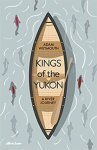 Surprisingly, I did the best with travel books, perhaps because I’ve started thinking about travel writing more broadly and not just as a white man going to the other side of the world and seeing exotic things, since I don’t often enjoy such narratives. Granted, I did read a few like that, and they were exceptional (The Glitter in the Green by Jon Dunn, The Shadow of the Sun by Ryszard Kapuściński and Kings of the Yukon by Adam Weymouth), but if I include essays, memoirs and poetry with significant place-based and migration themes, I was at 26.
The numbers
Exactly the same total as last year (2019 had my maximum-ever of 343). From those three years’ evidence, I’d say I’ve found my natural limit. Next year I will aim for 340 again.
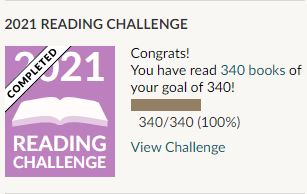
(This is what my lifestyle allows; yours is likely very different. I have bookish friends who read 80 books a year, 120, 150, 180, 200, and so on. My very busy university lecturer/town councillor husband felt bad for ‘only’ reading 65 books this past year, but keep in mind that the average person reads just 12 per year. My message to you, no matter your numbers, is YOU READ LOADS!)
Fiction: 49.7% (6.5% graphic novels; 5.3% short stories)
Nonfiction: 35%
Poetry: 15.3%
(Fiction and nonfiction are usually just about equal for me; I’m surprised that fiction pulled well ahead this year. I also read a bit more poetry this year than last.)
Female author: 66.47%
Male author: 30%
Nonbinary author: 0.88% (Meg-John Barker, Alice Hattrick and Olivia Laing)
Multiple genders (in anthologies): 2.65%
(I’ve been reading more and more by women each year, but this is the first time that female + nonbinary authors have outnumbered men by more than 2:1. I mostly attribute this to my interest in women’s stories. There were also three trans authors on my list.)
BIPOC author: 18.5%
(The first time I have specifically tracked this figure. Not too bad, but I’d prefer 25% or higher.)
Work in translation: 5%
(A decline from last year’s 7.2%. Must try harder!)
E-books: 13.2%
Print books: 86.8%
(Slightly higher than last year because of my new reviewing gig for Shelf Awareness, for which I read almost exclusively e-books.)
2021 releases: 41.8% (add in the 2020 releases and it’s 54.4%)
Pre-release books: 20%
Rereads: 12 (3.5%)
Where my books came from for the whole year:
- Free print or e-copy from publisher: 31.8%
- Public library: 24.7%
- Secondhand purchase: 16.8%
- Free (The Book Thing of Baltimore, the free mall bookshop, a giveaway, Little Free Libraries, etc.): 9.4%
- Downloaded from NetGalley or Edelweiss: 5.9%
- New purchase (sometimes at a bargain price): 5.6%
- University library: 3.8%
- Gifts: 2%
(Decreased from last year: review copies, NetGalley/Edelweiss, gifts; increased from last year: library borrowing, new and secondhand purchases, free books.)
Additional statistics courtesy of Goodreads:
73,520 pages read
Average book length: 216 pages (thank you, novellas and poetry!)
Average rating for 2021: 3.7
Extra Superlatives
First book completed:
Last book completed (also the shortest, at 46 pages)
Longest book, at 628 pages:
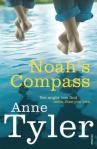
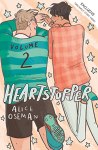
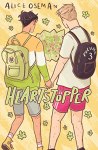
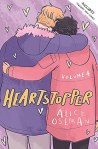
Authors I read the most by: Anne Tyler (5), thanks to Liz’s readalong project; Jim Davis and Alice Oseman cartoons (4 volumes each); Jim Crumley nature books and Emily Rapp Black memoirs (3 each)

Publishers I read the most from: Carcanet (18), then Picador (17), then Bloomsbury and Faber (14 each); in overall first place was undoubtedly Penguin and its many imprints.
My top discovery of the year: the Heartstopper teen graphic novel series.

My proudest bookish achievement: being asked to be a judge for the McKitterick Prize.
The books that made me laugh the most: The Echo Chamber by John Boyne and Early Morning Riser by Katherine Heiny.
Best book club selections: The Light Years by Elizabeth Jane Howard, Woman on the Edge of Time by Marge Piercy, The Year of Living Danishly by Helen Russell.
Most genuinely helpful book: How to Talk to a Science Denier by Lee McIntyre.
Best last lines encountered: “So where are we gonna go? / I don’t know. Let’s just drive and find out.” (from Heartstopper, Volume 4 by Alice Oseman).
Best 2021 book title: Mrs Death Misses Death.

Shortest book title encountered: In (Will McPhail), followed by Lot (Bryan Washington).
Biggest disappointments: Some of my lowest ratings went to Indelicacy by Amina Cain, Klara and the Sun by Kazuo Ishiguro, and Ness by Robert Macfarlane.
 A 2021 book that everyone loved but me: The Lincoln Highway by Amor Towles.
Themes that kept turning up in my reading: Covid-19, colours (thanks to my summer reading challenge), disability (thanks to shadowing the Barbellion Prize), the mental and physical health benefits of time in nature; perennial topics like friendship, parenting and sisterhood.
Three May Graphic Novel Releases: Orwell, In, and Coma
These three terrific graphic novels all have one-word titles and were published on the 13th of May. Outwardly, they are very different: a biography of a famous English writer, the story of an artist looking for authentic connections, and a memoir of a medical crisis that had permanent consequences. The drawing styles are varied as well. But if the books share one thing, it’s an engagement with loneliness: It’s tempting to see the self as being pitted against the world, with illness an additional isolating force, but family, friends and compatriots are there to help us feel less alone and like we are a part of something constructive.
Orwell by Pierre Christin; illustrated by Sébastien Verdier
[Translated from the French by Edward Gauvin]
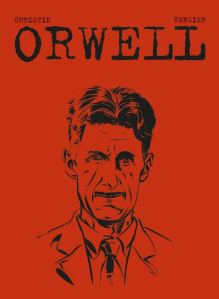 George Orwell was born Eric Blair in Bengal, where his father worked for the colonial government. As a boy, he loved science fiction and knew that he would become a writer. He had an unhappy time at prep school, where he was on reduced fees, and proceeded to Eton and then police training in Burma. Already he felt that “imperialism was an evil thing.” Among this book’s black-and-white panes, the splashes of colour – blood, a British flag – stand out, and guest artists contribute a two-page colour spread each, illustrating scenes from Orwell’s major works. His pen name commemorates a local river and England’s patron saint, marking his preoccupation with the essence of Englishness: something deeper than his hated militarism and capitalism. Even when he tried to ‘go native’ for embedded journalism (Down and Out in Paris and London and The Road to Wigan Pier), his accent marked him out as posh. He was opinionated and set out “rules” for clear writing and the proper making of tea.
The book’s settings range from Spain, where Orwell went to fight in the Civil War, via a bomb shelter in London’s Underground, to the island of Jura, where he retired after the war. I particularly loved the Scottish scenery. I also appreciated the notes on where his life story entered into his fiction (especially in A Clergyman’s Daughter and Keep the Aspidistra Flying). During World War II he joined the Home Guard and contributed to BBC broadcasting alongside T.S. Eliot. He had married Eileen, adopted a baby boy, and set up a smallholding. Even when hospitalized for tuberculosis, he wouldn’t stop typing (or smoking).
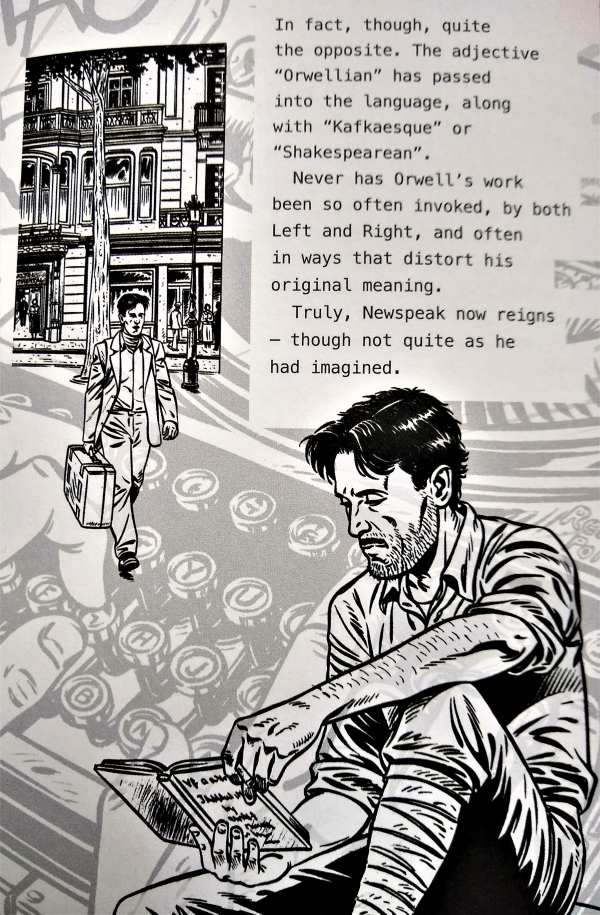 Christin creates just enough scenes to give a sense of the sweep of Orwell’s life, and incorporates plenty of the author’s own words in a typewriter font. He recognizes all the many aspects, sometimes contradictory, of his subject’s life. And in an afterword, he makes a strong case for Orwell’s ideas being more important now than ever before. My knowledge of Orwell’s oeuvre, apart from the ones everyone has read – Animal Farm and 1984 – is limited; luckily this is suited not just to Orwell fans but to devotees of life stories of any kind.
With thanks to SelfMadeHero for the free copy for review.
In by Will McPhail
Nick never knows the right thing to say. The bachelor artist’s well-intentioned thoughts remain unvoiced, such that all he can manage is small talk. Whether he’s on a subway train, interacting with his mom and sister, or sitting in a bar with a tongue-in-cheek name (like “Your Friends Have Kids” or “Gentrificchiato”), he’s conscious of being the clichéd guy who’s too clueless or pathetic to make a real connection with another human being. That starts to change when he meets Wren, a Black doctor who instantly sees past all his pretence.
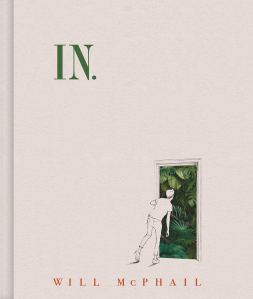 Like Orwell, In makes strategic use of colour spreads. “Say something that matters,” Nick scolds himself, and on the rare occasions when he does figure out what to say or ask – the magic words that elicit an honest response – it’s as if a new world opens up. These full-colour breakthrough scenes are like dream sequences, filled with symbols such as a waterfall, icy cliff, or half-submerged building with classical façade. Each is heralded by a close-up image on the other person’s eyes: being literally close enough to see their eye colour means being metaphorically close enough to be let in. Nick achieves these moments with everyone from the plumber to his four-year-old nephew.
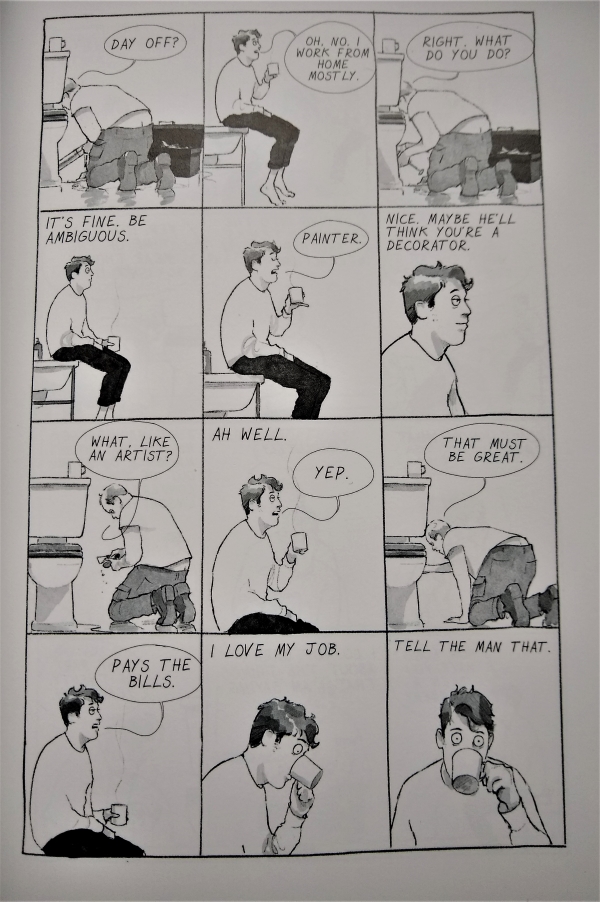
Alternately laugh-out-loud funny and tender, McPhail’s debut novel is as hip as it is genuine. It’s a spot-on picture of modern life in a generic city. I especially loved the few pages when Nick is on a Zoom call with carefully ironed shirt but no trousers and the potential employers on the other end get so lost in their own jargon that they forget he’s there. His banter with Wren or with his sister reveals a lot about these characters, but there’s also an amazing 12-page wordless sequence late on that conveys so much. While I’d recommend this to readers of Alison Bechdel, Craig Thompson, and Chris Ware (and expect it to have a lot in common with Kristen Radtke’s forthcoming Seek You: A Journey through American Loneliness), it’s perfect for those brand new to graphic novels, too – a good old-fashioned story, with all the emotional range of Writers & Lovers. I hope it’ll be a wildcard entry on the Sunday Times Young Writer of the Year Award shortlist.
With thanks to Sceptre for the free copy for review.
Coma by Zara Slattery
In May 2013, Zara Slattery’s life changed forever. What started as a nagging sore throat developed into a potentially deadly infection called necrotising fascitis. She spent 15 days in a medically induced coma and woke up to find that one of her legs had been amputated. As in Orwell and In, colour is used to differentiate different realms. Monochrome sketches in thick crayon illustrate her husband Dan’s diary of the everyday life that kept going while she was in hospital, yet it’s the coma/fantasy pages in vibrant blues, reds and gold that feel more real.
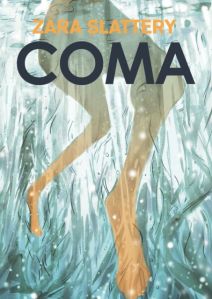 Slattery remembers, or perhaps imagines, being surrounded by nightmarish skulls and menacing animals. She feels accused and guilty, like she has to justify her continued existence. In one moment she’s a puppet; in another she’s in ancient China, her fate being decided for her. Some of the watery landscapes and specific images here happen to echo those in McPhail’s novel: a splash park, a sunken theatre; a statue on a plinth. There’s also a giant that reminded me a lot of one of the monsters in Spirited Away.
Meanwhile, Dan was holding down the fort, completing domestic tasks and reassuring their three children. Relatives came to stay; neighbours brought food, ran errands, and gave him lifts to the hospital. He addresses the diary directly to Zara as a record of the time she spent away from home and acknowledges that he doesn’t know if she’ll come back to them. A final letter from Zara’s nurse reveals how bad off she was, maybe more so than Dan was aware.


This must have been such a distressing time to revisit. In this interview, Slattery talks about the courage it took to read Dan’s diary even years after the fact. I admired how the book’s contrasting drawing styles recreate her locked-in mental state and her family’s weeks of waiting – both parties in limbo, wondering what will come next.
Brighton, where Slattery is based, is a hotspot of the Graphic Medicine movement spearheaded by Ian Williams (author of The Lady Doctor). Regular readers know how much I love health narratives, and with my keenness for graphic novels this series couldn’t be better suited to my interests.
With thanks to Myriad Editions for the free copy for review.
Read any graphic novels recently?
Final 2020 Statistics and Retrospective / 2021 Reading Goals
In 2020…
My mother was supposed to visit us in May – my first visit from family in 13 years – and we were meant to be in the States for Christmas. These planned trips had to be cancelled, of course, and many gigs and regular events we would have attended in London and elsewhere couldn’t go ahead.
We managed two mini-breaks, one to Dorset and Devon and one to Hay-on-Wye, as well as a daytrip to Avebury and Silbury Hill, a night out at an Oxford comedy club, a few meals out, and some outdoor meet-ups with family and friends.
It was also the year we finally started doing video chats with family in America, and we kept up with certain friends better than ever thanks to Zoom meetings.
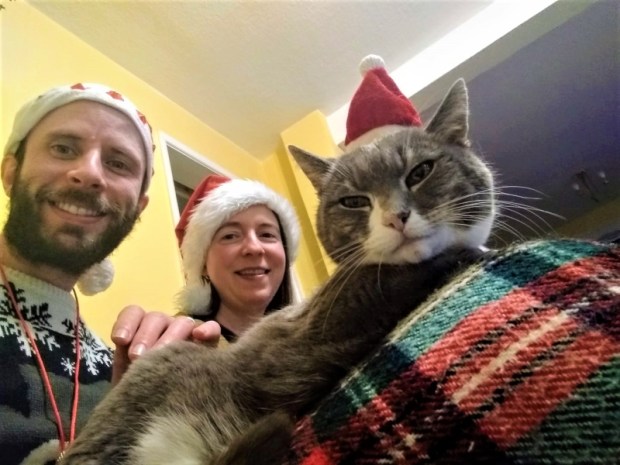
All told, I have no grounds for complaint about the year that has just passed. I know we are lucky to have had good health, stable employment and a wonderful town and community.
Moreover, I was spoiled for choice with online bookish and musical content last year:
- 45 livestreamed gigs (28+ Bookshop Band, 4 Duke Special, 3 Edgelarks and Megson, 2 Switchfoot, and 1 each by Bellowhead, Krista Detor, Lau, Mark Erelli and Nerina Pallot)
- 8 neighborhood book club meetings
- 8 literary festival events
- 8 quizzes (mostly general trivia; 1 bookish, run by Penguin – I did well among the hundreds of entries!)

- 6 literary prize announcements
- 4 festivals, mostly of folk music
- 4 book launch events
- 3 book club/preview events
- 2 conferences (mostly book-related)
I’m also lucky that, unlike many, my reading was not affected by a stressful year. My reading total was very close to the previous year’s (343), which means that after five years above 300 and climbing, I’ve now figured out what my natural limit is. Next year I will aim for 340 again.
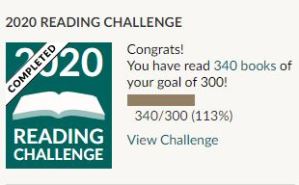
Some interesting additional statistics, courtesy of Goodreads:

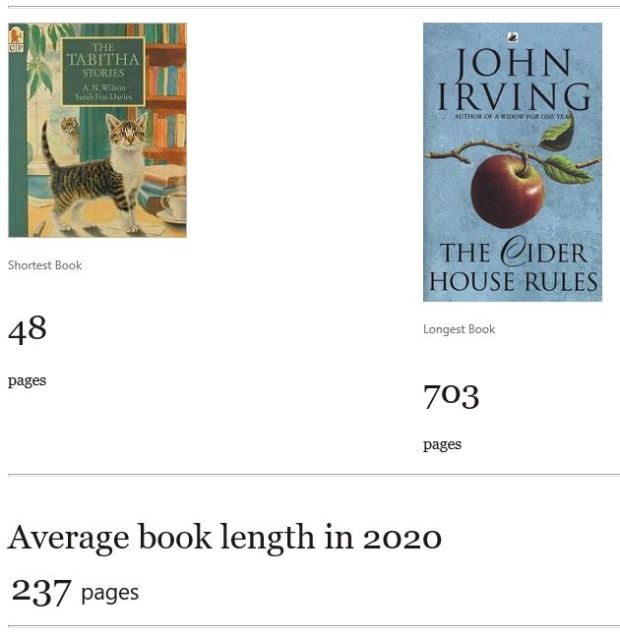
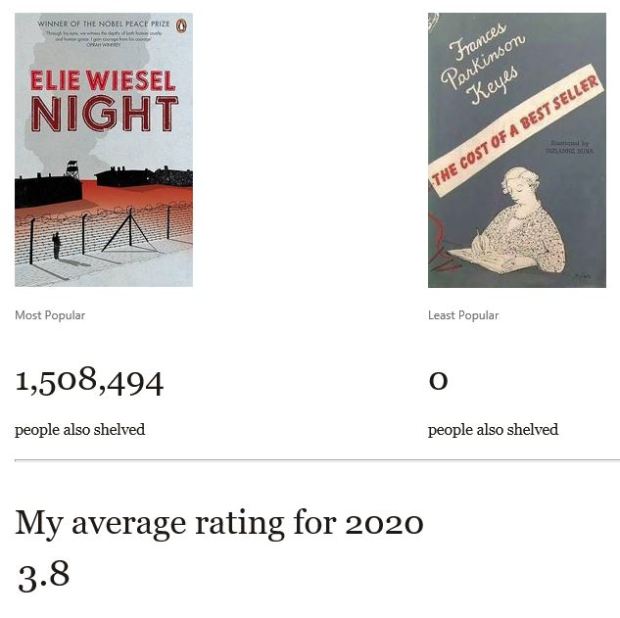
First read of the year: Last read of the year:

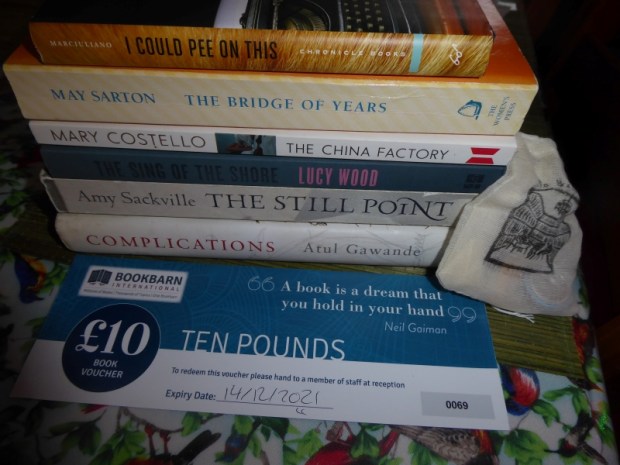
This was my Christmas book haul thus far (I have a feeling more may be marooned at my in-laws’ house), including money to spend the next time I can get to Bookbarn. I started a few of them right away.
My husband reads between one-fifth and one-quarter of what I do in a year, but by anyone’s accounting, 76 books is a lot in a year, especially considering that he has a busy full-time university lecturer job, is a town councillor, and is on lots of other voluntary committees. We overlap in some of our reading tastes (nature and travel writing, and some literary fiction) and I pass a lot of my review copies or library books his way, but he’s less devoted to new books and more likely to pick up books with heavier historical, political, or scientific content. If you’re interested, his rundown of his reading, including his top 3 reads of the year, is here.
2021 Reading Goals
My immediate priorities are to clear my set-aside pile (20 books) and everything I’m currently reading, start some January releases, and get back into some university library books to last me while I have limited access to our public library.
These are the 2021 proofs and finished copies I have received thus far:

Looking further ahead, I plan to continue and/or participate in many of 2020’s reading challenges again, as well as join in Liz’s Anne Tyler readalong for the novels I own and haven’t read yet. (The first one for me will be The Clock Winder in mid- to late February.)
Genres in which my achievement often lags far behind my intentions include literature in translation, biographies, and travel books. To address the first one, I’m going to set up a shelf in my house for unread works in translation, as a visual reminder and area to select from. I’ll start with the one below left as part of my “M” 4-in-a-Row.
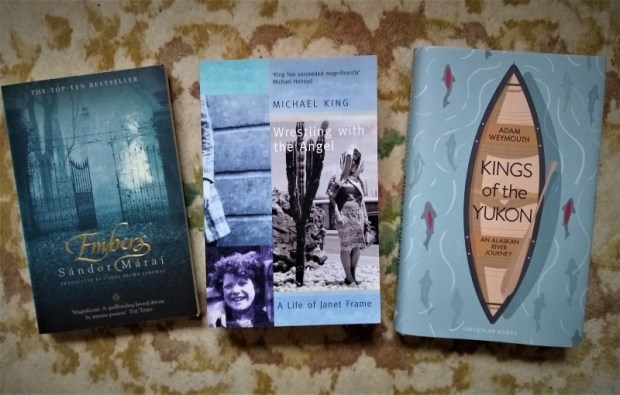
I would be happy to read even one biography this year, since they often take me many months to read. I’m going to make it the one above, of Janet Frame. Standard travel narratives intimidate me for some reason; I get on with them much better if they are in essays or incorporate memoir and/or nature writing. We have a whole shelf of unread travel books, many of which are of the more traditional going somewhere and reporting on what you see type. I want to clear the shelf to give them to my father-in-law, who expressed interest in reading more travel books. I’ll start with the 2018 Young Writer of the Year Award winner, above.
A “Classic of the Month” and “Doorstopper of the Month” are regular features on my blog, yet I don’t always manage to complete one each month. My aim will be to have at least one classic and one doorstopper on the go at all times, and hope that that translates to one a month as much as possible. Here’s my first pair:
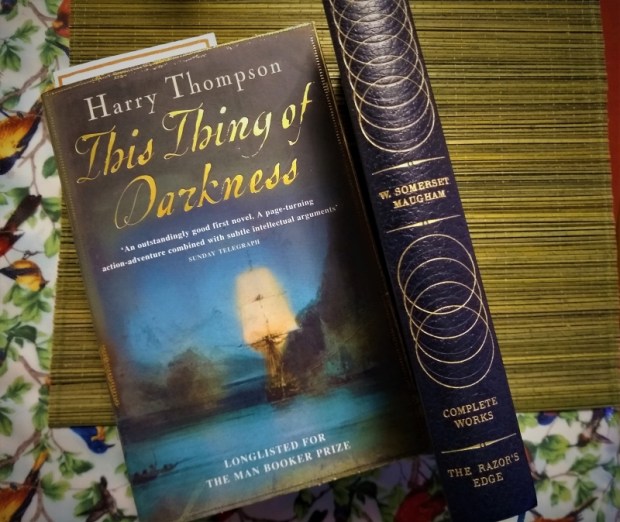
I can see that lots of other book bloggers are prioritizing doorstoppers and backlist reading in 2021. Apart from the modest goals I’ve set here, I expect my reading to be as varied and over-the-top as ever. I know I’ll read lots of 2021 releases, but backlist books are often more memorable, so I’ll try to arrange my stacks and choose my challenges so as to let them shine.
What are some of your reading goals for 2021?
Adventures in Rereading: Julian Barnes and Jennifer Egan
My last two rereads ended up being as good as or better than they had been the first time around; these two, however, failed to live up to my memory of them, one of them dramatically so. My increased literary experience and/or the advance of years meant these works felt less fresh than they did the first time around.
Flaubert’s Parrot by Julian Barnes (1984)
 Barnes is in my trio of favorite authors, along with A. S. Byatt and David Lodge. He’s an unapologetic intellectual and a notable Francophile who often toggles between England and France, especially in his essays and short stories. This was his third novel and riffs on the life and works of Gustave Flaubert, best known for Madame Bovary.
Odd-numbered chapters build a straightforward narrative as Geoffrey Braithwaite, a widower, retired doctor and self-described “senile amateur scholar,” travels to Rouen for five days to see the sites associated with Flaubert and becomes obsessed with determining which of two museum-held stuffed parrots Flaubert used as his inspiration while writing the story “A Simple Heart.” Even-numbered chapters, however, throw in a variety of different formats: a Flaubert chronology, a bestiary, an investigation of the contradictory references to Emma Bovary’s eye color, a dictionary of accepted ideas, an examination paper, and an imagined prosecutor’s case against the writer.
There are themes and elements here that recur in much of Barnes’s later work:
- History – what remains of a life? (“He died little more than a hundred years ago, and all that remains of him is paper.”)
- Love versus criticism of one’s country (“The greatest patriotism is to tell your country when it is behaving dishonourably, foolishly, viciously.”)
- Time and its effects on relationships and memory
- How life is transmuted into art
- Languages and wordplay
- Bereavement
Indeed, I was most struck by Chapter 13, “Pure Story,” in which Dr. Braithwaite finally comes clean about his wife’s death and the complications of their relationship. Barnes writes about grief so knowingly and with such nuance, yet his own wife, Pat Kavanagh, didn’t die until 2008. Much of what he’s published since then has dwelt on loss, but more than two decades earlier he was already able to inhabit that experience in his imagination.
As a 22-year-old graduate student, I gobbled this up even though I knew very little about French literature and history and hadn’t yet read any Flaubert. I wasn’t quite as dazzled by the literary and biographical experimentation this time. While I still admired the audacity of the novel, I wouldn’t call it a personal favorite any longer. I think others of Barnes’s works will resonate for me more on a reread.
My original rating (c. 2006): 
My rating now: 
A Visit from the Goon Squad by Jennifer Egan (2010)
This makes up a pleasing pair as it shares Barnes’s experimentation with form and meditation on time. Before my reread I only remembered that it was about washed-up musicians and that there was one second-person chapter and another told as a PowerPoint presentation. Looking back at my original review, I see I was impressed by how Egan interrogated “society’s obsession with youth and celebrity, the moments of decision that can lead to success or to downfall … and the way time (the ‘goon’ of the title) and failure can wear away at one’s identity.” Back then I called the Pulitzer Prize-winning novel “achingly fresh, contemporary and postmodern. It is, in fact, so up-to-the-minute that one wonders how long that minute can last.” I was right to question its enduring appeal: this time I found the book detached, show-offy and even silly in places, and the characterization consistently left me cold.
 This was probably the first linked short story collection I ever read (now a favorite subgenre), and the first time I’d encountered second-person narration in fiction, so it’s no wonder I was intrigued. “Each chapter involves a very clever shift in time period and point of view,” I noted in 2011. This time, though, I found the 1970s–2020s timeline unnecessarily diffuse, and I was so disinterested in most of the characters – kleptomaniac PA Sasha, post-punk music producer Bennie, musician turned janitor turned children’s performer Scotty, a disgraced journalist, a starlet, and so on – that I didn’t care to revisit them.
The chapter in which Scotty catches a fish and takes it into Bennie’s office was a favorite, along with the PowerPoint presentation Sasha’s daughter puts together on the great pauses of rock music (while also revealing a lot about her family dynamic), but I found the segment on PR attempts to burnish an African general’s reputation far-fetched and ended up mostly skimming five of the last six chapters.
This was a buddy read with Laura T. (see her review); we came to similar conclusions: this may have felt fresh and even prescient about technology in 2010–11, but it didn’t stand up to a reread; still, we’ll keep our copies if just for the 75-page PowerPoint presentation.
Note: Egan has said that her next project is a companion piece to Goon Squad that uses a similar structure and follows some of its peripheral characters into new territory. Based on this rereading experience, I don’t think I’ll seek out the sequel.
My original rating (June 2011):
My rating now: 
To reread next: Everything Is Illuminated by Jonathan Safran Foer and On Beauty by Zadie Smith
Done any rereading lately?
Bookbarn Book Haul & More
 We’re back from our weekend in Bristol and Exeter to hang out with university friends and attend our goddaughter’s dedication service. On the way (ish) down, we stopped at Bookbarn International, one of my favorite places to look for secondhand books. The shop is always coming up with new ideas and ventures – a rare books room, a café, stationery and store-brand merchandise, new stock alongside the used books, and so on – and has recently been doing some renovating of the main shop space. I contributed to a crowdfunder for this and got to pick up my rewards while I was there, including the items at right and a £10 store voucher, which, along with the small balance of my vendor account, more than covered my purchases that day.
We arrived around noon so started with a café lunch of all-day veggie cooked breakfasts plus cakes and coffee. Delicious! Then it was time for some dedicated browsing. All of the books on the main shop floor are £1 each; they’re working on restocking this area after the refurbishment. I found 12 books here, and ordered another two (the Janet Frame biography and Gail Godwin’s nonfiction book Heart) from the warehouse for £2 each.

From my book haul, I’m particularly pleased with:
- The sequel to another Robertson Davies novel I own
- The Frame biography – I loved her three-part autobiography and have also been dipping into her fiction; it will be fascinating to learn the ‘truth’ behind how she presented her life in memoir and autofiction. This copy looks to be in new condition, too.
- The Tulip by Anna Pavord, which I’ve long meant to read
- Another Carolyn Parkhurst novel – I loved The Dogs of Babel and Harmony
- Another Wendy Perriam novel – I read my first last year and have been hoping to find more
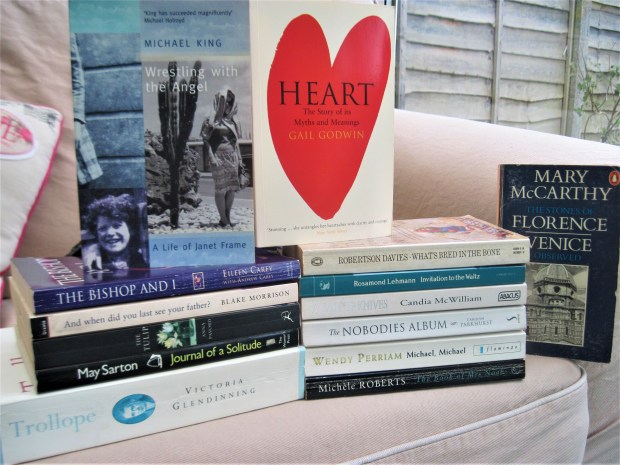
I also bought copies of two of my favorite memoirs, And When Did You Last See Your Father? and Journal of a Solitude (though I own a copy in America, I’d like it to be part of my rereading project this year). I now own two unread novels each by Candia McWilliam and Michèle Roberts and three by Rose Tremain, so I’ll need to be sure I read one from each author this year. I also have a bad habit of hoarding biographies but not reading them, so I want to at least read the Frame one before the year is out.
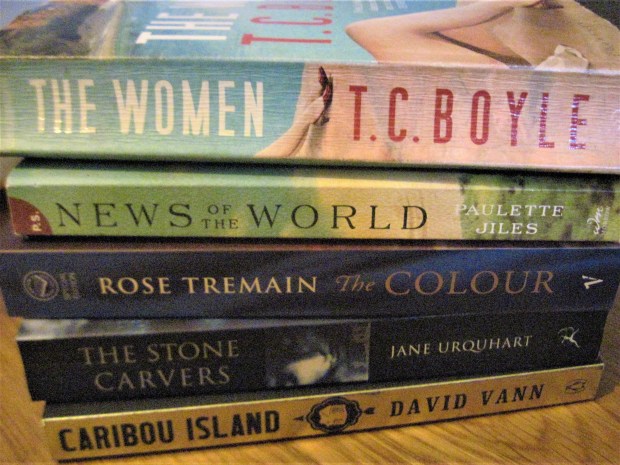
Between Bristol’s charity shops and Book-Cycle in Exeter, I bought another five novels during the weekend, including the Vann to reread and several by authors I want to increase my familiarity with. (Smug points for not buying the £2.50 copy of Boyle’s The Women at Bookbarn and then finding it at Book Cycle for 50 pence instead.) Total weekend spend on 19 books: £2.12.
Picked up any good secondhand bargains recently?
2020 Reading Goals and Anticipated Releases
Review copies have started to feel like an obligation I don’t want. Almost as soon as one comes through the door, I regret having asked for or accepted it. (Now I have to read the danged thing, and follow through with a review!) So I’m going to cut back severely this year. The idea is to wait until late in 2020 to figure out which are the really worthwhile releases, and then only read those instead of wading through a lot of mediocre stuff.
“Until one has some kind of professional relationship with books one does not discover how bad the majority of them are. In much more than nine cases out of ten the only objectively truthful criticism would be ‘This book is worthless,’ while the truth about the reviewer’s own reaction would probably be ‘This book does not interest me in any way, and I would not write about it unless I were paid to’. … The best practice, it has always seemed to me, would be simply to ignore the great majority of books and to give very long reviews … to the few that seem to matter.” (from “Confessions of a Book Reviewer” in Books v. Cigarettes by George Orwell)
These are the January to May 2020 releases I own so far, with perhaps a few more on the way. I acquired a lot of these in September through November, before I made the decision to cut down on review copies.

I’m also looking forward to new books by Sebastian Barry, Susanna Clarke, Stephanie Danler, Anne Enright, Yaa Gyasi, John Irving, Daisy Johnson, Daniel Kehlmann, Sue Monk Kidd, Rebecca Dinerstein Knight, Maya Shanbhag Lang, Helen Macdonald, Hilary Mantel, David Mitchell, Sarah Moss, Mark O’Connell, Maggie O’Farrell, Anne Tyler, Abraham Verghese, Raynor Winn and Molly Wizenberg.
I can still access new/pre-release books via my public library and NetGalley/Edelweiss, especially fiction to review for BookBrowse and nonfiction for Kirkus and the TLS.
This resolution is not about denying or punishing myself, as bloggers’ book-buying bans sometimes seem to be, so if an unmissable book (e.g. HAMNET) is offered on Twitter or via my blog, I won’t consider it cheating to say yes. FOMO will likely be a chronic condition for me this year, but ultimately I hope to do myself a favor.
With the reading time I’m saving, I plan to make major inroads into those 440 print books I own and haven’t read yet, and to do a lot of re-reading (I only managed one and a bit rereads in 2019). I might well blog less often and only feature those books that have been exceptional for me. I’ve set aside this shelf of mostly fiction that I think deserves re-reading soon:

“I do not think we go back to the exciting books,—they do not usually leave a good taste in the mouth; neither to the dull books, which leave no taste at all in the mouth; but to the quiet, mildly tonic and stimulating books,—books that have the virtues of sanity and good nature, and that keep faith with us.” (from “On the Re-Reading of Books” in Literary Values by John Burroughs)
I hope (as always) to read more classics, literature in translation and doorstoppers. Travel and biography are consistently neglected categories for me. Though I won’t set specific goals for these genres, I will aim to see measurable progress. I will also take advantage of the Wellcome Book Prize being on hiatus this year to catch up on some of the previous winners and shortlisted books that I’ve never managed to read.
Mostly, I want to avoid any situations that make me feel guilty or mean (so no more books received direct from the author, and any review books that disappoint will be quietly dropped), follow my whims, and enjoy my reading.
What are some of your goals (reading-related or otherwise) for 2020?
American Book Acquisitions and 2019 Reading Goals
We arrived in the UK on January 1, after an overnight flight from Baltimore. There was no midnight announcement, no complimentary champagne; nothing. Clearly I had my hopes too high. So we’re feeling a bit cheated out of our New Year’s Eve experience and will be doing a recreated countdown and toast when we have houseguests over for this Epiphany weekend.
It was a low-key, relaxing couple of weeks back in the States, the majority of it spent seeing family and friends. We also made it into D.C. to see the new Obama portraits. Mostly I enjoyed doing not a lick of work. And I acquired books, of course: a secondhand and remainder stack that, after my trade-in of some cast-off books, cost just $4; and a few ARCs I’m excited about.


2019 Goals
I’m feeling restless in my career, like if someone gave me permission to quit all my gigs I would do it tomorrow. But, of course, only a fool would do so with no plan to replace them with other remunerative work. The year is likely to involve a lot of rethinking for me as I evaluate which of my proofreading and writing jobs feel worthwhile, and what’s taking me in the direction I want to go (not that I currently know what that is).
Life is awfully hard to plan out. Reading is much easier! So here are my fairly modest reading goals for the year, some of them overlapping:
- I plan to reinstate the Classic and Doorstopper of the month features I ran in 2017, since otherwise I hardly ever read them. I’m starting with Annabel’s readalong of The Name of the Rose by Umberto Eco, which is just over 500 pages but also conveniently falls into one of the below categories.

The doorstoppers I have around to choose from.
- I’ll make a second attempt at getting through some of the travel books and biographies I own, though I won’t hold myself to any particular target. At least five of each would be nice.


- I’m determined to up my literature in translation ratio. These are all the books I own that were originally published in other languages – pitiful! – but I will get hold of more through the library and publishers.

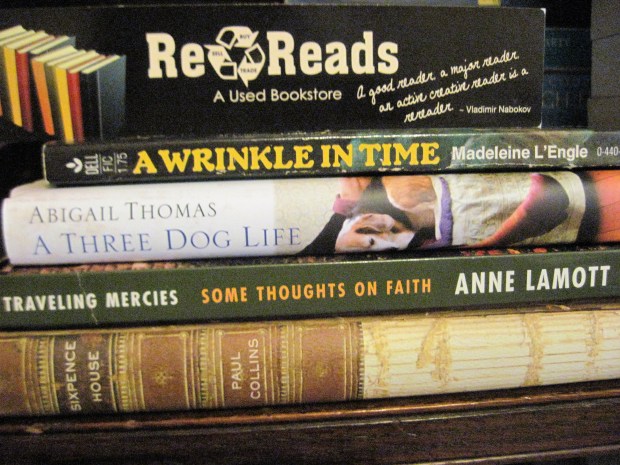
- Re-reading is something I undertake very reluctantly. I have friends who swear by it, but to me it can feel like a waste of time. Last year I re-read just four books: Little Women, Give Me Everything You Have, Crossing the Moon, and Diary of a Bookseller. In each case, on the second reading I rated the book a star lower. That suggests that, far from appreciating books more on a second reading, I have less patience with them and find more flaws! All the same, I’ve chosen four books to re-read in 2019. The Collins is a longtime favorite about moving to Hay-on-Wye; the Thomas is one of the books that first got me into reading memoirs. I’ve been let down by Lamott’s latest three books so wanted to go back to one of her spiritual classics; I’ve gotten into L’Engle’s writing for adults and want to revisit her most famous children’s book (which I don’t think I comprehended at age nine or whatever I was).
- I have a bad habit of racing through self-help and theology books rather than taking my time mulling over them and fully exploring how I might apply them in my life. This was especially true of The Artist’s Way, one of my bibliotherapy prescriptions. I started out with the aim of completing the daily “morning pages” of free writing (though for me they were ‘evening pages’; I’m not a morning person) and each chapter’s self-knowledge exercises. But soon I’d given up on the writing and contemplation and begun just reading the book straight through, which is not the point of it at all. So this year I mean to go back through the Cameron and Rubin books more mindfully, and use the McLaren devotional as it is intended, reading the recommended Bible passages alongside the weekly reflections.

 Bookish Beck = Rebecca Foster. American transplant to England. Freelance proofreader and book reviewer.
