Blog Tour Review: Little Fires Everywhere by Celeste Ng
I’m delighted to be helping to close out the UK blog tour for Little Fires Everywhere. Celeste Ng has set an intriguing precedent with her first two novels, 2014’s Everything I Never Told You and this new book, the UK release of which was brought forward by two months after its blockbuster success in the USA. The former opens “Lydia is dead. But they don’t know this yet.” The latter starts “Everyone in Shaker Heights was talking about it that summer: how Isabelle, the last of the Richardson children, had finally gone around the bend and burned the house down.” From the first lines of each novel, then, we know the basics of what happens: Ng doesn’t write mysteries in the generic sense. She doesn’t want us puzzling over whodunit; instead, we need to ask why, examining motivations and the context of family secrets.
 Little Fires Everywhere opens in the summer of 1997 in the seemingly idyllic planned community of Shaker Heights, Ohio: “in their beautiful, perfectly ordered city, […] everyone got along and everyone followed the rules and everything had to be beautiful and perfect on the outside, no matter what mess lay within.” That strict atmosphere will take some getting used to for single mother Mia Warren, a bohemian artist who has just moved into town with her fifteen-year-old daughter, Pearl. They’ve been nomads for Pearl’s whole life, but Mia promises that they’ll settle down in Shaker Heights for a while.
Mia and Pearl rent a duplex owned by Elena Richardson, a third-generation Shaker resident, local reporter and do-gooder, and mother of four stair-step teens. Pearl is fascinated by the Richardson kids, quickly developing an admiration of confident Lexie, a crush on handsome Trip, and a jokey friendship with Moody. Izzy, the youngest, is a wild card, but in her turn becomes enraptured with Mia and offers to be her photography assistant. Mia can’t make a living just from her art, so takes the occasional shift in a Chinese restaurant and also starts cleaning the Richardsons’ palatial home in exchange for the monthly rent.
The novel’s central conflict involves a thorny custody case: Mia’s colleague at the restaurant, Bebe Chow, was in desperate straits and abandoned her infant daughter, May Ling, at a fire station in the dead of winter. The baby was placed with the Richardsons’ dear friends and neighbors, the McCulloughs, who yearn for a child and have suffered multiple miscarriages. Now Bebe has gotten her life together and wants her daughter back. Who wouldn’t want a child to grow up in the comfort of Shaker Heights? But who would take a child away from its mother and ethnic identity? The whole community takes sides, and the ideological division is particularly clear between Mia and Mrs. Richardson (as she’s generally known here).
For all that Shaker Heights claims to be colorblind, race and class issues have been hiding under the surface and quickly come to the forefront. Mrs. Richardson’s journalistic snooping and Mia’s warm words – she seems to have a real knack for seeing into people’s hearts – are the two driving forces behind the plot, as various characters decide to take matters into their own hands and make their own vision of right and wrong a reality. Fire is a potent, recurring symbol of passion and protest: “Did you have to burn down the old to make way for the new?” Whether they follow the rules or rebel, every character in this novel is well-rounded and believable: Ng presents no clear villains and no easy answers.

The U.S. cover
There are perhaps a few too many coincidences, and a few metaphors I didn’t love, but I was impressed at how multi-layered this story is; it’s not the simple ethical fable it might at first appear. There are so many different shards in its mosaic of motherhood: infertility, adoption, surrogacy, pregnancy, abortion; estrangement, irritation, longing, pride. “It came, over and over, down to this: What made someone a mother? Was it biology alone, or was it love?” Ng asks. I also loved the late-1990s setting. It’s a time period you don’t often encounter in contemporary fiction, and Ng brings to life the ambiance of my high school years in a way I found convincing: the Clinton controversy, Titanic, the radio hits playing at parties, and so on.
Each and every character earns our sympathy here – a real triumph of characterization, housed in a tightly plotted and beautifully written novel you’ll race through. This may particularly appeal to readers of Curtis Sittenfeld, Pamela Erens and Lauren Groff, but I’d recommend it to any literary fiction reader. One of the best novels of the year.
My rating:
Little Fires Everywhere was published by Little, Brown UK on November 9th. My thanks to Grace Vincent for the review copy.
The Lucky Ones by Julianne Pachico
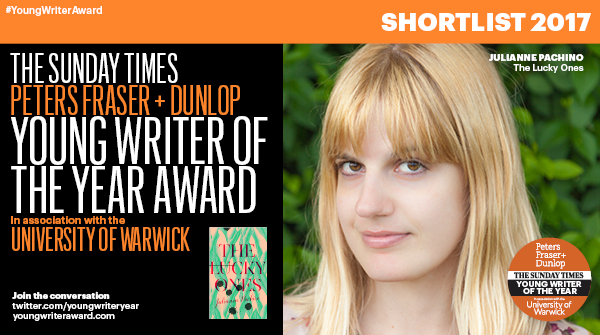 Sunday Times Young Writer of the Year Award shortlist review #3
If you’ve been following the shadow panel’s progress on Twitter, you’ll know that we’re all extremely impressed with this one. Marketed as a novel in America but as a short story collection here in the UK, The Lucky Ones is really somewhere in between: it’s a linked story collection in which the 11 chapters could stand alone but are so much richer together. Each generally adds a layer of meaning to the others by filling in the background or following a certain character a decade or more into the future. The book keeps creeping backward and leaping forward to show how terror endured in one’s past never really goes away.
The title certainly seems ironic, as many of the schoolmates, teachers and hangers-on who people these Colombia-set stories face imprisonment, torture or disappearance. The story titles, too, seem innocuous, even sweet. But the first story, “Lucky,” sets the precedent for things turning very dark very fast. Stephanie Lansky’s family leaves for a weekend party at the Montoyas’ country house, but teenage Stephanie stays home, planning to smoke in secret and meet up with a friend at the mall. Scary snatches of radio dialogue about Communist rebels and bombs contrast with her escapist re-reading of Arthurian romances, but the threat becomes real when a man comes to the door to get her. With the maid missing and her parents not answering their phones, she’s effectively a hostage in her own home. The open-ended conclusion is masterly; its “could be,” “maybe” and “It’s still possible” phrases leave the reader to wonder whether Stephanie will be one of the lucky ones or not.
The stories range from 1993 to 2013, and over those two decades we zoom in and out to visit some of Stephanie’s classmates and teachers. For instance, in “Lemon Pie,” my favorite individual story, her teacher, Mr. B., is now a prisoner in a jungle camp and nourishes what little sanity he has left by teaching his old Hamlet lesson plans to groups of leaves and sticks. In the next story, “M + M,” we meet another of Mr. B.’s pupils, a scholarship student who fell out spectacularly with a friend over their differing class status. Ten years later, he’s a guerrilla commander so harsh that he orders deserters executed by their friends.
 Seven of the stories are in the third person, but others add in some interesting variety: in “Siberian Tiger Park,” the third graders of Stephanie’s class form a first-person plural voice as they set their vivid imaginations loose on the playground and turn against their former ringleader, and “The Bird Thing,” a slice of horror in which a maid’s traumatic memories feed a monster, is told in the second person. And then there’s “Junkie Rabbit,” a first-person story set among a coca-consuming colony of pet rabbits gone feral. It’s Watership Down on speed. Indeed, drug use and wildness are recurring tropes, and there’s a hallucinatory quality to these stories – somewhere between languid and frantic – that suits the subject matter.
Before starting this I knew nothing about the relatively recent conflict in Colombia. It’s estimated that there were 60,000 forced disappearances on top of the documented carnage. We meet one character who has his hand chopped off for “publishing the wrong kind of articles,” but the country’s atrocities usually show up in asides, woven in so subtly and elegantly that they’re among the most arresting passages in the book:
On Saturdays … you got to run to the riverside, slide down the bank, and go swimming or throw stones or try to catch tiny silver fish with your bare hands, then feed them leftovers from lunch. Except when the bodies were floating in the water. Rumor was that men always floated face up, women face down. Sometimes there were vultures sitting on them and sometimes not. But if there were bodies, you would just go to the little stream instead and that was better. There the fish would eat rice straight from your hand, grains floating through the water like confetti thrown at a wedding.
Almost every story has at least one paragraph that striking. I thought two stories added less than the others and might have been cut to get the page count down closer to 200, but for the originality of the setup and the sheer excellence of the writing this book can’t be topped.
More shadow panel reviews of The Lucky Ones:
Annabel’s at Annabookbel
Clare’s at A Little Blog of Books
Dane’s at Social Book Shelves
Eleanor’s at Elle Thinks
Talking ’bout My Generation? Conversations with Friends by Sally Rooney
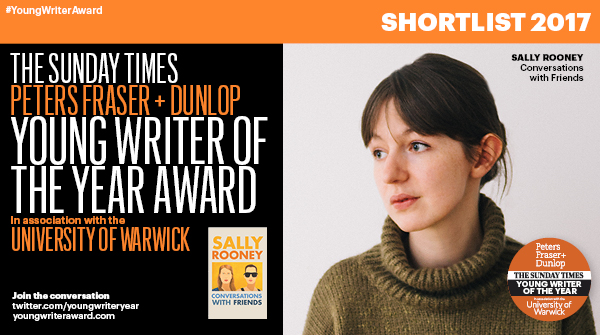 Sunday Times Young Writer of the Year Award shortlist review #2
The first thing to note about a novel with “Conversations” in the title is that there are no quotation marks denoting speech. In a book so saturated with in-person chats, telephone calls, texts, e-mails and instant messages, the lack of speech marks reflects the swirl of voices in twenty-one-year-old Frances’ head; thought and dialogue run together. This is a work in which communication is a constant struggle but words have lasting significance.
 It’s the summer between years at uni in Dublin, and Frances is interning at a literary agency and collaborating with her best friend (and ex-girlfriend) Bobbi on spoken word poetry events. She’s the ideas person, and Bobbi brings her words to life. At an open mic night they meet Melissa, an essayist and photographer in her mid-thirties who wants to profile the girls. She invites them back for a drink and Frances, who is from a slightly rough background – divorced parents and an alcoholic father who can’t be relied on to send her allowance – is dazzled by the apparent wealth of Melissa and her handsome actor husband, Nick. Bobbi develops a crush on Melissa, and before too long Frances falls for Nick. The stage is set for some serious amorous complications over the next six months or so.
Young woman and older, married man: it may seem like a cliché, but Sally Rooney is doing a lot more here than just showing us an affair. For one thing, this is a coming of age in the truest sense: Frances, forced into independence for the first time, is figuring out who she is as she goes along and in the meantime has to play roles and position herself in relation to other people:
At any time I felt I could do or say anything at all, and only afterwards think: oh, so that’s the kind of person I am.
I couldn’t think of anything witty to say and it was hard to arrange my face in a way that would convey my sense of humour. I think I laughed and nodded a lot.
What will be her rock in the uncertainty? She can’t count on her parents; she alienates Bobbi as often as not; she reads the Gospels out of curiosity but finds no particular solace in religion. Her other challenge is coping with the chronic pain of a gynecological condition. More than anything else, this brings home to her the disappointing nature of real life:
I realised my life would be full of mundane physical suffering, and that there was nothing special about it. Suffering wouldn’t make me special, and pretending not to suffer wouldn’t make me special. Talking about it, or even writing about it, would not transform the suffering into something useful. Nothing would.
 Rooney writes in a sort of style-less style that slips right down. There’s a flatness to Frances’ demeanor: she’s always described as “cold” and has trouble expressing her emotions. I recognized the introvert’s risk of coming across as aloof. Before I started this I worried that I’d fail to connect to a novel about experiences so different from mine. I was quite the strait-laced teen and married at 23, so I wasn’t sure I’d be able to relate to Frances and Bobbi’s ‘wildness’. But this is much more about universals than it is about particulars: realizing that you’re stuck with yourself, exploring your sexuality and discovering that sex is its own kind of conversation, and deciding whether ‘niceness’ is really the same as morality.
With its prominent dialogue and discrete scenes, I saw the book functioning like a minimalist play, and I could also imagine it working as an on-location television miniseries. In some ways the dynamic between Frances and Bobbi mirrors that between the main characters in Paulina and Fran by Rachel B. Glaser, Friendship by Emily Gould, and The Animators by Kayla Rae Whitaker, so if you enjoyed any of those I highly recommend this, too. Rooney really captures the angst of youth:
You’re twenty-one, said Melissa. You should be disastrously unhappy.
I’m working on it, I said.
This is a book I was surprised to love, but love it I did. Rooney is a tremendous talent whose career we’ll have the privilege to watch unfolding. I’ve told the shadow panel that if we decide our focus is on the “Young” in Young Writer, there’s no doubt that this nails the zeitgeist and should win.
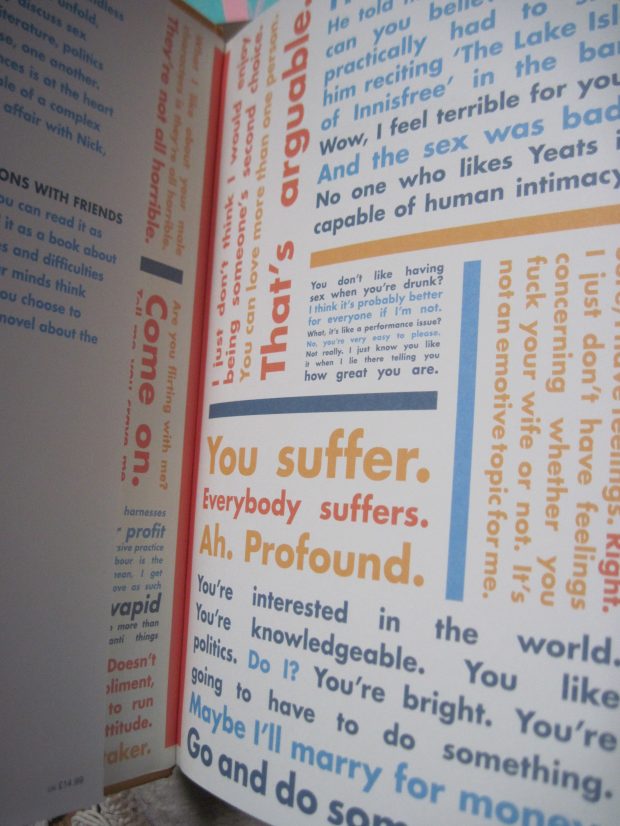
The conversations even spill out onto the endpapers.
Reviews of Conversations with Friends:
From the shadow panel:
Annabel’s at Annabookbel
Clare’s at A Little Blog of Books
Dane’s at Social Book Shelves
Eleanor’s at Elle Thinks
Others:
Jacob’s Room Is Full of Books by Susan Hill
Susan Hill has published dozens of books in multiple genres, but is probably best known for her perennially popular ghost story, The Woman in Black (1983). Apart from that and two suspense novellas, the only book I’d read by her before is Howards End Is on the Landing (2009), a sort of prequel to this work. Both are bookish memoirs animated by the specific challenge to spend more time reading from her shelves and revisiting the books that have meant the most to her in the past. Though not quite a journal, this is set up chronologically and also incorporates notes on the weather, family events and travels, and natural phenomena encountered near her home in Norfolk.
The Virginia Woolf reference in the title is fitting, as Hill realizes she has four shelves’ worth of books about Woolf and her Bloomsbury set. It’s just one of many mini-collections she discovers in her library on regular “de-stocking” drives when she tries to be realistic about what, at age 75, she’s likely to reread or reference in the future. “A book that cannot be returned to again and again, and still yield fresh entertainment and insights, is only half a book,” Hill contends. Some authors who merit frequent rereading for her are Edith Wharton, Muriel Spark, W. Somerset Maugham and Olivia Manning, while other passions had a time limit: she’s gone off E.F. Benson, and no longer reads about Antarctica or medieval theology.
 Hill is unashamedly opinionated, though she at least has the humility to ask what individual taste matters. Her substantial list of no-nos includes fairy tales, science fiction, Ethan Frome, Patricia Highsmith and e-readers, and she seems strangely proud of never having read Jane Eyre. She’s ambivalent about literary festivals and especially about literary prizes: they were a boon to her as a young author, but she was also on the infamous 2011 Booker Prize judging panel, and disapproves of that prize being opened up to American entries.
As well as grumpy pronouncements, this book is full of what seems like name-dropping: encounters with Iris Murdoch, J.B. Priestley, Susan Sontag and the like. (To be fair, the stories about Murdoch and Sontag are rather lovely.) Although aspects of this book rubbed me the wrong way, I appreciated it as a meditation on how books are woven into our lives. I took note of quite a few books I want to look up, and Hill ponders intriguing questions that book clubs might like to think about: Can we ever enjoy books as purely as adults as we did as children, now that we have to “do something” with our reading (e.g. discussing or reviewing)? Is it a lesser achievement to turn one’s own life experiences into fiction than to imagine incidents out of thin air? Will an author unconsciously “catch the style” of any writer they are reading at the time of their own compositions? Is it better to come to a book blind, without having read the blurb or anything else about it?
You’ll applaud; you’ll be tempted to throw the book at the wall (this was me with the early page disparaging May Sarton). Perhaps on consecutive pages. But you certainly won’t be indifferent. And a book that provokes a reaction is a fine thing.
Some favorite lines:
“Cold room, warm bed, good book.”
“I have had fifty-five years of experience but still every book is like walking a tightrope. I might fall off.”
“People say they can never part with a book. I can. As fast as I get one out of the back door, two new ones come in through the front anyway.”
“How many people are there living in the books here? Only take the complete novels of Dickens and add up all the characters in each one and then multiply by … and I already need to lie down. Overall, there must be thousands of imaginary people sharing this house with us.”
“One of the best presents anyone can give you is the name of a writer whose books they believe will be ‘you’ – and they are. Someone you would almost certainly never have found for yourself.”
My rating:
Jacob’s Room Is Full of Books was released in the UK on October 5th. My thanks to Profile Books for the free copy for review.
On the Road with Ma: The Lauras by Sara Taylor
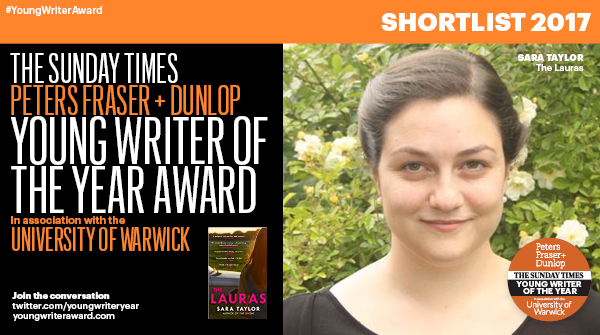
Sunday Times Young Writer of the Year Award shortlist review #1
Sara Taylor’s debut, The Shore, was a gritty and virtuosic novel-in-13-stories that imagined 250 years of history on a set of islands off the coast of Virginia. It was one of my favorite books of 2015, and earned Taylor a spot on that year’s Sunday Times Young Writer of the Year Award shortlist as well as the Baileys Prize longlist. Her second book is a whole different kettle of fish: a fairly straightforward record of an extended North American road trip that 13-year-old Alex took with his/her mother 30 years ago.
Alex and Ma have run off from their home in Virginia and left Alex’s father behind. They travel, seemingly at random, all over – North Carolina, Michigan, Mississippi, Nevada, California – stopping for weeks at a time for Ma to earn enough to move on again. On the way they visit various sites from Ma’s past, mostly foster homes where she lived as a runaway teen and made fleeting connections with friends and lovers. Her five best friends were all apparently named Laura. Sometimes it seems Ma is after revenge; other times she’s making amends for mistakes from her past or attending to unfinished business. One thing gradually becomes clear: this is no arbitrary journey but a quest with a destination. It even has a Harold Fry element, though Taylor avoids Rachel Joyce’s schmaltz.
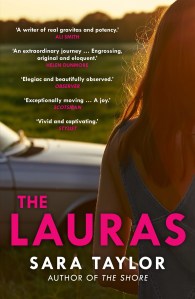 The Lauras is more complex than your average coming-of-age tale, largely because of Alex’s deliberate androgyny: a whole novel passes without us figuring out whether the narrator is male or female. “I suppose I was forgettable, came across still as whichever gender a person expected to see … being either and neither and both at once fit me more closely than the other options on offer,” Alex writes. But this chosen indeterminateness is not without consequences: there are a couple of disturbing scenes of bullying and sexual assault.
I enjoyed the mother-and-teen banter and the depiction of characters who are restless and rootless, driven on by traumatic memories as much as by uncertainty about the future. However, I had a few problems with the book. A road trip is generally a fun fictional setup, but here it tends towards the episodic and the repetitive. Moreover, Ma’s past is generally conveyed by secondhand stories rendered in Alex’s voice, which subordinates Ma’s perspective to her child’s and relies on somewhat dull reportage. Also, the metaphorical language and level of psychological understanding seem too advanced for a young teen, which only emphasizes the disjunction between the events being recounted (perhaps from the 1990s?) and the supposed present day three decades later. Those niggles explain why I abandoned this book a third of the way through on my first attempt in December 2016, and why, for me at least, it overall pales in comparison with the originality of The Shore.

I prefer this cover image.
Bearing in mind that I might be meeting these authors at the shortlist event or prize-giving ceremony, I’m not going to rate the five ST Young Writer books. (It wouldn’t take much sleuthing to find my Goodreads ratings, but never mind.) I’m still a huge fan of Sara Taylor’s work and look forward to her next book; were this to be the consensus of the rest of the shadow panel I would happily recognize it, but it’s unlikely to be one of my top two.
Other reviews of The Lauras:
Postscript: Taylor and I have a few neat connections: she graduated from Randolph College (formerly Randolph-Macon Women’s College), whose study abroad program in Reading, England brought me over here for the first time, and when not working on her PhD at UEA lives with her husband in Reading. Plus a tiny mention from The Lauras made me cheer: Ma went to Hood College, my alma mater!
Where My Books Come From
This challenge Laura (Reading in Bed) posted the other day is just too fun for me to pass up, plus it allows me to get a jump on my 2017 statistics. The idea is to look at the last 30 books you’ve read and note where you got hold of each one – whether from the publisher, the library, new or secondhand at a bookshop, etc. If you wish, you can also look at the whole year’s books and work out percentages. Leave a comment to let me know what you figure out about your own books’ provenance.

My bedside table (and environs): always a mix of secondhand, library and review copies.
Fall Down 7 Times Get Up 8: A Young Man’s Voice from the Silence of Autism, Naoki Higashida: Public library
A Girl Walks into a Book: What the Brontës Taught Me about Life, Love, and Women’s Work, Miranda K. Pennington: E-book from Edelweiss
The Great Profundo and Other Stories, Bernard MacLaverty: Secondhand copy from Book-Cycle, Exeter
Dakota: A Spiritual Geography, Kathleen Norris: Free from the Book Thing of Baltimore
Finding Myself in Britain: Our Search for Faith, Home and True Identity, Amy Boucher Pye: Christmas gift from my Amazon wish list last year
No Apparent Distress: A Doctor’s Coming-of-Age on the Front Lines of American Medicine, Rachel Pearson: PDF from publisher
At Seventy: A Journal, May Sarton: Secondhand copy from Wonder Book and Video
A Wood of One’s Own, Ruth Pavey: Free from publisher
A Sand County Almanac and Sketches Here and There, Aldo Leopold: University library
Ghost Stories of an Antiquary Vol. II, M.R. James: Free from publisher
This Little Art, Kate Briggs: Free from publisher
Reputations, Juan Gabriel Vásquez: Gift from a Goodreads friend
The Rector’s Daughter, F.M. Mayor: Secondhand copy from a charity shop
An English Guide to Birdwatching, Nicholas Royle: Gift from a Goodreads friend
The Fact of a Body: A Murder and a Memoir, Alexandria Marzano-Lesnovich: E-book from Edelweiss
Unruly Creatures: Stories, Jennifer Caloyeras: PDF from author
One Year Wiser: An Illustrated Guide to Mindfulness, Mike Medaglia: Free from publisher
A Glorious Freedom: Older Women Leading Extraordinary Lives, Lisa Congdon: PDF from publisher
Dreadful Wind and Rain: A Lyrical Fairy Tale, Diane Gilliam: Won in Twitter giveaway
As a God Might Be, Neil Griffiths: Free from publisher
Devil’s Day, Andrew Michael Hurley: E-book from NetGalley
Interlibrary Loan Sharks and Seedy Roms: Cartoons from Libraryland, Benita L. Epstein: University library
Skating at the Vertical: Stories, Jan English Leary: E-book from NetGalley
Master Georgie, Beryl Bainbridge: Free from work staff room years ago
The Immortalists, Chloe Benjamin: Free proof copy for Bookbag review
Jacob’s Room Is Full of Books, Susan Hill: Free from publisher
Slade House, David Mitchell: Public library
The Lauras, Sara Taylor: Free for Sunday Times Young Writer of the Year Award shadow panel reading
Survival Lessons, Alice Hoffman: Birthday gift from my Amazon wish list
A Field Guide to the North American Family, Garth Risk Hallberg: Free from publisher
And the statistics for 2017 so far:
- Free print or e-copy from publisher: 30.11% (Wow – how lucky am I?!)
- Downloaded from NetGalley or Edelweiss: 22.3%
- Public library: 18.22%
- Secondhand purchase: 15.24%
- Free (other) = from giveaways or Book Thing of Baltimore: 6.69%
- Gifts: 6.32%
- University library: 1.12%
The November Outlook
Normally I’d start the month off with a few recommendations for new books, but I’ve only finished one November book I can recommend (Skating on the Vertical, short stories by Jan English Leary; not yet reviewed); I DNFed another couple and skimmed one more. So instead I’ll give a quick survey of what the month holds.
- Young Writer of the Year reviews and events. I’ve read The Lauras; expect my review on Monday. I’m currently reading The Lucky Ones, Conversations with Friends, and the Steven Runciman biography, which will be my doorstopper for the month. There will be a shortlist event in London on the 18th, and on the 24th the shadow panel is meeting up to select a winner.

- I’ll be finishing up a brief climate change feature for Foreword Reviews magazine, consisting of mini-reviews of four upcoming books on an environmental theme.
- Review books I owe write-ups for: Jacob’s Room Is Full of Books by Susan Hill (released last month) and The Smell of Fresh Rain by Barney Shaw (out on the 14th). I’m fascinated by the science of smell and taste, so I’m intrigued to find out what Shaw has to say about a sense that often gets little attention.
- Blog tour for Celeste Ng’s new novel, Little Fires Everywhere, on the 14th. I haven’t started it yet but I’m looking forward to it immensely.
- You’d think with all those review books and library piles I wouldn’t be taking on any more projects…but I couldn’t resist agreeing to another “Book Wars” column (my third) for Stylist magazine, due on the 17th. I used to love reading Stylist when I worked in London; if you’re lucky enough to come across the magazine in your commuting, look out for my contribution to the Christmas-themed special.
- The Iris Murdoch Readalong begins with Under the Net. I’ll aim to squeeze it in before the end of the month. (Can I count it as my Classic?!)
- If I get a chance, I’ll also participate in German Literature Month by reading Bernhard Schlink’s The Woman on the Stairs on my Kindle.
- I’m revisiting some of my favorite Victorian pastiches for an article on neo-Victorian novels for Bookmarks magazine, due at the end of the month.
- Otherwise, I’ll be focusing on novellas for November, including some nonfiction novellas. I have a big pile of books set aside that are around 150 pages or shorter. I’ll get to as many of them as I can and summarize them in a roundup or two. They’re quick wins, true, often read in a single sitting (I read Alice Hoffman’s Survival Lessons this morning, for instance), but this doesn’t feel like a cheaty way to build up the book list because brevity is such an admirable skill.
How does November look for you?
A Few Spooky Reads for Halloween
I’m not at all one for scary books; horror and even crime fiction rarely make it onto my reading agenda. But in advance of Halloween I did read a few books that would count as creepy. Maybe you’ll fancy picking one of them up today?
Ghost Stories of an Antiquary, Vol. II by M.R. James
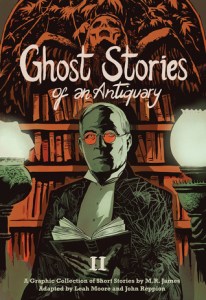 I’ve only ever read one M.R. James piece before, in an anthology of stories about libraries. This was perhaps not an ideal way to encounter his ghost stories for the first time. Though all four (“Number 13,” “Count Magnus,” “Oh, Whistle and I Will Come to You, My Lad” and “The Treasure of Abbot Thomas”) are adapted by the same pair, Leah Moore and John Reppion, each is illustrated by a different artist, so the drawing style ranges from rounded and minimalist to an angular, watercolor Marvel style. The stories have thematic links of research, travel, archaeological discovery and antiquities. Very often there are found documents that must be interpreted. Several narrators are scholars coming across unexplained phenomena: a hotel room that appears and disappears, a sarcophagus lid that opens on its own, a storm summoned by a whistle, and so on.
In a brief introduction, Jason Arnopp applauds the decision to “show readers the ghouls and ghosts,” but I disagree – to me a central problem with using the graphic form for these tales that center around nameless horror is that depicting the source of horror saps it of its power. Still, I appreciated the introduction to James’s ghost stories.
My rating:
With thanks to SelfMadeHero for the free copy for review.
Devil’s Day by Andrew Michael Hurley
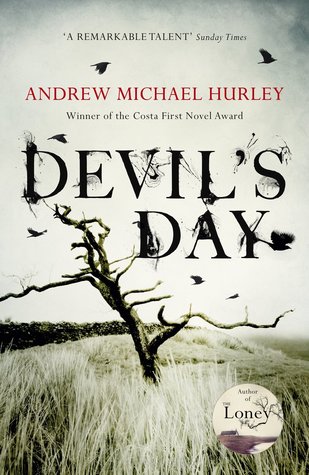 In Hurley’s Lancashire farmland setting, Devil’s Day is a regional Halloween-time ritual when the locals serve up the firstborn lamb of spring as a sacrifice to ward off the Devil’s shape-shifting appearance in the human or animal flock. Is it all a bit of fun, or necessary for surviving supernatural threat? We see the year’s turning through the eyes of John Pentecost, now settled back on his ancestral land with his wife, Kat, and their blind son, Adam. However, he focuses on two points from his past: his bullied childhood and a visit home early on in his marriage that coincided with the funeral of his grandfather, “the Gaffer”. The Endlands is a tight-knit community with a long history of being cut off from everywhere else, which makes it an awfully good place to keep secrets.
The first and last quarters of the book flew by for me, while the middle dragged a bit. The rural atmosphere and the subtle air of menace reminded me of Elmet and Bellman and Black. I’ll certainly seek out Hurley’s acclaimed debut, The Loney. [Read via NetGalley]
Favorite lines:
“Nothing changed in Underclough. Nothing happened. Not really. … elsewhere was always a place where the worst things happened. … The world outside the valley might well collapse but we wouldn’t necessarily feel the ripples here.”
My rating: 
Slade House by David Mitchell
“If I could just see a ghost, just once … Just one ghost, so I know that death’s not game over, but a door.”
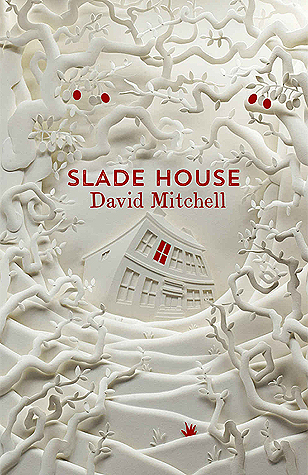 This was so cool! I feel like I’d never experienced a “real” Mitchell book before (having only read The Thousand Autumns of Jacob de Zoet, which is in some ways the odd one out), and I was impressed by how he brings everything together in this short novel. Every nine years between 1979 and 2015, a different visitor gets sucked into the treacherous world-within-a-world of the Grayer twins’ Slade House. This dilapidated mansion located off an unassuming alley morphs to fit each guest’s desires. To reveal more would spoil the fun, so I’ll just say that I love how Mitchell lulls you into a pretty horrific pattern before springing a couple of major surprises in later chapters. Each time period and narrator feels distinct and believable, and I’m told one character is from two other Mitchell novels (and the phrase “bone clock” even makes an appearance). I need to pick up Cloud Atlas soon for sure. [Public library copy]
My rating: 
Recommended spooky listening: The album That Ghost Belongs to Me by The Bookshop Band – all songs inspired by scary books.
Did you read anything scary this Halloween season?
Library Checkout Reboot
The Library Checkout blog meme was created by Shannon of River City Reading and previously hosted by Charleen of It’s a Portable Magic. I’m taking over as the host as of this month. There’s nothing too complicated about this challenge; it’s just a way of celebrating the libraries that you frequent, whether that’s your local public library branch or another specialist library. Maybe keeping track of your borrowing habits will encourage you to make even more use of libraries. Use ’em or lose ’em, after all.

I usually post this on the last Monday of the month, but you can post whenever is convenient for you. I’ll look into a proper link-up service, but for now just paste a link to your own post in the comments. (Feel free to use the above image, too.) The basic categories are: Library Books Read; Currently Reading; Checked Out, To Be Read; On Hold; and Returned Unread. Others I sometimes add are Skimmed Only and Returned Unfinished. I generally add in star ratings and links to reviews of any books I’ve managed to read.
A couple of weeks ago I went nuts at the university library on my husband’s campus. As a staff member he can borrow 25 books pretty much indefinitely (unless they’re requested). One or both of us has been associated with the University of Reading for over 15 years now, so the library there is a nostalgic place I love visiting. It’s technically currently undergoing a major renovation, but the books are still available, so it doesn’t make much difference to me.
LIBRARY BOOKS READ
- Interlibrary Loan Sharks and Seedy Roms: Cartoons from Libraryland by Benita L. Epstein
 (So dated, I’m afraid! A few good ones, though.)
 - Fall Down 7 Times, Get Up 8 by Naoki Higashida
- Autumn by Karl Ove Knausgaard
- A Sand County Almanac by Aldo Leopold [university library]

SKIMMED ONLY
- Option B by Sheryl Sandberg and Adam Grant
CURRENTLY READING
- Slade House by David Mitchell
- Halfway to Silence by May Sarton [poetry; university library]
CHECKED OUT, TO BE READ
A manageable selection from the public library:
Plus loads of books from lots of different genres from the university library; these will keep me going well past Christmas, I reckon!


RETURNED UNFINISHED
- The Seventh Function of Language by Laurent Binet
Have you been taking advantage of your local libraries? What appeals from my library stacks?
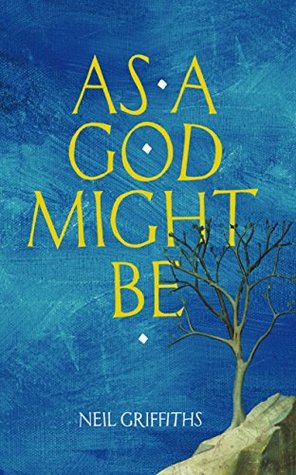
As a God Might Be by Neil Griffiths
[Note: A shortened, edited version of this review appeared in the June 15th, 2018 issue of the Church Times.]
Proctor McCullough isn’t a churchgoer. He’s not even particularly religious. Yet somehow he senses that God is calling him to build a chapel, with a little house beside it, on a cliff in the southwest of England. It’s a source of bewilderment for his partner, Holly, and their London friends. Is Mac mentally ill, or having a particularly acute midlife crisis? He’s handed off from a minister to a therapist to a neurologist, but no one knows what to make of him. This forty-four-year-old father of two, an otherwise entirely rational-seeming advisor to the government on disaster situations, won’t be deterred from his mission.
It’s important to get a sense of the way this character speaks:
I want a structure that will move people to contemplate something other than all the obvious stuff … to be confronted with a sense of something and only be able to define it as Other.
God is the transcendent Other for whom creation, what we know as life, is a gratuitous act of love, a dispossession of a portion of His infinite creativity given over to our thriving. It is a gift from His infinite excess. That we can know Him at all is because of the possibility of this excess within us, which we experience as love, art, great feats of the mind. Our bounty is Him.
Down at the project site, Mac acquires four young workers/disciples: Rebecca, Nathaniel, Terry and Rich. Rebecca is a sarcastic, voluptuous teenager who will be off to Cambridge in a few months. She perhaps represents vanity, temptation and judgment, while the other three are more difficult to slot into symbolic roles. Terry is a dreadlocked lager lout who takes care of a mother with early dementia; contrary to appearances, he’s also a thinker, and takes to carrying around a Bible along with a collection of other theological works. Nat and Rich are more sketch-like figures, just ciphers really, which became problematic for me later on.
 With Mac we shuttle between the building site and his home in London for weeks at a time. The idea of incorporating Pascal’s mystical hexagon into the church design captivates him, and the costs – initially set at £100,000 – balloon. Meanwhile, his relationship with Holly is strained almost to the breaking point as they each turn to alternative confidants, and there’s a renegotiation process as they decide whether their actions have torn them apart for good.
Like Sarah Moss, Neil Griffiths realistically blends serious concepts with everyday domestic tasks: sure, there may be a God-ordained chapel to build, but Mac also has to do the shopping and get his six-year-old twins fed and in bed at a decent hour. If Mac is meant to be a Messiah figure here, he’s a deeply flawed one; he can even be insufferable, especially when delivering his monologues on religion. If you’re like me, you’ll occasionally get incensed with him – particularly when, at the midpoint, he concocts a Clintonian justification for his behavior.
All the same, the themes and central characters were strong enough to keep me powering through this 600-page novel of ideas. Mac’s violent encounters with God and with the nature of evil are compelling, and although some of the events of the last third push the boundaries of credibility, it’s worth sticking with it to see where Griffiths takes the plot. There’s no getting past the fact that this is a dense theological treatise, but overlaid on it is a very human story of incidental families and how love sustains us through the unbearable.
If I had to point to the novel’s forebears, I’d mention Hamlet, A.S. Byatt’s The Virgin in the Garden, Michael Arditti’s Easter, and even Ayn Rand’s The Fountainhead. If you’ve read any Dostoevsky (I haven’t, yet) or Iris Murdoch, you’ll likely spot philosophical echoes. The title itself is from Wallace Stevens. It’s all unabashedly highbrow, and a greater than average familiarity with the Christian tradition is probably key. For the wary, I’d suggest not trying too hard to read metaphorical significance into character names or chapter and section titles – I’m sure those meanings are in there, but better to let the story carry you along rather than waste time trying to work it all out.
While reading this novel I was bitterly regretting the demise of Third Way magazine; it would have been a perfect place for me to engage with Griffiths’ envelope-pushing theology. I was also wishing I was still involved with Greenbelt Festival’s literature programming, as this would make a perfect Big Read. (Though however would we get people to read 600 pages?! In my experience of book clubs, it’s hard enough to get them to read 200.)
I’m grateful to Dodo Ink (“an independent UK publisher publishing daring and difficult fiction”) for stepping into the breach and taking a chance on a book that will divide Christians and the nonreligious alike, and to publicist Nicci Praça for the surprise copy that turned up on my doorstep. This turned out to be just my sort of book: big and brazen, a deep well of thought that will only give up its deeper meanings upon discussion and repeat readings.
My rating:
As a God Might Be was published in the UK by Dodo Ink on October 26th. This is Neil Griffiths’ third novel, after Betrayal in Naples (2004) and Saving Caravaggio (2006). He says that this most recent book took him seven years to write.
 Bookish Beck = Rebecca Foster. American transplant to England. Freelance proofreader and book reviewer.
