Adventures in the Town of Books
We had a wonderful time in Hay-on-Wye. The weather was gorgeous – which we never would have counted on in Wales in early April – and it was a treat to get out into the countryside. Even though there were road works on the main route through Hay and a house under construction across from our Airbnb property, it was so quiet most of the time. Most often we only heard sheep and pheasants in the fields or songbirds flitting around the garden. We’ve been back to normal life for a few days, but the contrast between Hay and our terraced street’s noisy neighbors and frequent car movement has remained stark. Also, I greatly enjoyed the time off work, and struggled to clear 200+ e-mails the day after we got back.


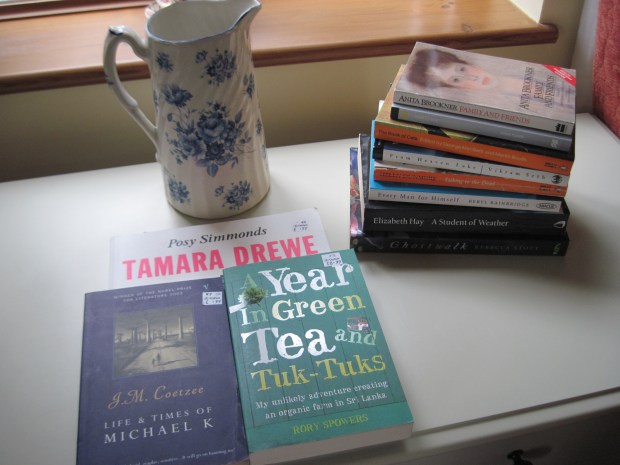
Early bargains came from the Oxfam charity shop (a box outside with paperbacks at 5 for £1, plus various nearly new copies at 99p each) and the ‘honesty’ shopping areas around the castle (50p paperbacks and £1 hardbacks). Each day my husband’s and my rival stacks kept growing.
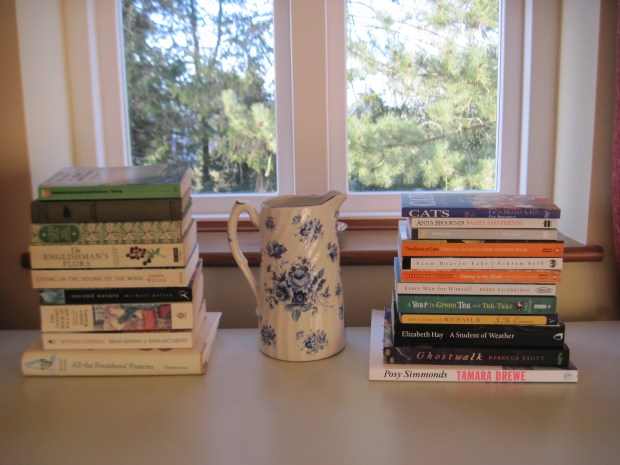
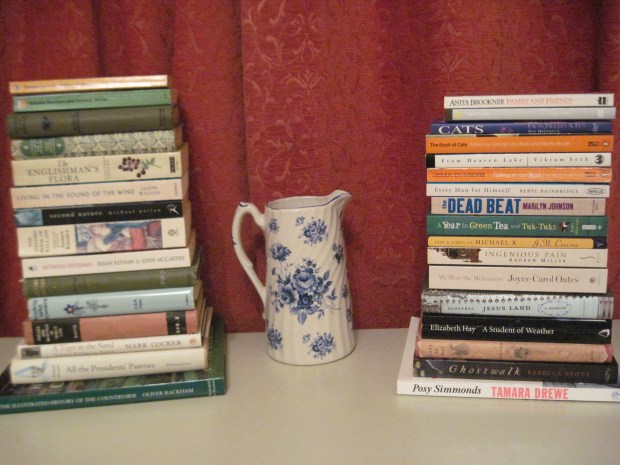
In the end we purchased 40 books, averaging ~£1.48 each: 3 gifts (alas that we couldn’t do better in this respect) plus another 18 or 19 books each. All very equitable! My husband focused on nature and travel, including some rare and novelty insect books.
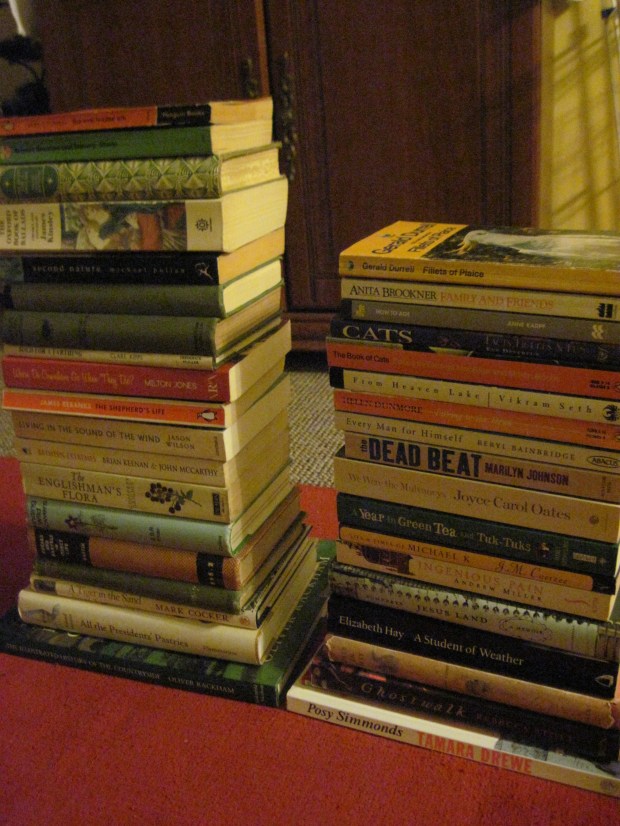
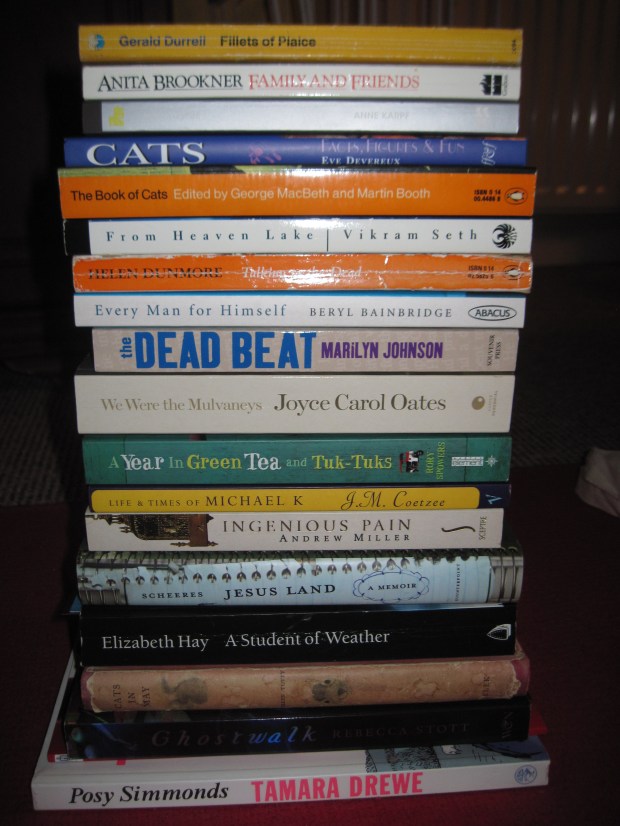
Some of my prize finds were a vintage copy of the next book in Doreen Tovey’s cat series, a copy of the Joyce Carol Oates novel I intend to make my introduction to her work, and Marilyn Johnson’s book on obituaries. As a bonus, three of the books I bought are ones I’ve already read: Vikram Seth’s travel book on China, How to Age from the School of Life series – a total bargain at 50p!, and Posy Simmonds’ Tamara Drewe, an update of Thomas Hardy’s Far from the Madding Crowd and one of the first graphic novels I ever read and loved.
Of course, I didn’t end up reading very much (or any) of many of the books I took with me. I glanced at The Rebecca Rioter, but didn’t find it at all interesting; I forgot to look at The Airbnb Story; and I seem to be stuck fast just two chapters into Our Mutual Friend. On the other hand, I’ve been enjoying Bruce Chatwin’s On the Black Hill, of which I read over half, and I made good progress in George Saunders’s Lincoln in the Bardo.
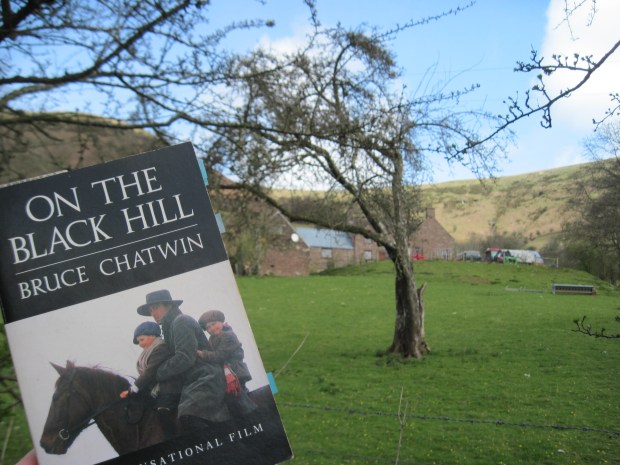
We sought out “The Vision” farm we found on the map, which presumably inspired Chatwin.
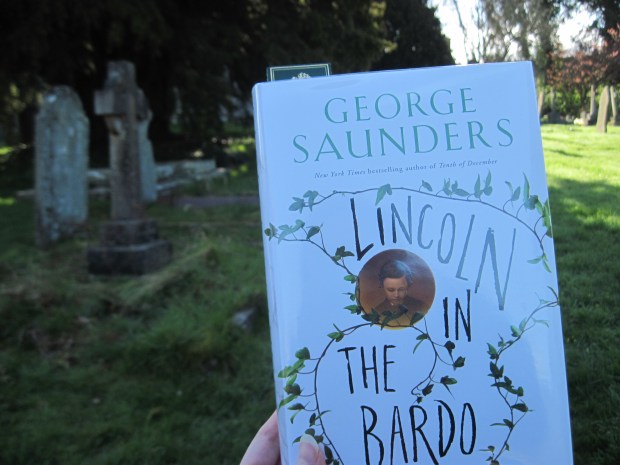
I took Lincoln in the Bardo for a jaunt up the road to the Cusop churchyard; it seemed an appropriate spot.
It’s also been fun to browse Francis Kilvert’s diary entries from his years as the curate in nearby Clyro. In one of my favorite passages, he expresses horror at finding British tourists overrunning Llanthony Abbey ruins. For a minister, he certainly sounds like a misanthrope:
I had the satisfaction of managing to walk from Hay to Clyro by the fields without meeting a single person, always a great triumph to me and a subject for warm self congratulation for I have a peculiar dislike to meeting people, and a peculiar liking for a deserted road.
We went out to Llanthony for the first time on this trip, and paid Clyro’s church a visit, too.
-

- Llanthony Priory ruins
-

- Clyro’s church
-
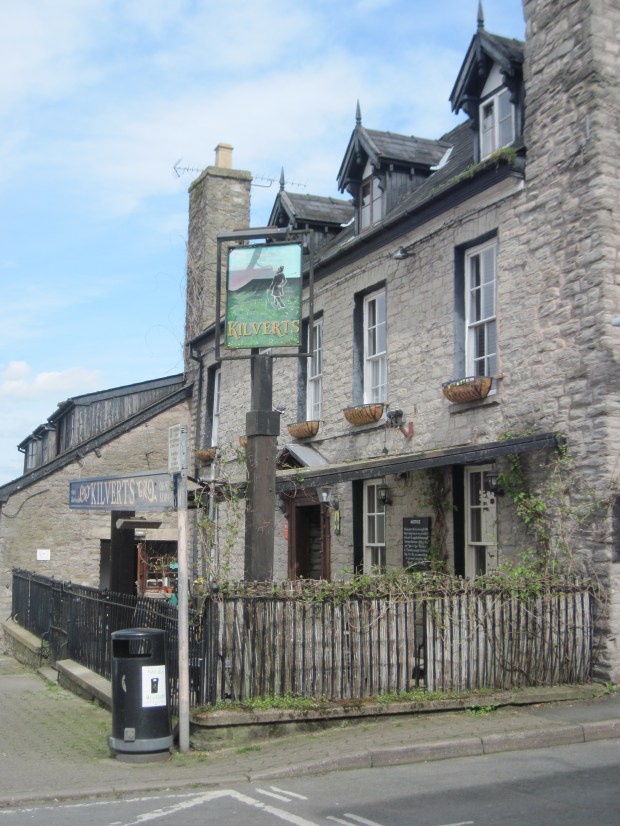
- Kilverts restaurant in Hay.
-
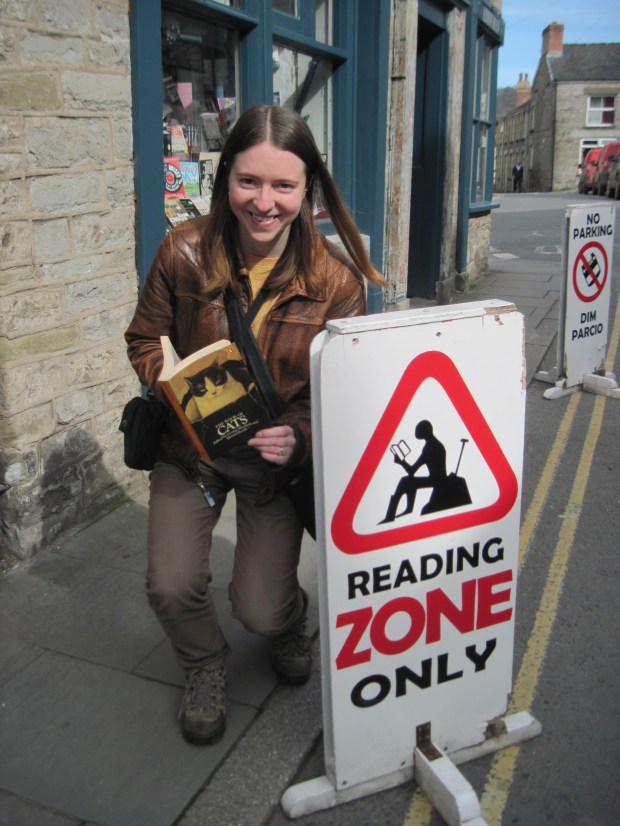
- In the reading zone.
-
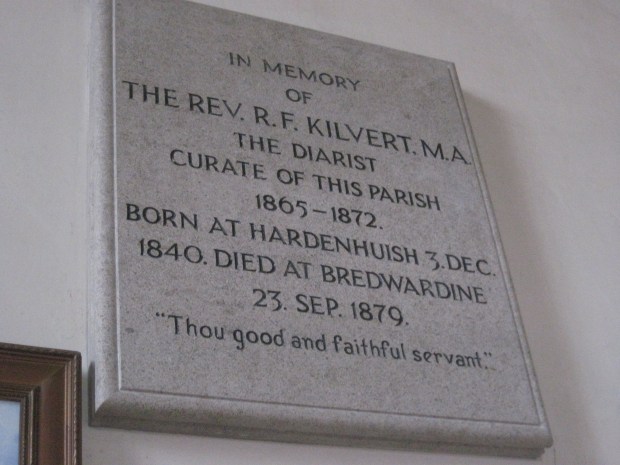
- Inside Clyro church.
-
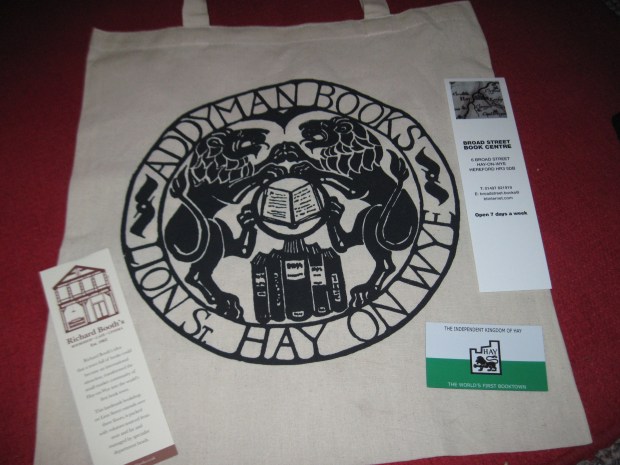
- New Hay swag! (tote, bookmarks and magnet)
Hay is much less shabby compared to our first visit. Many of the shops have been spruced up, and the pubs can’t get away with serving bog-standard fare anymore. A number of the newest eateries and entertainment venues are only open on weekends, so we’ll be sure to time our next trip to cover a Friday–Saturday. The town has even gained some hipster establishments, like a fair-trade shop and a coffee shop/vintage clothing emporium.
-
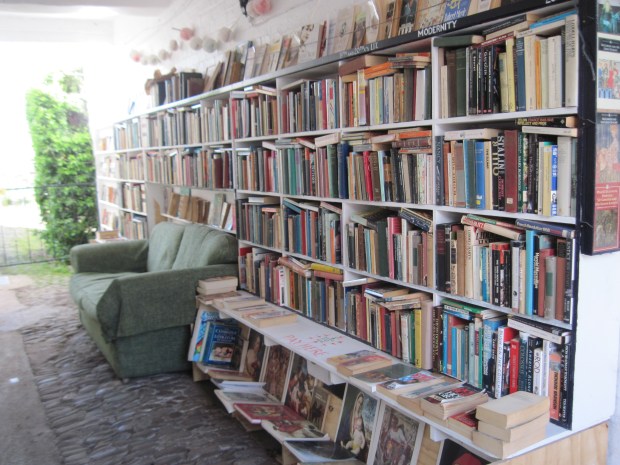
- You find books down every alley in Hay.
-

- A phoenix on the Hay Book Arts Trail.
-

- Best random spotting: a book A.S. Byatt once owned!
The Book Arts Trail was celebrating the 40 years of ‘independence’ of Richard Booth’s kingdom of Hay this year, and I expect we’ll still find the place going strong at 50.
Which of my book purchases tempt you?
The Devil and Webster by Jean Hanff Korelitz
It’s hard to resist a campus novel. The Devil and Webster, the sixth novel by Jean Hanff Korelitz, is unusual in focusing more on the administration than the students of a fictional American college. Webster College, Massachusetts was founded as a Native American training academy in the eighteenth century by missionary Josiah Webster. Now it rivals Harvard and other Ivy League schools, attracting liberal students with its enlightened gender and racial politics. (I had Swarthmore and Oberlin in mind as models.)
Yet Naomi Roth, Webster’s first female president, soon finds that racial and sexual tension still bubble under the surface here. A decade ago, her first major challenge as president was dealing with the uproar when Nell Jones-Givens, who lived in female-only Radclyffe Hall, began transitioning to become Neil. But now she faces an even stickier problem: A group of students have set up an Occupy-style camp in the center of the quad to protest the decision to deny tenure to Nicholas Gall, a popular African-American anthropology professor.
 The protest is spearheaded by Omar Khayal, a charismatic Palestinian refugee who wowed Naomi’s closest friend, Dean of Admissions Francine Rigor, with his application essay about growing up in the midst of conflict and surviving the death of his entire family. What Omar and these other outraged students don’t know – and Naomi can’t reveal because of the confidentiality of the process – is that Gall has a negligible publication record and was also found guilty of plagiarism. They instead presume that this is all because he is black.
What starts off as manageable dissent thus morphs into unpleasant, racially motivated retribution. “Webster is not a city on a hill. Webster is still the reactionary place it was before,” Omar declares in a media interview. In this context, Naomi’s upcoming Native American conference, though planned long ago, seems like a pathetic attempt at placation.
Throughout, the third-person narration sticks close to Naomi, a compelling protagonist not least because she’s a single mother and her daughter Hannah is also a protesting Webster student. By documenting Naomi’s thoughts (often in italics) versus what she says, Korelitz emphasizes the difficult position she’s in, always having to hold her tongue and speak diplomatically, as when addressing the protest camp:
“My only interest is in learning more about your concerns and your intentions. We share this community, and I’m sure we all want the best for it. If there are problems to be identified, issues to be discussed, changes to be made…whatever. It won’t happen if you won’t…” Talk, she wanted to say. Open your fucking mouths with their years of orthodontia and use those expensively educated voices to articulate your pathetic complaints about this…this halcyon, evolved, rarified, creative, and intellectual college campus, where you are free to learn and nap and make things and have sex and get high and change your fucking gender even, and clean water comes out of the tap and you wave your school ID under a scanner to help yourself to smorgasbords of food (meat! meat alternative! vegan! lactose-sensitive! nut-free! gluten-free!) and all we expect of you is that you pass your classes and don’t hurt anyone else. But she didn’t say these things. Of course she didn’t say them.
Naomi has her own background in feminist activism, but now, instead of being in a position to ‘speak truth to power,’ she has to realize that, as Francine reminds her, she is the power.
This is an interesting book about appearances and assumptions. Again and again characters make ethical compromises, proving how difficult it is to find and maintain the moral high ground. As the college’s historian points out to Naomi, from its very beginnings Webster has had a tendency towards capitulation. He plans to write up this story in a book called The Devil and Webster – which is also a reference to “The Devil and Daniel Webster,” the 1936 O. Henry Award-winning, Faustian short story by Steven Vincent Benét. I haven’t read the story, but looking at a synopsis I can see that it’s relevant in that it touches on themes of race, patriotism and the treatment of Native Americans.
The story line feels fresh and surprising, if at times melodramatic. My problem was more with the author’s style, which seemed to me old-fashioned and belabored. Korelitz has a habit of minutely describing everything: a house, a room, the food, the hairstyles, and so on. There are four pages on Naomi’s presidential wardrobe, and we get not just a passing reference to her PhD thesis but three pages on it. This means that it feels like it takes forever for the plot to get going. Much of modern fiction is more minimalist, I think, or would more naturally weave in its short bits of backstory. I even wondered if this book would have been better off as a collection of linked short stories from different points in Naomi’s or the college’s past.
This is all a shame, because while I liked the characters, dialogue and setting and enjoyed many of the turns of phrase (e.g. “filling in the spousal synapses” and “Garrison Keillor’s voice had a narcotic vocal element that always made her feel sleepy, each word a nepenthe puff”), I found the book tiresome overall, and can’t imagine myself picking up another one from Korelitz any time soon.
The Devil and Webster was published in the UK by Faber & Faber on April 6th and in the USA by Grand Central Publishing on March 21st. My thanks to Josh Smith for the review copy.
My rating: 
What are your favorite campus novels?
Besides Donna Tartt’s The Secret History, I’ve loved Kingsley Amis’s Lucky Jim, Chad Harbach’s The Art of Fielding, Julie Schumacher’s Dear Committee Members, and many of David Lodge’s books. See also my review of Bradstreet Gate by Robin Kirman.
Wellcome Prize Shortlist, Pt. 2: The Tidal Zone by Sarah Moss
This is Sarah Moss’s third consecutive appearance on the Wellcome Book Prize shortlist, after Bodies of Light in 2015 and Signs for Lost Children in 2016, a pair of linked novels about a female doctor in the nineteenth century. The Tidal Zone, on the other hand, is a contemporary story of how a sudden, strange illness shakes up one middle-class family.
It’s a clichéd image from television and films: new parents tiptoe into their baby’s room every night to make sure he or she is still breathing. But 15 years later, narrator Adam Goldschmidt starts doing the same thing for his teenage daughter, Miriam, after she collapses on her school’s sports field and stops breathing for a few minutes. Thanks to a teacher’s quick thinking, CPR and paramedics soon see her stable again, but for Adam and his wife Emma, herself a GP, this is like a biblical loss of innocence: for the first time they realize that something calamitous could happen to Miriam or their eight-year-old, Rose, at any moment. Adam feels himself part of a global web of suffering parents, including those whose children are bombed in the Middle East or shot by police in America. All he sees are potential Pietàs.
It comforts me to think that most parents in most of time and most of the world have lived with this fear as a matter of course. It comforts me to think that while I have little fellowship in my fear with the parents at the school gate, the massed ghosts of England and the majority of parents living in the world now are with me. Although it turns out, of course, once people have a reason to tell you, that more of the school-gate parents than you used to imagine live in the overlap between ordinary life and tragedy.
Miriam is a delightfully sarcastic kid, lefty and socially engaged. I love her banter with the rest of the family. She was never going to be a meek angel in a hospital bed. Still, she’s ready to resume regular life long before Adam and Emma are ready to let her out of their sight for more than an hour or two. Meanwhile, Adam has to keep things ticking over at home. A stay-at-home dad in Coventry, he teaches the occasional art history class at the local university and is slowly writing a book about Coventry Cathedral, which was bombed to destruction during World War II and later rebuilt. Occasional chapters about the cathedral’s history make the narrative arc even clearer: this is all about catastrophe and reconstruction. How does a family, or a city, bounce back from what looked like the end?
Eventually a diagnosis and suggested treatment arrive, but the mystery remains of what caused Miriam’s cardiac arrest in the first place. What combination of factors – what she’d eaten, how much she’d exercised, what was in the air – could account for a failure to keep breathing? And could there be a genetic aspect to this condition that could link back to Adam’s mother’s unexpected death when he was nine?
It’s from Adam’s early memories of his mother that the title comes: when he was a boy they explored the tidal zone at the Cornwall coast, looking for creatures in the rock pools. Just as tidal pools mark the boundary between the land and the sea, this novel probes the liminal space between survival and death. But it also recognizes that even in that crucial gap, daily activities continue: hanging up the laundry, emptying the dishwasher, fielding pleas for a cat, and carping about NHS and university bureaucracy. Moss writes so well about normal life – something I also noticed in Night Waking, the other novel of hers that I’ve read, which is narrated by a mother of young children (and a character who’s briefly mentioned here, as Adam’s friend) – she lends correct weight to the everyday without overlooking epiphanies and moments of timelessness.

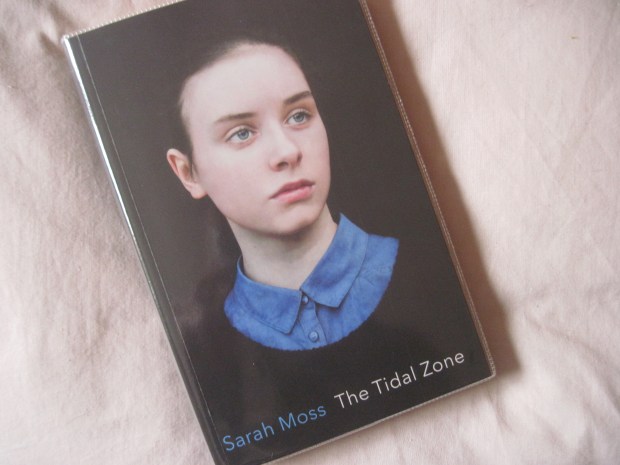
I love this striking cover: Eliza (2015) by Michael Gaskell. It’s an acrylic portrait on board of his niece and won second prize in that year’s BP Portrait Awards – but it’s so amazingly crisp I would have sworn it was a photograph!
I admired many things about the novel, particularly how easily Moss writes from a male viewpoint and the ways in which she reflects on the storytelling impulse. The extraordinary first chapter opens with “Once upon a time” and narrates the quotidian miracles of conception, pregnancy, birth and child development before making this personal, proceeding from “the girl” to “you” and finally to “I” in the second chapter. On several (perhaps one too many) occasions Moss repeats that fairytale opener to tell about Miriam’s medical journey or explain how Adam’s mother and American-born father met at a commune. This emphasizes the way we construct narratives around everything from our origins to our health.
A plan is a story about the future … a diagnosis is a story, brings a story’s promise of safe conduct through time and place to an anticipated ending.
I felt a bit too much time was spent on Adam’s father, and in the back of my mind was the niggling thought that this First World family is never facing true disaster because they have all kinds of safety nets in place; Moss’s is a very middle-class vision. I also think some readers could struggle with the slight aimlessness of the plot, though by the end you do get the sense that the characters are looking to the future in simple ways.
However, I don’t think those small complaints detract from the novel’s power. It’s a sobering but ultimately reassuring story with a simple message: we are all fragile, and we must appreciate life and health while we can.
You can’t go round not loving things because they’ll die.
May we forget. It is a pity that the things we learn in crisis are all to be found on fridge magnets and greetings cards: seize the day, savour the moment, tell your love—May we live long enough to despise the clichés again, may we heal enough to take for granted sky and water and light, because the state of blind gratitude for breath and blood is not a position of intelligence.
My rating: 
My gut feeling: Moss’s fiction shows true commitment to probing issues of health and medicine, and she’s an underrated author in general. Glancing back at the description of the books the Wellcome Prize panel is looking for (“At some point, medicine touches all our lives. … The subjects these books grapple with might include birth and beginnings, illness and loss, pain, memory, and identity”), I think this novel is a very strong contender indeed.
More reviews:
Clare’s at A Little Blog of Books
Eleanor’s at Elle Thinks
Eric’s at Lonesome Reader
Shortlist strategy:
Currently reading: I Contain Multitudes, Ed Yong’s (surprisingly?) enjoyable book about microbial life – I’m nearly halfway through and have taken it with me on our mini-holiday. Also The Gene by Siddhartha Mukherjee, a daunting 500+-page history of genetics, but I’ve loved this author’s work before (The Emperor of All Maladies).
I’m away in Hay-on-Wye through Thursday the 6th but will be back and responding to comments on Friday the 7th.
Making Plans for April & a Return to Hay-on-Wye
In April I’ll be busy with the last three books on the Wellcome Book Prize shortlist. I’m nearing halfway in Ed Yong’s I Contain Multitudes, have just started Siddhartha Mukherjee’s dauntingly dense The Gene, and am still awaiting my library hold on David France’s How to Survive a Plague. With the shadow panel’s decision due by the 23rd, it’s going to be something of a struggle! If push comes to shove, I’ll have to leave Dickens aside for next month and call Mukherjee and/or France my doorstopper for April.
As to other planned posts for the month…
- I read my second Margaret Laurence novel a little while back and just need to find time to write it up.
- I’m taking part in a nonfiction blog tour for a bereavement memoir on the 11th.
- I’m working on four review books, including two offered directly by the authors.
- I’ll try to round up a few recent or upcoming theology titles for an Easter post.
- If I get a chance, I’ll preview two or more recommended May releases.
Luckily, it’s a quieter month for me in terms of work deadlines. I’ve been working like a fiend to get ready for our short break to Hay-on-Wye, leaving Monday and returning Thursday evening. Tomorrow I’ll be submitting four completed reviews and scheduling a Wellcome Prize post for while we’re away, and then I’ll be able to breathe a big sigh of relief and allow myself some time off – always a difficult thing for freelancers to manage.
This will be our sixth trip to Hay-on-Wye, the Book Town in Wales. Our other visits clustered between 2004 and 2011; I can hardly believe it’s nearly six years since we’ve been back to one of our favorite places! Yet it’s a bittersweet return. On four of our previous trips, we stayed in the same B&B, a gorgeous eighteenth-century house with extensive gardens. It’s where we got engaged in 2006. It also served the finest breakfast known to man: organic Full English PLUS homemade cereals and jam to go with warm croissants; local single-variety apple juice PLUS all-you-can-drink tea. Around 2013 we toyed with the idea of going back, but didn’t make a serious enquiry until 2014. Alas, they’d closed temporarily while the hostess underwent breast cancer treatment. We wished them well, hoping we’d get a message when they reopened for business. Instead, we found her obituary in the Guardian last year.
So, although Hay is still our special place, we’re sad the experience won’t be quite the same. We also noticed that more shops have closed since last we visited, but there are still about 12, a lot for a town of its size. Some of these are top-class, like Booth’s, the Cinema Bookshop and Addyman’s. There will certainly be no dearth of tempting shopping opportunities. I’m not going with much of a plan in mind. Our general strategy is to start with the cheapest shops/bargain basements and then move on to more expensive and specialist ones.
Hay is better for browsing than for concerted searching for particular titles – for that you’re better off going online (many of the shops do Internet sales). It’s also not a place to go for cheap paperbacks – for that you’re better off at your local charity shop. So although I’m taking an updated list of books that are priorities to find, I don’t expect to make much of a dent in it. I’ll just wander and see what catches my eye. We’ll also visit Llanthony Priory and Clyro Church, go for a good country walk, and have lunch with a friend in the Brecon area.
Taking books to Hay is rather like taking coal to Newcastle, but it must be done. I’ve picked four topical reads to sample while I’m there: a selection from Reverend Francis Kilvert’s diary – he was the curate of Clyro from 1865 to 1872; Bruce Chatwin’s 1982 debut novel On the Black Hill, set on the England–Wales border; the obscure classic The Rebecca Rioter, about the Rebecca Riots against tolls in rural Wales in 1839–43; and a Kindle copy of The Airbnb Story, since we’re renting an Airbnb property this time.
But that’s not all. I need to make progress in at least some of the books I currently have on the go, too, so I will be loading up a book-themed tote bag with the following:
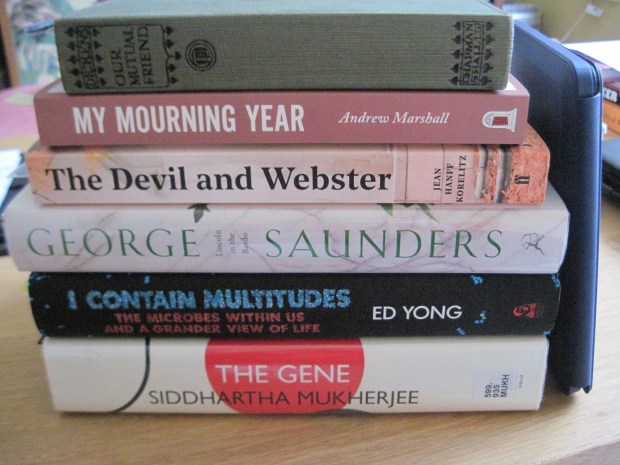
I call this my Hay-stack. Geddit? In progress on the Kindle are a poetry book and two religion books.
Now, the last thing I needed just before a trip to Hay was an influx of secondhand books, but I couldn’t help myself. This afternoon a local green initiative ran a swap shop where you bring things you don’t want anymore and go home with things you do want. I donated a couple of household items and a few books … but came away with 13 books. Good travel and literature finds. I’m particularly pleased with Elizabeth Bishop’s Complete Poems and a Dave Eggers novel I’ve not read. It’s fun to think of the journeys these books have been on: John Sutherland’s How to Read a Novel (which I have already read, but would like to have around for reference) is an ex-library book all the way from Westborough, Massachusetts! I left my details so I can get involved with future local greening activities, too.
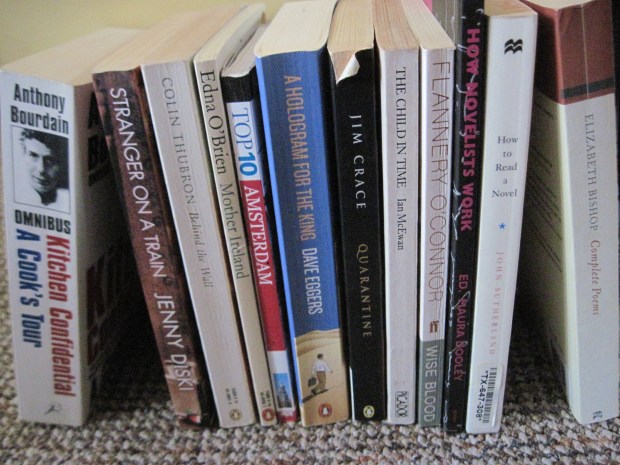
The one not pictured will be a gift.
I know a number of my readers are Hay regulars, or have at least made the trek once. If you have any up-to-date recommendations for us in terms of shopping or eating out in the area, do let me know (by tomorrow night if you can – we’re away from Monday morning).
See also: My review of Hay local interest book Under the Tump by Oliver Balch.
Enjoy my Sarah Moss review while I’m away, and I’ll see you back here on Friday!
First Encounter: Haruki Murakami (The Wind-Up Bird Chronicle)
I don’t know why I resisted reading Haruki Murakami for so long. I have some friends who are big fans of his work, but I always thought his fiction would be a bit too odd for me. The Wind-Up Bird Chronicle (1994), which I just finished last night, is certainly bizarre, but in the best possible way: it questions our comfort in the everyday by contorting familiar elements in the way that dreams do. This is the story of a young man who’s become lost in his own life and is looking for the way back. It’s a hero’s quest through a baffling, mystical underworld.
It all starts with a missing cat and a dirty phone call. It’s 1984. Thirty-year-old Toru Okada recently left his job as a law clerk and has been aimlessly spending days at home while his wife, Kumiko, goes out to her magazine editor job. A week ago the cat – named Noboru Wataya, after Toru’s hateful brother-in-law – disappeared, so he’s cooking himself some spaghetti and pondering his cat hunting strategy when he gets a call from what seems to be a phone sex hotline, except that the female speaker claims to know him well. And unexpected phone calls just keep coming, including from Malta Kano, a clairvoyant who foretells that he will experience “Bad things that seem good at first, and good things that seem bad at first.”

The cover on my library paperback. Yuck!
There’s a narrow alleyway behind their suburban Tokyo house that cuts between two rows of back gardens. On these hot June days, it’s an almost preternaturally still place, with the quiet broken only by the mechanical-sounding call of a creature Toru thinks of as the wind-up bird. He heads down the alley to look for the cat, but all he finds is the deserted (haunted?) Miyawaki house with a bird sculpture and an old, dry well in its yard. He also meets May Kasahara, a blunt sixteen-year-old who’s taking a year off school after a motorcycle accident.
So far, so realist (mostly). But things keep getting weirder, mainly through a series of further appearances and disappearances. The first to go is Kumiko, who says she’s been having an affair. Toru doesn’t believe, her, though. Or, rather, he doesn’t think a pattern of cheating is enough of an explanation for her leaving everything behind one morning. He knows there’s a deeper force driving this, and he’s determined to rescue his wife from it. Meanwhile, he has more encounters with and stories of pain from peculiar characters – everyone from a World War II lieutenant and a former fashion designer to Malta Kano’s ex-prostitute sister, Creta.
Rather like a Kafka antihero, Toru simply can’t grasp what’s happening to him.
I shook my head. Too many things were being left unexplained. The one thing I understood for sure was that I didn’t understand a thing. … “I’m sick of riddles. I need something concrete that I can get my hands on. Hard facts. Something I can use as a lever to pry the door open. That’s what I want.”
Yet his first-person narration anchors the book, making him an Everyman who we journey along with in his state of confusion. So even as the plot gets increasingly outlandish and somewhat taken over by other voices – via long monologues, letters, or tales stored in computer files – we always have this sympathetic protagonist to come home to. Like in Dickens’s novels, I noticed that minor characters like the Kano sisters keep turning up just when you’re in danger of forgetting them due to the weight of the intervening pages.

I prefer this, or pretty much any other, cover.
Yesterday I gave a gleeful squeal when a review copy of just 190 pages arrived. “So you love short books?” my husband asked. I do … but I also adore long ones that have a darn good reason to be that long – creating a whole world you can get lost in. That’s what I’m trying to celebrate with this year’s monthly Doorstopper series: books whose 500+ pages fly by, best consumed in big gulps. Such won’t always be the case: City on Fire and Hame both felt like a slog in places, though were ultimately worth engaging with. But my first encounter with Murakami showcased expansive storytelling at its best. I want to read more books like this.
I’m not entirely sure I comprehended all that happens at the end of The Wind-Up Bird Chronicle, but that doesn’t really matter. The novel left me mesmerized, shaking my head as if waking up from the strangest dream but hoping to someday go back to its world. And for 99.8% of it I forgot that I was reading a work in translation.
If I were to make a word cloud of important phrases from the book, it would look off the wall: lemon drops, a necktie, wells, bald men, baseball bats, birthmarks, being skinned alive, zoo animals, a hotel room, a wig factory, and so on. That list might intrigue you; equally, it might put you off in the same way that I was always daunted by the idea of Japanese magic realism. Let me assure you, this stunning novel is so much more than the sum of its parts.
My rating: 
How do you feel about Murakami? Which of his books should I read next?
Classic of the Month: The Tenant of Wildfell Hall
Thank you to those who recommended Anne Brontë’s The Tenant of Wildfell Hall (1848) as my classic for March. I’m glad I read it, not least because, like Narcissism for Beginners, it’s an epistolary within an epistolary – bonus! I imagine most of my readers will already be familiar with the basic plot, but if you’re determined to avoid spoilers you’ll want to look away from my second through fourth paragraphs.
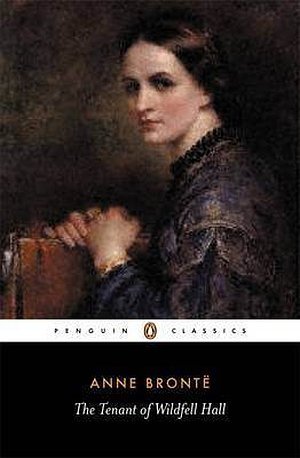 The chronology and structure of the novel struck me as very sophisticated: in 1847, gentleman farmer Gilbert Markham is writing a detailed letter to a friend, describing how he fell in love with the widow Helen Graham – the new tenant at Wildfell Hall, a painter who’s living there in secret – starting in the autumn of 1827. (I even wondered if this could have been one of the earliest instances of a female author writing from a male point-of-view.) Their interrupted and seemingly ill-fated courtship reminded me of Lizzy and Darcy’s in Pride and Prejudice: Gilbert initially thinks Helen stubborn and argumentative, especially in how she refuses to accept neighbors’ advice on how to raise her young son, Arthur. Gradually, though, he comes to be captivated by this intelligent and outspoken young woman on whose “lofty brow … thought and suffering seem equally to have stamped their impress.”
And indeed, at the heart of Gilbert’s narrative is a lengthy journal by Helen herself, starting in 1821, explaining the misfortune that drove her to take refuge in the isolation of Wildfell Hall. For, as in Anne’s sister Charlotte’s Jane Eyre, there’s an impediment to the marriage of true minds in the form of a living spouse. Helen is still tied to Arthur Huntingdon, a dissolute alcoholic she married against her family’s advice and has ever since longed to see reformed. In a phrase I was highly bemused to see in use in the middle of the nineteenth century, she defends him thusly: “if I hate the sins I love the sinner, and would do much for his salvation.” The novel’s religious language may feel outdated in places, but the imagined psyche of a woman who stays with an abusive or at least neglectful partner is spot on.
For the most part I enjoyed the story line, but I must confess that I wearied of Helen’s 260-page account, filled as it is with repetitive instances of her incorrigibly loutish husband’s carousing. I had a bit too much of her melodrama and goody-goody moralizing, such that it felt like a relief to finally get back to Gilbert’s voice. The last 100 pages, though, and particularly the last few chapters, are wonderful and race by. I loved this late metaphor for Helen’s chastened beauty:
This rose is not so fragrant as a summer flower, but it has stood through hardships none of them could bear. The cold rain of winter has sufficed to nourish it, and its faint sun to warm it; the bleak winds have not blanched it or broken its stem, and the keen frost has not blighted it. Look, … it is still fresh and blooming as a flower can be, with the cold snow even now on its petals.

Anne Brontë c. 1834, painted by Patrick Branwell Brontë [Public domain or Public domain], via Wikimedia Commons (restored version).
As always, I’m dumbfounded by the Brontës’ profound understanding of human motivation and romantic love given their sheltered upbringing. Theirs were wild hearts. I’ll always be a Charlotte fan first and foremost, but I was delighted with my first experience of Anne’s work and look forward to trying Agnes Grey in the near future.
Lest you think Victorian literature is all po-faced, righteous ruminating, I’ll end with my favorite funny quote from the book. This is from Gilbert’s snide, sporty brother Fergus (I wish he’d had a larger role!), seeming to mock Jane Austen with this joke about needing to know everything about Helen Graham as soon as she arrives in town:
“mind you bring me word how much sugar she puts in her tea, and what sort of caps and aprons she wears, and all about it, for I don’t know how I can live till I know,” said Fergus very gravely. But if he intended the speech to be hailed as a masterstroke of wit, he signally failed, for nobody laughed. However, he was not much disconcerted at that; for when he had taken a mouthful of bread and butter, and was about to swallow a gulp of tea, the humour of the thing burst upon him with such irresistible force that he was obliged to jump up from the table, and rush snorting and choking from the room.
My rating:
Next month: Eleanor of Elle Thinks recommends Our Mutual Friend as the book that will finally get me back into Dickens, so I plan to make it do double duty as my Classic and Doorstopper for April.
Library Checkout: March 2017
A dangerous thing happened a few weeks ago. I lost track of the number of library books I had on my account and happened to accidentally borrow a 16th book via the self-service machine (I always thought that 15 was the maximum). So the next time I visited I tested this limit and successfully borrowed enough books to get me up to a total of 21! Whoopsie. Of course, I have so many review books and Kindle titles on hand that a suggested limit of 15 should be more than enough, so I will try not to abuse the privilege too often.

A lot of the books I have on loan are hangovers from last month, and they’re likely to stick around for a while yet given the reading I still have to do for the Wellcome Book Prize shadow panel. However, I managed to get through nine library reads in March so far, and will hopefully finish the Murakami as this month’s doorstopper as well. I’ve added in ratings and links to any reviews for books I haven’t already featured on the blog in some way.
LIBRARY BOOKS READ
- Days Without End by Sebastian Barry [to review for BookBrowse]

- The Unexpected Professor: An Oxford Life in Books by John Carey
- Swimming Lessons by Claire Fuller
- Bad Dreams and Other Stories by Tessa Hadley
- The Good People by Hannah Kent

- Nonsense by Christopher Reid [poetry]
- This One Summer by Mariko and Jillian Tamaki [graphic novel]
- Let Them Eat Chaos by Kate Tempest [poetry]
- Fragile Lives: A Heart Surgeon’s Stories of Life and Death on the Operating Table by Stephen Westaby
SKIMMED ONLY
- Go Lean Vegan: The Revolutionary 30-Day Diet Plan to Lose Weight and Feel Great by Christine Bailey
- The No Spend Year: How I Spent Less and Lived More by Michelle McGagh

- Reading Allowed: True Stories and Curious Incidents from a Provincial Library by Chris Paling

CURRENTLY READING
- The Tidal Zone by Sarah Moss
- The Wind-Up Bird Chronicle by Haruki Murakami
- Jackself by Jacob Polley [poetry]
CHECKED OUT, TO BE READ
- Ashland & Vine by John Burnside
- Outline by Rachel Cusk
- The Rebecca Rioter: A Story of Killay Life by Amy Dillwyn
- Still Alice by Lisa Genova
- The Owl at the Window: A Memoir of Loss and Hope by Carl Gorham
- A Smell of Burning: The Story of Epilepsy by Colin Grant
- Finn Family Moomintroll & Sculptor’s Daughter by Tove Jansson
- Human Acts by Han Kang
- In the Bonesetter’s Waiting-Room: Travels through Indian Medicine by Aarathi Prasad
- Lincoln in the Bardo by George Saunders
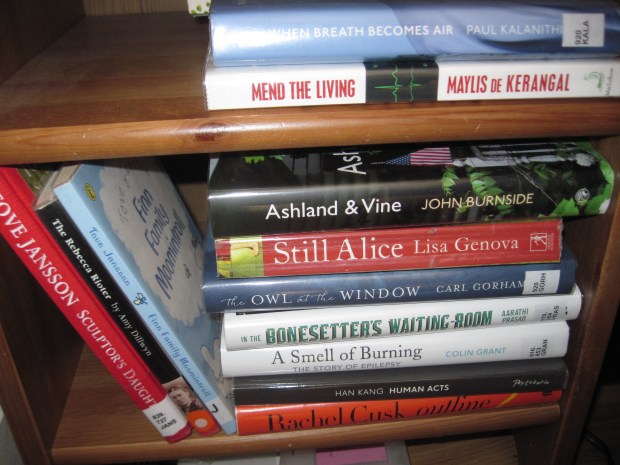
CHECKED OUT, TO SKIM AGAIN FOR WELLCOME PRIZE SHADOW PANEL
- Mend the Living by Maylis de Kerangal
- When Breath Becomes Air by Paul Kalanithi
IN THE RESERVATION QUEUE
- The Otters’ Tale by Simon Cooper
- How to Survive a Plague: The Story of How Activists and Scientists Tamed AIDS by David France [for Wellcome prize shadow panel]
- Where Poppies Blow: The British Soldier, Nature, the Great War by John Lewis-Stempel
- Augustown by Kei Miller
- The Gene by Siddhartha Mukherjee [for Wellcome prize shadow panel]
RETURNED UNFINISHED
- Pondlife: A Swimmer’s Journal by Al Alvarez – I read the first 57 pages but found the entries fairly repetitive.
- The Best of Adam Sharp by Graeme Simsion – Compared to the Rosie books, this felt like it had no spark.
RETURNED UNREAD
- The Pursuit of Love by Nancy Mitford (I’ll have a little break before reading another one of hers)
- A Beginner’s Guide to Losing Your Mind: Survival Techniques for Staying Sane by Emily Reynolds (did not seem at all relevant to me)
Hosted by Charleen of It’s a Portable Magic.
Have you been taking advantage of your local libraries? What appeals from my lists?
Wellcome Prize Shortlist, Part 1: de Kerangal and Kalanithi
I’m delighted to announce the final members of our Wellcome Book Prize 2017 shadow panel:
Ruby blogs at My Booking Great Blog.
GrrlScientist is an ornithologist and science journalist who was on the judging panel for the 2016 Royal Society Insight Investment Science Book Prize.
Along with Paul and Amy, this brings us up to five people – the same number as the official judging panel.
Luckily, I’ve already read two of the shortlisted titles, one quite recently and one nearly a year and a half ago. Here are the reviews I published on Goodreads at the time. I’ll be getting both books back out of the library soon to have another look before we choose our winner.
Mend the Living by Maylis de Kerangal
(translated from the French by Jessica Moore; published in the USA as The Heart)
[This is the French author’s second novel to be translated into English. It has been made into a film and won the Prix Orange du Livre and the Grand prix RTL du livre. It was also recently shortlisted for the Albertine Prize, an American readers’ choice award for contemporary French fiction. If you’re based in the States, feel free to vote by April 30th!]
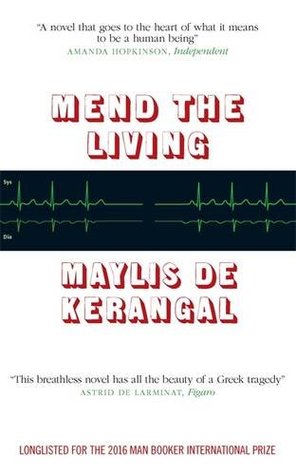 Nineteen-year-old Simon Limbeau is declared brain dead in a French hospital after a car accident, but his heart lives on: metaphorically through the love of his parents, sister, friends, and girlfriend; but also literally, in the recipient of his organ donation. Again and again de Kerangal makes a distinction between the physical reality of organs and what they represent: “Simon’s eyes are not just his nervous retina, his taffeta iris, his pupil of pure black in front of the crystalline – they are also his gaze; his skin isn’t just the threaded mesh of his epidermis, his porous cavities – it’s his light and his touch, the living sensors of his body.”
The novel spends time with Simon’s family, especially his mother, but also with the transplant coordinator, the surgeons, the nurse, and so on. I was reminded of ER as well as the French TV show The Returned – this would work really well on screen, and would be a way of avoiding the more off-putting aspects of the author’s style. She writes long, run-on sentences: sometimes half a page, sometimes even stretching to two pages, and stuffs her prose with abstruse vocabulary (or at least that’s how the translator has rendered it), a lot of it medical but some of it simply inaccessible: “emollient conjugality” plus at least a dozen English words I’d never encountered (e.g. abulic, tumid, atony, claudicant, auscultation, precellence, torticollis, naevi, scialytic).
The worst example of the unnecessary opacity is “the digitigrade gait of the sardana dancer when he’s nearing a quintal, the corpulence of an ex-obese man calibrating him in thickness, in fullness, but without visible excrescence” – in plain English, the guy is stocky.
Read in November 2016.
My rating: 
My gut feeling: The novel gives a vivid sense of the fragility of life and imbues parts of the body with metaphorical meaning. However, I think the style makes it too inaccessible and I can’t see its appeal ever being more than niche.
More reviews:
Annabel’s at Shiny New Books
Carolyn’s at Rosemary and Reading Glasses
When Breath Becomes Air by Paul Kalanithi
[The first posthumous nominee for the Wellcome Book Prize. I’ll be interested to see what I make of this one when I revisit it.]
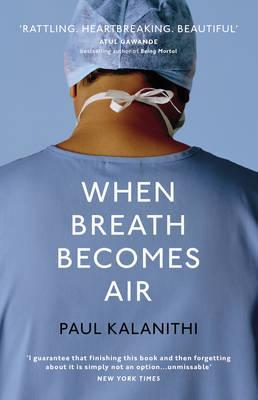 Paul Kalanithi was 36 and just completing his neurosurgery residency in Stanford, California when he was diagnosed with advanced lung cancer that did not respond well to treatment. It came as a complete surprise to this non-smoker, and set his life on a new course. He and his coterie of doctors managed his symptoms so he could operate for as long as possible, but when the time came he knew he wanted to devote his last year to writing this memoir. In addition, he would get a brief, sweet taste of fatherhood: he and his wife Lucy, also in the medical field, decided to have a child, a daughter named Cady.
Kalanithi grew up the son of Indian immigrants in Arizona. “I was driven less by achievement than by trying to understand, in earnest: What makes human life meaningful?” he recalls. Degrees in English literature and human biology were disparate attempts to find an answer. Like Henry Marsh (Do No Harm), he has a surgeon’s knowledge of the anatomy of reasoning, but realizes that does not provide the full picture. He recognizes the responsibility of holding others’ lives in the balance, and regrets occasional failures of empathy.
Those burdens are what make medicine holy and wholly impossible: in taking up another’s cross, one must sometimes get crushed by the weight.
It’s intriguing to see religious language in that statement – indeed, Kalanithi saw his work as a calling, and one with moral connotations. Christian imagery shows up repeatedly:
Instead of being the pastoral figure aiding a life transition, I found myself the sheep, lost and confused.
Openness to human relationality does not mean revealing grand truths from the apse; it means meeting patients where they are, in the narthex or nave, and bringing them as far as you can.
When’s the last time you encountered the word “narthex”?! The vocabulary is striking throughout, as in another favorite passage: “A tureen of tragedy was best allotted by the spoonful. Only a few patients demanded the whole at once; most needed time to digest.”
Kalanithi died in March 2015. In addition to the foreword by Abraham Verghese, there’s a lovely epilogue from his widow, who’s more than competent to carry on his legacy.
I appreciate stories lived on the knife edge of life and death, but I would recommend this to those who don’t normally choose to read illness narratives, simply for the beauty of its prose – a fine blend of literature and medicine – and the wholehearted picture of a life cut short.
Read in October 2015 (Random House were looking for early readers via NetGalley).
My rating: 
My gut feeling: I suspect this is by far the most popular and best-selling title on this year’s shortlist. So many people have taken it to their hearts. It will take a truly special book to knock it from the top spot.
More reviews:
Shadow panelist Paul’s at Nudge
Shadow panelist Ruby’s at My Booking Great Blog
Susan’s at A life in books
Shortlist strategy:
Currently reading: The Tidal Zone by Sarah Moss – about halfway through.
Up next: Whichever of the remaining nonfiction titles turns up to the library for me first!
I’ve also sent off an emergency e-mail to Bodley Head asking for a copy of Ed Yong’s I Contain Multitudes; it’s on loan through my library system until April 19th, which gives me no time to read it even if it comes back on time.
Blog Tour: Foxes Unearthed by Lucy Jones
Cold, delicately as the dark snow
A fox’s nose touches twig, leaf;
[…]
Across clearings, an eye,
A widening deepening greenness,
Brilliantly, concentratedly,
Coming about its own business
~Ted Hughes, “The Thought-Fox” (1957)
Foxes Unearthed, freelance journalist Lucy Jones’s first book, won a Society of Authors’ Roger Deakin Award for nature writing. If you’re familiar with Patrick Barkham’s Badgerlands, you’ll recognize this as a book with a comparable breadth and a similar aim: clearing the reputation of an often unfairly reviled British mammal. Jones ranges from history to science and from mythology to children’s literature in her search for the truth about foxes. Given the media’s obsession with fox attacks, this is a noble and worthwhile undertaking.
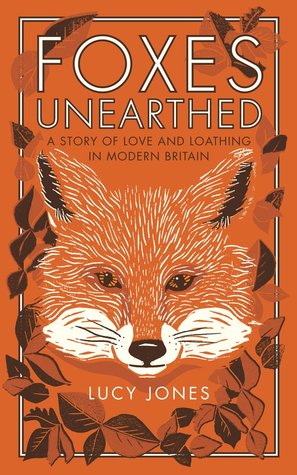 The book proper opens with a visit to Roald Dahl’s house, now a Buckinghamshire museum, where he wrote Fantastic Mr. Fox. Still one of the best-known representations of foxes in British literature, Dahl’s Mr. Fox is a Robin Hood-like hero, outsmarting a trio of mean-spirited farmers to provide a feast for his family. Foxes’ seemingly innate wiliness prompts ambivalent reactions, though; we admire it, but we also view it as a threat or an annoyance. As Jones puts it, the fox of fables and traditional stories is “a villain we cheer for.”
Not everyone cheers, of course. Under Henry VIII, the Vermin Acts of 1532 (not repealed until the 1750s) promised a reward to anyone who killed foxes, then considered a nuisance animal. Fox hunting and the cruel sport of “tossing” have a long history that eventually came up against the movement towards animal welfare, starting with Jeremy Bentham in the 1740s and codified by the 1911 Protection of Animals Act. Meanwhile, Jones notes, children’s books advocating compassion for animals, such as Anna Sewell’s Black Beauty (1877), ensured that the message made it out of the legislative chamber and into everyday life.
The second chapter is a useful survey of fox behavior. Foxes are omnivores, and in recent decades have started to move into Britain’s cities, where they find plenty of food to scavenge. In rural settings, foxes are still the subject of farmers’ loathing even though they rarely take lambs and actually help keep rabbit numbers in check. Still, the stereotype of foxes killing for fun instead of for hunger persists, whereas they in fact cache their surplus food. Chapter 3 asks whether fox numbers have reached pest status and considers various control strategies, from straightforward culling to the non-lethal methods supported by conservationists.
I enjoyed Jones’s meetings with figures from both sides of the debate. She goes along on a fox hunt, but also meets or quotes animal rights activists, academics, and high-profile nature promoters like Chris Packham. All told, though, I felt the book could have been closer to 200 pages than 300. Most chapters are very long, and some could easily be combined and/or shortened. For instance, Chapter 1 relays the amount of information about fox hunting that most readers will be prepared to absorb, yet it’s then the subject of two more chapters.

At the British Wildlife Centre in Surrey. Photo by Chris Foster.
This is an important book for correcting misconceptions, but your enjoyment of it may be in proportion to your personal interest in the subject. In terms of fonts and cover design, though, you’re unlikely to come across a more gorgeous book this year.
Foxes Unearthed was published in paperback by Elliott & Thompson on March 16th. Thanks to Alison Menzies for arranging my free copy for review.
To encounter foxes in fiction, try the following:
- Glow by Ned Beauman
- The Many Selves of Katherine North by Emma Geen
- Midwinter by Fiona Melrose
- The Soho Leopard by Ruth Padel (a poetry book with a sequence on urban foxes)
& the forthcoming How to Be Human by Paula Cocozza (April 6th).
Wellcome Book Prize 2017 Shadow Panel
Newsflash! I’ve started a shadow panel of readers who will make our way through the six medical-themed titles shortlisted for the Wellcome Book Prize and deliberate to choose our own winner before the official prize announcement on Monday, April 24th. I hope to get the panel up to five – I’ve been in contact with a couple of science journalists via Twitter – but for now we are three, including:
Paul Cheney: blogs at Halfman, Halfbook and writes for Nudge’s Book Life section.
Amy Pirt: blogs at This Little Bag of Dreams and writes for Mookychick and g3 magazine.
The Wellcome Book Prize is an annual award sponsored by the Wellcome Trust, a global charitable foundation founded by Sir Henry Wellcome in 1936 and dedicated to improving health. The current incarnation of the prize has been running since 2009 and the winner gets a whopping £30,000. Books are nominated by their publishers, and for the 2017 award cycle they must have been issued in the UK between January 1, 2016 and December 31, 2016.
One thing that’s unique about the Wellcome Prize is that both fiction and nonfiction books are eligible. Here’s how the website describes the aim of the prize:
To be eligible for entry, a book should have a central theme that engages with some aspect of medicine, health or illness. At some point, medicine touches all our lives. Books that find stories in those brushes with medicine are ones that add new meaning to what it means to be human. The subjects these books grapple with might include birth and beginnings, illness and loss, pain, memory, and identity. In keeping with its vision and goals, the Wellcome Book Prize aims to excite public interest and encourage debate around these topics.
So as we’re reading (or looking back at) the six shortlisted books, those are the criteria we’ll be keeping in mind.
Here’s the full 2017 shortlist:
- How to Survive a Plague by David France: a history of the AIDS crisis.
- When Breath Becomes Air* by Paul Kalanithi: a posthumous memoir by a neurosurgeon.
- Mend the Living* by Maylis de Kerangal (trans. Jessica Moore): a novel about a donor heart [published in the USA as The Heart].
- The Tidal Zone by Sarah Moss: a novel about a child who suddenly falls ill.
- The Gene by Siddhartha Mukherjee: a thorough history of genetics.
- I Contain Multitudes by Ed Yong: a survey of the human body’s microbes.

* = the two I’ve already read and reviewed on Goodreads. I’ll get these reviews together for my first shortlist post on Thursday. Next up for me is The Tidal Zone, which I plan to start today. I have the three other nonfiction titles on request from the public library and hope they’ll come in soon – each one is well over 300 pages, so I’ll need plenty of time with them!
For more on this year’s nominees and the official judging panel, see this Guardian article.
What interests you from the Wellcome Book Prize shortlist? Are there some titles you’ve already read? If you’ve reviewed any of these, let me know and I’d be happy to link to your reviews when I post mine.
Also, if you’d like to read any of the shortlisted books along with us over the next five weeks, I’d love to know that you’re taking part and will help share your reviews, so do get in touch!
(A huge thanks to Naomi of The Writes of Woman for advice on running a shadow panel.)
 Bookish Beck = Rebecca Foster. American transplant to England. Freelance proofreader and book reviewer.
 Bookish Beck