The Orange Grove by Larry Tremblay (Peirene)
Larry Tremblay is a Francophone writer, theatre director and actor based in Montreal. In addition to three novels, he has published a short story collection and many books of poetry and plays. The Orange Grove (2013), which was longlisted for the 2017 International Dublin (formerly IMPAC) literary award, is the fable-like story of one family in the war-torn Middle East and the way notions of justice and sacrifice drive them to make extreme choices.
Tamara and Zahed live with their twin sons, nine-year-old Aziz and Ahmed, alongside an orange grove planted by Zahed’s father. Soulayed, a militant elder from the next village, describes it thus:
Your father, Mounir, worked his whole life on this arid soil. It was desert here. With God’s help your father worked a miracle. Made oranges grow where there had been only sand and stones.
When Mounir and his wife Shahina are killed in a bombing, Soulayed stands among the ruins and counsels Zahed to seek revenge against their enemies by sending one of his sons to be a suicide bomber. There’s no doubt Soulayed is manipulating this grief-stricken family to his own ends, but he isn’t solely to blame when their culture at large romanticizes martyrdom.
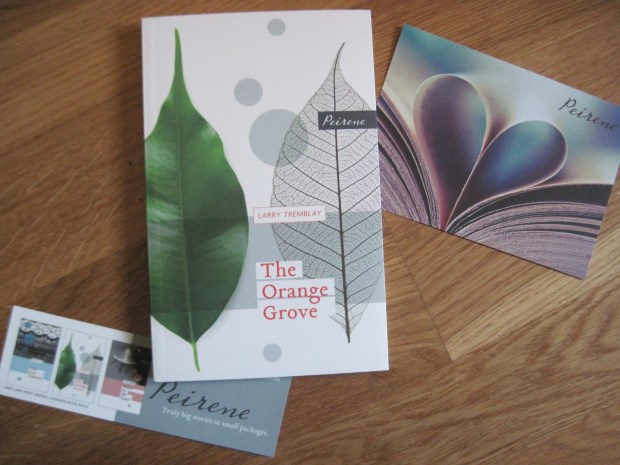
Zahed makes his choice, but Tamara won’t accept it. In a clever reprise of the Genesis story of Jacob and Esau, she helps the boys to make a switch right under their father’s nose. The last third of the book, like a coda, zooms ahead 11 years to show us the surviving brother, coming to the end of a four-year theatre training program in Montreal. He’s given a starring role in his teacher’s wartime play but the story line cuts a little too close to the bone, and for the first time he tells a stranger the story of two brothers: one who died and one who lived.
Peirene Press issues novellas in trios. This is the second in the “East and West: Looking Both Ways” series; I’ve also reviewed the first, The Last Summer by Ricarda Huch. Tremblay and Huch both tackle the theme of betrayal and the practice of choosing one person to die for the crimes of the many. The Orange Grove has a simple style that edges towards flatness but is saved by the occasional striking metaphor (e.g. “Minutes stretched out as if made of dough”). A book about suicide bombing could easily turn mawkish, but the restrained narration reins it in to create a tight and fairly engrossing tale of family ties and religious motivations.
[The third book in the series, Dance by the Canal by Kerstin Hensel, will be released later in 2017.]
The Orange Grove was published in the UK on May 1st. Translated from the French by Sheila Fischman. With thanks to James Tookey of Peirene Press for the free copy for review.
My rating: 
Personal Inscriptions, Etc. in Books
A couple of months ago we finally rescued the last boxes (we think) of our possessions out of my in-laws’ attic and storage cupboard…only five years after we moved out! As I was sorting through a box of my husband’s childhood books, I found a couple that he had won through school prizes – both of which seem to prefigure his love of British wildlife, and badgers in particular.


We also found another book he accidentally inherited from his school when the library burned down – along with the Gerald Durrell memoir and a paperback copy of Animal Farm, that makes three books that never made it back to the school even after they rebuilt. Oops!


I gave some thought to the other personal inscriptions in our book collection. Although we don’t have all that many examples in total, my mother (whom I generally call “Marm”) is the queen of inscriptions: you can count on her to write the date, the occasion, and a heartfelt message inside the front cover of any book she gives as a gift. It’s terribly sweet.


I got the Betty Crocker cookbook as a birthday present just as I was setting off for my Master’s year in Leeds – the first time I ever had to cook for myself. Over the last 11.5 years it’s gotten a lot of use, as the missing fragments of the ring binder show.


Another cookbook with some sentimental value to us is Delia Smith’s Complete Illustrated Cookery Course – a classic of English cuisine that we got as a wedding present. It’s extra special as the giver, my husband’s Auntie Joan (not actually an aunt, but a first cousin once removed or something like that), passed away earlier this year.
Do you like writing and/or receiving personal inscriptions in books?
Four Recommended June Releases
Here are four enjoyable books due out next month that I was lucky enough to read in advance. The first is the sophomore novel from an author whose work I’ve enjoyed before, the second is a highly anticipated memoir from an author new to me, and the third and fourth – both among my favorite books of 2017 so far – strike me as 2018 Wellcome Book Prize hopefuls: one is a highly autobiographical novel about bereavement, and the other is a courageous memoir about facing terminal cancer. I’ve pulled 250-word extracts from my full reviews and hope you’ll be tempted by one or more of these.
The Gypsy Moth Summer by Julia Fierro
(Coming from St. Martin’s Press on June 6th)
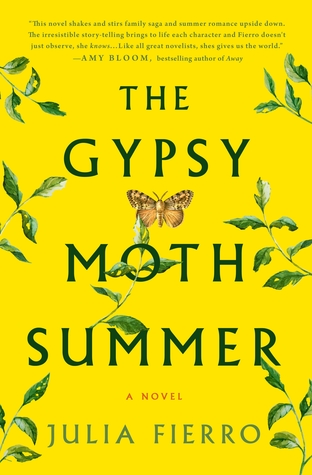 It’s the summer of 1992 and a plague of gypsy moth caterpillars has hit Avalon Island, a community built around Grudder Aviation. The creatures are just one of many threats to this would-be fairy tale world. For Maddie Pencott LaRosa, it’s no simple Sweet Sixteen time of testing out drugs and sex at parties. Her grandfather, Grudder’s president, is back in town with her grandmother, Veronica, and they’re eager to hide the fact that he’s losing his marbles. Also recently returned is Leslie Day Marshall, daughter of the previous Grudder president; she’s inherited “The Castle” and shocked everyone with the family she brought back: Jules, an African-American landscape architect, and their two mixed-race children.
Depending on when you were born, you might not think of the 1990s as “history,” but this novel does what the best historical fiction does: expertly evoke a time period. Moving between the perspectives of six major characters, the novel captures all the promise and peril of life, especially for those who love the ‘wrong’ people. I especially loved small meetings of worlds, like Maddie and Veronica getting together for tea and Oprah.
My main criticism would be that there is a lot going on here – racism, domestic violence, alcohol and prescription drug abuse, cancer, teen sex (a whole lotta sex in general) – and that can make things feel melodramatic. But in general I loved the atmosphere: a sultry summer of Gatsby-esque glittering parties and garden mazes, a time dripping with secrets, sex and caterpillar poop.


[It felt like I kept seeing references to gypsy moths in the run-up to reading this book, like a passage from Amy Poehler’s Yes Please, and a random secondhand book I spotted in Hay-on-Wye (though in that case it’s actually the name of a ship and is a record of a sea voyage).]
Read-alike: The Seed Collectors by Scarlett Thomas
My rating:
Hunger: A Memoir of (My) Body by Roxane Gay
(Coming from HarperCollins on June 13th [USA] and from Corsair on August 3rd [UK])
 I’d never read anything by Roxane Gay before, but somehow already knew the basics of her story: the daughter of Haitian immigrants to the American Midwest, she was gang raped at age 12, and to some extent everything she’s done and become since then has been influenced by that one horrific experience. Not least her compulsive overeating: “I ate and ate and ate to build my body into a fortress,”she writes. At her heaviest Gay was super morbidly obese according to her BMI, a term that “frames fat people like we are the walking dead.”
Though presented as a memoir, this is more like a collection of short autobiographical essays (88 of them, in six sections). The portions that could together be dubbed her life story take up about a third of the book, and the rest is riffs around a cluster of related topics: weight, diet, exercise and body image. The writing style is matter-of-fact (e.g. “My body is a cage of my own making”), which means she never comes across as self-pitying. I appreciate how she holds opposing notions in tension: she doesn’t know how she developed such an “unruly” body; she knows exactly how it happened.
The structure of the book made it a little repetitive for me, but I think what Gay has written will be of tremendous value, not just to rape victims or those whose BMI is classed as obese, but to anyone who has struggled with body image – so pretty much everyone, especially women.
Read-alike: I Know Why the Caged Bird Sings by Maya Angelou
My rating:
In Every Moment We Are Still Alive by Tom Malmquist
(Coming on from Sceptre on June 1st [UK] and from Melville House on February 6, 2018 [USA])
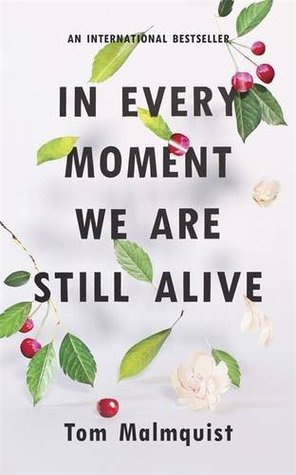 In this autobiographical novel from a Swedish poet, Tom faces the loss of his partner and his father in quick succession. The novel opens in medias res at Söder hospital, where Tom’s long-time girlfriend, Karin, has been rushed for breathing problems. Doctors initially suspect pneumonia or a blood clot, but a huge increase in her white blood cells confirms leukemia. This might seem manageable if it weren’t for Karin, 33, being pregnant with their first child. The next morning she’s transferred to another hospital for a Cesarean section and, before he can catch his breath, Tom is effectively a single parent to Livia, delivered six weeks early.
Malmquist does an extraordinary job of depicting Tom’s bewilderment. He records word for word what busy doctors and jobsworth nurses have to say, but because there are no speech marks their monologues merge with Tom’s thoughts, conversations and descriptions of the disorienting hospital atmosphere to produce a seamless narrative of frightened confusion. There is an especially effective contrast set up between Karin’s frantic emergency room treatment and the peaceful neonatal ward where Livia is being cared for.
While it’s being marketed as a novel, this reads more like a stylized memoir. Similar to Karl Ove Knausgaard’s books, it features the author as the central character and narrator, and the story of grief it tells is a highly personal one.With its frank look at medical crises, this is a book I fully expect to see on next year’s Wellcome Book Prize shortlist.
Read-alike: Mend the Living by Maylis de Kerangal
My rating: 
The Bright Hour: A Memoir of Living and Dying by Nina Riggs
(Coming on June 6th from Simon & Schuster [USA] and from Text Publishing on August 3rd [UK])
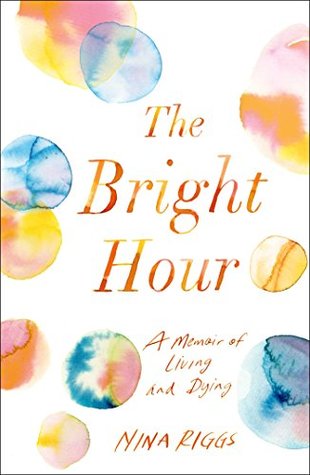 You’re going to hear a lot about this one. It’s been likened to When Breath Becomes Air, an apt comparison given the beauty of the prose and the literary and philosophical approach to terminal cancer. It’s a wonderful book, so wry and honest, with a voice that reminds me of Anne Lamott and Elizabeth McCracken.
It started with a tiny spot of cancer in the breast. “No one dies from one small spot,” Nina Riggs and her husband told themselves. Until it wasn’t just a spot but a larger tumor that required a mastectomy. And then there was the severe back pain that alerted them to metastases in her spine, and later in her lungs. Riggs was a great-great-great-granddaughter of Ralph Waldo Emerson, and she quotes from her ancestor’s essays as well as from Michel de Montaigne’s philosophy of life to put things in perspective.
Riggs started out as a poet, and you can tell. She’s an expert at capturing the moments that make life alternately euphoric and unbearable – sometimes both at once. Usually these moments are experienced with family: her tough mother, who died after nine years with multiple myeloma, providing her with a kind of “morbid test drive” for her own death; and her husband and their two precocious sons. Whether she’s choosing an expensive couch, bringing home a puppy, or surprising her sons with a trip to Universal Studios, she’s always engaged in life. You never get a sense of resignation or despair.
Some of my favorite lines:
“inside the MRI machine, where it sounded like hostile aliens had formed a punk band”
“my pubic hair all falls out at once in the shower and shows up like a drowned muskrat in the drain.”
“My wig smells toxic and makes me feel like a bank robber. But maybe it is just a cloak for riding out into suspicious country.”
“‘Merry Christmas,’ says a nurse who is measuring my urine into a jug in the bathroom. ‘Do you want some pain meds? Do you want another stool softener?’”
(Nina Riggs died at age 39 on February 23, 2017.)
Read-alike: A Series of Catastrophes and Miracles by Mary Elizabeth Williams
My rating: 
What June books do you have on the docket? Have you already read any that you can recommend?
Library Checkout: May 2017
We fly to America tomorrow morning, but, as you can see, despite my best efforts I’ve managed to leave behind a sizeable pile of library books for when I get back.
And that’s not to mention this gorgeous set of review copies awaiting my return!

I’ve added in ratings and links to any reviews of books I haven’t already featured here in some way.
LIBRARY BOOKS READ
- Ashland & Vine by John Burnside

- The Otters’ Tale by Simon Cooper
- Glad of These Times by Helen Dunmore [poetry]
- The Valentine House by Emma Henderson
- Bodies of Light by Sarah Moss
- Mothering Sunday by Graham Swift

- Gizelle’s Bucket List: My Life with a Very Large Dog by Lauren Fern Watt

SKIMMED ONLY
- A Smell of Burning: The Story of Epilepsy by Colin Grant

- Sculptor’s Daughter: A Childhood Memoir by Tove Jansson
- In the Bonesetter’s Waiting-Room: Travels through Indian Medicine by Aarathi Prasad
- Where Poppies Blow: The British Soldier, Nature, the Great War by John Lewis-Stempel
CHECKED OUT, TO BE READ
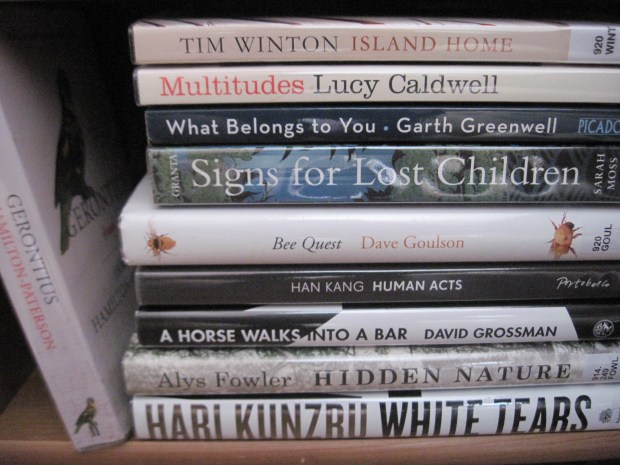
- Multitudes: Eleven Stories by Lucy Caldwell
- Hidden Nature: A Voyage of Discovery by Alys Fowler
- Bee Quest: In Search of Rare Bees by Dave Goulson
- What Belongs to You by Garth Greenwell
- A Horse Walks into a Bar by David Grossman
- Gerontius by James Hamilton-Paterson
- Human Acts by Han Kang
- White Tears by Hari Kunzru
- Signs for Lost Children by Sarah Moss
- Island Home: A Landscape Memoir by Tim Winton
As to America: I hope you would agree I have been very restrained in only requesting three books to borrow from my parents’ local public library. The Coates and Shapiro are extremely short memoirs I should have no trouble getting through, and the Strayed, a collection of advice columns, is the kind of book that I can dip in and out of. My Kindle and my personal library will more than make up for any further shortfall in reading material.
ON HOLD, TO BE CHECKED OUT
- Between the World and Me, Ta-Nehisi Coates
- Tiny Beautiful Things, Cheryl Strayed
IN THE RESERVATION QUEUE
- Hourglass, Dani Shapiro
(Hosted by Charleen of It’s a Portable Magic.)
Have you been taking advantage of your local libraries? What appeals from my lists?
Making Plans (and Book Lists) for America
On Tuesday we leave for two weeks in America. It’s nearly a year and a half since our last trip – much too long – so we’ll be cramming in lots of visits with friends and family and doing a fair bit of driving around the Mid-Atlantic states. I’m giving myself the whole time off, which means I’ve been working flat out for the past two weeks to get everything done (including my U.K. and U.S. taxes). I’m nearly there: at the 11-day countdown I still had 12 books I wanted to finish and 12 reviews to write; now I’m down to five books, only one of which might be considered essential, and all the reviews are ready to submit/schedule. What with the holiday weekend underway, it should all be manageable.
I’m a compulsive list maker in general, but especially when it comes to preparing for a trip. I’ve kept adding to lists entitled “Pack for America,” “Do in America,” “Buy in America,” and “Bring back from America.” But the more fun lists to make are book-related ones: what paper books should I take to read on the plane? Which of the 315 books on my Kindle ought I to prioritize over the next two weeks? Which exclusively American books should I borrow from the public library? What secondhand books will I try to find? And which of the books in the dozens of boxes in the closet of my old bedroom will I fit in my suitcase for the trip back?
I liked the sound of Laila’s habit of taking an Anne Tyler novel on every flight. That’s just the kind of cozy reading I want, especially as I head back to Maryland – not far at all from Tyler’s home turf of Baltimore. I browsed the blurbs on a few of her paperbacks I have lying around and chose Back When We Were Grownups to be my fifth Tyler and one of my airplane reads.
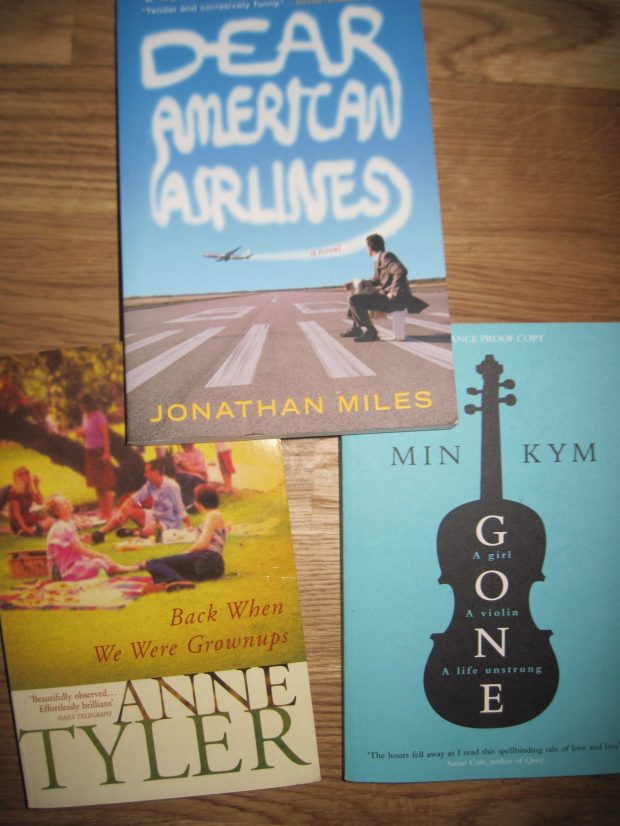
I’m also tempted by Min Kym’s Gone, a memoir by a violin virtuoso about having her Stradivarius stolen. I picked up a proof copy in a 3-for-£1 charity sale a couple of weeks ago. And then I can’t resist the aptness of Jonathan Miles’s Dear American Airlines (even though we’re actually flying on Virgin). I’ll start one or more of these before we go, just to make sure they ‘take’.
I almost certainly won’t need three print books for the trip, particularly if I take advantage of the in-flight entertainment. We only ever seem to watch films while we’re in America or en route there, so between the two legs I’ll at least try to get to La La Land and The Light between Oceans; I’m also considering Nocturnal Animals, Silence, and the live-action Beauty and the Beast – anyone seen these?
However, I’ll also keep my Kindle to hand, as I find it easier to pick up and put down on multi-part journeys like ours to the airport (train ride + coach ride). Some of the books on my Kindle priority list are: The Day that Went Missing by Richard Beard, Cork Dork by Bianca Bosker, Eleanor Oliphant Is Completely Fine by Gail Honeyman, The Fact of a Body by Alexandria Marzano-Lesnevich, Mrs. Fletcher by Tom Perrotta (out in August), The Power by Naomi Alderman, Reservoir 13 by Jon McGregor, The Rules Do Not Apply by Ariel Levy, See What I have Done by Sarah Schmidt, You Should Have Left by Daniel Kehlmann … and the list continues, but I’ll stop there.

My book shopping list is an ongoing one, as the many cross-outs and additions on this sheet show. Finding specific books at my beloved Wonder Book can be a challenge, so I usually just keep in mind the names of authors I’d like to read more by. This time that might include Arnold Bennett, Geoff Dyer, Elizabeth Hay, Bernd Heinrich, W. Somerset Maugham, Haruki Murakami and Kathleen Norris. In addition to the couple of secondhand bookstores we always hit, I hope to visit a few new-to-me ones on stays with friends in Virginia.
As for those poor books sat in boxes in the closet, I have plans to unearth novels by Anita Brookner, Mohsin Hamid, Kent Haruf, Penelope Lively, Howard Norman and Philip Roth – for reading while I’m there and/or bringing back with me. I’m also contemplating borrowing my dad’s omnibus edition of the John Updike “Rabbit” novels. From my nonfiction hoard, I fancy an Alexandra Fuller memoir, D.H. Lawrence’s travel books and more of May Sarton’s journals. If only it weren’t for luggage weight limits!
On Monday I’ll publish my intercontinental Library Checkout, on Tuesday I have a few June releases to recommend, and then I’m scheduling a handful of posts for while I’m away – a couple reviews I happen to have ready, plus some other lightweight stuff. Alas, I read no doorstoppers in May, but I have a list (of course) of potential ones for June, so will attempt to resurrect that monthly column.
Though I may be slow to respond to comments and read your blogs while I’m away, I will do my best and hope to catch up soon after I’m back.
Classic of the Month: The Moon and Sixpence
This was indeed the perfect follow-up to Fabrizio Dori’s Gauguin, the SelfMadeHero graphic novel I reviewed earlier in the month. W. Somerset Maugham’s short novel functioned like a prequel for me because, whereas Dori focuses on Gauguin’s later life in the South Pacific, Maugham concentrates on his character Charles Strickland’s attempt to make a living as a painter in Paris.
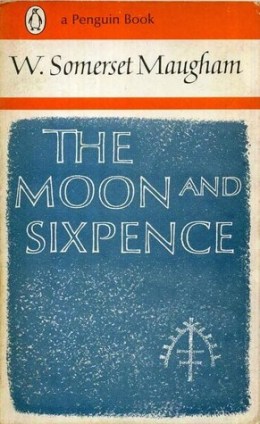 The Moon and Sixpence – the unusual title comes from the TLS reviewer’s description of the protagonist in Of Human Bondage as so absorbed in reaching for the moon that he doesn’t notice the sixpence at his feet – is narrated by an unnamed author drawn into Strickland’s orbit through his wife Amy Strickland’s attendance at London literary soirées. He hasn’t gotten to know the couple very well at all when he hears that Charles, a stockbroker, has abandoned his family and left for Paris to pursue painting – a hobby for which he’s never previously shown any aptitude.
Amy sends the narrator off to Paris to talk sense into her husband, but Charles never shows the least remorse. The narrator marvels at his insouciance and utter conviction that he is meant to be an artist.
He was single-hearted in his aim, and to pursue it he was willing to sacrifice not only himself – many can do that – but others. He had a vision. Strickland was an odious man, but I still think he was a great one.
I noted familiar themes from Of Human Bondage (published in 1915, four years prior to The Moon and Sixpence), especially the artist’s struggle, nomadism and the threat of poverty. Dirk Stroeve, the talentless Dutch painter who becomes friendly with the narrator in Paris and recognizes Strickland’s brilliance even as he lets the man walk all over him, reminded me of the happy-go-lucky Thorpe Athelny in Bondage.
At less than a third of the length of that earlier novel, though, The Moon and Sixpence struck me as a condensed parable about genius and sacrifice.
Beauty is something wonderful and strange that the artist fashions out of the chaos of the world in the torment of his soul. … It was the work of a man who had delved into the hidden depths of nature and had discovered secrets. … There was something primeval there and terrible. It was not human. It brought to … mind vague recollections of black magic. It was beautiful and obscene.
This is a fascinating character study, whether or not you’re aware of Gauguin’s life as the inspiration, and would be a great introduction to Maugham’s work if you’ve not read him before. (Secondhand copy from Bookbarn International.)
My rating:
Brain vs. Heart Surgery: Admissions and Fragile Lives
It’s never too early to start thinking about which books might make it onto next year’s Wellcome Book Prize nominees list, open to any medical-themed books published in the UK in calendar year 2017. I’ve already read some cracking contenders, including these two memoirs from British surgeons.
Brain surgeon Henry Marsh’s first book, Do No Harm, was one of my favorite reads of 2015. In short, enthrallingly detailed chapters named after conditions he had treated or observed, he reflected on life as a surgeon, expressing sorrow over botched operations and marveling at the God-like power he wields over people’s quality of life. That first memoir saw him approaching retirement age and nearing the end of his tether with NHS bureaucracy.
Admissions: A Life in Brain Surgery serves as a sort of sequel, recording Marsh’s last few weeks at his London hospital and the projects that have driven him during his first years of retirement: woodworking, renovating a derelict lock-keeper’s cottage by the canal in Oxford, and yet more neurosurgery on medical missions to Nepal and the Ukraine. But he also ranges widely over his past, recalling cases from his early years in medicine as well as from recent memory, and describing his schooling and his parents. If I were being unkind, I might say that this feels like a collection of leftover incidents from the previous book project.
However, the life of a brain surgeon is so undeniably exciting that, even if these stories are the scraps, they are delicious ones. The title has a double meaning, of course, referring not only to the patients who are admitted to the hospital but also to a surgeon’s confessions. And there are certainly many cases Marsh regrets, including operating on the wrong side in a trapped nerve patient, failing to spot that a patient was on the verge of a diabetic coma before surgery, and a young woman going blind after an operation in the Ukraine. Often there is no clear right decision, though; operating or not operating could lead to equal damage.

Once again I was struck by Marsh’s trenchant humor: he recognizes the absurdities as well as the injustices of life. In Houston he taught on a neurosurgery workshop in which students created and then treated aneurysms in live pigs. When asked “Professor, can you give us some surgical pearls?” he “thought a little apologetically of the swine in the nearby bay undergoing surgery.” A year or so later, discussing the case of a twenty-two-year-old with a fractured spine, he bitterly says, “Christopher Reeve was a millionaire and lived in America and he eventually died from complications, so what chance a poor peasant in Nepal?”
Although some slightly odd structural decisions have gone into this book – the narrative keeps jumping back to Nepal and the Ukraine, and a late chapter called “Memory” is particularly scattered in focus – I still thoroughly enjoyed reading more of Marsh’s anecdotes. The final chapter is suitably melancholy, with its sense of winding down capturing not just the somewhat slower pace of his retired life but also his awareness of the inevitable approach of death. Recalling two particularly hideous deaths he observed in his first years as a doctor, he lends theoretical approval for euthanasia as a way of maintaining dignity until the end.
What I most admire about Marsh’s writing is how he blends realism and wonder. “When my brain dies, ‘I’ will die. ‘I’ am a transient electrochemical dance, made of myriad bits of information,” he recognizes. But that doesn’t deter him from producing lyrical passages like this one: “The white corpus callosum came into view at the floor of the chasm, like a white beach between two cliffs. Running along it, like two rivers, were the anterior cerebral arteries, one on other side, bright red, pulsing gently with the heartbeat.” I highly recommend his work to readers of Atul Gawande and Paul Kalanithi.
My rating:
Admissions: A Life in Brain Surgery was published in the UK by Weidenfeld & Nicolson on May 4th. My thanks to the publisher for sending a free copy for review. It will be published in the USA by Thomas Dunne Books on October 3rd.
What Marsh does for brain surgery in his pair of memoirs, Professor Stephen Westaby does for heart surgery in Fragile Lives, a vivid, compassionate set of stories culled from his long career. A working class lad from Scunthorpe who watched his grandfather die of heart failure, he made his way up from hospital porter to world-leading surgeon after training at Charing Cross Hospital Medical School.
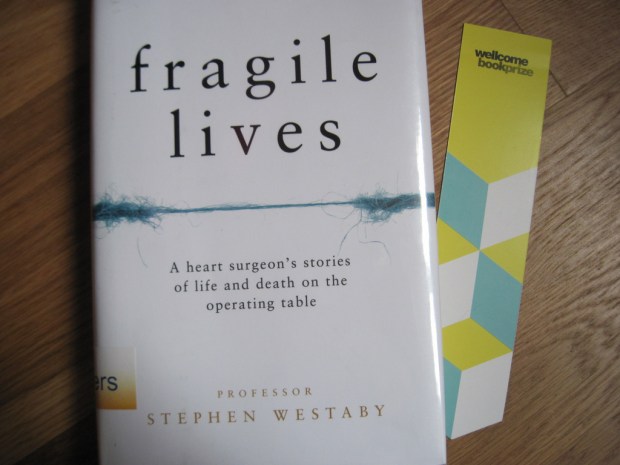
Each of these case studies, from a young African mother and her sick child whom he met while working in Saudi Arabia in the 1980s to a university student who collapses not far from his hospital in Oxford, is told in impressive depth. Although the surgery details are not for the squeamish, I found them riveting. Westaby conveys a keen sense of the adrenaline rush a surgeon gets while operating with the Grim Reaper looking on. I am not a little envious of all that he has achieved: not just saving the occasional life despite his high-mortality field – as if that weren’t enough – but also pioneering various artificial heart solutions and a tracheal bypass tube that’s named after him.
Like Marsh, he tries not to get emotionally attached to his patients, but often fails in this respect. “Surgeons are meant to be objective, not human,” he shrugs. But, also like Marsh, at his retirement he feels that NHS bureaucracy has tied his hands, denying necessary funds and equipment. Both authors come across as mavericks who don’t play by the rules, but save lives anyway. This is a fascinating read for anyone who enjoys books on a medical theme.
A few favorite lines:
“We stop life and start it again, making things better, taking calculated risks.”
“We were adrenaline junkies living on a continuous high, craving action. From bleeding patients to cardiac arrests. From theatre to intensive care. From pub to party.”
My rating:
Fragile Lives: A Heart Surgeon’s Stories of Life and Death on the Operating Table was published in the UK by HarperCollins on February 9th. I read a public library copy. It will be published in the USA, by Basic Books, under the title Open Heart on June 20th.
Books in Brief: Five I Loved Recently
Ironically, Tuesday’s post on all the books I’ve abandoned so far in 2017 was my most popular in ages; it received nearly twice as many views as most of my recent posts. I think readers must find it reassuring that they’re ‘allowed’ to give up on a book rather than struggle through to the end of something they’re really not enjoying. However, I unwittingly stirred up some controversy when I shared the post on a Facebook group for book bloggers and authors and got a few replies along the lines of “I would never write about a book I didn’t like or didn’t finish. It’s not fair to the author.” Hmmm.
Anyway, today I have five pretty much unreserved recommendations instead. An original take on the American Civil War, a retelling of a Shakespearean tragedy, a highly unusual travel book, a creative blending of poems and recipes, and a wonderful book about sisters and betrayal from a Canadian author new to me. I hope you’ll find something here to enjoy.
Days Without End
By Sebastian Barry
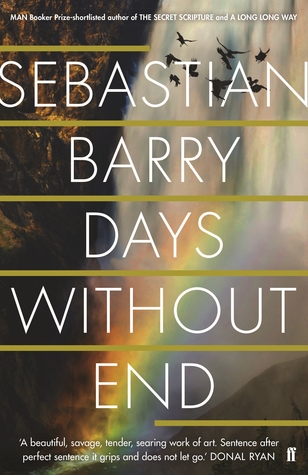 An entirely believable look at the life of the American soldier in the 1850s and 1860s, this novel succeeds due to its folksy dialect and a perfect balance between adventuresome spirit and repulsion at wartime carnage. While it shares some elements with Westerns and Civil War fiction, it’s unique in several ways. Though thrilling and episodic, it’s deeply thoughtful as well. Thomas writes semi-literate English but delivers profound, beautiful statements all the same. Lovely metaphors and memorable turns of phrase abound. Finally, this book is the most matter-of-fact consideration of same-sex relationships I’ve ever encountered in historical fiction. Heart-breaking, life-affirming, laugh-out-loud: these may be clichés, but here’s one novel that is all these things and more. Truly unforgettable. (See my full review at BookBrowse. See also my related article on the Native American practice of cross-dressing, known as winkte or berdache.)
My rating:
New Boy: Othello Retold
By Tracy Chevalier
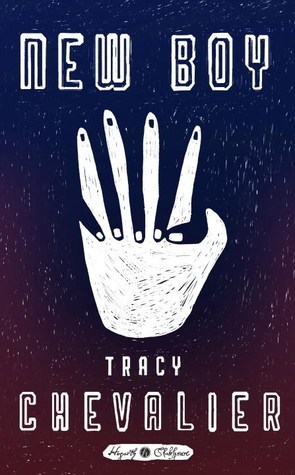 (My second favorite in the Hogarth Shakespeare series, after Margaret Atwood’s Hag-Seed.) Chevalier is known for historical fiction, but here she gives Othello a near-contemporary situation and a backdrop much closer to home: her native Washington, D.C. Spring 1974: it’s Ghanaian diplomat’s son Osei Kokote’s first day at a new school. Fortunately, he’s taken under the wing of one of the most popular sixth grade girls, Dee, and they’re soon inseparable. The novel takes place all in one day, divided into discrete sections by recess periods and a lunch break. Jump rope rhymes, jungle gyms, kickball games, arts and crafts, and a typical cafeteria meal of Salisbury steak and tater tots: it’s impressive how Chevalier takes ordinary elements and transforms them into symbols of a complex hierarchy and shifting loyalties. The language of possession and desire felt overly dramatic to me when applied to eleven-year-olds. However, it’s a remarkable exploration of the psyche of a boy isolated by his race. (Full review forthcoming at the Pittsburgh Post-Gazette website.)
My rating: (maybe more like 3.75)
Tragic Shores: A Memoir of Dark Travel
By Thomas H. Cook
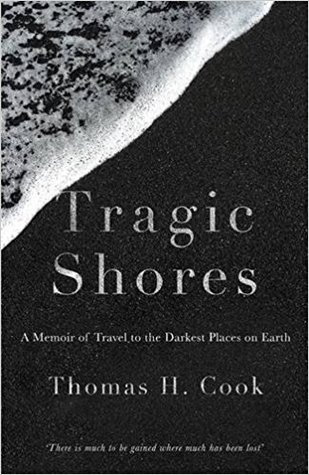 Cook is a crime writer. In this out-of-the-ordinary travel memoir he blends personal experience and history to tell of the ‘dark places’ he’s drawn to visiting. In 28 chapters that jump around in chronological order, he chronicles journeys he’s made to places associated with war, massacres, doomed lovers, suicides and other evidence of human suffering. Some are well known – Lourdes, Auschwitz, Verdun and Ground Zero – while others, like a Hawaiian leper colony and the hideaway of a fifteenth-century serial killer, require more background. A section on Okinawa and Hiroshima is among the book’s highlights: excellent descriptions of the mass suicide rooms where the Japanese retreated as the Americans approached and the atomic bomb drop itself bring history to life. But the most memorable chapter of all is one in which suffering touches Cook in a personal way. A meditative and often melancholy picture of humanity at its best and worst. (See my full review at Nudge.)
My rating:
Eat This Poem: A Literary Feast of Recipes Inspired by Poetry
By Nicole Gulotta
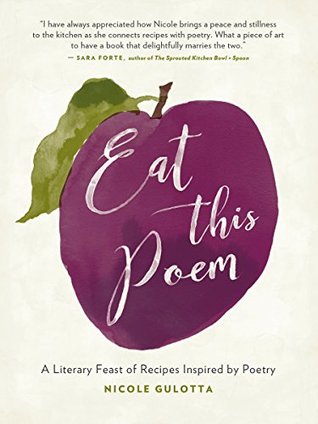 This arose from Gulotta’s blog of the same title. It’s a luscious mix of food-themed poems – none of which I’d ever encountered before, even if certain of the poets were familiar to me (like Mary Oliver, Sharon Olds and Wendell Berry) – commentary, personal anecdote and recipes that manage to hit the sweet spot in a Venn diagram between trendy, frugal, simple and indulgent. I could see myself making and eating any of these recipes, but my eye was particularly drawn to baked sweet potatoes with maple yogurt, vanilla-pear crumble, butternut squash macaroni and cheese, olive oil pumpkin bread, and cornmeal waffles. It might seem like this is a book that would only have niche appeal, but I don’t think that’s the case. Whether you like to cook or just like to eat, whether you love poetry or struggle to understand it, I’d recommend this for pleasant occasional reading. It only misses out on five stars because some of the observations are fairly obvious; these poems mostly speak for themselves.
My rating:
A Student of Weather
By Elizabeth Hay
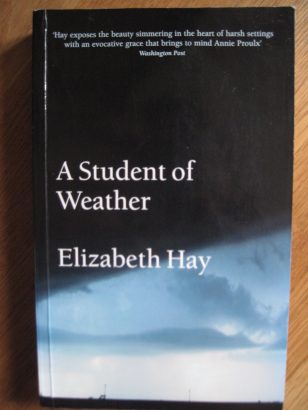 Set between the 1930s and 1970s, Hay’s debut (shortlisted for Canada’s Giller Prize in 2000) focuses on a pair of sisters, Norma Joyce and Lucinda Hardy, and the frostbitten young weather researcher who stumbles upon their Saskatchewan farmhouse one January evening in 1938. “Two sisters fell down the same well, and the well was Maurice Dove.” Seventeen-year-old Lucinda became the capable family housekeeper after their mother’s death. Norma Joyce is a precocious, sneaky eight-year-old. On each of Maurice’s visits, and in the years to come, they quietly jostle for his attention. Despite the upheaval of war and a move to Ontario, some things never change. Hay lends her story allusive depth by referencing biblical pairs of opposites: Jacob and Esau, Mary and Martha, and the Prodigal Son and his jealous older brother. My favorite parts were when the sisters were together in Canada; once Norma Joyce moves to New York, the book starts drifting a bit. However, there are such astute observations about what goes on in family and romantic relationships, and many perfect sentences. I thoroughly enjoyed reading this slowly over the course of a month, and I’d gladly read anything else from Hay.
My rating:
Have you read any of these? Which one takes your fancy?
All the Books I’ve Abandoned So Far This Year
Last year’s abandoned books posts were popular ones – strangely so considering that, instead of giving recommendations like usual, I was instead listing books I’d probably steer you away from. This is such a subjective thing, though; I know that at least a few of the books I discuss below (especially the Mervyn Peake and Rachel Cusk) have admirers among my trusted fellow bloggers. So consider this a record of some books that didn’t work for me: take my caution with a grain of salt, and don’t let me put you off if you think there’s something here that you’d really like to try. (For some unfinished books I give ratings, while for others where I haven’t read far enough to get a good sense of the contents I refrain from rating. This list is in chronological order of my reading rather than alphabetical by title or author.)
 Titus Groan by Mervyn Peake: Vivid scene setting and amusingly exaggerated characters, but I couldn’t seem to get anywhere. It takes over 50 pages for one servant to tell another that the master has had a son?! Hearing that the book only lasts until Titus’s second birthday made me fear the next 400+ pages would just be more of the same. I bought the whole trilogy secondhand, so I hope I’ll be successful on a future attempt. (Set aside at page 62.)
 Seven Seasons in Siena: My Quixotic Quest for Acceptance among Tuscany’s Proudest People, by Robert Rodi: I read the first 49 pages but found the information about the city’s different districts and horse races tedious. Favorite passage: “it’s what’s drawn me to Italians in general—their theatricality, their love of tradition, their spirit. Ever since my first trip to Rome, some ten years ago, I’ve found the robustness of the Italians’ appetites (for food, for music, for fashion) to be a welcome antidote to the dismaying anemia of modern American culture.”
A Book about Love by Jonah Lehrer: Read the first 31% of the Kindle book. Featured in my Valentine’s Day post about “Love” titles.
 Pondlife: A Swimmer’s Journal by Al Alvarez: I read the first 57 pages but found the entries fairly repetitive. The book spans nine years, but up to that point it was all set in 2002, when Alvarez was 73, and he reported so frequently that the conditions (weather, etc.) at the Hampstead Heath ponds didn’t differ enough to keep this interesting. Unless he’s traveling, you can count on each entry remarking on the traffic getting there, the relative scarcity or overabundance of fellow swimmers at the pond, the chilly start and the ultimately invigorating, calming effect of the water. Impressive that he’d been taking early-morning swims there since age 11, though. Favorite line (from a warm, late June day): “the water is like tepid soup – duck soup with swan-turd croutons.”
 The Best of Adam Sharp by Graeme Simsion: I read the first 36 pages of a library copy and gave up in grave disappointment. Compared to the two Rosie books, this felt like it had no spark. It’s just lots of name-dropping of 1960s and ’70s songs. I felt no connection to either Adam’s current life in England or his memories of his nascent relationship with soap actress Angelina back in Australia.
 The Wild Other: A Memoir by Clover Stroud: Normally I love memoirs that center on bereavement or major illness, but there’s so much going on in this book that drowns out the story of her mother falling off her horse and suffering a TBI when Stroud was 16. For instance, there’s a lot about the blended family she grew up in, embarrassing detail about her early sexual experiences, and an account of postnatal depression that plunges her back into memories of her mother’s accident. “Horses are the source of powerful magic that’s changed my life,” Stroud asserts, so she talks a lot about both real horses and chalk figures of them, but that’s not the same as affirming the healing power of nature, which is how this book has been marketed. Well written, yet I couldn’t warm to the story of a posh Home Counties upbringing, which means I never got as far as the more tantalizing contents set in Ireland and Texas. (Read the first 78 pages.)
 The Evening Road by Laird Hunt: I read about the first 50 pages, skimmed the rest of the first part, and barely glanced at the remainder. Hunt’s previous novel, Neverhome, was a pretty unforgettable take on the Civil War narrative. This latest book is trying to do something new with Jim Crow violence. In the 1920s–30s history Hunt draws on, lynchings were entertainment in the same way other forms of execution were in previous centuries; buses have even been put on to take people to “the show” up at Marvel, Indiana. Hateful Ottie Lee narrates the first half of the novel as she rides with her handsy boss Bud Lancer and her unappealing husband Dale to see the lynching. Their road trip includes a catfish supper, plenty of drinking, and a stop at a dance hall. It ends up feeling like a less entertaining The Help. A feel-good picaresque about a lynching? It might work if there were a contrasting tone, a hint that somewhere in this fictional universe there is an appropriate sense of horror about what is happening. I think Hunt’s mistake is to stick with Ottie Lee the whole time rather than switching between her and Calla Destry (the black narrator of the second half) or an omniscient narrator. I’d long given up on the novel by the time Calla came into play.
 Outline by Rachel Cusk: I read the first 66 pages before setting this aside. I didn’t dislike the writing; I even found it quite profound in places, but there’s not enough story to peg such philosophical depth on. This makes it the very opposite of unputdownable. Last year I read the first few pages of Aftermath, about her divorce, and found it similarly detached. In general I just think her style doesn’t connect with me. I’m unlikely to pick up another of her books, although I have had her memoir of motherhood recommended. Lines I appreciated: “your failures keep returning to you, while your successes are something you always have to convince yourself of”; “it’s a bit like marriage, he said. You build a whole structure on a period of intensity that’s never repeated. It’s the basis of your faith and sometimes you doubt it, but you never renounce it because too much of your life stands on that ground.”
Last but not least, Our Mutual Friend by Charles Dickens, in which I barely made it a few chapters.
Only nine in five months – not too shabby? There’s also a handful of other books that I decided to skim instead of read in their entirety, though.
I’ll be interested to hear if you’ve read any of these books – or plan to read them – and believe that they are worth persisting with.
Two Mother–Daughter Author Pairs for Mother’s Day
This coming Sunday is Mother’s Day in the USA. (Mothering Sunday generally falls in March here in the UK, so every year I have to buy a card early to send to my mother back in the States, but I still associate Mother’s Day with May.) Earlier in the year I got over halfway through a Goodreads giveaway book, Beyond the Pale by Emily Urquhart, before I realized its author was the daughter of a Canadian novelist I’d read before, Jane Urquhart. That got me thinking about other mother–daughter pairs that might be on my shelves. I found one in the form of Sue Monk Kidd’s The Secret Life of Bees plus an advance e-copy of her daughter Ann Kidd Taylor’s upcoming debut novel, The Shark Club. (I’ve previously reviewed their joint memoir, Traveling with Pomegranates.) And, as a bonus, I have a mini-review of Graham Swift’s novella Mothering Sunday: A Romance.
The Whirlpool, Jane Urquhart
 From 1986, this was Urquhart’s first novel. Overall it reminded me of A. S. Byatt (especially The Virgin in the Garden) and John Fowles’s The French Lieutenant’s Woman. Set in 1889 on the Canadian side of Niagara Falls, it features characters who, each in their separate ways, are stuck in the past and obsessed with death and its symbolic stand-in, the whirlpool. Maud Grady, the local undertaker’s widow, takes possession of the corpses of those who’ve tried to swim the Falls. Her creepy young son starts off mute and becomes an expert mimic. Major David McDougal is fixated on the War of 1812, while his wife Fleda camps out in a tent reading Victorian poetry, especially Robert Browning, and awaiting a house that may never be built. Local poet Patrick sees Fleda from afar and develops romanticized ideas about her.
Each of these narratives is entertaining, but I was less convinced by their intersections – except for the brilliant scenes when Patrick and Maud’s son engage in wordplay. In particular, I was unsure what the prologue and epilogue (in which Robert Browning, dying in Venice, is visited by images of Shelley’s death by drowning) were meant to add. This is the second Urquhart novel I’ve read, after Sanctuary Line. I admire her writing but her plots don’t always come together. However, I’m sure to try more of her work: I have a copy of Away on the shelf, and Changing Heaven (1990) sounds unmissable – it features the ghost of Emily Brontë! [Bought from a Lambeth charity shop for 20p.]
My rating:
Beyond the Pale: Folklore, Family and the Mystery of Our Hidden Genes, Emily Urquhart
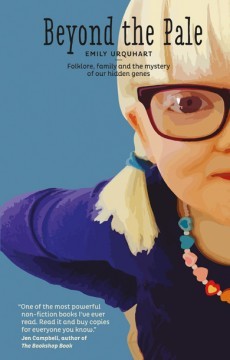 In December 2010, the author’s first child, Sadie, was born with white hair. It took weeks to confirm that Sadie had albinism, a genetic condition associated with extreme light sensitivity and poor eyesight. A Canadian folklorist, Urquhart is well placed to trace the legends that have arisen about albinos through time and across the world, ranging from the Dead Sea Scroll story of Noah being born with blinding white skin and hair to the enduring superstition that accounts for African albinos being maimed or killed to use their body parts in folk medicine.
She attends a NOAH (America’s National Organization for Albinism and Hypopigmentation) conference, discovers potential evidence of a family history of albinism, and even makes a pilgrimage to Tanzania to meet some victims. It’s all written up in as engaging present-tense narrative of coming to terms with disability: to start with Urquhart is annoyed at people reassuring her “it could be worse,” but by the end she’s ever so slightly disappointed to learn that her second child, a boy, will not be an albino like his sister. [Goodreads giveaway copy]
My rating:
The Secret Life of Bees, Sue Monk Kidd
 It’s hard to believe it was 15 years ago that this debut novel was an It book, and harder to believe that I’d never managed to get around to it until now. However, in some ways it felt familiar because I’d read a fair bit of background via Kidd’s chapter in Why We Write about Ourselves and Traveling with Pomegranates, in which she and her daughter explored the Black Madonna tradition in Europe.
It joins unusual elements you wouldn’t expect to find in fiction – beekeeping and the divine feminine – with more well-trodden territory: the Civil Rights movement in the South in the 1960s, unhappy family relationships, secrets, and a teenage girl’s coming of age. Fourteen-year-old Lily is an appealing narrator who runs away from her memories of her mother’s death and her angry father, peach farmer T. Ray. You can’t help but fall in love with the rest of her new African-American, matriarchal clan, including their housekeeper, Rosaleen, who scandalizes the town by registering to vote, and the bee-keeping Boatwright sisters, August, June, and May, who give Lily and Rosaleen refuge when they skip town.
Although this crams in a lot of happenings and emotional ups and downs, it’s a charming story that draws you into the brutal heat of a South Carolina summer and keeps you hoping Lily will forgive herself and slip into the rhythms of a purposeful life of sisterhood. [Secondhand purchase in America]
A favorite line: “The way people lived their lives, settling for grits and cow shit, made me sick.”
My rating:
The Shark Club, Ann Kidd Taylor
 Dr. Maeve Donnelly loves sharks even though she was bitten by one as a child. She’s now a leading researcher with a Florida conservancy and travels around the world to gather data. Her professional life goes from strength to strength, but her personal life is another matter. Aged 30, she’s smarting from a broken engagement to her childhood sweetheart, Daniel, and isn’t ready to open her heart to Nicholas, a British colleague going through a divorce.
Things get complicated when Daniel returns to their southwest Florida island to work as the chef at her grandmother’s hotel – with his six-year-old daughter in tow. Maeve is soon taken with precocious Hazel, who founds the title club (pledge: “With this fin, I do swear. To love sharks even when they bite. When they lose their teeth, I will find them. When I catch one, I will let it go”), but isn’t sure she can pick up where she left off with Daniel. Meanwhile, evidence has surfaced of a local shark finning operation, and she’s determined to get to the bottom of it.
This is a little bit romance and a little bit mystery, and Taylor brings the Florida Keys setting to vibrant life. It took a while to suspend disbelief about Maeve’s background – an orphan and a twin and a shark bite survivor and a kid brought up in a hotel? – but I enjoyed the sweet yet unpredictable story line. Nothing earth-shattering, but great light reading for a summer day at the beach. Releases June 6th from Viking. [Edelweiss download]
My rating:
Mothering Sunday: A Romance, Graham Swift
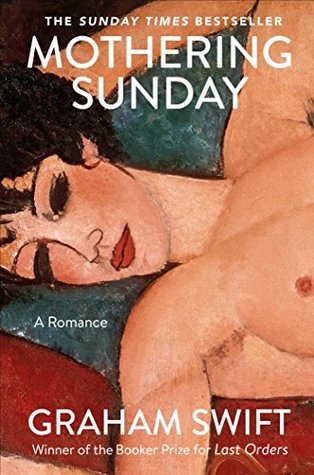 If you’re expecting a cozy tale of maternal love, let the Modigliani nude on the U.K. cover wipe that notion out of your mind. Part of me was impressed by Swift’s compact picture of one sexy, fateful day in 1924 and the reverberations it had for a budding writer even decades later. Interesting class connotations, too. But another part of me thought, isn’t this what you would get if Ian McEwan directed a middling episode of Downton Abbey? It has undeniable similarities to Atonement and On Chesil Beach, after all, and unlike those novels it’s repetitive; it keeps cycling round to restate its main events and points. There’s some good lines, but overall this felt like a strong short story stretched out to try to achieve book length. [Library read]
My rating:
 Bookish Beck = Rebecca Foster. American transplant to England. Freelance proofreader and book reviewer.
