And the Winner Is…
I’m just back from London, where I saw the Wellcome Book Prize 2017 announced in the course of an awards ceremony held at the Wellcome Collection. It was an enjoyable evening; I needn’t have been so nervous. And it was lovely to meet two fellow bloggers.
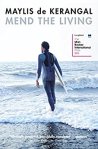 I’ll post a full write-up tomorrow, but for now I will just convey the news, to those who may not have heard yet, that the winner of this year’s Wellcome Book Prize is Mend the Living by Maylis de Kerangal. This was quite a shock to many of us in attendance. I hope it won’t sound ungracious if I say it was the collective least favorite of the shadow panel. But keep in mind that that’s relative: it was a strong set of six very different books, each worth reading.
Wellcome Book Prize Shadow Panel Decision
It’s been a whirlwind five weeks as we on the shadow panel have made our way through the six books shortlisted for the Wellcome Book Prize 2017. The list is strong and varied: an account of the AIDS crisis, a posthumous memoir by a neurosurgeon, a thorough history of genetics, an introduction to the microbial world, and novels about a donor heart and an ordinary family’s encounter with unexpected illness. All have been well worth engaging with, but when it came to decision time we had a pretty clear winner: When Breath Becomes Air by Paul Kalanithi. (With Sarah Moss’s The Tidal Zone a fairly close second.)


“I realized that the questions intersecting life, death, and meaning, questions that all people face at some point, usually arise in a medical context.” ~Paul Kalanithi
I first read this book a year and a half ago; when I picked it back up on Friday, I thought I’d give it just a quick skim to remind myself why I loved it. Before I knew it I’d read 50 pages, and I finished it last night in the car on the way back from a family party, clutching my dinky phone as a flashlight, awash in tears once again. (To put this in perspective: I almost never reread books. My last rereading was of several Dickens novels for my master’s in 2005–6.)
What struck me most on my second reading is how Kalanithi, even in his brief life, saw both sides of the medical experience (as the U.K. book cover portrays so well). He was the harried neurosurgery resident making life and death decisions and marveling at the workings of the brain; in a trice he was the patient with terminal lung cancer wondering how to make the most of his remaining time with his family.

Yet in both roles his question was always “What makes human life meaningful?” – a quest that kept him shuttling between science, literature and religion. In eloquent prose and with frequent scriptural allusions, this short, technically unfinished book narrates Kalanithi’s past (his growing-up years and medical training), present (undergoing cancer treatment but ultimately facing death) and future (the legacy he leaves behind, including his daughter).
Looking back once again at the guidelines for the Wellcome Book Prize (“At some point, medicine touches all our lives. Books that find stories in those brushes with medicine are ones that add new meaning to what it means to be human”), When Breath Becomes Air stands out as a perfect exemplar. In her blog review, Ruby writes, “This book looks death right in the eye and doesn’t seek to rationalise it, explain it, avoid it. It deals with it head on.” In his Nudge review Paul calls the book “equally heart breaking and full of love … a painfully honest account of a short, but intense life.”
My thanks, once again, to the other members of the shadow panel: Paul Cheney, GrrlScientist, Ruby Jhita and Amy Pirt.
Tomorrow evening the winner of the Wellcome Book Prize 2017 will be announced at an awards ceremony at the Wellcome Collection in London. As thanks for my participation in the blog tour, I’ve been invited to attend. Small talk and networking are very much outside of my comfort zone, but I couldn’t pass up this opportunity and hope to at the very least meet one or two fellow bloggers. I’ll post very quickly when I get home from the ceremony tomorrow night to announce the winner, and promise a longer write-up of the event sometime on Tuesday.
Polishing off the Wellcome Prize Shortlist: How to Survive a Plague
Spanning from the summer of 1981, when the New York Times first broke the story about a rare cancer observed in homosexuals, to 1996, when protease inhibitors came onto the market and offered HIV sufferers a new lease on life, How to Survive a Plague is a comprehensive history of the AIDS crisis. Especially in its early chapters, it reads like a fascinating medical mystery – though we already know the answers, the book skillfully captures the ignorance and terror that reigned for so many years as people sought to understand what Gay-Related Immune Deficiency (GRID, the original name for AIDS) was and how it was transmitted.
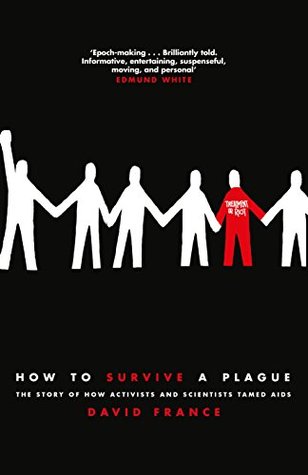 As a journalist and a gay man, David France was right in the thick of the crisis when he moved to Manhattan in 1981. He lost friends and lovers to AIDS, and had his own health scares, too – once, on assignment in war-torn Central America, he developed what he thought was a Kaposi’s sarcoma lesion but turned out to be a sign of amoebic infection.
Throughout the 1980s the number of HIV cases roughly doubled each year; media coverage was intense but often alarmist. Undertakers refused to deal with AIDS victims, and Jerry Falwell and his ilk spoke of a gay conspiracy taking over America. Far too slowly, research advanced to cope with the crisis. France gives details of the medical trials and presidential commissions that kept AIDS at the forefront of the national conscience, generally thanks to patient advocacy groups like ACT UP (AIDS Coalition to Unleash Power) and PWA (People with AIDS – more proactive terminology than victims or patients).
The book reminds me most of Sheri Fink’s Five Days in Memorial, another social history with a vast scope and a large cast of characters; here there are about 25 doctors, researchers and activists, many of them based in New York City, who keep recurring. For instance, there’s Joe Sonnabend, an infectious diseases expert who specialized in treating gay men for venereal diseases; Larry Kramer, who wrote an angry novel about fellow homosexuals yet tried to lead the response; and Richard Berkowitz, a former sex worker who co-wrote How to Have Sex in an Epidemic, a safe sex guide that encouraged a surge in condom use.
I rather underestimated the reading load the Wellcome shortlist would create for me; I ended up getting bogged down in this 500+-page book’s level of detail and only succeeded in skimming it. I think that for someone without a personal stake in the story of AIDS, watching the 2012 documentary film of the same title that spawned the book would be an easier way to absorb copious information and keep track of all the individuals and organizations involved.
Nonetheless, I can certainly affirm the importance of a landmark book like this one. When I surveyed critical opinion on it for Bookmarks magazine, I noticed many comparisons to Randy Shilts’s 1987 And the Band Played On, but while that book was written in medias res and deliberately vilified a French-Canadian flight attendant named Gaëtan Dugas who was linked with multiple AIDS cases in North America, How to Survive a Plague benefits from two decades of hindsight and reflects a mixture of journalistic objectivity and personal grief.
It’s sobering to remember the scale of the AIDS epidemic: 100,000 Americans had died of it by 1991. As one HIV-positive ACT UP activist cried out to Bill Clinton, then a Democratic candidate, at a campaign event, “Bill, we’re dying of neglect!” France’s book really brings home how traumatic these years were for a whole country, but especially for homosexuals. He describes the relief of knowing that effective medical treatment was finally in the pipeline, but also the lingering effects of shame, bitterness, and fear.
Nobody left those years uncorrupted by what they’d witnessed, not only the mass deaths—100,000 lost in New York City alone, snatched from tightly drawn social circles—but also the foul truths that a microscopic virus had revealed about American culture: politicians who welcomed the plague as proof of God’s will, doctors who refused the victims medical care, clergymen and often even parents themselves who withheld all but a shiver of grief. Such betrayal would be impossible to forget in the subsequent years.
My rating: 
My gut feeling: France has written a definitive history of the AIDS crisis in the United States. It’s a cautionary tale that must not be forgotten. While not among my personal favorites from the shortlist, it would be a worthy winner.
More reviews:
Clare’s at A Little Blog of Books
Stay tuned for our shadow panel winner, which I will announce here tomorrow morning!
Wellcome Book Prize Blog Tour: Ed Yong’s I Contain Multitudes
Ed Yong is a London-based science writer for The Atlantic and is part of National Geographic’s blogging network. I had trouble believing that I Contain Multitudes: The Microbes within Us and a Grander View of Life is his first book; it’s so fluent and engaging that it immediately draws you into the microbial world and keeps you marveling at its strange yet fascinating workings. Yong writes like a journalist rather than a scientist, and that’s a good thing: with an eye to the average reader, he uses a variety of examples and metaphors, intersperses personal anecdotes of visiting researchers at their labs or in the field, and is careful to recap important facts in a lucid way.
The book opens with a visit to San Diego Zoo (see the exclusive extract following my review), where we meet Baba the pangolin. But “Baba is not just a pangolin. He is also a teeming mass of microbes,” Yong explains. “Some of them live inside him, mostly in his gut. Others live on the surface of his face, belly, paws, claws, and scales.” Believe it or not, but we are roughly half and half human cells and microbial cells, making each of us – like all creatures – more of an ecosystem (another term is “holobiont”) than a single entity.
Microbes vary between species but also within species, so each individual’s microbiome in some ways reflects a unique mixture of genes and experiences. This is why people’s underarms smell subtly different, and how hyenas use their scent glands to convey messages. The microbiome may well be tailored to different creatures’ functions, so researchers at San Diego Zoo are testing swabs from their animals to see if there could be discernible signatures for burrowing or flying activities, or for disease. I was struck by the breadth of species considered here: not just mammals, but also invertebrates like beetles, cicadas, and squid – my entomologist husband would surely be proud. The “Us” in the subtitle is thus used very inclusively to speak of the way that microbes live in symbiosis with all living things.
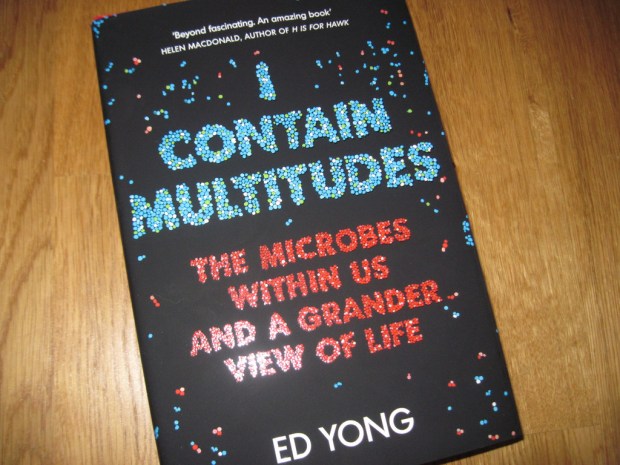
I love the textured dust jacket too.
If I were to boil down Yong’s book to one message, it’s that microbes are not simply “bad” or “good” but have different roles depending on the context and the host. You can hardly dismiss all bacteria as germs that must be eradicated when there are thousands of benign species in your gut (versus fewer than 100 kinds that cause infectious diseases). If it weren’t for the microbes passed on to us at birth, we wouldn’t be able to digest the complex sugars in our mothers’ milk. Other creatures rely on bacteria to help them develop to adulthood, like the tube worms that thrive on Navy ship hulls at Pearl Harbor.
Yet Yong feels too little attention is given to beneficial microbes, and in many cases we continue the campaign to rid ourselves of them through overuse of antibiotics and taking cleanliness to unhelpful extremes. “We have been tilting at microbes for too long, and created a world that’s hostile to the ones we need,” he asserts.
The book is full of lines like that one that combine a nice turn of phrase and a clever literary allusion. In the title alone, after all, you have references to Walt Whitman (“I contain multitudes” is from his “Song of Myself”) and Charles Darwin (“there is grandeur in this view of life” is part of the closing sentence in his On the Origin of Species). Yong also sets up helpful analogies, comparing the immune system to a thermostat and antibiotics to “shock-and-awe weapons … like nuking a city to deal with a rat.”
History and future are also brought together very effectively, with the narrative looking backwards to Leeuwenhoek’s early microscope work and Pasteur and Koch’s germ theory, but also forwards to the prospects that current research into microbes might enable: eliminating elephantiasis, protecting frogs from deadly fungi via probiotics in the soil, fecal microbiota transplants to cure C. diff infections, and so on.
The possibilities seem endless, and this is a book that will keep you shaking your head in amazement. I’d liken Yong’s style to David Quammen’s or Rebecca Skloot’s. His clear and intriguing science writing succeeds in inspiring wonder at the natural world and at the bodies that carry us through it.
With thanks to Joe Pickering at The Bodley Head for the review copy.
My rating: 
An exclusive extract from “PROLOGUE: A TRIP TO THE ZOO”
I Contain Multitudes by Ed Yong
(The Bodley Head)
All of us have an abundant microscopic menagerie, collectively known as the microbiota or microbiome.1 They live on our surface, inside our bodies, and sometimes inside our very cells. The vast majority of them are bacteria, but there are also other tiny organisms including fungi (such as yeasts) and archaea, a mysterious group that we will meet again later. There are viruses too, in unfathomable numbers – a virome that infects all the other microbes and occasionally the host’s cells. We can’t see any of these minuscule specks. But if our own cells were to mysteriously disappear, they would perhaps be detectable as a ghostly microbial shimmer, outlining a now-vanished animal core.2
In some cases, the missing cells would barely be noticeable. Sponges are among the simplest of animals, with static bodies never more than a few cells thick, and they are also home to a thriving microbiome.3 Sometimes, if you look at a sponge under a microscope, you will barely be able to see the animal for the microbes that cover it. The even simpler placozoans are little more than oozing mats of cells; they look like amoebae but they are animals like us, and they also have microbial partners. Ants live in colonies that can number in their millions, but every single ant is a colony unto itself. A polar bear, trundling solo through the Arctic, with nothing but ice in all directions, is completely surrounded. Bar-headed geese carry microbes over the Himalayas, while elephant seals take them into the deepest oceans. When Neil Armstrong and Buzz Aldrin set foot on the Moon, they were also taking giant steps for microbe-kind.
When Orson Welles said ‘We’re born alone, we live alone, we die alone’, he was mistaken. Even when we are alone, we are never alone. We exist in symbiosis – a wonderful term that refers to different organisms living together. Some animals are colonised by microbes while they are still unfertilised eggs; others pick up their first partners at the moment of birth. We then proceed through our lives in their presence. When we eat, so do they. When we travel, they come along. When we die, they consume us. Every one of us is a zoo in our own right’– a colony enclosed within a single body. A multi-species collective. An entire world.
Footnotes
- In this book, I use the terms ‘microbiota’ and ‘microbiome’ interchangeably. Some scientists will argue that microbiota means the organisms themselves, while microbiome refers to their collective genes. But one of the very first uses of microbiome, back in 1988, used the term to talk about a group of microbes living in a given place. That definition persists today – it emphasises the ‘biome’ bit, which refers to a community, rather than the ‘ome’ best, which refers to the world of genomes.
- This imagery was first used by the ecologist Clair Folsome (Folsome, 1985).
- Sponges: Thacker and Freeman, 2012; placozoans: personal communication from Nicole Dubilier and Margaret McFall-Ngai.
My gut feeling: This book is a fine example of popular science writing, and has much to teach us about the everyday workings of our bodies. It’s one of my three favorites from the shortlist.
See also: Paul’s review at Nudge
Shortlist strategy: Tomorrow I’ll post a quick response to David France’s How to Survive a Plague, and on Sunday we will announce our shadow panel winner.
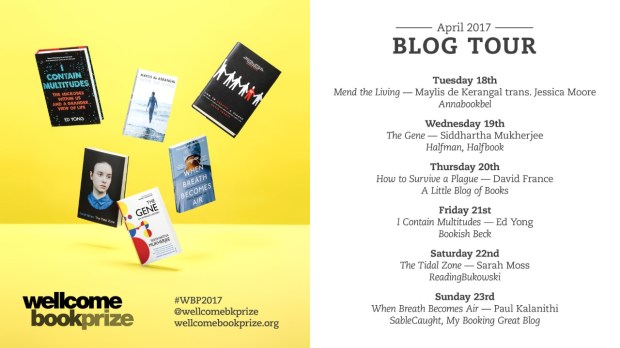
I was delighted to be asked to participate in the Wellcome Book Prize blog tour. See below for details of where other reviews and features have appeared or will be appearing soon.
And if you are within striking distance of London, please consider coming to one of the shortlist events being held this Saturday and Sunday.
Show Her a Flower, a Bird, a Shadow by Peg Alford Pursell
Northern California’s Peg Alford Pursell is the founder of Why There Are Words, a Bay Area series of public literary readings, and the independent publishing house WTAW Press. Her short fiction has been shortlisted for the Flannery O’Connor Award.
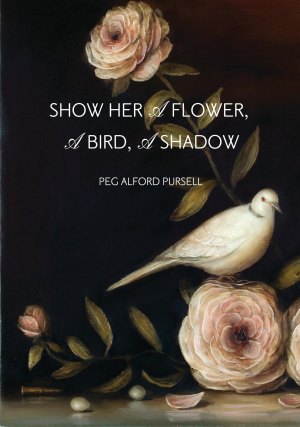
The lovely cover image is from White Dove and Roses by David Kroll.
Her debut work, Show Her a Flower, a Bird, a Shadow, is a collection of flash fictions, ranging in length from a few lines to a few pages, many of which have been previously published in literary journals or anthologies. They often read like poems, with the alliteration, colors and imagery lending more resonance to the prose than you usually find in short stories. First and last lines are especially incisive, like the phrase that opens “Petal, Feather, Particle,” about a single mother on her way to a hotel to calm her daughter down: “Show her a flower, a bird, a shadow, and she will show you what is simultaneously forming and falling apart.”
Plot is incidental and largely secondary to language and emotion here, but many of the pieces share a topic of shaky relationships, and the bonds that last in life versus the ones that fade away. Young female first-person narrators frequently alternate with third-person stories about older women, but a recurring theme throughout is how others view you versus how you see yourself. Especially in the context of long-term relationships, these characters have to keep life from going stagnant by staying in motion and living mindfully:
Just as in marriage. He didn’t believe in stopping, resting, or pausing. Drive was everything. Look at the fat bumblebee busy on the flower stalk: the creature anything but in repose, gathering nectar for all it’s worth before moving on to the next. That was how to be in the world. (from “At the Flower”)
Likewise, “This is what familiarity demands: that I examine every detail again as if new clues will present themselves,” a woman thinks while looking at photographs of her daughter (in “The Girl in the Picture”).
A few of my favorite stories were “Day of the Dead,” which mixes Mexican traditions with the narrator’s own bereavements; “Girl on a Hobby Horse,” in which a woman meditates with her Buddhist daughter after her own 14-year relationship breaks down; and “A Weak Light Shining through the High Small Window,” about a woman visiting her brain-injured husband in the hospital and imagining their future together.
The final piece, “Inscription of Time,” reminded me most of Margaret Drabble’s The Dark Flood Rises with its picture of a woman who has lost many family members and friends yet gains a necessary sense of closure when a former lover, a race car driver who once had an accident that left him in a temporary coma, invites her to his apartment to say a proper goodbye. “It was as if he’d understood what she hadn’t known until that moment. That she needed an ending.”
It may be only 70 pages long, but this book packs a poetic punch. Its images and lines linger, and it deserves to be read slowly and mulled over. I’d recommend it to readers of Tessa Hadley and Desiree Cooper, and fans of flash fiction in general.
Show Her a Flower, a Bird, a Shadow was released by ELJ Editions on March 31st. My thanks to the author for sending a PDF copy for review.
My rating:
Wellcome Prize Shortlist, Pt. 3: The Gene, Siddhartha Mukherjee
Siddhartha Mukherjee is an assistant professor of medicine at Columbia University, where his lab specializes in stem cells and blood cancers. His book The Emperor of All Maladies, which won a Pulitzer Prize in 2011, is among my most memorable reads of the past decade. Along with Rebecca Skloot’s The Immortal Life of Henrietta Lacks, it was one of the first books to turn me on to health-themed reading.
 So it was a disappointment to find that I could never really engage with his second full-length work, The Gene: An Intimate History. There’s no denying this book’s impressive scope: it’s a comprehensive survey of the past 150 years of genetics research, but it also stretches back to antiquity to see the different ways people have imagined that heredity works. It’s a no-holds-barred science and social history text, both chronological and thematic in approach, and it also surprises with its breadth of literary reference (as in the epigraphs from 1Q84 and The Importance of Being Earnest). However, my favorite snippets were those that constitute a mini family memoir of the schizophrenia that runs through the author’s India-based family.
Part of the problem was that a lot of the early material concerning Gregor Mendel and Charles Darwin is very familiar to me. High school genetics material has stayed fresh in my mind even though so many other subjects have faded, and I’ve done a lot of reading on Darwin for my Victorian Literature MA and on my own time. Darwin’s cousin, Francis Galton, then provides a segue into the dark side of genetics: eugenics. A lot of space is given to Nazism, but Mukherjee also hits closer to home with the case of Carrie Buck, a “feeble-minded” woman whose enforced sterilization the U.S. Supreme Court affirmed in 1927.
Other important figures in the history of genetics include Dutch botanist Hugo de Vries, Hermann Muller, Oswald Avery, Linus Pauling, and the famous English team that discovered the structure of DNA, Watson, Crick & Franklin. Parts Three and Four, which chronicle the advances in genetics that fell between the 1970s and early 2000s, struck me as particularly dull, whereas Part Five held my interest much more strongly in that it brings things up to date with the developments of the last 15 years, including epigenetics, genetic testing for breast cancer and schizophrenia, stem cell therapy and the search for a “gay gene.”
The book did leave me with a strong sense that our knowledge of genes – the least divisible unit of information about life – affects our understanding of the human identity and future:
In the early decades of the twenty-first century, we are learning to speak yet another language of cause and effect, and constructing a new epidemiology of self: we are beginning to describe illness, identity, affinity, temperament, preferences—and, ultimately, fate and choice—in terms of genes and genomes. This is not to make the absurd claim that genes are the only lenses through which fundamental aspects of our nature and destiny can be viewed. But it is to propose and to give serious consideration to one of the most provocative ideas about our history and future: that the influence of genes on our lives and beings is richer, deeper, and more unnerving than we had imagined. This idea becomes even more provocative and destabilizing as we learn to interpret, alter, and manipulate the genome intentionally, thereby acquiring the ability to alter future fates and choices.
However, at nearly 500 very dense, small-print pages, this book will, I fear, struggle to find a broad readership. Is it for science majors and graduate students? They’re likely to have their own university-approved textbooks. Is it an introduction for the general layman? Without a keen interest in science and a determination to learn the last word about genetics, readers are unlikely to persist with such a tome. I have a greater than average interest in genetic diseases, yet couldn’t manage more than a desultory skim. Unlike The Emperor of All Maladies, I can’t see this becoming a modern classic of popular science writing. For me it’s this year’s Citizen Kane: an achievement I can objectively admire but not personally warm to.
My rating: 
My gut feeling: This was also shortlisted for the 2016 Royal Society Insight Investment Science Book Prize. I think it was better suited to that prize’s aims than to the Wellcome Prize’s. Keeping in mind that “the Wellcome Book Prize aims to excite public interest and encourage debate around these topics [birth and beginnings, illness and loss, pain, memory, and identity],” I unfortunately can’t see Mukherjee having the necessary universal appeal.
More reviews:
Paul’s at Nudge; he’s also on the Wellcome Book Prize blog tour for this title on Wednesday.
Shortlist strategy: I’m reviewing Ed Yong’s I Contain Multitudes for the Wellcome Book Prize blog tour on Friday. The last hurdle is David France’s How to Survive a Plague, another doorstopper I’m having to skim to get through. I plan to review it here on Saturday and on Sunday we will announce our shadow panel winner.
Three Theology Books for Easter
If you’ve been celebrating Passover or gearing up for Easter this past week, you might be interested in picking up one of these three recent (or forthcoming) theology titles I’ve encountered. (See also the more extensive Easter reading list I compiled two years ago.)
Misfit Faith: Confessions of a Drunk Ex-Pastor, Jason J. Stellman
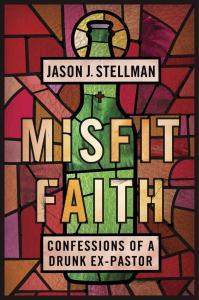 Stellman is a former pastor who runs a podcast called “Drunk Ex-Pastors” with his best friend and agnostic cohost, Christian Kingery. His book suffers a bit, I think, from an unclear aim: it started off as an apologia for his conversion to Catholicism after an unchurched upbringing and fervently Evangelical teen years. What it turned into is more of a theological ramble about how to see God and the world anew. For instance, God is Father, but also flesh, so we don’t need to condemn the secular: “embracing a Christianity that reflects the Incarnation by validating the physical world rather than vilifying it.”
With (dated, geeky) pop culture references, Stellman encourages a rejection of xenophobia and an embrace of narrative and ritual, which Roman Catholicism perhaps makes more space for than your average Protestant tradition. The last few lines of the book are a wonderful plea for openness, hearkening back to the very definition of ‘catholic’ – broad and inclusive:
Is misfit faith about love or suffering? Feasting or fasting? Divinity or humanity? Heaven or earth? The answer is yes, to all of it. And yeah, I want it all: the now and the later, the spirit and the flesh, the head, the heart, and the stations of the cross. I would rather embrace way too much than way too little, because something tells me that as wide as I can open my arms and heart, God’s are always open wider.
I’d recommend this to readers of David Dark and Rob Bell.
My rating:
I received this e-book from Blogging for Books (via Edelweiss) for this review.
What Is the Bible? How an Ancient Library of Poems, Letters, and Stories Can Transform the Way You Think and Feel about Everything, Rob Bell
 Speaking of Rob Bell…this is one of his stronger books. Not as fresh and vibrant as Velvet Elvis, but it will have a big impact on teens and twentysomethings starting to question the narrow interpretations of the Bible they’ve grown up with in conservative churches. Bell stresses the importance of reading the Bible literately rather than literally: always looking deeper than surface facts to see what’s really going on here; striving to understand the background of Jewish practice and Roman occupation at the time of Jesus.
Bell emphasizes that the Bible is a disparate set of books written by fallible people who were defined by their own historical context, yet if you ask why they wrote down these stories of their interactions with the divine in this way – why they mattered to them then – you might get a glimpse of why they might still matter to us now. The “haphazard humanity” of the Bible, then is for him stronger evidence of its reliability than some rigid perfection would be.
He chooses a number of the more unusual incidents in the Bible to illuminate with a closer reading, such as Jesus writing in the dust, Ehud assassinating tubby King Eglon, and the Book of Revelation. Part 4 is usefully structured around FAQs (e.g. “So how would you define the word of God? The creative action of God speaking in and through the world, bringing new creation and new life into being”). This is like listening to a really good sermon series. (Releases May 16th.)
My rating:
My Jewish Year: 18 Holidays, One Wondering Jew, Abigail Pogrebin
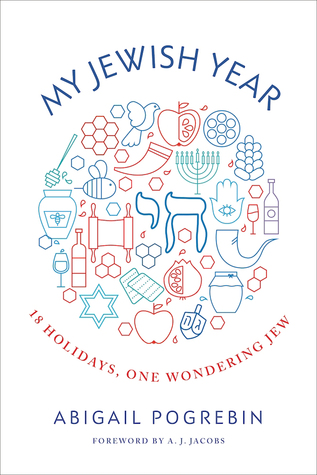 One thing Bell stresses is that Jesus was Jewish, so you can’t understand the stories about him apart from their Jewish context. This bighearted, open-minded book strikes me as a perfect model for how any person of faith should engage with their tradition: not just offering lip service and grudgingly showing up to a few services a year, but knowing what you believe and practice, and why.
Like many an American Jew, Pogrebin marked a limited set of holidays: Hanukkah, the Passover seder, Rosh Hashanah, Yom Kippur, and Shabbat. She circumcised her son, and hosted bar/bat mitzvahs for him and her daughter. Yet she had a nagging feeling that she had never genuinely locked into her own religion, and longed to go beyond the beginner stage.
So from September 2014 to September 2015, she celebrated all the holidays in the Jewish calendar, seeking to move beyond clichés and simplistic interpretations; interviewing rabbis and scholars of every stripe and reading Torah commentaries to discover meanings she’d missed before. Yom Kippur isn’t just a day of atonement; it’s for pondering the fact of your own death, taking stock of your life and asking what must change. Hanukkah, uncomfortably, is not just about persecution but about Jew-on-Jew violence.
There are opposite strands running through the Jewish ritual year: gratitude for survival (Purim) versus sorrow at tragedies (Holocaust Remembrance Day); feasting versus fasting. I was consistently impressed by how Pogrebin draws thematic connections and locates the resonance of religious ritual in her daily life.
Favorite lines:
“[I]t’s a quintessential Jewish act: seeking, grappling. If you’re reaching, it’s because you believe there’s something to grab hold of.”
“I’m beginning to think that Judaism is obsessed with brevity and instability. But rather than finding the message depressing, it’s clarifying.”
“Judaism is always asking us to apply epic stories to everyday decisions.”
“Judaism reminds us not to run from transitions, but to consecrate them.”
My rating: 
A Jest of God by Margaret Laurence
A Jest of God (1966) is the second in Margaret Laurence’s five-novel Manawaka sequence; it followed The Stone Angel (1964), which I reviewed here back in December. Recently reissued as part of the Apollo Classics imprint from Head of Zeus Books, these two books have been a wonderful opportunity for me to further my knowledge of Canadian literature.
Although Rachel Cameron, the narrator of A Jest of God, is a 34-year-old second-grade teacher who still lives with her mother, she has attributes in common with 90-year-old Hagar Shipley, the unforgettable central character of The Stone Angel. Both have a history of sexual hang-ups – Rachel’s in the form of erotic dreams – and experience temporary losses of self-control. The most striking example is when Rachel reluctantly accepts her fellow teacher Calla’s invitation to her Pentecostal church and, though she is mortified at hearing others speaking in tongues, involuntarily enters in herself with hysterical crying.
I loved this sequence. The Tabernacle of the Risen and Reborn provides such a contrast to Rachel’s mother’s staid church tradition, and it’s a perfect introduction to Rachel’s patterns of pride and embarrassment (another link to Hagar). Although Rachel frequently issues stern orders to herself – “Now, then. Enough of this. The main thing is to be sensible, to stop thinking and to go to sleep” – she can’t seem to stop worrying and second-guessing. This applies to her career as well as to her personal relationships. With her principal’s support, she takes surprisingly stern action against her favorite pupil when he starts playing truant.

It’s hard to say much more about the plot without giving too much away. Do I emulate the vagueness of the back cover blurb and simply explain that Rachel unexpectedly “falls in love for the first time, and embarks upon an affair that will change her life in unforeseen ways”? I’d prefer to go into a bit more depth, so if you want to avoid learning what happens I suggest skipping over my next few paragraphs.
To start with it seems Rachel’s best romantic prospect is Calla, who’s certainly interested. But about a third of the way into the novel, as the boredom of the long summer vacation is setting in, Nick Kazlik returns to town. He was the milkman’s son and Rachel’s childhood acquaintance, and is now a high school teacher in another town. They go out to a movie and share a kiss, and from there their relationship progresses rapidly. Rachel loses her virginity to him out in a field, and the more sex they have the more she’s seized with a belated terror of pregnancy. No doubt her anxiety about motherhood is colored by her passive-aggressive relationship with her own mother, whose dodgy heart leaves her utterly dependent on Rachel.
The novel reminded me most of Margaret Drabble’s The Millstone and Carrie Snyder’s Girl Runner. Like the protagonists of those novels, Rachel’s options seem stark: acquiring a secret abortion, or changing her life irrevocably by having a child out of wedlock. As the title phrase suggests, Rachel feels God is laughing at her presumptuousness: first for believing she might be loved in proportion to her own passion, and then for thinking she could become a mother. I wasn’t fond of the way the book backtracked on this main source of tension at the end. A retreat from calamity might seem fitting given Rachel’s usual overthinking, but the resolution felt to me like too much of a deus ex machina reprieve.
Ultimately, I found Nick and Rachel’s affair the least interesting element of this novel. Compared with the friendship with Calla, the startling religious experience, the interactions with pupils and the school principal, the troubled mother–daughter relationship, and an odd late-night encounter with the new owner of her late father’s funeral parlor, what’s a bit of sex? We’re meant to rejoice at Rachel’s chance at romance, I think, but also to recognize it as a fleeting but necessary spur to an altered life.
Two aspects of this reprint edition deserve a mention. There’s a terrific afterword from Margaret Atwood recalling meeting Laurence, her literary idol, at the Governor General’s Awards ceremony in 1967 (Atwood won for poetry and Laurence won for fiction with this novel). Apollo Classics have also chosen an excellent cover image: a 1960 photograph by Rosemary Gilliat Eaton entitled Woman preparing paint for an art class, Frobisher Bay.

The Margaret Laurence House in Neepawa, Manitoba, Canada. By Amqui (Own work) [CC BY-SA 3.0 (http://creativecommons.org/licenses/by-sa/3.0)%5D, via Wikimedia Commons.
With thanks to Blake Brooks at Head of Zeus/Apollo Classics for the free copy for review.
My rating:
Blog Tour: My Mourning Year by Andrew Marshall
Andrew G. Marshall is the author of 18 self-help books about relationships. He has written for newspapers, appeared on television and radio programs, and worked as a marriage therapist. However, he has shared little about his own experience of relationships until now. Twenty years have passed since the death of his long-term partner, Thomas Hartwig. Sharing this diary of Thom’s death with several friends and family members who’d suffered recent bereavements seemed to help, so he’s hoping that in book form it can be of wider benefit to those who are in the midst of grief.
Marshall met Thom, then the headmaster of a German language school, on a holiday to Spain in September 1989. They alternated between Germany and England every other weekend for years, and in 1995 Thom finally relocated to join Marshall near Brighton. Thom had plans to start an interior design business, but fell ill just six months later. By early 1997, he had a diagnosis of liver failure and was given weeks to live. They traveled to Germany to get Thom a second opinion and, despite his resolution to die back in England, he breathed his last at the German hospital on March 9th, aged 43.
The above constitutes a brief Part One, while the rest of the book recounts the first full year after Thom’s death. Marshall tracks the changes in several areas of his life:
Family Life: “People become counselors to make sense of their difficult families, and of course I am no exception,” Marshall notes. He grew up in a conservative middle-class family in Bedford and didn’t come out until he was nearly 30. Hugely disappointed that his parents and sister didn’t make it to Thom’s memorial service, Marshall moves from not talking to his family at all to making tentative overtures of reconciliation. There’s a particularly touching scene where he confronts his parents about the way they repressed emotion while he was growing up and hears the words “I love you” from his father for the first time.
 Career: For part of his mourning year, Marshall worked on the Agony television program as an “agony uncle.” He took a break from Relate counseling, but continued to write freelance articles, many of them touching on illness and death, and contributed a “Revelations” celebrity profile column to the Independent, in which he interviewed authors and pop stars about life’s turning points. Two of my favorite moments in the book arise from this: Jim Crace (promoting Quarantine) tells how he realized the emptiness of atheism when burying his father; and Carol Shields’s Larry’s Party provides Marshall’s gateway into literary fiction, which he’d never attempted before.
Home Life: “There is something terribly sad about the clutter we accumulate,” Marshall sighs. “I was loved and I did love, but now all I had was this debris.” Thom moved to England with 87 packing cases; even at the hospital in Germany there were two bags of stuff to look through. Back in England, though Marshall tries to navigate around “Thom-shaped holes” in his life, especially near holidays, he realizes this relationship hasn’t ended: he kisses his lover’s ashes goodnight, and heeds Thom’s late advice to replace the vacuum cleaner. Meanwhile he goes on short vacations, sees friends, dogsits, and even tries counseling – but finds it’s “like watching a conjurer saw a lady in half, but knowing how he does it.”
Spirituality: Marshall has several experiences he has trouble explaining. For instance, at certain points he smells vanilla all around him and chooses to take it as a sign of Thom’s enduring presence – a trace of the vanilla candle that burned beside his deathbed. He also has some psychic messages conveyed, by both friends and strangers, and attends a spiritualist service. But it is an interview with forensics expert Kathy Reichs that helps him to once and for all detach the idea of Thom’s dead body from that of his spirit.
Self-Expression: Writing the “Revelations” column and this diary proved better therapy for Marshall than traditional counseling sessions. Towards the end of this book he also takes an introduction to playwriting course, and in the intervening years several of the plays he has written have been performed around the UK.
Love: After Thom’s death, Marshall was desperate for physical comfort, and temporarily found it with Peter, whom he met at a gay sauna. I admired Marshall’s honesty about this fling; it must have been tempting to excise it from the record to make himself look better. But their relationship never went beyond a few dates. This sad story has a happy coda, though: In 2001 Marshall met Ignacio, who became his civil partner in 2008 and his husband in 2015.
I’ve read many bereavement memoirs, but the diary format makes this one a unique blend of momentous occasions – Princess Diana’s funeral and the preparations for a catered dinner party on the anniversary of Thom’s death – and the challenges of everyday life. I would not hesitate to recommend it to anyone who has experienced or is currently enduring bereavement; it will be reassuring to read about the flux in Marshall’s emotions and see an example of how to rebuild after loss.
Perhaps this is the reality of mourning: you never get over the loss but reassemble the daily minutiae into a new life. At the beginning it feels like a box of flat-pack furniture with the instructions in Swedish, but finally you discover that tab A can slide into slot B. Eventually you own something quite functional – even though there are always a few screws left over and it never looks as good as it does in the catalogue.
Whether the clairvoyants are correct and Thom has become my guardian spirit is not important[;] he is always with me. I have integrated his personality into mine and in that way he lives on through me.
(For more on the author, and Thom, see the book’s website.)
My Mourning Year will be released by RedDoor Publishing on Thursday, April 20th. Thanks to Anna Burtt for the review copy.
My rating:
Adventures in the Town of Books
We had a wonderful time in Hay-on-Wye. The weather was gorgeous – which we never would have counted on in Wales in early April – and it was a treat to get out into the countryside. Even though there were road works on the main route through Hay and a house under construction across from our Airbnb property, it was so quiet most of the time. Most often we only heard sheep and pheasants in the fields or songbirds flitting around the garden. We’ve been back to normal life for a few days, but the contrast between Hay and our terraced street’s noisy neighbors and frequent car movement has remained stark. Also, I greatly enjoyed the time off work, and struggled to clear 200+ e-mails the day after we got back.


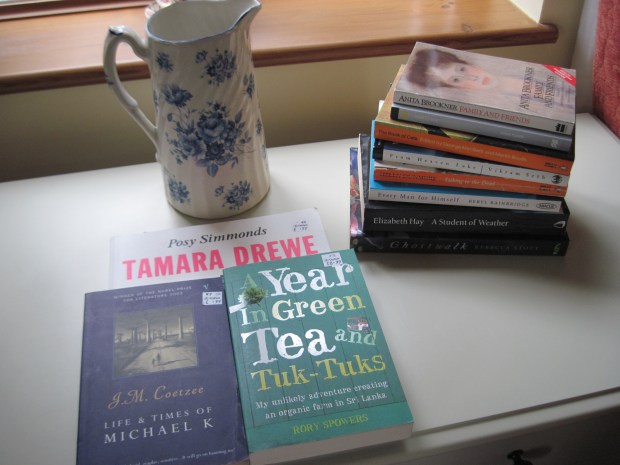
Early bargains came from the Oxfam charity shop (a box outside with paperbacks at 5 for £1, plus various nearly new copies at 99p each) and the ‘honesty’ shopping areas around the castle (50p paperbacks and £1 hardbacks). Each day my husband’s and my rival stacks kept growing.
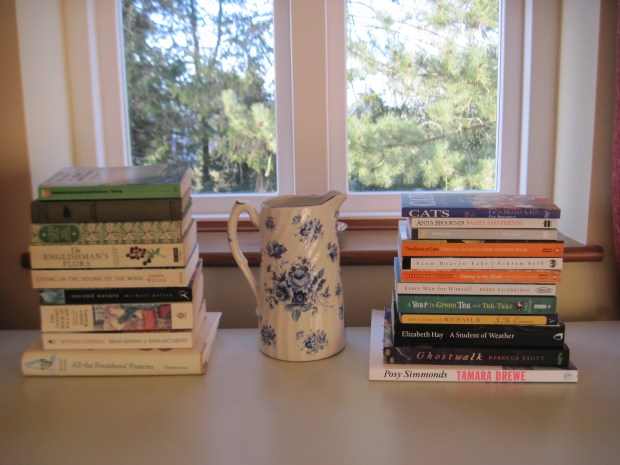
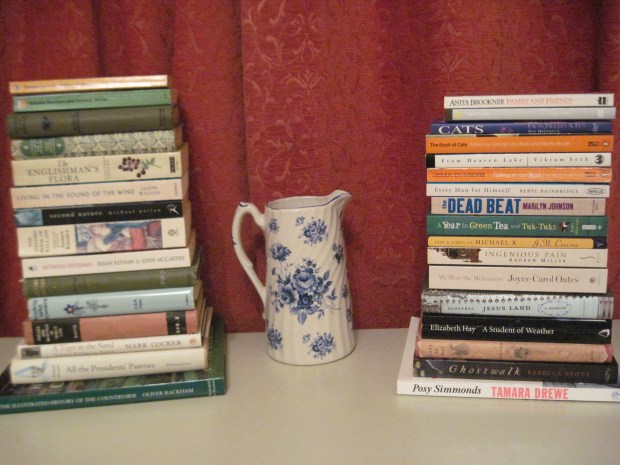
In the end we purchased 40 books, averaging ~£1.48 each: 3 gifts (alas that we couldn’t do better in this respect) plus another 18 or 19 books each. All very equitable! My husband focused on nature and travel, including some rare and novelty insect books.
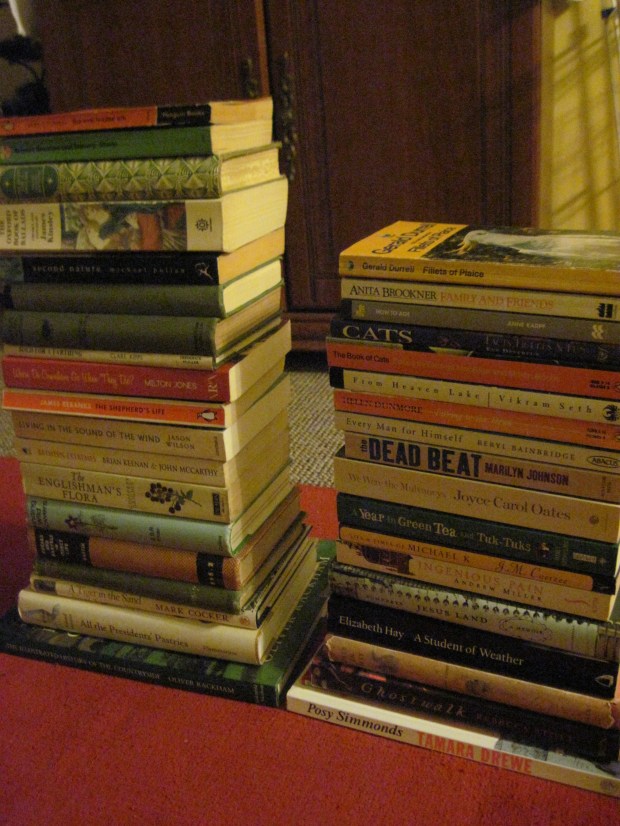
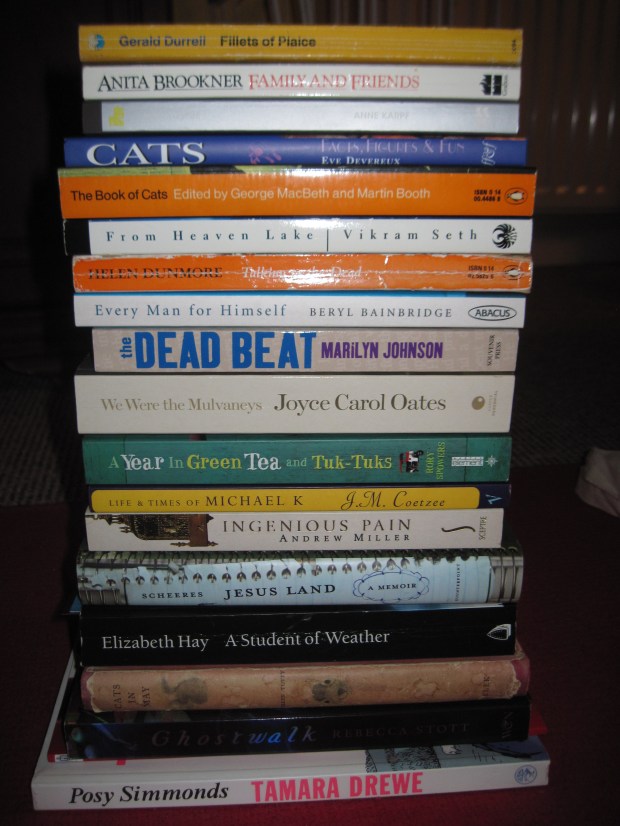
Some of my prize finds were a vintage copy of the next book in Doreen Tovey’s cat series, a copy of the Joyce Carol Oates novel I intend to make my introduction to her work, and Marilyn Johnson’s book on obituaries. As a bonus, three of the books I bought are ones I’ve already read: Vikram Seth’s travel book on China, How to Age from the School of Life series – a total bargain at 50p!, and Posy Simmonds’ Tamara Drewe, an update of Thomas Hardy’s Far from the Madding Crowd and one of the first graphic novels I ever read and loved.
Of course, I didn’t end up reading very much (or any) of many of the books I took with me. I glanced at The Rebecca Rioter, but didn’t find it at all interesting; I forgot to look at The Airbnb Story; and I seem to be stuck fast just two chapters into Our Mutual Friend. On the other hand, I’ve been enjoying Bruce Chatwin’s On the Black Hill, of which I read over half, and I made good progress in George Saunders’s Lincoln in the Bardo.
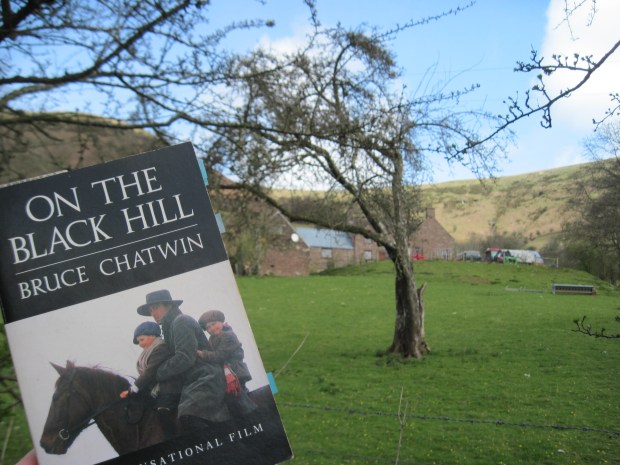
We sought out “The Vision” farm we found on the map, which presumably inspired Chatwin.
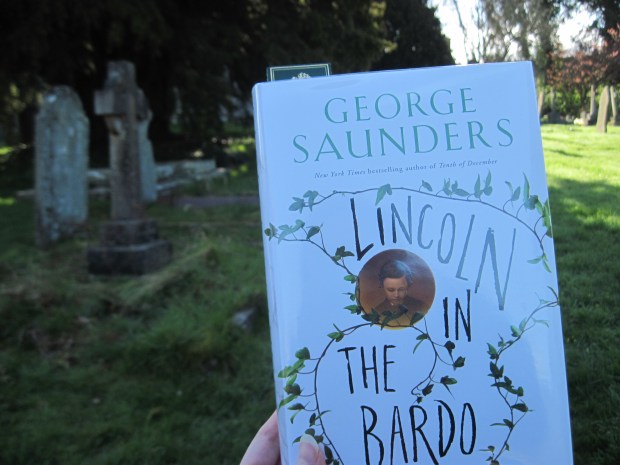
I took Lincoln in the Bardo for a jaunt up the road to the Cusop churchyard; it seemed an appropriate spot.
It’s also been fun to browse Francis Kilvert’s diary entries from his years as the curate in nearby Clyro. In one of my favorite passages, he expresses horror at finding British tourists overrunning Llanthony Abbey ruins. For a minister, he certainly sounds like a misanthrope:
I had the satisfaction of managing to walk from Hay to Clyro by the fields without meeting a single person, always a great triumph to me and a subject for warm self congratulation for I have a peculiar dislike to meeting people, and a peculiar liking for a deserted road.
We went out to Llanthony for the first time on this trip, and paid Clyro’s church a visit, too.
-

- Llanthony Priory ruins
-

- Clyro’s church
-

- Kilverts restaurant in Hay.
-
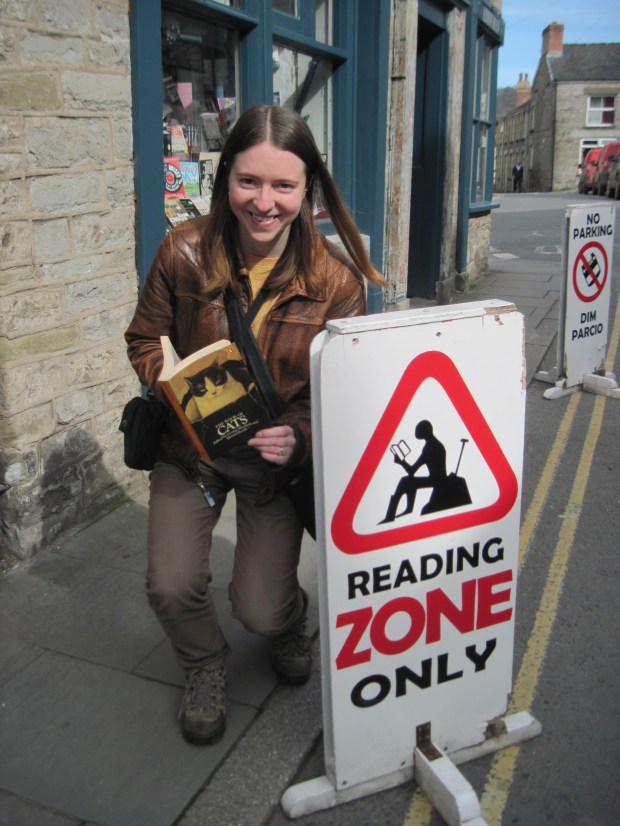
- In the reading zone.
-
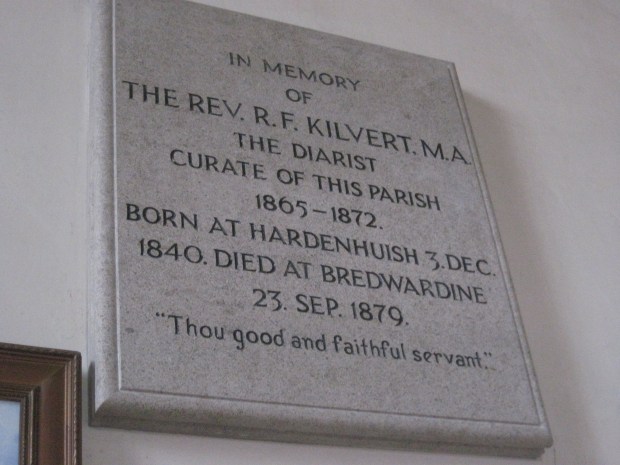
- Inside Clyro church.
-
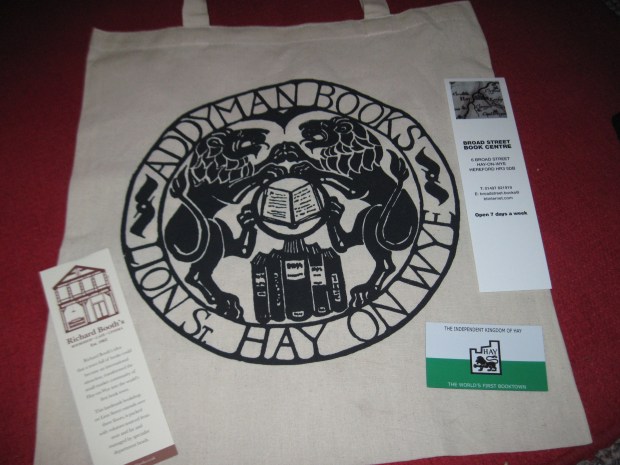
- New Hay swag! (tote, bookmarks and magnet)
Hay is much less shabby compared to our first visit. Many of the shops have been spruced up, and the pubs can’t get away with serving bog-standard fare anymore. A number of the newest eateries and entertainment venues are only open on weekends, so we’ll be sure to time our next trip to cover a Friday–Saturday. The town has even gained some hipster establishments, like a fair-trade shop and a coffee shop/vintage clothing emporium.
-
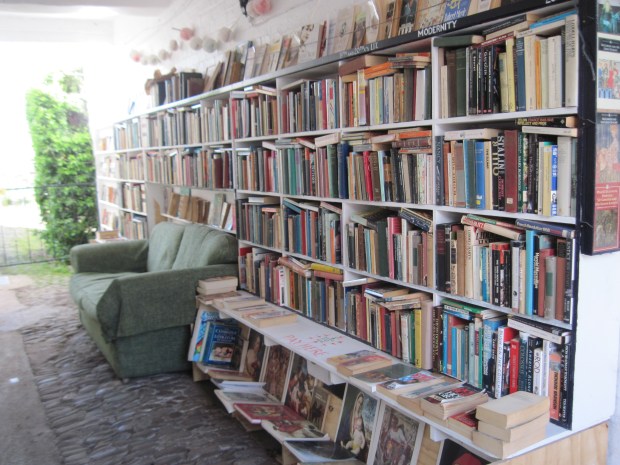
- You find books down every alley in Hay.
-

- A phoenix on the Hay Book Arts Trail.
-

- Best random spotting: a book A.S. Byatt once owned!
The Book Arts Trail was celebrating the 40 years of ‘independence’ of Richard Booth’s kingdom of Hay this year, and I expect we’ll still find the place going strong at 50.
 Bookish Beck = Rebecca Foster. American transplant to England. Freelance proofreader and book reviewer.
