Reviews Roundup, February–March
One of my goals with this blog was to have one convenient place where I could gather together all my writing that appears in disparate online locations. To that end, once a month I provide links to all book reviews I’ve published elsewhere, with a rating (below each description) and a taster so you can decide whether to read more. A few exceptions: I don’t point out my Kirkus Indie, BlueInk or Publishers Weekly reviews since I don’t get a byline. Meanwhile, I’ve done my first article for the Los Angeles Review of Books – exciting!
The Bookbag
Three-Martini Lunch by Suzanne Rindell: Brings the late 1950s, specifically the bustling, cutthroat New York City publishing world, to life through the connections between three young people who collide over a debated manuscript. The three first-person voices fit together like a dream. It’s an expert evocation of Beat culture and post-war paranoia over Communism and homosexuality. Walking into Eden’s office, especially, you’ll think you’ve landed on the set of Mad Men. This classy, well-plotted follow-up will win Rindell even more fans and tide us all over until the film version of The Other Typist – produced by and starring Keira Knightley – appears. Releases May 19th in the UK.

 Why We Came to the City by Kristopher Jansma: Five university friends strive to make their lives count against the indifferent backdrop of recession-era New York City. When one of them falls ill, they pull together like a family. The tone of the novel lies somewhere between A Little Life and the sitcom Friends (a Mexican version of which the characters watch obsessively). Even as his characters realize that they are not special and not in control of their lives, Jansma never lets his book descend too far into gloom. Narrowly misses out on 5 stars from me because the storyline loses momentum in Part Two. Rich with emotion and literary allusions (from Walden to The Iliad), this is my favorite novel of the year so far.
Waltzing in Vienna by C.G. Metts (& interview): Three girlfriends – a singer staging a comeback, a psychology professor reawakening to sexuality after being widowed, and a socialite Southern Belle – are reunited in Charleston, South Carolina in their early forties. Remembering their wild college days, they wonder how to make midlife count. There’s a fun Sex and the City or Ya-Ya Sisterhood vibe to this recommended debut novel. I liked the mixture of nostalgia and gentle feminism, and I think this may also inspire readers to see South Carolina’s coastal landscape for themselves. The title phrase is the friends’ shorthand for smoking marijuana together.

 The Cauliflower® by Nicola Barker: Put simply, this is a fictionalized biography of the largely illiterate Hindu guru Sri Ramakrishna (1836–1886). That may sound dry as dust, but Barker makes it a playful delight by skipping around in time and interspersing aphorisms, imagined film scenes, questions and answers, and even a recipe with the narrative chapters. The kernel of the story – set in 1857 at the Dakshineswar Kali Temple, six miles north of Calcutta – is narrated in the first person by the guru’s nephew, Hriday. Scripture of all types (the Bible is also cited) is a relevant, joyful echo here rather than a dull set of rules. Bizarre but very readable. Releases April 21st.
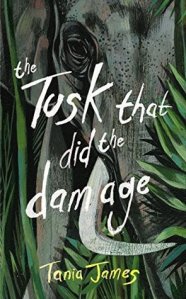 The Tusk That Did the Damage by Tania James: This composite picture of the state of wildlife conservation in India is told from three perspectives: an elephant named the Gravedigger, a poacher, and a documentary filmmaker. James ably intersperses three voices as she explores how people fail to live up to their ideals and make harmful assumptions. Despite these attributes, it was one of those books I had to force myself through. Perhaps it was the environmental agenda: if a book is going to wear its message so openly, it has to live up to it in terms of the writing. I might have preferred it if the whole novel had been from Emma’s point of view, with one climactic encounter with the Gravedigger to make the poaching question immediate and not simply academic.

BookBrowse
Dog Run Moon: Stories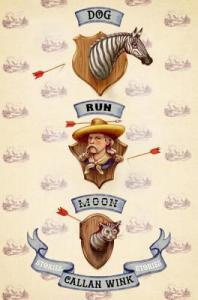 by Callan Wink [subscription service]: Wink’s debut story collection, set mostly under Montana’s open skies, stars a motley cast of aimless young men, ranchers, Native Americans, and animals live and dead. He plays around with Western stereotypes in intriguing ways. A few of the tales are a bit less compelling, and I would have preferred more variety in narration (8 of 9 are third person), but the stand-outs more than make up for it. My two favorites were “Runoff” (there’s a double meaning to the title) and “Exotics,” in which all the characters are lured by the life they don’t currently have.
 For Books’ Sake
Interview with Rachel B. Glaser, author of Paulina & Fran [my review of which was in last month’s roundup]
Foreword Reviews
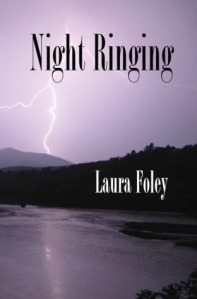 Night Ringing by Laura Foley: Foley’s strong fifth collection ruminates on romance and family via autobiographical free verse. One of the collection highlights is “In the Honda Service Area,” which unexpectedly unites modern technology with ancient literature. While a woman describes her impending hip replacement surgery to a friend, Foley tries to concentrate on Homer’s Iliad. The collection is dedicated to Foley’s partner, Clara Giménez, and lesbian romance is a subtle undercurrent. Especially recommended for fans of Jane Hilberry and Adrienne Rich.
The Temple of Paris by Laura DeBruce: This second volume in Laura DeBruce’s Quicksilver Legacy trilogy is a fast-paced fantasy adventure novel. In the previous book, the author introduced the “Immortals,” centuries-old creatures who are impervious to disease and aging due to a magic elixir. If Hana, the teenage protagonist, can learn how to use the elixir in her possession correctly, she can save her mother from a potentially fatal blood disorder. Although the complicated plot might be challenging for those new to the series, older teens will appreciate the rollicking story and the chance for vicarious European sightseeing.

 Mon amie américaine by Michèle Halberstadt: After years of heavy smoking and migraines, a brain aneurysm plunges forty-year-old Molly into a coma. The novel is presented as Michèle’s confessional letter to her American friend Molly, addressed in the second person. During Molly’s coma and after she wakes up, Michèle ponders their unlikely friendship and also frets over her threatened marriage. The novella is like a cross between Jenny Offill’s Dept. of Speculation and Jean-Dominique Bauby’s The Diving-Bell and the Butterfly, and bears tantalizing traces of deliberate homage to Pedro Almodóvar’s coma-themed Talk to Her: an understated dual account of betrayal and disability.
 Specimen: Stories by Irina Kovalyova: “People like to pretend that our genes define the truth for us. But I assure you that’s not the case,” a character insists in the title story. Diverse in setting and form, these nine stories, long-listed for the Frank O’Connor International Short Story Award, contrast the scientific understanding of genetics with deeper wisdom about the bonds of love and family. Nestling science into rich psychological narratives, Kovalyova’s work is reminiscent of that of Andrea Barrett and A. S. Byatt; in fact, the latter is directly referenced in one story. She also channels Anthony Marra and Adam Johnson by affirming love’s survival in spite of repressive situations.
Of Crime and Passion by Jonathan Harnisch: In this novella, a proud young man seeks to transcend his underprivileged upbringing by worming his way into the homes of the rich and seducing powerful women. At its heart, the book is about the ongoing conflict between economic and social classes. With the melodramatic action and old-fashioned dialogue, though, it is easy to imagine this coming-of-age tale working better in the form of a play.
Hakai Magazine
(a Canadian publication highlighting coastal ecosystems)
 Seal by Victoria Dickenson: “It is hard to imagine a creature more distant from the human species in bodily form, habits, and habitat than the seal,” Dickenson writes in her introduction, “yet our mutual regard tells of a long, shared history of interaction.” Seal is the latest in the 80-strong Animal series from Reaktion Books. Like other volumes, this gives a brief discussion of the featured animal’s evolutionary biology, followed by an interdisciplinary survey of how it has entered human culture throughout history. In the final two chapters—the highlight of an occasionally dry book—Dickenson gives a balanced account of the history of hunting seals.
Los Angeles Review of Books
“Rediscovering an Overlooked Woman Novelist”: A dual review of Constance Fenimore Woolson: Portrait of a Lady Novelist by Anne Boyd Rioux () and Miss Grief and Other Stories (), a new selection of Woolson’s short fiction.
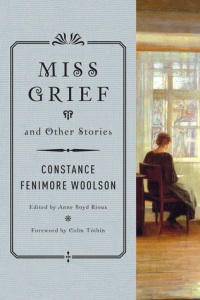 Constance Fenimore Woolson (1840–1894) is most often remembered for her connection to male writers; her great-uncle was pioneering American novelist James Fenimore Cooper, and in her later years as an expatriate in Europe she associated with Henry James, fueling rumors of a romance between them. Deserving to be known in her own right, Woolson represents key junctures between realism and regionalism, and between American and European styles. Gives a remarkable picture of a bold, bright woman who paved the way for writers such as Edith Wharton, E. M. Forster, and Willa Cather, and who arguably might be hailed in the same breath as Henry James and George Eliot.
Nudge
My quick response to Instructions for a Heatwave, for a Maggie O’Farrell retrospective: Another spot-on tale of family and romantic relationships – O’Farrell always gets the emotional tenor just right. You may spot hints of Rachel Joyce’s The Unlikely Pilgrimage of Harold Fry or Bernhard Schlink’s The Reader, but the psychological and linguistic precision is all O’Farrell’s own. Her descriptive language is unfailingly elegant. I love how she opens with the heat as the most notable character: “It inhabits the house like a guest who has outstayed his welcome: it lies along corridors, it circles around curtains, it lolls heavily on sofas and chairs.”
Pretentiousness: Why It Matters by Dan Fox: This wide-ranging essay discusses pretentiousness as it relates to class, taste, and modern art. Fox grew up outside of Oxford but now lives in New York City, where he is the co-editor of frieze. From its Latin etymology we learn that pretentious means “to stretch before,” so to hold something in front of you like a mask. He thus starts off by talking about acting techniques and rhetoric, then broadens this out to themes of authenticity and self-discovery. The most interesting part of the book concerns class connotations. This is a somewhat meandering work, and though it has good individual lines it is not always riveting.
 Third Way magazine
I’ve reviewed books, mostly fiction, for them for the last 2.5 years; sadly, the April 2016 issue will be the final one. It’s a shame; the progressive Christian perspective on popular culture is a niche it will be hard to fill.
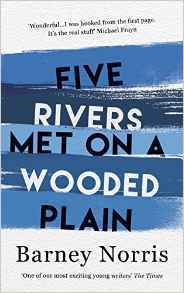
Five Rivers Met on a Wooded Plain by Barney Norris: Barney Norris is a playwright in his twenties, so it’s no surprise that there’s something a little staged to his debut novel. The lives of the book’s five narrators collide one night when a car hits a moped in Salisbury town center. We hear from each protagonist in turn as they reflect on their losses and wonder whether religion – represented by Salisbury Cathedral and the scripture and rituals of Christianity – might help. Rita is the liveliest and most engaging character, difficult as her expletive-strewn narrative might be to traverse. Like David Nicholls, Norris prizes emotional connection and delivers a theatrical plot. If he can avoid the more clichéd aspects of a novel like One Day, he could have a long career in fiction ahead of him. Releases April 21st.
I also post reviews of most of my casual reading and skimming on Goodreads:
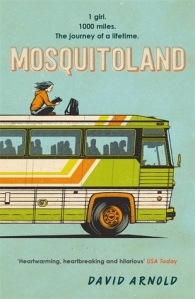 Mosquitoland by David Arnold: I don’t read a whole lot of YA, but the voice of this one captured me right away. Like Hazel in The Fault in Our Stars, Mim (Mary Iris Malone) is a lovably sarcastic oddball – she describes herself as “a young Ellen Page” à la Juno – with some hidden issues that come out over the course of the book. Here Mim’s journey takes the form of a road trip from Mississippi, where she lives with her father and new stepmother, back to Ohio to be with her sick mother. She meets a kooky cast of secondary characters along the way, narrowly escapes danger, and even gets a chance at romance.
A Change of World: Poems by Adrienne Rich: This is a forthcoming Norton reissue of Rich’s first collection from 1951. I’d always thought of her as a later, feminist poet, so it was jolting to see an introduction from W.H. Auden – that made it feel like a real generational crossover. It’s a very impressive debut, full of mannered, rhyme-rich verse. Two favorites were “Walden 1950” (“Thoreau, lank ghost, comes back to visit Concord, / Finds the town like all towns, much the same— / A little less remote, less independent”) and “The Innocents.” I’ll be interested to read some of her later work and see if she loosened up with form. Releases June 21st.
 The Shadow Hour by Kate Riordan: A clever dual-timeline novel with a pleasing Gothic flavor. In 1922 Grace Fairford takes up a governess position at Fenix House near Cheltenham, the very place where her grandmother, Harriet Jenner, worked in 1878. Every few chapters the perspective shifts from Grace (first person) to Harriet (third person). The novel is full of coincidences and the sense of history repeating itself. Riordan’s writing is capable, sometimes clichéd, but the echoes of Jane Eyre and The Turn of the Screw make this a delicious guilty-pleasure read.
Life’s Too Short to Pretend You’re Not Religious by David Dark: Etymologically, the word “religion” means to bind together again. Simply put, Dark’s thesis is that we’re all connected: we are in relationship with the people around us and can’t pretend otherwise. What we need is a shared vision for our shared life, and that involves engaging with other people. No pie-in-the-sky theology here; Dark affirms Daniel Berrigan’s assertion that “the actual world is our only world,” so things like climate change, gun control, immigration, and foreign policy are religious issues because they affect us all in this life. Together we have to imagine another story that isn’t capitalism and American imperialism as usual.
Adios, Cowboy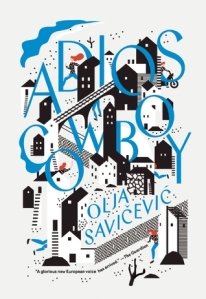 by Olja Savičević Ivančević: In summer 2009, Dada (aka Rusty) returns to her Croatian hometown to care for her mother. Going home facing up to the fact of her brother’s death – when he was 18 he threw himself under a train. “One has to sit down beside one’s demon and mollify it until it’s calm – that’s all, perhaps, that can be done,” she muses. Now for the title: Dada’s late father, brother, and friends (“the Iroquois Brothers”) were all big on cowboys and Indians. When news comes that a spaghetti western actor/director named Ned Montgomery will be passing through town, it causes Dada to think about her father and her brother and, what’s more, about the workings of her own memory.
Now Go Out There: (and Get Curious) by Mary Karr: There’s not much to this Syracuse University commencement speech. Leftovers of sob-story autobiography and clichéd advice cobbled together. Disappointing given how much I loved Karr’s recent The Art of Memoir. For a truly inspirational graduation address, I recommend David Foster Wallace’s This Is Water.

 How to Be Here: A Guide to Creating a Life Worth Living by Rob Bell: Bell left his pastoral role to become a motivational speaker so, unsurprisingly, this book is closer to self-help than theology. He’s good pals with Elizabeth Gilbert, and this book would make a great companion piece to her Big Magic. It’s about how to find what gets you out of bed in the morning and live mindfully. As always, his formatting – bite-size paragraphs, stretching out phrases with line breaks – is slightly annoying. I didn’t learn a whole lot; it was more a case of being reminded of things I knew deep down. He prefaces most chapters with an anecdote about his creative ventures, some of which were utter failures.
And my highest recommendation goes to…
The Summer Guest by Alison Anderson: The kernel of the novel is a true story: for two summers in the late 1880s, Chekhov stayed at the Lintvaryovs’ guest house in Luka, Ukraine. One strand of the narration is a journal kept during those years by Zinaida, the family’s eldest daughter, a doctor dying of a brain tumor. Zina’s story is offset by those of two contemporary women. Katya, a Russian émigré in London who’s trying to keep her failing publishing house afloat, sends the never-before-published diary to Ana, a translator based near the French border with Switzerland. There’s a touch of mystery here: where was the diary found? And what became of the novel Chekhov mentions he had in progress? Ana’s search for answers takes her to the Lintvaryov estate, even though Ukraine in 2014 is a hotbed of unrest. Having recently watched the BBC War & Peace miniseries with rapt interest and seen a Tchaikovsky symphony performance, it was the perfect time to get lost in an intricate, playful novel about how Russian literature still resonates. I’ll certainly be looking up Anderson’s other novels.
Reviews Roundup, November–December
One of my goals with this blog is to have one convenient place where I can gather together all my writing that has appeared in disparate online locations. To that end, once a month I provide links to all book reviews I’ve published elsewhere, with a rating (below each description) and a taster so you can decide whether to read more. A few exceptions: I won’t point out my Kirkus Indie, BlueInk or Publishers Weekly reviews since I don’t get a byline.
The Bookbag
 In Search of Mary: The Mother of All Journeys by Bee Rowlatt: A BBC journalist and mother of four sets out, baby in tow, to trace the steps of Mary Wollstonecraft in Norway and France. A follow-up trip to California is a little off-topic, but allows Rowlatt to survey the development of feminism over the last few centuries. This isn’t as successful a bibliomemoir as many I’ve read in recent years, such as Rebecca Mead’s My Life in Middlemarch or Samantha Ellis’s How to Be a Heroine, but for readers interested in engaging in the ongoing debate about how women can balance work life with motherhood, and especially for any women who have attempted traveling with children, it’s a fun, sassy travelogue.

Foreword Reviews
 Italy Invades: How Italians Conquered the World by Christopher Kelly and Stuart Laycock: Proceeding alphabetically from Afghanistan to Zimbabwe, the authors give a comprehensive picture of Italians’ global reach through one- to five-page snapshots. There are many familiar names here, such as Caesar, Garibaldi and Marco Polo. Along with exploration, some major reasons for historical crossover were trade, war, colonialism and immigration. At times it feels as if the authors are grasping at straws; better to skip one-paragraph write-ups altogether and focus instead on the countries that have extensive links with Italy. Nonetheless, this is a lively, conversational book full of surprising facts.

Why You Won’t Go to Hell by Benjamin Vande Weerdhof Andrews: In a well-structured argument, Andrews prizes empirical thinking, rejects the supernatural, and affirms the possibility of godless morality. His central thesis is that religion doesn’t evolve to keep pace with society and so holds humanity back. The book’s tone is too often defensive, often in response to included website comments, and there are some failures of accuracy and fairness. Ultimately, though, this could be an inspirational book for atheists or believers, prompting both groups to question their assumptions and be willing to say “I don’t know.” Readers of Sam Harris and Christopher Hitchens will be particularly drawn to the book, but others should take a chance on it too.

 Cultured Food for Health by Donna Schwenk: When Schwenk started eating cultured foods in 2002, she had diabetes, high blood pressure, and a premature newborn. Keen to see if good bacteria could help with her medical problems, she started introducing the “healing powerhouse” of kefir (a fermented milk product resembling thin yogurt), kombucha (bubbly tea), and cultured vegetables into her diet, and soon reaped the rewards. About a quarter of the book is background information about probiotic foods. Bullet-pointed lists of health benefits, along with an alphabetical inventory of the diseases that cultured foods can treat, should prove helpful. The rest of the book is devoted to recipes, most vegetarian.
Three Simple Questions: Being in the World, But Not of It by Charlie Horton: Horton, trained as a social worker, was diagnosed with cerebellar degeneration in 1988. It has gradually affected his speech and movement. Despite having lived with disability for nearly three decades, he declares, “the world I live in is rich, and my spirit is young.” Here he documents how he deals with depression and physical limitations through guided meditations that bring him closer to God. Although he comes from a Christian perspective, he writes about spirituality in such inclusive terms that his work should speak to people of any faith.
Middle Passage: The Artistic Life of Lawrence Baker by Louis B. Burroughs, Jr.: This ghostwritten autobiography of an African-American artist is not only an evocative, eventful life story that moves from the Jim Crow South to the North, but also a forceful artist’s manifesto. Burroughs writes in Baker’s voice, a decision that works surprisingly well. The title is a powerful reference to the slave trade. Indeed, Burroughs consciously crafts Baker’s autobiography as an “up from slavery” narrative reminiscent of Richard Wright and Maya Angelou – with ‘slavery’ in this case being poverty and racism.
Nudge
 40 Sonnets by Don Patterson: All but one of the poems in this new book have the sonnet’s traditional 14 lines; “The Version” is a short prose story about writing an untranslatable poem. However, even in the more conventional verses, there is a wide variety of both subject matter and rhyme scheme. Topics range from love and death to a phishing phone call and a footpath blocked off by Dundee City Council. A few favorites were “A Powercut,” set in a stuck elevator; “Seven Questions about the Journey,” an eerie call-and-response; and “Mercies,” a sweet elegy to an old dog put to sleep. There weren’t quite enough stand-outs here for my liking, but I appreciated the book as a showcase for just how divergent in form sonnets can be.
 Without You There Is No Us by Suki Kim: This is a quietly gripping book even though not much of moment happens over Kim’s five months teaching young men at a missionary-run college in Pyongyang. She was in a unique position in that students saw her as ethnically one of their own but she brought an outsider’s perspective to bear on what she observed. Just before she flew back to the States in 2011, Kim Jong-Il died, an event she uses as a framing device. It could have represented a turning point for the country, but instead history has repeated itself with Kim Jong-un. Kim thus ends on a note of frustration: she wants better for these young men she became so fond of. A rare glimpse into a country that carefully safeguards its secrets and masks its truth.
 Alive, Alive Oh!: And Other Things that Matter by Diana Athill: Diana Athill turns 98 on December 21st. Apart from “Dead Right,” however, this collection is not primarily concerned with imminent death. Instead Athill is still grateful to be alive: marveling at a lifetime of good luck and health and taking joy in gardening, clothing, books, memories and friendships. Six of the 10 essays originally appeared elsewhere. The collection highlight is the title piece, about a miscarriage she suffered in her forties. Another stand-out is “The Decision,” about moving into a retirement home in her nineties. This doesn’t live up to her best memoirs, but is an essential read for a devoted fan, and a consolation given she will likely not publish anything else (though you never know). [For first-time Athill readers, I’d recommend starting with Somewhere Towards the End, followed by Stet, about her work as a literary editor.]
I also post reviews of most of my casual reading and skimming on Goodreads:
The Weightless World by Anthony Trevelyan: This debut novel blends postcolonial bureaucracy with steampunk zaniness. The setup is familiar enough: businessmen head overseas to take financial advantage of a former colony, puzzle over unfamiliar customs, and by the end are chastened but gain a clearer sense of values. Narrator Steven Strauss is the personal assistant to Raymond Ess, an entrepreneur with a history of mental illness. Their aviation company has gone bust; Strauss is to accompany Ess to India and keep him occupied by looking for an anti-gravity machine. Not anchored by either current events or convincing fantasy, the plot suffers in comparison to works by Geoff Dyer or Nick Harkaway. Despite entirely serviceable writing and a gravity-defying theme, it never really takes off.

 My Confection: Odyssey of a Sugar Addict by Lisa Kotin: 1978. Twenty-one-year-old mime goes to macrobiotic rehab to recover from sugar addiction. Fails. Shows signs of being a sex addict as well. Pared down to headlines, that’s how this fairly rambling memoir about Kotin’s relationships with food, family, lovers, and career opens. I kept waiting for a turn, some moment of revelation, when Kotin’s binge eating would be solved. Still, her recreation of her obsessive younger self can be pretty funny and charming, and her family sounds a bit like the Sedaris clan. I found this a bit dated, but others may find the time period and Jewish family background more evocative.
 Good on Paper by Rachel Cantor: I’m going to chalk this one up to blurb inflation. The writing is lively and the plot well crafted, with quirky postmodern touches, but the novel as a whole did not live up to my absurdly high expectations: it’s really nothing like A.S. Byatt’s Possession. It’s 1999 and Shira Greene is a failed translator from the Italian, now working as a temp in New York City and raising her daughter Andi with the help of her gay, Pakistani co-parent, Ahmad. One day she gets a call from Romei, a Nobel Prize-winning Italian poet who wants her to translate his new work, a version of Dante’s Vita Nuova that focuses on his relationship with his ill wife – and eventually starts to comment on Shira’s own life in surprising ways.
Water Sessions by James Lasdun: Wonderful poems from a severely underrated writer. The British Lasdun has relocated to small-town upstate New York, where he’s learned the spiritual worth of manual labor. There are such interesting rhyme schemes and half-rhymes throughout. One of the most striking poems, “Thing One and Thing Two,” compares human and animal sexuality in a rather disturbing way. The title sequence is a dialogue between a patient and a therapist, discussing what went wrong in a relationship and how arguments are never ‘about’ the thing that started it.
 The Secret Chord by Geraldine Brooks: A retelling of the life of King David from the perspective of the prophet Nathan. The naming takes some getting used to, but the stories – from gory massacres to moments of triumph – are recognizable from the Old Testament. What makes Brooks’s take unique is the different points of view it shows and the ways it subtly introduces doubt about David’s carefully cultivated image. It’s sensual historical fiction, full of rich descriptive language. Strangely unmemorable for me, perhaps because the storyline is just too familiar. Brooks doesn’t offer a radical reinterpretation but sows small seeds of doubt about the hero we think we know. (Full review in Jan/Feb 2016 issue of Third Way magazine.)
 When I Die: Lessons from the Death Zone by Philip Gould: Gould may be familiar to British readers as a key strategist of the New Labour movement and one of Tony Blair’s advisors. In 2008 he was diagnosed with esophageal cancer and chose to pay for private treatment at New York’s Sloan-Kettering hospital instead of going for a radical operation through the NHS – a fateful decision. Gould’s own account is fairly short, about 140 pages, but it’s supplemented by short reminiscences from his wife and two daughters. Daughter Georgia’s, especially, is a very good blow-by-blow of his final week. All royalties from the book went to the National Oesophago-Gastric Cancer Fund.
 Twain’s End by Lynn Cullen: “Twain’s End” was a possible name for the Clemens house in Connecticut, but it’s also a tip of the hat to Howards End and an indication of the main character’s impending death. In January 1909, when the novel opens, Samuel Clemens, 74, is busy dictating his autobiography and waiting for Halley’s Comet, the heavenly body that accompanied his birth, to see him back out. His secretary, Isabel Lyon, is 45 and it’s no secret that the two of them are involved. I love how the novel shifts between the perspectives of several strong female characters yet still gives a distinct portrait of Clemens/Twain. Interestingly, I found that it helped to have visited the Twain house in Connecticut – I could truly picture all the scenes, especially those set in the billiard room and conservatory.
 Meadowland: The Private Life of an English Field by John Lewis-Stempel: Lewis-Stempel is a proper, third-generation Herefordshire farmer, but also a naturalist with a poet’s eye. His day job might involve shooting rabbits, cutting hay and delivering lambs, but he still finds the time to notice and appreciate wildlife. He knows his field’s flowers, insects and birds as well as he knows his cows; he gets quiet and close enough to the ground to watch a shrew devouring beetles. June and July are the stand-out chapters, with some truly magical moments. When his mower breaks on a stone, he has to cut the hay by hand, returning him to a centuries-gone model of hard labor. All delivered in the loveliest prose.

Did You Ever Have a Family by Bill Clegg: A strong debut novel about personal and community responses to tragedy. Clegg’s multivocal approach works quite well, though there are perhaps a few too many voices diluting the mixture. I like how the revelations of what really happened that night before the wedding to cause the fatal house fire come gradually, making you constantly rethink who was responsible and what it all means. The small-town Connecticut setting is a good one, but I’d question the decision to set so much of the book in Washington, where the bereaved June drives on a whim. For a tragic story, it’s admirably lacking in melodrama.
 A Homemade Life: Stories and Recipes from My Kitchen Table by Molly Wizenberg: Foodoir extraordinaire! I liked this even better than Delancey, which is a terrific book about opening a pizza restaurant in Seattle with her husband. Here we get the prequel: the death of her father Burg from cancer, time spent living in Paris, building a new life in Seattle, starting her now-famous food blog (Orangette), and meeting her husband Brandon through it. Each brief autobiographical essay is perfectly formed and followed by a relevant recipe, capturing precisely how food is tied up with her memories. Wizenberg’s very fond of salad, but also of cake, and every recipe is full-on in terms of flavors and ingredients.
Ellen Foster by Kaye Gibbons: This was a random library book sale purchase, chosen almost entirely for the title. I set aside my usual dislike of child narrators and found an enjoyable voice-driven novella about a feisty ten-year-old who loses both her parents (good riddance to her father, at least) and finds her own unconventional family after cycling through the homes of some truly horrid relatives. Just as an example, her maternal grandmother sends her out to work picking cotton. The book is set in the South, presumably in the 1970s or 80s, so it’s alarming to see how strong racial prejudice still was.
 The Ecco Book of Christmas Stories, edited by Alberto Manguel: I read this over several years, a handful each holiday season. There are some very unusual choices, including some that really have hardly anything to do with Christmas (e.g. one by Bessie Head). Still, it’s a nice book to have to hand, even if just to skip through. Manguel strikes a good balance between well-known short story writers, authors you might never think to associate with Christmas, and fairly obscure works in translation. Four favorites: “A Christmas Memory,” Truman Capote (overall favorite); “Christmas Is a Sad Season for the Poor,” John Cheever; “The Zoo at Christmas,” Jane Gardam; and “O’Brien’s First Christmas,” Jeanette Winterson.
The Seed Collectors & The A to Z of You and Me
The Seed Collectors by Scarlett Thomas
“I have no idea why everyone thinks nature is so benign and glorious and wonderful. All nature is trying to do is kill us as efficiently as possible.”
 This offbeat novel about obsession, sex and inheritance is set in Kent in 2011 and stars an extended family of botanists. The concept of a family tree has a more than usually literal meaning here given the shared surname is Gardener and most members are named after plants. We have Great-Aunt Oleander, recently deceased; cousin Bryony and her children Holly and Ash; siblings Charlie and Clem (short for Clematis); and half-sister Fleur, who has taken over Oleander’s yoga center, Namaste House. The generation in between was virtually lost, perhaps to a plant-based drug overdose, on a seed collecting expedition to the South Pacific. Oleander has left each motherless child one of these possibly deadly seed pods.
Did I mention the book is saturated with sex? Incest, adultery, illegitimate children, S&M, Internet porn, you name it. But beyond that, the metaphorical language is highly sexualized – bursting with seeds, fertility and genital-like plants. I can’t think when I’ve encountered such oversexed vocabulary since D.H. Lawrence’s Sons and Lovers. Here’s a sampling:
Dave seems to be avoiding the clouds as he works the little plane up into the sky, penetrating it slowly, and really quite gently.
A surprising amount of plants look like dicks.
(of peat) It’s like walking on a giant’s pubes.
All lettuce wants is sex. And violence. Just like all plants. It wants to reproduce, and it wants to kill or damage its rivals so they don’t reproduce.
So many flowers are basically little sex booths.
And she was pulling him towards her, deeper into her, as if he were a flower and she an insect desperate for his cheap, sugary nectar.
Connections between characters morph and take on new dimensions as the book goes on. A few characters are unrealized, such as Fleur, which meant I felt slightly disconnected from them. (My ‘favorite’ in a book stuffed full of unlikable figures was probably Bryony, whose hunger for food, alcohol and shopping seems to be endless.) Likewise, not all the storylines are truly essential, so the book seems aimless for its final third; it definitely could have been shorter and tied together better, perhaps with some flashbacks to the previous generation’s experiences on the island to make the past feel more alive. The spiritual element remains vague, although there is a pleasant touch of magic realism along the way.
Despite these reservations, I truly enjoyed Thomas’s unusual writing. She moves freely between characters’ perspectives but also inserts odd second-person asides asking philosophical questions about wasted time and what is truly important in life. One peculiar little section even imagines the point-of-view of a robin in the garden of Namaste House, with made-up words fit for “The Jabberwocky”: “The man is, as always, incompt and untrig. He sloggers around his rooms in his black and grey ragtails like an elderly magpie.”
I like the range of questions you’re left with as a reader: Is nature malicious? Can we overcome our addictions? How much of who we are is down to our parentage? Does life really just come down to sex? The content of the novel might be reminiscent of A.S. Byatt and Andrea Barrett’s science-infused fiction or The World Before Us by Aislinn Hunter, but the style is totally different. I can’t even think who it reminds me of; it feels pretty one of a kind to me. Luckily this is Thomas’s sixth novel, so there’s plenty more for me to explore.
With thanks to Canongate for the free copy, won in a Goodreads giveaway.
My rating:
The A to Z of You and Me by James Hannah
 Lying in a hospice bed, 40-year-old Ivo looks back on his life. Even after just four short decades and a modest career at a garden center, he has plenty to regret. Hard partying and drug use exacerbated his diabetes and prompted kidney failure. His lifestyle also led indirectly to his girlfriend, a nursing student named Mia (the “you” whom he often addresses directly), leaving him. He’s estranged from his sister and the friends he’d been close to since school days, especially Mal. How did he mess up so badly and cut himself off so completely that he’s now dying alone? And how much can he put right before he goes?
There’s plenty of affecting writing in Hannah’s debut novel, as in one of my favorite passages: “The sun chooses this moment to radiate through to me, through me. It feels like – it feels like life. I can sense my corrupt blood bubbling and basking beneath the surface.” I also love how Hannah captures the routines of institutional life – the sights, smells and sounds that come to define Ivo’s circumscribed life:
Round the corner now. Noticeboard up on the right, pinned every inch over with flyers and leaflets. The papers at the bottom lift and flutter in the convection of the heater beneath.
I am lost in a world of regular hums, distant beeping, the periodic reheating of the coffee machine in the corridor, and that steady kazoo [of his next-door neighbor’s breathing].
Nurse Sheila and Amber, the daughter of another hospice patient, are great supporting characters. Sheila’s A to Z game, encouraging Ivo to think of a memory attached to body parts starting with each letter of the alphabet, provides a hokey but effective structure. As Ivo’s condition deteriorates and his thoughts are scrambled by morphine, his narration gradually becomes less coherent and more insular. This means that by the time we reach the conclusion (which somehow manages to be both predictable and shocking at the same time), we aren’t sure whether he’s giving a reliable account of events or imagining things.
Ultimately, I felt confused about what Hannah meant for the book to be. Is this Irvine Welsh lite? Or a Rachel Joyce style tear-jerker? It’s similar in setup to The Love Song of Miss Queenie Hennessy, you see, and the remembered relationship with Mia is rather sappy. However, keep in mind that in British English the letter Z is pronounced ‘zed’, so the title doesn’t rhyme, which keeps it from being overly twee. Another barrier to my appreciation of the novel was that I never understood why Ivo was dying. People don’t die of kidney failure nowadays, thanks to dialysis and transplantation. (I have a kidney disease, so I should know!)
I’d recommend this book to fans of Mark Haddon, David Nicholls and Donal Ryan. I’ll follow Hannah’s career and hope he can avoid melodrama and a contrived structure – the two near-pitfalls of this one – in the future.
With thanks to Transworld Books for the free copy, won in a Goodreads giveaway.
My rating:
 Bookish Beck = Rebecca Foster. American transplant to England. Freelance proofreader and book reviewer.
 Bookish Beck