Love Your Library, August 2024
It’s a Bank Holiday today here in the UK – if you have the day off, I hope you’re spending it a fun way. We’re on a day trip to Windsor Castle with friends who got free tickets through her work. Otherwise, there’s no way we would ever have gone: it’s very expensive, plus down with the monarchy and all that.
Thanks so much to Eleanor (here, here and here), Laura (the two images below) and Marcie for posting about their recent library reading!


Marina Sofia has posted a couple of relevant blogs, one a review of an Alberto Manguel book about his home library and the other a series of tempting photos of world libraries.
In the media: I loved this anti-censorship George Bernard Shaw quote posted by Book Riot on Instagram…

…and my heart was warmed by the story of Minnesota governor and current vice-presidential candidate Tim Walz installing a Little Free Library in the state capitol earlier this year. He gets my vote!
One volunteering day, a staff member told the strange-but-true story of an e-mail just received to the general libraries account. A solicitor presiding over an estate clearance let us know about a West Berkshire Libraries book found among their client’s effects, borrowed in early 1969 and never returned. Did we want it back? The consensus was that, as we’ve been doing fine without this book since BEFORE THE MOON LANDING, we will drop the issue.
Not exactly library related, but in other fun book news, I took a couple of online quizzes and got intriguing results:


My suggestion (for Angie Kim’s Happiness Falls) featured in the recent Faber Members’ summer reading recommendation round-up. And here’s that blog post I wrote for Foreword Reviews about the Bookshop Band’s new album and tour.
I’m hosting book club a week on Wednesday. Although it’s felt for a while like it might be doomed, the group has had a stay of execution at least until January. We took a break for the summer and at our July social everyone made enthusiastic noises about joining in with the four autumn and winter reads we voted on – plus we have two prospective new members who we hope will join us for the September meeting. So we’ll see how it goes.
My library use over the last month:
READ
- Private Rites by Julia Armfield

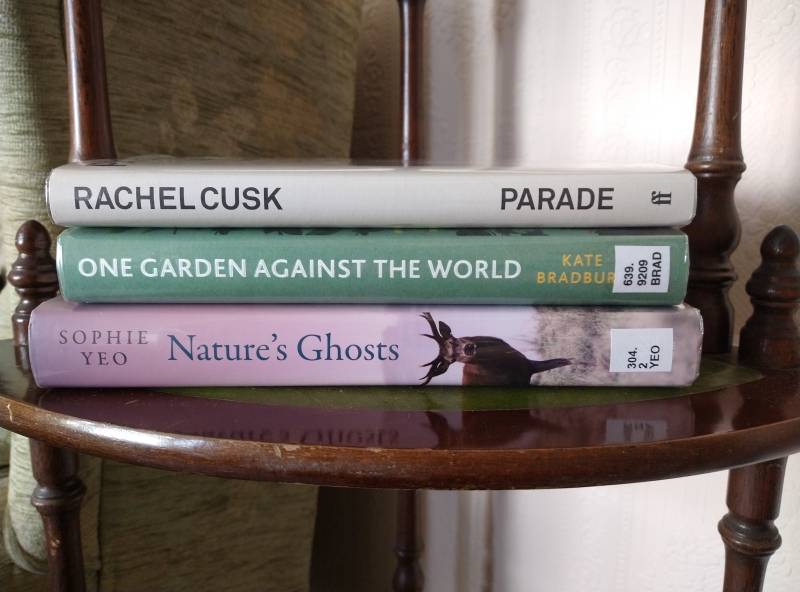
- Parade by Rachel Cusk

SKIMMED
- Nature’s Ghosts: A History – and Future – of the Natural World by Sophie Yeo
CURRENTLY READING
- One Garden against the World: In Search of Hope in a Changing Climate by Kate Bradbury
- Clear by Carys Davies (for September book club)
- Moominpappa at Sea by Tove Jansson
- The Garden against Time: In Search of a Common Paradise by Olivia Laing
- The Burial Plot by Elizabeth Macneal
- Late Light: Finding Home in the West Country by Michael Malay
- The Song of the Whole Wide World: On Motherhood, Grief, and Poetry by Tamarin Norwood
- The Echoes by Evie Wyld
CHECKED OUT, TO BE READ
- Wasteland: The Dirty Truth about What We Throw Away, Where It Goes, and Why It Matters by Oliver Franklin-Wallis
- This Is My Sea by Miriam Mulcahy
IN THE RESERVATION QUEUE
- The Glassmaker by Tracy Chevalier
- James by Percival Everett
- Small Rain by Garth Greenwell
- Bothy: In Search of Simple Shelter by Kat Hill
- The Painter’s Daughters by Emily Howes
- Dispersals: On Plants, Borders and Belonging by Jessica J. Lee
- Held by Anne Michaels
- Playground by Richard Powers
- Intermezzo by Sally Rooney
ON HOLD, TO BE PICKED UP
- The Accidental Garden: The Plot Thickens by Richard Mabey
RETURNED UNFINISHED
- The Cove: A Cornish Haunting by Beth Lynch – I enjoyed her previous memoir, and her writing is evocative, but this memoir about her return to the beloved site of childhood holidays lacks narrative drive. If you’re more familiar with the specific places, or can read it on location, you might be tempted to read the whole thing. I read 30 pages.
What have you been reading or reviewing from the library recently?

Share a link to your own post in the comments. Feel free to use the above image. The hashtag is #LoveYourLibrary.
The Secret Life of Books by Tom Mole
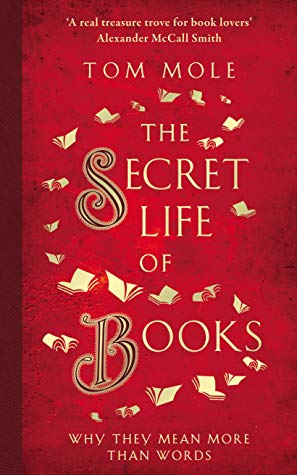 If you’re like me and author Tom Mole, the first thing you do in any new acquaintance’s house is to scrutinize their bookshelves, whether openly or surreptitiously. You can learn all kinds of surprising things about what someone is interested in, and holds dear, from the books on display. (And if they don’t have any books around, should you really be friends?)
Mole runs the Centre for the History of the Book at the University of Edinburgh, where he is a professor of English Literature and Book History. His specialist discipline and this book’s subtitle – “Why They Mean More than Words” – are clues that here he’s concerned with books more as physical and cultural objects than as containers of knowledge and stories:
“reading them is only one of the things we do with books, and not always the most significant. For a book to signal something about you, you don’t necessarily need to have read it.”
From the papyrus scroll to the early codex, from a leather-bound first edition to a mass-market paperback, and from the Kindle to the smartphone reading app, Mole asks how what we think of as a “book” has changed and what our different ways of accessing and possessing books say about us. He examines the book as a basis of personal identity and relationships with other people. His learned and digressive history of the book contains many pleasing pieces of trivia about authors, libraries and bookshops, making it a perfect gift for bibliophiles. I also enjoyed the three “interludes,” in which he explores three paintings that feature books.
There are a lot of talking points here for book lovers. Here are a few:
- Are you a true collector, or merely an “accumulator” of books? (Mole is the latter, as am I. “I have a few modest antiquarian volumes, but most of my books are paperbacks … I was the first in my immediate family to go to university, and I suspect the books on my shelves reassure me that I really have learned something along the way.”)
- In Anne Fadiman’s scheme, are you a “courtly” or a “carnal” reader? The former keeps a book pristine, while the latter has no qualms about cracking spines or dog-earing pages. (I’m a courtly reader, with the exception that I correct all errors in pencil.)
- Is a book a commercial product or a creative artifact? (“This is why authors quite often cross out the printed version of their name when they sign. Their action negates the book’s existence as a product of industry or commerce and reclaims it as the product of their own artistic effort.”)
- How is the experience of reading an e-book, or listening to an audiobook, different from reading a print book? (There is evidence that we remember less when we read on a screen, because we don’t have the physical cues of a book in our hand, plus “most people could in theory fit a lifetime’s reading on a single e-reader.”)
I would particularly recommend this to readers who have enjoyed Anne Fadiman’s Ex Libris, Alberto Manguel’s various books on libraries, and Tim Parks’s Where I’m Reading From.
A personal note: I was delighted to come across a mention of one of the visiting professors on my Master’s course in Victorian Literature at the University of Leeds, Matthew Rubery. In the autumn term of 2005, he taught one of my seminars, “The Reading Revolution in the Victorian Period,” which had a Book History slant and included topics like serial publication, anonymity and the rise of the media. A few years ago Rubery published an academic study of audiobooks, The Untold Story of the Talking Book, which Mole draws on for his discussion.
Two more favorite passages:
“when I’m reading, I’m not just spending time with a book, but investing time in cultivating a more learned version of myself.”
“A library is an argument. An argument about who’s in and who’s out, about what kinds of things belong together, about what’s more important and what’s less so. The books that we choose to keep, the ones that we display most prominently, and the ones that we shelve together make an implicit claim about what we value and how we perceive the world.”
My rating: 
The Secret Life of Books will be published by Elliott & Thompson on Thursday 19th September. My thanks to Alison Menzies for arranging my free copy for review.
Tidings by Ruth Padel & Other Christmassy Reading
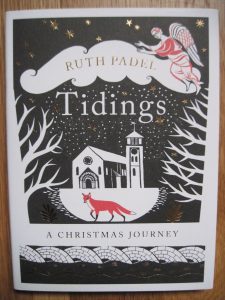 Ruth Padel is one of my favorite poets, so I jumped at the chance to read her new book-length holiday poem, Tidings: A Christmas Journey. Set across one Christmas Eve and Christmas day and narrated by Charoum, the Angel of Silence, the poem switches between Holly, a seven-year-old girl excited for Christmas, and Robin, a forty-four-year-old homeless man who follows a fox to a Crisis Centre. Here he gets a hot meal and some human kindness to make up for the usual bleakness of the holidays:
Christmas is the salt mine.
Salt in the wound, a nothing-time.
I was loved once. Who by? Can’t remember.
I especially liked the fragments that juxtapose this contemporary London story with centuries of history:
Up here the evening glides over golden moss
on the flat-top tomb of Mary Wollstonecraft
&
Pagan Christmas fizzes and teems with ghosts,
midwinter fires, mummers and waites, Yule
logs and mistletoe.
The poem also journeys to Jerusalem and Rome to survey a whole world of Christmas traditions, then and now.
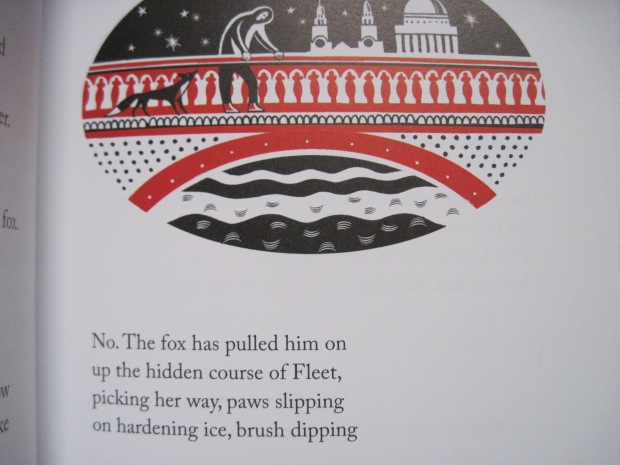
It’s a lovely little volume, with the red, black and white theme offset by touches of gold. The illustrations are gorgeous, but the story line disappointed me: starting with the character names, it all felt rather clichéd. Padel has treated urban foxes much more successfully in her collection The Soho Leopard, and apart from a very few instances – like the above quotes – the verse struck me as largely undistinguished, even awkward (like the out-of-place clinical vocabulary in “Love, / and the lack of it, can change the limbic brain”). This means that, for me, this book fails to earn a place as a Christmas classic I’ll reread year after year.
Tidings was published in the UK by Chatto & Windus on November 3rd. My thanks to Cat Mitchell of Random House for the free review copy.
My rating: 
Other Christmassy Reading
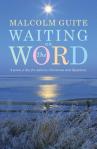 This year I’m resuming my place in Waiting on the Word, Malcolm Guite’s selection of religious-slanted poems to read from the start of Advent through Epiphany. For those who want to explore the history and interpretation of Christmas, I can recommend The First Christmas by the late Marcus Borg, one of my favorite progressive theologians.
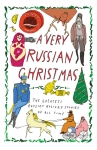
As I have for the past several years, I’ll dip into The Ecco Book of Christmas Stories, edited by Alberto Manguel. My favorites are by Truman Capote, John Cheever, Jane Gardam and Jeanette Winterson (who has a brand-new, full-length Christmas story collection out this year). I’ll also sample some Russian classics via A Very Russian Christmas, which has short stories from Tolstoy, Chekhov and more.
 In addition, I have Cleveland Amory’s The Cat Who Came for Christmas and The Cat Who Stayed for Christmas out from the library, which should make for some very cozy reading under the cat. I’ll browse the numerous Christmas-themed poems in U.A. Fanthorpe’s Collected Poems, another library book. And I may even deign to try Hogfather, one from my husband’s beloved Discworld series by the late Terry Pratchett.
[See also this wonderful list of Christmas reading suggestions from Heaven Ali.]
Are you reading anything special this Christmas season?
Reviews Roundup, November–December
One of my goals with this blog is to have one convenient place where I can gather together all my writing that has appeared in disparate online locations. To that end, once a month I provide links to all book reviews I’ve published elsewhere, with a rating (below each description) and a taster so you can decide whether to read more. A few exceptions: I won’t point out my Kirkus Indie, BlueInk or Publishers Weekly reviews since I don’t get a byline.
The Bookbag
 In Search of Mary: The Mother of All Journeys by Bee Rowlatt: A BBC journalist and mother of four sets out, baby in tow, to trace the steps of Mary Wollstonecraft in Norway and France. A follow-up trip to California is a little off-topic, but allows Rowlatt to survey the development of feminism over the last few centuries. This isn’t as successful a bibliomemoir as many I’ve read in recent years, such as Rebecca Mead’s My Life in Middlemarch or Samantha Ellis’s How to Be a Heroine, but for readers interested in engaging in the ongoing debate about how women can balance work life with motherhood, and especially for any women who have attempted traveling with children, it’s a fun, sassy travelogue.

Foreword Reviews
 Italy Invades: How Italians Conquered the World by Christopher Kelly and Stuart Laycock: Proceeding alphabetically from Afghanistan to Zimbabwe, the authors give a comprehensive picture of Italians’ global reach through one- to five-page snapshots. There are many familiar names here, such as Caesar, Garibaldi and Marco Polo. Along with exploration, some major reasons for historical crossover were trade, war, colonialism and immigration. At times it feels as if the authors are grasping at straws; better to skip one-paragraph write-ups altogether and focus instead on the countries that have extensive links with Italy. Nonetheless, this is a lively, conversational book full of surprising facts.

Why You Won’t Go to Hell by Benjamin Vande Weerdhof Andrews: In a well-structured argument, Andrews prizes empirical thinking, rejects the supernatural, and affirms the possibility of godless morality. His central thesis is that religion doesn’t evolve to keep pace with society and so holds humanity back. The book’s tone is too often defensive, often in response to included website comments, and there are some failures of accuracy and fairness. Ultimately, though, this could be an inspirational book for atheists or believers, prompting both groups to question their assumptions and be willing to say “I don’t know.” Readers of Sam Harris and Christopher Hitchens will be particularly drawn to the book, but others should take a chance on it too.

 Cultured Food for Health by Donna Schwenk: When Schwenk started eating cultured foods in 2002, she had diabetes, high blood pressure, and a premature newborn. Keen to see if good bacteria could help with her medical problems, she started introducing the “healing powerhouse” of kefir (a fermented milk product resembling thin yogurt), kombucha (bubbly tea), and cultured vegetables into her diet, and soon reaped the rewards. About a quarter of the book is background information about probiotic foods. Bullet-pointed lists of health benefits, along with an alphabetical inventory of the diseases that cultured foods can treat, should prove helpful. The rest of the book is devoted to recipes, most vegetarian.
Three Simple Questions: Being in the World, But Not of It by Charlie Horton: Horton, trained as a social worker, was diagnosed with cerebellar degeneration in 1988. It has gradually affected his speech and movement. Despite having lived with disability for nearly three decades, he declares, “the world I live in is rich, and my spirit is young.” Here he documents how he deals with depression and physical limitations through guided meditations that bring him closer to God. Although he comes from a Christian perspective, he writes about spirituality in such inclusive terms that his work should speak to people of any faith.
Middle Passage: The Artistic Life of Lawrence Baker by Louis B. Burroughs, Jr.: This ghostwritten autobiography of an African-American artist is not only an evocative, eventful life story that moves from the Jim Crow South to the North, but also a forceful artist’s manifesto. Burroughs writes in Baker’s voice, a decision that works surprisingly well. The title is a powerful reference to the slave trade. Indeed, Burroughs consciously crafts Baker’s autobiography as an “up from slavery” narrative reminiscent of Richard Wright and Maya Angelou – with ‘slavery’ in this case being poverty and racism.
Nudge
 40 Sonnets by Don Patterson: All but one of the poems in this new book have the sonnet’s traditional 14 lines; “The Version” is a short prose story about writing an untranslatable poem. However, even in the more conventional verses, there is a wide variety of both subject matter and rhyme scheme. Topics range from love and death to a phishing phone call and a footpath blocked off by Dundee City Council. A few favorites were “A Powercut,” set in a stuck elevator; “Seven Questions about the Journey,” an eerie call-and-response; and “Mercies,” a sweet elegy to an old dog put to sleep. There weren’t quite enough stand-outs here for my liking, but I appreciated the book as a showcase for just how divergent in form sonnets can be.
 Without You There Is No Us by Suki Kim: This is a quietly gripping book even though not much of moment happens over Kim’s five months teaching young men at a missionary-run college in Pyongyang. She was in a unique position in that students saw her as ethnically one of their own but she brought an outsider’s perspective to bear on what she observed. Just before she flew back to the States in 2011, Kim Jong-Il died, an event she uses as a framing device. It could have represented a turning point for the country, but instead history has repeated itself with Kim Jong-un. Kim thus ends on a note of frustration: she wants better for these young men she became so fond of. A rare glimpse into a country that carefully safeguards its secrets and masks its truth.
 Alive, Alive Oh!: And Other Things that Matter by Diana Athill: Diana Athill turns 98 on December 21st. Apart from “Dead Right,” however, this collection is not primarily concerned with imminent death. Instead Athill is still grateful to be alive: marveling at a lifetime of good luck and health and taking joy in gardening, clothing, books, memories and friendships. Six of the 10 essays originally appeared elsewhere. The collection highlight is the title piece, about a miscarriage she suffered in her forties. Another stand-out is “The Decision,” about moving into a retirement home in her nineties. This doesn’t live up to her best memoirs, but is an essential read for a devoted fan, and a consolation given she will likely not publish anything else (though you never know). [For first-time Athill readers, I’d recommend starting with Somewhere Towards the End, followed by Stet, about her work as a literary editor.]
I also post reviews of most of my casual reading and skimming on Goodreads:
The Weightless World by Anthony Trevelyan: This debut novel blends postcolonial bureaucracy with steampunk zaniness. The setup is familiar enough: businessmen head overseas to take financial advantage of a former colony, puzzle over unfamiliar customs, and by the end are chastened but gain a clearer sense of values. Narrator Steven Strauss is the personal assistant to Raymond Ess, an entrepreneur with a history of mental illness. Their aviation company has gone bust; Strauss is to accompany Ess to India and keep him occupied by looking for an anti-gravity machine. Not anchored by either current events or convincing fantasy, the plot suffers in comparison to works by Geoff Dyer or Nick Harkaway. Despite entirely serviceable writing and a gravity-defying theme, it never really takes off.

 My Confection: Odyssey of a Sugar Addict by Lisa Kotin: 1978. Twenty-one-year-old mime goes to macrobiotic rehab to recover from sugar addiction. Fails. Shows signs of being a sex addict as well. Pared down to headlines, that’s how this fairly rambling memoir about Kotin’s relationships with food, family, lovers, and career opens. I kept waiting for a turn, some moment of revelation, when Kotin’s binge eating would be solved. Still, her recreation of her obsessive younger self can be pretty funny and charming, and her family sounds a bit like the Sedaris clan. I found this a bit dated, but others may find the time period and Jewish family background more evocative.
 Good on Paper by Rachel Cantor: I’m going to chalk this one up to blurb inflation. The writing is lively and the plot well crafted, with quirky postmodern touches, but the novel as a whole did not live up to my absurdly high expectations: it’s really nothing like A.S. Byatt’s Possession. It’s 1999 and Shira Greene is a failed translator from the Italian, now working as a temp in New York City and raising her daughter Andi with the help of her gay, Pakistani co-parent, Ahmad. One day she gets a call from Romei, a Nobel Prize-winning Italian poet who wants her to translate his new work, a version of Dante’s Vita Nuova that focuses on his relationship with his ill wife – and eventually starts to comment on Shira’s own life in surprising ways.
Water Sessions by James Lasdun: Wonderful poems from a severely underrated writer. The British Lasdun has relocated to small-town upstate New York, where he’s learned the spiritual worth of manual labor. There are such interesting rhyme schemes and half-rhymes throughout. One of the most striking poems, “Thing One and Thing Two,” compares human and animal sexuality in a rather disturbing way. The title sequence is a dialogue between a patient and a therapist, discussing what went wrong in a relationship and how arguments are never ‘about’ the thing that started it.
 The Secret Chord by Geraldine Brooks: A retelling of the life of King David from the perspective of the prophet Nathan. The naming takes some getting used to, but the stories – from gory massacres to moments of triumph – are recognizable from the Old Testament. What makes Brooks’s take unique is the different points of view it shows and the ways it subtly introduces doubt about David’s carefully cultivated image. It’s sensual historical fiction, full of rich descriptive language. Strangely unmemorable for me, perhaps because the storyline is just too familiar. Brooks doesn’t offer a radical reinterpretation but sows small seeds of doubt about the hero we think we know. (Full review in Jan/Feb 2016 issue of Third Way magazine.)
 When I Die: Lessons from the Death Zone by Philip Gould: Gould may be familiar to British readers as a key strategist of the New Labour movement and one of Tony Blair’s advisors. In 2008 he was diagnosed with esophageal cancer and chose to pay for private treatment at New York’s Sloan-Kettering hospital instead of going for a radical operation through the NHS – a fateful decision. Gould’s own account is fairly short, about 140 pages, but it’s supplemented by short reminiscences from his wife and two daughters. Daughter Georgia’s, especially, is a very good blow-by-blow of his final week. All royalties from the book went to the National Oesophago-Gastric Cancer Fund.
 Twain’s End by Lynn Cullen: “Twain’s End” was a possible name for the Clemens house in Connecticut, but it’s also a tip of the hat to Howards End and an indication of the main character’s impending death. In January 1909, when the novel opens, Samuel Clemens, 74, is busy dictating his autobiography and waiting for Halley’s Comet, the heavenly body that accompanied his birth, to see him back out. His secretary, Isabel Lyon, is 45 and it’s no secret that the two of them are involved. I love how the novel shifts between the perspectives of several strong female characters yet still gives a distinct portrait of Clemens/Twain. Interestingly, I found that it helped to have visited the Twain house in Connecticut – I could truly picture all the scenes, especially those set in the billiard room and conservatory.
 Meadowland: The Private Life of an English Field by John Lewis-Stempel: Lewis-Stempel is a proper, third-generation Herefordshire farmer, but also a naturalist with a poet’s eye. His day job might involve shooting rabbits, cutting hay and delivering lambs, but he still finds the time to notice and appreciate wildlife. He knows his field’s flowers, insects and birds as well as he knows his cows; he gets quiet and close enough to the ground to watch a shrew devouring beetles. June and July are the stand-out chapters, with some truly magical moments. When his mower breaks on a stone, he has to cut the hay by hand, returning him to a centuries-gone model of hard labor. All delivered in the loveliest prose.

Did You Ever Have a Family by Bill Clegg: A strong debut novel about personal and community responses to tragedy. Clegg’s multivocal approach works quite well, though there are perhaps a few too many voices diluting the mixture. I like how the revelations of what really happened that night before the wedding to cause the fatal house fire come gradually, making you constantly rethink who was responsible and what it all means. The small-town Connecticut setting is a good one, but I’d question the decision to set so much of the book in Washington, where the bereaved June drives on a whim. For a tragic story, it’s admirably lacking in melodrama.
 A Homemade Life: Stories and Recipes from My Kitchen Table by Molly Wizenberg: Foodoir extraordinaire! I liked this even better than Delancey, which is a terrific book about opening a pizza restaurant in Seattle with her husband. Here we get the prequel: the death of her father Burg from cancer, time spent living in Paris, building a new life in Seattle, starting her now-famous food blog (Orangette), and meeting her husband Brandon through it. Each brief autobiographical essay is perfectly formed and followed by a relevant recipe, capturing precisely how food is tied up with her memories. Wizenberg’s very fond of salad, but also of cake, and every recipe is full-on in terms of flavors and ingredients.
Ellen Foster by Kaye Gibbons: This was a random library book sale purchase, chosen almost entirely for the title. I set aside my usual dislike of child narrators and found an enjoyable voice-driven novella about a feisty ten-year-old who loses both her parents (good riddance to her father, at least) and finds her own unconventional family after cycling through the homes of some truly horrid relatives. Just as an example, her maternal grandmother sends her out to work picking cotton. The book is set in the South, presumably in the 1970s or 80s, so it’s alarming to see how strong racial prejudice still was.
 The Ecco Book of Christmas Stories, edited by Alberto Manguel: I read this over several years, a handful each holiday season. There are some very unusual choices, including some that really have hardly anything to do with Christmas (e.g. one by Bessie Head). Still, it’s a nice book to have to hand, even if just to skip through. Manguel strikes a good balance between well-known short story writers, authors you might never think to associate with Christmas, and fairly obscure works in translation. Four favorites: “A Christmas Memory,” Truman Capote (overall favorite); “Christmas Is a Sad Season for the Poor,” John Cheever; “The Zoo at Christmas,” Jane Gardam; and “O’Brien’s First Christmas,” Jeanette Winterson.
 Bookish Beck = Rebecca Foster. American transplant to England. Freelance proofreader and book reviewer.
 Bookish Beck