Spring Reads, Part II: Blossomise, Spring Chicken & Cold Spring Harbor
Our garden is an unruly assortment of wildflowers, rosebushes, fruit trees and hedge plants, along with an in-progress pond, and we’ve made a few half-hearted attempts at planting vegetable seeds and flower bulbs. It felt more like summer earlier in May, before we left for France; as the rest of the spring plays out, we’ll see if the beetroot, courgettes, radishes and tomatoes amount to anything. The gladioli have certainly been shooting for the sky!
I recently encountered spring (if only in name) through these three books, a truly mixed bag: a novelty poetry book memorable more for the illustrations than for the words, a fascinating popular account of the science of ageing, and a typically depressing (if you know the author, anyway) novel about failing marriages and families. Part I of my Spring Reading was here.
Blossomise by Simon Armitage; illus. Angela Harding (2024)
 Armitage has been the Poet Laureate for yonks now, but I can’t say his poetry has ever made much of an impression on me. That’s especially true of this slim volume commissioned by the National Trust: it’s 3 stars for Angela Harding’s lovely if biologically inaccurate (but I’ll be kind and call them whimsical) engravings, and 2 stars for the actual poems, which are light on content. Plum, cherry, apple, pear, blackthorn and hawthorn blossom loom large. It’s hard to describe spring without resorting to enraptured clichés, though: “Planet Earth in party mode, / petals fizzing and frothing / like pink champagne.” The haiku (11 of 21 poems) feel particularly tossed-off: “The streets are learning / the language of plum blossom. / The trees have spoken.” But others are sure to think more of this than I did.
A favourite passage: “Scented and powdered / she’s staging / a one-tree show / with hi-viz blossoms / and lip-gloss petals; / she’ll season the pavements / and polished stones / with something like snow.” (Public library) 
Spring Chicken: Stay Young Forever (or Die Trying) by Bill Gifford (2015)
 Gifford was in his mid-forties when he undertook this quirky journey into the science and superstitions of ageing. As a starting point, he ponders the differences between his grandfather, who swam and worked his orchard until his death from infection at 86, and his great-uncle, not so different in age, who developed Alzheimer’s and died in a nursing home at 74. Why is the course of ageing so different for different people? Gifford suspects that, in this case, it had something to do with Uncle Emerson’s adherence to the family tradition of Christian Science and refusal to go to the doctor for any medical concern. (An alarming fact: “The Baby Boom generation is the first in centuries that has actually turned out to be less healthy than their parents, thanks largely to diabetes, poor diet, and general physical laziness.”) But variation in healthspan is still something of a mystery.
Over the course of the book, Gifford meets all number of researchers and cranks as he attends conferences, travels to spend time with centenarians and scientists, and participates in the Baltimore Longitudinal Study of Aging. There have been some truly zany ideas about how to pause or reverse aging, such as self-dosing with hormones (Suzanne Somers is one proponent), but long-term use is discouraged. Some things that do help, to an extent, are calorie restriction and periodic fasting plus, possibly, red wine, coffee and aspirin. But the basic advice is nothing we don’t already know about health: don’t eat too much and exercise, i.e., avoid obesity. The layman-interpreting-science approach reminded me of Mary Roach’s. There was some crossover in content with Mark O’Connell’s To Be a Machine and various books I’ve read about dementia. Fun and enlightening. (New purchase – bargain book from Dollar Tree, Bowie, MD) 
Cold Spring Harbor by Richard Yates (1986)
 Cold Spring Harbor is a Long Island hamlet whose name casts an appropriately chilly shadow over this slim novel about families blighted by alcoholism and poor decisions. Evan Shepard, only in his early twenties, already has a broken marriage behind him after a teenage romance led to an unplanned pregnancy. Mary and their daughter Kathleen seem to be in the rearview mirror as he plans to return to college for an engineering degree. One day he accompanies his father into New York City for an eye doctor appointment and the car breaks down. The men knock on a random door and thereby become entwined with the Drakes: Gloria, the unstable, daytime-drinking mother; Rachel, her beautiful daughter; and Phil, her earnest but unconfident adolescent son.
Evan and Rachel soon marry and agree to Gloria’s plan of sharing a house in Cold Spring Harbor, where the Shepards live (Evan’s mother is also an alcoholic, but less functional; she hides behind the “invalid” label). Take it from me: living with your in-laws is never a good idea! As the Second World War looms, and with Evan and Rachel expecting a baby, it’s clear something will have to give with this uneasy family arrangement, but the dramatic break I was expecting – along the lines of a death or accident – never arrived. Instead, there’s just additional slow crumbling, and the promise of greater suffering to come. Although Yates’s character portraits are as penetrating as in Easter Parade, I found the plot a little lacklustre here. (Secondhand – Clutterbooks, Sedbergh) 
Any ‘spring’ reads for you recently?
Autumnal Children’s and YA Books
Browsing through old magazines, I found a fun BookPage reading list from October 2019 entitled “Pumpkin spice latte literature.” It asks, “what if autumn were distilled into a book? The mixture of crispness and warmth, the thrill of possibility, the bittersweetness of change—these books are pure pumpkin spice.” I love the lateral thinking that came up with
 The Art of Fielding by Chad Harbach (back to school in the Midwest)
- I Remember Nothing by Nora Ephron (wry reflections from the autumn of a life)
- Possession by A.S. Byatt (bookish geeking out)
- Calling a Wolf a Wolf by Kaveh Akbar (taking comfort from a vision of recovery from alcoholism)
- An Enchantment of Ravens by Margaret Rogerson (wit and magic)
I’ve read the first three, and am keen to catch up on Akbar’s debut poetry collection after loving Pilgrim Bell this summer. I’m only unlikely to pick up Rogerson’s fantasy. In any case, I enjoyed seeing how the editors came up with their selections.
I tend to be rather more literal with my seasonal reading recommendations. Does it have autumn in the title or as a setting?! Is it about pumpkins or Halloween?
This year I happen to have amassed all children’s and YA selections.
October, October by Katya Balen (2020)
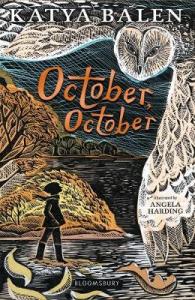 I’ll admit it: it was Angela Harding’s gorgeous cover illustration that drew me to this one. But I found a story that lived up to it, too. October, who has just turned 11 and is named after her birth month, lives in the woods with her father. Their shelter and their ways are fairly primitive, but it’s what October knows and loves. When her father has an accident and she’s forced into joining her mother’s London life, her only consolations are her rescued barn owl chick, Stig, and the mudlarking hobby she takes up with her new friend, Yusuf.
The child’s perspective is well rendered through artful run-on sentences. Balen is careful to show the consequences of October’s decisions and to present advantages as well as disadvantages so it’s not just countryside = good, city = bad. I thought the father’s recovery a bit too quick, but overall, this middle grade novel was a great read for any age, as well as one to get kids thinking about illness and loss. And how about these heart-tugging last lines? “There are stories everywhere and I want to tell them all. And all the world is wild and waiting for me.” (Public library) 
Autumn Story by Jill Barklem (1980)
 The second in the quartet of seasonal “Brambly Hedge” stories. Autumn is a time for stocking the pantry shelves with preserves, so the mice are out gathering berries, fruit and mushrooms. Young Primrose wanders off, inadvertently causing alarm – though all she does is meet a pair of elderly harvest mice and stay for tea and cake in their round nest amid the cornstalks. I love all the little touches in the illustrations: the patchwork tea cosy matches the quilt on the bed one floor up, and nearly every page is adorned with flowers and other foliage. After we get past the mild peril that seems to be de rigueur for any children’s book, all is returned to a comforting normal. Time to get the Winter volume out from the library. (Public library)
Une Chanson d’ours by Benjamin Chaud (2011)
 The first whole book I’ve read in French in many a year. I just about coped, given that it’s a picture book with not all that many words on a page; any vocabulary I didn’t know offhand, I could understand in context. It’s late into the autumn and Papa Bear is ready to start hibernating for the year, but Little Bear spies a late-flying bee and follows it out of the woods and all the way to the big city. Papa Bear, realizing his lad isn’t beside him in the cave, sets out in pursuit and bee, cub and bear all end up at the opera hall, to the great surprise of the audience. What will Papa do with his moment in the spotlight? This is a lovely book that, despite the whimsy, still teaches about the seasons and parent–child bonds as it offers a vision of how humans and animals could coexist. I’ve since found out that this was made into a series of four books, all available in English translation. (Little Free Library)
Pumpkinheads by Rainbow Rowell; illus. Faith Erin Hicks (2019)
 This YA graphic novel is set on a Nebraska pumpkin patch that’s more like Disney World than a simple field down the road. Josiah and Deja have worked together at the Succotash Hut for the last three autumns. Today they’re aware that it’s their final Halloween before leaving for college. Deja’s goal is to try every culinary delicacy the patch has to offer – a smorgasbord of foodstuffs that are likely to be utterly baffling to non-American readers: candy apples, Frito pie (even I hadn’t heard of this one), kettle corn, s’mores, and plenty of other saccharine confections.
Josiah’s goal, by contrast, is to catch the eye of Marcy, the beauty who works at the fudge stand. Deja convinces him to desert the Succotash Hut and go in pursuit of Marcy via as many food stands as possible. She’s willing to indulge his unrealistic fantasy even though, as a bisexual who’s dated just about everyone at the patch, she knows romance is sometimes not all it’s cracked up to be. Meanwhile, there’s an angry billy goat on the loose.
This is a fun and quick romp, and the ending genuinely surprised me. I liked the story better than the art, though – my main problem was that these teen characters look more like they’re 30 (Josiah, especially, looks almost haggard what with the sharp lines down the sides of his face – I guess they’re to give him a ‘chiselled’ jaw?), similar to that weird phenomenon of much older actors playing high schoolers. So, I laughed to see in an afterword conversation between Rowell and Hicks that one of the major things they changed from early mock-ups was making the protagonists look older. (Public library) 
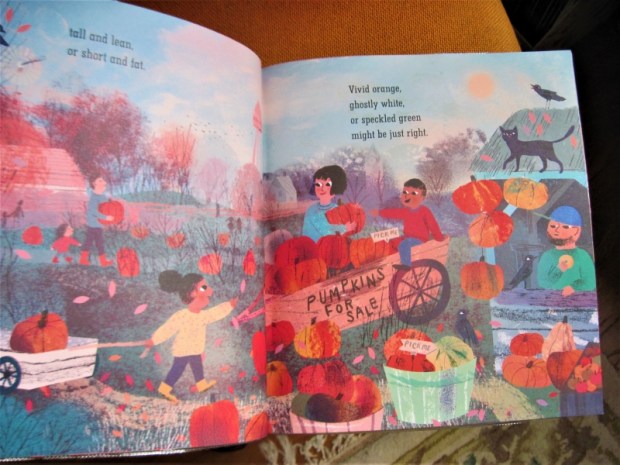
Pick a Pumpkin by Patricia Toht; illus. Jarvis (2019)
 From picking the best pumpkin at the patch to going out trick-or-treating, this is a great introduction to Halloween traditions. It even gives step-by-step instructions for carving a jack-o’-lantern. The drawing style – generally 2D, and looking like it could be part cut paper collages, with some sponge painting – reminds me of Ezra Jack Keats and most of the characters are not white, which is refreshing. There are lots of little autumnal details to pick out in the two-page spreads, with a black cat and crows on most pages and a set of twins and a mouse on some others. The rhymes are either in couplets or ABCB patterns. Perfect October reading. (Public library)
 Any super-autumnal reading for you this year?
Do you read children’s picture books and YA novels even if you (and any children) are well past that age – or is it just me?
Novellas in November, Batch #2: 2 Fiction, 2 Nonfiction
Fiction about caregiving for AIDS patients and Victorian ghosts; nonfiction about American race relations and British wildlife: novellas have it all! Here are my latest four reads. All were  .
.
Fiction:
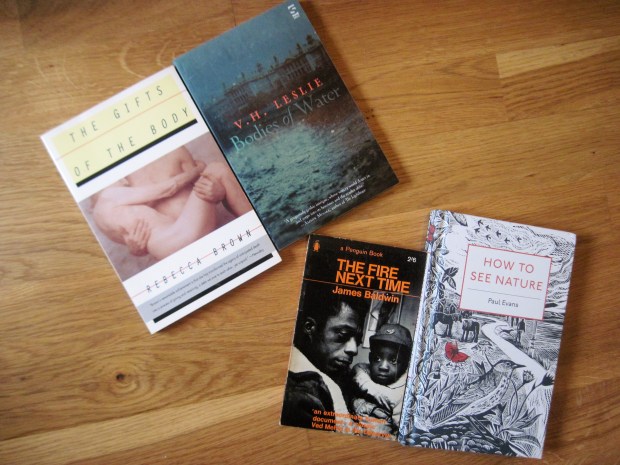
The Gifts of the Body by Rebecca Brown (1994)
[163 pages]
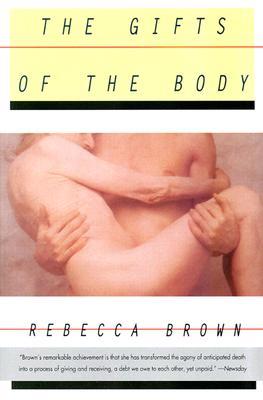 This is rather like a set of linked short stories, narrated by a home care aide who bathes and feeds those dying of AIDS. The same patients appear in multiple chapters titled “The Gift of…” (Sweat, Tears, Hunger, etc.) – Rick, Ed, Carlos, and Marty, with brief appearances from Mike and Keith. But for me the most poignant story was that of Connie Lindstrom, an old woman who got a dodgy blood transfusion after her mastectomy; the extra irony to her situation is that her son Joe is gay, and feels guilty because he thinks he should have been the one to get sick. Several characters move in and out of hospice care, and one building is so known for its AIDS victims that a savant resident greets the narrator with a roll call of its dead and dying. Brown herself had been a home-care worker, and she delivers these achingly sad vignettes in plain language that keeps the book from ever turning maudlin.
A favorite passage:
“I’d thought about the sores all week long, about how they looked and how it frightened me. But I’d worked myself up to acting like it didn’t bother me. … I also kept telling myself that even if I wasn’t feeling or thinking the right things, at least he was getting fed, at least he was getting his sheets changed, at least his kitchen was getting cleaned, at least his body was getting salve.”
(I found my copy over the summer in a Little Free Library in my mother’s new town in the States and read it in one day, on my travel to and from London for the Barbara Kingsolver event. Rebecca Brown is a repeat presence on my novellas list: Excerpts from a Family Medical Dictionary was in my 2016 roster.)
Bodies of Water by V. H. Leslie (2016)
[130 pages]
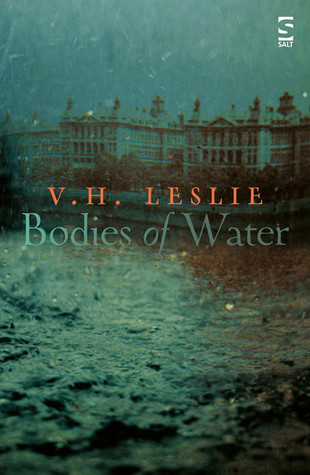 Left over from my R.I.P. reading plans. This was nearly a one-sitting read for me: I read 94 pages in one go, though that may be because I was trapped under the cat. The first thing I noted was that the setup and dual timeframe are exactly the same as in Barbara Kingsolver’s Unsheltered: we switch between the same place in 2016 and 1871. In this case it’s Wakewater House, a residential development by the Thames that incorporates the site of a dilapidated Victorian hydrotherapy center. After her partner cheats on her, Kirsten moves into Wakewater, where she’s alone apart from one neighbor, Manon, a hoarder who’s researching Anatomical Venuses – often modeled on prostitutes who drowned themselves in the river. In the historical strand, we see Wakewater through the eyes of Evelyn Byrne, who rescues street prostitutes and, after a disastrously ended relationship of her own, has arrived to take the Water Cure.
The literal and metaphorical connections between the two story lines are strong. Annabel described this novella as “watery,” and I would agree: pretty much every paragraph has a water word in it, whether it’s “river,” “sea,” “aquatic” or “immersion.” Both women see ghostly figures emerging from the water, and Manon’s interest in legends about water spirits and the motif of the drowned girl adds texture. Short chapters keep things ticking over, and I loved the spooky atmosphere.
A favorite line: “Sometimes old places like this retain a bit of the past, in the fabric of the building, and occasionally, they seep.”
(Purchased from Salt Publishing during their #JustOneBook fundraising campaign in late May.)
Nonfiction:
The Fire Next Time by James Baldwin (1963)
[89 pages]
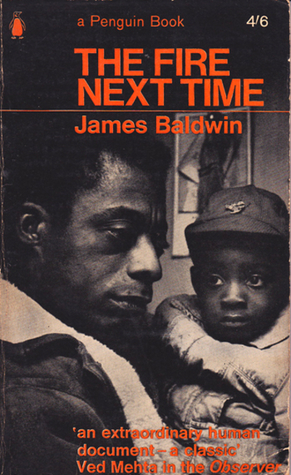 This was written yesterday, right? Actually, it was 55 years ago, but apart from the use of the word “Negro” you might have fooled me. Baldwin’s writing is still completely relevant, and eminently quotable. I can’t believe I hadn’t read him until now. This hard-hitting little book is composed of two essays that first appeared elsewhere. The first, “My Dungeon Shook,” a very short piece from the Madison, Wisconsin Progressive, is a letter addressed to his nephew and namesake on the 100th anniversary of emancipation. No doubt it directly inspired Ta-Nehisi Coates’s Between the World and Me.
“Down at the Cross: Letter from a Region in My Mind” is a 66-page essay that first appeared in the New Yorker. It tells of a crisis of faith that hit Baldwin when he was a teenager. Whereas he used to be a fervent young preacher in his church, he started to question to what extent Christianity of all stripes was upholding white privilege and black subjugation. Unless religion was making things better, he decided he wanted no part of it. Curiosity about the Nation of Islam led to Baldwin meeting Elijah Muhammad for dinner at his home in Chicago. I marked out so many passages from this essay. Here are a few that stood out most:
“To be sensual, I think, is to respect and rejoice in the force of life, of life itself, and to be present in all that one does, from the effort of loving to the breaking of bread.”
“If the concept of God has any validity or any use, it can only be to make us larger, freer, and more loving. If God cannot do this, then it is time we got rid of Him.”
“When a white man faces a black man, especially if the black man is helpless, terrible things are revealed.”
How to See Nature by Paul Evans (2018)
[164 pages]
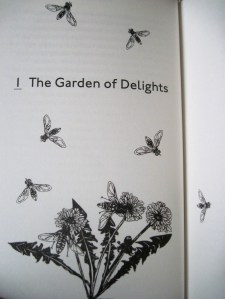
 How to See Nature (1940), a quaint and perhaps slightly patronizing book by Shropshire naturalist and photographer Frances Pitt, was intended to help city evacuees cope with life in the countryside. Recently Pitt’s publisher, Batsford, commissioned Shropshire naturalist Paul Evans to revisit the topic. The result is a simply lovely volume (with a cover illustration by Angela Harding and black-and-white interior drawings by Evans’s partner, Maria Nunzia) that reflects on the range of modern relationships with nature and revels in the wealth of wildlife and semi-wild places we still have in Britain.
He starts with his own garden, where he encounters hedgehogs and marmalade hoverflies. Other chapters consider night creatures like bats; weeds and what they have to offer; and the wildlife of rivers, common land, moors and woods. I particularly enjoyed a section on reintroduced species such as beavers and red kites. The book closes with an A–Z bestiary of British wildlife, from adders to zooplankton.
 Throughout, Evans treats issues like tree blight, climate change and species persecution with a light touch. Although it’s clear he’s aware of the diminished state of nature and quietly irate at how we are all responsible for pollution and invasive species, he writes lovingly and with poetic grace. I would not hesitate to recommend this to fans of contemporary nature writing.
Favorite lines:
“the orb-weavers wait: sexual cannibals adorned in the extra-terrestrial glow of their pearl diadems, suspended in ethereal scaffolds woven from hundreds of glands controlled by their own sovereign will and unique metabolism”
“The last ‘woo-oooo’ of a tawny owl meets the first clockwork hiccup of a pheasant, then bird by bird in the scanty light, the songs begin”
(Paul Evans is a repeat presence on my novellas list: Herbaceous was in my 2017 roster.)
How to See Nature was published by Batsford on November 6th. My thanks to the publisher for a free copy for review.
 Bookish Beck = Rebecca Foster. American transplant to England. Freelance proofreader and book reviewer.
 Bookish Beck