#DoorstoppersInDecember: Book of Lives by Margaret Atwood & The End of Mr. Y by Scarlett Thomas
Later than intended, I’m reporting back on Margaret Atwood’s memoir, which I started in late November, and a long-neglected 500+-page novel I plucked from my shelves. Both offered page-turning intrigue and a blend of history, magic, and pure weirdness. Many thanks to Laura for hosting Doorstoppers in December, which encouraged me to pick them up!
Book of Lives: A Memoir of Sorts by Margaret Atwood (2025)
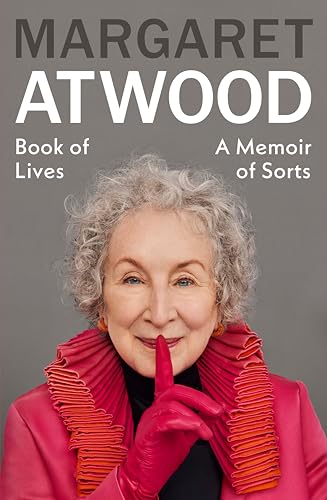 I gave some initial thoughts about the book here to tie in with Margaret Atwood Reading Month. What I said then proved true of the book as a whole: it’s delightful though dense with detail and historical context. I did get a little bogged down in the names and details of decades worth of publishing, but there is some tasty gossip, such as the fact that Margaret Laurence spread mean rumours about her (and was a drunk) but later changed her ways. It’s been a lucky window of time for Atwood to live through: she has known simplicity and the need for do-it-yourself practicality, but has also experienced privilege, even luxury (multiple homes and worldwide travel). Mostly, she had the good fortune of being at the start of Canada’s literary boom. In the early 1960s, only five Canadian novels were published per year. Through her involvement with literary magazines and House of Anansi Press and her books on Susanna Moodie and the tropes of Canadian literature, she helped create the scene.
There are frequent mentions of how people or events made their way into her fiction and poetry. Coyly, she writes, “I just have a teeming imagination. Also, like all novelists, I’m a kleptomaniac.” The page or two of context on each book is illuminating and it never becomes the tedious “I published this book … then I published this book” that she mentioned wanting to avoid in the introduction. Rather, these sections made me want to go reread lots of her books to appreciate them anew. I was also reminded how often she’s been ahead of her time, with topics and details that seem prophetic (she proposed Payback before the financial crisis hit, for instance). Some elements felt particularly timely: she experienced casual misogyny and an alarming number of near-misses – she says things like “I won’t give his name … you know who you are … though you’re probably dead” – and, through her involvement in bird conservation, she’s well aware of the disastrous environmental trajectory we’re on.
For a memoir, this is not especially forthcoming about the author’s inner life and emotions. Where it is, she masks the material in a layer of technique. So when she’s confessing to having an affair while married to Jim Polk (whom she met at Harvard), she writes it like a fairytale scene in which she went into the woods with a wolf. When she was fretting about Graeme Gibson’s reluctance to divorce her first wife and marry her, she imagines letters to her ‘inner advice columnist’. (Note: Gibson was her long-time partner and his sons were like her stepchildren but they never did marry – and he only ‘allowed’ her the one child, though she wanted two of her own. One ‘Jess Gibson’ has a speculative short story collection, The Good Eye, coming out in May 2026. No doubt her work will be compared with her mother’s, but bully for her for not using the name Atwood to try to ride her coattails.)
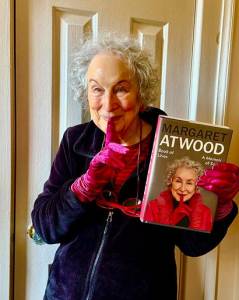
A cute pic from her Substack in November
One of the successful literary touches is the recurring “We Nearly Lose Graeme” segments about his risky behaviour and various mishaps. He had dementia and mini strokes before suffering a major one while in London with her for The Testaments tour; he died five days later. Her reflections on his death are poignant, but generic: “We can all believe three things simultaneously: The person is in the ground. The person is in the Afterlife. The person is in the next room. You keep expecting to see him. Even when you know it’s coming, a death is a shock.” At the crucial moment, she turns to the first-person plural and the second person.
I skimmed some of the bits about Graeme’s earlier life and the behind-the-scenes of publishing; I felt that he and many of her literary pals are more important to her than they are to readers. But that’s okay. The same goes for her earlier life; I noted that the account of her time as a summer camp counsellor felt more detailed than necessary. However, with her gift for storytelling, even the smallest incident can be rendered amusing. She looks for the humour, coincidence, or irony in any situation, and her summations and asides are full of dry humour. Some examples:
- “Spoiler: Jim and I eventually got married, one of the odder things to happen to both of us.”
- “After a while, the hand [at the window of her Harvard student accommodation] went away. It’s what you wish for in a disembodied hand.”
- “Eventually the iguana [inherited from her roommate] was given a new home at a zoo among other iguanas, where it was probably happier. Hard to tell.”
It’s not a book for the casual reader who kinda liked one or two Atwood novels; it’s more for the diehard fans among us, and offers a veritable trove of stories and photographs. But don’t expect a tell-all. Think of this more as a companion to her oeuvre. The title feels literal in that it’s as if she’s lived several lives: the wilderness kid, the literary ingénue, the family and career woman, the philanthropist and elder stateswoman. She doesn’t try to pull all of her incarnations into one, instead leaving all of the threads trailing into the beyond. If anything, “Peggy Nature” (her name from summer camp) is the role that has persisted. I probably liked the childhood material most, which makes sense as it’s what she’s looking back on with most fondness. Towards the close, Atwood mentions her heart condition and seems perfectly accepting of the fact that she won’t be around for much longer. But her body of work will endure. I’m so grateful for it and for the gift of this self-disclosure, however coy. (Can I be greedy and hope for another novel?) She leaves this message: “We scribes and scribblers are time travellers: via the magic page we throw our voices, not only from here to elsewhere, but also from now to a possible future. I’ll see you there.” [570 pages] (Public library) 
The End of Mr. Y by Scarlett Thomas (2006)
 This is a mash-up of the campus novel, the Victorian pastiche, and the time travel adventure. Ariel Manto is a PhD student working on thought experiments. Inciting incidents come thick and fast: her supervisor disappears, the building that houses her office partially collapses as it’s on top of an old railway tunnel, and she finds a copy of Thomas Lumas’s vanishingly rare The End of Mr. Y in a box of mixed antiquarian stock going for £50 at a secondhand bookshop. Rumour has it the book is cursed, and when Ariel realises that the key page – giving a Victorian homoeopathic recipe for entering the “Troposphere,” a dream/thought realm where one travels through time and space – has been excised, she knows the quest has only just begun. It will involve the book within a book, Samuel Butler novels, a theologian and a shrine, lab mice plus the God of Mice, and a train line whose destinations are emotions.
The plot is pretty bonkers and I’m not sure I can satisfactorily explain its internal logic now, but as is true of the best doorstoppers, it absorbed me completely. I read it very quickly (for me) and even read 120 pages in one sitting thanks to my cat pinning me to the sofa. It also felt prescient in discussing “machine consciousness” – a topic adjacent to artificial intelligence. Ariel is a Disaster Woman avant la lettre, living on noodles and cut-price wine. Her current ‘relationship’ consisting of rough sex with a married professor is the latest in a string of unhealthy connections. But time travel offers the possibility not just of reversing her own mistakes, but of going right back to the start of humanity. Verging on steampunk, this was much better than the other Thomas novels I’ve read, The Seed Collectors and Oligarchy. It was longlisted for the Orange (Women’s) Prize and would be a great choice for readers of Nicola Barker and Susanna Clarke. [502 pages] (Secondhand – Book-Cycle, Exeter; it’s been on my shelves since 2016!) 
Wendell Berry’s “Why I Am Not Going to Buy a Computer” & Why I Acquired My First Smartphone at Age 40.5
Wendell Berry is an American treasure: the 89-year-old Kentucky farmer is also a philosopher, poet, theologian, and writer of fiction, and many of his pronouncements bear the timeless wisdom of a biblical prophet. I’ve read his work from several genres and was curious to see how this 1987 essay – originally published in Harper’s Magazine and reprinted, along with some letters to the editor in response, plus extra commentary in the form of a 1990 essay, by Penguin in 2018 as the 50th and final entry in their Penguin Modern pamphlet series – might resonate with my own reluctance to adopt current technology.
The title essay is brief, barely filling 4.5 pages of a small-format paperback. It’s so concise that it would be difficult to summarize in many fewer words, but I’ll run through the points he makes across the initial essay, the replies to the correspondence, and a follow-up piece entitled “Feminism, the Body and the Machine” (1989). Berry laments his reliance on energy corporations and wants to limit that as much as possible. He decries consumerism in general; he isn’t going to acquire something just to be ‘keeping up with the times’. He doesn’t believe a computer will make his work better, and it doesn’t meet his criteria for a useful tool (smaller, cheaper and less energy-intensive than what it replaces; sourced locally and easily repaired by a non-specialist). He is perfectly happy with his current arrangement: he writes his work by hand and his wife types it up for him. He is loath to lose this human touch.

The letters to the editor, predictably, accuse him of self-righteousness for depicting his choice as the more virtuous one. The correspondents also felt they had to stand up for Berry’s wife, who might have better things to do than act as her husband’s secretary. This is the only time the author becomes slightly defensive, basically saying, ‘you don’t know anything about me, my wife or my marriage … maybe she wants to!’ He doubles down on the environmental harm caused by technology and consumerism, acknowledging his continued dependence on fossil fuels and vowing to avoid them, and unnecessary purchases, where possible.
If some technology does damage to the world, … then why is it not reasonable, and indeed moral, to try to limit one’s use of that technology?
To the extent that we consume, in our present circumstances, we are guilty. To the extent that we guilty consumers are conservationists, we are absurd. … can we do something directly to solve our share of the problem? … Why then is not my first duty to reduce, so far as I can, my own consumption?
If the use of a computer is a new idea, then a newer one is not to use one.
He even appears to speak prophetically to the rise of artificial intelligence:
My wish simply is to live my life as fully as I can. … And in our time this means that we must save ourselves from the products that we are asked to buy in order, ultimately, to replace ourselves. The danger most immediately to be feared in ‘technological progress’ is the degradation and obsolescence of the body.
Certain of his arguments felt relevant to me as I ponder my own relationship to technology. I compose all my reviews on a 19-year-old personal computer that’s not connected to the Internet. I don’t listen to the radio and have seen maybe three films in the past two years. We’ve been television-free for a decade and I have never regretted it (Berry: “It is easy – it is even a luxury – to deny oneself the use of a television set, and I zealously practice that form of self-denial. Every time I see television (at other people’s houses), I am more inclined to congratulate myself on my deprivation.”).
I find it so hard to adjust to new tech that my reluctance may have shaded into suspicion. I’m certainly no early adopter, but I’d also object to the label “Luddite”: since 2013 I’ve been using e-readers, which are invaluable in my reviewing work. But for 15 years or more I have been looking at other people and their smartphones with disdain. I prided myself on my resistance. Stubbornness seemed like a virtue when the alternative was spending a lot of money on something I didn’t need.

Receiving my first cell phone in July 2004 (with my dad at left; at Dulles airport).
Two months ago, though, I finally gave in and accepted a hand-me-down Motorola Android phone from my father-in-law, after nearly 20 years of using an old-style mobile phone. As we were renegotiating our phone and Internet contract, I got virtually unlimited minutes and data on this device for £6/month, with no initial outlay. Had I been forced to make a purchase, I think I would still be holding out. But I had gotten to the point where refusal was cutting off my nose to spite my face. Why keep martyring myself – saying I couldn’t make important household phone calls because they drained my pay-as-you-go credit; learning complex workarounds to post to Instagram from my PC; taking crap photos on a digital camera held together with a rubber band? Why resist utility just for the sake of it?
To be clear, this was not a matter of saving time. I’m not a busy person. Plus I believe there is value in slowing down and acting deliberately. (See this book-based article I wrote for the Los Angeles Review of Books in 2018 on the benefits of “wasting time.”) Mindless scrolling is as much a temptation on a PC as on a phone, so avoiding social media was not a motive for me; others with addictive tendencies may decide otherwise. Nor did I view convenience as reason enough per se. However, I admit I was attracted to the efficiency of a pocket-sized device that can at once replace a computer, pager, telephone, Rolodex, phonebook, camera, photo album, television screen, music player, camcorder, Dictaphone, stopwatch, calculator, map, satnav, flashlight, encyclopaedia, Kindle library, calendar, diary, Post-It notes, notebook, alarm clock and mirror. (Have I missed anything?) Talk about multi-tasking!

Out with the old, in with the new?
I would still say that I object to tech serving as a status symbol or a basis for self-importance, and I’d be pretty dubious about it ever being a worthwhile hobby. Should this phone fail me in future, I’ll copy my husband’s habit of buying a secondhand handset for £60–80. I wouldn’t acquire something that represented new extraction of rare resources. Treating things (or people) as disposable is anathema to me, something about which I know Berry would agree. I’m naturally parsimonious, obsessive about keeping things going for as long as possible and recycling them responsibly when they reach their end of life.
It’s one reason why I’ve gotten involved in the Repair Café movement. I volunteer for our local branch, which started up in February, on the admin and publicity side of things. The old-fashioned, make-do-and-mend ethos appeals to me. It’s the same spirit evoked in the lyrics of American singer-songwriter Mark Erelli’s “Analog Hero”:
He’s the fix-it man, the fix-it man
If he can’t put it back together, then it was never worth a damn
Maybe he’s crazy for trying to save what’s already gone
Now it ain’t even broken and we’re going for the upgrade
Nobody thinks twice ’bout what we’re really throwing away
It’s out with the old, in with the new…
I can imagine Wendell Berry still pecking out his words on a typewriter on his Kentucky farm. He’s an analogue hero, too. And he doesn’t go nearly as far as Mark Boyle, whose radical life experiment is recounted in The Way Home: Tales from a life without technology, which I reviewed for Shiny New Books in 2019.
I have pretty much made my peace with owning a smartphone. I have few apps and am still more likely to work at my PC or on paper. I’ll concede that I enjoy being able to post to X or Instagram wherever I am, and to keep up with messages on the go. (I used to have to say cryptic things to friends like, “once I leave the house, I will be unavailable except by text.”) Mostly, I’m relieved to have shed the frustrations of outmoded tech. Though I still keep my Nokia brick by my bedside as a trusty alarm clock – and a torch for when the cat wakes me between 2 and 5 each morning.

Ultimately, I feel, a smartphone is a tool like any other. It’s how you use it. Salman Rushdie comes to much the same conclusion about the would-be murder weapon wielded against him: “a knife is a tool, and acquires meaning from the use we make of it. It is morally neutral” (from Knife).
Berry’s argument about overreliance on energy remains a good one, but we are all so complicit in so many ways – even more so than in the late 1980s when he was writing – that avoiding the computer, and now the smartphone, doesn’t seem to hold particular merit. While this pamphlet will be but a quaint curio piece for most readers (rather than a parallel to the battle of wills I’ve conducted with myself), it is engaging and convincing, and the societal issues it considers are still ones to be wrestled with.
My copy was purchased with part of a £30 voucher I received free from Penguin UK for being part of their “Bookmarks” online community – answering polls, surveys, etc.
Reading about Mothers and Motherhood: Cosslett, Cusk, Emma Press Poetry, Heti, and Pachico
It was (North American) Mother’s Day at the weekend, an occasion I have complicated feelings about now that my mother is gone. But I don’t think I’ll ever stop reading and writing about mothering. At first I planned to divide my recent topical reads (one a reread) into two sets, one for ambivalence about becoming a mother and the other for mixed feelings about one’s mother. But the two are intertwined – especially in the poetry anthology I consider below – such that they feel more like facets of the same experience. I also review two memoirs (one classic; one not so much) and two novels (autofiction vs. science fiction).

The Year of the Cat: A Love Story by Rhiannon Lucy Cosslett (2023)
This was on my Most Anticipated list last year. A Covid memoir that features adopting a cat and agonizing over the question of whether to have a baby sounded right up my street. And in the earlier pages, in which Cosslett brings Mackerel the kitten home during the first lockdown and interrogates the stereotype of the crazy cat lady from the days of witches’ familiars onwards, it indeed seemed to be so. But the further I got, the more my pace through the book slowed to a limp; it took me 10 months to read, in fits and starts.
 I’ve struggled to pinpoint what I found so off-putting, but I have a few hypotheses: 1) By the time I got hold of this, I’d tired of Covid narratives. 2) Fragmentary narratives can seem like profound reflections on subjectivity and silences. But Cosslett’s strategy of bouncing between different topics – worry over her developmentally disabled brother, time working as an au pair in France, PTSD from an attempted strangling by a stranger in London and being in Paris on the day of the Charlie Hebdo terrorist attack – with every page or even every paragraph, feels more like laziness or arrogance. Of course the links are there; can’t you see them?
3) Cosslett claims to reject clichéd notions about pets being substitutes for children, then goes right along with them by presenting Mackerel as an object of mothering (“there is something about looking after her that has prodded the carer in me awake”) and setting up a parallel between her decision to adopt the kitten and her decision to have a child. “Though I had all these very valid reasons not to get a cat, I still wanted one,” she writes early on. And towards the end, even after she’s considered all the ‘very valid reasons’ not to have a baby, she does anyway. “I need to find another way of framing it, if I am to do it,” she says. So she decides that it’s an expression of bravery, proof of overcoming trauma. I was unconvinced. When people accuse memoirists of being navel-gazing, this is just the sort of book they have in mind. I wonder if those familiar with her Guardian journalism would agree. (Public library)
A Life’s Work: On Becoming a Mother by Rachel Cusk (2001)
 When this was first published, Cusk was vilified for “hating” her child – that is, for writing honestly about the bewilderment and misery of early motherhood. We’ve moved on since then. Now women are allowed to admit that it’s not all cherubs and lullabies. I suspect what people objected to was the unemotional tone: Cusk writes like an anthropologist arriving in a new land. The style is similar to her novels’ in that she can seem detached because of her dry wit, elevated diction and frequent literary allusions.
I understand that crying, being the baby’s only means of communication, has any number of causes, which it falls to me, as her chief companion and link to the world, to interpret.
Have you taken her to toddler group, the health visitor enquired. I had not. Like vaccinations and mother and baby clinics, the notion instilled in me a deep administrative terror.
We [new parents] are heroic and cruel, authoritative and then servile, cleaving to our guesses and inspirations and bizarre rituals in the absence of any real understanding of what we are doing or how it should properly be done.
She approaches mumsy things as an outsider, clinging to intellectualism even though it doesn’t seem to apply to this new world of bodily obligation, “the rambling dream of feeding and crying that my life has become.” By the end of the book, she does express love for and attachment to her daughter, built up over time and through constant presence. But she doesn’t downplay how difficult it was. “For the first year of her life work and love were bound together, fiercely, painfully.” This is a classic of motherhood literature, and more engaging than anything else I’ve read by Cusk. (Secondhand purchase – Awesomebooks.com)
The Emma Press Anthology of Motherhood, ed. by Rachel Piercey and Emma Wright (2014)
There’s a great variety of subject matter and tone here, despite the apparently narrow theme. There are poems about pregnancy (“I have a comfort house inside my body” by Ikhda Ayuning Maharsi), childbirth (“The Tempest” by Melinda Kallismae) and new motherhood, but also pieces imagining the babies that never were (“Daughters” by Catherine Smith) or revealing the complicated feelings adults have towards their mothers.
“All My Mad Mothers” by Jacqueline Saphra depicts a difficult bond through absurdist metaphors: “My mother was so hard to grasp: once we found her in a bath / of olive oil, or was it sesame, her skin well-slicked / … / to ease her way into this world. Or out of it.” I also loved her evocation of a mother–daughter relationship through a rundown of a cabinet’s contents in “My Mother’s Bathroom Armoury.”
 In “My Mother Moves into Adolescence,” Deborah Alma expresses exasperation at the constant queries and calls for help from someone unconfident in English. “This, then, is how you should pray” by Flora de Falbe cleverly reuses the structure of the Lord’s Prayer as she sees her mother returning to independent life and a career as her daughter prepares to leave home. “I will hold you / as you held me / my mother – / yours are the bathroom catalogues / and the whole of a glorious future.”
I connected with these perhaps more so than the poems about becoming a mother, but there are lots of strong entries and very few unmemorable ones. Even within the mothers’ testimonials, there is ambivalence: the visceral vocabulary in “Collage” by Anna Kisby is rather morbid, partway to gruesome: “You look at me // like liver looks at me, like heart. You are familiar as innards. / In strip-light I clean your first shit. I’m not sure I do it right. / It sticks to me like funeral silk. … There is a window // guillotined into the wall. I scoop you up like a clod.”
A favourite pair: “Talisman” by Anna Kirk and “Grasshopper Warbler” by Liz Berry, on facing pages, for their nature imagery. “Child, you are grape / skins stretched over fishbones. … You are crab claws unfurling into cabbage leaves,” Kirk writes. Berry likens pregnancy to patient waiting for an elusive bird by a reedbed. (Free copy – newsletter giveaway)
Motherhood by Sheila Heti (2018)
I first read this nearly six years ago (see my original review), when I was 34; I’m now 40 and pretty much decided against having children, but FOMO is a lingering niggle. Even though I already owned it in hardback, I couldn’t resist picking up a nearly new paperback I saw going for 50 pence in a charity shop, if only for the Leanne Shapton cover – her simple, elegant watercolour style is instantly recognizable. Having a different copy also provided some novelty for my reread, which is ongoing; I’m about 80 pages from the end.
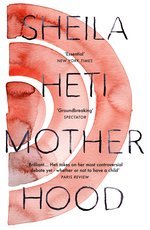 I’m not finding Heti’s autofiction musings quite as profound this time around, and I can’t deny that the book is starting to feel repetitive, but I’ve still marked more than a dozen passages. Pondering whether to have children is only part of the enquiry into what a woman artist’s life should be. The intergenerational setup stands out to me again as Heti compares her Holocaust survivor grandmother’s short life with her mother’s practical career and her own creative one.
For the past month or so, I’ve also been reading Alphabetical Diaries, so you could say that I’m pretty Heti-ed out right now, but I do so admire her for writing exactly what she wants to and sticking to no one else’s template. People probably react against Heti’s work as self-indulgent in the same way I did with Cosslett’s, but the former’s shtick works for me. (Secondhand purchase – Bas Books & Home, Newbury)
A few of the passages that have most struck me on this second reading:
I think that is how childbearing feels to me: a once-necessary, now sentimental gesture.
I don’t want ‘not a mother’ to be part of who I am—for my identity to be the negative of someone else’s positive identity.
The whole world needs to be mothered. I don’t need to invent a brand new life to give the warming effect to my life I imagine mothering will bring.
I have to think, If I wanted a kid, I already would have had one by now—or at least I would have tried.
Jungle House by Julianne Pachico (2023)
{BEWARE SPOILERS}
 Pachico’s third novel is closer to sci-fi than I might have expected. Apart from Lena, the protagonist, all the major characters are machines or digital recreations: AI, droids, a drone, or a holograph of the consciousness of a dead girl. “Mother” is the AI security system that controls Jungle House, the Morel family’s vacation home in a country that resembles Colombia, where Pachico grew up and set her first two books. Lena, as the human caretaker, is forever grateful to Mother for rescuing her as a baby after the violent death of her parents, who were presumed rebels.
Mother is exacting but mercurial, strict about cleanliness yet apt to forget or overlook things during one of her “spells.” Lena pushes the boundaries of her independence, believing that Mother only wants to protect her but still longing to explore the degraded wilderness beyond the compound.
Mother was right, because Mother was always right about these kinds of things. The world was a complicated place, and Mother understood it much better than she did.
In the house, there was no privacy. In the house, Mother saw all.
Mother was Lena’s world. And Lena, in turn, was hers. No matter how angry they got at each other, no matter how much they fought, no matter the things that Mother did or didn’t do … they had each other.
It takes a while to work out just how tech-reliant this scenario is, what the repeated references to “the pit bull” are about, and how Lena emulated and resented Isabella, the Morel daughter, in equal measure. Even creepier than the satellites’ plan to digitize humans is the fact that Isabella’s security drone, Anton, can fabricate recorded memories. This reminded me a lot of Klara and the Sun. Tech themes aren’t my favourite, but I ultimately thought of this as an allegory of life with a narcissistic mother and the child’s essential task of breaking free. It’s not clinical and contrived, though; it’s a taut, subtle thriller with an evocative setting. (Public library)
See also: “Three on a Theme: Matrescence Memoirs”
Does one or more of these books take your fancy?
Booker Prize 2021: Longlist Reading and Shortlist Predictions
The 2021 Booker Prize shortlist will be announced tomorrow, September 14th, at 4 p.m. via a livestream. I’ve managed to read or skim eight of 13 from the longlist, only one of which I sought out specifically after it was nominated (An Island – the one no one had heard of; it turns out it was released by a publisher based just 1.5 miles from my home!). I review my four most recent reads below, followed by excerpts of reviews of ones I read a while ago and my brief thoughts on the rest, including what I expect to see on tomorrow’s shortlist.
Klara and the Sun by Kazuo Ishiguro
 Why ever did I put this on my Most Anticipated list of the year and pre-order a signed copy?! I’m a half-hearted Ishiguro fan at best (I love Nocturnes but am lukewarm on the other four I’ve read, including his Booker winner) and should have known that his take on AI would be no more inspiring than Ian McEwan’s (Machines Like Me) a couple of years back.
Klara is an Artificial Friend purchased as part of an effort to combat the epidemic of teenage loneliness – specifically, to cheer up her owner, Josie, who suffers from an unspecified illness and is in love with her neighbour, Rick, a bright boy who remains excluded. Klara thinks of the sun as a god, praying to it and eventually making a costly bargain to try to secure Josie’s future health.
Part One’s 45 pages are slow and tedious; the backstory could have been dispensed with in five fairy tale-like pages. There’s a YA air to the story: for much of the length I might have been rereading Everything, Everything. In fact, when I saw Ishiguro introduce the novel at a Guardian/Faber launch event, he revealed that it arose from a story he wrote for children. The further I got, the more I was sure I’d read it all before. That’s because the plot is pretty much identical to the final story in Mary South’s You Will Never Be Forgotten.
Klara’s highly precise diction, referring to everyone in the third person, also gives this the feeling of translated fiction. While that is part of Ishiguro’s aim, of course – to explore the necessarily limited perspective and speech of a nonhuman entity (“Her ability to absorb and blend everything she sees around her is quite amazing”) – it makes the prose dull and belaboured. The secondary characters include various campy villains, the ‘big reveals’ aren’t worth waiting for, and the ending is laughably reminiscent of Toy Story. This took me months and months to force myself through. What a slog! (New purchase) 
An Island by Karen Jennings (2019)
 Seventy-year-old Samuel has been an island lighthouse keeper for 14 years when a brown-skinned stranger washes up on his beach. Sole survivor from a sunken refugee boat, the man has no English, so they communicate through gestures. Jennings convincingly details the rigors of the isolated life here: Samuel dug his own toilet pipes, burns his trash once a week, and gets regular deliveries from a supply boat. Nothing is wasted and everything is appreciated here, even the thirdhand magazines and videotapes he inherits from the mainland.
Although the core action takes place in just four days, Samuel is so mentally shaky that his memories start getting mixed up with real life. We learn that he has been a father, a prisoner and a beggar. Jennings is South African, and in this parallel Africa, racial hierarchy still holds sway and a general became a dictator through a military coup. Samuel’s father was involved in the independence movement, while Samuel himself was arrested for resisting the dictator.
The novella’s themes – jealousy, mistrust, possessiveness, suspicion, and a return to primitive violence – are of perennial relevance. Somehow, it didn’t particularly resonate for me. It’s not dissimilar in style to J. M. Coetzee’s vague but brutal detachment, and it’s a highly male vision à la Doggerland. Though highly readable, it’s ultimately a somewhat thin fable with a predictable message about xenophobia. Still, I’m glad I discovered it through the Booker longlist. 
My thanks to Holland House for the free copy for review.
Bewilderment by Richard Powers
 This has just as much of an environmentalist conscience as The Overstory, but a more intimate scope, focusing on a father and son who journey together in memory and imagination as well as in real life. The novel leaps between spheres: between the public eye, where neurodivergent Robin is a scientific marvel and an environmental activist, and the privacy of family life; between an ailing Earth and the other planets Theo studies; and between the humdrum of daily existence and the magic of another state where Robin can reconnect with his late mother. When I came to the end, I felt despondent and overwhelmed. But as time has passed, the book’s feral beauty has stuck with me. The pure sense of wonder Robin embodies is worth imitating. (Review forthcoming for BookBrowse.)
China Room by Sunjeev Sahota
 Sahota appeared on Granta’s list of Best Young British Novelists in 2013 and was previously shortlisted for The Year of the Runaways, a beautiful novel tracking the difficult paths of four Indian immigrants seeking a new life in Sheffield.
Three brides for three brothers: as Laura notes, it sounds like the setup of a folk tale, and there’s a timeless feel to this short novel set in the Punjab in the late 1920s and 1990s – it also reminded me of biblical stories like those of Jacob and Leah and David and Bathsheba. Mehar is one of three teenage girls married off to a set of brothers. The twist is that, because they wear heavy veils and only meet with their husbands at night for procreation, they don’t know which is which. Mehar is sure she’s worked out which brother is her husband, but her well-meaning curiosity has lasting consequences.
In the later storyline, a teenage addict returns from England to his ancestral estate to try to get clean before going to university and becomes captivated by the story of his great-grandmother and her sister wives, who were confined to the china room. The characters are real enough to touch, and the period and place details make the setting vivid. The two threads both explore limitations and desire, and the way the historical narrative keeps surging back in makes things surprisingly taut. See also Susan’s review. (Read via NetGalley) 
Other reads, in brief:
(Links to my full reviews)
 Second Place by Rachel Cusk: Significantly more readable than the Outline trilogy and with psychological depths worth pondering, though Freudian symbolism makes it old-fashioned. M’s voice is appealing, as is the marshy setting and its isolated dwellings. This feels like a place outside of time. The characters act and speak in ways that no real person ever would – the novel is most like a play: melodramatic and full of lofty pronouncements. Interesting, but nothing to take to heart; Cusk’s work is always intimidating in its cleverness.
 A Town Called Solace by Mary Lawson: In 1972, Clara, a plucky seven-year-old, sits vigil for the return of her sixteen-year-old sister, who ran away from home; and their neighbour, who’s in the hospital. One day Clara sees a strange man moving boxes in next door. This is Liam Kane, who inherited the house from a family friend. Like Lawson’s other works, this is a slow burner featuring troubled families. It’s a tender and inviting story I’d recommend to readers of Tessa Hadley, Elizabeth Strout and Anne Tyler.
 No One Is Talking About This by Patricia Lockwood: This starts as a flippant skewering of modern life. A woman who became a social media star by tweeting quips like “Can a dog be twins?” reflects on life on “the portal” and under “the dictator.” Midway through the book, she gets a wake-up call when her mother summons her back to the Midwest for a family emergency. It’s the about-face that makes this novel, forcing readers to question the value of a digital existence based on glib pretence. Funny, but with an ache behind it.
 Light Perpetual by Francis Spufford: While I loved the premise, the execution didn’t live up to it. Spufford calls this an act of “literary resurrection” of five figures who survive a South London bombing. But these particular characters don’t seem worth spending time with; their narratives don’t connect up tightly, as expected, and feel derivative, serving only as ways to introduce issues (e.g. mental illness, sexual assault, racial violence, eating disorders) and try out different time periods. I would have taken a whole novel about Ben.
 This leaves five more: Great Circle (by Maggie Shipstead) I found bloated and slow when I tried it in early July, but I’m going to give it another go when my library hold comes in. The Sweetness of Water (Nathan Harris) I might try if my library acquired it, but I’m not too bothered – from Eric’s review on Lonesome Reader, it sounds like it’s a slavery narrative by the numbers. I’m not at all interested in the novels by Anuk Arudpragasam, Damon Galgut, or Nadifa Mohamed but can’t say precisely why; their descriptions just don’t excite me.
Here’s what I expect to still be in the running after tomorrow. Clear-eyed, profound, international; bridging historical and contemporary; much that’s unabashedly highbrow.
- Second Place by Rachel Cusk
 The Promise by Damon Galgut (will win)
- No One Is Talking About This by Patricia Lockwood
- Bewilderment by Richard Powers
- China Room by Sunjeev Sahota
- Light Perpetual by Francis Spufford
What have you read from the longlist? What do you expect to be shortlisted?
20 Books of Summer, #6–8: Aristide, Hood, Lamott
This latest batch of colour-themed summer reads took me from a depleted post-pandemic landscape to the heart of dysfunctional families in Rhode Island and California.
Under the Blue by Oana Aristide (2021)
Fans of Station Eleven, this one’s for you: the best dystopian novel I’ve read since Mandel’s. Aristide started writing this in 2017, and unknowingly predicted a much worse pandemic than Covid-19. In July 2020, Harry, a middle-aged painter inhabiting his late nephew’s apartment in London, finally twigs that something major is going on. He packs his car and heads to his Devon cottage, leaving its address under the door of the cute neighbour he sometimes flirts with. Hot days stack up and his new habits of rationing food and soap are deeply ingrained by the time the gal from #22, Ash – along with her sister, Jessie, a doctor who stocked up on medicine before fleeing her hospital – turn up. They quickly sink into his routines but have a bigger game plan: getting to Uganda, where their mum once worked and where they know they will be out of range of Europe’s at-risk nuclear reactors. An epic road trip ensues.
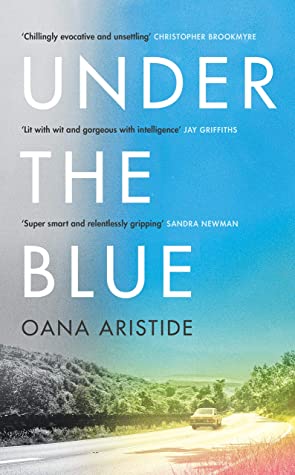 It gradually becomes clear that Harry, Ash and Jessie are among mere thousands of survivors worldwide, somehow immune to a novel disease that spread like wildfire. There are echoes of Cormac McCarthy’s The Road in the way that they ransack the homes of the dead for supplies, and yet there’s lightness to their journey. Jessie has a sharp sense of humour, provoking much banter, and the places they pass through in France and Italy are gorgeous despite the circumstances. It would be a privilege to wander empty tourist destinations were it not for fear of nuclear winter and not finding sufficient food – and petrol to keep “the Lioness” (the replacement car they steal; it becomes their refuge) going. While the vague sexual tension between Harry and Ash persists, all three bonds are intriguing.
In an alternating storyline starting in 2017, Lisa and Paul, two computer scientists based in a lab at the Arctic Circle, are programming an AI, Talos XI. Based on reams of data on history and human nature, Talos is asked to predict what will happen next. But when it comes to questions like the purpose of art and whether humans are worth saving, the conclusions he comes to aren’t the ones his creators were hoping for. These sections are set out as transcripts of dialogues, and provide a change of pace and perspective. Initially, I was less sure about this strand, worrying that it would resort to that well-worn trope of machines gone bad. Luckily, Aristide avoids sci-fi clichés, and presents a believable vision of life after the collapse of civilization.
The novel is full of memorable lines (“This absurd overkill, this baroque wedding cake of an apocalypse: plague and then nuclear meltdowns”) and scenes, from Harry burying a dead cow to the trio acting out a dinner party – just in case it’s their last. There’s an environmentalist message here, but it’s subtly conveyed via a propulsive cautionary tale that also reminded me of work by Louisa Hall and Maja Lunde. (Public library)
Ruby by Ann Hood (1998)
Olivia had the perfect life: fulfilling, creative work as a milliner; a place in New York City and a bolthole in Rhode Island; a new husband and plans to try for a baby right away. But then, in a fluke accident, David was hit by a car while jogging near their vacation home less than a year into their marriage. As the novel opens, 37-year-old Olivia is trying to formulate a letter to the college girl who struck and killed her husband. She has returned to Rhode Island to get the house ready to sell but changes her mind when a pregnant 15-year-old, Ruby, wanders in one day.
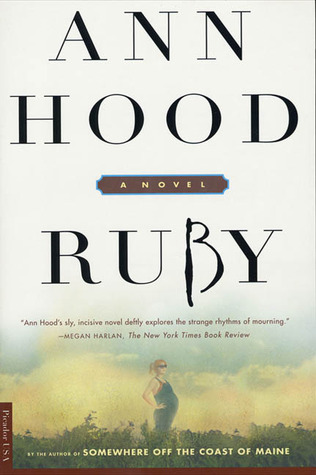 At first, I worried that the setup would be too neat: Olivia wants a baby but didn’t get a chance to have one with David before he died; Ruby didn’t intend to get pregnant and looks forward to getting back her figure and her life of soft drugs and petty crime. And indeed, Olivia suggests an adoption arrangement early on. But the outworkings of the plot are not straightforward, and the characters, both main and secondary (including Olivia’s magazine writer friend, Winnie; David’s friend, Rex; Olivia’s mother and sister; a local lawyer who becomes a love interest), are charming.
It’s a low-key, small-town affair reminiscent of the work of Anne Tyler, and I appreciated how it sensitively explores grief, its effects on the protagonist’s decision-making, and how daunting it is to start over (“The idea of that, of beginning again from nothing, made Olivia feel tired.”). It was also a neat touch that Olivia is the same age as me, so in some ways I could easily imagine myself into her position.
This was the ninth book I’ve read by Hood, an author little known outside of the USA – everything from grief memoirs to a novel about knitting. Ironically, its main themes of adoption and bereavement were to become hallmarks of her later work: she lost her daughter in 2002 and then adopted a little girl from China. (Secondhand purchase, June 2021)
[I’ve read another novel titled Ruby – Cynthia Bond’s from 2014.]
Blue Shoe by Anne Lamott (2002)
I’m a devoted reader of Lamott’s autobiographical essays about faith against the odds (see here), but have been wary of trying her fiction, suspecting I wouldn’t enjoy it as much. Well, it’s true that I prefer her nonfiction on the whole, but this was an enjoyably offbeat novel featuring the kind of frazzled antiheroine who wouldn’t be out of place in Anne Tyler’s work.
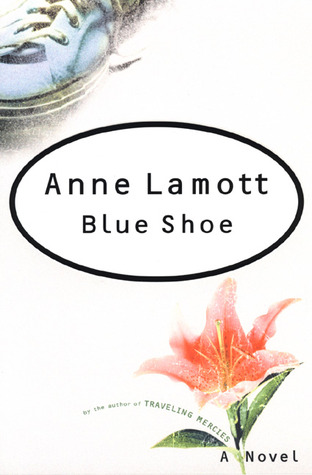 Mattie Ryder has left her husband and returned to her Bay Area family home with her young son and daughter. She promptly falls for Daniel, the handyman she hires to exterminate the rats, but he’s married, so she keeps falling into bed with her ex, Nicky, even after he acquires a new wife and baby. Her mother, Isa, is drifting ever further into dementia. A blue rubber shoe that Mattie finds serves as a totem of her late father – and his secret life. She takes a gamble that telling the truth, no matter what the circumstances, will see her right.
As in Ruby, I found the protagonist relatable and the ensemble cast of supporting characters amusing. Lamott crafts some memorable potted descriptions: “She was Jewish, expansive and yeasty and uncontained, as if she had a birthright for outrageousness” and “He seemed so constrained, so neatly trimmed, someone who’d been doing topiary with his soul all his life.” She turns a good phrase, and adopts the same self-deprecating attitude towards Mattie that she has towards herself in her memoirs: “She usually hoped to look more like Myrna Loy than an organ grinder’s monkey when a man finally proclaimed his adoration.”
At a certain point – maybe two-thirds of the way through – my inward reply to a lot of the novel’s threads was “okay, I get it; can we move on?” Yes, the situation with Isa is awful; yes, something’s gotta give with Daniel and his wife; yes, the revelations about her father seem unbearable. But with a four-year time span, it felt like Mattie was stuck in the middle for far too long. It’s also curious that she doesn’t apply her zany faith (a replica of Lamott’s) to questions of sexual morality – though that’s true of more liberal Christian approaches. All in all, I had some trouble valuing this as a novel because of how much I know about Lamott’s life and how closely I saw the storyline replicating her family dynamic. (Secondhand purchase, c. 2006 – I found a signed hardback in a library book sale back in my U.S. hometown for $1.)
Hmm, altogether too much blue in my selections thus far (4 out of 8!). I’ll have to try to come up with some more interesting colours for my upcoming choices.
Next books in progress: The Other’s Gold by Elizabeth Ames and God Is Not a White Man by Chine McDonald.
Read any of these? Interested?
Recent Online Literary Events with George Saunders and Kazuo Ishiguro
I’ve been taking advantage of various free and inexpensive literary events – a bonus of our temporarily virtual-only world. I have five of them stored up to write about, but to keep this post from getting absurdly long I’ll focus on two for now and feature the rest another time.
George Saunders in Conversation with Max Porter
(5×15 event)
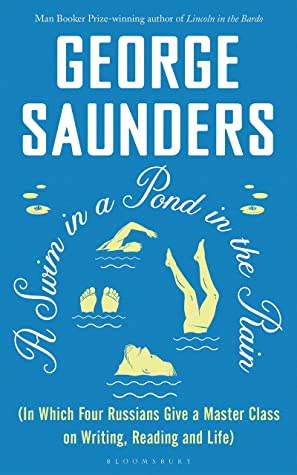 Saunders’s latest book, A Swim in a Pond in the Rain, is a written version of the graduate-level masterclass in the Russian short story that he offers at Syracuse University, where he has taught in the Creative Writing Program since 1997. His aim here was to “elevate the short story form,” he said. While the book reprints and discusses just seven stories (three by Anton Chekhov, two by Leo Tolstoy, and one each by Nikolai Gogol and Ivan Turgenev), in the class he and his students tackle more like 40. He wants people to read a story, react to the story, and trust that reaction – even if it’s annoyance. “Work with it,” he suggested. “I am bringing you an object to consider” on the route to becoming the author you are meant to be – such is how he described his offer to his students, who have already overcome 1 in 100 odds to be on the elite Syracuse program but might still need to have their academic egos tweaked.
The book is, thus, not just a set of essays on the Russian masters but also a guide to how to write well. It was clear there was mutual admiration between Saunders and Max Porter, who interviewed him. They discussed the revision process as an accumulation of micro-decisions that make the work better. For instance, Saunders compared two Tolstoy stories, “The Snowstorm” and “Master and Man” (written 20 years later), and noted that, though they are thematically similar, the later one is more organized.
Saunders spoke about writing as a dual process of intuition and iteration; a bunch of different “yous” have acted on a text by the time it’s done. Early on in his career, he thought that he had to choose which writer he wanted to be (e.g., Hemingway or Kerouac), but as he aged he realized that the mind is never fixed. He went surprisingly deep into Buddhism at this point, likening writing to meditation – both are practices pursued with intensity. To his younger self, he would say to keep going: improving is simply a matter of time (i.e., that 10,000 hours figure that’s bandied about as necessary for developing expertise).
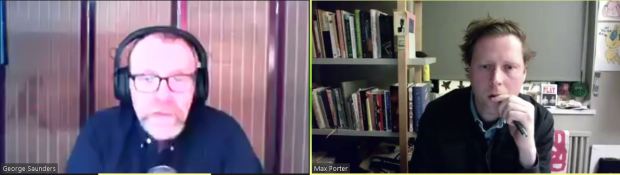
The only drawback to this event was that Saunders was speaking from his snow-encased upstate New York basement and had a horrible Internet connection; often his voice was faint and delayed, while his image stayed static. We and Porter could only stare gormlessly and wait for his face to move to match his words! I think the book would be too niche for me – I’ve hardly read anything by the Russians, and since I don’t write fiction I’m not in need of a guide to those kinds of writing decisions – but it was nice to ‘meet’ Saunders ‘in person’.
An Evening with Kazuo Ishiguro
(Faber Members / Guardian Live event)
Ishiguro’s new novel, Klara and the Sun, was published by Faber yesterday. This conversation with Alex Clark also functioned as its launch event. It’s one of my most anticipated books of the year, so I pre-ordered a signed copy along with my ticket and look forward to it arriving soon. Klara is an Artificial Intelligence “friend” purchased to combat teenage loneliness. A childlike figure, she is cheerful and treats the sun like a god. Ishiguro said that the book developed from a story he wrote for children aged five to six, about a little girl who takes a doll home – except his daughter, author Naomi Ishiguro, told him no way was it suitable for young children, being far too dark. He likes “displaced or alien narrators, fish out of water,” he said, because the limited perspective allows him to focus on oddness.
In addition to Clark’s questions, a few pre-recorded questions from literary celebs (Daisy Johnson, Bernardine Evaristo, and David Mitchell) encouraged Ishiguro to create a tripartite schema for his novels, reflect on his writing about Japan, and look back at the devices he has used. Asked by Johnson about the connections between his novels, he admitted that his first three novels all retread the same ground: a man who has made a mess of his life or career picks over the past. Then his mid period is set in dreamscapes, while his most recent three novels are dystopian fantasies (though he does not see Klara as set in a dystopian world).
In response to Evaristo’s question about whether he felt an obligation to write about Japan, he said that with his early work he was conscious of needing to represent a group of people who even then (due to World War II) were viewed with suspicion or antipathy. He left Japan at age five so the country didn’t seem entirely real to him. What he knew was based on very early memories, what his mother told him, comic books sent by his grandparents, etc. As he stated in his Nobel Prize acceptance speech, writing about Japan in his twenties therefore felt like “an act of preservation.” Still, he wants his characters and situations to be universal.

Replying to Mitchell’s three questions (cheeky!), he explained that his first ambition was to be a singer/songwriter, and he wrote 100+ songs. Songwriting taught him minimalism. “You can say a huge amount by what you don’t say,” he noted. He hopes to create spaces, or rather vacuums that suck in the reader’s attention. Unlike Mitchell, he always knows the ending of a book before he begins, and his decisions are all about wanting to lodge in the reader’s brain. Thus, memorable endings are a priority for him, whereas they might not be for other writers. I was struck by his characterization of his own life: when he looks back, he doesn’t see a clear path that arose from his choices; instead, he sees a “weird, incoherent mess.” For this reason, he’s turned against the reflective device of his first three books. If he can come up with a theme, he’s hankering to write a book about hitchhikers in the north of England.
Towards the end of the (overlong) discussion, he mentioned that he has been questioning the novelist’s role due to the events of the past year: wondering about the meaning of fiction when so many have died and so many believe fake news. It was a melancholy but realistic point to end on. While I’m not an Ishiguro completist (The Unconsoled doesn’t appeal to me at all and I’m not sure I can be bothered with When We Were Orphans, but I will try The Buried Giant; I’ve read the rest), the event whetted my appetite to read his new book. (See also this Goodreads interview. I loved the anecdotes about learning he’d won the Nobel!)
Bookish online events coming up soon: The Rathbones Folio Prize announcement on the 24th and Claire Fuller’s book launch for Unsettled Ground on the 25th.
 Bookish Beck = Rebecca Foster. American transplant to England. Freelance proofreader and book reviewer.
 Bookish Beck