R.I.P., Part II: Duy Đoàn, T. Kingfisher & Rachael Smith
A second installment for the Readers Imbibing Peril challenge (first was a creepy short story collection). Zombies link my first two selections, an experimental poetry collection and a historical novella that updates a classic, followed by a YA graphic novel about a medieval witch who appears in contemporary life to help a teen deal with her problems. I don’t really do proper horror; I’d characterize all three of these as more mischievous than scary.
Zombie Vomit Mad Libs by Duy Đoàn
 The Vietnamese American poet’s second collection strikes a balance between morbid – a pair of sonnets chants the names and years of poets who died by suicide – and playful. Multiple poems titled “Zombie” or “Zombies” are composed of just 1–3 cryptic lines. Other repeated features are blow-by-blow descriptions of horror movie scenes and the fill-in-the-blank Mad Libs format. There is an obsession with Leslie Cheung, a gay Hong Kong actor who also died by suicide, in 2003. Đoàn experiments linguistically as well as thematically, by adding tones (as used in Vietnamese) to English words. This was a startling collection I admired for its range and pluck, though I found little to personally latch on to. I was probably expecting something more like 36 Ways of Writing a Vietnamese Poem by Nam Le. But if you think poetry can’t get better than zombies + linguistics + suicides, boy have I got the collection for you! (Đoàn’s first book, We Play a Game, won the Yale Series of Younger Poets Prize and a Lambda Literary Award for bisexual poetry.)
To be published in the USA by Alice James Books on November 12. With thanks to the publisher for the advanced e-copy for review.
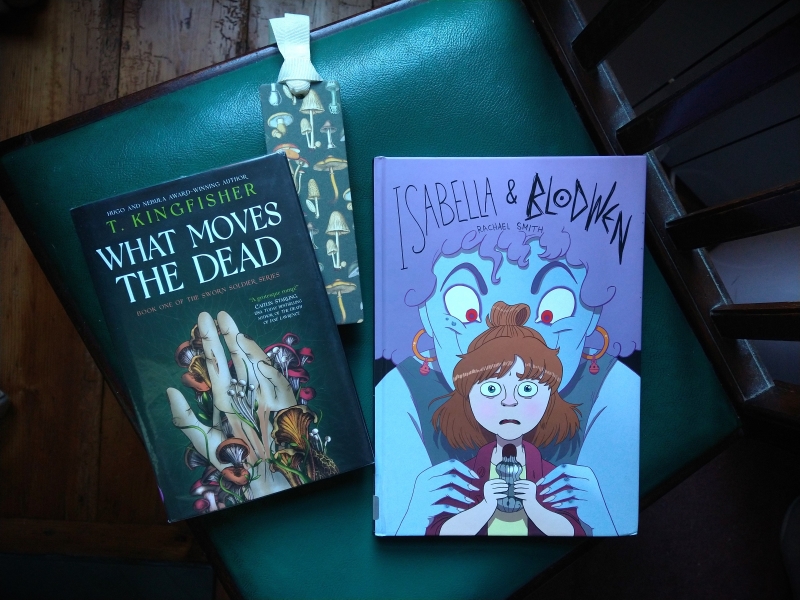
What Moves the Dead by T. Kingfisher (2022)
{MILD SPOILERS AHEAD}
 This first book in the “Sworn Soldier” duology is a retelling of Edgar Allan Poe’s “The Fall of the House of Usher.” Set in the 1890s, it’s narrated by Alex Easton, a former Gallacian soldier who learns that their childhood friend Madeline Usher is dying and goes to visit her at her and her brother Roderick’s home in Ruritania. Easton also meets the Ushers’ friend, the American doctor Denton, and Eugenia Potter, an amateur mycologist (and aunt of a certain Beatrix). Easton and Potter work out that what is making Madeline ill is the same thing that’s turning the local rabbits into zombies…
At first it seemed the author was awkwardly inserting a nonbinary character into history, but it’s more complicated than that. The sworn soldier tradition in countries such as Albania was a way for women, especially orphans or those who didn’t have brothers to advocate for them, to have autonomy in martial, patriarchal cultures. Kingfisher makes up European nations and their languages, as well as special sets of pronouns to refer to soldiers (ka/kan), children (va/van), etc. She doesn’t belabour the world-building, just sketches in the bits needed.
This was a quick and reasonably engaging read, though I wasn’t always amused by Kingfisher’s gleefully anachronistic tone (“Mozart? Beethoven? Why are you asking me? It was music, it went dun-dun-dun-DUN, what more do you want me to say?”). I wondered if the plot might have been inspired by a detail in Merlin Sheldrake’s Entangled Life, but it seems more likely it’s a half-conscious addition to a body of malevolent-mushroom stories (Mexican Gothic by Silvia Moreno-Garcia, various by Jeff VanderMeer, The Beauty by Aliya Whiteley). I was drawn in by Easton’s voice and backstory enough to borrow the sequel, about which more anon. (T. Kingfisher is the pen name of Ursula Vernon.) (Public library)
Isabella & Blodwen by Rachael Smith (2023)
 I’d reviewed Smith’s adult graphic memoirs Quarantine Comix (mental health during Covid) and Glass Half Empty (alcoholism and bereavement) for Foreword and Shelf Awareness, respectively. When I spotted this in the Young Adult section and saw it was about a witch, I mentally earmarked it for R.I.P. Isabella Maria Penwick-Wickam is a precocious 16-year-old student at Oxford. With her fixation on medieval history and folklore, she has the academic side of the university experience under control. But her social life is hopeless. She’s alienated flatmates and classmates alike with her rigid habits and judgemental comments. On a field trip to the Pitt Rivers Museum, where students are given a rare opportunity to handle artefacts, she accidentally drops a silver bottle into her handbag. Before she can return it, its occupant, a genie-like blowsy blue-and-purple witch named Blodwen, is released into the world. She wreaks much merry havoc, encouraging Issy to have some fun and make friends.
It’s a sweet enough story, but a few issues detracted from my enjoyment. Issy is often depicted more like a ten-year-old. I don’t love the blocky and exaggerated features Smith gives her characters, or the Technicolor hues. And I found myself rolling my eyes at how the book unnaturally inserts a sexual harassment theme – which Blodwen responds to in modern English, having spoken in archaic fashion up to that point, and with full understanding of the issue of consent. I can imagine younger teens enjoying this, though. (Public library)
The mini playlist I had going through my mind as I wrote this:
- “Running with Zombies” by The Bookshop Band (inspired by The Making of Zombie Wars by Aleksandar Hemon)
- “Flesh and Blood Dance” by Duke Special
- “Dead Alive” by The Shins
And to counterbalance the evil fungi of the Kingfisher novella, here’s Anne-Marie Sanderson employing the line “A mycelium network is listening to you” in a totally non-threatening way. It’s one of the multiple expressions of reassurance in her lovely song “All Your Atoms,” my current earworm from her terrific new album Old Light.
Reading with the Seasons: Summer 2021, Part I
I’m more likely to choose lighter reads and dip into genre fiction in the summer than at other times of year. The past few weeks have felt more like autumn here in southern England, but summer doesn’t officially end until September 22nd. So, if I get a chance (there’s always a vague danger to labelling something “Part I”!), before then I’ll follow up with another batch of summery reads I have on the go: Goshawk Summer, Klara and the Sun, Among the Summer Snows, A Shower of Summer Days, and a few summer-into-autumn children’s books.
For this installment I have a quaint picture book, a mystery, a travel book featured for its title, and a very English classic. I’ve chosen a representative quote from each.
Summer Story by Jill Barklem (1980)
 One of a quartet of seasonal “Brambly Hedge” stories in small hardbacks. It wouldn’t be summer without weddings, and here one takes place between two mice, Poppy Eyebright and Dusty Dogwood (who work in the dairy and the flour mill, respectively), on Midsummer’s Day. I loved the little details about the mice preparing their outfits and the wedding feast: “Cool summer foods were being made. There was cold watercress soup, fresh dandelion salad, honey creams, syllabubs and meringues.” We’re given cutaway views of various tree stumps, like dollhouses, and the industrious activity going on within them. Like any wedding, this one has its mishaps, but all is ultimately well, like in a classical comedy. This reminded me of the Church Mice books or Beatrix Potter’s works: very sweet, quaint and English.
Source: Public library
My rating: 
These next two give a real sense of how heat affects people, physically and emotionally.
Heatstroke by Hazel Barkworth (2020)
“In the heat, just having a human body was a chore. Just keeping it suitable for public approval was a job”
 From the first word (“Languid”) on, this novel drips with hot summer atmosphere, with its opposing connotations of discomfort and sweaty sexuality. Rachel is a teacher of adolescents as well as the mother of a 15-year-old, Mia. When Lily, a pupil who also happens to be one of Mia’s best friends, goes missing, Rachel is put in a tough spot. I mostly noted how Barkworth chose to construct the plot, especially when to reveal what. By the one-quarter point, Rachel works out what’s happened to Lily; by halfway, we know why Rachel isn’t telling the police everything.
The dynamic between Rachel and Mia as they decide whether to divulge what they know is interesting. This is not the missing person mystery it at first appears to be, and I didn’t sense enough literary quality to keep me wanting to know what would happen next. I ended up skimming the last third. It would be suitable for readers of Rosamund Lupton, but novels about teenage consent are a dime a dozen these days and this paled in comparison to My Dark Vanessa. For a better sun-drenched novel, I recommend A Crime in the Neighborhood.
Source: Public library
My rating: 
The Shadow of the Sun: My African Life by Ryszard Kapuściński (1998; 2001)
[Translated from the Polish by Klara Glowczewska]
“Dawn and dusk—these are the most pleasant hours in Africa. The sun is either not yet scorching, or it is no longer so—it lets you be, lets you live.”
 The Polish Kapuściński was a foreign correspondent in Africa for 40 years and lent his name to an international prize for literary reportage. This collection of essays spans decades and lots of countries, yet feels like a cohesive narrative. The author sees many places right on the cusp of independence or in the midst of coup d’états. Living among Africans rather than removed in a white enclave, he develops a voice that is surprisingly undated and non-colonialist. While his presence as the observer is undeniable – especially when he falls ill with malaria and then tuberculosis – he lets the situation on the ground take precedence over the memoir aspect. I read the first half last year and then picked the book back up again to finish this year. The last piece, “In the Shade of a Tree, in Africa” especially stood out. In murderously hot conditions, shade and water are two essentials. A large mango tree serves as an epicenter of activities: schooling, conversation, resting the herds, and so on. I appreciated how Kapuściński never resorts to stereotypes or flattens differences: “Africa is a thousand situations, varied, distinct, even contradictory … everything depends on where and when.”
Along with Patrick Leigh Fermor’s A Time of Gifts and the Jan Morris anthology A Writer’s World, this is one of the best few travel books I’ve ever read.
Source: Free bookshop
My rating: 
August Folly by Angela Thirkell (1936)
“The sun was benignantly hot, the newly mown grass smelt sweet, bees were humming in a stupefying way, Gunnar was purring beside him, and Richard could hardly keep awake.”
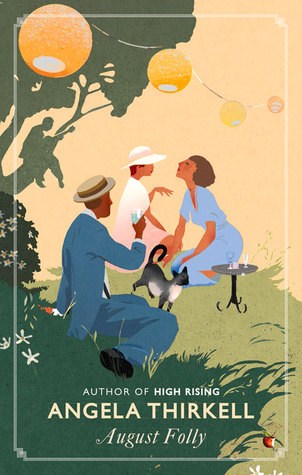 I’d been curious to try Thirkell, and this fourth Barsetshire novel seemed as good a place to start as any. Richard Tebben, not the best and brightest that Oxford has to offer, is back in his parents’ village of Worsted for the summer and dreading the boredom to come. That is, until he meets beautiful Rachel Dean and is smitten – even though she’s mother to a brood of nine, most of them here with her for the holidays. He sets out to impress her by offering their donkey, Modestine, for rides for the children, and rather accidentally saving her daughter from a raging bull. Meanwhile, Richard’s sister Margaret can’t decide if she likes being wooed, and the villagers are trying to avoid being roped into Mrs Palmer’s performance of a Greek play. The dialogue can be laughably absurd. There are also a few bizarre passages that seem to come out nowhere: when no humans are around, the cat and the donkey converse.
This was enjoyable enough, in the same vein as books I’ve read by Barbara Pym, Miss Read, and P.G. Wodehouse, though I don’t expect I’ll pick up more by Thirkell. (No judgment intended on anyone who enjoys these authors. I got so much flak and fansplaining when I gave Pym and Wodehouse 3 stars and dared to call them fluffy or forgettable, respectively! There are times when a lighter read is just what you want, and these would also serve as quintessential English books revealing a particular era and class.)
Source: Public library
My rating:
As a bonus, I have a book about how climate change is altering familiar signs of the seasons.
Forecast: A Diary of the Lost Seasons by Joe Shute (2021)
“So many records are these days being broken that perhaps it is time to rewrite the record books, and accept the aberration has become the norm.”
 Shute writes a weather column for the Telegraph, and in recent years has reported on alarming fires and flooding. He probes how the seasons are bound up with memories, conceding the danger of giving in to nostalgia for a gloried past that may never have existed. However, he provides hard evidence in the form of long-term observations (phenology) such as temperature data and photo archives that reveal that natural events like leaf fall and bud break are now occurring weeks later/earlier than they used to. He also meets farmers, hunts for cuckoos and wildflowers, and recalls journalistic assignments.
The book deftly recreates its many scenes and conversations, and inserts statistics naturally. It also delicately weaves in a storyline about infertility: he and his wife long for a child and have tried for years to conceive, but just as the seasons are out of kilter, there seems to be something off with their bodies such that something that comes so easily for others will not for them. A male perspective on infertility is rare – I can only remember encountering it before in Native by Patrick Laurie – and these passages are really touching. The tone is of a piece with the rest of the book: thoughtful and gently melancholy, but never hopeless (alas, I found The Eternal Season by Stephen Rutt, on a rather similar topic, depressing).
Forecast is wide-ranging and so relevant – the topics it covers kept coming up and I would say to my husband, “oh yes, that’s in Joe Shute’s book.” (For example, he writes about the Ladybird What to Look For series and then we happened on an exhibit of the artwork at Mottisfont Abbey.) I can see how some might say it crams in too much or veers too much between threads, but I thought Shute handled his material admirably.
Source: Public library
My rating: 
 Bookish Beck = Rebecca Foster. American transplant to England. Freelance proofreader and book reviewer.
 Bookish Beck