My Best Backlist Reads of the Year
Like many bloggers, I’m irresistibly drawn to the new books released each year. However, I consistently find that many of my more memorable reads were published earlier – most of these happen to have been published between one and a few years ago, with the ‘oldest’ being from 2004. These dozen selections – alphabetical within genre but in no particular rank order – together with my Best of 2023 post (coming up tomorrow), make up about the top 10% of my year’s reading.

Fiction
 Loved and Missed by Susie Boyt: The heart-wrenching story of a woman who adopts her granddaughter because of her daughter’s drug addiction. The prose is stunning as Boyt traces the history of this complicated, makeshift family. The title has a wry double meaning, but also connotations of anticipatory grief. There can be love even where there is estrangement, or eternal separation. That is one of the enduring messages of this gem of a short novel.
 Homesick by Jennifer Croft: Each vignette – some just a paragraph long – is perfectly chosen to reveal a family dynamic and a moment in American history. What Croft does so brilliantly is to chart the accretion of ordinary and landmark events that form a life. In the end it didn’t matter whether this was presented as memoir or autofiction, so true was it to the experience of 1990s girlhood, as well as to sisterhood and coming of age.
 Search by Michelle Huneven: When middle-aged restaurant critic Dana Potowski is invited to be on the search committee to appoint the next minister for her California Unitarian church, she reluctantly agrees but soon wonders whether the experience could be interesting fodder for a new book… The setup might seem niche but will resonate with anyone who’s had a brush with bureaucracy. Pure pleasure; lit fic full of gossip and good food.
 Under the Rainbow by Celia Laskey: Researchers identified Big Burr, Kansas as the most homophobic town in America. An Acceptance Across America task force descends on the rural backwater for a two-year program promoting education and friendship. Each chapter in the linked short story collection is a first-person, present-tense confession from a local or a queer visitor, whose stories interlock. Laskey inhabits all 11 with equal skill and compassion.
 The Chosen by Elizabeth Lowry: This utterly immersive novel examines Thomas Hardy’s relationship with his first wife, Emma Gifford. It opens on the morning of her death. The couple had long been estranged, but Hardy was instantly struck with grief – and remorse, his guilt compounded by what he found in her journals. A universal tale of waning romance, loss, and regret. Beautifully understated; perfectly convincing for the period but also timeless.
 Lucy by the Sea by Elizabeth Strout: As Covid hits, William whisks Lucy from her NYC apartment to a house at the Maine coast. She’s an Everywoman recounting the fear and confusion of the early pandemic. Isolation has benefits: the first ‘room of her own’ she’s ever had, and time to ponder her childhood trauma and what went wrong in her marriage. Astute on American politics and writers’ inspirations; an effortless voice and emotional intelligence.
Nonfiction
 Bibliomaniac by Robin Ince: Ince was meant to undertake a stadium tour in Autumn 2021, but a Covid resurgence put paid to that. Not one for sitting around at home, he formulated Plan B: 100+ events, most of them in independent bookshops, over the course of two months, criss-crossing Britain and hitting many of my favourites. He’s not just a speaker at them but, invariably, a customer. I sensed a kindred spirit in so many lines. Witty and open-minded.
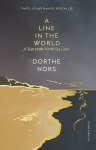 A Line in the World by Dorthe Nors: Nors lives in rural Jutland along the west coast of Denmark – little visited and largely unknown to foreigners. This can be both good and bad. Tourists feel they’re discovering somewhere new, but the residents are insular. Local legends and traditions, bird migration, reliance on the sea, wanderlust, maritime history, a visit to church frescoes, and more. Gorgeous writing and atmosphere, despite the bleakness.
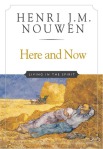 Here and Now by Henri Nouwen: This collection of micro-essays under themed headings like “Living in the Present” and “Suffering” is a perfect introduction to the Dutch Catholic priest’s theology. I marked out many reassuring or thought-provoking passages. I was taken by his ideas that the life of compassion is one of “downward mobility” and that inner freedom comes when you don’t judge anyone. Peaceful and readable; a good bedside devotional.
Poetry
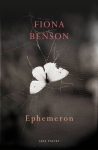 Ephemeron by Fiona Benson: Exquisite poems about the ephemeral, whether that be insect lives, boarding school days, primal emotions or moments from her children’s early years. The book is in four discrete corresponding sections but themes and language bleed from one into another and the whole is shot through with astonishing corporeality and eroticism. The form varies but the alliteration, slant rhymes and unexpected metaphors make each poem glisten.
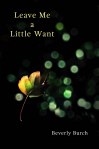 Leave Me a Little Want by Beverly Burch: Burch’s fourth collection juxtaposes the cosmic and the mundane, marvelling at the behind-the-scenes magic that goes into one human being born but also making poetry of an impatient wait in a long post office queue. Beset by environmental anxiety and the scale of bad news during the pandemic, she pauses in appreciation of the small and gradual.
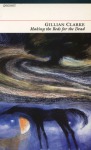 Making the Beds for the Dead by Gillian Clarke: Full of colour and nature imagery, profuse with alliteration and slant rhymes, relishing its specialist terminology, and taking on the serious subject matter of manmade disasters. Several sequences are devoted to gardening and geology; some pieces are ekphrastic, or dedicated to particular poets. The title sequence tackles the 2001foot and mouth disease outbreak. “The Fall” is on 9/11. Very affecting stuff.
My overall favourites were: in novels, Search and The Chosen (one contemporary and one historical) and in poetry, Ephemeron.
What were your best backlist reads this year?
Poetry Review Catch-up: Burch, Carrick-Varty, Davidson, Marya, Parsons (#ReadIndies)
As Read Indies month continues, I’m catching up on poetry collections I’ve been sent by three independent publishers: the UK’s Carcanet Press, and Alice James Books and Terrapin Press, both based in the USA. Various as these five are in style and technique, nature and family ties are linking themes. From each I’ve chosen one short poem as a representative.

Leave Me a Little Want by Beverly Burch (2022)
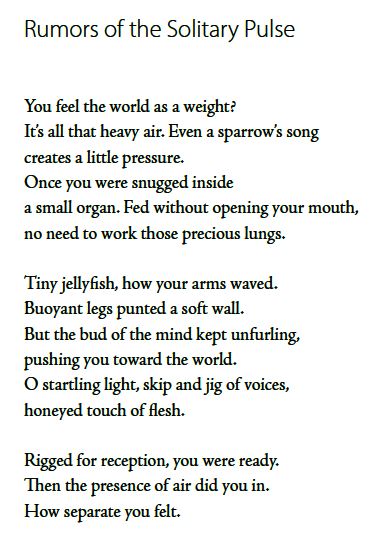
 Burch’s fourth collection juxtaposes the cosmic and the mundane, marvelling at the behind-the-scenes magic that goes into one human being born but also making poetry of an impatient wait in a long post office queue. We find weather and travel; smell as well as sight and sound; alliteration and internal rhyme. Beset by environmental anxiety and the scale of bad news during the pandemic, she pauses in appreciation of the small and gradual. Often nature teaches these lessons. “Practice slow. Days for a seed to unfurl a shoot, / yawn out true leaves. Stems creep upward like prayers. / Weeks to make a flower, more to shape fruit.” Burch expresses gratitude for what is and what has been: a man carrying an infant outside her kitchen window gives her a pang for the baby days, but when she puts her hunting cat on house arrest she realizes how glad she is that impulsivity is past: “Intensity. More subtle than passion. / Odd to be grateful so much of my life is over.” Each section contains multiple unrhymed sonnets, as well as an “incantation” and/or an exploration of “Ars Poetica”.
With thanks to Terrapin Books for the free e-copy for review.
More Sky by Joe Carrick-Varty (2023)
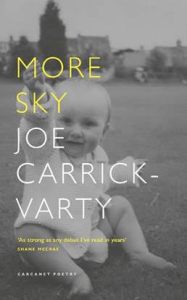 In this debut collection by an Eric Gregory Award-winning poet, his father’s suicide is ever-present – and not just in poems like “54 Questions for the Man Who Sold a Shotgun to My Father” but in seemingly unrelated pieces that start off being about something else. Everything comes around to the reality of a neglectful, alcoholic father and the sordid flat he inhabited before his death. Carrick-Varty alternates between an intimate “you” address and third-person scenarios, auditioning coping mechanisms. His frame of reference is wide: football, rappers, Buddhist cosmology. Some poems are printed sideways up the page; there are stanzas, paragraphs and columns. The word “suicide” itself is repeated to the point where it loses meaning, becoming just a sibilant collection of syllables (as in “From the Perspective of Coral,” where “suicide” is substituted for sea creatures, or the long culminating poem, “sky doc,” in which every stanza opens with “Once upon a time when suicide was…”) The tone is often bitter, as is to be expected, but there is joy in the deft use of language.

With thanks to Carcanet Press for the free e-copy for review.
Arctic Elegies by Peter Davidson (2022)
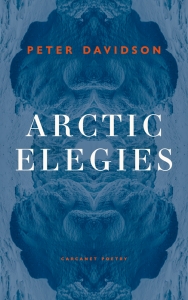 Much of the verse in Davidson’s second collection draws on British religious history and liturgy. Some is also in conversation with art, music or other poetry. In all of these cases, I found the Notes at the end of the volume invaluable for understanding the context and inspiration. While most are in stanzas, some employing traditional forms (e.g., “Sonnet for Trinity Sunday”), a few of the poems are in paragraphs and feel more like essays, such as “Secret Theatres of Scotland.” As the title heralds, an elegiac tone runs throughout, with “Arctic Elegy” (taking material from an oratorio he wrote for performance in St Andrew’s Cathedral in 2015) dedicated to the ill-fated Franklin Expedition of 1845–8:
Wonderful is the patience of the snow
And glorious the violence of the cold.
How lovely is the power of the dark pole
To draw the iron and move the compass rose.
As cold as loss as cold as freezing steel
In this same vein, I also appreciated the wry “The Museum of Loss” and the ornate “The Mourning Virtuoso.” There’s a bit of an Auden flavour here, but the niche topics didn’t always hold my attention. 

With thanks to Carcanet Press for the free copy for review.
Sugar Work by Katie Marya (2022)
 Marya’s debut collection contains frank autobiographical poems about growing up in Atlanta and Las Vegas with a single mother who was a sex worker and an absentee father. As the pages turn, she gets her first period, loses her virginity, marries and divorces. Her childhood persists in photographs, and the details of places, foods and pop culture form the recognizable texture of American suburbia. Social media haunts or taunts: that photo her addict father posts every year on Facebook of him holding her, aged three, on a beach; the Instagram perfection she wishes she could attain. Marya’s phrasing is carnal, unsentimental and in-your-face (viz. “Valentine’s Day: “Do you think love only exists / because death exists? / I do not want to marry you. // But I do want explosions / of white taffeta and a cake / propped up in my mouth // with your hand for a photo. / Skin is a casing and I hook / mine to yours with a needle.”) There is also a feminist determination to see justice for women who are abused and accused.
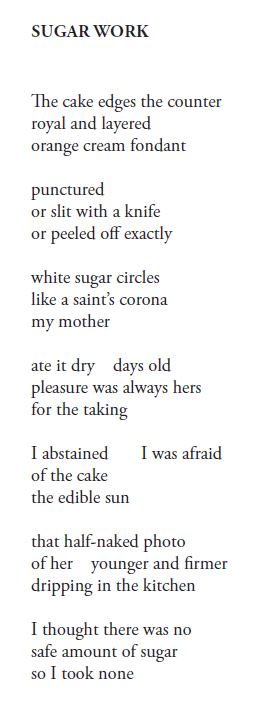
With thanks to Alyson Sinclair PR for the free e-copy for review.
The Mayapple Forest by Kim Ports Parsons (2022)
 Parts of this alliteration-rich debut collection respond to the pandemic’s gifts of time and attention. Gardening and baking, two of the activities that sustained so many people during lockdowns, appear as acts of faith – planting seeds and waiting to see what becomes of them – and acts of remembrance (in “The Poetry of Pie,” she’s a child making peach pie with her mother). There is a fresh awareness of nature, especially birds: starlings, a bluebird nest, the lovely portrait in “Barn Owl.” From the forest floor to the stars, this world is full of wonders. Human stories thread through, too: dancing to soul music, fixing an elderly woman’s hair, the layers of history uncovered during a renovation of her childhood home. Contrasting with her temporary residence in the Midwest is her nostalgia for Baltimore. Parsons reflects on the sudden loss of her father (“A quick death’s a blessing / for the one who dies”) and the still-tender absence of her mother, the book’s dedicatee.

With thanks to Terrapin Books for the free e-copy for review.
Read any good poetry recently?
 Bookish Beck = Rebecca Foster. American transplant to England. Freelance proofreader and book reviewer.
 Bookish Beck