#1962Club: A Dozen Books I’d Read Before
I totally failed to read a new-to-me 1962 publication this year. I’m disappointed in myself as I usually manage to contribute one or two reviews to each of Karen and Simon’s year clubs, and it’s always a good excuse to read some classics.

My mistake this time was to only get one option: Pale Fire by Vladimir Nabokov, which I had my husband borrow for me from the university library. I opened it up and couldn’t make head or tail of it. I’m sure it’s very clever and meta, and I’ve enjoyed Nabokov before (Pnin, in particular), but I clearly needed to be in the right frame of mind for a challenge, and this month I was not.
Looking through the Goodreads list of the top 100 books from 1962, and spying on others’ contributions to the week, though, I can see that it was a great year for literature (aren’t they all?). Here are 12 books from 1962 that I happen to have read before, most of which I’ve reviewed here in the past few years. I’ve linked to those and/or given review excerpts where I have them, and the rest I describe to the best of my muzzy memory.
 The Wolves of Willoughby Chase by Joan Aiken – The snowy scene on the cover and described in the first two paragraphs drew me in and the story, a Victorian-set fantasy with notes of Oliver Twist and Jane Eyre, soon did, too. Dickensian villains are balanced out by some equally Dickensian urchins and helpful adults, all with hearts of gold. There’s something perversely cozy about the plight of an orphan in children’s books: the characters call to the lonely child in all of us; we rejoice to see how ingenuity and luck come together to defeat wickedness. There are charming passages here in which familiar smells and favourite foods offer comfort. This would make a perfect stepping stone from Roald Dahl to one of the Victorian classics.
 Instead of a Letter by Diana Athill – This was Athill’s first book, published when she was 45. An unfortunate consequence of my not having read the memoirs in the order in which they are written is that much of the content of this one seemed familiar to me. It hovers over her childhood (the subject of Yesterday Morning) and centres in on her broken engagement and abortion, two incidents revisited in Somewhere Towards the End. Although Athill’s careful prose and talent for candid self-reflection are evident here, I am not surprised that the book made no great waves in the publishing world at the time. It was just the story of a few things that happened in the life of a privileged Englishwoman. Only in her later life has Athill become known as a memoirist par excellence.
 The Drowned World by J.G. Ballard – (Read in October 2011.) Quite possibly the first ‘classic’ science fiction work I’d ever read. I found Ballard’s debut dated, with passages of laughably purple prose, poor character development (Beatrice is an utter Bond Girl cliché), and slow plot advancement. It sounded like a promising environmental dystopia – perhaps a forerunner of Oryx and Crake – but beyond the plausible vision of a heated-up and waterlogged planet, the book didn’t have much to offer. The most memorable passage was when Strangman drains the water and Kerans discovers Leicester Square beneath; he walks the streets and finds them uninhabited except by sea creatures clogging the cinema entrances. That was quite a potent, striking image. But the scene that follows, involving stereotyped ‘Negro’ guards, seemed like a poor man’s Lord of the Flies rip-off.
 Silent Spring by Rachel Carson – Carson’s first chapter imagines an American town where things die because nature stops working as it should. Her main target was insecticides that were known to kill birds and had presumed negative effects on human health through the food chain and environmental exposure. Although the details may feel dated, the literary style and the general cautions against submitting nature to a “chemical barrage” remain potent.
 We Have Always Lived in the Castle by Shirley Jackson – I loved the offbeat voice and unreliable narration, and the way that the Blackwood house is both a refuge and a prison for the sisters. “Where could we go?” Merricat asks Constance when she expresses concern that she should have given the girl a more normal life. “What place would be better for us than this? Who wants us, outside? The world is full of terrible people.” As the novel goes on, you ponder who is protecting whom, and from what. There are a lot of great scenes, all so discrete that I could see this working very well as a play with just a few backdrops to represent the house and garden. It has the kind of small cast and claustrophobic setting that would translate very well to the stage.
 Tales from Moominvalley by Tove Jansson – Moomintroll discovers a dragon small enough to be kept in a jar; laughter brings a fearful child back from literal invisibility. But what struck me more was the lessons learned by neurotic creatures. In “The Fillyjonk who believed in Disasters,” the title character fixates on her belongings, but when a gale and a tornado come and sweep it all away, she experiences relief and joy. My other favourite was “The Hemulen who loved Silence.” After years as a fairground ticket-taker, he can’t wait to retire and get away from the crowds and the noise, but once he’s obtained his precious solitude he realizes he needs others after all. In “The Fir Tree,” the Moomins, awoken midway through hibernation, get caught up in seasonal stress and experience Christmas for the first time.
The Snowy Day by Ezra Jack Keats – A perennial favourite from my childhood, with a paper-collage style that has influenced many illustrators. Just looking at the cover makes me nostalgic for the sort of wintry American mornings when I’d open an eye to a curiously bright aura from around the window, glance at the clock and realize my mom had turned off my alarm because it was a snow day and I’d have nothing ahead of me apart from sledding, playing boardgames and drinking hot cocoa with my best friend. There was no better feeling.

 A Wrinkle in Time by Madeleine L’Engle – (Reread in 2021.) I probably picked this up at age seven or so, as a follow-on from the Chronicles of Narnia. Interplanetary stories have never held a lot of interest for me. As a child, I was always more drawn to talking-animal stuff. Again I found the travels and settings hazy. It’s admirable of L’Engle to introduce kids to basic quantum physics, and famous quotations via Mrs. Who, but this all comes across as consciously intellectual rather than organic and compelling. Even the home and school talk feels dated. I most appreciated the thought of a normal – or even not very bright – child like Meg saving the day through bravery and love. This wasn’t for me, but I hope that for some kids, still, it will be pure magic.
 The Golden Notebook by Doris Lessing – I read this feminist classic in my early twenties, in the days when I was working at a London university library. Lessing wrote autofiction avant la lettre, and the gist of this novel is that ‘Anna’, a writer, divides her life into four notebooks of different colours: one about her African upbringing, another about her foray into communism, a third containing an autobiographical novel in progress, and the fourth a straightforward journal. The fabled golden notebook is the unified self she tries to create as her romantic life and mental health become more complicated. Julianne Pachico read this recently and found it very powerful. I think I was too young for this and so didn’t appreciate it at the time. Were I to reread it, I imagine I would get a lot more out of it.
 The Pumpkin Eater by Penelope Mortimer – More autofiction. Like a nursery rhyme gone horribly wrong, this is the story of a woman who can’t keep it together. She’s the woman in the shoe, the wife whose pumpkin-eating husband keeps her safe in a pumpkin shell, the ladybird flying home to find her home and children in danger. Aged 31 and already on her fourth husband, the narrator, known only as Mrs. Armitage, has an indeterminate number of children. Her current husband, Jake, is a busy filmmaker whose philandering soon becomes clear, starting with the nanny. A breakdown at Harrods is the sign that Mrs. A. isn’t coping. Most chapters begin in medias res and are composed largely of dialogue, including with Jake or her therapist. The book has a dark, bitter humour and brilliantly recreates a troubled mind.
 One Day in the Life of Ivan Denisovich by Aleksandr Solzhenitsyn – This was required reading in high school, a novella and circadian narrative depicting life for a prisoner in a Soviet gulag. And that’s about all I can tell you about it. I remember it being just as eye-opening and depressing as you might expect, but pretty readable for a translated classic.
 A Cat in the Window by Derek Tangye – Tangye wasn’t a cat fan to start with, but Monty won him over. He lived with newlyweds Derek and Jeannie first in the London suburb of Mortlake, then on their flower farm in Cornwall. When they moved to Minack, there was a sense of giving Monty his freedom and taking joy in watching him live his best life. They were evacuated to St Albans and briefly lived with Jeannie’s parents and Scottie dog, who became Monty’s nemesis. Monty survived into his 16th year, happily tolerating a few resident birds. Tangye writes warmly and humorously about Monty’s ways and his own development into a man who is at a cat’s mercy. This was really the perfect chronicle of life with a cat, from adoption through farewell. Simon thought so, too.
Here’s hoping I make a better effort at the next year club!
Reading the Meow: Cat Books by Nadia Mikail, Derek Tangye and Doreen Tovey
Reviews of books about cats have been a standard element on my blog over the years, though not for quite a while now. The new Reading the Meow challenge, hosted by Mallika of Literary Potpourri, was a good excuse to revive the feature. I read all of these from the library. #ReadingtheMeow2023 #LoveYourLibrary

Alfie, who turned 15 last month, accompanies me in all things, including reading. I made him a medallion for his birthday that reads “World’s Best Cat” on one side and “World’s Most Annoying Cat” on the other.


The Cats We Meet Along the Way by Nadia Mikail (2022)
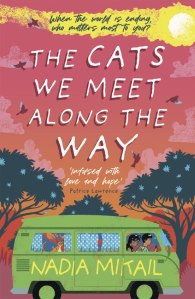 Just the one cat, actually. (Ripoff!) But Fleabag, a one-eared stray ‘the colour of gone-off curry’ who just won’t leave, is a fine companion on this end-of-the-world Malaysian road trip. Mikail’s debut teen novel, which won the Waterstones Children’s Book Prize 2023, imagines that news has come of an asteroid that will make direct contact with Earth in one year. The clock is ticking; just nine months remain. Teenage Aisha and her boyfriend Walter have come to terms with the fact that they’ll never get to do all the things they want to, from attending university to marrying and having children.
Aisha’s father died of cancer when she was young, and her older sister June disappeared two years ago. Aisha decides that what is most important now is finding June and trying to heal their estrangement, so she and Walter set out in a campervan with his parents and her mother (and Fleabag, of course). Mikail sensitively portrays the tangle of anger, grief and fear these characters feel, and it’s interesting to encounter the food and flora of a country that will be unfamiliar to many. Even though everything feels doomed, there are hopeful tasks Aisha and her family can be part of. Teens will no doubt be smart enough to realise that we face a similar calamity in the form of climate breakdown; it’s just that the timescale is a little different. 
A Cat in the Window by Derek Tangye (1962)
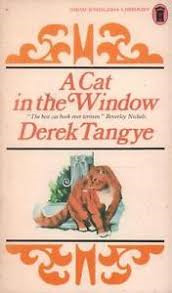 My second from Tangye. I’ve read from The Minack Chronicles out of order because I happened to find a free copy of Lama a few years ago and read it for Novellas in November. Tangye wasn’t a cat fan to start with, but Monty won him over. They met in the Savoy hotel when Tangye and Jeannie were newlyweds of three months, and Monty was six weeks old. He lived with them first in the London suburb of Mortlake, then on their flower farm in Cornwall. During the London years they kept long hours and often returned from gatherings at 2 a.m., to be met with Monty in the front window giving a lordly and annoyed glare.
When they moved to Minack there was a sense of giving Monty his freedom and taking joy in watching him live his best life. In between, they were evacuated to St Albans and briefly lived with Jeannie’s parents and Scottie dog, who became Monty’s nemesis. Ever after, he would attack dogs he saw on the canal path. In Cornwall, the threats to a free-roaming cat included foxes and rabbit traps, but Monty survived into his 16th year, happily tolerating a few resident birds: Hubert the gull, Charlie the chaffinch and Tim the robin.
Tangye writes warmly and humorously about Monty’s ways and his own development into a man who is at a cat’s mercy.
I had observed … that cat owners … were apt to fall into two types. Either they ignored the cat, put it out a night whatever the weather, left it to fend for itself when they went away on holidays, and treated it, in fact, as a kind of better class vermin; or else they worshipped the animal like a god. The first category appeared callous, the second devoid of sense.
He portrays life as a series of manageable incidents. This was really the perfect chronicle of life with a cat, from adoption through farewell. It’s the kind of thing I might like to write about Alfie, if only for my husband’s and my benefit, after he shuffles off this kitty coil. 
Cats in Concord by Doreen Tovey (2001)
 My seventh from Tovey. I can hardly believe that, having started her writing career in the 1950s, she was still publishing into the new millennium! (She lived 1918–2008.) Tovey was addicted to Siamese cats. As this volume opens, she’s so forlorn after the death of Saphra, her fourth male, that she instantly sets about finding a replacement. Although she sets strict criteria she doesn’t think can be met, Rama fits the bill and joins her and Tani, her nine-year-old female. They spar at first, but quickly settle into life together. As always, there are various mishaps involving mischievous cats and eccentric locals (I have a really low tolerance for accounts of folksy neighbours’ doings). The most persistent problem is Rama’s new habit of spraying.
Towards the end, Tani succumbs to a virus while Rama recovers … and guess what, Tovey immediately gets a replacement. In fact, the last lines of the book are “If anyone reading this book has lost a beloved cat and is grieving, I would urge them to get another. I am sure they were put into this world for our admiration—and I think that they think that way too.” I’m probably done with Tovey; Cats in the Belfry and Cats in May were terrific, but it’s been diminishing returns ever since and I’ve ended up skimming most of the last few I tried. 
I also recently enjoyed these two picture books, one about a cat’s mercurial day-and-night moods and the other about an indoor cat who doesn’t realize how good he has it. (Also pictured in the left-hand photograph above.)


Seven Cats I Have Loved by Anat Levit (Translated by Yardenne Greenspan) for #NovNov22
“Most of the cats I come across must be able to sense right away that I am nothing but a cat in human clothes.”
 This short memoir could have fit next week’s nonfiction focus, but because it is translated from the Hebrew I’ve chosen to use it to round off our literature in translation week. Poet Anat Levit didn’t start off as a cat lady, yet in the year following her divorce she adopted five kittens. The first, Shelly, was a present for her small daughters, Daphna and Shlomit, and then another four fluffballs tempted her at the pet store: Afro, Lady, Mocha and Jesse. Add on Cleo, a beautiful Siamese she bought on impulse from a neighbour, and Mishely, a local stray she started to look after, and there you have it: the seven cats who took over her life.
This is a loose narrative filled with little observations on the differences in her cats’ appetites, mannerisms, and relationships to each other and to the author. As much as she loves them, Levit seems to find the animals a heavy emotional burden: she constantly wonders if she’s doing her best for them, treating them all the same (better than her children?), and so on.
Unfortunately, I felt the most attention is paid to the cats’ various illnesses and vet visits, and especially the periods of decline leading to each one’s death. Pets only live a fraction as long as humans, so books about loving them often incorporate death, and some might argue that it’s an essential part of the story: that your care for an animal companion encompasses their whole life and includes the duty to ease their death. Fair enough. But it can be a downer to read about. So, cat lovers, think carefully about whether you can handle the content; if you’re after sweet anecdotes and antics, this is not that book. Something about either the writing or the translation meant that I found the tone either too matter-of-fact (recounting the physical facts of deterioration) or melodramatic, e.g.,
That evening, it dawned on me that I had to hurry up and release Cleo from the relics of existence that survived in his body. Sometimes, death dawdles for no reason. On the threshold of my cats’ demise, it prescribed the kind of suffering that seemed to have erased the sweetness of all their previous years at once.
– and not often finding a balance. Still, there are some sweet moments that pet owners will appreciate. (A similar read from last year: The Writer’s Cats by Muriel Barbery.)
[133 pages]
With thanks to Serpent’s Tail for the free copy for review.

R.I.P. Reads, Part I: Ahlberg, Gaskell, Hinchcliffe and Watson
I don’t generally read horror or suspense, but the R.I.P. challenge is my annual excuse to pick up some slightly scarier material. For this first installment of super-short responses, I have a children’s book about a seriously problematic cat, a Victorian ghost story, and two recent Scotland-set novels about exiles haunted by the unexplained. (All: Public library)

The Improbable Cat by Allan Ahlberg (2003)
 I picked this up expecting a cute cat tale for children, only realizing afterwards that it’s considered horror. When a grey kitten wanders into their garden, Davy is less enamoured than the rest of the Burrell family. His suspicion mounts as the creature starts holding court in the lounge, expecting lavish meals and attention at all times. His parents and sister seem to be under the cat’s spell in some way, and it’s growing much faster than any young animal should. Davy and his pal George decide to do something about it. Since I’m a cat owner, I’m not big into evil cat stories (e.g., Cat out of Hell by Lynne Truss), and this one was so short as to feel underdeveloped.
 “The Old Nurse’s Story” by Elizabeth Gaskell (1852)
(collected in Gothic Tales (2000), ed. Laura Kranzler)
I had no idea that Gaskell had published short fiction, let alone ghost stories. Based on the Goodreads and blogger reviews, I chose one story to read. The title character tells her young charges about when their mother was a child and the ghost of a little girl tried to lure her out onto the Northumberland Fells one freezing winter. It’s predictable for anyone who reads ghost stories, but had a bit of an untamed Wuthering Heights feel to it. 
Hare House by Sally Hinchcliffe (2022)
 The unnamed narrator is a disgraced teacher who leaves London for a rental cottage on the Hare House estate in Galloway. Her landlord, Grant Henderson, and his rebellious teenage sister, Cass, are still reeling from the untimely death of their brother. The narrator gets caught up in their lives even though her shrewish neighbour warns her not to. There was a lot that I loved about the atmosphere of this one: the southwest Scotland setting; the slow turn of the seasons as the narrator cycles around the narrow lanes and finds it getting dark earlier, and cold; the inclusion of shape-shifting and enchantment myths; the creepy taxidermy up at the manor house; and the peculiar fainting girls/mass hysteria episode that precipitated the narrator’s banishment and complicates her relationship with Cass. The further you get, the more unreliable you realize this narrator is, yet you keep rooting for her. There are a few too many set pieces involving dead animals, and, overall, perhaps more supernatural influences than are fully explored, but I liked Hinchcliffe’s writing enough to look out for what else she will write. (Readalikes: The Haunting of Hill House and Wakenhyrst)
Metronome by Tom Watson (2022)
 Ever since I read Blurb Your Enthusiasm, I’ve been paying more attention to jacket copy. This is an example of a great synopsis that really gives a sense of the plot: mysterious events, suspicion within a marriage, and curiosity about what else might be out there. Aina and Whitney believe they are the only people on their island. They live simply on a croft and hope that, 12 years after their exile, they’ll soon be up for parole. Whitney stubbornly insists they wait for the warden to rescue them, while Aina has given up thinking anyone will ever come. There’s a slight Beckettian air, then, to the first two-thirds of this dystopian novel. When someone does turn up, it’s not who they expect. The eventual focus on parenthood meant this reminded me a lot of The Road; there are also shades of The Water Cure and Doggerland (though, thankfully, the dual protagonists ensure a less overly male atmosphere than in the latter). This was an easy and reasonably intriguing read, but ultimately a bit vague and bleak for me, and not distinguished enough at the level of the prose (e.g., way too many uses of “onside”).
The Dark Is Rising Readalong #TDiRS22 & #Headliners2023 Online Event
Annabel’s readalong was the excuse I needed to try something by children’s fantasy author Susan Cooper – she’s one of those much-beloved English writers who happened to pass me by during my upbringing in the States. I’ve been aware of The Dark Is Rising (1973) for just a few years, learning about it from the Twitter readalong run by Robert Macfarlane. (My husband took part in that, having also missed out on Cooper in his childhood.)

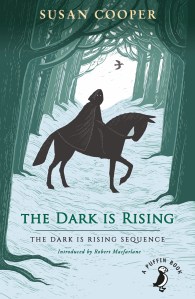 Christmas is approaching, and with it a blizzard, but first comes Will Stanton’s birthday on Midwinter Day. A gathering of rooks and a farmer’s ominous pronouncement (“The Walker is abroad. And this night will be bad, and tomorrow will be beyond imagining”) and gift of an iron talisman are signals that his eleventh birthday will be different than those that came before. While his large family gets on with their preparations for a traditional English Christmas, they have no idea Will is being ferried by a white horse to a magic hall, where he is let in on the secret of his membership in an ancient alliance meant to combat the forces of darkness. Merriman will be his guide as he gathers Signs and follows the Old Ones’ Ways.
I loved the evocation of a cosy holiday season, and its contrast with the cosmic conflict going on under the surface.
He was not the same Will Stanton that he had been a very few days before. Now and forever, he knew, he inhabited a different timescale from that of everyone he had ever known or loved…But he managed to turn his thoughts away from all these things, even from the two invading, threatening figures of the Dark. For this was Christmas, which had always been a time of magic, to him and to all the world. This was a brightness, a shining festival, and while its enchantment was on the world the charmed circle of his family and home would be protected against any invasion from outside.
The bustling family atmosphere is reminiscent of Madeleine L’Engle’s children’s books (e.g., Meet the Austins), as is the nebulous world-building (A Wrinkle in Time) – I found little in the way of concrete detail to latch onto, and like with Alan Garner’s The Owl Service, I felt out of my depth with the allusions to local legend. Good vs. evil battles are a mainstay of fantasy and children’s fiction, like in J.R.R. Tolkien’s books, or The Chronicles of Narnia I read over and over between the ages of about five and nine. Had I read this, too, as a child, I’m sure I would have loved it, but I guess I’m too literal-minded an adult these days; it’s hard for me to get swept up in the magic. See also Annabel’s review. (Public library)
Headliners 2023 Online Event
For a small fee (the proceeds went to The Arts Emergency Fund), I joined in this Zoom event hosted by Headline Books and Tandem Collective yesterday evening to learn about 10 of the publisher’s major 2023 releases.
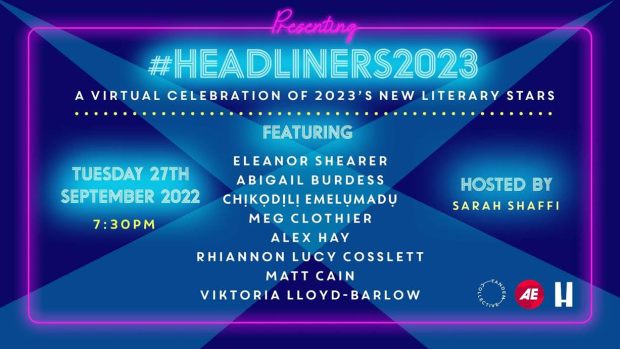
Six of the authors were interviewed live by Sarah Shaffi; the other four had contributed pre-recorded video introductions. Here’s a super-brief rundown, in the order in which they appeared, with my notes on potential readalikes:
Dazzling by Chikodili Emelumadu (16 February)
Two girls at a restrictive Nigerian boarding school tap into their power as “Leopard People” to bring back their missing fathers and achieve more than anyone expects of them.
Sounds like: Akwaeke Emezi’s works
A Pebble in the Throat by Aasmah Mir (2 March)
A memoir contrasting her upbringing in Glasgow with her mother’s in Pakistan, this promises to be thought-provoking on the topics of racism and gender stereotypes.
Sounds like: Brown Baby or Brit(ish)
River Sing Me Home by Eleanor Shearer (19 January)
In 1834 Barbados, a former slave leaves her sugarcane plantation to find her five children. Shearer is a mixed-race descendant of Windrush immigrants and wanted to focus not so much on slavery as on its aftermath and the effects of forced dispersion.
Sounds like: Sugar Money
Becoming Ted by Matt Cain (19 January)
In a Northern seaside town, Ted is dumped by his husband and decides to pursue his dream of becoming a drag queen.
Sounds like: Rachel Joyce’s works
Mother’s Day by Abigail Burdess (2 March)
As a baby, Anna was left by the side of the road*; now she’s found her birth mother, just as she learns she’s pregnant herself. Described as a darkly comic thriller à la Single White Female.
(*Burdess had forgotten that this really happened to her best childhood friend; her mum had to remind her of it!)
Sounds like: A Crooked Tree or When the Stars Go Dark
Me, Myself and Mini Me by Charlotte Crosby (2 March)
A reality TV star’s memoir of having a child after an ectopic pregnancy.
Sounds like: Something Katie Price would ‘write’. I had not heard of this celebrity author before and don’t mean to sound judgmental, but the impression made by her appearance (heavily altered by cosmetic surgery) was not favourable.
All the Little Bird Hearts by Viktoria Lloyd-Barlow (2 March)
In the Lake District in the 1980s, Sunday is an autistic mother raising a daughter, Dolly. The arrival of glamorous next-door neighbours upends their lives.
Sounds like: Claire Fuller’s works
The Year of the Cat by Rhiannon Lucy Cosslett (19 January)
A work of creative nonfiction about adopting a cat named Mackerel (who briefly appeared on the video) during lockdown, and deciding whether or not to have a child.
Sounds like: Motherhood, with a cat
The Book of Eve by Meg Clothier (30 March)
Set in Northern Italy in 1500, this is about a convent librarian who discovers a rich tradition of goddess worship that could upend the patriarchy.
Sounds like: Kiran Millwood Hargrave’s and Maggie O’Farrell’s historical novels
The Housekeepers by Alex Hay (6 July)
A historical heist novel set in 1905, this is about Mrs King, a Mayfair housekeeper who takes revenge for her dismissal by assembling a gang of disgruntled women to strip her former employer’s house right under her nose during a party.
Sounds like: Richard Osman’s works
If there was a theme to the evening, it was women’s power!
I’m most keen to read The Year of the Cat, but I’d happily try 3–4 of the novels if my library acquired them.
Which of these 2023 releases appeal to you most?
Love Your Library, February 2022
We’re now onto the fifth month of the Love Your Library feature. A big thank you to…
- “The Fab Four of Cley,” who run a Little Free Library in their area. They found last month’s post and gave me a link to a bilingual piece they wrote about a book sale they ran at their local church, with the thousands of books they’d amassed. Heavenly!
- Margaret of From Pyrenees to Pennines for her lovely account (with photos!) of a visit to the Central Public Library of Valencia.
- Mary R. of Bibliographic Manifestations for her post on interlibrary loans.
Blogger Laila of Big Reading Life also mentioned ILLs recently. I know some states and provinces are able to offer this service for free. When I lived in Maryland, statewide ILLs were free and I took full advantage of it. It’s how I binged on books by Marcus Borg, Frederick Buechner, Jan Morris, and many others during the year between my Master’s degree and moving back to England permanently. For my thesis research I’d had the University of Leeds’ ILL team get me an obscure Victorian novel on microfiche all the way from Australia. I also cheekily put through a few university ILLs for myself while I worked for King’s College London’s library system. Where I live now in the UK, a public library ILL costs £3 per book, so isn’t worth doing; you might as well find a secondhand copy at that price. I do miss the freedom of knowing that I could borrow (almost) anything I want.
Two funny moments from my recent library volunteering: I found Mrs Dalloway shelved under D, and an M. C. Beaton “Agatha Raisin” mystery shelved under R!
Read from the library recently:
 The Jasper & Scruff series by Nicola Colton: Having insisted I don’t like sequels or series … I do sometimes make exceptions, like I did for these early reader books (meant for, I don’t know, maybe ages 7 to 9?). I was drawn by the grey and white cat with a bowtie – that’s Jasper, a dapper fellow who likes the fine things in life and desperately wants to be admitted to the Sophisticats’ club, until he realizes they’re snooty and just plain mean. Whereas Scruff the puppy, though he makes life messy, is loving and fun. I liked the sequels more than the original because they build on each other, bringing back characters from the earlier books for a pirate-themed scavenger hunt, a reality TV-style talent show, and bookshop and diner ventures. There are good lessons about being honest and fair, even if others are cheating to outcompete you, and being yourself instead of putting on airs. I also like the menagerie of mammals: not just dogs and cats, but African megafauna, too.
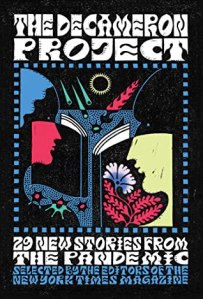 The Decameron Project: 29 New Stories from the Pandemic (originally published in The New York Times): Creative responses to Covid-19, ranging from the prosaic to the fantastical. I appreciated the mix of authors, some in translation and some closer to genre fiction than lit fic. Standouts were by Victor LaValle (NYC apartment neighbours; magic realism), Colm Tóibín (lockdown prompts a man to consider his compatibility with his boyfriend), Karen Russell (time stops during a bus journey), Rivers Solomon (an abused girl and her imprisoned mother get revenge), Matthew Baker (a feuding grandmother and granddaughter find something to agree on), and John Wray (a relationship starts up during quarantine in Barcelona). The best story of all, though, was by Margaret Atwood.
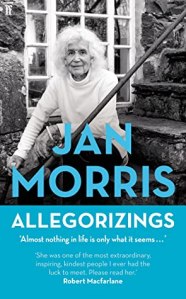 Allegorizings by Jan Morris: Disparate, somewhat frivolous essays written mostly pre-2009, or in 2013, and kept in trust by her publisher for publication as a posthumous collection, so strangely frozen in time. She was old but not super-old; thinking vaguely about death, but not at death’s door. The organizing principle, that everything can be understood on more than one level and so we must think beyond the literal, is interesting but not particularly applicable to the contents. There are mini travel pieces and pen portraits, but I got more out of the explorations of concepts (maturity, nationalism) and universal experiences (being caught picking one’s nose, sneezing).
 The Priory by Dorothy Whipple (read for book club): A cosy between-the-wars story, pleasant to read even though some awful things happen, or nearly happen. Like in Downton Abbey and the Cazalet Chronicles, there’s an upstairs/downstairs setup that’s appealing. It was interesting to watch how my sympathies shifted. The Persephone afterword provides useful information about the Welsh house (where Whipple stayed for a month in 1934) and family that inspired the novel. Whipple is a new author for me and I’m sure the rest of her books would be just as enjoyable, but I would only attempt another if it was significantly shorter than this one.
Borrowed since last month:

My latest university library book haul. Paradise by Toni Morrison is to read with my women’s classics book club subgroup in mid-April. Findings is to reread just because Kathleen Jamie is amazing. The other three are in preparation for the 1954 Club coming up in April.

Do share a link to your own post in the comments, and feel free to use the above image. I’ve co-opted a hashtag that is already popular on Twitter and Instagram: #LoveYourLibrary.
Here’s a reminder of my ideas of what you might choose to post (this list will stay up on the project page):
- Photos or a list of your latest library book haul
- An account of a visit to a new-to-you library
- Full-length or mini reviews of some recent library reads
- A description of a particular feature of your local library
- A screenshot of the state of play of your online account
- An opinion piece about library policies (e.g. Covid procedures or fines amnesties)
- A write-up of a library event you attended, such as an author reading or book club.
If it’s related to libraries, I want to hear about it!
Six Short Cat Books for #NovNov: Muriel Barbery, Garfield and More
Reviews of books about cats have been a regular element on my blog over the years, though not for quite a while. I happen to have amassed a number of illustrated novelty cat books recently, all of them under 150 pages, so Novellas in November is my excuse to feature them together. All six were enjoyable and a nice break from heavier reads on my stacks: .
The Writer’s Cats by Muriel Barbery; illus. Maria Guitart (2020; 2021)
[Translated from the French by Alison Anderson; 80 pages]
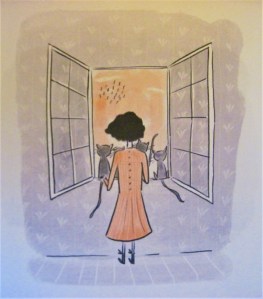
 I could have included this in a translated literature post, but decided to go by theme instead; I also considered reviewing it during nonfiction week as I thought it was a brief memoir. As it turns out, it’s a whimsical tale I’d be more likely to classify under fiction. Barbery has four Chartreux cats – two pairs of siblings: Ocha and Mizu, and Kirin and Petrus. Kirin, one of the younger pair, narrates the book, giving the cats’ view of the writer (and the musician she lives with). They diagnose her as being afflicted with restlessness, doubt and denial, and decide to learn to read so that they can act as literary advisors and comment on her work in progress. Naturally, they’d like to receive royalties for this service. “Yes, we are – in all modesty – decorative, protective deities watching over her rigid little aesthetic world”. Barbery is a Japanophile, so Guitart’s illustrations mix Japanese minimalism with Parisian chic and use as a palette the grey and orange colouring of the cats themselves. This was cute! (Also reviewed by Annabel and Davida.) A favourite illustration:
With thanks to Gallic Books for the free copy for review.
Four Garfield comics anthologies by Jim Davis:
Two’s Company (#5, 1984), We Love You Too (#10, 1985), Here We Go Again (#11, 1986), Flying High (#16, 1988)
[Each: 128 pages]
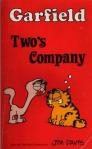


When these came into our temporary Little Free Library at the end of the summer I snapped them up, remembering happy times reading the syndicated comic in the Washington Post and watching the animated TV show on weekends growing up. I could even hear the actor who voices Garfield in my head on some lines.
In a sense, if you’ve read one of these volumes you’ve read them all, because the same sorts of set pieces repeat. Garfield’s gluttony and laziness know no bounds, so in between naps, he’ll snatch lasagnes and whatever other people food he can get. He’ll mock owner Jon, bait Odie the dog, ignore the mice in the house, terrorize Nermal the cute kitten, and flirt with Arlene. For the most part, the plots don’t leave the house, though in Two’s Company Jon and Garfield fly to Hawaii on vacation.
Garfield was the original grumpy cat, with smugness the only other emotion you’ll regularly see on his face. His ways will remind you of your own feline acquaintances (except he also drinks coffee and hates Mondays). The sense of humour is sarcasm par excellence. A favourite page from Flying High:

The Calculating Cat Returns by Nancy Prevo; illus. Eric Gurney (1978)
[138 pages]
 A tongue-in-cheek book mostly composed of black-and-white cartoons. The “calculating cat” is a bit like Terry Pratchett’s “real cat” from The Unadulterated Cat, but comes in a few varieties (or “CAT-egories,” as they’re called here): Pampered Cats, Working Cats, and Tramp cats. My cat was apparently the third type, living on the streets, for a short time, though you’d never know it to look at him now. During his 10th summer he tried working as a hunter, but quickly retired. He’s now solidly of the pampered class.
There are chapters here on playtime, eating habits, sleep, travel, and mating (not something many of us cat owners have to worry about these days). This remains reasonably undated because cats don’t change; it’s the human fashions that evolve and would look different in a book published today. (Free bookshop)
A favourite drawing:

Any cat (or dog) books among your recent reading?
Novellas in November, Part 1: 3 Nonfiction, 2 Super-Short Fiction
Short books; short reviews.
Nonfiction:
The Measure of My Days by Florida Scott-Maxwell (1968)
[150 pages]
 I learned about this from one of May Sarton’s journals, which shares its concern with ageing and selfhood. The author was an American suffragist, playwright, mother and analytical psychologist who trained under Jung and lived in England and Scotland with her Scottish husband. She kept this notebook while she was 82, partly while recovering from gallbladder surgery. It’s written in short, sometimes aphoristic paragraphs. While I appreciated her thoughts on suffering, developing “hardihood,” the simplicity that comes with giving up many cares and activities, and the impossibility of solving “one’s own incorrigibility,” I found this somewhat rambly and abstract, especially when she goes off on a dated tangent about the equality of the sexes. (Free from The Book Thing of Baltimore)
Hope in the Dark: Untold Histories, Wild Possibilities by Rebecca Solnit (2004)
[143 pages]
 “Activism is not a journey to the corner store, it is a plunge into the unknown. The future is always dark.” This resonated with the Extinction Rebellion handbook I reviewed earlier in the year. Solnit believes in the power of purposeful individuals working towards social justice, even in the face of dispiriting evidence (the largest protests the world had seen didn’t stop the Iraq War). Instead of perfectionism, she advises flexibility and resilience; things could be even worse had we not acted. At first I thought it depressing that 15 years on we’re still dealing with many of the issues she mentions here, and the environmental crisis has only deepened. But her strong and stirring writing is a reminder that, though injustice is always with us, so is everyday heroism. (Free from The Book Thing of Baltimore)
Lama by Derek Tangye (1966)
[160 pages]
 Tangye wrote a series of cozy animal books similar to Doreen Tovey’s. He and his wife Jean ran a flower farm in Cornwall and had a succession of cats, along with donkeys and a Muscovy duck named Boris. After the death of their beloved cat Monty, Jean wanted a kitten for Christmas but Tangye, who considered himself a one-cat man rather than a wholesale cat lover, hesitated. The matter was decided for them when a little black stray started coming round and soon made herself at home. (Her name is a tribute to the Dalai Lama’s safe flight from Tibet.) Mild adventures ensue, such as Lama going down a badger sett and Jeannie convincing herself that she’s identified another stray as Lama’s mother. Pleasant, if slight; I’ll read more by Tangye. (From Kennet Centre free bookshop)
Fiction:
The Small Miracle by Paul Gallico (1951)
[47 pages]
 Like Tangye, Gallico is known for writing charming animal books, but fables rather than memoirs. Set in postwar Assisi, Italy, this stars Pepino, a 10-year-old orphan boy who runs errands with his donkey Violetta to earn his food and board. When Violetta falls ill, he dreads losing not just his livelihood but also his only friend in the world. But the powers that be won’t let him bring her into the local church so that he can pray to St. Francis for her healing. Pepino takes to heart the maxim an American corporal gave him – “don’t take no for an answer” – and takes his suit all the way to the pope. This story of what faith can achieve just manages to avoid being twee. (From Kennet Centre free bookshop)
Birthday Girl by Haruki Murakami (2002; English translation by Jay Rubin, 2003)
[42 pages]
 Reprinted as a stand-alone pamphlet to celebrate the author’s 70th birthday, this is about a waitress who on her 20th birthday is given the unwonted task of taking dinner up to the restaurant owner, who lives above the establishment. He is taken with the young woman and offers to grant her one wish. We never hear exactly what that wish was. It’s now more than 10 years later and she’s recalling the occasion for a friend, who asks her if the wish came true and whether she regrets what she requested. She surveys her current life and says that it remains to be seen whether her wish will be fulfilled; I could only assume that she wished for happiness, which is shifting and subjective. Encountering this in a larger collection would be fine, but it wasn’t particularly worth reading on its own. (Public library)
I’ve also had a number of novella DNFs so far this month, alas: Atlantic Winds by William Prendiville (not engaging in the least), By Grand Central Station I Sat Down and Wept by Elizabeth Smart (fascinating autobiographical backstory; pretentious prose) and The Dream Life of Balso Snell by Nathanael West (even more bizarre and crass than I’m used to from him).
Onwards!
Have you read any of these novellas? Which one takes your fancy?
20 Books of Summer, #11–13: Harrison, Pym, Russell
It’s cats and butterflies in the spotlight this time, adding in a gazelle as a metaphor for Freddie Mercury’s somebody to love.
Travelling Cat: A Journey round Britain with Pugwash by Frederick Harrison (1988)
If Tom Cox had been born 20 years earlier, this is the sort of book he might have written. In 1987, saddened more by his cat Podey being run over than by the end of his marriage, Harrison set out from South London in his Ford Transit van for a seven-month drive around the country. He decided to take Pugwash, one of his local (presumably ownerless) cats, along as a companion.
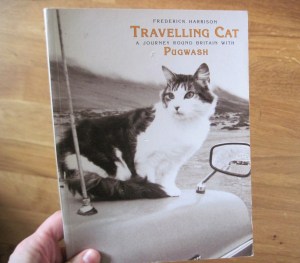 They encountered Morris dancers, gypsies, hippies at Stonehenge for the Summer Solstice, sisters having a double wedding, and magic mushroom collectors. They went to a county fair and beaches in Suffolk and East Yorkshire, and briefly to Hay-on-Wye. And on the way back they collected Podey, whom he’d had stuffed. Harrison muses on the English “vice” of nostalgia for a past that probably never existed; Pugwash does what cats do, and very well.
It’s all a bit silly and dated and lightweight, but enjoyable nonetheless. Plus there are tons of black-and-white photos of “Pugs” and other feline friends. This was a secondhand purchase from The Bookshop, Wigtown.
Favorite lines:
“Cats hate to make prats of themselves. But then, don’t we all?”
(last lines) “Warm, fed, contented, unemployable, and entirely at peace with the world. Yes indeed. Cats certainly know something we don’t.”
Some Tame Gazelle by Barbara Pym (1950)
(An example of a book that just happens to have an animal in the title.) I’d only read one other Pym novel, Quartet in Autumn, a late and fairly melancholy story of four lonely older people. With her first novel I’m in more typical territory, I take it. The middle-aged Bede sisters are pillars of the church in their English village. Harriet takes each new curate under her wing, making of them a sort of collection, and fends off frequent marriage proposals from the likes of a celebrity librarian and an Italian count.
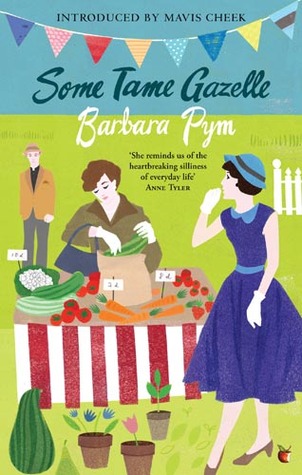 Belinda, on the other hand, only has eyes for one man: Archdeacon Hochleve, whom she’s known and loved for 30 years. They share a fondness for quoting poetry, the more obscure the better (like the title phrase, taken from “Some tame gazelle, or some gentle dove: / Something to love, oh, something to love!” by Thomas Haynes Bayly). The only problem is that the archdeacon is happily married. So single-minded is Belinda that she barely notices her own marriage proposal when it comes: a scene that reminded me of Mr. Collins’s proposal to Lizzie in Pride and Prejudice. Indeed, Pym is widely recognized as an heir to Jane Austen, what with her arch studies of relationships in a closed community.
There were a handful of moments that made me laugh, like when the seamstress finds a caterpillar in her cauliflower cheese and has to wipe with a Church Times newspaper when the Bedes run out of toilet paper (such mild sacrilege!). This is enjoyable, if fluffy; it was probably a mistake to have read one of Pym’s more serious books first: I expected too much of this one. If you’re looking for a quick, gentle and escapist read in which nothing awful will happen, though, it would make a good choice. Knowing most of her books are of a piece, I wouldn’t read more than one of the remainder – it’ll most likely be Excellent Women.
An Obsession with Butterflies: Our Long Love Affair with a Singular Insect by Sharman Apt Russell (2003)
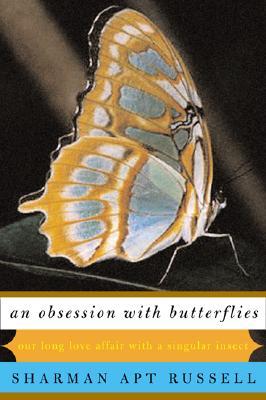 This compact and fairly rollicking book is a natural history of butterflies and of the scientists and collectors who have made them their life’s work. There are some 18,000 species and, unlike, say, beetles, they are generally pretty easy to tell apart because of their bold, colorful markings. Moth and butterfly diversity may well be a synecdoche for overall diversity, making them invaluable indicator species. Although the history of butterfly collecting was fairly familiar to me from Peter Marren’s Rainbow Dust, I still learned or was reminded of a lot, such as the ways you can tell moths and butterflies apart (and it’s not just about whether they fly in the night or the day). And who knew that butterfly rape is a thing?
The final third of the book was strongest for me, including a trip to London’s Natural History Museum; another to Costa Rica’s butterfly ranches, an example of successful ecotourism; and a nicely done case study of the El Segundo Blue butterfly, which was brought back from the brink of extinction by restoration of its southern California dunes habitat. Russell, a New Mexico-based author of novels and nonfiction, also writes about butterflies’ cultural importance: “No matter our religious beliefs, we accept the miracle of metamorphosis. One thing becomes another. … Butterflies wake us up.”
 I also recently read the excellent title story from John Murray’s 2003 collection A Few Short Notes on Tropical Butterflies. Married surgeons reflect on their losses, including the narrator’s sister in a childhood accident and his wife Maya’s father to brain cancer. In the late 1800s, the narrator’s grandfather, an amateur naturalist in the same vein as Darwin, travelled to Papua New Guinea to collect butterflies. The legends from his time, and from family trips to Cape May to count monarchs on migration in the 1930s, still resonate in the present day for these characters. The treatment of themes like science, grief and family inheritance, and the interweaving of past and present, reminded me of work by Andrea Barrett and A.S. Byatt.
(I’ve put the book aside for now but will go back to it in September as I focus on short stories.)
Other butterfly-themed books I have reviewed:
- Four Wings and a Prayer: Caught in the Mystery of the Monarch Butterfly by Sue Halpern (one of last year’s 20 Books of Summer)
- Ruins by Peter Kuper (a graphic novel set in Mexico, this also picks up on monarch migration)
- Magdalena Mountain by Robert Michael Pyle (a novel about butterfly researchers in Colorado)
“Cat Poems” & Other Cats I’ve Encountered in Books Recently
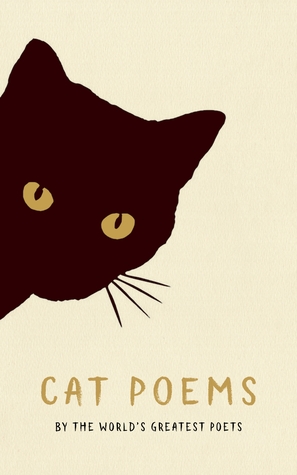 Cat Poems: An enjoyable selection of verse about our feline friends, nicely varied in terms of the time period, original language of composition, and outlook on cats’ contradictory qualities. I was unaware that Angela Carter and Muriel Spark had ever written poetry. There are perhaps too many poems by Stevie Smith – six in total! – though I did enjoy their jokey rhymes.
Some favorite lines:
“Cat sentimentality is a human thing. Cats / are indifferent, their minds can’t comprehend / the concept ‘I shall die’, they just go on living.” (from “Sonnet: Cat Logic” by Gavin Ewart)
“For every house is incomplete without him and a blessing is lacking in the spirit.” (from “Jubilate Agno” by Christopher Smart)
“These adorable things. When my life gives out, they’d eat me up in a second.” (from “I’ll Call Those Things My Cats” by Kim Hyesoon)
My rating:
Cat Poems was published in the UK on October 4th. My thanks to Serpent’s Tail for the free copy for review.
Even when it’s not a book specifically about cats, cats often turn up in my reading. Maybe it’s simply that I look out for them more since I became a cat owner several years ago. Here are some of the quotes, scenes or whole books featuring cats that I’ve come across this year.
Cats real and imaginary
 Stranger on a Train by Jenni Diski: “I find myself astonished that a creature of another species, utterly different to me, honours me with its presence and trust by sitting on me and allowing me to stroke it. This mundane domestic moment is as enormous, I feel at such moments, as making contact across a universe with another intelligence. This creature with its own and other consciousness and I with mine can sit in silence and enjoy each other’s presence. … This is a perfectly everyday scene but sometimes it takes my breath away that another living thing has allowed me into its life.”
 Certain American States by Catherine Lacey: “This cat wants to destroy beauty—I can tell. He is more than animal, he is evil, a plain enemy of the world. I wish him ill. I do. Almost daily I find a mess of feathers in the dirt. Some mornings there are whole bird carcasses left on my porch—eyes shocked open, brilliant blue wings, ripped and bloody. I have thought often of what it would take to kill a cat, quietly and quickly, with my bare hands. I have thought of this often. In fact I am thinking of it right now.” (from the story “Because You Have To”)
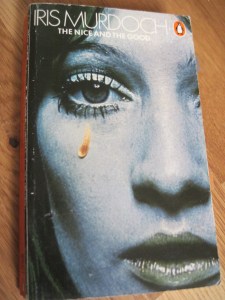 The Nice and the Good by Iris Murdoch: “Montrose was a large cocoa-coloured tabby animal with golden eyes, a square body, rectangular legs and an obstinate self-absorbed disposition, concerning whose intelligence fierce arguments raged among the children. Tests of Montrose’s sagacity were constantly being devised, but there was some uncertainty about the interpretation of the resultant data since the twins were always ready to return to first principles and discuss whether cooperation with the human race was a sign of intelligence at all. Montrose had one undoubted talent, which was that he could at will make his sleek hair stand up on end, and transform himself from a smooth stripey cube into a fluffy sphere. This was called ‘Montrose’s bird look’.”
 Four Bare Legs in a Bed and Other Stories by Helen Simpson: “They found it significant that I called my cat Felony. I argued that I had chosen her name for its euphonious qualities. She used to sink her incisors into the hell of my hand and pause a fraction of a millimeter from breaking the skin, staring at me until her eyes were reduced to sadistic yellow semibreves. She murdered without a qualm. She toyed with her victims, smiling broadly at their squeaks and death throes.
‘Why isn’t she a criminal?’ I asked. …
‘The difference is,’ said Mr Pringle, that we must assume your cat commits her crimes without mischievous discretion.’” (from the story “Escape Clauses”)
 In Delia Owens’s Where the Crawdads Sing, Sunday Justice is the name of the courthouse cat. He sits grooming on the courtroom windowsill during the trial and comes in and curls up to sleep in the cell of a particular prisoner we’ve come to care about.
A recommended picture book
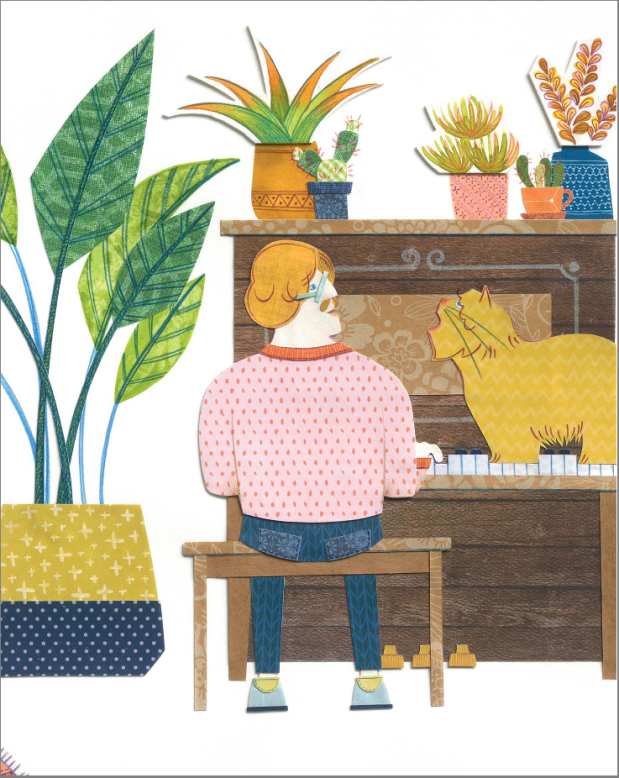
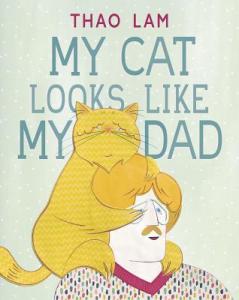 My Cat Looks Like My Dad by Thao Lam: I absolutely loved the papercut collage style of this kids’ book. The narrator explains all the ways in which the nerdy-cool 1970s-styled dad resembles the family cat, who is more like a sibling than a pet. “Family is what you make it.” There’s something of a twist ending, too. (Out on April 15, 2019.)
My rating: 
Later today I’m off to America for two weeks, but I’ll be scheduling plenty of posts, including the usual multi-part year-end run-down of my best reads, to go up while I’m away. Forgive me if I’m less responsive than usual to comments and to your own blogs!
 Bookish Beck = Rebecca Foster. American transplant to England. Freelance proofreader and book reviewer.
 Bookish Beck