Two Records of Bodily Transformation: Amateur and Shapeshifters
Amateur: A True Story about What Makes a Man, Thomas Page McBee
 Thomas Page McBee was the first transgender man to box at Madison Square Garden. In his second memoir, which arose from a Quartz article entitled “Why Men Fight,” he recounts the training leading up to his charity match and ponders whether aggression is a natural male trait. McBee grew up in a small town outside Pittsburgh with a stepfather who sexually abused him from age four. In 2011 he started the testosterone injections that would begin his gender transformation. During the years that followed, other men seemed to pick fights with him fairly often, and he was unsure what to do about it. Finally, in 2015, the Manhattan editor decided to confront the belligerent male stereotype by starting boxing training.
What I most appreciated were the author’s observations of how others have related to him since his transition. He notices that he’s taken more seriously at work as a man, and that he can be an object of fear – when jogging behind a woman at night, for instance. One of the most eye-opening moments of the book is when he realizes that he’s been talking over his own sister. Thankfully, McBee is sensitive enough to stop and change, recognizing that kindness and vulnerability are not faults but attributes any person should be proud of.
I have a feeling I would have preferred his previous memoir, Man Alive, which sounds like it has more about the transition itself. Jonathan Eig’s biography of Muhammad Ali is one of the best books I’ve read this year, and in comparison I didn’t find the boxing writing here very interesting. Likewise, this pales beside two similar but more perceptive books I’ve read that have been hugely influential on my own understanding of gender identity: Conundrum by Jan Morris and The Argonauts by Maggie Nelson.
My rating: 
Amateur was published in the UK by Canongate on August 2nd. My thanks to the publisher for the free copy for review.
Shapeshifters: On Medicine and Human Change by Gavin Francis
 Gavin Francis is a physician with a practice near Edinburgh. His latest book is like a taster course in medical topics. The overarching theme is the modifications the body undergoes, so there are chapters on, for example, body-building, tattoos, puberty, prosthetic limbs, dementia and menopause. Over his years in general practice Francis has gotten to know his patients’ stories and seen them change, for better or worse. These anecdotes of transformation are one source for his book, but he also applies insight from history, mythology, literature, etymology and more. So in a chapter on conception he discusses the Virgin Mary myth, Leonardo da Vinci’s fetal diagrams, the physiological changes pregnant women experience, and the case of a patient, Hannah, who had three difficult, surprise pregnancies in quick succession.
We are all in the process of various transformations, Francis argues, whether by choice or involuntarily. (I decided on the link with McBee because of a chapter on sex changes.) I was less convinced by the author’s inclusion of temporary, reversible changes such as sleep, hallucinations, jet lag and laughter. And while each chapter is finely wrought, I felt some sort of chronological or anatomical order was necessary to give the book more focus. All the same, I suspect this will be a strong contender for next year’s Wellcome Book Prize because of its broad relevance to human health and its compassionate picture of bodies in flux.
My rating: 
Shapeshifters was published by the Wellcome Collection/Profile Books on May 2nd. My thanks to the publisher for the proof copy for review.
Mini-Reviews of Three Recent Releases: Chariandy, Dean & Tallack
Brother by David Chariandy
 Canadian author David Chariandy’s second novel was longlisted for the Giller Prize and won the Rogers Writers’ Trust Fiction Prize. Narrator Michael and his older brother Francis grew up in the early 1980s in The Park, a slightly dodgy area of Toronto. Their single mother, Ruth, is a Trinidadian immigrant who worked long shifts as a cleaner to support the family after their father left early on. From the first pages we know that Francis is an absence, but don’t find out why until nearly the end of the book. The short novel is split between the present, as Michael and Ruth try to proceed with normal life, and vignettes from the past, culminating in the incident that took Francis from them 10 years ago.
The title is literal, of course, but also street slang for friends or comrades. Michael looked up to street-smart Francis, who fell in with a gang of “losers and neighbourhood schemers” and got expelled from school at age 18. Francis tried to teach his little brother how to carry himself: “You’ve got to be cooler about things, and not put everything out on your face all the time.” Yet the more we hear about Francis staying with friends at a barber shop and getting involved with preparations for a local rap DJ competition, the more his ideal of aloof masculinity starts to sound ironic, if not downright false.
I came into the book with pretty much no idea of what it was about. It didn’t fit my narrow expectations of Canadian fiction (sweeping prairie stories or hip city ones); instead, it reminded me of The Corner by David Simon, We, the Animals by Justin Torres, and Another Day in the Death of America by Gary Younge. It undoubtedly gives a powerful picture of immigrant poverty and complicated grief. Yet the measured prose somehow left me cold.
My rating:
Brother was published in the UK by Bloomsbury on March 8th. My thanks to the publisher for the free copy for review.
Sharp by Michelle Dean
 “People have trouble with women who aren’t ‘nice,’ … who have the courage to sometimes be wrong in public.” In compiling 10 mini-biographies of twentieth-century women writers and cultural critics who weren’t afraid to be unpopular, Dean (herself a literary critic) celebrates their feminist achievements and insists “even now … we still need more women like this.” Her subjects include Rebecca West, Mary McCarthy, Susan Sontag, Joan Didion, Nora Ephron and Renata Adler. She draws on the women’s correspondence and published works as well as biographies to craft concise portraits of their personal and professional lives.
You’ll get the most out of this book if a) you know nothing about these women and experience this as a taster session; or b) you’re already interested in at least a few of them and are keen to learn more. I found the Dorothy Parker and Hannah Arendt chapters most interesting because, though I was familiar with their names, I knew very little about their lives or works. Parker’s writing was pulled from a slush pile in 1914 and she soon replaced P.G. Wodehouse as Vanity Fair’s drama critic. Her famous zingers masked her sadness over her dead parents and addict husband. “This was her gift,” Dean writes: “to shave complex emotions down to a witticism that hints at bitterness without wearing it on the surface.”
Unfortunately, such perceptive lines are few and far between, and the book as a whole lacks a thesis. Chance meetings between figures sometimes provide transitions, but the short linking chapters are oddly disruptive. In one, by arguing that Zora Neale Hurston would have done a better job covering a lynching than Rebecca West, Dean only draws attention to the homogeneity of her subjects: all white and middle-class; mostly Jewish New Yorkers. I knew too much about Sontag and Didion to find their chapters interesting, but enjoyed reading more about Ephron. I’ll keep the book to refer back to when I finally get around to reading Mary McCarthy. It has a terrific premise, but I found myself asking what the point was.
My rating: 
Sharp was published in the UK by Fleet on May 3rd. My thanks to the publisher for a proof copy for review.
The Valley at the Centre of the World by Malachy Tallack
 I’d previously enjoyed Malachy Tallack’s two nonfiction books, Sixty Degrees North and The Undiscovered Islands. In his debut novel he returns to Shetland, where he spent some of his growing-up and early adult years, to sketch out a small community and the changes it undergoes over about ten months. Sandy has lived in this valley for three years with Emma, but she left him the day before the action opens. Unsure what to do now, he sticks around to help her father, David, butcher the lambs. After their 90-year-old neighbor, Maggie, dies, Sandy takes over her croft. Other valley residents include Ryan and Jo, a troubled young couple; Terry, a single dad; and Alice, who moved here after her husband’s death and is writing a human and natural history of the place, The Valley at the Centre of the World. (This strand reminded me of Annalena McAfee’s Hame.)
The prose is reminiscent of the American plain-speaking style of books set in the South or Appalachia – Richard Ford, Walker Percy, Ron Rash and the like. We dive deep into this tight-knit community and its secrets. It’s an offbeat blend of primitive and modern: the minimalism of the crofting life contrasts with the global reach of Facebook, for instance. When Ryan and Jo host a housewarming party, all the characters are brought together at about the halfway point, and some relationships start to shift. Overall, though, this is a slow and meandering story. Don’t expect any huge happenings, just some touching reunions and terrific scenes of manual labor. David is my favorite character, an almost biblical patriarch who seems “to live in a kind of eternal present, looking neither forward nor backward but always, somehow, towards the land.”
Tallack has taken a risk by writing in phonetic Shetland dialect. David’s speech is particularly impenetrable. The dialect does rather intrude; the expository passages are a relief. I’ve been to Shetland once, in 2006. This quiet story of belonging versus being an outsider is one to reread there some years down the line: I reckon I’d appreciate it more on location.
My rating: 
The Valley at the Centre of the World was published by Canongate on May 3rd. My thanks to the publisher for the free copy for review.
Waiting for the Last Bus by Richard Holloway
Theology rarely appears on this blog, though I have a dual degree in English and Religion and read a fair number of books with religious themes. Never fear: it’s not your average pie-in-the-sky Christian talk in Waiting for the Last Bus, Richard Holloway’s brand-new book about old age and death. Holloway was a career priest and has written nearly 30 theological works, but he comes at things from a refreshingly different angle. In Leaving Alexandria (2012), one of my all-time favorite memoirs, he recorded his drift away from orthodoxy – even as he rose through the ranks of the Church of Scotland to become Bishop of Edinburgh. He recognizes morality as provisional (like in another of his books I’ve read, Godless Morality (1999)) – the Church has changed its mind about women and gay people, for instance – and doesn’t waste time pondering the supernatural or the chance of eternal life, but he still thinks religion has lessons to teach us about how we can approach death with dignity.

The thematic scaffolding of this short book, which grew out of a Radio 4 series that aired in 2016, is acceptance versus denial. For Holloway, going prematurely bald was like a preview of ageing, and the futility of the quack hair restoration pills he ordered from a magazine was his first lesson in accepting what you cannot change about yourself. Seeing ourselves as we really are is a lifelong struggle, Holloway acknowledges; some only grasp their identity right at the end, as death approaches. Predestination is a doctrine common to Christianity and Islam, but he is more inclined to mix free will and fate. His recurring metaphor is of a deck of cards: life is a hand that you are dealt, but you get to choose exactly how to play it.
This is a richly allusive book, full of snatches of literature (especially poetry), as well as excerpts from obituaries and from funeral addresses Holloway has given. He also discusses the fear of death, the dystopian possibilities of cryogenic freezing, countering regrets with forgiveness, and how the way we face death could redeem a disappointing life. Holloway’s is a voice of wisdom worth heeding, and he is honest and humble instead of giving pat answers to life’s enormous questions. I would be particularly likely to recommend this to readers of Julian Barnes’s Nothing to Be Frightened Of who want a contrasting perspective.
A couple of favorite passages:
“I have ministered [Last Rites] myself and seen the peace they can bring at the end. I have sent good friends into the arms of a merciful God I was no longer sure I believed in. And I was convinced not only of the efficacy but of the honesty of what I was doing. I was not there to ventilate my doubts but to help the dying find the strength to cast off and take the tide that was pulling them out.”
“Religion is at its most compelling when it restrains the urge to explain death away and contents itself with voicing our sorrow and defiance that [death] keeps beating us into the ground. It feels most authentic when it stops preaching and becomes, instead, our song, our protest, the handkerchief waved against the immense tank looming at the corner of the street.”
My rating:
Waiting for the Last Bus is published in the UK today, March 1st. With thanks to Canongate for the free copy for review.
Mini-Reviews: The Graybar Hotel & Saints for All Occasions
My attention was drawn to The Graybar Hotel, the debut story collection by Curtis Dawkins, because the author is a convicted murderer serving a life sentence in a Michigan prison. (You can read more about his background in this Guardian article.) These 14 short stories are all set at least partially in prison, and feature men learning how to live with the consequences of their mistakes and how to fill long, empty days. They perfect their amateur tattooing skills, write raps, or carve soap figures; they watch TV or make collect calls to random numbers. There’s a kind of make-do attitude in the air, as well as the idea that you can reinvent yourself – starting with your past. But of course there are also more destructive forces around, with drugs, suicide, and violent revenge always lurking in the background.
 Perhaps of necessity, the collection is rather homogeneous. For instance, all but two stories are in the first person, with the typical narrator an observer who recounts other prisoners’ dreams and desperate actions but reveals little or nothing about himself. My favorite stories are those that also look backward and/or forward to show the protagonist’s life before and after prison rather than just dwelling on daily life in the pen. In one stand-out, “Leche Quemada,” Clyde is released after 12 years and tries to slip back into life with Melissa but finds that – like the boiled milk candies his Hispanic cellmates made and he always coveted – what you’ve been waiting for all this time might not be all that you hope for. My overall favorite is “Engulfed,” in which Steven, who admitted selling phony security systems after he fell for a set designer, calls his roommate out for lies about his past. Fire as a destructive yet cleansing force that reveals the truth is a potent symbol here as well as in “Six Pictures of a Fire at Night.”
*All proceeds from the book go into an education fund for Dawkins’s children.
My rating:
The Graybar Hotel was published in the UK by Canongate on July 20th. My thanks to Alice Laing for the free copy for review.
 Having enjoyed J. Courtney Sullivan’s The Engagements, I was keen to try her new novel, Saints for All Occasions. It opens in 2009 with Nora Rafferty, a mother of four, rushing to the hospital after being informed of a death in the family. She reluctantly accepts that her next task will be to contact the abbey where her estranged sister Theresa, now known as Mother Cecilia, lives. From County Clare, the girls moved to Boston together in the late 1950s: Nora to join Charlie, the fiancé she didn’t really love, and Theresa to have a chance at a new and exciting life. Moving back and forth between 2009 and earlier points in the sisters’ history, the novel considers the way their decisions have played out over the course of half a century, musing over what was fated and what they might have changed. We meet and spend much time with Nora’s children, especially John, who worked on the campaigns of a suspiciously Mitt Romney-esque figure and adopted a daughter from China with his wife; and Bridget, who’s planning to have a baby with her partner Natalie but hasn’t come out to her mother yet.
I’m not sure I ever gave this book a fair shake; from the earliest pages it reminded me so strongly of other Irish-American family stories I’ve read: Mary Costello’s Academy Street, Anne Enright’s The Green Road, Nick Laird’s Modern Gods, Maggie O’Farrell’s This Must Be the Place, and Colm Tóibín’s Brooklyn. With these forebears in my mind, it was hard to judge the book on its own merits. I also thought the ‘secret’ was as plain as day from the beginning. If it’s a less familiar story line for you, you may well enjoy it more than I did.
Favorite lines:
Charlie gave her a sad smile. ‘Isn’t there anything you like about Boston?’ Nora thought it over. ‘Brigham’s vanilla ice cream,’ she said. ‘That’s it.’
It was amazing that you did not become your grief entirely, and walk around leaking it everywhere. It could lie dormant inside of you for days, weeks, years. You could seem a perfectly whole person to everyone you met. Without warning, grief might poke you in the ribs, punch you in the gut, knock the wind out of you. But even then, you seemed just fine. The world went on and on.
My rating:
Saints for All Occasions is published in the UK today, August 31st, by Fleet. My thanks to Hayley Camis for the free review copy.
Review: Darke by Rick Gekoski
Dr. James Darke, the narrator of rare-book dealer Rick Gekoski’s debut novel, is of the same lineage as titular antiheroes like Hendrik Groen and Fredrik Backman’s Ove, or J. Mendelssohn, protagonist of the title novella in Colum McCann’s Thirteen Ways of Looking: an aging widower and curmudgeon with an unforgettable voice.
As Darke begins, this retired English teacher is literally sealing himself off from the world. He hires a handyman to take out the door’s built-in letterbox, change the locks and install a high-tech peephole; he has all his mail redirected to an old colleague, George; he changes his e-mail address; and he compiles a thorough list of service providers who will come to him – everything from grocery deliveries to a doctor. Now, with any luck, he won’t need to set foot outside his London home while he writes this “coming-of-old-age book.”
 For eight months Darke stays in self-imposed exile, his solitude broken only by visits from Bronya, a Bulgarian cleaner who engages him in discussions of his beloved Dickens. Although he’s only sixty-something, Darke sounds like a much older man, complaining of constipation and vision problems and launching a vendetta against the annoying neighbor dog. Ignoring the pile of adamant letters George guiltily delivers on behalf of Darke’s daughter, Lucy, he keeps up his very particular habits and rituals (I loved the steps of making coffee with an espresso-maker) and gives himself over to memories of life with Suzy.
The novel is tripartite: In Part I we meet Darke and get accustomed to his angry, hypercritical voice. In Part II we descend into a no-holds-barred account of his wife Suzy’s death from lung cancer. She’s another wonderful character: pessimistic, ungraceful and utterly foul-mouthed. Here Darke unleashes the full extent of his bitterness. He mocks the approach, advocated by Joan Didion (“that poor Joan D’Idiot,” he calls her!), of turning to sages of the past for comfort, instead insisting that literature – including W.B. Yeats, T.S. Eliot and all the rest – was of no use to him in the face of his wife’s impending death:
We don’t have God, so we have literature, with its associated proverbs and allegories, its received wisdom. We quote and genuflect and defer and pay homage, as if in a holy sanctuary. But just as God failed us, so too will reading. We will turn against it as certainly, and rightly, as we did against Him. Nobody, and nothing, can explain life for us.
Luckily, Part III is something of a reprieve, as Darke starts to come out of his temporary retreat and resume life. He has a rental car delivered and sets out for Oxford, where he revisits his and Suzy’s old university haunts and hesitantly reopens a connection with Lucy and her young son, Rudy.
Sebastian Barry astutely notes the novel’s debt to Dante, but the component parts of the Divine Comedy are reordered, with the purgatory of the house-bound months broken by the hellish narrative of Suzy’s dying, which is then lifted by Darke’s return to life.
Each section has a different tone and is enjoyable in its own way, but for me there was no getting around the fact that Part I is the most entertaining. I was surprised to read in the Acknowledgments that Gekoski toned down this first dose of Darke considerably, on the advice of his wife and his literary agent; I think he could have hammed him up a fair bit more. Also, Lucy didn’t ring true for me as a character, which detracted from what’s meant to be an alternately volatile and poignant relationship; I preferred Darke’s scenes with Bronya.
In any case, the novel makes great metaphorical use of light and darkness. Not so subtle, maybe, but it works:
witnessing a protracted and horrible death infects the soul, the images implant themselves, root and flourish, you can never look at yourself or others in the innocent light – you are tarnished, uncleanably darkened.
And of course, look to literature and you find nothing but “shitslingers – Kahlil Gibran, Mr Tolstoy, the dreaded Eliot – all of them. Just wandering in the dark with flashlights.”
With lots of memorable scenes and turns of phrase, Darke is a rewarding glance at loss, literature and the sometimes futile search for salvation. It’s inspiring to see Gekoski, an American-born academic and literary critic (he’s been dubbed the Bill Bryson of the book world), turn his hand to fiction at age 71. I knew of him through his nonfiction, including Outside of a Dog: A Bibliomemoir, which I read in 2010, and have also enjoyed a couple of his articles that nicely presage this novel, on the subjects of reading through grief and turning against print books. I hope you’ll give his work a try.
Darke was published in the UK on February 2nd. With thanks to Becca Nice and Jamie Norman of Canongate for the free copy for review.
My rating:
Undying: Poems by Michel Faber
Today, July 7th, happens to be my ninth wedding anniversary. For Michel Faber, however, it marks a more somber occasion: two years since his wife, Eva, died of cancer. They met in 1988 and got to spend over 25 years together. It was a second marriage for Eva, a visual artist – a bohemian life full of travel and each working on their art, until a six-year battle with multiple myeloma (a cancer of the bone marrow) cut Eva down in her fifties.
 Faber’s new book, Undying: A Love Story, is a striking outpouring of 67 poems, most of them written in 2014–15, after Eva died. In two halves, it takes up first Eva’s illness and death, and then the aftermath and memories. Faber gives a vivid sense of how completely cancer changed both their lives: “There were three of us in our marriage. / You, me, and your cancer.” Eva’s illness put everything into perspective: “In our former lives, B.C., / all sorts of issues seemed to matter – / like minor wastes of money, and a scarcity / of storage space.”
The poems vary widely in stanza length and style. With only a few exceptions, they are in the first person – “I” and “we” – and addressed directly to Eva as “you,” even after she was gone. In one of my favorites, “You Loved to Dance,” Faber remembers the rare occasions in their relationship when they danced together and shakes his head over lost opportunities: “A thousand chances that we didn’t take. … Half a dozen dances in a quarter-century. / I doubt you thought that that was all there’d be.”
Although this is mostly free verse, the occasional rhyming couplet ends a poem:
Yes, let us not leave off praying.
Not for God our soul to keep
but just to die, of old age, in our sleep.
Wake-up call. You’re dead another day.
The hotel hopes I have enjoyed my stay.
As you can see from those last lines, the tone is gently sardonic. Faber’s strategy is often to hold up physical artifacts of Eva’s life – the hundreds of menstrual pads she’d accumulated, only to go through early menopause (“Change Of Life”); the odd foodstuffs he found in their cupboards after her death and tried to use up (“Tamarind”) – and turn them to gently mocking commentary on all the futile plans we make. Most ironic of all is “Or, If Only,” in which he catalogues all the ways life can kill you when you don’t want it to, whereas by the end Eva longed for an easy way out: “We’d jump at any offer. / Any speedy death would do us.”
In subject matter and tone I would liken these poems to Christian Wiman’s and Christopher Reid’s. Wiman is a poet and theologian who has himself been through the trenches – long, painful years of treatment for blood cancer. Christopher Reid’s A Scattering is a poetic reflection on his wife Lucinda’s death from a brain tumor. Though you can sense the rich emotion in the poems of Undying, Faber doesn’t quite match either of these authors for craft. His talent is better suited to the expansive world of a novel like The Crimson Petal and the White.
I was thus dismayed to read in this book’s publicity materials that Faber does not intend to write any more fiction – “[Eva’s] death is a major factor in his decision not to write any further novels. A talented artist, she set aside her career to help further his, despite his protestations – and he is dedicating much of the rest of his life to making her work better known.” Faber’s The Book of Strange New Things was one of my most memorable reads from 2014. The story of an interplanetary missionary separated from his wife, it takes on new ache when you realize Faber was writing it in the shadow of his own wife’s death. If, indeed, it was to be his last novel, it’s appropriate that it gives such a poignant portrait of a marriage.
I’ll keep hoping that Faber writes more fiction. In the meantime, any fan of his writing should get hold of these tender, elegiac poems.
All I can do, in what remains of my brief time,
is mention, to whoever cares to listen,
that a woman once existed, who was kind
and beautiful and brave, and I will not forget
how the world was altered, beyond recognition,
when we met.
With thanks to Canongate for the free copy for review.
My rating: 
The Lonely City by Olivia Laing
For several years in her mid-thirties, British author Olivia Laing lived in New York City. A relationship had recently fallen through and she was subletting an apartment from a friend. Whole days went by when she hardly left the flat, whiling away her time on social media and watching music videos on YouTube. Whenever she did go out, she felt cut off because of her accent and her unfamiliarity with American vernacular; she wished she could wear a Halloween mask all the time to achieve anonymity. How ironic, she thought, that in a city of millions she could be so utterly lonely.
Loneliness feels like such a shameful experience, so counter to the lives we are supposed to lead, that it becomes increasingly inadmissible, a taboo state whose confession seems destined to cause others to turn and flee. … [L]oneliness inhibits empathy because it induces in its wake a kind of self-protective amnesia, so that when a person is no longer lonely they struggle to remember what the condition is like.
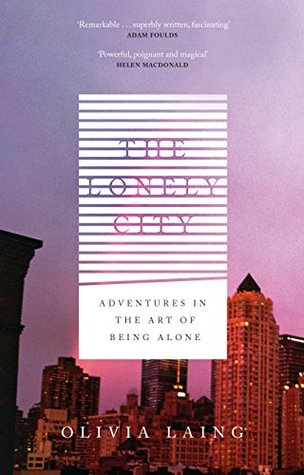 Whereas alcoholic writers were the points of reference for her previous book, the superb The Trip to Echo Spring (2013), here outsider artists take center stage: Edward Hopper, Andy Warhol, David Wojnarowicz, Henry Darger, and the many lost to AIDS in the 1980s to 1990s. It’s a testament to Laing’s skill at interweaving biography, art criticism and memoir when I say that I knew next to nothing about any of these artists to start with and have little fondness for modern art but still found her book completely absorbing.
Several of the artists shared underlying reasons for loneliness: an abusive childhood, mental illness and/or sexuality perceived as aberrant. Edward Hopper might seem the most ‘normal’ of the artists profiled, but even he was bullied when he shot up to 6 feet at age 12; his wife Jo, doing some amateur psychoanalyzing, named it the root of his notorious taciturnity. His Nighthawks, with its “noxious pallid green” shades, perfectly illustrates the inescapability of “urban alienation,” Laing writes: when she saw it in person at the Whitney, she realized the diner has no door. (It’s a shame the book couldn’t accommodate a centerfold of color plates, but each chapter opens with a black-and-white photograph of its main subject.)
Andy Warhol was born Andrej Warhola to Slovakian immigrants in Pittsburgh in 1928. He was often tongue-tied and anxious, and used fashion and technology as ways of displacing attention. In 1968 he was shot in the torso by Valerie Solanas, the paranoid, sometimes-homeless author of SCUM Manifesto, and ever after had to wear surgical corsets. For Warhol and Wojnarowicz, art and sex were possible routes out of loneliness. As homosexuals, though, they could be restricted to sordid cruising grounds such as cinemas and piers. Like Klaus Nomi, a gay German electro-pop singer whose music Laing listened to obsessively, Wojnarowicz died of AIDS. Nomi was one of the first celebrities to succumb, in 1983. The epidemic only increased the general stigma against gay people. Even Warhol, as a lifelong hypochondriac, was leery about contact with AIDS patients. Through protest marches and artworks, Wojnarowicz exposed the scale of the tragedy and the lack of government concern.
In some ways Henry Darger is the oddest of the outsiders Laing features. He is also the only one not based in New York: he worked as a Chicago hospital janitor for nearly six decades; it was only when he was moved into a nursing home and the landlord cleared out his room that an astonishing cache of art and writing was discovered. Darger’s oeuvre included a 15,000-page work of fiction set in “the Realms of the Unreal” and paintings that veer towards sadism and pedophilia. Laing spent a week reading his unpublished memoir. With his distinctive, not-quite-coherent style and his affection for the asylum where he lived as an orphaned child, he reminded me of Royal Robertson, the schizophrenic artist whose work inspired Sufjan Stevens’s The Age of Adz album, and the artist character in the movie Junebug (2005).
A few of the chapters are less focused because they split the time between several subjects. I also felt that a section on Josh Harris, Internet entrepreneur and early reality show streaming pioneer, pulled the spotlight away from outsider art. Although I can see, in theory, how his work is performance art reflecting on our lack of true connection in an age of social media and voyeurism, I still found this the least relevant part.

The American cover
The book is best when Laing is able to pull all her threads together: her own seclusion – flitting between housing situations, finding dates through Craigslist and feeling trapped behind her laptop screen; her subjects’ troubled isolation; and the science behind loneliness. Like Korey Floyd does in The Loneliness Cure, Laing summarizes the physical symptoms and psychological effects associated with solitude. She dips into pediatrician D.W. Winnicott’s work on attachment and separation in children, and mentions Harry Harlow’s abhorrent rhesus monkey experiments in which babies were raised without physical contact.
The tone throughout is academic but not inaccessible. Ultimately I didn’t like this quite as much as The Trip to Echo Spring, but it’s still a remarkable piece of work, fusing social history, commentary on modern art, biographical observation and self-knowledge. The first chapter and the last five paragraphs, especially, are simply excellent. Your interest may wax and wane through the rest of the book, but I expect that, like me, you’ll willingly follow Laing as a tour guide into the peculiar, lonely crowdedness you find in a world city.
(See also Laing’s list of 10 Books about Loneliness, chosen for Publishers Weekly.)
With thanks to Canongate for sending a free copy.
My rating: 
 Bookish Beck = Rebecca Foster. American transplant to England. Freelance proofreader and book reviewer.
 Bookish Beck