July Releases by Carson, Du Bois, Humphreys, Nolen & Watkins
This month I have novels set in the Mojave Desert and a Northern Ireland that never was; poetry about food and cross-cultural identity / adolescent boys and self-harm; and a short nonfiction book offering ideas for how to reconnect with nature. Repeated themes include environmental damage, Bible imagery and toxic masculinity.
Few and Far Between by Jan Carson
“So this is all true.”
“Historically true or made-up true?”
“What’s the difference?”
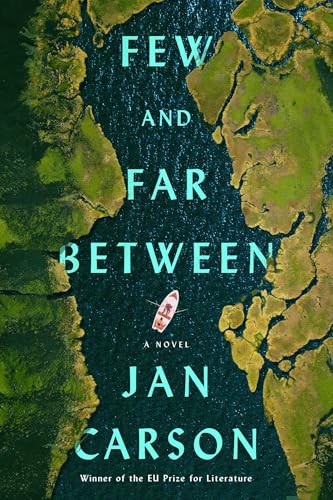 This was my first from Carson – and her U.S. debut – though she’s well known in Northern Ireland for her novels and short story collections. (Our own Cathy of 746 Books gets a mention in the Acknowledgements!) Her fourth novel is a work of alternative history with subtle magic realist touches. In 1958, Terrence O’Neill (shortly to be elected Prime Minister) proposed draining Lough Neagh to give Northern Ireland a seventh county. That never happened, but in the world of Carson’s novel it did, creating “the Ark,” an archipelago of islands in the large lake. It was primarily a refuge for people fleeing the Troubles – and also happens to provide a nice raft of allusions to the Book of Genesis. In 2017, middle-aged siblings Marion and Robert-John Connolly are two of the last few remaining residents of the Ark, working as caretakers. They grew up here with their overbearing anthropologist father and German mother. Rumour has it that the government will soon flood the lake to deal with an algae bloom. The Connollys hope that the arrival of Alex Anderson, a homegrown academic writing a history of the Ark, will be their chance to defend their home.
Carson has given careful attention to her worldbuilding here. Along with the previously inhabited islands are four on the “Far Side” that seem more metaphorical: Middle Flat houses “the Sleepers,” who are in a coma due to trauma (cf. Suzanne O’Sullivan’s The Sleeping Beauties); Church Flat is a sort of bardo for the “Almost Dead”; Tom’s Hard is a suicide spot; and Eglish Flat is where people go to bury things they don’t want anyone to know about. Except, like the return of the repressed made physical, all that detritus has been resurfacing. Excerpts from Alex’s manuscript in progress treat this all matter-of-factly, and before long it all feels completely natural. Flashbacks to the 1970s and 1990s fill in backstories for the oddball central characters, whose off-kilter upbringing keeps them tied to an island chain that harbours as many bad memories as good ones. This was intriguing for its blend of realism and fabulist elements; I never knew what was going to happen next. I’ll read more by Carson for sure.
With thanks to Scribner for the proof copy for review.
Eating Air by Suyin Du Bois
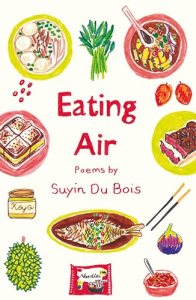 In this yummy debut poetry pamphlet, food is wrapped up with memory and serves as tokens of a mixed Chinese-Malaysian and Belgian identity. Sometimes when Du Bois is travelling in Asia, people assume that she is a total foreigner and bring her a fork instead of chopsticks, or remark on her bravery in trying dishes that are an acquired taste. In fact, she’s up for eating anything, no matter how spicy or unusual. Food can be about travel and adventure, but also about comfort and a sense of home. Family chats and celebrations revolve around good meals and drink: “We sate silence with stories / of firm favourites and elusive treats we long for”. A trip to London’s Chinatown entails more of that delicious alliteration and sibilance: “a pile of slender leaves serenades me with its many names: / eng chai, ong choy, kangkong, water spinach, morning glory.” I particularly loved the clever blend of cookery and family tradition in “Ode to Kaya,” where the quest for the perfect egg jam made with palm sugar and coconut milk brings back memories of a departed relative: “Goh Ee Poh has long since condensed / into photographs, so I sweeten my never-asked / regret, trace down someone else’s heirloom recipe.” These 19 poems are a feast, ranging widely across places, languages and cuisines.
With thanks to The Emma Press for the free copy for review.
Unwilded: Finding Our Way Back to Nature by Alastair Humphreys
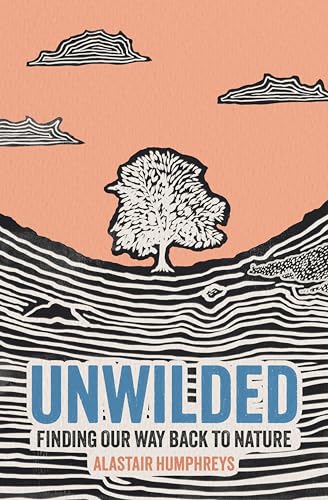 I discovered Humphreys’ work through his previous book, the Wainwright Prize-longlisted Local (and he’s now a judge for this year’s nature writing race). His wry, sometimes silly tone is reminiscent of Lev Parikian, and the two authors share a clear passion for the natural world and for enthusing others about its everyday wonders here in England. Humphreys opens with two recent events that reassured him that people care about nature: the public outcry that greeted the illegal cutting down of the famous Sycamore Gap tree at Hadrian’s Wall, and the joyful (if competitive) response to sightings of the Aurora Borealis. The former also serves as a cautionary tale of what happens when people are disconnected from nature: The two men convicted for the Sycamore Gap incident retorted that it was “just a tree.”
Humphreys doesn’t point fingers but acknowledges that the issue is systemic and affects all of us, even avowed countryside-lovers: “Our busy indoor lives, the moth-like lure of bright screens and shopping centres, and restricted access to much of our remaining green space all combine to make us more disconnected from the natural world than any previous generation.” Short chapters give strategies for various activities that, in as little as 15 minutes, could get people more engaged with the outdoors: litter picking, photographing the same tree every week for a year, foraging for blackberries, testing the water quality in a local stream, wild swimming, planting trees, and joining in a parkrun. I liked his idea of marking each full moon by enjoying a different spot by night. He also worked outdoors for one hour per day for a week, and dabbled in performance art through graffiti reading “15 Minutes to Nature” with an arrow or “NOTICE THIS TREE.” It’s easy to become disheartened by the scale of environmental problems, but Humphreys suggests choosing five to focus on, and then joining up with other local concerned citizens to work towards five corresponding mitigating actions. This is a readable and practical book written with a light touch. Like Lucy Jones’s Losing Eden, it ends with a utopian epilogue imagining humans living in harmony with a restored natural world. Let’s all keep living in hope, and doing our bit to make it a reality.
With thanks to the author and Eye Books for the free copy for review.
Afterlight by Caleb Nolen
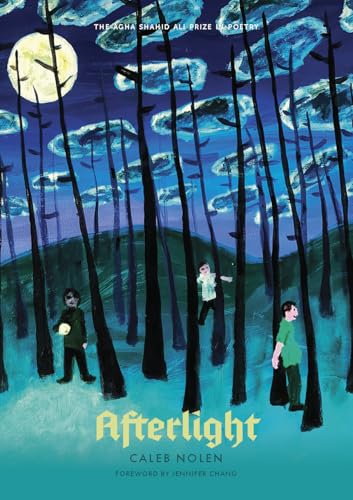 Nolen’s debut collection won the Agha Shahid Ali Prize in Poetry (the same award that my old blogger friend Carolyn Oliver won for her first book, Inside the Storm I Want to Touch the Tremble). It reflects on an early life marked by male friendship, addiction and other self-destructive behaviours, including suicidal ideation. The poet barely knew his father, who had a new wife and kids and treated meetings with his older sons as begrudged obligations. He and his high school friends snuck beer, weed and prescription pills. There were other even more dangerous things around, too –
from “First Gun”
A pistol, wrapped in an old shirt, hidden behind a panel
in his parents’ basement. When he brought it out to show us,
he held it carefully in both hands.
I was reading this collection at the same time as Michael Amherst’s The Boyhood of Cain, and the two chimed for their equation of expected masculinity with violence –
from “Letter to Cain”
My first consolation, my first friend,
tell me what you learned when the blood cried out:
who are we the keepers of, we who were not kept?
Nolen is 40, too young to have four dead friends – Bobby, Mike, Jonathan and Troy – threading through his memory. The book is rife with biblical references (“Jonah Years,” “Killing the Fattened Calf”), including letters addressed to particular figures: Abel, Job, the Woman Taken in Adultery, Paul the Apostle, Judas, the Man Possessed by Demons. Personal and religious history mesh, such that the quartet of departed friends are included alongside Mary of Oignies and the like in an Appendix of Hagiographies.
You’re making a life out of scribbling
the names of your dead friends.
This is a sombre collection that looks back with pain rather than nostalgia. Gentle alliteration and glimpses of nature help to make the vision of the past endurable.
With thanks to the University of Utah Press for the advanced e-copy for review.
Yellow Pine by Claire Vaye Watkins
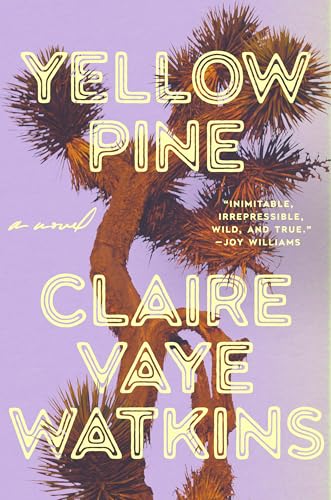 Watkins’s fourth work of fiction exudes love for a distinctive and endangered landscape: the deserts of the American West. Rose has worked for the Sierra Club and has a preteen daughter, Juniper, who lives with her father back east. The book opens with Miles, a former lover, returning to Rose’s life. Approaching age 40 and grieving her alcoholic mother’s untimely death, she finds herself yearning for a baby even though she feels it’s morally questionable to have children in a time of climate breakdown. If Miles won’t commit, she has a backup plan called “The Swirl” whereby male acquaintances will be invited to inseminate her after signing away parental rights. (Just the sperm, thanks; Rose will take care of the rest.) Meanwhile, she’s part of a loose group based at the Yellow Pine encampment, protesting the construction of a solar farm that would devastate local tortoise populations. The defenders’ impassioned conversations about how to work toward good in a time of corporation-driven extinctions are a highlight. It’s a bold, kooky, horny novel in the same vein as Melissa Broder’s Death Valley and Miranda July’s All Fours, but still manages an intellectual rigour and felicity of prose that I perhaps wasn’t expecting. Some sample lines:
It was surprisingly nice to be named a friend by the man who’d once poured salt on the slug of her heart
Rose and Miles sallied forth, trying again in Indian summer in a low-key failed state on a dying planet.
Love laid down a new layer. Rose’s despair patinaed with faith.
“I’m trying to be unapocalyptic. I’m trying to be practical.”
I’ve been reading Watkins since her debut story collection, Battleborn, won the Dylan Thomas Prize, though it’s her first novel, Gold Fame Citrus, to which I’m most partial. Her third book, I Love You but I’ve Chosen Darkness, went too far off the rails for me, whereas this one is a return to form. The outlook is a little bit woo-woo and I appreciated the environmental theme more than the indulgent autofiction framework. Still, it feels realistic and up-to-the-minute, positing human connection and purposeful collective action as antidotes to hopelessness. (“It wasn’t enough to be anti … You had to be for something.”)
With thanks to riverrun/John Murray (Hachette) for the free copy for review.
Which of these July releases have you read, or will you seek out now?
What am I missing out on?
A Publisher Party and a One-Man Play
I was a veritable social butterfly this past week: I went out two evenings in a row! (Believe me, that’s rare.) On Tuesday I met up with bloggers Annabel, Eric and Kim at the Faber Spring Party held at Crypt on the Green in London, and on Wednesday my husband and I attended a performance at the University of Reading of Michael Mears’s one-man play on the plight of Britain’s conscientious objectors during World War I, This Evil Thing.
Faber Spring Party
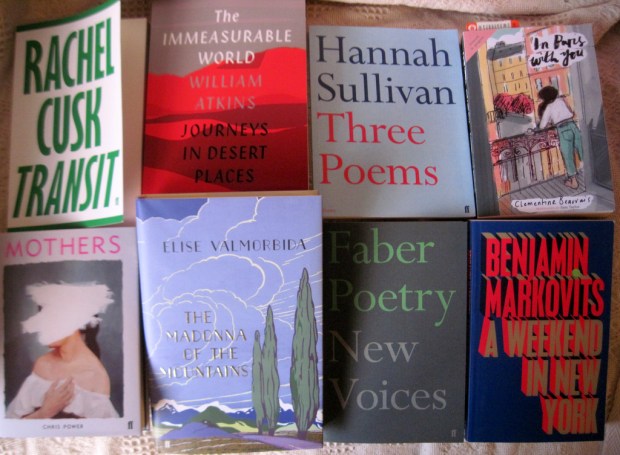
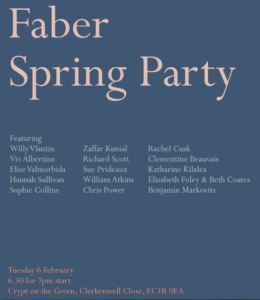 I’ve never been to an event quite like this. Publisher Faber & Faber, which will be celebrating its 90th birthday in 2019, previewed its major releases through to September. Most of the attendees seemed to be booksellers and publishing insiders. Drinks were on a buffet table at the back; books were on a buffet table along the side. Glass of champagne in hand, it was time to plunder the free books on offer. I ended up taking one of everything, with the exception of Rachel Cusk’s trilogy: I couldn’t make it through Outline and am not keen enough on her writing to get an advanced copy of Kudos, but figured I might give her another try with the middle book, Transit.

For the evening’s presentation, each featured author had a few minutes to introduce their new book and/or give a short reading.
Rachel Cusk opened the evening with a reading from Kudos. If you’re familiar with her recent work, you won’t be surprised at this synopsis: a man on a plane recounts having his dog put to sleep. (Out on May 3rd.)
William Atkins’s book on deserts, The Immeasurable World, is based on three years of travel and is, he is not ashamed to say, in the old-fashioned travel writing tradition. (Out on June 7th.)
Hannah Sullivan’s Three Poems is a hybrid work of poem-essays. #2 is more philosophical, she said; #3 is about her father’s death and her son’s birth. She read sonnet 3.21. (Out now.)
Clémentine Beauvais’s In Paris with You is a YA romance in free verse, loosely based on Eugene Onegin. I don’t know the source text but started this on the train ride home and it’s enjoyable thus far. I’m in awe at how translator Sam Taylor has taken the French of her Songe à la douceur and turned it into English poetry. (Out on June 7th.)
Chris Power’s Mothers is a book of linked short stories, three of which are about a character named Eva. He read a portion of a story about her having an encounter with an unpleasant man in Innsbruck. (Out on March 1st.)
Elise Valmorbida’s The Madonna of the Mountains, set in 1923–50, is a saga that resembles “an Italian Mother Courage,” she says. She read a scene in which a character comes across a madwoman. (Out on April 5th.)
Zaffar Kunial read the poem “Spark Hill” from his forthcoming collection Us. It’s about a childhood fight in the area of Birmingham where he grew up. He had a folder open in front of him but, impressively, recited the long poem completely from memory. (Out on July 5th.)
American novelist Benjamin Markovits was a professional basketball player in Germany for six months. Like the tennis-playing protagonist of his upcoming book, A Weekend in New York, he got tired of being measured. After 15 years, his hero is eager to escape a life of being constantly ranked. This is the first in a quartet of novels that inevitably invites comparison with John Updike’s “Rabbit” books. (Out on June 7th.)
I confess I didn’t previously know the name Viv Albertine; she was the guitarist for the female punk band The Slits, and To Throw Away Unopened is her second memoir. Albertine realized that it was her mother who had made her an angry rebel; the title is the label on a bag she found in her mother’s room after her death. (Out on April 5th.)
Sophie Collins incorporates hybrid forms in her poetry – what she calls “lyric essays.” The theme of her book Who Is Mary Sue? is perceptions of women’s writing (with “Mary Sue” as a metonym for the stereotypical good girl). She read from “Engine.” (Out now.)
Katharine Kilalea’s debut novel Ok, Mr Field is about an injured concert pianist who becomes obsessed with a house he buys in South Africa. (Out on June 7th.)
Elizabeth Foley and Beth Coates are the authors of two Homework for Grown-Ups books. Their new book, What Would Boudicca Do?, is about lessons we can draw from the women of history. For instance, the sampler booklet has pieces called “Dorothy Parker and Handling Jerks” and “Frida Kahlo and Finding Your Style.” There’s a heck of a lot of books like this out this year, though, and I’m not so sure this one will stand out. (Out on September 6th.)
Richard Scott read two amazingly intimate poems from his upcoming collection, Soho. One, “cover-boys,” was about top-shelf gay porn; the other was about mutilated sculptures of male bodies in the Athens archaeological museum. If you appreciated Andrew McMillan’s Physical, you need to get hold of this the second it comes out. I went back and read “cover-boys” in the sampler booklet and it wasn’t nearly as powerful as it was aloud; Scott’s reading really brought it to life, in contrast to some other authors’ dull delivery. (Out on April 5th.)
Sue Prideaux’s forthcoming biography of Friedrich Nietzsche is entitled I Am Dynamite! She encountered her subject when she wrote her first biography, of Edvard Munch. Although Nietzsche has been embraced by far-right groups in America, he was in fact against racism, nationalism, and anti-semitism, so he has important messages for us today. I’ll be keen to get hold of this one. (Out on September 6th.)
Guitar in hand, Willy Vlautin closed the evening with a performance of the title track from the soundtrack album to his fifth novel, Don’t Skip Out on Me – he was the singer in Portland, Oregon alt-country band Richmond Fontaine, which has recently stopped touring. He said the novel asks, “can you make the scars of broken people bearable?” (Out now.)

Now that I’ve got this terrific stack of books, wherever do I start?! I’m currently reading the Beauvais; from there I’ll focus on ones that have already been released, starting with Vlautin and the two poetry collections. The titles that aren’t out until June can probably wait – though it’s tempting to be one of the privileged few who get to read them nearly four months early. One Faber book per week should see me getting through all these by the final release date.
This Evil Thing
Michael Mears plays about 50 different characters in this one-man production. He’s an actor and pacifist who has written a number of solo pieces over 20 years. In this commemorative year of the end of the First World War, he knew we would hear a lot about battles, soldiers, and their families back home. But conscientious objectors weren’t likely to be remembered: theirs is a “story that’s rarely told,” he realized. This Evil Thing sets out to correct that omission. The title phrase refers not to war in general but specifically to conscription.
 The two main characters Mears keeps coming back to in the course of the play are Bert Brocklesby, a Yorkshire preacher, and philosopher Bertrand Russell. Brocklesby refused to fight and, when he and other COs were shipped off to France anyway, resisted doing any work that supported the war effort, even peeling the potatoes that would be fed to soldiers. He and his fellow COs were beaten, placed in solitary confinement, and threatened with execution. Meanwhile, Russell and others in the No-Conscription Fellowship fought for their rights back in London. There’s a wonderful scene in the play where Russell, clad in nothing but a towel after a skinny dip, pleads with Prime Minister Asquith.
As in solo shows I’ve seen before (e.g. A Christmas Carol with Patrick Stewart), Mears had to find subtle ways to distinguish between characters: he used a myriad different voices, including regional accents; he quickly donned a jacket, hat, or pair of glasses. Russell was identified by his ever-present pipe. The most challenging scene, Mears said in the Q&A at the end, was one with four characters in a French street café.
Mears reveals during the play that his grandfather fought in WWI and his father in WWII, but he has never had to put his own pacifist views to the test. What about Hitler? people always ask. Mears is honest and humble enough to admit that he doesn’t know what he would have done had he been called on to fight Hitler, or had he faced persecution as a CO in WWI. Ultimately, what Mears hopes audiences take from his play, which won acclaim at the Edinburgh Festival Fringe, is that “this is not an irrelevant piece of history.” Standing up for what you believe in, especially if it goes against the spirit of the times, is always valuable.
 Bookish Beck = Rebecca Foster. American transplant to England. Freelance proofreader and book reviewer.
