The Suspicions of Mr Whicher Stage Production
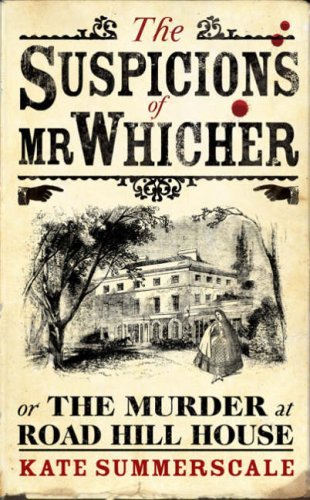
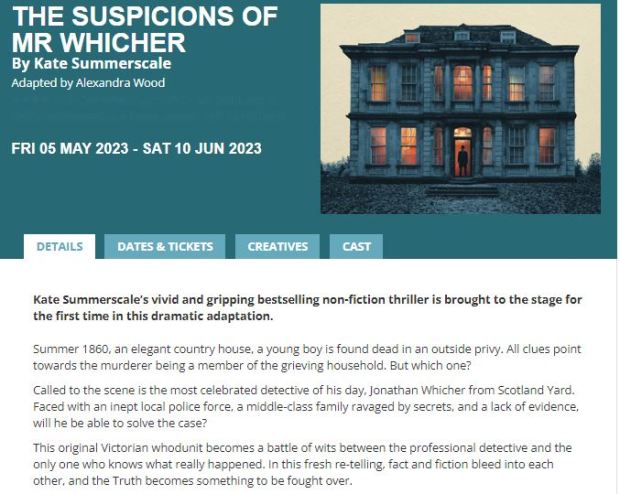
Just a few months after Notes from a Small Island, it was back to one of my local theatres, The Watermill, for the stage adaptation of another book club selection, this time the Victorian true crime narrative The Suspicions of Mr Whicher by Kate Summerscale, which won the Samuel Johnson Prize (now called the Baillie Gifford Prize) for non-fiction in 2008.
{SPOILERS ENSUE}
I must have read the book in 2009, the year after it first came out, and while I had the best intentions of rereading it in time for our book club meeting earlier this month, I didn’t even manage to skim it. I remembered one fact alone, the method of murder, which is not surprising as it was particularly gruesome: A young boy had his throat slit and was stuffed down the privy. But that was all that had remained with me. My husband filled me in on the basics and the discussion, held at our house, reminded me of the rest. We then made it a book club outing to the theatre.
The crime took place in late June 1860 at the Wiltshire home of the Kent family: the patriarch, a factory inspector; his four children from his first marriage; his second wife, formerly the older set’s governess; and their three young children. Jonathan “Jack” Whicher, sent by Scotland Yard to investigate, was one of London’s first modern detectives and inspired Wilkie Collins and Charles Dickens. Constance Kent, 16, later confessed to the murder of her three-year-old half-brother, Saville, motivated by anger at her stepmother for replacing her mentally ill mother, but uncertainty remained as to whether she had acted alone.
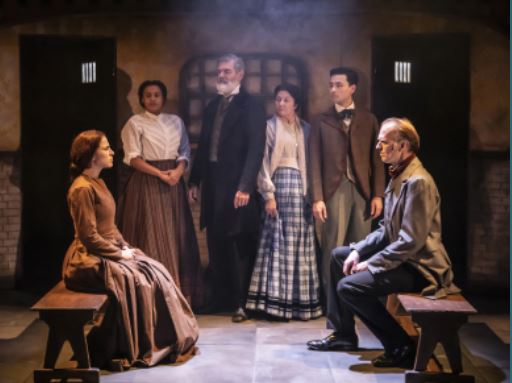
The play was very well done, maintaining tension even though there was a decision to introduce Constance as the killer immediately: the action opens on her and Mr Whicher in her cell at Fulham Prison in the 1880s. This is an invented scene in which he has come to visit, begging her to tell him the whole truth in exchange for him writing a letter to try to secure her early release. (She appealed four times but ended up serving a full 20-year sentence.)
Cold, stark lighting and a minimal set of two benches against a backdrop of steel doors and a mullioned window evoke the prison setting, with only the subtle change to warmer lighting indicating flashbacks as Constance and Whicher remember or act out events from 20 or more years before. These two remain on stage for the entirety of the first act. Four other actors cycle in and out, playing Kent family members and various other small roles. For instance, the bearded middle-aged actor who plays Mr Kent also appears as a coroner giving a precis of Saville’s autopsy – he mentions Collins and Dickens, but the evolution of the Victorian detective is, by necessity, a much smaller element of the play than it was in the book.
It’s a tiny theatre, but projections on a screen (such as a sinuous family tree) and a balcony, used for wordless presence or loud pronouncements, made it seem bigger than it was. Saville himself is only depicted as a mute figure on that upper level, in the truly spooky scene that closes the first act. I remember when the Watermill put out a discreet call for child actors, warning parents about the sort of content to expect. Three children play the role (plus one other bit part) in rotation. Pulsing violin music enhanced the feeling of dread, and each act was no more than 45 minutes, so the atmosphere remained taut.

Production photographs by Pamela Raith.
A missing nightdress – presumably blood-stained – as well as her own father’s hunch, were among the main evidence against Constance, so Whicher did not secure a conviction at the time and was publicly ridiculed for his failure to crack the case. That and his own loss of a child are suggested to be behind his obsession with tying up loose ends. While Constance expresses regret for her actions and calmly takes him through the accepted timeline of the murder, she refuses to give him anything extra.
The second act delves into what happened next for Constance: living among nuns in France and then in Brighton, where she decided to confess, and then relocating to Australia, where she worked in a halfway house for lepers and troubled youth, as if to make up for the harm she caused earlier in her life (and she lived to age 100!). This involved the most significant change of set and actors, with the former Mr. and Mrs. Kent now filling in as the older Constance and William, the brother closest to her in age.
The play fixates on the siblings’ relationship, returning several times to their whim to run away to Bristol and be “cabin boys” together. I wondered if there was even meant to be a sexual undercurrent to their connection. William Savill-Kent went on to be a successful marine biologist specialising in corals and Australian fisheries. One theory is that they were accomplices in the murder but Constance took the fall so that her brother could live a full life.
Intriguingly, the team behind the production decided to espouse this hypothesis explicitly. In the chilling final scene, then, a crib is wheeled out to the centre of the stage and Constance floats on in a white nightdress to lower the side closest to the audience. Just before the lights go down, William, too, appears in a white nightdress and stands over the far side of the crib.
Although I referred to the book as “compulsive” in the one mention I find of it in my computer files, from 2011, I only gave it 3 stars – my most common rating in those years, an indication that a book was alright but I moved right along to the next in the stack and it didn’t stick with me. My book club had mixed feelings, too, generally feeling that there was too much extraneous detail, which perhaps kept a narrative that could have read as fluidly as a novel from being truly gripping. The play, though, was thrilling.
Book (c. 2009): 
Play: 
Buy The Suspicions of Mr. Whicher from Bookshop.org [affiliate link]
Paul Auster Reading Week: Winter Journal & The New York Trilogy
Before this year, I’d read only one book by Paul Auster: Timbuktu, which fit into last year’s all-animal 20 Books of Summer for its canine main character. This year I’ve enjoyed having Annabel’s Paul Auster Reading Week as an excuse to binge on more Auster, including one of his memoirs, Winter Journal, and his most famous set of novels, the New York Trilogy. I’m reading another two Auster books, one fiction and nonfiction, and will see if I can finish and write them up before the week ends.

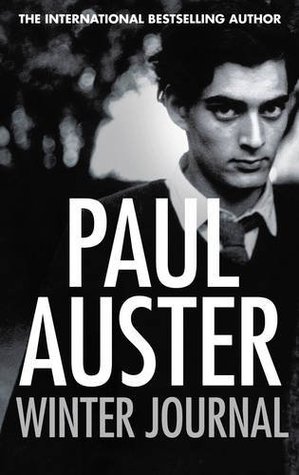
Winter Journal (2012)
This is one of the most remarkable memoirs I’ve ever read. Approaching age 64 and the winter of his life, Auster decided to assemble his most visceral memories. Here he parades them past in a seemingly random order yet manages to give a sense of the sweep of his life. The use of the second person draws readers in to (re-)experience things along with the author, while also creating an artistic distance between the subject and his reminiscences. Auster describes his aim thus:
Time is running out, after all. Perhaps it is just as well to put aside your stories for now and try to examine what it has felt like to live inside this body from the first day you can remember being alive until this one. A catalogue of sensory data. What one might call a phenomenology of breathing.
 His life reappears through scars, through accidents and near-misses, through what his hands felt and his eyes observed. A three-year-old rips his cheek open on a protruding nail in a department store. A teenager slowly builds up a portfolio of sexual experiences. A young man lives and works in Paris and the South of France. A marriage to one fellow author (Lydia Davis) ends and a relationship with another (Siri Hustvedt) begins. A fiftysomething rushing to get home to the toilet makes an ill-advised turn against traffic and totals his car – luckily, he and his family escape unhurt. Numbness after his mother’s death cedes to a panic attack.
I particularly enjoyed the 53-page section in which Auster gives tours through the 21 places he’s lived since infancy, recounting the details he remembers of the dwellings and what happened during his time there. It’s impressive how much he can condense, but also how much he can convey in just a few pages on each home. This is the sort of format I could imagine borrowing for a short autobiographical piece – it would be a way of redeeming that involuntarily nomadic period when my husband and I moved every six to 18 months.
Reading this alongside the New York Trilogy allowed me to spot the ways, big and small, in which those novels draw on Auster’s life story. I’m now keen to read more of his nonfiction, especially The Invention of Solitude, which offended his relatives by revealing the shameful family story of how his grandmother shot and killed his grandfather in their kitchen. 
Annabel says: “The book is written in the second person – addressing himself; it gives a real sense of intimacy to his story. … Auster is an unconventional, analytical and eloquent writer, and this unconventional memoir was a delight to read, he can look with humour at himself as well as being serious.”
Laura F. says: “You know how people say they’d read anything by their favourite author, even a grocery list? Winter Journal gets pretty close to that territory. … I’ve never read a memoir like this, and though focused on the physical, it’s a fully emotional experience.”
Some favorite lines:
“as long as you continue to travel, the nowhere that lies between the here of home and the there of somewhere else will continue to be one of the places where you live.”
“We are all aliens to ourselves, and if we have any sense of who we are, it is only because we live inside the eyes of others.”
“you can only conclude that every life is marked by a number of close calls, that everyone who manages to reach the age you have come to now has already wriggled out of a number of potentially absurd, nonsensical deaths. All in the course of what you would call ordinary life.”
Readalikes: I Am, I Am, I Am by Maggie O’Farrell & The Lost Properties of Love by Sophie Ratcliffe
The New York Trilogy
(also my Doorstopper of the Month at 580 pages)
City of Glass (1985)
 A metafictional mystery about a crime writer named Daniel Quinn who turns private investigator when he gets a phone call asking for the Paul Auster Detective Agency. This is one of those books where what actually happens is a lot less important than the atmosphere it creates. So what feels essential to me here is the sense of a labyrinthine New York City and a confusion of languages and relationships. Quinn, who is helpfully untethered after the death of his wife and son, is hired to tail Peter Stillman’s father, who has recently been released from a mental hospital, where he was sentenced after being judged insane for keeping his son in isolation in a dark apartment for nine years.
Feral children, maps, eggs, the Tower of Babel and Don Quixote are some of the recurring sources of metaphors in a deliberately disorienting and intertextually rich short novel that kept me turning the pages even when I didn’t know precisely what was going on. We get a glimpse of Auster himself, and are invited to muse on such tiny subjects as destiny, the limitations of language, the purpose of books, and the nature of truth. I’m curious to see whether the other two novels follow on from the story at all or just resemble it thematically.
Ghosts (1986)
I jumped straight into this from City of Glass, and it suffered by comparison. It is not a sequel per se, because it has different characters and is set in the late 1940s instead of the early 1980s, but it shares some of the same concerns (with literature, identity, doubling, the essential otherness of the writer, and so on) and again is a sort of metafictional mystery.
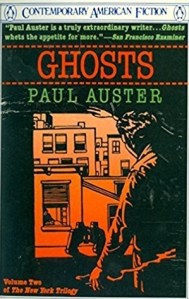 Part of why I couldn’t take this novella entirely seriously is the silly naming: White hires Blue to trail Black (really; all of the secondary characters are named after colors, too). It turns out Black is a writer who does little besides sit in his apartment, writing. Only when Blue disguises himself as a tramp and then as a salesman and meets Black in various other contexts does he realize that Black, too, is an investigator … writing up a case of following a writer who hardly leaves his desk.
While I appreciated the circularity and the uncertainty over whether these accidental twins would destroy each other, as well as the literary references to Whitman, Thoreau and Hawthorne, the whole felt slightly inconsequential (“Blue watches Black, and little of anything happens.”). Plotlessness is part of the point, but makes for only a moderately interesting read.
[There is one coded reference to Auster here: the fact that the book opens on February 3, 1947, the day he was born.]
The Locked Room (1986)
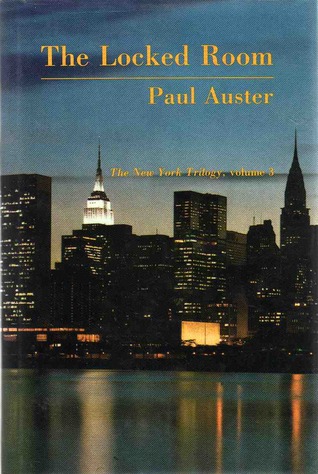 While most of the New York Trilogy is told in the third person, this is a first-person narrative that seems to pick up where City of Glass left off. It begins in 1977, when the unnamed narrator gets a letter from Sophie Fanshawe, the wife of his childhood best friend, telling him that Fanshawe disappeared six months ago, and despite the best efforts of a detective, Quinn (in another link to CoG, the narrator encounters Peter Stillman on a later trip to Paris), no trace can be found. The narrator has been named Fanshawe’s literary executor and takes it upon himself to get the man’s unpublished work out into the world: plays are produced, novels are published. He also starts writing a biography of the friend he always envied.
Except it’s more like he’s becoming Fanshawe, especially when he marries Sophie. Doubling has been a major theme of the trilogy, and here the metaphorical kill-or-be-killed situation seems to turn literal at the conclusion, which I didn’t particularly understand (e.g. he acquires and destroys a red notebook – is this in some way meant to be the same red notebook Quinn left behind at the end of CoG?). The narrator presents himself as the author of all three books, and asserts, “These three stories are finally the same story, but each one represents a different stage in my awareness of what it is about. I don’t claim to have solved any problems.”
The metafictional aspect of this novel is that Fanshawe’s early life is a lot like Auster’s as revealed in Winter Journal, while Sophie’s resembles his wife Siri Hustvedt’s (and the pair would later name their daughter Sophie). 
 Themes of the trilogy:
- Identity complications, including disguises, doubles and substitutes
- Writers and writing; the creator versus characters
- The limits of language (e.g. Stillman’s monologue in CoG is astonishing)
- Freedom/randomness versus fate
One representative passage from each volume:
- “New York was an inexhaustible space, a labyrinth of endless steps, and no matter how far he walked, no matter how well he came to know its neighbourhoods and streets, it always left him with the feeling of being lost. Lost, not only in the city, but within himself as well. … New York was the nowhere he had built around himself” (City of Glass)
- “Writing is a solitary business. It takes over your life. In some sense, a writer has no life of his own. Even when he’s there, he’s not really there. / Another ghost. / Exactly.” (Ghosts)
- “In the end, each life is no more than the sum of contingent facts, a chronicle of chance intersections, of flukes, of random events that divulge nothing but their own lack of purpose.” (The Locked Room)
My rating for the trilogy as a whole:
 Bookish Beck = Rebecca Foster. American transplant to England. Freelance proofreader and book reviewer.
 Bookish Beck