Late Summer Novels (Bamford, Ellis, Hornak, King) & Poetry Collections for the Transition into Autumn (Hurst, McNish, Plath)
It’s been feeling autumnal for a few weeks now with the drizzle, chilly mornings and evenings, honking of geese overhead, and harvesting our last garden apples – though it remains warm and summer only officially ended on Monday. I’ve recently finished off a summer-titled trilogy and the second entry in a seasonal quartet. I’m also throwing in a couple fun novels I bought earlier in the year.
Before and after Tuesday’s autumn equinox, a few poetry collections have been my fitting companions for the start of a new season.
Idle Grounds by Krystelle Bamford (2025)
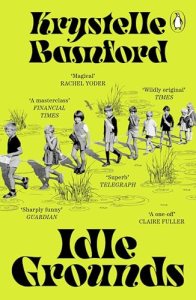 “The following is an account of an afternoon in June in which we sallied forth, and then, for the most part, back.” I was drawn in by the mock-heroic first-person plural voice of a gaggle of cousins at a New England family get-together. It’s 1989 and they’re here for one of the adults’ birthdays, but that’s of no concern to the kids, who are a world unto themselves. In the first chapter, three-year-old Abi goes missing and the rest set out on a quest to rescue her. The shed, the woods, a driveway full of cars, the river: every setting seems to offer adventure, but maybe also danger. And then the oldest boy cousin, Travis, vanishes too. “Intermezzo” chapters offer snippets of family lore – about their grandmother Beezy’s awful novel, The Lilac Swing, and so on – that don’t add much of interest to this meandering novella. To deliver on the promise of the narrative voice, Bamford needed to give her debut a little more: more intrigue, more pivotal scenes, more closeness to a few characters rather than surface descriptions of a bunch, maybe more pages to make something of the not-so-momentous family secrets. As it is, I had to agree with this tongue-in-cheek line on p. 136: “in our depleted state, we thought the very thought you’re thinking now, which is enough already.” (New purchase with voucher – Hungerford Bookshop)
Book 3 of The Summerhouse Trilogy
The Fly in the Ointment by Alice Thomas Ellis (1989)
{BEWARE SPOILERS!}
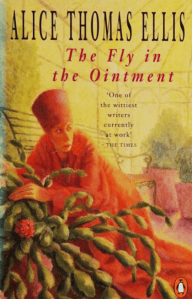 Following The Clothes in the Wardrobe (1987) and The Skeleton in the Cupboard (1988), this novella revisits the run-up to Margaret and Syl’s wedding from Lili’s perspective. It’s the shortest of the three books and adds no new plot details or real character insight, but Lili’s voice is alluring all the same. She’s an incorrigible flirt, or perhaps what we would now call a love (not necessarily sex) addict: “Sometimes I felt I would disappear if I couldn’t see the person opposite falling in love with me. I just wouldn’t be there.” Lili is pivotal to the narrative because of her well-meaning interventions: first, she falsely portrays the coming union as blessed by creating a fake (tissue paper) bloom for the cactus in the summerhouse; then, in agreement with other characters such as Mrs Monro that there shouldn’t be a wedding after all, she decides to sabotage it by ensuring that she and Syl be caught in flagrante in the summerhouse. While this was an interesting project for Ellis to undertake, the first volume was by far my favourite and I didn’t think the second and third wholly necessary. (Secondhand – Regent Books, Wantage)
So Good to See You by Francesca Hornak (2025)
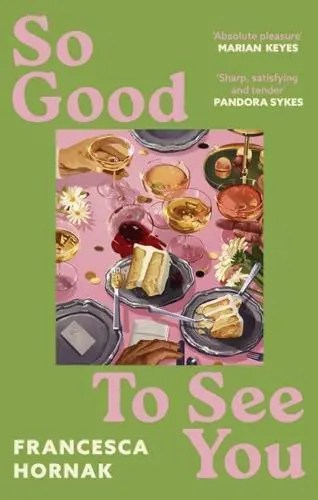 Daniel, Rosie and Serge were good friends at Oxford but since their graduation in 2004 they’ve drifted into indifference and resentment. Daniel is a Hollywood star but still can’t forgive filmmaker Serge for stealing his idea for a biopic of a working-class lad. Serge is on a break from his relationship with Isla, a younger movie makeup artist with whom he has twins. Rosie regrets that her on-again, off-again relationship with Serge meant she wasted prime years. In August 2019, they’re all brought together for Serge’s cousin Caspar’s big gay wedding in Provence. The Campbell cousins come from inherited wealth, but no one knows Serge’s production company is heavily in debt. As best man and “best woman,” Serge and Rosie have to write a joint speech; Daniel has to hide his dependency on alcohol and drugs.
This is a light, Taylor Jenkins Reid-esque soap opera that I swallowed in big gulps. I’d enjoyed Hornak’s Christmas-set debut, Seven Days of Us (2017), but when I looked back at it I realised how identikit the two are: set mostly over a matter of days, with each chapter marked by a precise place and time stamp. I guess she hit on a winning formula and decided to repeat it, but I was disappointed to notice the similarity. In this case, zooming in slows the action and makes the book feel overlong, though it’s perceptive about class, privilege, disappointment, the longing for parenthood, and loyalty among family and friends. (Her previous novel now seems almost prescient with its depiction of a Christmas in quarantine! Perhaps I’ll reread it.) (New purchase with voucher – Hungerford Bookshop) 
Apt Pupil by Stephen King (1982)
(Novella published in Different Seasons under the heading “Summer of Corruption”)
{BEWARE SPOILERS!}
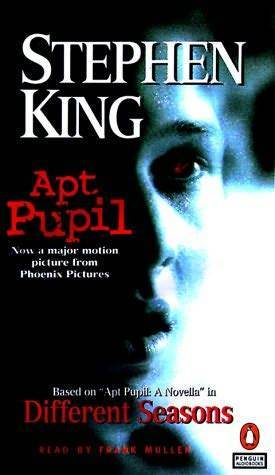 Thirteen-year-old Todd Bowden becomes obsessed with his elderly neighbour, whom he has identified as German concentration camp officer Kurt Dussander, in the summer of 1974. His parents think that he goes over to read to “Mr. Denker,” but in fact he’s extorting sordid war stories out of the old man. When Todd’s grades nosedive, Dussander agrees to impersonate his grandfather at a conference with the school counsellor so his parents remain oblivious. Now each has dirt on the other; blackmail goes both ways. The book suggests Dussander’s ongoing sadism sparks something inexorable in the young man, and both engage in further senseless carnage. I wasn’t sure if it was respectful of King to treat the Holocaust like a contagious sin. As Todd’s (real) grandfather says, “Sometimes the past don’t rest so easy. Why else do people study history?” I don’t think an editor would have let the story stand today. This is not as full-on horror as others I’ve read by King (Misery and Pet Sematary), but still gruesome and – for an animal lover like me – Dussander’s torture of cats and dogs was harder to read about than the murders of unhoused people. A neat connection back to Rita Hayworth and Shawshank Redemption, which I read back in the spring: Dussander mentions that “The banker who bought [the stocks] for me went to jail for murdering his wife a year” later in Maine. (Little Free Library)
Three on a Theme: Autumnal Poetry
Keats described autumn as the season of “mellow fruitfulness,” as I was reminded by Kate Mosse’s Autumn. Fruit and feminism are themes that link these three collections. All:
The Fox’s Wedding by Rebecca Hurst (2022)
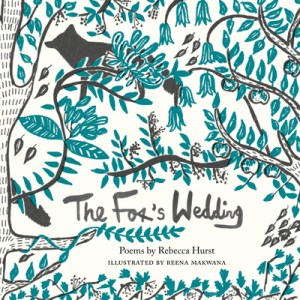 I’ve read Hurst’s debut full-length collection, The Iron Bridge, and jumped at the chance to catch up on her previous chapbook. Its hint of fairy tale menace feels appropriate for early spooky season. A witch turns into a hare and flees in “Familiar.” The girl who will win the hand of “The Frog Prince” spends her evenings “squashing worms and slugs and snails beneath / the crêpe soles of her black school shoes.” Needlecraft recurs: “Once there was a child/ who woke alone in the forest. … S/he took the path of needles / to ask needle-sharp questions.” There are folktale rhythms to “Brothers,” which also mentions gingerbread men. The woods morph with the advance of the year (“let the seasons pleat / folding one year to the next”) and hide creatures real and imagined. “Now it is Michaelmas: the land sun-warm, / fields shorn, blackberries ripe to bursting.” The atmosphere of this pamphlet – defiant, magical, mischievous – casts a spell. (New purchase from The Emma Press)
Plum by Hollie McNish (2017)
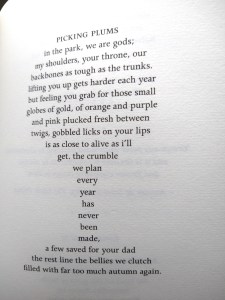
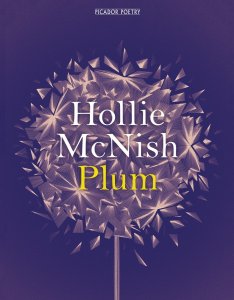 A late tree-shaped poem captures a treasured ritual with her daughter. But if I tell you that “plum” is also the last in a long string of euphemisms for female genitalia in “Voldemort,” that will give a better sense of McNish’s tone, which is often cheeky and snarky. She includes poems she wrote as a child and teenager but also remembers her adolescence from adulthood, pinpointing moments of peer pressure and misogyny that she experienced. She wishes she and her friends had been less obsessed with what boys thought of them and hopes to teach her daughter to stand firm in her own identity. McNish has local roots and is known for her conversational memoirs and her spoken word poetry. Like Harry Baker, Jay Bernard and Kae Tempest’s works, it’s probably not best encountered in print. In performance, fairly simple and repetitive phrasing can come to life. (Secondhand – Library book sale)
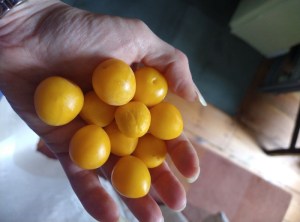
I spend the summer months watching like a hawk for when wild and waste-ground plums ripen and fall so I can scurry around gathering them to eat or freeze for autumn and winter desserts. Our cherry plum tree produced its first fruits this year, too (below).
Crossing the Water by Sylvia Plath (1971)
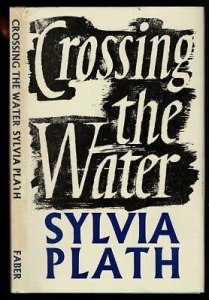 I got less out of this posthumous collection than I did from Ariel and Winter Trees, but there are still striking turns of phrase: “The future is a grey seagull / Tattling in its cat-voice of departure, departure” (from “A Life”) and “At our feet, the weed-moustachioed sea / Exhibits its glaucous silks” (from “Whitsun”). Canada, age, sleep, surgery: the imagery feels a little all over the place. The stand-out poems for me were “Small Hours,” in which marble statues metaphorically watch over the speaker’s troubled insomnia, and “Mirror,” which reflects the unstoppable advance of age and contrasts true self with appearances. Most redolent of autumn were a poem about pheasant hunting and “Blackberrying”:
Nobody in the lane, and nothing, nothing but blackberries,
Blackberries on either side, …
A blackberry alley, going down in hooks, and a sea
Somewhere at the end of it, heaving. Blackberries
Big as the ball of my thumb
The Devon lanes aren’t so empty these days, I can attest! A line from “Last Words” ties in perfectly and is a good resolution for us all: “I should sugar and preserve my days like fruit!” (University library)
I started my preserving late and will not do as much as I have in other years. So far I’ve made apple and tomato chutney and set some rosehip cordial steeping. This afternoon I’m going to attempt rosehip curd – we found a jar of “hagebutten” in a Berlin supermarket this time last year and it was so delicious that we’re going to try to recreate it, though it requires laborious deseeding and mincing plus two boiling stages. More Vitamin C than orange juice, apparently!
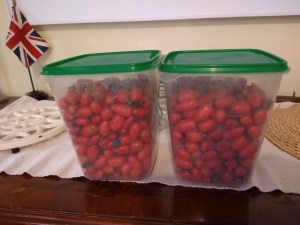
Rosehips ready for preserving!
Summer Reads, Part I: Buti, Ellis, C. Foster (Reread), Itami, Thomson
The less said about the summer of 2026, the better. It feels like the heat wave will never end. We’ve had 4 mm of rain the whole month. Drought imperils so much. But it’s not right to complain when wildfires rage not so far away. One glance at the news headlines and there’s no avoiding the signs of climate breakdown everywhere. I can’t bear it. I just keep reading.
Year of the Drought by Roland Buti (2015; 2017)
[Translated from French by Charlotte Mandell]
How exhausting was that summer of 1976, always beating down on our heads!
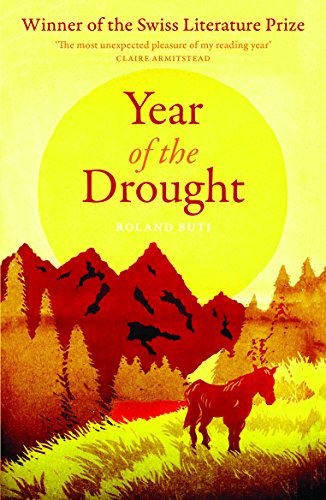 This Swiss novella takes place during the infamous European heat wave that people still talk about half a century later. It’s a perfect febrile setting for 13-year-old Gus’s coming-of-age, which includes a sexual awakening and the dawning realisation that his parents aren’t perfect; that in fact his family is falling apart. The Sutters’ operations embody the move from family smallholding to an industrial model. They keep a small number of cattle but are also experimenting with large-scale henhouses holding thousands of birds. In contrast with that vast flock, about whose welfare the characters seem indifferent, is an injured white dove that Gus finds and keeps as a pet. (A wise choice by Buti: it’s easier to feel compassion for an individual, such as the dove or the old farm horse, Bagatelle, than for a faceless mass.) Helping Gus and his father on the farm is distant cousin Rudy, who has Down’s syndrome; disrupting their routines is Cécile, Gus’s mother’s friend, who has come to stay with them.
Because of the drought, our minds were full of dreams of coolness and moisture
Dreams of rain, dreams of love, dreams of preserving some mythical family happiness that maybe never existed. Like the weather, everything goes wrong – in tragic ways. It’s all so awful I recoiled. Buti jumps ahead several decades to offer a longer view of the land, but I couldn’t ignore how casually the teenage Gus adopted his father’s violent, misogynistic ways. None of what happens bodes well for the future. The one laugh I got out of the experience was the charity shop accidentally labelling the book “Romance fiction.” (Secondhand – BHF, Newbury)
Book 1 of The Summerhouse Trilogy
The Clothes in the Wardrobe by Alice Thomas Ellis (1987)
 I hadn’t had great luck with Ellis, fiction and nonfiction, before, but I’m so glad I was tempted by this omnibus edition and tried her again. This melancholy, introspective novella was right up my street. Margaret’s yearning for her Egyptian upbringing isn’t the only reason I reached for Moon Tiger as a readalike; Ellis’s tone reminded me of Barbara Comyns and Penelope Lively for its mix of cynicism and nostalgia. Margaret is soon to marry Sylvester, though she doesn’t love him at all and he’s closer to her mother’s age as well as a known womanizer. Perhaps the engagement was her mother’s idea more than her own? The title is an apt symbol for living to someone else’s expectations: “my life fitted me as ill as a garment designed for somebody else,” Margaret thinks. It’s no coincidence that she’s to be married in her mother’s old wedding dress. There are also sartorial metaphors around memory (“Did the elderly have minds like old wardrobes stuffed to overflowing…”) and resistance to ageing. I marked out so many shrewd observations and witty conversations. I empathized with Margaret’s feeling of being trapped in a life she hasn’t chosen.
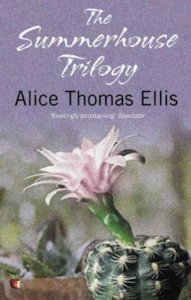 It seems like one of those books where nothing will happen, but there’s actually a surprise ending that looks set to move Margaret onto a different track. As I understand it, the other two volumes repeat the weeks leading up to the wedding from other perspectives: Margaret’s staid mother-in-law-to-be; and her mother’s bohemian friend Lili, who was her bridesmaid back in Egypt and arrives in time to shake things up. I love that premise. The omnibus cover seems random, but the question of whether the cactus in the summerhouse will flower as good luck for the wedding becomes an important plot point. I’ll jump right into Book 2. (Secondhand – Regent Books, Wantage)
The Screaming Sky by Charles Foster (2021)
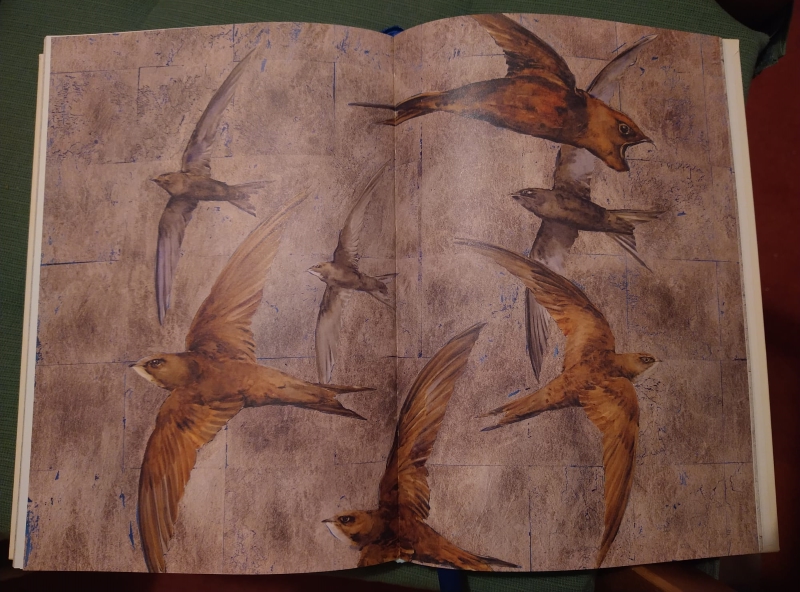
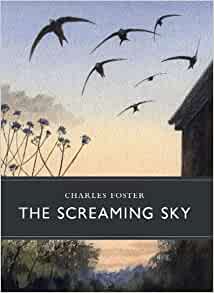 The only thing that has redeemed these dry, scorching days is the swifts screeching across the sky. How can it be that I was once unaware of them? How is it possible for people not to look up for these noisy acrobats whenever they’re outdoors? Somehow, I was oblivious until maybe 10–15 years ago. Now, I always have at least one eye on the sky during these crucial few months. And although this year swifts have been with me since early April (first in Portugal and then in our neighbourhood), I’m already dreading their departure for Africa in a few weeks. They’re still here! I trill to myself each morning. But soon that won’t be true. And with populations in freefall, there may come a day when they don’t return to the UK at all.
Charles Foster is a kindred spirit who sets similar emotional store by the presence or absence of the common swift (Apus apus). I appreciated this when I first read it five years ago (my review), but all the more so now. The monograph takes us through one year with swifts. In the summer, he needs travel no further than his own street in Oxford, but the rest of the time he has to chase them down in continental Europe and central and southern Africa. It’s an old-fashioned quest, a romantic pursuit, a hopeless attempt to keep hold of creatures as fast and elusive as the wind. Foster salts his narrative with all the salient facts but acknowledges that, for all we claim to know about them, these birds retain an essential magic and mystery. “Their power, freedom and joy are the way that everything really is – though we don’t usually see it. It is just that when the swifts scream through the sky, you can’t miss it. That’s how everything, all the time, is meant to be.” (Review copy from Little Toller Books)
My original rating:
My rating now: 
Bonus content:
From Robert Macfarlane’s The Book of Birds (illus. Jackie Morris):
From the Spell Songs album Let the Light In: “Swifts”
& My current earworm, also featuring Kris Drever: a more general reassurance – or at least philosophical acceptance – that change is the one constant in life, in perfect pop song form (“Change”)
And from Ugandan poet Nick Makoha’s The New Carthaginians: “in the first part of the night, I saw the coastal villages, men arguing / about the price of oil and swifts darting into shadows.” (from “Codex© of Birds”)
Kakigori Summer by Emily Itami (2025)
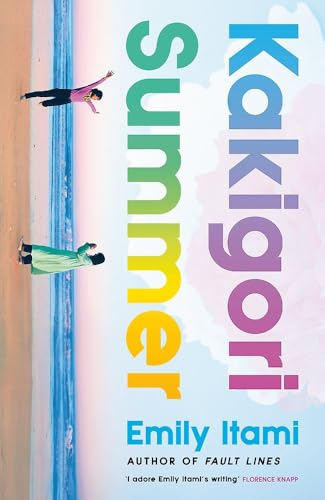 Itami was shortlisted for a Costa Award for her enjoyable 2021 debut, Fault Lines. Kakigori is a flavoured shaved-ice dessert and it’s a great choice of title for this bittersweet – but mostly sweet – story of three sisters raised between Tokyo and London who reunite in Japan to spend a summer together with their prickly great-grandmother, Obaachan, who’s nearing 100. Narration alternates between Rei, the oldest, who has a high-flying finance job and keeps everyone in line; Kiki, who’s a single mother and works in a care home for the elderly; and Ai, a flighty pop star now in disgrace for her affair with a married man. Although there is much joy in their banter, little Hikaru’s antics, and the pursuit of the finest culinary treats, a shadow over it all is their mother’s unexplained death. She went for a swim one day when they were girls and never came back, nor was a body ever found; they have to suspect suicide. (“Well, that’s that, then. Nothing will be all right ever again.”) This easy-reading novel affirms the goodness of life despite the reality of death. Its typically Japanese feasts and funerary rites brought to mind Bryan Washington’s similarly well-balanced Memorial. My only note would be that I’m not sure the voices were distinctive enough to warrant three first-person narrators; third person rotating would probably have done the job. (Public library)
Saltwater: A Midsummer Ghost Story by Elaine Thomson (2026)
“The dead are closer than we think.”
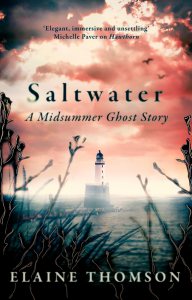 I hadn’t heard of the Scottish island of Stroma, so assumed it was made up. In fact, it’s real, lying between Orkney and the north coast of Caithness on mainland Scotland, but uninhabited as of 1962. Tom Torrance travels by train and boat from Edinburgh a few days before midsummer to oversee the last steps in the construction of the island’s lighthouse and meet with Mr Stevenson (of the famous lighthouse-building clan, which included novelist Robert Louis Stevenson). With him is his brother Jamie; he’s not of much practical help, but they cling to each other because they lost their mother to tuberculosis a week ago. The travelling minister Tom meets on the train gives him a rowan-wood amulet and cautions him that midsummer is a liminal time when the spirit world is close at hand. Tom doesn’t heed the warning. He arrives to find a disaster-prone construction project that has entailed serious injuries and broken machinery. Flora Christie and her grandmother, Thrawn Jean, are local women with healing powers who are treated with suspicion: women, especially those with red hair, are considered bad luck around boats. The men want to seal a “witch bottle” into the wall for good luck. He dismisses their superstitions but at the same time keeps seeing hallucinations of the dead in the waves and on the in-construction edifice. Is it grief, Flora’s special whisky, or a real taste of the supernatural?
This was highly reminiscent of Michelle Paver’s work. The typical Victorian-pastiche ghost story bores me because it’s always just the same: the narrator is a dignified gentleman who can’t possibly be seeing such things, yet documents them and his own horror with great precision. Thomson set herself an interesting challenge, writing a quartet of Scottish ghost stories set at turning points of the year. (This is the second, after Hawthorn.) I probably won’t try the others unless my library acquires them. (Public library)
Paul Auster Reading Week: Winter Journal & The New York Trilogy
Before this year, I’d read only one book by Paul Auster: Timbuktu, which fit into last year’s all-animal 20 Books of Summer for its canine main character. This year I’ve enjoyed having Annabel’s Paul Auster Reading Week as an excuse to binge on more Auster, including one of his memoirs, Winter Journal, and his most famous set of novels, the New York Trilogy. I’m reading another two Auster books, one fiction and nonfiction, and will see if I can finish and write them up before the week ends.

Winter Journal (2012)
This is one of the most remarkable memoirs I’ve ever read. Approaching age 64 and the winter of his life, Auster decided to assemble his most visceral memories. Here he parades them past in a seemingly random order yet manages to give a sense of the sweep of his life. The use of the second person draws readers in to (re-)experience things along with the author, while also creating an artistic distance between the subject and his reminiscences. Auster describes his aim thus:
Time is running out, after all. Perhaps it is just as well to put aside your stories for now and try to examine what it has felt like to live inside this body from the first day you can remember being alive until this one. A catalogue of sensory data. What one might call a phenomenology of breathing.
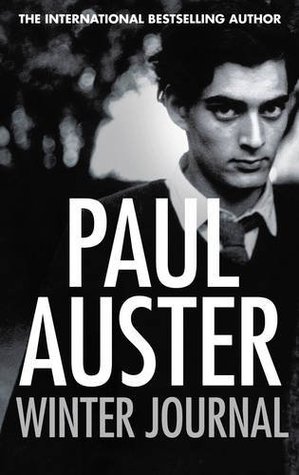 His life reappears through scars, through accidents and near-misses, through what his hands felt and his eyes observed. A three-year-old rips his cheek open on a protruding nail in a department store. A teenager slowly builds up a portfolio of sexual experiences. A young man lives and works in Paris and the South of France. A marriage to one fellow author (Lydia Davis) ends and a relationship with another (Siri Hustvedt) begins. A fiftysomething rushing to get home to the toilet makes an ill-advised turn against traffic and totals his car – luckily, he and his family escape unhurt. Numbness after his mother’s death cedes to a panic attack.
I particularly enjoyed the 53-page section in which Auster gives tours through the 21 places he’s lived since infancy, recounting the details he remembers of the dwellings and what happened during his time there. It’s impressive how much he can condense, but also how much he can convey in just a few pages on each home. This is the sort of format I could imagine borrowing for a short autobiographical piece – it would be a way of redeeming that involuntarily nomadic period when my husband and I moved every six to 18 months.
Reading this alongside the New York Trilogy allowed me to spot the ways, big and small, in which those novels draw on Auster’s life story. I’m now keen to read more of his nonfiction, especially The Invention of Solitude, which offended his relatives by revealing the shameful family story of how his grandmother shot and killed his grandfather in their kitchen. 
Annabel says: “The book is written in the second person – addressing himself; it gives a real sense of intimacy to his story. … Auster is an unconventional, analytical and eloquent writer, and this unconventional memoir was a delight to read, he can look with humour at himself as well as being serious.”
Laura F. says: “You know how people say they’d read anything by their favourite author, even a grocery list? Winter Journal gets pretty close to that territory. … I’ve never read a memoir like this, and though focused on the physical, it’s a fully emotional experience.”
Some favorite lines:
“as long as you continue to travel, the nowhere that lies between the here of home and the there of somewhere else will continue to be one of the places where you live.”
“We are all aliens to ourselves, and if we have any sense of who we are, it is only because we live inside the eyes of others.”
“you can only conclude that every life is marked by a number of close calls, that everyone who manages to reach the age you have come to now has already wriggled out of a number of potentially absurd, nonsensical deaths. All in the course of what you would call ordinary life.”
Readalikes: I Am, I Am, I Am by Maggie O’Farrell & The Lost Properties of Love by Sophie Ratcliffe
The New York Trilogy
(also my Doorstopper of the Month at 580 pages)
City of Glass (1985)
 A metafictional mystery about a crime writer named Daniel Quinn who turns private investigator when he gets a phone call asking for the Paul Auster Detective Agency. This is one of those books where what actually happens is a lot less important than the atmosphere it creates. So what feels essential to me here is the sense of a labyrinthine New York City and a confusion of languages and relationships. Quinn, who is helpfully untethered after the death of his wife and son, is hired to tail Peter Stillman’s father, who has recently been released from a mental hospital, where he was sentenced after being judged insane for keeping his son in isolation in a dark apartment for nine years.
Feral children, maps, eggs, the Tower of Babel and Don Quixote are some of the recurring sources of metaphors in a deliberately disorienting and intertextually rich short novel that kept me turning the pages even when I didn’t know precisely what was going on. We get a glimpse of Auster himself, and are invited to muse on such tiny subjects as destiny, the limitations of language, the purpose of books, and the nature of truth. I’m curious to see whether the other two novels follow on from the story at all or just resemble it thematically. 
Ghosts (1986)
I jumped straight into this from City of Glass, and it suffered by comparison. It is not a sequel per se, because it has different characters and is set in the late 1940s instead of the early 1980s, but it shares some of the same concerns (with literature, identity, doubling, the essential otherness of the writer, and so on) and again is a sort of metafictional mystery.
 Part of why I couldn’t take this novella entirely seriously is the silly naming: White hires Blue to trail Black (really; all of the secondary characters are named after colors, too). It turns out Black is a writer who does little besides sit in his apartment, writing. Only when Blue disguises himself as a tramp and then as a salesman and meets Black in various other contexts does he realize that Black, too, is an investigator … writing up a case of following a writer who hardly leaves his desk.
While I appreciated the circularity and the uncertainty over whether these accidental twins would destroy each other, as well as the literary references to Whitman, Thoreau and Hawthorne, the whole felt slightly inconsequential (“Blue watches Black, and little of anything happens.”). Plotlessness is part of the point, but makes for only a moderately interesting read. 
[There is one coded reference to Auster here: the fact that the book opens on February 3, 1947, the day he was born.]
The Locked Room (1986)
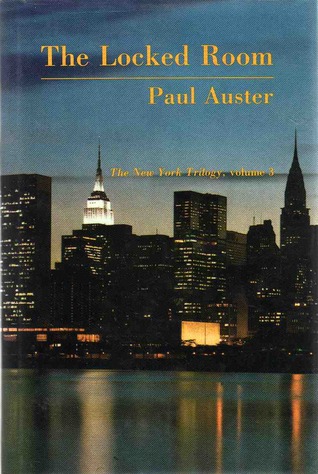 While most of the New York Trilogy is told in the third person, this is a first-person narrative that seems to pick up where City of Glass left off. It begins in 1977, when the unnamed narrator gets a letter from Sophie Fanshawe, the wife of his childhood best friend, telling him that Fanshawe disappeared six months ago, and despite the best efforts of a detective, Quinn (in another link to CoG, the narrator encounters Peter Stillman on a later trip to Paris), no trace can be found. The narrator has been named Fanshawe’s literary executor and takes it upon himself to get the man’s unpublished work out into the world: plays are produced, novels are published. He also starts writing a biography of the friend he always envied.
Except it’s more like he’s becoming Fanshawe, especially when he marries Sophie. Doubling has been a major theme of the trilogy, and here the metaphorical kill-or-be-killed situation seems to turn literal at the conclusion, which I didn’t particularly understand (e.g. he acquires and destroys a red notebook – is this in some way meant to be the same red notebook Quinn left behind at the end of CoG?). The narrator presents himself as the author of all three books, and asserts, “These three stories are finally the same story, but each one represents a different stage in my awareness of what it is about. I don’t claim to have solved any problems.”
The metafictional aspect of this novel is that Fanshawe’s early life is a lot like Auster’s as revealed in Winter Journal, while Sophie’s resembles his wife Siri Hustvedt’s (and the pair would later name their daughter Sophie). 
 Themes of the trilogy:
- Identity complications, including disguises, doubles and substitutes
- Writers and writing; the creator versus characters
- The limits of language (e.g. Stillman’s monologue in CoG is astonishing)
- Freedom/randomness versus fate
One representative passage from each volume:
- “New York was an inexhaustible space, a labyrinth of endless steps, and no matter how far he walked, no matter how well he came to know its neighbourhoods and streets, it always left him with the feeling of being lost. Lost, not only in the city, but within himself as well. … New York was the nowhere he had built around himself” (City of Glass)
- “Writing is a solitary business. It takes over your life. In some sense, a writer has no life of his own. Even when he’s there, he’s not really there. / Another ghost. / Exactly.” (Ghosts)
- “In the end, each life is no more than the sum of contingent facts, a chronicle of chance intersections, of flukes, of random events that divulge nothing but their own lack of purpose.” (The Locked Room)
My rating for the trilogy as a whole:
 Bookish Beck = Rebecca Foster. American transplant to England. Freelance proofreader and book reviewer.
