Three I Read for Father’s Day: Faber Poetry Anthology; Giffels & Pascoe
I’m behind on reviews after a long weekend visiting friends. As I did last year, I picked out three books related to fathers and fatherhood. It’s my ideal Three on a Theme recipe: one fiction + one nonfiction + one poetry. I won a copy of a poetry anthology about parenthood and completed the trio with a memoir that’s been on my shelves for a number of years and a debut novel I bought secondhand mostly for the title.
Family Lines: Poems about Parents and Parenthood, ed. Simon Armitage and Rachel Bower (2026)
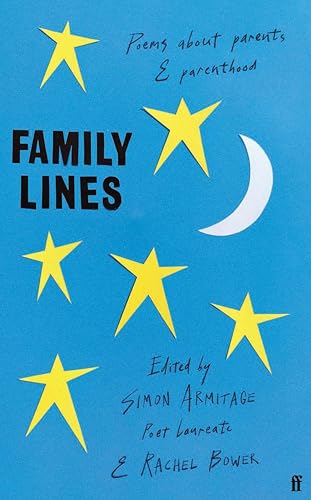 Not all of the poems are about fathers, of course, but there are plenty of selections here that feel true of any family relationship: the complicated emotions, the sometimes physical realities of transformation and care, the risks of ageing and loss, and how identity is defined by a connection or an opposition. This suffered a bit from its first third – covering pregnancy, birth, and early parenthood – being very similar in scope to Night Feeds and Morning Songs (2021, ed. Ana Sampson), which I reviewed for Mother’s Day. Some of the same contributors feature, though I think only the one specific poem overlaps, Liz Berry’s “The Republic of Motherhood.” Highlights included Gail McConnell’s prose poem “Orange” contemplating lesbian motherhood and Rita Dove’s “Daystar” about never-ending domestic duties: “She wanted a little room for thinking; / but she saw diapers steaming on the line”.
Contemporary material mingles with older; Homer and Wordsworth are two of the ten poets included in a chapter on fathers and father figures. “Sleep” by Roger Robinson was the best example of the theme, a sweet tribute to a man who “for the next twenty years / … battles on his job every day / just so you could be comfortable / and have the space to be what you want.” Relevant entries from other sections were Alden Nowlan’s “It’s Good to Be Here,” about his inauspicious beginning in 1932 with a 14-year-old mother (“I’m in trouble, she said / to him. …// … they began to talk very quietly and at last he said / well, I guess we’ll just have to make the best of it”); Anne Sexton’s “All My Pretty Ones,” about going through her late father’s things and wondering if she’s inherited his alcoholism; and Hartley Coleridge’s “Lines—,” acknowledging he’ll never live up to his father’s talent: “Because I bear my Father’s name / I am not quite despised, / My little legacy of fame / I’ve not yet realized.” (Faber giveaway)
Furnishing Eternity: A Father, a Son, a Coffin, and a Measure of Life by David Giffels (2018)
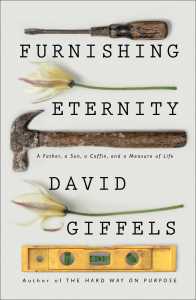 Losing his mother and best friend to cancer within a year, and then turning 50, got Giffels to thinking about mortality. He had a whim to build his own coffin and decided it would be a perfect joint project with his widowed father, who had a home workshop full of tools. As sprightly and driven as his father was, he was also in his eighties and had survived a couple of different cancers, so it was never far from the author’s mind that he needed to make the most of his time with his father while he could. I’m not at all interested in woodworking or DIY, but this is an unusual and likable memoir that alternates the practicalities of building the casket with memories of his relationships with his mother and friend John, who was an artist. While Giffels mentions his wife Gina frequently, he doesn’t talk about his own children as much as I might have expected to take the lessons full circle. No matter; I appreciated the middle-aged Ohio hipster’s thoughts on friendship, ageing and grief. Bereavement memoirs are more often the preserve of women, it seems, so it was good to have a different take.
This is how middle-aged friendships often go, slipping and slipping until ‘we really should get together soon’ becomes a discomforting veil for the truth—that such friendships cease to exist.
I thought a time would come when I would feel definitively like a grown-up, like I would have achieved a certain kind of acumen for making decisions and knowing what to do in unknowable situations, when I wouldn’t feel insecure in real-life grown-up scenarios (board meetings; ordering wine; delivering eulogies). Instead, I still felt like a kid. Or rather, I felt like an adult who was in the continuous loop of his youth.
death is a shattering. Grief is the chaos of wreckage. Only life can find the pattern, and only in its own sweet time. What I remember from the long season of loss was wanting each day to pass as quickly as possible. To get beyond it. I guess I missed the fact that the by-product of this wish was for my own life to rush by.
(New bargain purchase from Amazon)
Our Father Who Art in the Tree by Judy Pascoe (2002)
“It was simple for me: the saints were in heaven, and guardian angels had extendable wings like Batman, and my dad had died and gone to live in the tree in the back yard.”
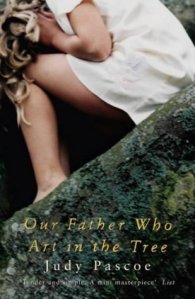 The premise of this Australia-set novella was appealing enough for me to overcome my usual antipathy to child narrators. It probably helps that Simone is looking back from adulthood rather than limited to a 10-year-old’s knowledge. She tells her mother, Dawn, about the voice coming from the tree and it turns out that the two of them are the only ones who can hear her father. He tells them that he’s sorry he left, that he will always love them, that death is not so bad. Simone’s three brothers and best friend, the judgemental neighbours: they’re all clueless. The boys carry on with normal life as best they can, while Dawn has the chance to start over with “the drain man.” Meanwhile, the tree keeps encroaching on the house, undermining the foundations. It’s both a literal problem and a symbol of the enormity of grief, and the book as a whole works on both levels. Despite the early promise of magic, I found it to be a mostly realistic and reasonably touching look at the aftermath of family tragedy. (Secondhand – Community Furniture Project, Newbury)
May Poetry Releases: Blood & Cord Anthology; Connolly, Goss, Harrison
Apart from Monsters, my focus for May releases has been on poetry, with three Carcanet collections plus a poetry-heavy anthology of writing on early parenthood. Love, history, nature and parental bonds are a few underlying subjects that connect some or all of these.
The Recycling by Joey Connolly
Joey Connolly’s second collection reminded me most of Caroline Bird’s work (especially the mise en abyme ending to “For Such a Widely Used Material, Glass Sure Does Have Some Downsides”): effusive and sometimes absurdist, with unexpected imagery and wordplay.
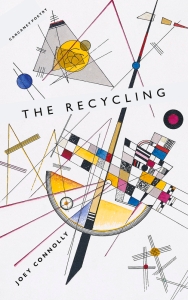 In keeping with the title, there are environmentalist considerations and musings on materials, but also the connotation of reusing language or rehashing ideas. I appreciated this strategy when he’s pondering etymology (“Strange noun full of verb, noun / bending to verb, strange / idea of repeating repetition” in the title poem) or reworking proverbs in the hilarious “Poem in Which Is Is Sufficient” (“Sufficient unto the glaze / is the primer thereunder. Sufficient / unto the applecart is the upset / thereof” and so on) but perhaps less so during 22 indulgent pages of epigraphs. The distance-designated poems of the inventive “Solvitur Ambulando” section range from history to science fiction: “Abstracted, ankle deep in the proto-gutters of Elizabethan London: / how were you ejected from your life to wash up here?”
It’s such a versatile book. I loved the philosophical self-questioning of “Why Try and Be Good When This World” (“the / mental carapace required to weather the hardness / of indifference insulates you from what it means to be alive”) and the utterly original love poetry (“I will take out the bins, and I will try not to leave the keys / in the door, and I will continue / to love you / to the fullest extent to which I find myself able. Oh love. Checkmate”). Eminently quotable stuff. Here are two of my favourite passages:
like an
amateur kintsugi enthusiast in the ruined chinashop
of my childhood idealism
What sweet sorrow
to persist within this disappeared world
With thanks to Carcanet Press for the advanced e-copy for review.
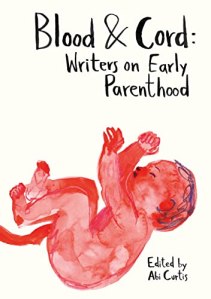
Blood & Cord: Writers on Early Parenthood, edited by Abi Curtis
“The introduction of a new baby rearranges a life, and this requires a new language and a new kind of engagement with the world,” Abi Curtis writes in her introduction. These poems and pieces of flash autofiction or memoir are often visceral, as the title and cover image by Elīna Brasliņa indicate. Elizabeth Hogarth’s “Animal Body” tracks how primal instinct takes over. Second- and third-person narratives distance the speaker from the experience, as in Ruth Charnock’s hybrid “three tarot cards for the new mother.” As I’ve come to expect from The Emma Press, there’s a wide variety of formats, styles and even page layout, with some poems printed in landscape.
 Curtis’s four poems are, together, the strongest entry. I particularly loved the final lines of “September Birth”: “We listen close but cannot fathom / Your new language. We will spend / The rest of our days learning it.” Naomi Booth, too, zeroes in on language in “What is tsunami?” A daughter’s acquisition of language provides entertainment (“She names her favourite doll, Hearty Campfire”) but also induces apprehension:
There are certain words that you dread hearing her say. The first is money. … You dread the way it will become as concrete to her as sky and cat and gate. Mu-nee. Mu-nee.
Not all of these are jubilant birth stories. There are children who are longed for but never arrive. There are also babies who never breathe, or soon die. Alex McRae Dimsdale’s “Bath” is a heartbreaking poem about bidding goodbye to a stillborn son:
It wasn’t the first time that a couple had to leave
the hospital without their newborn.
What could they give us instead?
Here, a small white wooden box –
inside, a packet of wildflower seeds,
your wristband, little
stripy hat. A curlicued certificate
inked with your footprints.
…
what maternal sin did I commit,
deciding who you were
for a whole life that was
already stopped before it started?
“Other Mothers,” a prose essay by poet Rebecca Goss (from whom more below), is about her infant daughter’s death in hospital.
There are a few male contributors, outnumbered five to one by women writers. Poets Liz Berry and Gail McConnell illuminate same-sex motherhood. The two short stories – i.e., those that are clearly fiction rather than memoir by different pronouns – were among the weakest pieces for me: the one piles cruel irony on misery (no real surprise as it’s by an author I’ve had a strong reaction against in the past; the only saving grace was a clever reference to Hemingway’s six-word story about baby shoes); the other is silly and contrived.
I think this was my seventh Emma Press book, and my fourth of their anthologies, of which I’d recommend The Emma Press Anthology of Love. This one was a bit more uneven for me, but I can see it holding appeal for new parents who are of a literary bent.
Published in association with the York Centre for Writing, York St John University. With thanks to The Emma Press for the free copy for review.
Latch by Rebecca Goss
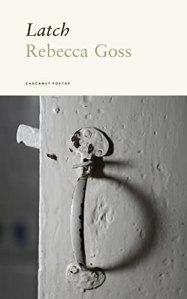 Rebecca Goss’s fourth poetry collection arises from a rural upbringing in Suffolk. Her parents’ farm was a “[s]emi-derelict, ramshackle whimsy of a place”. There’s nostalgia for the countryside left behind and for a less complicated family life before divorce, yet this is no carefree pastoral. From the omnipresent threats to girls to the challenges of motherhood, Goss is awake to the ways in which women are compelled to adapt to life in male spheres. The title/cover image has multiple connotations: the first bond between mother and child; the gates and doors that showcase craftsmanship (as in “Blacksmith, Making”) or seek to shut menacing forces out (see “The Hounds”), but cannot ensure safety.
Even the individual poem titles tell tales: “The Retired Agronomist Drives a Tractor in the Summer Because He Likes the Oily Smell of the Machine” and three with the enticing pattern “Woman Returns to Childhood Home…” Trees and animals provide much of the imagery. A few of my personal favourites were “Rooks,” “Weir,” and “In Song Flight.”

With thanks to Carcanet Press for the advanced e-copy for review.
Kitchen Music by Lesley Harrison
Lesley Harrison is a Scottish poet with a number of pamphlets and collections to her name. Orkney and other remote islands are settings for these atmospheric poems filled with whale song and weather (“the vast dark hung with / ropes of song”), birds and wordplay. Language and folktales inspire the poet, and she engages in word association and creates rebuses built around middle letters rather than first. There are also black-and-white photographs, and whale images by Marina Rees punctuating “C-E-T-A-C-E-A.” My attention threatened to drift away from the sometimes wispy lines and paragraphs, but this would be well worth taking on holiday to read on location.

With thanks to Carcanet Press for the advanced e-copy for review.
Would you be interested in reading one or more of these?
 Bookish Beck = Rebecca Foster. American transplant to England. Freelance proofreader and book reviewer.
