Last Love Your Library of 2025 & Another for #DoorstoppersInDecember
Thanks to Eleanor, Margaret and Skai for writing about their recent library reading! Marcie also joined in with a post about completing Toronto Public Library’s 2025 Reading Challenge with books by Indigenous authors.
I managed to fit in a few more 2025 releases before Christmas. My plan for January is to focus on reading from my own shelves (which includes McKitterick Prize submissions and perhaps also review copies to catch up on), so expect next month to be a lighter one.
My recent reading has featured many mentions of how much libraries mean, particularly to young women.
 In her autobiographical poetry collection Visitations (coming out in April), Julia Alvarez writes of how her family’s world changed when they moved to New York City from the Dominican Republic in the 1960s. “Waiting for My Father to Pick Me Up at the Library” adopts the tropes of Alice in Wonderland: as her future expands, her father’s life shrinks.
 In The Mercy Step by Marcia Hutchinson, the public library is a haven for Mercy, growing up in Bradford in the 1960s. She can hardly believe it’s free for everyone to use, even Black people. Greek mythology is her escape from an upbringing that involves domestic violence and molestation. “It’s peaceful and quiet in the Library. No one shouts or throws things or hits anyone. If anyone talks, the Librarian puts a finger to her mouth and tells them to shush.”
 The Serviceberry by Robin Wall Kimmerer affirms the social benefits of libraries: “I love bookstores for many reasons but revere both the idea and the practice of public libraries. To me, they embody the civic-scale practice of a gift economy and the notion of common property. … We don’t each have to own everything. The books at the library belong to everyone, serving the public with free books”.
 After Rebecca Knuth retired from an academic career in library and information science, she moved to London for a master’s degree in creative nonfiction and joined the London Library as well as the public library. But in her memoir London Sojourn (coming out in January), she recalls that she caught the library bug early: “Each weekday, I bused to school and, afterward, trudged to the library and then rode home with my geologist father. … Mostly, I read.”
 And in Joyride, Susan Orlean recounts the writing of each of her books, including The Library Book, which is about the 1986 arson at the Los Angeles Central Library but also, more widely, about what libraries have to offer and the oddballs often connected with them.
My library use over the last month:
(links are to any reviews of books not already covered on the blog)
READ
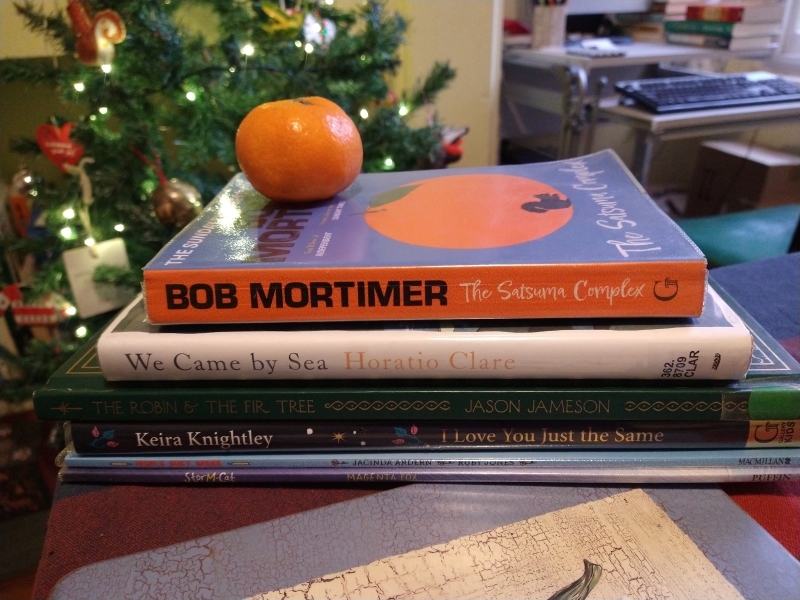
- Mum’s Busy Work by Jacinda Ardern; illus. Ruby Jones

- Book of Lives: A Memoir of Sorts by Margaret Atwood

- Storm-Cat by Magenta Fox

- The Robin & the Fir Tree by Jason Jameson
- I Love You Just the Same by Keira Knightley – Proof that celebrities should not be writing children’s books. I would say the story and drawings were pretty good … if she were a college student.

- Winter by Val McDermid

- The Search for the Giant Arctic Jellyfish, The Search for Carmella, & The Search for Our Cosmic Neighbours by Chloe Savage
- Weirdo Goes Wild by Zadie Smith and Nick Laird; illustrated by Magenta Fox
- Murder Most Unladylike by Robin Stevens


+ A final contribution to #DoorstoppersInDecember
Do Admit: The Mitford Sisters and Me by Mimi Pond
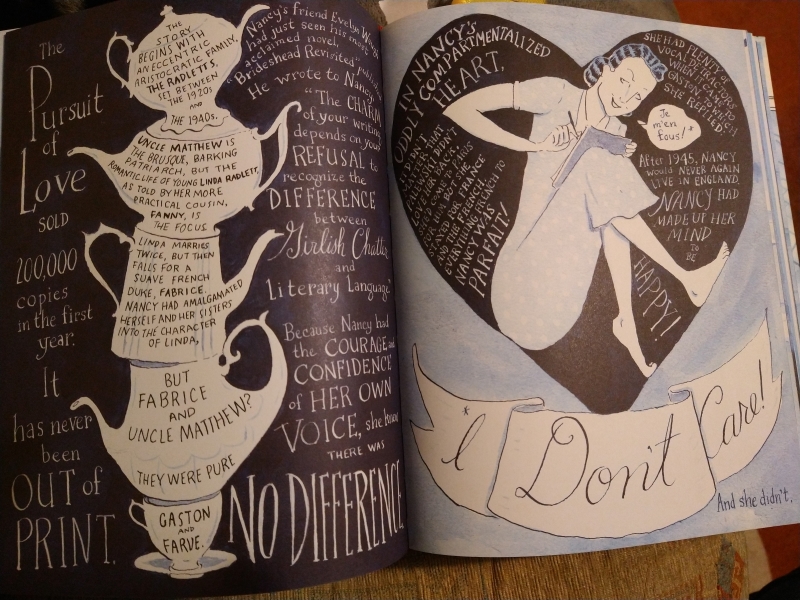
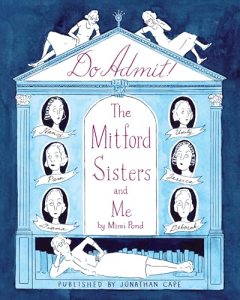 Truth really is stranger than fiction. Of the six Mitford sisters, two were fascists (Diana and Unity) and one was a communist (Jessica). Two became popular authors (Nancy and Jessica). One (Unity) was pals with Hitler and shot herself in the head when Britain went to war with Germany; she didn’t die then but nine years later of an infection from the bullet still stuck in her brain. This is all rich fodder for a biographer – the batshit lives of the rich and famous are always going to fascinate us peons – and Pond’s comics treatment is a great way of keeping history from being one boring event after another. Although she uses the same Prussian blue tones throughout, she mixes up the format, sometimes employing 3–5 panes but often choosing to create one- or two-page spreads focusing on a face, a particular setting or a montage. No two pages are exactly alike and information is conveyed through dialogue, documents and quotations. If just straight narrative, there are different typefaces or text colours and it is interspersed with the pictures in a novel way. Whether or not you know a thing about the Mitfords, the book intrigues with its themes of family dynamics, grief, political divisions, wealth and class. My only misgiving, really, was about the “and Me” part of the title; Pond appears in maybe 5% of the book, and the only personal connections I gleaned were that she wished she had sisters, wanted to escape, and envied privilege and pageantry. [444 pages]
CURRENTLY READING
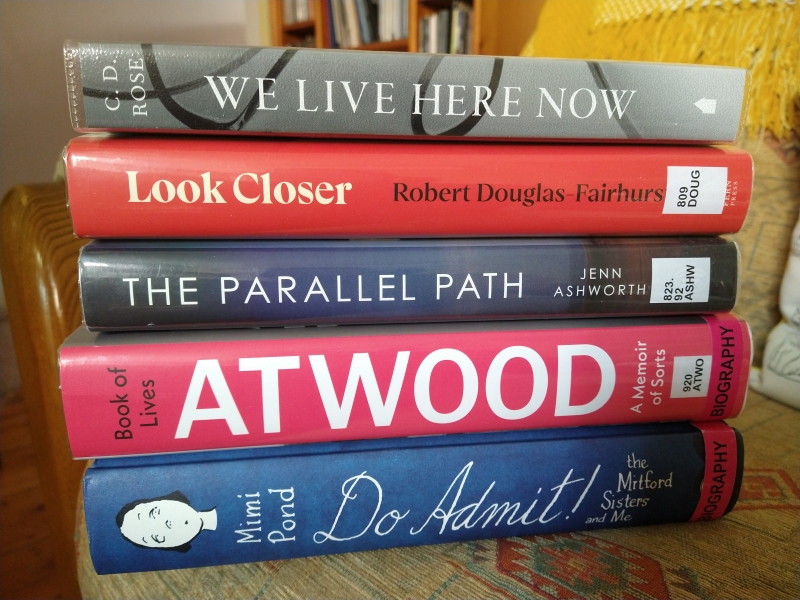
- The Parallel Path: Love, Grit and Walking the North by Jenn Ashworth
- The Honesty Box by Lucy Brazier
- Of Thorn & Briar: A Year with the West Country Hedgelayer by Paul Lamb
- The Satsuma Complex by Bob Mortimer (for book club in January; I’m grumpy about it because I didn’t vote for this one, had no idea who the author [a TV comedian in the UK] was, and the writing is shaky at best)
- We Live Here Now by C.D. Rose
SKIMMED
- Look Closer: How to Get More out of Reading by Robert Douglas-Fairhurst
CHECKED OUT, TO BE READ
- It’s Not a Bloody Trend: Understanding Life as an ADHD Adult by Kat Brown
- We Came by Sea by Horatio Clare
ON HOLD, TO BE COLLECTED
- The Two Faces of January by Patricia Highsmith
- Arsenic for Tea by Robin Stevens
IN THE RESERVATION QUEUE
- Honour & Other People’s Children by Helen Garner
- Snegurochka by Judith Heneghan
- Ultra-Processed People by Dr. Chris van Tulleken (for book club in February)
RETURNED UNFINISHED
- Night Life: Walking Britain’s Wild Landscapes after Dark by John Lewis-Stempel
What have you been reading or reviewing from the library recently?

Share a link to your own post in the comments. Feel free to use the above image. The hashtag is #LoveYourLibrary.
Book Serendipity, Mid-December 2024 to Mid-February 2025
I call it “Book Serendipity” when two or more books that I read at the same time or in quick succession have something in common – the more bizarre, the better. This is a regular feature of mine every couple of months. Because I usually have 20–30 books on the go at once, I suppose I’m more prone to such incidents. People frequently ask how I remember all of these coincidences. The answer is: I jot them down on scraps of paper or input them immediately into a file on my PC desktop; otherwise, they would flit away!
The following are in roughly chronological order.
- The angel Ariel appears in Through a Glass Darkly by Jostein Gaarder and Constructing a Witch by Helen Ivory.
- The protagonist’s surname is English in Wild Houses by Colin Barrett and The Cannibal Owl by Aaron Gwyn.
- I read scenes of grief over a tree being cut down / falling next to one’s house in Dispersals by Jessica J. Lee and Small Rain by Garth Greenwell, one right after the other.
- A mother who does kundalini yoga in All Fours by Miranda July and Unattached by Reannon Muth.
- The idea that happiness (unlike anxiety and sorrow) leaves no trace in writing or in life appeared for me on the same day in Memorial Days by Geraldine Brooks and Small Rain by Garth Greenwell.
- Someone considers suicide by falling but realizes that at the current height they would injure themself but not die in Wild Houses by Colin Barrett, The Snow Queen by Michael Cunningham, and The Courage Consort by Michel Faber.
- The homosexual “bear” stereotype appears in The Snow Queen by Michael Cunningham and Small Rain by Garth Greenwell.
- A William Blake epigraph in Open, Heaven by Seán Hewitt and one of the poems included in Poetry Unbound by Pádraig Ó Tuama.
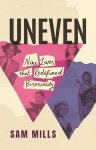
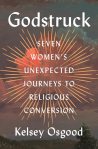
- A group biography including nine pen portraits (plus the author): Nine Minds by Daniel Tammet, followed in quick succession by Uneven by Sam Mills. (Similar, but with just seven subjects, is a book I’m currently reading about women’s religious conversions, Godstruck by Kelsey Osgood.)
- A book–life serendipity moment: in All Fours by Miranda July there is mention of an elderly cat named Alfie who needs to be given medication several times a day. Snap!
- By chance, I started reading Myself and Other Animals, a posthumous collection of short autobiographical pieces by Gerald Durrell, on his centenary (7 January 2025).
- Guilt over destroying a bird’s nest in The Book of George by Kate Greathead and I’ll Come to You by Rebecca Kauffman.
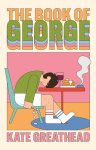
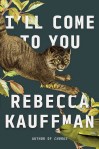
- The main female character has a birthmark in The Book of George by Kate Greathead and The Blindfold by Siri Hustvedt.
- Reading two novels at the same time that open with a new family having to be found for a little boy because his mentally ill mother is presumed to have died by suicide: Unexpected Lessons in Love by Bernardine Bishop and Going Home by Tom Lamont.
 The protagonist is mistaken for a two-year-old boy’s father in The Book of George by Kate Greathead and Going Home by Tom Lamont.
- The mother is named Ellen in The Book of George by Kate Greathead and I’ll Come to You by Rebecca Kauffman.
- An ailing elderly father named Vic in Going Home by Tom Lamont and The God of the Woods by Liz Moore.
- A mother is sent to a mental hospital after the loss of her young son in Invisible by Paul Auster and The God of the Woods by Liz Moore.
- A brother and sister share a New York City apartment in Invisible by Paul Auster and The Book of George by Kate Greathead.
- A mention of the Japanese artist Hokusai in While the Earth Holds Its Breath by Helen Moat and The Secret Life of Snow by Giles Whittell.
 Adults dressing up for Halloween in The Blindfold by Siri Hustvedt and I’ll Come to You by Rebecca Kauffman.
- A second husband named Tim in Unexpected Lessons in Love by Bernardine Bishop and Because We Must by Tracy Youngblom.
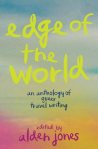
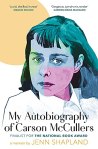
- The idea that ‘queers find each other’ in Edge of the World: An Anthology of Queer Travel Writing edited by Alden Jones and My Autobiography of Carson McCullers by Jenn Shapland.
- Experiencing 9/11 as a freshman in college (just like me!) in Dirty Kitchen by Jill Damatac and The Book of George by Kate Greathead. (There is also a 9/11 section in Confessions by Catherine Airey.)
- An intense poker game in I’ll Come to You by Rebecca Kauffman and Going Home by Tom Lamont.
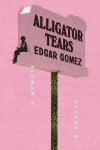 The main character is expelled on false drug possession charges in Invisible by Paul Auster and Alligator Tears by Edgar Gomez.
- Missing the chance to say goodbye before a father’s death, and a parent wondering aloud to their son whether they’ve been a good parent in The Book of George by Kate Greathead and The Remains of the Day by Kazuo Ishiguro.
- Someone departs suddenly, leaving her clothes and books behind, in Invisible by Paul Auster and My Autobiography of Carson McCullers by Jenn Shapland.
- Mentions of DACA (Deferred Action for Childhood Arrivals, an Obama-era U.S. immigration policy) and “Two-Buck Chuck” (a nickname for the Charles Shaw bargain wine sold at Trader Joe’s) in Dirty Kitchen by Jill Damatac and Alligator Tears by Edgar Gomez.
- A City Hall wedding in New York City in Baumgartner by Paul Auster and Dirty Kitchen by Jill Damatac.
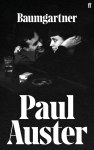
- Polish Jewish heritage and a parent who died of pancreatic cancer in Baumgartner by Paul Auster and The History of Love by Nicole Krauss.
- In Because We Must by Tracy Youngblom, she reads The Tale of Despereaux by Kate DiCamillo aloud to her son while he is recovering in hospital. I was reading Despereaux at the same time! (Also, in real-life serendipity, Youngblom and I both have a sister named Trish.)
- A code of 1–3 knocks is used in Confessions by Catherine Airey and The History of Love by Nicole Krauss.
 A scene of a teacup breaking in Junction of Earth and Sky by Susan Buttenwieser and The Möbius Book by Catherine Lacey.
What’s the weirdest reading coincidence you’ve had lately?
January Releases: Greathead, Kauffman, Mills & Watts (#ReadIndies)
I feel out of practice writing reviews after the endless period of sluggish and slightly lackluster reading that was January. Here we are at the start of Kaggsy and Lizzy Siddal’s Reading Independent Publishers Month challenge and I’m happy to make this my first tie-in post as these four books all happen to be from independent publishers. The first two are American novels (that could arguably be called linked short story collections) very much in my wheelhouse for their focus on dysfunctional families and disappointing characters. I also have a group biography aiming to illuminate bisexuality, and a poetry collection about girlhood/womanhood and nature.
The Book of George by Kate Greathead
The marketing for this novel courts relatability: you probably know a George – you might have dated one (women read the most litfic). Each chapter dates to a different period in George’s life, adolescence to late thirties. From the fact that 9/11 happened when he was a college freshman, I know he’s my exact contemporary, and I could indeed see bits of myself in this Everyman schmuck: indecisive, lazy, underachieving, privileged but never living up to his own or others’ expectations. Life keeps happening around him, but you wonder if he’ll ever make something happen for himself. Two gags are revealing: In college he is known for his impression of a clinically depressed penis going through airport security, and later he has 15 minutes of fame for appearing in a hidden-camera Super Bowl commercial. He’s been writing fiction for years – first a Stoner rip-off, then a Kerouac homage – but by the time he gets a short story collection together, it’s the height of #MeToo and he’s missed his moment to publish. Meanwhile, his cohort is doing great things, winning awards for documentaries (his pal Jeremiah) or becoming pro bono lawyers (his longsuffering girlfriend Jenny).
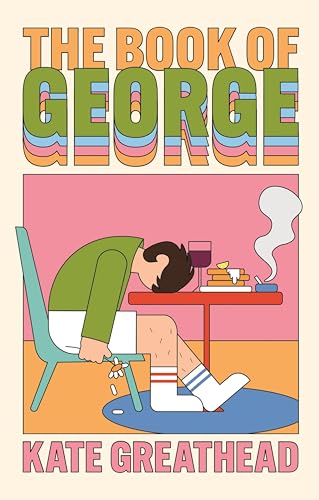 If you need to like a protagonist, expect frustration. Some of George’s behaviour is downright maddening, as when he obsessively plays his old Gameboy while his mother and Jenny pack up his childhood room. Tracing his relationships with his mother, his sister Cressida, and Jenny is rewarding. Sometimes they confront him over his shortcomings; other times they enable him. The novel is very funny, but it’s a biting, ironic humour, and there’s plenty of pathos as well. There are a few particular gut-punches, one relating to George’s father and others surrounding nice things he tries to do that backfire horribly. I thought of George as a rejoinder to all those ‘So-and-So Is Not Okay at All’ type of books featuring a face-planting woman on the cover. Greathead’s portrait is incisive but also loving. And yes, there is that hint of George, c’est moi recognition. His failings are all too common: the mildest of first-world tragedies but still enough to knock your confidence and make you question your purpose. For me this had something of the old-school charm of Jennifer Egan and Jonathan Safran Foer novels I read in the Naughties. I’ll seek out the author’s debut, Laura & Emma.
With thanks to Atlantic Books for the free copy for review. (Published in the USA by Henry Holt and Co. in 2024.)
I’ll Come to You by Rebecca Kauffman
Is 30 years long enough ago to count as historical fiction? In any case, this takes us through the whole of 1995, proceeding month by month and rotating through the close third-person perspectives of the members of one extended family as they navigate illnesses, break-ups and fraught parenting journeys. Corinne and Paul are trying to get pregnant; Paul’s mother, Ellen (again!), is still smarting from her husband leaving with no explanation; Corinne’s father, Bruce, has dementia but his wife, Janet, is doing her best to keep his cognitive deficiencies from the rest of the family. Son Rob is bitter about his ex-wife moving on so quickly, but both he and Ellen will have new romantic prospects before the end.
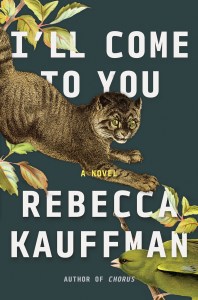 The family’s lies and secrets – also involving a Christmas run-in with Bruce’s shell-shocked brother decades ago – lead to everything coming to a head in a snowstorm. (As best I can tell, the 1995 setting was important mostly so there wouldn’t be cell phones during this crisis.) As with The Book of George, the episodic nature of the narrative means that particular moments are memorable but the whole maybe less so, and the interactions between characters stand out more than the people themselves. I’ll Come to You, named after a throwaway line in the text, is poorly served by both its cover and title, which give no sense of the contents. However, it’s a sweet, offbeat portrait of genuine, if generic, Americans; I was most reminded of J. Ryan Stradal’s work. Although I DNFed Kauffman’s The Gunners some years back, I’d be interested in trying her again with Chorus, which sounds like another linked story collection.
With thanks to Counterpoint (USA) for the advanced e-copy for review.
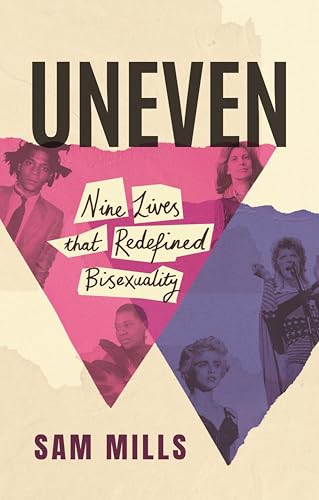
Uneven: Nine Lives that Redefined Bisexuality by Sam Mills
Back in 2022 I reviewed Julia Shaw’s Bi: The hidden culture, history and science of bisexuality, which took a social sciences approach. By contrast, this is a group biography of nine bisexuals – make that 10, as there are plenty of short memoir-ish passages from Mills, too. Oscar Wilde, Colette, Marlene Dietrich, Anaïs Nin, Susan Sontag: more or less familiar names, though not all of them are necessarily known for their sexuality. The chapters deliver standard potted biographies of the individuals’ work and relationships, probably containing little that couldn’t be found elsewhere in recent scholarship and not really living up to the revolutionary promise of the subtitle. However, it was worthwhile for Mills to recover Wilde as a bisexual rather than a closeted homosexual. A final trilogy of chapters comes more up to date with David Bowie, Jean-Michel Basquiat and Madonna. The closer to the present day, the more satisfying connections there are between figures. For instance, Madonna looked to both Dietrich and Bowie as role models and fashion icons, and she and Basquiat were lovers.
 Mills and Shaw consider the same fundamental issues: bi erasure, with bisexuality the least understood and most easily overlooked element of LGBT and many passing as straight if in heterosexual marriages; and the stereotype of bis as hypersexual or promiscuous. Mills is keen to stress that bisexuals have very different trajectories and phases. Like Wilde, they might have a heterosexual era of happy marriage and parenthood followed by a homosexual spree. Or they might have simultaneous lovers of multiple genders. Some might never even act on strong same-sex desires. (Late last year I encountered a similar unity-in-diversity approach in Daniel Tamet’s Nine Minds, a group biography about autistic people.)
The 1890s to 1980s window allows for a record of changing mores yet means that the book seems rather dated. Were it written by an author of a later generation (Mills, who I knew for The Fragments of My Father, is around 50), the point of view and terminology would likely be quite different. Also, including a section on Bessie Smith within a chapter mostly on Colette felt tokenistic. (Though later considering Basquiat separately does add a BIPOC view.) Ultimately, though, my problem with Uneven was that I don’t want to know about behaviour – which is all that a biography can usually document – so much as the internal, soul stuff. Even from Mills, whose accounts of her long-term relationships and flings (including, yes, a threesome) can be titillating but not very enlightening, I didn’t get a sense of what it feels like. So neither the Shaw nor the Mills gave me precisely what I was looking for, which means that the perfect book on bisexuality either doesn’t exist or is out there but I haven’t found it yet. Any suggestions?
With thanks to Atlantic Books for the free copy for review.
The Face in the Well by Rebecca Watts
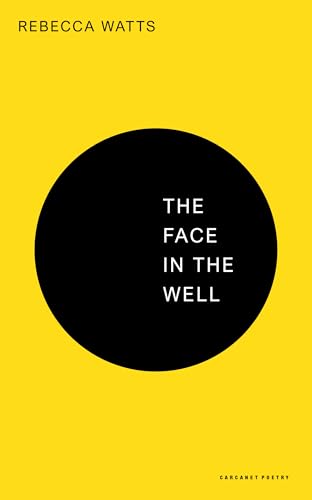 I’ve also read Watts’ The Met Office Advises Caution and Red Gloves; this is her third collection. The Suffolk and Cambridgeshire scenery of her early and adult lives weaves all through, sometimes as an idyll that blurs the lines between humans and nature (“Private No Access”) but other times provoking anxiety about common or gendered dangers, as in the title poem or “The Old Mill” (“What happened there, / down by the old mill, / they never tell. // Something about / a man and a girl / is the most you’ll hear.”). “Woman Seeks” is a tongue-in-cheek advert for the perfect man. Animals – a dolphin, a shark, rodents, a wandering albatross, a robin – recur, as do women poets, especially Emily Brontë, and Victorian death culture (“Victoriana” and “Baroque”). Adulthood brings routine whereas childhood stands out for minor miracles, such as a free soda from a vending machine.
The format and tone vary a lot, so the book is more of a grab bag than a cohesive statement. I noted slant rhymes and alliteration, always a favourite technique of mine. I especially liked “Entropy,” about finding a slice of cake in the freezer labeled by someone who is now dead (“Nothing ever // really dies: all the pieces of you / persist, riven and reconfigured / in infinite unknowable ways”) and “Personal Effects,” about the artefacts from her childhood that her mother guards under the bed (“twists of my hair, my teeth, / my bracelet from the hospital.”).
With thanks to Carcanet Press for the advanced e-copy for review.
Which of these appeal to you? What indie publishers have you been reading from recently?
Best Backlist Reads of the Year
Like many bloggers, I’m irresistibly drawn to the new books released each year. However, I consistently find that many of my most memorable reads were published years or even decades ago. These 16 selections, in alphabetical order within genre, together with my Best of 2022 post (coming up tomorrow), make up the top 9.5% or so of my reading for the year. Three of the below were rereads.
Fiction
First, a special mention for this trio:
Birds of a Lesser Paradise by Megan Mayhew Bergman
Delicate Edible Birds by Lauren Groff
Birds of America by Lorrie Moore
It’s unusual for me to fall so wholeheartedly for short stories. I intended to write up these three “Birds” collections as part of my short story focus in September but ultimately decided to spend more time with the latter two (and then fell ill with Covid before I could write them up, so look out for my full reviews early in the new year). The word from the title is incidental, really; the books do have a lot in common in terms of theme and tone, though. The environment, fidelity and motherhood are recurring elements. The warmth and psychological depth are palpable. Each story feels fleshed out enough that I would happily read an entire novel set in its world, but also such that it is complete unto itself. Two of these writers (Bergman and Moore) are best known for short stories; the third, to my mind, should be.
 Falling Angels by Tracy Chevalier: I’ve read all of Chevalier’s novels and always thought of this one as my favourite. A reread didn’t change that. I loved the neat structure that bookends the action between the death of Queen Victoria and the death of Edward VII, and the focus on funerary customs (with Highgate Cemetery a major setting) and women’s rights.
 Julia and the Shark by Kiran Millwood Hargrave: Julia and her parents are on an island adventure to Unst, in the north of Shetland, where her father will keep the lighthouse for a summer and her mother, a marine biologist, will search for the Greenland shark. Hargrave treats the shark as both a real creature and a metaphor for all that lurks – all that we fear and don’t understand. Beautifully illustrated, too; a modern children’s classic in the making.
 We Have Always Lived in the Castle by Shirley Jackson: A brooding character study of two sisters isolated by their scandalous family history and the suspicion of the townspeople. I loved the offbeat voice and unreliable narration, and the way the Blackwood house is both a refuge and a prison for the sisters. Who is protecting whom, and from what? There are a lot of great scenes, all so discrete that I could see this working very well as a play
 Foster by Claire Keegan: A delicate, heart-rending novella about a deprived young Irish girl sent to live with rural relatives for one pivotal summer. It bears all the hallmarks of a book several times its length: a convincing and original voice, rich character development, an evocative setting, just enough backstory, psychological depth, conflict and sensitive treatment of difficult themes like poverty and neglect. I finished the one-sitting read in a flood of tears.
 Small Things Like These by Claire Keegan: One good man’s small act of rebellion is a way of standing up to the injustice of the Magdalen Laundries, a church-sanctioned system that must have seemed too big to tackle. Keegan fits so much into so few pages, including Bill working out who his father was and deciding what to make of the middle of his life. Like Foster, this is set in the 1980s but feels timeless. Absolutely beautiful.
 The Murderer’s Ape by Jakob Wegelius: Sally Jones is a ship’s engineer who journeys from Portugal to India to clear her captain’s name when he is accused of murder. She’s also a gorilla. This was the perfect rip-roaring adventure story to read at sea (on the ferry to Spain in May); the twisty plot and larger-than-life characters who aid or betray Sally Jones kept the nearly 600 pages turning quickly.
Poetry
 Honorifics by Cynthia Miller: Miller is a Malaysian American poet in Edinburgh. The themes of her debut include living between countries and feeling like an exile versus finding a sense of home. There’s much variety here, and so many beautiful lines and evocative images. Miller incorporates a lot of unusual structures, some of them traditional forms and others freer: a numbered list, columns, dictionary definitions or prose paragraphs. Flora and fauna references plus a consideration of the expat life meant this was custom made for me.
Nonfiction
 The Boys in the Boat by Daniel James Brown: The University of Washington rowing team in general, and Joe Rantz in particular, were unlikely champions. Boatbuilding and rowing both come across as admirable skills involving hard physical labour, scientific precision and an artist’s mind. All along, Brown subtly weaves in the historical background: Depression-era Seattle with its shantytowns, and the rise of Hitler in Germany. A classic underdog story.
 My Life in Houses by Margaret Forster: Having become a homeowner for the first time earlier this year, I was interested in how an author would organize their life around the different places they’ve lived. The early chapters about being a child in Carlisle are compelling in terms of cultural history; later on she observes gentrification in London, and her home becomes a haven for her during her cancer treatment.
 Sightlines by Kathleen Jamie: A reread started on our July trip to the Outer Hebrides. I’d forgotten how closely Jamie’s interests align with my own: Scotland and its islands, birds, the prehistoric, museums, archaeology. I particularly appreciated “Three Ways of Looking at St Kilda,” but everything she writes is profound: “if we are to be alive and available for joy and discovery, then it’s as an animal body, available for cancer and infection and pain.”
 Reflections from the North Country by Sigurd F. Olson: Olson was a well-known environmental writer in his time (through 1970s), also serving as president of the National Parks Association. This collection of passionate, philosophically oriented essays about the state of nature places him in the vein of Aldo Leopold – before-their-time conservationists. He ponders solitude, wilderness and human nature, asking what is primal in us.
 Smile by Sarah Ruhl: These warm and beautifully observed autobiographical essays stem from the birth of her twins and the slow-burning medical crises that followed. Shortly after delivery, Ruhl developed Bell’s palsy, a partial paralysis of the face. Having a lopsided face, grimacing and squinting when she tried to show expression – it was a minor problem in the grand scheme of things, yet provoked questions about whether the body equates to identity.
 Owls of the Eastern Ice by Jonathan C. Slaght: Slaght has become an expert on the Blakiston’s fish owl during nearly two decades of fieldwork in the far east of Russia. Slaght thinks of Russia as his second home, and you can sense his passion for the fish owl and for conservation in general. Amid the science, this is a darn good story, full of bizarre characters. Top-notch nature and travel writing; a ride along on a consequential environmentalist quest.

Some of the best backlist reads I own and could lay my hands on.
What were your best backlist reads this year?
Nonfiction Catch-Up: Long-Term Thinking, Finding a Home in Wales, Eels
Not long now until Nonfiction November. I’m highlighting three nonfiction books I’ve read over the last few months; any of them would be well worth your time if you’re still looking for some new books to add to the pile. I’ve got a practical introduction to the philosophy and politics of long-term/intergenerational planning, a group biography about the two gay couples who inhabited a house in the Welsh hills in turn, and a wide-ranging work on eels.
The Good Ancestor: How to Think Long Term in a Short-Term World by Roman Krznaric
 I saw Krznaric introduce this via a digital Hay Festival session back in May. He is an excellent speaker and did an admirable job of conveying all the major ideas from his recent work within a half-hour presentation. Unfortunately, this meant that reading the book itself didn’t add much for me, although it goes deeper into his propositions and is illustrated with unique, helpful figures.
Without repeating from my write-up of the Festival talk, then, I’ll add in points and quotes that struck me:
- “some of the fundamental ways we organise society, from nation states and representative democracy to consumer culture and capitalism itself, are no longer appropriate for the age we live in.”
- 100 years as the minimum timeframe to think about (i.e., a long human life) – “taking us beyond the ego boundary of our own mortality so we begin to imagine futures that we can influence yet not participate in ourselves.”
- “The phones in our pockets have become the new factory clocks, capturing time that was once our own and offering in exchange a continuous electronic now full of infotainment, advertising and fake news. The distraction industry works by cleverly tapping into our ancient mammalian brains: our ears prick up at the ping of an arriving message … Facebook is Pavlov, and we’re the dogs.”
- The Intergenerational Solidarity Index as a way of assessing governments’ future preparation: long-term democracies tend to perform better, though they aren’t perfect; Iceland scores the highest of all, followed by Sweden.
- Further discussion of Doughnut Economics (a model developed by Krznaric’s wife, Kate Raworth), which pictures the sweet spot humans need to live in between a social foundation and the ecological ceiling; failures lead to overshoot or shortfall.
- Four fundamental barriers to change: outdated institutional designs (our basic political systems), the power of vested interests (fossil fuel companies, Amazon, et al.), current insecurity (refugees), and “insufficient sense of crisis” – we’re like frogs in a gradually boiling pot, he says, and need to be jolted out of our complacency.
This is geared more towards economics and politics than much of what I usually read, yet fits in well with other radical visions of the future I’ve engaged with this year (some of them more environmentalist in approach), including Footprints by David Farrier, The Future Earth by Eric Holthaus, and Notes from an Apocalypse by Mark O’Connell.
With thanks to WH Allen for the free copy for review.
On the Red Hill: Where Four Lives Fell into Place by Mike Parker (2019)
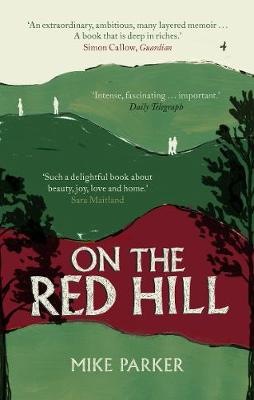 I ordered a copy from Blackwell’s after this made it through to the Wainwright Prize shortlist – it went on to be named the runner-up in the UK nature writing category. It’s primarily a memoir/group biography about Parker, his partner Peredur, and George and Reg, the couple who previously inhabited their home of Rhiw Goch in the Welsh Hills and left it to the younger pair in their wills. In structuring the book into four parts, each associated with an element, a season, a direction of the compass and a main character, Parker focuses on the rhythms of the natural year. The subtitle emphasizes the role Rhiw Goch played, providing all four with a sense of belonging in a rural setting not traditionally welcoming to homosexuals.
Were George and Reg the ‘only gays in the village,’ as the Little Britain sketch has it? Impossible to say, but when they had Powys’ first same-sex civil partnership ceremony in February 2006, they’d been together nearly 60 years. By the time Parker and his partner took over the former guesthouse, gay partnerships were more accepted. In delving back into his friends’ past, then, he conjures up another time: George fought in the Second World War, and for the first 18 years he was with Reg their relationship was technically illegal. But they never rubbed it in any faces, preferring to live quietly, traveling on the Continent and hosting guests at their series of Welsh B&Bs; their politics was conservative, and they were admired locally for their cooking and hospitality (Reg) and endurance cycling (George).
There are lots of in-text black-and-white photographs of Reg and George over the years and of Rhiw Goch through the seasons. Using captioned photos, journal entries, letters and other documents, Parker gives a clear impression of his late friends’ characters. There is something pitiable about both: George resisting ageing with nude weightlifting well into his sixties; Reg still essentially ashamed of his sexuality as well as his dyslexia. I felt I got to know the younger protagonists less well, but that may simply be because their stories are ongoing. It’s remarkable how Welsh Parker now seems: though he grew up in the English Midlands, he now speaks decent Welsh and has even stood for election for the Plaid Cymru party.
It’s rare to come across something in the life writing field that feels genuinely sui generis. There were moments when my attention waned (e.g., George’s feuds with the neighbors), but so strong is the overall sense of time, place and personality that this is a book to prize.
The Gospel of the Eels: A Father, a Son and the World’s Most Enigmatic Fish by Patrik Svensson
[Translated from the Swedish by Agnes Broomé]
“When it comes to eels, an otherwise knowledgeable humanity has always been forced to rely on faith to some extent.”
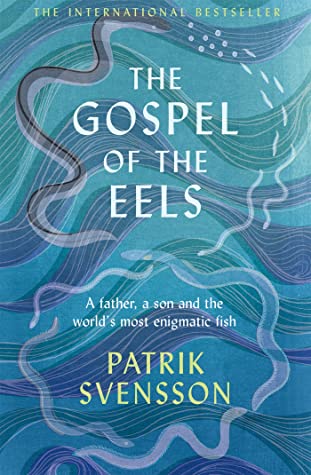 We know the basic facts of the European eel’s life cycle: born in the Sargasso Sea, it starts off as a larva and then passes through three stages that are almost like separate identities: glass eel, yellow eel, silver eel. After decades underwater, it makes its way back to the Sargasso to spawn and die. Yet so much about the eel remains a mystery: why the Sargasso? What do the creatures do for all the time in between? Eel reproduction still has not been observed, despite scientists’ best efforts. Among the famous names who have researched eels are Aristotle, Sigmund Freud and Rachel Carson, all of whom Svensson discusses at some length. He even suggests that, for Freud, the eel was a suitable early metaphor for the unconscious – “an initial insight into how deeply some truths are hidden.”
But there is a more personal reason for Svensson’s fascination with eels. As a boy he joined his father in eel fishing on Swedish summer nights. It was their only shared hobby; the only thing they ever talked about. His father was as much a mystery to him as eels are to science. And it was only as his father was dying of a cancer caused by his long road-paving career that Svensson came to understand secrets he’d kept hidden for decades.
Chapters alternate between this family story and the story of the eels. The book explores eels’ place in culture (e.g., Günter Grass’ The Tin Drum) and their critically endangered status due to factors such as a herpes virus, nematode infection, pollution, overfishing and climate change. A prior curiosity about marine life would be helpful to keep you going through this, but the prose is lovely enough to draw in even those with a milder interest in nature writing.
With thanks to Picador for the free copy for review.
One of my recent borrows from the public library’s children’s section was the picture book Think of an Eel by Karen Wallace. Her unrhymed, alliterative poetry and the paintings by Mike Bostock beautifully illustrate the eel’s life cycle and journey.

You simply must hear folk singer Kitty Macfarlane’s gorgeous song “Glass Eel” – literally about eels, it’s also concerned with migration, borders and mystery.
 Bookish Beck = Rebecca Foster. American transplant to England. Freelance proofreader and book reviewer.
 Bookish Beck