May Graphic Novels by Alison Bechdel, Peter Kuper & Craig Thompson
May has been chock-full of new releases for me! For this first batch of reviews, I’m featuring three fantastic graphic novels that have made it onto my Best of 2025 (so far) list. I don’t read graphic books as often as I’d like to – my library tends to major on superhero comics and manga, which aren’t my cup of tea – but I sometimes get a chance to access them for paid review purposes. (The first two below are ones I was sent for potential Shelf Awareness reviews, but I missed the deadlines.) Reading these took me back to the early 2010s when I worked for a university library in South London and would walk to Lambeth Library on my lunch breaks to borrow huge piles of books, mostly taking advantage of their excellent graphic novel selection. That was where my education and fascination began.
Spent: A Comic Novel by Alison Bechdel
 I’ve read all but one of Bechdel’s works now. Fun Home was among the first graphic books I read and is a great choice if you’re new to this form of storytelling. It’s a family memoir about her father’s funeral home business and closeted lifestyle, which emerged shortly after her own coming-out – and shortly before his accidental death. In Spent, Alison and her handy wife Holly live on a Vermont pygmy goat farm. Alison has writer’s block and is struggling financially despite her famous memoir about her taxidermist father having been made into a successful TV series, Death & Taxidermy. Mostly, she’s consumed with anxiety about the state of the world, what with the ongoing pandemic, her sister’s right-wing opinions, and the litany of awful headlines. “Who can draw when the world is burning?” she exclaims.
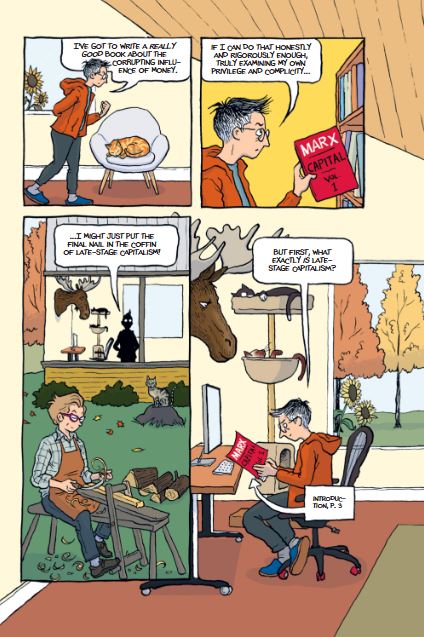
Then Alison has an idea for a book – or maybe a reality TV series – called $UM that will wean people off of capitalism. That creative journey is mirrored in Spent, which is composed of 12 “episodes” titled after Marxist terminology. Through Alison’s ageing hippie friends and their kids, Bechdel showcases alternative ways of living: a commune, a throuple, nonbinary identity, unpaid internships, Just Stop Oil demos, and the influencer lifestyle versus rejection of technology. It’s (auto)fiction exaggerated to the brink of absurdity, with details changed enough to mock but not enough to hide (e.g., she’s published by “Megalopub,” the hardware store is “Home Despot,” her show airs on “Schmamazon”).

Tiny details in the drawings reward close attention, such as Alison and Holly’s five cats’ antics during their morning routine, and a stuffed moose head rolling its eyes. It’s the funniest I can remember Bechdel being, with much broad humour derived from the outrageous screen mangling of her book – cannibalism, volcanoes and dragons come out of nowhere – and her middle-class friends’ hand-wringing over their liberal credentials. Even the throwaway phrases are hilarious. It’s a gleeful and zeitgeist-y satire, yet draws to a touching close as Alison has the epiphany that she can’t fix everything herself so must simply do what she can, “with a little help from her annoying, tender-hearted, and utterly luminous friends.”
Accessed as an e-book from Mariner Books. Published in the UK by Jonathan Cape (Penguin).
Insectopolis: A Natural History by Peter Kuper
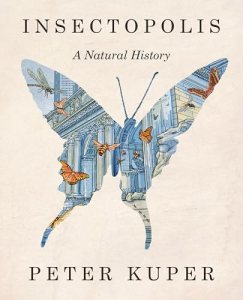 Nearly a decade ago, I reviewed Peter Kuper’s Ruins, which features monarch migration and has as protagonist a laid-off Natural History Museum entomologist. Here insects have even more of a starring role. The E. O. Wilson epigraph sets the stage: “If all mankind were to disappear, the world would regenerate back to the rich state of equilibrium that existed ten thousand years ago. If insects were to vanish, the environment would collapse into chaos.” We follow an African American brother-and-sister pair, the one dubious and the other eager, as they walk downtown to the New York Public Library. The sister, who holds a PhD in entomology, promises that its exhibition on insects is going to be amazing. But just before they reach the building, a red alert flashes up on every smartphone and sirens start blaring. A week later, the city is a ruin of overturned cabs and debris. Only insects remain and, group by group, they guide readers through the empty exhibit, interacting within and across species.


It’s a sly blend of science, history, stories and silliness. I loved the scenes of mosquitoes and ants railing against how they’ve been depicted as villainous, and dignified dung beetles resisting scatological jokes and standing up for their importance in ecosystems. There are interesting interludes about insects in literature (not just Kafka and Nabokov, but the Japanese graphic novel The Book of Human Insects by Osamu Tezuka), and unsung heroines of entomology get their moment in the sun. The pages in which Margaret Collins, an African American termite researcher in the 1950s, and Rachel Carson appear to a dragonfly as ghosts and tell their stories of being dismissed by male researchers were among my favourites. Informative and entertaining at once; what could be better? Welcome our insect overlords!
Accessed as an e-book from W. W. Norton & Company.
Ginseng Roots by Craig Thompson
 I’d read several of Thompson’s works and especially enjoyed his previous graphic memoir, Blankets, about his first love and loss of faith. When I read this blurb, I worried the niche subject couldn’t possibly sustain my attention for nearly 450 pages. But I was wrong; this is a vital book about everything, by way of ginseng. It begins with childhood summers working on American ginseng farms with his siblings in Marathon, Wisconsin. Theirs was a blue collar and highly religious family, but Thompson and his little brother Phil were allowed to spend their earnings from the back-breaking labour of weeding and picking rocks as they pleased. Each hour, each dollar, meant a new comic from the pharmacy. “Comics helped me survive my childhood. But what will help me survive my adulthood?” Thompson asks.

Together with Phil, he travels first to Midwest ginseng farms and festivals and then through China and Korea to learn about the plant’s history, cultivation practices, lore, and medicinal uses. As he meets producers – including a Hmong man whose early life mirrors his own – he feels sheepish about how he makes a living: “I carry this working-class guilt – what I do isn’t real work.” When his livelihood is threatened by worsening autoimmune conditions, he tries everything from acupuncture to psychotherapy to save his hands and his creativity.
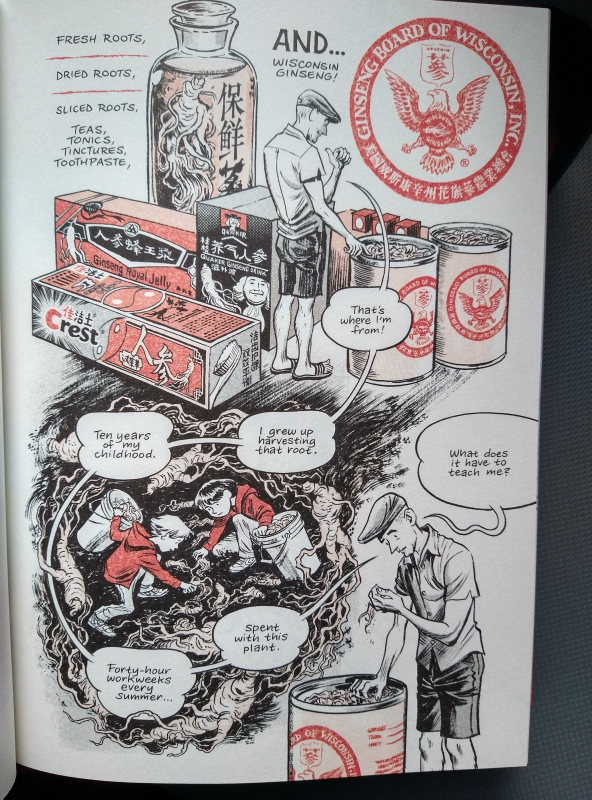
This chunky book has an appealing earth-tones palette and shifts smoothly between locations and styles, memories and research. When interviewing growers and Chinese medicine practitioners, the depictions are almost photorealistic, but there are also superhero pastiche panels and a cute ginseng mascot who pops up throughout the book. Like Spent, this pulls in class and economic issues in a lighthearted way and also explores its own composition process.
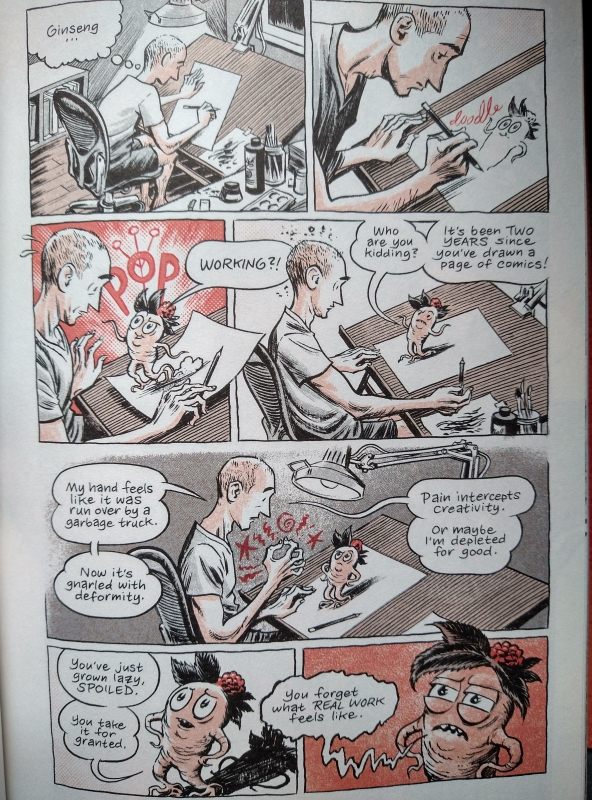
The story of ginseng is often sobering, involving the exploitation of immigrants (in the Notes, Thompson regrets that he was unable to speak with any of the Mexican migrant workers on whom the American ginseng harvest now depends), soil degradation, and pesticide pollution. The roots of the title are both literal and symbolic of the family story that unfolds in parallel. Both strands are captivating, but especially the autobiographical material: Thompson’s relationship with Phil, his new understanding but ongoing frustration with his parents, and the way all three siblings exhibit the damage of their upbringing – Phil’s marriage is crumbling; their sister Sarah, who has moved 26 times as an adult, wonders what she’s running from. A conversation with a Chinese herbal pharmacist gets to the heart of the matter: “I learned home is not WHERE I am. Home is HOW I am.”
Both expansive and intimate, this is a surprising gem from one of the best long-form graphic storytellers out there.
With thanks to Faber for the free copy for review. Published in the USA by Pantheon (Penguin).
One More Wellcome Longlist Review & Shortlist Predictions
Tomorrow the six titles on the Wellcome Book Prize shortlist will be revealed. I’ve managed to read one more from the longlist since my last batch.
The Butchering Art: Joseph Lister’s Quest to Transform the Grisly World of Victorian Medicine by Lindsey Fitzharris
 Surgery was a gory business with a notably high fatality rate well into the nineteenth century. Surgeons had the fastest hands in the West, but their victims were still guaranteed at least a few minutes of utter agony as they had a limb amputated or a tumor removed, and the danger wasn’t over after they were sewn up either: most patients soon died from hospital infections. The development of anesthetics and antiseptic techniques helped to change all that.
Fitzharris opens with the vivid and rather gruesome scene of a mid-thigh amputation performed by Robert Liston at University College Hospital in London in 1846. This surgery was different, though: it only took 28 seconds, but the patient felt nothing thanks to the ether he had been administered. He woke up a few minutes later asking when the procedure would begin. In the audience that day was Joseph Lister, who would become one of Britain’s most admired surgeons.
Lister came from a Quaker family and, after being educated at University College London, started his career in Edinburgh. Different to many medical professionals of the time, he was fascinated by microscopy and determined to find out what caused deadly infections. Carbolic acid and catgut ligatures were two of Lister’s main innovations that helped to fight infection. In fact, whether we realize it or not, his legacy is forever associated with antiseptics: Listerine mouthwash (invented in 1879) is named after him, and the Johnson brothers of Johnson & Johnson fame started their business mass-producing sterile surgical dressings after attending one of Lister’s lectures.
My interest tailed off a bit after the first third, as the book starts going into more depth about Lister’s work and personal life: he married his boss’s daughter and moved from Edinburgh to Glasgow and then back to London. However, the best is yet to come: the accounts of the surgeries he performed on his sister (a mastectomy that bought her three more years of life) and Queen Victoria (removing an orange-sized abscess from under her arm) are terrific. The chapter on treating the queen in secret at Balmoral Castle in 1871 was my overall favorite.

It probably wasn’t the best idea to start this book over my lunch one day!
I was that kid who loved going to Civil War battlefields and medical museums and looking at all the different surgical saws and bullet fragments in museum cases, so I reveled in the gory details here but was not as interested in the biographical material. Do be sure you have a strong stomach before you try reading the prologue over a meal. This is a comparable read to The Remedy, about the search for a cure to tuberculosis.
My rating:
Shortlist Predictions
Now, I’ve still only read half of the longlisted titles so far, so it’s hard to make any solid guesses. However, the below fall somewhere between wishes and informed predictions:
- In Pursuit of Memory by Joseph Jebelli: A definitive treatment of an epidemic of our time, Alzheimer’s disease. The neuroscientist author achieves the right balance between history and research on the one hand and personal stories readers can relate to on the other.
- The White Book by Han Kang: The only fiction title from the longlist that I haven’t read at least part of. This is also on this year’s Man Booker International Prize longlist and has been well received. From what I can tell, the health theme seems stronger than that of Stay with Me or Midwinter Break, and it would also be nice for one title in translation to make the shortlist.
- With the End in Mind by Kathryn Mannix: As I said in my review last week, this is an excellent all-round guide to preparation for death, based around touching patient stories plus the author’s experience in palliative care and CBT. Practical, compassionate and helpful.
- I Am, I Am, I Am by Maggie O’Farrell: For me, this book stands out as the one that most clearly illuminates the effects of illness, medical treatment, and other threats to life and limb in the course of an ordinary existence. I’d be very happy to see it win the whole thing.
- EITHER The Butchering Art by Lindsey Fitzharris OR The Vaccine Race by Meredith Wadman: I reckon one history of science title deserves to be on there; I think Wadman might have the slight edge.
- EITHER To Be a Machine by Mark O’Connell OR Behave by Robert Sapolsky: The Wellcome Prize loves big books investigating human tendencies and possibilities. I find the thought of either of these daunting, but I know they would also be illuminating. I’d prefer to read the O’Connell, but I’d give the edge to Sapolsky.
 Bookish Beck = Rebecca Foster. American transplant to England. Freelance proofreader and book reviewer.
 Bookish Beck