The 2025 McKitterick Prize Winner & SoA Awards Ceremony
Yesterday the Society of Authors’ awards were announced and the prizes handed out at a ceremony in London. As a McKitterick Prize judge, I was asked last month to give a 50-word blurb on the shortlist as a whole—
Each of these six novels has a fully realized style. So confident and inviting are they that it’s hard to believe they are debuts. With nuanced characters and authentic settings and dilemmas, they engage the mind and delight the emotions. I will be following these authors’ careers with keen interest.
—and on each individual shortlisted title:
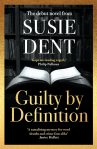 Etymology and Shakespeare studies are the keys to solving a cold case in Susie Dent’s clever, engrossing mystery, Guilty by Definition.
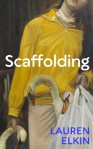 Psychoanalysis, motherhood, and violence against women are resounding themes in Lauren Elkin’s Scaffolding. As history repeats itself one sweltering Paris summer, the personal and political structures undergirding the protagonists’ parallel lives come into question. This fearless, sophisticated work ponders what to salvage from the past—and what to tear down.
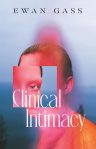 Clinical Intimacy’s mysterious antihero comes to life through interviews with his family, friends and clients. The brilliant oral history format builds a picture of isolation among vulnerable populations, only alleviated by care and touch—especially during Covid-19. Ewan Gass’s intricate story reminds us of the ultimate unknowability of other people.
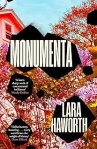
In Monumenta, Lara Haworth braids satire, magic realism, and metafiction into a compact and surprising meditation on how we seek to memorialise the tragedies of history.
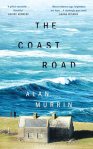
Set in small-town Ireland, The Coast Road is a subtle, compassionate novel in which the characters learn to write their own stories rather than bow to convention and fate. Alan Murrin is a must-read author for fans of Claire Keegan, Louise Kennedy, and Colm Tóibín.
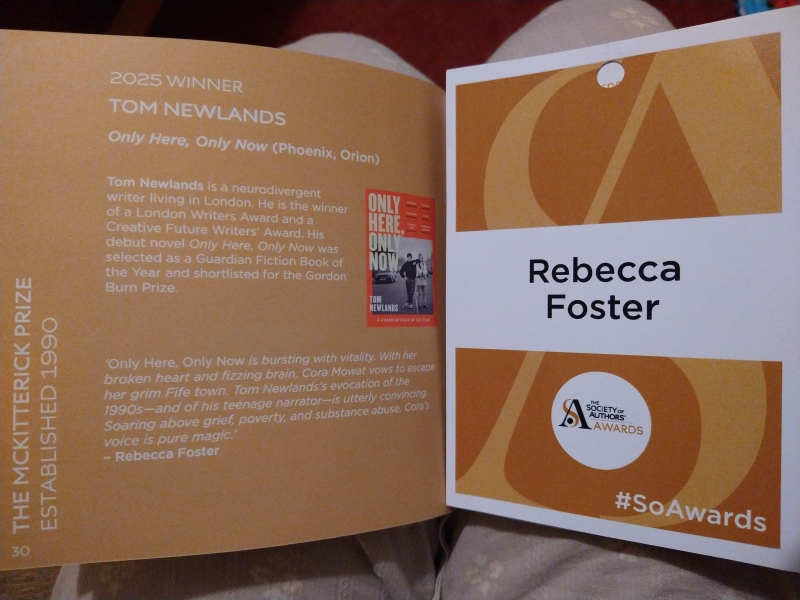
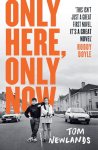 Only Here, Only Now is bursting with vitality. With her broken heart and fizzing brain, Cora Mowat vows to escape her grim Fife town. Tom Newlands’s evocation of the 1990s—and of his teenage narrator—is utterly convincing. Soaring above grief, poverty, and substance abuse, Cora’s voice is pure magic.
Our winner was Tom Newlands for Only Here, Only Now and our runner-up was Lauren Elkin for Scaffolding. (What an honour to have my blurb for the former used in the winners press release, the ceremony programme, and social media publicity.)


Newlands was also a runner-up for the ADCI Literary Prize “for a disabled or chronically ill writer, for an outstanding novel containing a disabled or chronically ill character or characters.” Here’s an excerpt from his statement for the press release:
To have my debut novel recognised in these two categories is particularly meaningful for me because they are linked by my experience. I didn’t start writing until the age of 40, in large part because growing up neurodivergent I didn’t feel my thought processes or methods of working were compatible with the production of a novel. There were no role models out there publishing stories like mine, and in the end, I wrote Only Here, Only Now because I couldn’t find the novel I wanted to read – a warm, vivid and funny story that examined poverty, disability and belonging, and that featured characters rarely found in British fiction.
Looking back to early on in this prize journey (which started back in November) … here was some of my early reading:
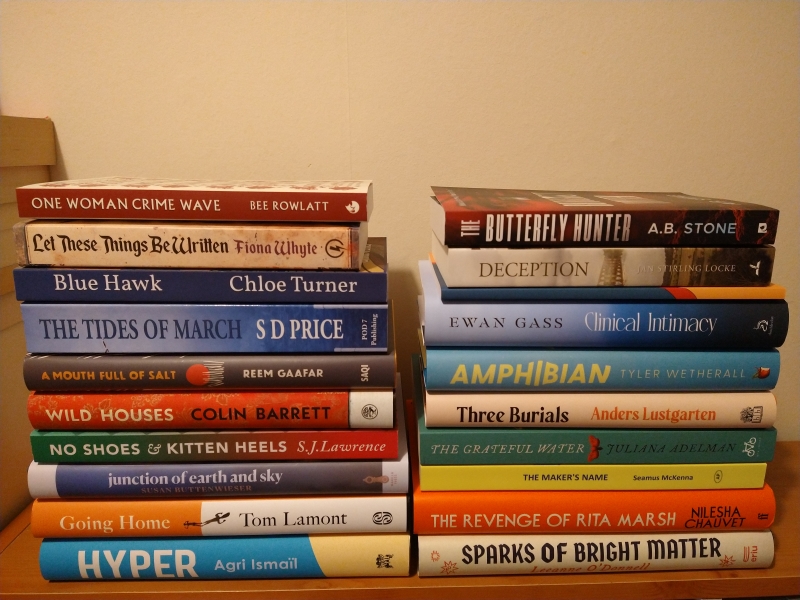
And our longlist:
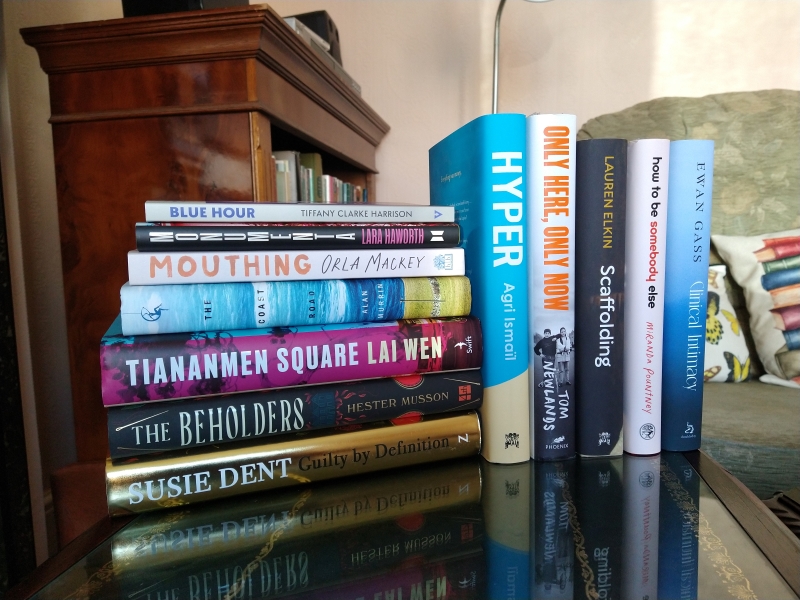
A couple of my favourite books from my reading that didn’t make the shortlist were:
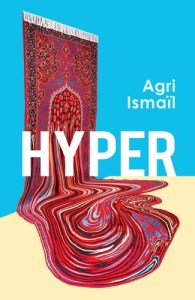 Hyper by Agri Ismaïl [I longlisted it – and then shortlisted it – but was outvoted]
Following a Kurdish family across several decades, this is a zeitgeist-y story that examines questions of national and personal autonomy. With its Dubai, Baghdad, London, and New York settings, it sets the second generation’s luxury, high finance, and fully online worlds against their parents’ bitter experience of exile after a failed independence movement. With its themes of dysfunction and failures and the long view of how we got here from there, it reminded me of Jonathan Franzen’s body of work.
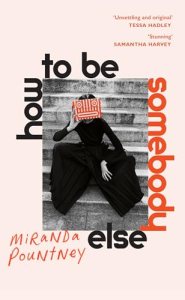 How to Be Somebody Else by Miranda Pountney [It had two votes to make the shortlist, but because it was so similar to Scaffolding in its basics (a thirtysomething woman in a big city, the question of motherhood, and pregnancy loss) we decided to cut it.]
This is the addictively readable story of Dylan, a late-thirties English woman who gives up her New York City advertising job and ponders authorship and motherhood while house-sitting an acquaintance’s apartment—and carrying on an affair with the married downstairs neighbour. As we see her interact with family and friends, we come to appreciate her not as some stereotypical ‘sad girl’ or ‘disaster woman’, but as an Everywoman seeking the time and space to become herself. It’s a sharp and witty novel for fans of Sally Rooney.
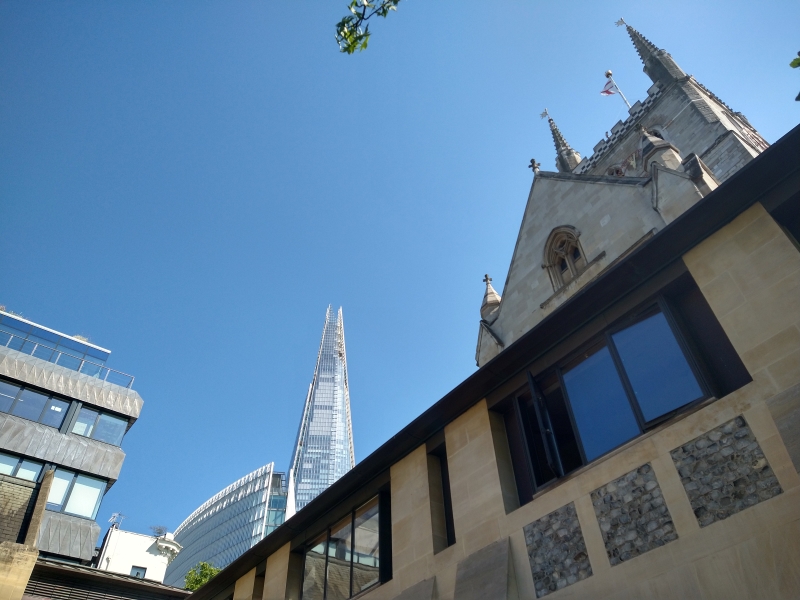
For the first time, I got to attend the SoA Awards ceremony in person yesterday. It was a hot day to be travelling in London, and after the oven of the Bakerloo line I was grateful to escape into the cool of Southwark Cathedral and its grounds. It was such a juxtaposition between the sleek City architecture and the ancient refuge of a church.
I worried that on such a warm and then busy day Hodge the cathedral cat wouldn’t show himself, but as I picked up my name badge he was asking to be let inside from the courtyard. He didn’t seem interested in strokes so I followed him at a respectful distance and let him settle in for a watchful rest.


Nominated authors and judges were treated to an exceptional afternoon tea, followed by the ceremony and drinks reception. It was lovely to meet my fellow judges Anietie Isong and Kathy O’Shaughnessy (author of the fantastic In Love with George Eliot, which won the SoA’s Paul Torday Memorial Prize) in the flesh as I’d only met them on Zoom before. We chatted a good bit with Lara Haworth, one of our shortlistees, and with Anne Booth, one of the Queen’s Knickers Award (children’s books) nominees, and also got to briefly meet Tom Newlands when he arrived for the ceremony. I always look out for literary ‘celebrities’ at such events and yesterday spotted Naomi Alderman, Caroline Bird, Joanne Harris and Alice Jolly.
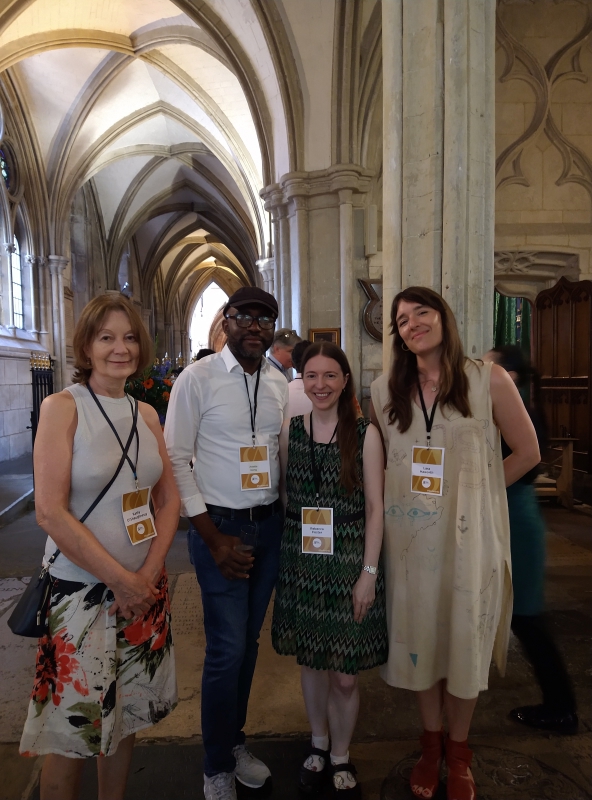


Dean Rev. Mark Oakley gave a welcome address via video, praising authors for bringing “resonance” rather than just “relevance.” He exhorted us, in the words of David Copperfield, to “read as if for life.” Joseph Coelho then gave a terrific keynote speech celebrating words written by humans (as opposed to an inaccurate AI-written bio of himself that he once encountered) and encouraging shortlistees, especially, to take time to bask in their achievement. Rejection is an ongoing, annual thing for him even at this stage of his career – he still remembers the £50 poetry gigs, changing in library toilets and school staff rooms; and the 12 years he spent trying to get published – even after he became the youngest-ever children’s laureate in 2022. “Wait for no one,” he challenged us: no one is going to give you permission or come save you, so go out there and do what you’re meant to do.
What an all-round fantastic experience this was! I’m so grateful to the Society of Authors for the opportunity.
Other notable winners announced yesterday included:
- Ashani Lewis (the only double winner): the Betty Trask Prize and Somerset Maugham award for Winter Animals
- Hisham Matar & Elif Shafak: the Gordon Bowker Volcano Prize (for a novel focusing on the experience of travel away from home), joint winners for My Friends and There Are Rivers in the Sky
Society of Authors Awards Ceremony & 2022 McKitterick Prize
The Society of Authors, the UK trade union for writers, awards multiple grants and prizes. As I’ve mentioned in a couple of previous posts, I was one of the manuscript judges for its 2022 McKitterick Prize, awarded to a debut novelist aged 40+.

Last night I watched part of the livestream for the SoA Awards ceremony, held at Southwark Cathedral. I had to take the above screenshot! SoA Chair Joanne Harris and keynote speaker Lemn Sissay handed out the prizes to the winners and runners-up. (The full list is available here; I’m particularly delighted that Will McPhail’s In, the first graphic novel nominated for an SoA award, won the £10,000 Betty Trask Prize.)
The McKitterick Prize winner was:
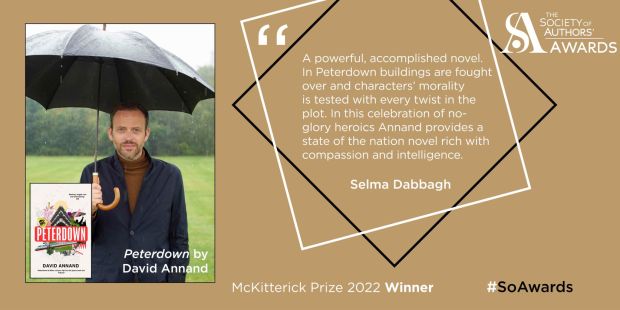
A book I clearly need to source at once!

And the runner-up was:
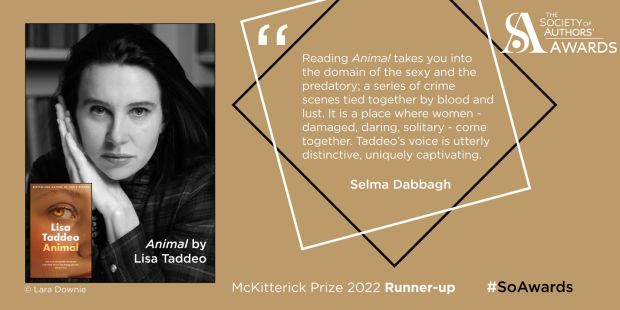
(A controversial novel I’m not so sure I see myself reading.)
Wishing an enjoyable long Jubilee weekend to those in the UK who plan to celebrate. Down with the monarchy, is the general vibe in my household, but we’ll have scones and meet some new neighbours at today’s street party (our first of two) anyway.
Young Writer of the Year Award 2020: Shortlist Reviews and Predictions
Being on the shadow panel for the Sunday Times Young Writer of the Year Award was a bookish highlight of 2017 for me. I’m pleased for this year’s panelists, especially blogging friend Marina Sofia, to have had the same opportunity, and I look forward to hearing who they choose as their shadow panel winner on December 3rd and then attending the virtual prize ceremony on December 10th.

At the time of the shortlisting, I happened to have already read Exciting Times by Naoise Dolan and was halfway through Catherine Cho’s memoir Inferno. I got the poetry collection Surge by Jay Bernard out from the library to have another go (after DNFing it last year), and the kind folk of FMcM Associates sent me the other two shortlisted books, a poetry collection and a novel, so that I could follow along with the shadow panel’s deliberations. Here are my brief thoughts on all five nominees.
Surge by Jay Bernard (2019)
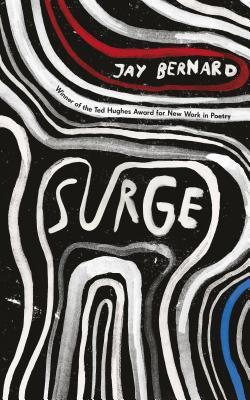 As a writer-in-residence at the George Padmore Institute, a research centre for radical Black history, in 2016, Bernard investigated the New Cross Massacre, a fire that killed 13 young people in 1981. In 2017, the tragedy found a horrific echo in the Grenfell Tower fire, which left 72 dead. This debut poetry collection bridges that quarter-century through protest poems from various perspectives, giving voice to victims and their family members and exploring the interplay between race, sexuality and violence. Patois comes in at several points, most notably in “Songbook.” I especially liked “Peg” and “Pride,” and the indictment of government indifference in “Blank”: “It-has-nothing-to-do-with-us today issued this statement: / those involved have defended their actions and been … acquitted / retired with full pay”. On the whole, I found it difficult to fully engage with this collection, but I am reliably informed that Bernard’s protest poems have more impact when performed aloud.
Readalikes: In Nearby Bushes by Kei Miller, A Portable Paradise by Roger Robinson and Don’t Call Us Dead by Danez Smith
My rating: 
Inferno by Catherine Cho (2020)
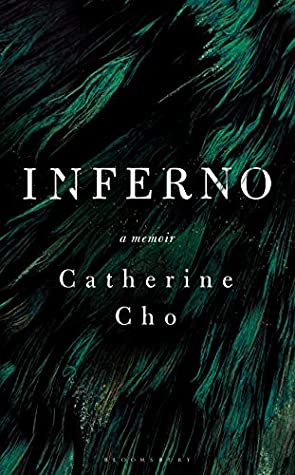 Cho, a Korean American literary agent based in London, experienced stress-induced postpartum psychosis after the birth of her son. She and her husband had returned to the USA when Cato was two months old to introduce him to friends and family, ending with a big Korean 100-day celebration at her in-laws’ home. Almost as soon as they got to her in-laws’, though, she started acting strangely: she was convinced cameras were watching their every move, and Cato’s eyes were replaced with “devil’s eyes.” She insisted they leave for a hotel, but soon she would be in a hospital emergency room, followed by a mental health ward. Cho alternates between her time in the mental hospital and a rundown of the rest of her life before the breakdown, weaving in her family history and Korean sayings and legends. Twelve days: That was the length of her hospitalization in early 2018, but Cho so painstakingly depicts her mindset that readers are fully immersed in an open-ended purgatory. She captures extremes of suffering and joy in this vivid account. (Reviewed in full here.)
Readalikes: An Angel at My Table by Janet Frame and Dear Scarlet by Teresa Wong
My rating: 
Exciting Times by Naoise Dolan (2020)
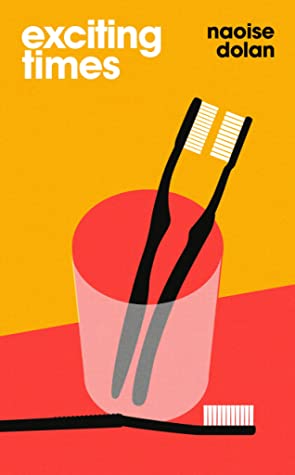 At 22, Ava leaves Dublin to teach English as a foreign language to wealthy preteens in Hong Kong and soon comes to a convenient arrangement with her aloof banker friend, Julian, who lets her live with him without paying rent and buys her whatever she wants. They have sex, yes, but he’s not her boyfriend per se, so when he’s transferred to London for six months, there’s no worry about hard feelings when her new friendship with Edith Zhang turns romantic. It gets a little more complicated, though, when Julian returns and she has to explain these relationships to her two partners and to herself. On the face of it, this doesn’t sound like it would be an interesting plot, and the hook-up culture couldn’t be more foreign to me. But with Ava Dolan has created a funny, deadpan voice that carries the entire novel. I loved the psychological insight, the playfulness with language, and the zingy one-liners (“I wondered if Victoria was a real person or three Mitford sisters in a long coat”). (Reviewed in full here.)
Readalikes: Besotted by Melissa Duclos and Conversations with Friends by Sally Rooney
My rating:
Tongues of Fire by Seán Hewitt (2020)
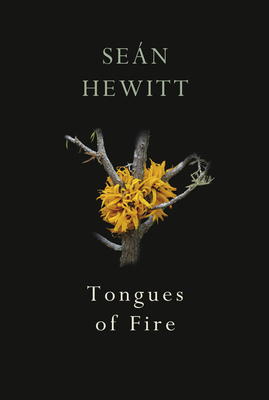 In the title poem, the arboreal fungus from the cover serves as “a bright, ancestral messenger // bursting through from one realm to another” like “the cones of God, the Pentecostal flame”. This debut collection is alive with striking imagery that draws links between the natural and the supernatural. Sex and grief, two major themes, are silhouetted against the backdrop of nature. Fields and forests are loci of meditation and epiphany, but also of clandestine encounters between men: “I came back often, // year on year, kneeling and being knelt for / in acts of secret worship, and now / each woodland smells quietly of sex”. Hewitt recalls travels to Berlin and Sweden, and charts his father’s rapid decline and death from an advanced cancer. A central section of translations of the middle-Irish legend “Buile Suibhne” is less memorable than the gorgeous portraits of flora and fauna and the moving words dedicated to the poet’s father: “You are not leaving, I know, // but shifting into image – my head / already is haunted with you” and “In this world, I believe, / there is nothing lost, only translated”.
Readalikes: Physical by Andrew McMillan and If All the World and Love Were Young by Stephen Sexton
My rating:
Nightingale by Marina Kemp (2020)
 Marguerite Demers, a 24-year-old nurse, has escaped Paris to be a live-in carer for elderly Jérôme Lanvier in southern France. From the start, she senses she’s out of place here – “She felt, as always in this village, that she was being observed”. She strikes up a friendship with a fellow outsider, an Iranian émigrée named Suki, who, in this story set in 2002, stands out for wearing a hijab. Everyone knows everyone here, and everyone has history with everyone else – flirtations, feuds, affairs, and more. Brigitte Brochon, unhappily married to a local farmer, predicts Marguerite will be just like the previous nurses who failed to hack it in service to the curmudgeonly Monsieur Lanvier. But Marguerite sticks up for herself and, though plagued by traumatic memories, makes her own bid for happiness. The novel deals sensitively with topics like bisexuality, euthanasia, and family estrangement, but the French provincial setting and fairly melodramatic plot struck me as old-fashioned. Still, the writing is strong enough to keep an eye out for what Kemp writes next. (U.S. title: Marguerite.)
Readalikes: French-set novels by Joanne Harris and Rose Tremain; The Hoarder by Jess Kidd
My rating:
General thoughts:
After last year’s unexpected winner – Raymond Antrobus for his poetry collection The Perseverance – I would have said that it’s time for a novel by a woman to win. However, I feel like a Dolan win would be too much of a repeat of 2017’s win (for Sally Rooney), and Kemp’s debut novel isn’t quite up to scratch. Much as I enjoyed Inferno, I can’t see it winning over these judges (three of whom are novelists: Kit de Waal, Sebastian Faulks and Tessa Hadley), though it would be suited to the Wellcome Book Prize if that comes back in 2021. So, to my surprise, I think it’s going to be another year for poetry.
I’ve been following the shadow panel’s thoughts via Marina’s blog and the others’ Instagram accounts and it looks like they are united in their admiration for the poetry collections, particularly the Hewitt. That would be my preference, too: I respond better to theme and style in poetry (Hewitt) than to voice and message (Bernard). However, I think that in 2020 the Times may try to trade its rather fusty image for something more woke, bearing in mind the Black Lives Matter significance and the unprecedented presence of a nonbinary author.
My predictions:
Shadow panel winner: Tongues of Fire by Seán Hewitt
Official winner: Surge by Jay Bernard
 Bookish Beck = Rebecca Foster. American transplant to England. Freelance proofreader and book reviewer.
 Bookish Beck