Books in Brief: Five I Loved Recently
Novels about Patricia Highsmith and a prison production of The Tempest; a true-life account of opening a secondhand bookstore; a faux memoir setting ancestors’ memories in the context of twentieth-century history; and an exposé of the happiness movement in America: these five very different books are all 4-star reads I can highly recommend.
The Crime Writer
By Jill Dawson
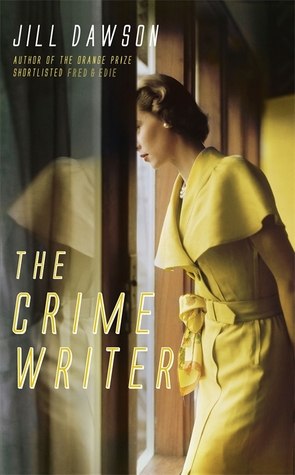 Patricia Highsmith hated the term “crime writer”; she preferred to speak of her work as “suspense novels,” animated by the threat of danger. Dawson’s terrific pastiche is set in the early 1960s, when the nomadic Highsmith was living in a remote cottage in Suffolk, England. Beyond the barest biographical facts, though, Dawson has imagined the plot based on Highsmith’s own preoccupations: fear of a stalker, irksome poison-pen letters, imagining what it would be like to commit murder … and snails. In a combination of third- and first-person narration, she shows “Pat” succumbing to alcoholism and paranoia as she carries on affairs with Sam, a married woman, and Ginny, a young journalist who’s obsessed with her. You’re never quite sure as you’re reading what is actually happening in the world of the novel and what only occurs in Highsmith’s imagination; I’m sure that’s deliberate. This counts as one of the most gripping, compulsive books I’ve encountered this year.
The Little Bookstore of Big Stone Gap
By Wendy Welch
 Everyone told Wendy Welch and her husband that they were crazy when they decided to open a used bookstore in a small Appalachian Coalfields town in the middle of a recession. They lived above the shop and initially stocked it with their own library plus books picked up cheap at yard sales – though Welch later learned to be much more choosy about what they added to their inventory and to tailor their selections to the tastes of country readers. Essentially, they were making it all up as they went along, but eight years later they’re still a community fixture in Big Stone Gap, Virginia. (I’d love to visit someday.) For the most part that’s because they branched out to fill other roles: hosting cultural events, murder mystery evenings, a writing group, a crafting circle, and regular Quaker meetings. I appreciated the details about the nitty-gritty of running a bookstore (like a chapter on pricing) more than the customer interactions. A warm and fuzzy book-lover’s delight.
Hag-Seed: The Tempest Retold
By Margaret Atwood
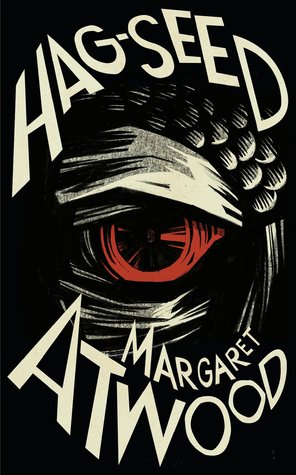 Margaret Atwood looks more like a good witch every year, and here she works her magic on The Tempest to produce the most satisfying volume of the Hogarth Shakespeare series yet. There’s a really clever play-within-the-play-within-the-play thing going on, and themes of imprisonment and performance resonate in multiple ways. It’s fun to see the disgraced Felix’s second act as a director of inmate plays at Fletcher Correctional – “I don’t care why you’re in here or what they say you’ve done: for this course the past is prologue.” Part V gets a little tedious/didactic as the cast hash out the characters’ afterlives, and at times (mainly the raps) you’re painfully aware that this is an old white lady trying to approximate how seasoned criminals might speak, but in general I thoroughly enjoyed this. Even though you see behind the scenes (e.g. my favorite chapter was about Felix wandering the streets of Toronto to buy props and costumes), you still get caught up in the magic. (See also Carolyn’s wonderful review at Rosemary and Reading Glasses.)
The Pursuit of Happiness: Why are we driving ourselves crazy and how can we stop?
By Ruth Whippman
 I call this niche genre anti-self-help. (Two other great examples are Smile or Die by Barbara Ehrenreich and Promise Land by Jessica Lamb-Shapiro.) Whippman has a particularly interesting perspective as a British Jew who moved to California for her husband’s work. With sharp humor and natural British cynicism, she investigates various manifestations of the American obsession with happiness, including the cult-like Landmark Forum, Zappos shoes HQ, Facebook’s encouragement of shallow social interaction, and the positive psychology movement. I especially liked her visit to Mormons in Salt Lake City (the nation’s happiest group, it seems, but also the most highly medicated against depression), but the funniest chapter is on happiness-focused parenting. The basic message is that the happiness movement went wrong by making it a matter of personal responsibility, of mental and spiritual triumph over circumstances. It gives no easy answers, but it’s a very enjoyable book.
Moonglow
By Michael Chabon
 Chabon’s seventh novel was inspired by his maternal grandfather’s deathbed confessions in 1989—or was it? A tongue-in-cheek author’s note refers to this as a “memoir,” and it’s narrated by “Mike Chabon,” but he and “Grandfather” (never named) are characters here in the same way that Jonathan Safran Foer and his ancestors are in Everything Is Illuminated. Space travel and explosives are Grandfather’s lifelong obsessions, but the chronology moves back and forth seemingly haphazardly, as if we are hearing this story exactly as it emerged. Chabon offers a rich meditation on how Jewishness and family secrets influence the creation of identity. With a seam of dark humor that brings to mind Jonas Jonasson’s The Hundred-Year-Old Man…, Moonglow inventively fuses family history and fiction but leaves cracks for happiness and meaning to shine through. (See my full review on the Pittsburgh Post-Gazette website.)
Have you read any of these? Which one takes your fancy?
Six Books that Disappointed Me Recently
I had high hopes for all of these: long-awaited novels from Jonathan Safran Foer (10 years after his previous one), Maria Semple and Zadie Smith; a Project Gutenberg download from the reliably funny Jerome K. Jerome; a brand new psychological thriller from James Lasdun, whose memoir and poetry I’ve loved; and a horse racing epic that generated Great American Novel buzz. But they all failed to live up to expectations.
Here I Am
By Jonathan Safran Foer
 Is it a simple account of the implosion of two Washington, D.C. fortysomethings’ marriage? Or is it a sweeping epic of Judaism from the biblical patriarchs to imagined all-out Middle Eastern warfare? Can it succeed in being both? I didn’t really think so. The dialogue between this couple as they face the fallout is all too real and cuts to the quick. I enjoyed the preparations for Sam’s bar mitzvah and I could admire Julia’s clear-eyed capability and Sam, Max and Benjy’s almost alarming intelligence and heart at the same time as I wondered to what extent she was Foer’s ex-wife Nicole Krauss and they were the authors’ kids. But about halfway through I thought the book got away from Foer, requiring him to throw in a death, a natural disaster, and a conflict with global implications. This feels more like a novel by Philip Roth or Howard Jacobson, what with frequent masturbation and sex talk on the one hand and constant quarreling about what Jewishness means on the other. The central message about being present for others’ suffering, and your own, got a little lost under the flood of events.
My rating: 
Three Men on the Bummel
 By Jerome K. Jerome
Jerome’s digressive style can be amusing in small doses, but this book is almost nothing but asides. I did enjoy the parts that most closely resemble a travelogue of the cycle trip through Germany, but these are drowned under a bunch of irrelevant memories and anecdotes. I much preferred Diary of a Pilgrimage.
My rating: 
The Fall Guy
By James Lasdun
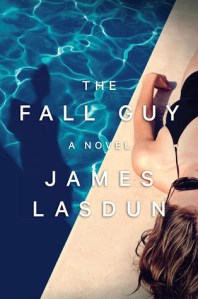 This is a capable psychological thriller about an out-of-work chef who becomes obsessed with the idea that his wealthy cousin’s alluring wife is cheating on him during a summer spent with them in their upstate New York bolthole. I liked hearing about Matthew’s cooking and Chloe’s photography, and it’s interesting how Lasdun draws in a bit about banking and the Occupy movement. However, the complicated Anglo-American family backstory between Matthew and Charlie feels belabored, and the fact that we only see things from Matthew’s perspective is limiting in a bad way. There’s a decent Hitchcock vibe in places, but overall this is somewhat lackluster.
My rating:
The Sport of Kings
By C.E. Morgan
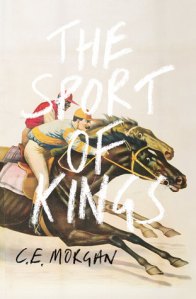 I found this Kentucky-based horse racing novel to be florid and overlong. The novel doesn’t achieve takeoff until Allmon comes on the scene at about page 180. Although there are good descriptions of horses, the main plot – training Hellsmouth to compete in the 2006 Derby – mostly passed me by. Meanwhile, the interpersonal relationships become surprisingly melodramatic, more fit for a late Victorian novel or maybe something by Faulkner. My favorite character was Maryleen, the no-nonsense black house servant. Henry himself, though, makes for pretty unpleasant company. Morgan delivers the occasional great one-liner (“Childhood is the country of question marks, and the streets are solid answers”), but her prose is on the whole incredibly overwritten. There’s a potent message in here somewhere about ambition, inheritance and race, but it’s buried under an overwhelming weight of words. (See my full Nudge review.)
My rating:
Today Will Be Different
By Maria Semple
 Bernadette fans, prepare for disappointment. There’s nothing that bad about the story of middle-aged animator Eleanor Flood, her hand-surgeon-to-the-stars husband Joe, and their precocious kid Timby, but nor is there anything very interesting about it. The novel is one of those rare ones that take place all in one day, a setup that enticed me, but all Eleanor manages to fit into her day – despite the title resolution – is an encounter with a pet poet who listens to her reciting memorized verse, another with a disgruntled former employee, some pondering of her husband’s strange behavior, and plenty of being downright mean to her son (as if his name wasn’t punishment enough). “In the past, I’d often been called crazy. But it was endearing-crazy, kooky-crazy, we’re-all-a-little-crazy-crazy,” Eleanor insists. I didn’t think so. I didn’t like being stuck in her head. In general, it seems like a bad sign if you’re eager to get away from a book’s narrator and her scatty behavior. Compared to Semple’s previous novel, it feels like quirkiness for quirkiness’ sake, with a sudden, contrived ending.
My rating:
Swing Time
By Zadie Smith
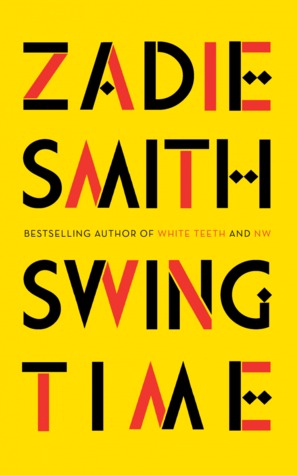 Smith’s fifth novel spans 25 years and journeys from London to New York City and West Africa in tracing the different paths two black girls’ lives take. The narrator (who is never named) and Tracey, both biracial, meet through dance lessons at age seven in 1982 and soon become inseparable. The way this relationship shifts over time is the most potent element of the novel, and will appeal to fans of Elena Ferrante. The narrator alternates chapters about her friendship with Tracey with chapters about her work for pop star Aimee in Africa. Unfortunately, the Africa material is not very convincing or lively and I was impatient for these sections to finish. The Aimee subplot and the way Tracey turns out struck me as equally clichéd. Despite the geographical and chronological sprawl, the claustrophobic narration makes this feel insular, defusing its potential messages about how race, money and class still define and divide us. A new Zadie Smith novel is an event; this one is still worth reading, but it definitely disappointed me in comparison to White Teeth and On Beauty. (Releases Nov. 15th.)
My rating: 
Have you read any of these? What did you think?
What’s the last book that really let you down?
A Nonfiction Bonanza
For much much of the summer I was sunk deep into several very good but not particularly page-turning works of nonfiction from my shelves. I spent months reading some of them, which is very unusual for me and often a sign that I’m not enjoying something, but this time that wasn’t the case. One of these nonfiction reads – the Fermor – ended up being among my favorite books of the year so far. Below I give quick write-ups of what I’ve finished lately and recall how these books came to be in my collection.
 Lincoln: A Foreigner’s Quest by Jan Morris: Like grape jelly, the obsession with Abraham Lincoln was something about American life that world traveler Jan Morris could never understand. Here she sets out to discover the melange of history and myth that composes the 16th president. She succeeds in giving not only the salient facts of Lincoln’s life but also a fair assessment of his character, in a lighthearted and accessible book that has neither the heft nor the heavygoing tone of a standard biography. Her discussion of his rhetorical style is especially good, and in a few passages she imagines the reader into scenes. Here’s one of the best pithy observations: “Academic historians cannot allow themselves such flip idiomatic judgments, but to an outsider like me that seems about the truth of it. He was a nice man. He could be scheming, irritable, disingenuous, but he was never pompous or overbearing.” [Remainder copy bought for $3.99 at Wonder Book and Video, Frederick, Maryland.]
 The Omnivore’s Dilemma by Michael Pollan: I made the mistake of reading this a decade after its publication, which means I already knew most of its facts about industrialized farming and the insidiousness of processed foods. I found Part I to be overly detailed and one-note, constantly harping on about corn. The book gets better as it goes on, though, with Pollan doing field research at Joel Salatin’s Polyface Farm in Virginia to compare large-scale organic agriculture with more sustainable grassroots operations. Pollan’s assessment of the ethics of eating meat is not quite as thorough as Jonathan Safran Foer’s (in Eating Animals), but he does a good job of showing all sides of the issue. This would make an excellent, comprehensive introduction to where food comes from for people who have never given it much thought. But then again, the people who need it most would never pick up a dense 400+-page book by a liberal journalist. [Bought in one of the Hay-on-Wye shops for £2.]
 The Naming of the Shrew by John Wright: Wright is known in the UK as TV chef Hugh Fearnley-Whittingstall’s go-to expert on foraging, especially fungi. His enthusiasm for the arcane details of Latin naming comes through clearly in this thorough history of taxonomy. At first I thought it would be a groaningly pun-filled book of arbitrarily arranged trivia, but by Chapter 2 Wright won me over. You’ll learn all about Carl Linnaeus and the taxonomists who preceded and followed him; rules for species naming and the meaning of common Latin prefixes and suffixes; the wildly divergent sources of names, from discoverers’ names to mythology; and the endless complications of a field where species are always being lumped, split, or re-evaluated. One of my favorite facts was that aloe vera and the boa constrictor are among the few species whose English names are the same as their Latin ones. [A birthday gift from my brother-in-law last year.]
 A Time of Gifts by Patrick Leigh Fermor: A true masterwork of travel writing. Over the course of three years, starting when he was just 18, Fermor walked from Holland to Constantinople. I was particularly eager to read this because he passes through a lot of places I went on my travels this past summer, including Germany, Austria and Bratislava. This first of three volumes covers up until his entry into Hungary. His descriptions of the landscape and the people he interacted with are as fresh as if they happened yesterday, and yet he was reconstructing this journey nearly 40 years after the fact. Although he was basically traveling rough, he managed to wangle invitations into castles and aristocrats’ homes. This gives him a broad base of observation such that you feel you’re getting a complete picture of European life in the early 1930s. It’s a precious glimpse of pre-war history, but Fermor doesn’t use too heavy a hand when recalling signs of rising Nazism. Lastly, this is simply damn fine writing:
Beer, caraway seed, beeswax, coffee, pine-logs and melting snow combined with the smoke of thick, short cigars in a benign aroma across which every so often the ghost of sauerkraut would float.
The Romanesque nave was packed and an anthem of great choral splendour rose from the gothic choir stalls, while the cauliflowering incense followed the plainsong across the slopes of the sunbeams.
When no buildings were in sight, I was back in the Dark Ages. But the moment a farmhouse or a village impinged, I was in the world of Peter Brueghel.
[Bought for £1 from a secondhand bookstore in Henley-on-Thames.] 
 The House by the Sea by May Sarton: This is the sixth of Sarton’s journals I’ve read. It covers 1975–6, when she was 63–4 and in her second year in Maine. Her health is not yet a worry, at least as compared to later journals, but there is a faint sense of diminished abilities and an awareness of death’s approach. Poetry has run dry for her, but in the course of writing this journal she publishes a series of biographical reflections and prepares to begin a new novel. Tamas the dog and Bramble the cat are faithful companions. Her former lover, Judy, suffers from dementia and visits with her are mostly painful reminders of what has been lost. These journals are not the place to turn if you want momentous events. Rather, read them for deep insight into a writer’s psyche, meditations on the benefits of solitude, and affirmation of the quiet joys of gardening and an ocean view. [Bought from a library book sale in America for 50 cents.]
What are some of the best nonfiction books you’ve read recently?
Watch the Movie or Read the Book?
It’s a risky business, adapting a well-loved book into a film. I’m always curious to see how a screenwriter and director will pull it off. The BBC generally does an admirable job with the classics, but contemporary book adaptations can be hit or miss. I’ve racked my brain to think of cases where the movie was much better than the book or vice versa, but to my surprise I’ve found that I can only think of a handful of examples. Most of the time I think the film and book are of about equal merit, whether that’s pretty good or excellent.
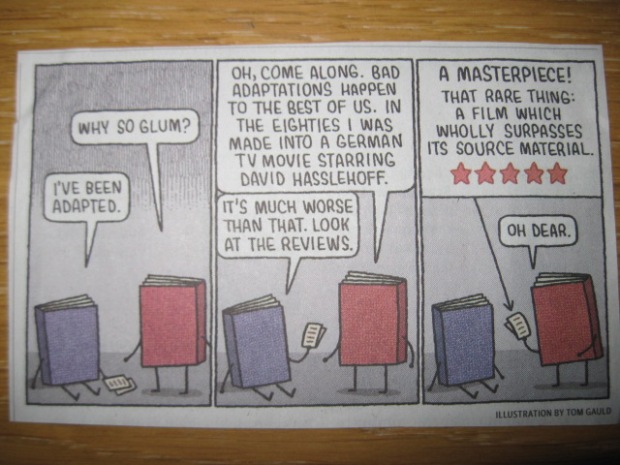
From one of my favorite Guardian cartoonists.
Watch the Movie Instead:
Birdsong [Sebastian Faulks] – Eddie Redmayne, anyone? The book is a slog, but the television miniseries is lovely.
One Day [David Nicholls] – Excellent casting (though Rafe Spall nearly steals the show). Feels less formulaic and mawkish than the novel.
 Father of the Bride and its sequel [Edward Streeter] – The late 1940s/early 1950s books that served as very loose source material are hopelessly dated.
This Is Where I Leave You [Jonathan Tropper] – Again, perfect casting. Less raunchy and more good-natured than the book.
Read the Book Instead:
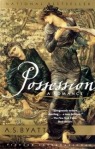 Possession [A.S. Byatt] – This is one of my favorite novels of all time. It has a richness of prose and style (letters, poems, etc.) that simply cannot be captured on film. Plus Aaron Eckhart couldn’t act his way out of a paper bag.
Everything Is Illuminated [Jonathan Safran Foer] – The movie’s not bad, but if you want to get a hint of Foer’s virtuosic talent you need to read the novel he wrote at 25.
A Prayer for Owen Meany [John Irving] – The film version, Simon Birch, was so mediocre that Irving wouldn’t let his character’s name be associated with it.
It’s Pretty Much Even:
Decent book and movie: Harry Potter and the Sorcerer’s Stone, The Help, The Hours, Memoirs of a Geisha, Never Let Me Go, The Remains of the Day
 Terrific book and movie: The Fault in Our Stars, The Hundred-Year-Old Man Who Climbed out of the Window and Disappeared (Swedish language), The Orchid Thief / Adaptation (both great but in very different ways!), Tamara Drewe (based on a graphic novel, which itself is based on Far From the Madding Crowd)
If I’m interested in a story, my preference is always to watch the movie before I read the book. If you do it the other way round, you’re likely to be disappointed with the adaptation. Alas, this means that the actors’ and actresses’ faces will be ineradicably linked with the characters in your head when you try to read the book. I consider this a small disadvantage. Reading the book after you’ve already enjoyed the storyline on screen means you get to go deeper with the characters and the plot, since subplots are often eliminated in movie versions.
 So although I’ve seen the films, I’m still keen to read Half of a Yellow Sun and The Kite Runner. I’m eager to both see and read The English Patient and The Shipping News (which would be my first by Proulx). All four of these I own in paperback. I’m also curious about two war novels being adapted this year, Billy Lynn’s Long Halftime Walk and The Yellow Birds. There’s every chance I’d like these better as movies than I did as books.
 As to books I’m interested in seeing on the big screen, the first one that comes to mind is Kitchens of the Great Midwest by J. Ryan Stradal. It might also be interesting to see how the larger-than-life feminist heroines of Siri Hustvedt’s The Blazing World and Brian Morton’s Florence Gordon would translate for cinema. Can you think of any others?
What film adaptations have impressed or disappointed you recently? Do you watch the movie first, or read the book first?
The Novel Cure—Bibliotherapy in Action
A good book, read at the right moment, should leave you uplifted, inspired, energized and eager for more. With so many books to choose from, what’s the point of reading even one more that leaves you cold?
I’ve mentioned my interest in bibliotherapy before. Well, for anyone new to the concept or interested in finding out more, The Novel Cure by Ella Berthoud and Susan Elderkin, two of the bibliotherapists at London’s School of Life, is an accessible introduction. Subtitled “An A–Z of Literary Remedies,” this is a learned and at times tongue-in-cheek book of advice about what fiction to read if you’re suffering from any sort of malady – physical, psychological, or imagined.
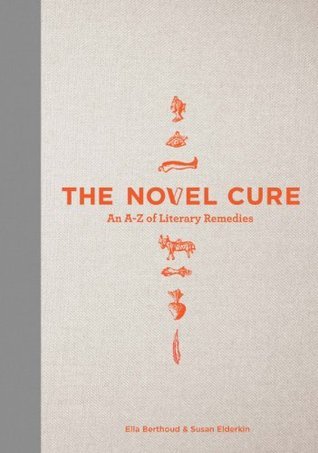 The alphabetical format and “see also” asides make it more like a cross-referenced encyclopedia than a book to read straight through, though I tried it both ways. Initially I flipped through at random, letting one entry take me to another related one and so on, but after a while I went back to the start and caught up on unread entries to finish within a year.
“It helps enormously at times of stress to read about other people who are going through similar things; watching how other people cope or fail to cope will make you feel less alone and give you strength,” the authors write to introduce the “cancer, caring for someone with” entry. I found this to be true when my sister lost her husband to cancer last year. She had never been a reader – apart from celebrity magazines – but in the past year she’s read nearly 90 books, many of them memoirs about illness and bereavement. Books are how I’ve always made sense of the world, so it’s been incredibly gratifying to see her turn to them as well. There are plenty of recommendations I’ll pass on to her from this book, especially “death of a loved one” (After You’d Gone by Maggie O’Farrell and Extremely Loud and Incredibly Close by Jonathan Safran Foer) and “widowed, being” (The Same Sea by Amos Oz and Major Pettigrew’s Last Stand by Helen Simonson).
You’ll be amazed at the range of conditions and circumstances for which the book offers prescriptions. Newly retired? “Bucolic and tranquil, The Enigma of Arrival [by V.S. Naipaul] will encourage you to take stock of your life and enjoy the unfolding of new possibilities.” Workaholic? “Immerse your desiccated soul in something very simple, very rustic, very small. We suggest [Thomas] Hardy’s gentlest, most innocent novel, Under the Greenwood Tree.” Two sections that felt particularly relevant to me as a vertically challenged freelancer were “short, being” and “tax return, fear of doing.” Meanwhile I’ll be pointing my husband to “baldness,” “flying, fear of,” “stress” and “tinnitus” (poor chap). But some of these entries surely resulted from the authors thinking “hey, here’s a great book we have to mention,” and then coming up with a category to fit it into, like “determinedly chasing after a woman even when she’s a nun” for In the Skin of a Lion by Michael Ondaatje.
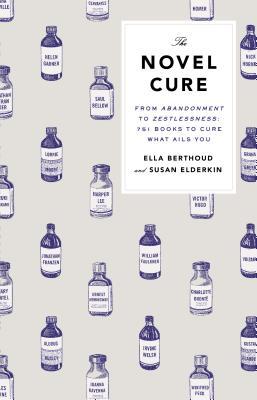
I think I prefer this U.S. cover.
Indeed, there’s a certain levity to this book that I think some reviewers have missed. These aren’t all entirely serious suggestions, though they are all worthwhile books. I especially liked the sections where the authors incorporate pastiche of the book in question. A piece recommending Pamela by Samuel Richardson is in the form of an old-fashioned letter, for example, while “single, being” apes Bridget Jones’s diary entries. They even imitate certain authors’ prose style, as in “Who poses questions without question marks and observes the subtle changes in the light with exquisite brevity.” Answer: J.P. Donleavy, apparently.
The book is also a great source of top ten lists (I’m working through their novels for thirty-somethings) and advice for how to deal with reading crises (e.g. “busy to read, being too” and “giving up halfway through, tendency to”). My only criticism of the book – and this is one I level against many examples from the ‘books about books’ genre – is that there’s a fair bit of plot summary, sometimes so much so that it puts me off reading a book rather than whets my appetite for it.
It’s a bit belated (or early) for suggesting this as a Christmas gift for a book lover, but perhaps you can hand it over as a birthday gift or an anytime present – even to yourself. I got my copy on Amazon for £4, quite a bargain for a book I’ll be returning to again and again over the years.
My rating: 
Do you agree that novels have the power to cure, or at least help with, problems?
 Bookish Beck = Rebecca Foster. American transplant to England. Freelance proofreader and book reviewer.
 Bookish Beck