Book vs. Film: What Are You Going Through / The Room Next Door
Film, because…
I’m borrowing the idea from a post series by Kate of Books Are My Favourite and Best that compares books and their adaptations. It’s now vanishingly rare for me to see movies – I can probably count on the fingers of one hand the ones I’ve seen in the last three years – because we haven’t had a television for a decade or more, don’t subscribe to any streaming services, find going to the cinema too expensive, and mostly can’t be bothered to get out an old laptop to watch our measly collection of DVDs. It’s kind of a shame, because I was a real cinephile in my high school and early college years, making my way through the American Film Institute’s top 100 list, recording B&W classics from late-night TV, and following the Oscars race to enter a low-value pool. It certainly means a lot more time for books, though.
BUT I watched two streamed movies while I was staying with my sister in the States, both chosen for their literary influences or similarities. (I ran out of time to watch Women Talking, which I was eyeing up but it would have incurred a separate cost.) One was The Menu, about a megalomaniac chef for whose extravagant multi-course meals the mega-rich travel to a private island. Elle suggested it as a companion to Land of Milk and Honey with its chef protagonist and questions of power, sexuality and wealth. The Menu, starring Ralph Fiennes, was good fun, with a twisty plot and strong performances, but got darker and gorier than expected as Fiennes’ character uses dishes to explore childhood trauma and settle old scores.
The other was Pedro Almodóvar’s first English-language feature, The Room Next Door (2024). It’s based on Sigrid Nunez’s What Are You Going Through (2020), which I read at its release. It’s the story of a writer whose friend, ravaged by cancer, asks her to be present when she ends her life. As is typical of Nunez’s sparse, Cusk-like autofiction, the characters have no names and minimal histories, there are no speech marks, and the scant plot is layered with various other found stories and aphorisms. The film is, of necessity, very different: it zeroes in on the assisted suicide plot, makes events more concrete, and goes as far as the aftermath rather than just-before-the-end. I watched it with my sister because, as a hospice nurse, she has an interest in the topic.

Julianne Moore at The Room Next Door premiere (BFI LFF: Royal Festival Hall, 19 October 2024) (Raph_PH, CC BY 2.0, via Wikimedia Commons).
{SPOILERS IN THE REMAINDER}
In The Room Next Door, Ingrid (Julianne Moore) is a writer whose latest book explores her fear of death. She and Martha (Tilda Swinton) were acquaintances when they worked for the same magazine, but they seem to have lost touch over the decades. Martha’s journalistic career was much more exciting, taking her to war zones as a correspondent. Martha has a daughter, Michelle, whom she’s really not in touch with, partly as a result of not being frank about the identity of Michelle’s father. Ingrid is shocked by Martha’s request and it takes her a while to come around to the idea of being the person ‘in the room next door’ when Martha takes the euthanasia drug she’s bought off the dark web.
Nunez’s novel opens with the narrator attending a doom-and-gloom lecture by her ex, who is convinced that climate change won’t be addressed and the human race will die out. I was surprised that he’s included in the film and in fact given an expanded role: not only is there the scene from the book in which Ingrid meets Damian (John Turturro) for lunch and tells him what’s going on with her friend, but we learn that he was an ex for both of them, and he helps Ingrid deal with the fallout of Martha’s actions. He also seems to function as a reminder of sexuality, which remains a powerful impulse even in the face of individual or collective death.
When I got home from the States, I reread the Nunez and – though she’s a favourite of mine – I confess I was disappointed. The philosophical and storytelling asides seem like unnecessary distractions when all you want to know is what happens with her friend. (I have, of course, also read The Spare Room, which preceded the Nunez by 12 years, in the meantime.) My original review seems generous as well as admirably succinct. (It’s depressing for me to go back to old reviews; not only have I not gotten any better, my writing has deteriorated, if anything. Is it laziness? Erosion of formality? Lack of time? Loss of focus?)

My sole complaint then was that Nunez spent too much time recounting the plot of a mystery novel the narrator reads. Well! Having reviewed her collected short stories, It Will Come Back to You, I can report that said plot is that of her “The Plan,” published in LitMag in 2019. How (playful and meta, yes, but) self-indulgent to borrow her own short story! So while I still appreciated the overall theme of empathy and the wise observations (“The only thing harder than seeing yourself grow old is seeing the people you’ve loved grow old … most people are in denial about aging, just as they are about dying”), and enjoyed the monologue from a cat which I’d forgotten about, I got bored and impatient the second time around. (I’m still a Nunez stan, though. – Am I using that right? Are we still saying that?)
Ultimately, then, The Room Next Door surpasses its source material for its focus, its performances, its locations, and its weirdness. Almodóvar cuts most of the peripheral material and makes it all about the women’s relationship with each other, as well as Ingrid’s with her ex and Martha’s with her daughter. The elegant Moore does a fine job in the role; the only way to have given a flavour of Nunez’s narration would have been to use voiceover or diary-writing scenes, which could have been naff. But Swinton is a marvel. Her American accent is ever so slightly strange, but that works; she’s such a striking person that it fits for her to be somewhat otherworldly. She is a perfect vessel for Martha’s frustrated rage and her body language, as well as the costuming and makeup, highlight the differences between her well periods, when she’s vibrant, and her worst relapses, when she’s pale and gaunt. (I was astonished to learn that both actors are now 65, by the way!)

Tilda Swinton, Pedro Almodóvar, and Julianne Moore at 81st Venice International Film Festival (Harald Krichel, CC BY-SA 4.0, via Wikimedia Commons).
In the book, the friends stay in an Airbnb in upstate New York. In the film, Casa Szoke, an hour from Madrid in Spain, stands in. It’s a stunning Modernist (also described as “brutalist”) house, and the pool terrace and the staircase dividing Martha’s room from Ingrid’s downstairs are key features. Probably the single most interesting decision Almodóvar made was to have Swinton play Michelle as well, which emphasizes the persistence of family traits and – because Michelle has a scene after Martha is dead – makes it seem like she’s not completely gone. Of course, Almodóvar has always gone in for surrealism and doubling, and I loved this hint of the mysterious. I also appreciated the repeated quotes from James Joyce’s novella The Dead (“faintly falling … upon all the living and the dead.”).
The gist may be the same, but the reading and viewing experiences are really very dissimilar and, while I wouldn’t dissuade you from either, it was the film that impressed me most.
Book
My original rating: 
My rating now: 
Film
#NovNov24 Halfway Check-In & Small Things Like These Film Review
Somehow half of November has flown by. We hope you’ve been enjoying reading and reviewing short books this month. So far we have had 40 participants and 84 posts! Remember to add your posts to the link-up, or alert us via a comment here or on Bluesky (@cathybrown746.bsky.social / @bookishbeck.bsky.social), Instagram (@cathy_746books / @bookishbeck), or X (@cathy746books / @bookishbeck).

If you haven’t already, there’s no better time to pick up our buddy read, Orbital by Samantha Harvey, which won the Booker Prize on Tuesday evening. Chair of judges Edmund de Waal said it is “about a wounded world” and that the panel’s “unanimity about Orbital recognises its beauty and ambition.” I was surprised to learn that it is only the second-shortest Booker winner; Offshore by Penelope Fitzgerald is even shorter.

Another popular novella many of us have read is Small Things Like These by Claire Keegan (my latest review is here). I went to see the excellent film adaptation, with a few friends from book club, at our tiny local arthouse cinema on Wednesday afternoon. I’ve read the book twice now – I might just read it a third time before Christmas – and from memory the film is remarkably faithful to its storyline and scope. (The only significant change I think of is that Bill doesn’t visit Ned in the hospital, but there are still flashbacks to the role that Ned played in Bill’s early life.)
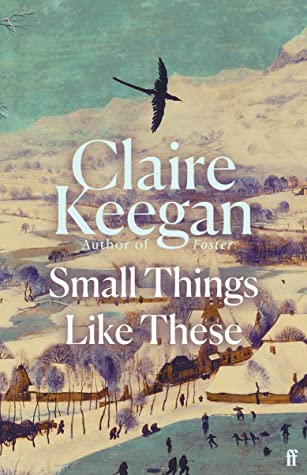 The casting and cinematography are exceptional. Cillian Murphy portrays Bill with just the right blend of stoicism, meekness, and angst. Emily Watson is chilling as Sister Mary, the Mother Superior of the convent, which is suitably creepy with dim brick hallways and clinical laundry rooms. The grimy cobbles and dull streetlamps of the town contrast with the warm light in the scenes of Bill’s remembered childhood at Mrs Wilson’s. Repeated shots – of Bill’s truck setting off across the bridge in the early morning, of him scrubbing coal dust from his hands with carbolic soap, of his eyes wide open in the middle of the night – are not recursive but a way of establishing the gruelling nature of his tasks and the unease that plagues him. A life of physical labour has aged him beyond 39 (cf. Murphy is 48) and he’s in pain from shouldering sacks of coal day in and day out.
Both book and film are set in 1985 but apart from the fashions and the kitschy Christmas decorations and window dressings you’d be excused for thinking it was the 1950s. Bill’s business deals in coal, peat and tinder; rural Ireland really was that economically depressed and technologically constrained. (Another Ireland-set film I saw last year, The Miracle Club, is visually very similar – it even features two of the same actors – although it takes place in 1967. It’s as if nothing changed for decades.)
 By its nature, the film has to be a little more overt about what Bill is feeling (and generally not saying, as he is such a quiet man): there are tears at Murphy’s eyes and anxious breathing to make Bill’s state of mind obvious. Yet the film retains much of the subtlety of Keegan’s novella. You have to listen carefully during the conversation between Bill and Sister Mary to understand she is attempting to blackmail him into silence about what goes on at the convent.
At the end of the film showing, you could have heard a pin drop. Everyone was stunned at the simple beauty of the final scene, and the statistics its story is based on. It’s truly astonishing that Magdalene Laundries were in operation until the late 1990s, with Church support. Rage and sorrow build in you at the very thought, but Bill’s quietly heroic act of resistance is an inspiration. What might we, ordinary people all, be called on to do for women, the poor, and the oppressed in the years to come? We have no excuse not to advocate for them.
(Arti of Ripple Effects has also reviewed the film here.)
So far this month I’ve read nine novellas and reviewed eight. One of these was a one-sitting read, and I have another pile of ones that I could potentially read of a morning or evening next week. I’m currently reading another 16 … it remains to be seen whether I will average one a day for the month!
Watch the Movie or Read the Book?
It’s a risky business, adapting a well-loved book into a film. I’m always curious to see how a screenwriter and director will pull it off. The BBC generally does an admirable job with the classics, but contemporary book adaptations can be hit or miss. I’ve racked my brain to think of cases where the movie was much better than the book or vice versa, but to my surprise I’ve found that I can only think of a handful of examples. Most of the time I think the film and book are of about equal merit, whether that’s pretty good or excellent.
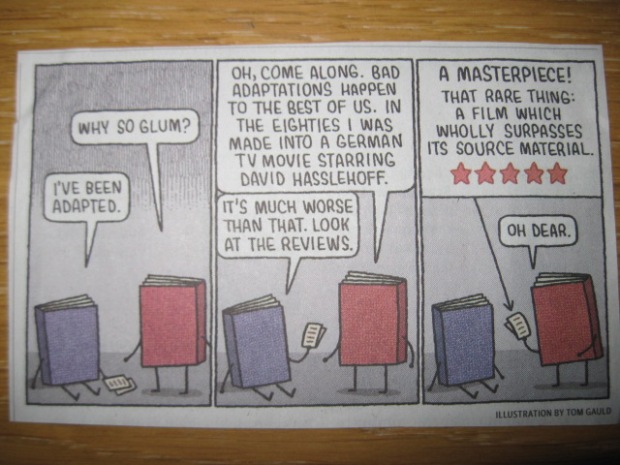
From one of my favorite Guardian cartoonists.
Watch the Movie Instead:
Birdsong [Sebastian Faulks] – Eddie Redmayne, anyone? The book is a slog, but the television miniseries is lovely.
One Day [David Nicholls] – Excellent casting (though Rafe Spall nearly steals the show). Feels less formulaic and mawkish than the novel.
 Father of the Bride and its sequel [Edward Streeter] – The late 1940s/early 1950s books that served as very loose source material are hopelessly dated.
This Is Where I Leave You [Jonathan Tropper] – Again, perfect casting. Less raunchy and more good-natured than the book.
Read the Book Instead:
 Possession [A.S. Byatt] – This is one of my favorite novels of all time. It has a richness of prose and style (letters, poems, etc.) that simply cannot be captured on film. Plus Aaron Eckhart couldn’t act his way out of a paper bag.
Everything Is Illuminated [Jonathan Safran Foer] – The movie’s not bad, but if you want to get a hint of Foer’s virtuosic talent you need to read the novel he wrote at 25.
A Prayer for Owen Meany [John Irving] – The film version, Simon Birch, was so mediocre that Irving wouldn’t let his character’s name be associated with it.
It’s Pretty Much Even:
Decent book and movie: Harry Potter and the Sorcerer’s Stone, The Help, The Hours, Memoirs of a Geisha, Never Let Me Go, The Remains of the Day
 Terrific book and movie: The Fault in Our Stars, The Hundred-Year-Old Man Who Climbed out of the Window and Disappeared (Swedish language), The Orchid Thief / Adaptation (both great but in very different ways!), Tamara Drewe (based on a graphic novel, which itself is based on Far From the Madding Crowd)
If I’m interested in a story, my preference is always to watch the movie before I read the book. If you do it the other way round, you’re likely to be disappointed with the adaptation. Alas, this means that the actors’ and actresses’ faces will be ineradicably linked with the characters in your head when you try to read the book. I consider this a small disadvantage. Reading the book after you’ve already enjoyed the storyline on screen means you get to go deeper with the characters and the plot, since subplots are often eliminated in movie versions.
 So although I’ve seen the films, I’m still keen to read Half of a Yellow Sun and The Kite Runner. I’m eager to both see and read The English Patient and The Shipping News (which would be my first by Proulx). All four of these I own in paperback. I’m also curious about two war novels being adapted this year, Billy Lynn’s Long Halftime Walk and The Yellow Birds. There’s every chance I’d like these better as movies than I did as books.
 As to books I’m interested in seeing on the big screen, the first one that comes to mind is Kitchens of the Great Midwest by J. Ryan Stradal. It might also be interesting to see how the larger-than-life feminist heroines of Siri Hustvedt’s The Blazing World and Brian Morton’s Florence Gordon would translate for cinema. Can you think of any others?
 Bookish Beck = Rebecca Foster. American transplant to England. Freelance proofreader and book reviewer.
