10th Blogging Anniversary! & Thoughts on the Women’s Prize and Carol Shields Prize Longlists
I can hardly believe I’ve been blogging for a decade. It seems like no time ago that I started this site on a whim early in my freelance career, soon after my main online publication folded and my brother-in-law died. This is now my 1,486th blog post (so close to that 1,500 milestone!), which means I average 12 posts a month. Between reviews, challenges, memes, book lists, and prize reactions, I maintain a very active blog. I’ve long since stopped caring about numbers of views and likes; I’ll never be a top influencer but I offer quality, thoughtful content for those who are similarly serious about books. The blog has also become a place where I can write about personal things in response to losses and other life changes.

I’m pleased that my blog anniversary happens to coincide with International Women’s Day, around when the Women’s Prize and Carol Shields Prize longlists are announced. I don’t plan to shadow either prize in a concerted way, partly because I’m too busy with reading debut novels in my role as a McKitterick Prize judge, but there are some books that appeal.
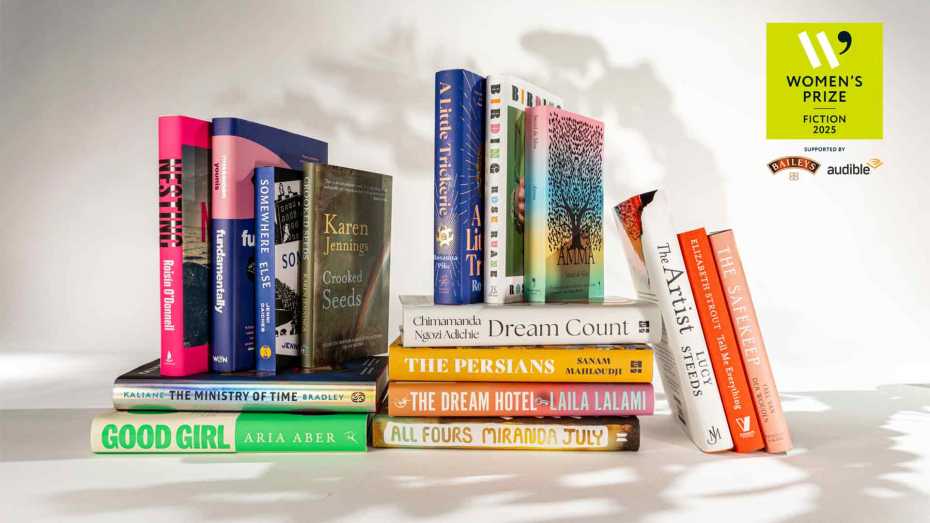
Women’s Prize Longlist
Read
- The Ministry of Time by Kaliane Bradley

- Tell Me Everything by Elizabeth Strout

- The Safekeep by Yael van der Wouden

Reading
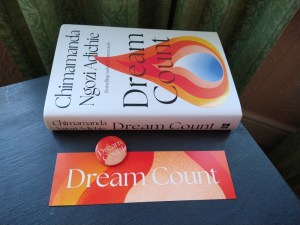 Dream Count by Chimamanda Ngozi Adichie
- All Fours by Miranda July
Already Wanted to Read
- Birding by Rose Ruane – For the cover if nothing else (it made my Cover Love post last year)
- The Artist by Lucy Steeds – Susan of A life in books rates it highly: see her review.
Unsure
- A Little Trickerie by Rosanna Pike – The premise is reasonably appealing (an orphan who pretends to be an angel) but I am very much not keen on medieval settings. I’ll wait and see if it’s shortlisted.
Decided Against
- Crooked Seeds by Karen Jennings – I read the Booker-longlisted An Island and it was fine but I don’t need to try anything else by her.
- Nesting by Roisín O’Donnell – 400 pages on an Irish domestic violence situation sounds like A Lot. Reviews have been very favourable, saying it’s as pacey as a thriller. Again, I’ll wait to see if it’s shortlisted.
Not Interested (for now)
- Good Girl by Aria Aber
- Somewhere Else by Jenni Daiches
- Amma by Saraid de Silva (but well done to Weatherglass Books!)
- The Dream Hotel by Laila Lalami
- The Persians by Sanam Mahloudji
- Fundamentally by Nussaibah Younis
The blurbs for these don’t attract me, but I’d be willing to change my mind if I see an enthusiastic review or two.
[Shortlist: 2 April; winner: 12 June]
Stab-in-the-dark shortlist predictions: Good Girl, Dream Count, The Dream Hotel, Nesting, The Artist, Tell Me Everything
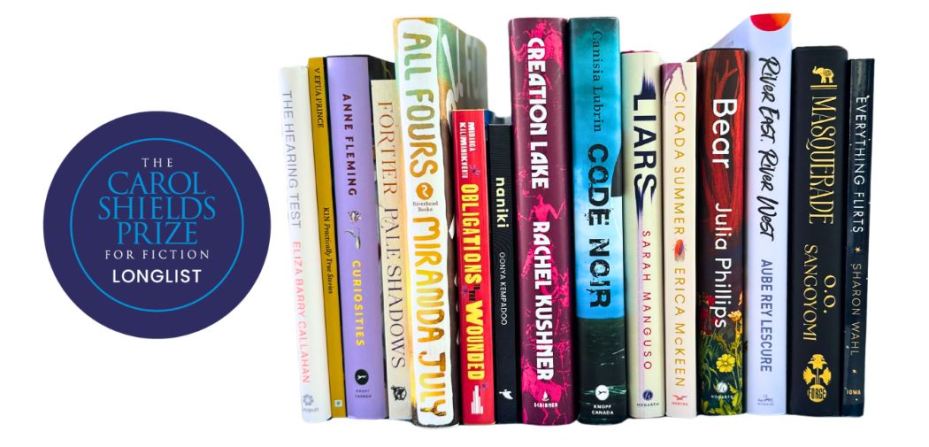
Carol Shields Prize Longlist
Read
- Liars by Sarah Manguso
DNF
- Cicada Summer by Erica McKeen – I read the first 15% last summer. In 2020, Husha has recently lost her mother and is locked down with her grandfather at his Ontario lake house. I recall that the prose was vague and somewhat obnoxiously poetic.
Reading
- All Fours by Miranda July – The only overlap with the WP. I don’t think that, as happened last year, the repeated title will be the winner. It’s too offbeat and divisive.
Want to Read
- The Hearing Test by Eliza Barry Callahan – Novella-length autofiction about adapting to disability.
- Curiosities by Anne Fleming – A historian becomes obsessed with the story told by five 17th-century manuscripts. Sounds like a queer Possession with a dash of North Woods.
- Pale Shadows by Dominique Fortier, translated by Rhonda Mullins – A Québécois author takes on the legacy of Emily Dickinson via the three women who first brought her poetry into print.
- Obligations to the Wounded by Mubanga Kalimamukwento – Linked short stories about Zambians and Zambian émigrés.
Unsure
- Bear by Julia Phillips – After reading Bear by Marian Engel, I don’t think I need any more bear legend-inspired romances in my life. (I already discounted Eowyn Ivey’s latest.)
- Kin: Practically True Stories by V Efua Prince – I’ve had good luck with other books from Wayne State University Press’ Made in Michigan series but can’t quite work out what this would be like.
- Everything Flirts: Philosophical Romances by Sharon Wahl – Could be intriguing; could be pretentious. At least it’s only novella length. All I can do is try an excerpt.
Not Interested (for now)
- Naniki by Oonya Kempadoo – Someone on Goodreads described this as being like spoken word at a sci-fi convention.
- Creation Lake by Rachel Kushner – I wasn’t keen when it was shortlisted for the Booker, and I haven’t changed my mind.
- River East, River West by Aube Rey Lescure – Ditto but from last year’s WP list.
- Code Noir by Canisia Lubrin – Normally I like linked short stories but a 400+ page count and the heavy subject matter of slavery regulations sound overwhelming.
- Masquerade by O.O. Sangoyomi – I struggle with fantasy at the best of times.
[Shortlist: 3 April; winner: 1 May]
Last year Laura T. and I covered most of the longlist between us and really enjoyed the project. (Marcie of Buried in Print also reviewed a lot of the longlist later in the year.) This year we’ll reassess at the shortlist stage and maybe request a few review copies from the publicist. See Laura’s prize longlist reactions here.
Stab-in-the-dark shortlist predictions: Curiosities, Obligations to the Wounded, Creation Lake, Code Noir, Masquerade
What have you read, or might you read, from these longlists?
Open Water & Other Contemporary Novellas Read This Year (#NovNov)
Open Water is our first buddy read, for Contemporary week of Novellas in November (#NovNov). Look out for the giveaway running on Cathy’s blog today!
I read this one back in April–May and didn’t get a chance to revisit it, but I’ll chime in with my brief thoughts recorded at the time. I then take a look back at 14 other novellas I’ve read this year; many of them I originally reviewed here. I also have several more contemporary novellas on the go to round up before the end of the month.
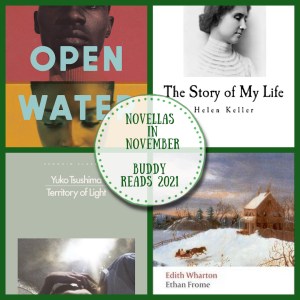
Open Water by Caleb Azumah Nelson (2021)
[145 pages]
 I always enjoy the use of second person narration, and it works pretty well in this love story between two young Black British people in South London. The title is a metaphor for the possibilities and fear of intimacy. The protagonist, a photographer, doesn’t know what to do with his anger about how young Black men are treated. I felt Nelson was a little heavy-handed in his treatment of this theme, though I did love that the pivotal scene is set in a barbershop, a place where men reveal more of themselves than usual – I was reminded of a terrific play I saw a few years ago, Barber Shop Chronicles.
Ultimately, I wasn’t convinced that fiction was the right vehicle for this story, especially with all the references to other authors, from Hanif Abdurraqib to Zadie Smith (NW, in particular); I think a memoir with cultural criticism was what the author really intended. I’ll keep an eye out for Nelson, though – I wouldn’t be surprised if this makes it onto the Sunday Times Young Writer of the Year Award shortlist in January. I feel like with his next book he might truly find his voice.
Readalikes:
- Assembly by Natasha Brown (also appears below)
- Poor by Caleb Femi (poetry with photographs)
- Normal People by Sally Rooney
Other reviews:
Other Contemporary Novellas Read This Year:
(Post-1980; under 200 pages)


Somebody Loves You by Mona Arshi 
Assembly by Natasha Brown
Indelicacy by Amina Cain 
A Lie Someone Told You About Yourself by Peter Ho Davies 

Blue Dog by Louis de Bernières 
The Office of Historical Corrections by Danielle Evans 
Anarchipelago by Jay Griffiths
Tinkers by Paul Harding


An Island by Karen Jennings
Ness by Robert Macfarlane
Black Dogs by Ian McEwan


Broke City by Wendy McGrath 
A Feather on the Breath of God by Sigrid Nunez
In the Winter Dark by Tim Winton
Currently reading:
- Inside the Bone Box by Anthony Ferner
- My Monticello by Jocelyn Nicole Johnson
- The Cemetery in Barnes by Gabriel Josipovici
What novellas do you have underway this month? Have you read any of my selections?

Booker Prize 2021: Longlist Reading and Shortlist Predictions
The 2021 Booker Prize shortlist will be announced tomorrow, September 14th, at 4 p.m. via a livestream. I’ve managed to read or skim eight of 13 from the longlist, only one of which I sought out specifically after it was nominated (An Island – the one no one had heard of; it turns out it was released by a publisher based just 1.5 miles from my home!). I review my four most recent reads below, followed by excerpts of reviews of ones I read a while ago and my brief thoughts on the rest, including what I expect to see on tomorrow’s shortlist.
Klara and the Sun by Kazuo Ishiguro
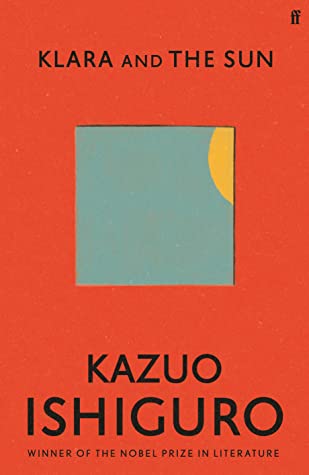 Why ever did I put this on my Most Anticipated list of the year and pre-order a signed copy?! I’m a half-hearted Ishiguro fan at best (I love Nocturnes but am lukewarm on the other four I’ve read, including his Booker winner) and should have known that his take on AI would be no more inspiring than Ian McEwan’s (Machines Like Me) a couple of years back.
Klara is an Artificial Friend purchased as part of an effort to combat the epidemic of teenage loneliness – specifically, to cheer up her owner, Josie, who suffers from an unspecified illness and is in love with her neighbour, Rick, a bright boy who remains excluded. Klara thinks of the sun as a god, praying to it and eventually making a costly bargain to try to secure Josie’s future health.
Part One’s 45 pages are slow and tedious; the backstory could have been dispensed with in five fairy tale-like pages. There’s a YA air to the story: for much of the length I might have been rereading Everything, Everything. In fact, when I saw Ishiguro introduce the novel at a Guardian/Faber launch event, he revealed that it arose from a story he wrote for children. The further I got, the more I was sure I’d read it all before. That’s because the plot is pretty much identical to the final story in Mary South’s You Will Never Be Forgotten.
Klara’s highly precise diction, referring to everyone in the third person, also gives this the feeling of translated fiction. While that is part of Ishiguro’s aim, of course – to explore the necessarily limited perspective and speech of a nonhuman entity (“Her ability to absorb and blend everything she sees around her is quite amazing”) – it makes the prose dull and belaboured. The secondary characters include various campy villains, the ‘big reveals’ aren’t worth waiting for, and the ending is laughably reminiscent of Toy Story. This took me months and months to force myself through. What a slog! (New purchase)
An Island by Karen Jennings (2019)
 Seventy-year-old Samuel has been an island lighthouse keeper for 14 years when a brown-skinned stranger washes up on his beach. Sole survivor from a sunken refugee boat, the man has no English, so they communicate through gestures. Jennings convincingly details the rigors of the isolated life here: Samuel dug his own toilet pipes, burns his trash once a week, and gets regular deliveries from a supply boat. Nothing is wasted and everything is appreciated here, even the thirdhand magazines and videotapes he inherits from the mainland.
Although the core action takes place in just four days, Samuel is so mentally shaky that his memories start getting mixed up with real life. We learn that he has been a father, a prisoner and a beggar. Jennings is South African, and in this parallel Africa, racial hierarchy still holds sway and a general became a dictator through a military coup. Samuel’s father was involved in the independence movement, while Samuel himself was arrested for resisting the dictator.
The novella’s themes – jealousy, mistrust, possessiveness, suspicion, and a return to primitive violence – are of perennial relevance. Somehow, it didn’t particularly resonate for me. It’s not dissimilar in style to J. M. Coetzee’s vague but brutal detachment, and it’s a highly male vision à la Doggerland. Though highly readable, it’s ultimately a somewhat thin fable with a predictable message about xenophobia. Still, I’m glad I discovered it through the Booker longlist.
My thanks to Holland House for the free copy for review.
Bewilderment by Richard Powers
 This has just as much of an environmentalist conscience as The Overstory, but a more intimate scope, focusing on a father and son who journey together in memory and imagination as well as in real life. The novel leaps between spheres: between the public eye, where neurodivergent Robin is a scientific marvel and an environmental activist, and the privacy of family life; between an ailing Earth and the other planets Theo studies; and between the humdrum of daily existence and the magic of another state where Robin can reconnect with his late mother. When I came to the end, I felt despondent and overwhelmed. But as time has passed, the book’s feral beauty has stuck with me. The pure sense of wonder Robin embodies is worth imitating. (Review forthcoming for BookBrowse.)
China Room by Sunjeev Sahota
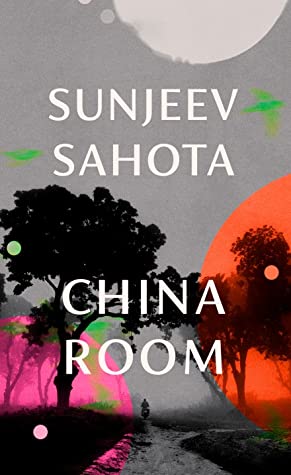 Sahota appeared on Granta’s list of Best Young British Novelists in 2013 and was previously shortlisted for The Year of the Runaways, a beautiful novel tracking the difficult paths of four Indian immigrants seeking a new life in Sheffield.
Three brides for three brothers: as Laura notes, it sounds like the setup of a folk tale, and there’s a timeless feel to this short novel set in the Punjab in the late 1920s and 1990s – it also reminded me of biblical stories like those of Jacob and Leah and David and Bathsheba. Mehar is one of three teenage girls married off to a set of brothers. The twist is that, because they wear heavy veils and only meet with their husbands at night for procreation, they don’t know which is which. Mehar is sure she’s worked out which brother is her husband, but her well-meaning curiosity has lasting consequences.
In the later storyline, a teenage addict returns from England to his ancestral estate to try to get clean before going to university and becomes captivated by the story of his great-grandmother and her sister wives, who were confined to the china room. The characters are real enough to touch, and the period and place details make the setting vivid. The two threads both explore limitations and desire, and the way the historical narrative keeps surging back in makes things surprisingly taut. See also Susan’s review. (Read via NetGalley)
Other reads, in brief:
(Links to my full reviews)
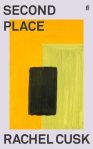
 Second Place by Rachel Cusk: Significantly more readable than the Outline trilogy and with psychological depths worth pondering, though Freudian symbolism makes it old-fashioned. M’s voice is appealing, as is the marshy setting and its isolated dwellings. This feels like a place outside of time. The characters act and speak in ways that no real person ever would – the novel is most like a play: melodramatic and full of lofty pronouncements. Interesting, but nothing to take to heart; Cusk’s work is always intimidating in its cleverness.
 A Town Called Solace by Mary Lawson: In 1972, Clara, a plucky seven-year-old, sits vigil for the return of her sixteen-year-old sister, who ran away from home; and their neighbour, who’s in the hospital. One day Clara sees a strange man moving boxes in next door. This is Liam Kane, who inherited the house from a family friend. Like Lawson’s other works, this is a slow burner featuring troubled families. It’s a tender and inviting story I’d recommend to readers of Tessa Hadley, Elizabeth Strout and Anne Tyler.
 No One Is Talking About This by Patricia Lockwood: This starts as a flippant skewering of modern life. A woman who became a social media star by tweeting quips like “Can a dog be twins?” reflects on life on “the portal” and under “the dictator.” Midway through the book, she gets a wake-up call when her mother summons her back to the Midwest for a family emergency. It’s the about-face that makes this novel, forcing readers to question the value of a digital existence based on glib pretence. Funny, but with an ache behind it.
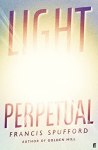 Light Perpetual by Francis Spufford: While I loved the premise, the execution didn’t live up to it. Spufford calls this an act of “literary resurrection” of five figures who survive a South London bombing. But these particular characters don’t seem worth spending time with; their narratives don’t connect up tightly, as expected, and feel derivative, serving only as ways to introduce issues (e.g. mental illness, sexual assault, racial violence, eating disorders) and try out different time periods. I would have taken a whole novel about Ben.
 This leaves five more: Great Circle (by Maggie Shipstead) I found bloated and slow when I tried it in early July, but I’m going to give it another go when my library hold comes in. The Sweetness of Water (Nathan Harris) I might try if my library acquired it, but I’m not too bothered – from Eric’s review on Lonesome Reader, it sounds like it’s a slavery narrative by the numbers. I’m not at all interested in the novels by Anuk Arudpragasam, Damon Galgut, or Nadifa Mohamed but can’t say precisely why; their descriptions just don’t excite me.
Here’s what I expect to still be in the running after tomorrow. Clear-eyed, profound, international; bridging historical and contemporary; much that’s unabashedly highbrow.
- Second Place by Rachel Cusk
 The Promise by Damon Galgut (will win)
- No One Is Talking About This by Patricia Lockwood
- Bewilderment by Richard Powers
- China Room by Sunjeev Sahota
- Light Perpetual by Francis Spufford
What have you read from the longlist? What do you expect to be shortlisted?
Book Serendipity, July to August 2021
I call it Book Serendipity when two or more books that I read at the same time or in quick succession have something pretty bizarre in common. Because I have so many books on the go at once (usually 20–30), I suppose I’m more prone to such incidents. I’ve realized that, of course, synchronicity is really the more apt word, but this branding has stuck. This used to be a quarterly feature, but to keep the lists from getting too unwieldy I’ve shifted to bimonthly.
The following are in roughly chronological order.
- I read two novels about the disappearance of a 15-year-old girl at the same time: Heatstroke by Hazel Barkworth and When the Stars Go Dark by Paula McLain.
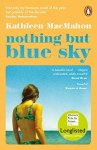
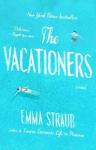
- Two novels in a row were set on a holiday in Spain: Nothing but Blue Sky by Kathleen MacMahon and The Vacationers by Emma Straub.
- I encountered mentions of the removal of the Edward Colston statue in God Is Not a White Man by Chine McDonald and I Belong Here by Anita Sethi on the same evening.
- Characters have the habit of making up names and backstories for strangers in Ruby by Ann Hood and Nothing but Blue Sky by Kathleen MacMahon.
- The main female character says she works out what she thinks by talking in Second Place by Rachel Cusk and The Amateur Marriage by Anne Tyler.

- A passive mother is bullied by her controlling husband in Nothing but Blue Sky by Kathleen MacMahon and Female Friends by Fay Weldon.
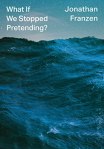
- Two reads in a row were a slim volume on the necessity of giving up denial: What White People Can Do Next by Emma Dabiri (re: racism) and What If We Stopped Pretending by Jonathan Franzen (re: climate change).

- Expressions of a strange sense of relief at disaster in Forecast by Joe Shute (re: flooding) and The Amateur Marriage by Anne Tyler (re: a car accident).
- The biomass ratios of livestock to humans to other mammals are cited in Silent Earth by Dave Goulson, The Anthropocene Reviewed by John Green, and Bewilderment by Richard Powers.
- Two Booker nominees referencing china crockery: An Island by Karen Jennings and China Room by Sunjeev Sahota (yep, it’s talking about the plates rather than the country).

- Teens sneak vodka in Heartstopper, Volume 3 by Alice Oseman and The Interestings by Meg Wolitzer.
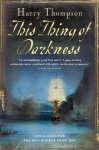
- Robert FitzRoy appears in The Glitter in the Green by Jon Dunn and Forecast by Joe Shute, and is the main subject of This Thing of Darkness by Harry Thompson, a doorstopper that has been languishing on my set-aside pile.
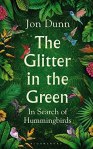

- Dave Goulson’s bumblebee research is mentioned in The Glitter in the Green by Jon Dunn, which I was reading at the same time as Goulson’s new book, Silent Earth.
- Reading two cancer memoirs that mention bucket lists at the same time: No Cure for Being Human by Kate Bowler and Year of Plagues by Fred D’Aguiar.


- Mentions of the damaging practice of clearing forest to plant eucalyptus in The Glitter in the Green by Jon Dunn and Forecast by Joe Shute.
- Mentions of mosquito coils being used (in Borneo or Australia) in Small Bodies of Water by Nina Mingya Powles and The Weekend by Charlotte Wood.


- Different words to the tune of Leonard Cohen’s “Hallelujah” in In Every Mirror She’s Black by Lola Akinmade Åkerström and How We Do Family by Trystan Reese.
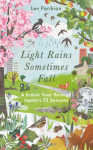 A brief mention of China and Japan’s 72 mini-seasons in Small Bodies of Water by Nina Mingya Powles: this will then be the setup for Light Rains Sometimes Fall by Lev Parikian, which I’ll be reading later in September.
- Beached whales feature in Fathoms by Rebecca Giggs and Small Bodies of Water by Nina Mingya Powles.
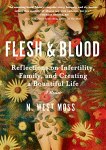
- A chapter in No Cure for Being Human by Kate Bowler is entitled “Flesh & Blood,” which is the title of the whole memoir by N. West Moss that I picked up next – and both are for Shelf Awareness reviews.
- A description of a sonogram appointment where the nurse calls the doctor in to interpret the results and they know right away that means the pregnancy is unviable, followed by an account of a miscarriage, in Flesh & Blood by N. West Moss and How We Do Family by Trystan Reese.

- Robin Wall Kimmerer and Robert Macfarlane quoted in Church of the Wild by Victoria Loorz and Small Bodies of Water by Nina Mingya Powles.
 Bookish Beck = Rebecca Foster. American transplant to England. Freelance proofreader and book reviewer.
 Bookish Beck