Five Perfect Winter Reads
When possible I enjoy reading with the seasons. As the holidays approached last year I picked out a pile of wintry reads that would see me through the dark, cold days of January. I’ve had a chance to read five of them so far, and give review extracts below. I may report back later on in the winter about a few books I plan to read with “snow” in the title.

In the Grip of Winter by Colin Dann
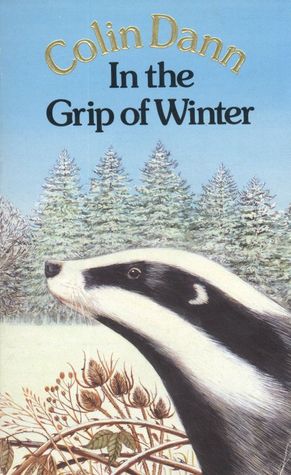 In this second book of the Farthing Wood series, the animals endure a harsh winter in their new home, the White Deer Park. When Badger falls down a slope and injures his leg, he’s nursed back to health at the Warden’s cottage, where Ginger Cat tempts him to join in a life of comfort and plenty. Meanwhile, Fox, Tawny Owl and the others are near starvation, and resort to leaving the park and stealing food from farms and rubbish bins. They have to band together and use their cunning to survive. This was a sweet book that reminded me of my childhood love of anthropomorphized animal stories (like Watership Down and the Redwall series). I doubt I’ll read another from the series, but this was a quaint read for the season.
My husband received this book for free from his school for some reason. Even early on his tastes turned towards wildlife. [One annoyance: the author always referred to Badger’s “set” instead of his “sett”; although it appears this may actually be a permissible variant, it wasn’t cool with me!]


Favorite wintry passage:
“‘Every winter is hard for some,’ Badger answered. ‘The weakest among us always suffer the most. The small creatures: the mice, the shrews, the voles and, particularly, the small birds – every winter takes its toll [on] them. But yes – I sense that this winter will be one to reckon with. There’s something in that wind…’”
My rating:
This Cold Heaven: Seven Seasons in Greenland by Gretel Ehrlich
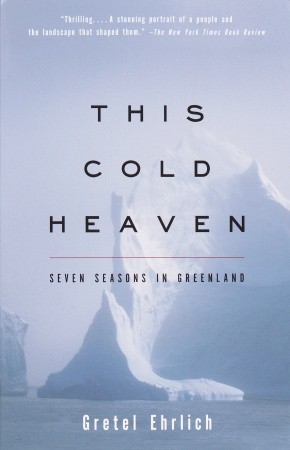 Once a year or so I encounter a book that’s so flawlessly written you could pick out just about any sentence and marvel at its construction. That’s certainly the case here. I never want to go to Greenland; English winters are quite dark and cold enough for me, and I don’t know if I could stomach seal meat at all, let alone for most meals and often raw. But that’s okay: I don’t need to book a flight to Qaanaaq, because through reading this I’ve already been in Greenland in every season, and I thoroughly enjoyed my armchair trek. Impressively, Ehrlich is always describing the same sorts of scenery, and yet every time finds a fresh way to write about ice and sun glare and frigid temperatures. I’ll be looking into her other books for sure.
Favorite wintry passage:
“The ice cap itself was a siren singing me back to Greenland, its walls of blue sapphire and sheer immensity always beguiling. Part jewel, part eye, part lighthouse, part recumbent monolith, the ice is a bright spot on the upper tier of the globe where the world’s purse strings have been pulled tight, nudging the tops of three continents together. Summers, it burns in the sun, and in the dark it hoards moonlight.”
My rating:
Further reading on Greenland: A Wilder Time: Notes from a Geologist at the Edge of the Greenland Ice by William E. Glassley (see my Foreword review) and The Prophets of Eternal Fjord by Kim Leine, an epic novel about an unconventional priest, set in late-eighteenth-century Denmark and Greenland (see my Nudge review). Also Sinéad Morrissey’s multi-part poem “Whitelessness.” You can read the first stanza of it here.
The Short Day Dying by Peter Hobbs
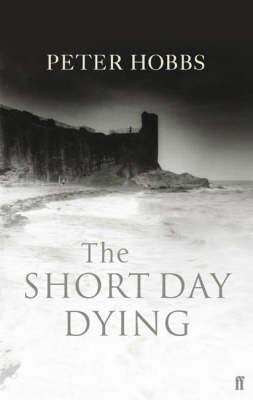 This short novel from 2005 deserves to be better known. It reminded me of Days Without End and On the Black Hill, but most of all of Francis Kilvert’s diary, perhaps as voiced by a rustic from Poldark. We journey through 1870 with Charles Wenmoth, a twenty-seven-year-old blacksmith’s apprentice and Methodist lay preacher in Cornwall mining country. Very little happens; the focus is on atmosphere and voice. The major struggle is with his melancholy spirit, which causes him to doubt his salvation. As winter circles round, the days grow shorter just as he senses life growing shorter. The short chapters are like undated diary entries (apparently based on the author’s great-great-grandfather’s); the sentences are almost completely unpunctuated, which at first had me twitching for my pencil to add commas to the run-on sentences, but eventually I gave myself over to the flow.
Favorite wintry passage:
“It is a shame we cannot stay children for ever and remain blind to the slow death of the land. How different it will all be in a few months the bare trees revealed as dark gnarled bodies. Something inside them though lives through the yearly famine and they always find new colour. I trust it is the same for us all.”
My rating:
Winter by Karl Ove Knausgaard
 This is my favorite of the three Knausgaard books I’ve read so far, and miles better than his Autumn. These short essays successfully evoke the sensations of winter and the conflicting emotions elicited by family life and childhood memories. The series is, loosely speaking, a set of instruction manuals for his unborn daughter, who is born a month premature in the course of this volume. So in the first book he starts with the basics of bodily existence – orifices, bodily fluids and clothing – and now he’s moving on to slightly more advanced but still everyday things she’ll encounter, like coins, stuffed animals, a messy house, toothbrushes, and the moon. I’ll see out this series, and see afterwards if I have the nerve to return to My Struggle.
Favorite wintry passage:
“winter not only muffles some sounds and intensifies others, it also has sounds that are entirely its own, unique to the season, and some of them are among the most beautiful of all. The low boom of ice-covered waters as they freeze, for instance, which can be heard on perfectly clear days or nights when the cold deepens, and which has something menacing or mighty about it, since it isn’t connected to an visible movement”
My rating:
Available Light by Marge Piercy
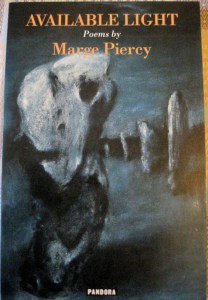 Many poetry volumes get a middling rating from me because some of the poems are memorable but others do nothing for me. This is on the longer side for a collection at 120+ pages, but only a handful of its poems fell flat. The subjects are diverse: travels in Europe (my cover depicts the Avebury stone circle in the gloom), menstruation, identifying as a Jew as well as a feminist, scattering her father’s ashes, the stresses of daily life, and being in love. The title poem, which appears first, has a slightly melancholy tone with its focus on the short days of winter, but the poet defiantly asserts meaning despite the mood: “Even the dead of winter: it seethes with more / than I can ever live to name and speak.” Piercy was a great discovery, and I’ll be trying lots more of her books from various genres.
Favorite wintry passage:
(from “Available light”)
In winter the light is red and short.
The sun hangs its wizened rosehip in the oaks.
By midafternoon night is folding in.
The ground is locked against us like a door.
Yet faces shine so the eyes stretch for them
and tracks in the snow are etched, calligraphy
My rating:
(And one book that didn’t quite work for me; I ended up abandoning it at 14%.
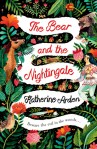 The Bear and the Nightingale by Katherine Arden: Some striking turns of phrase, an enchanting wintry atmosphere … but a little Disney-fied for me. I got this free for Kindle so may come back to it at some point.
Favorite wintry passage:
“The years slipped by like leaves. …The clouds lay like wet wool above the trees.”)
Have you read any wintry books this year?
Harvest Supper, Scrabble Tournament & Book Haul: A Great Trip to Bookbarn
I manage about an annual trip to Bookbarn International, one of my favorite secondhand bookshops in the UK. Apart from the stock in their newly opened Darwin Rare Books room and the 50-pence children’s books, everything in the shop is £1. I never fail to come out with a great stack of finds. Our trip on Thursday was extra special because we were going for the café’s Harvest Supper and Scrabble tournament, held as part of The Great Bath Feast.


We played one 45-minute game against another team of two, broke for an excellent vegetarian supper of squash, spinach and goat’s cheese pie with mashed potatoes and baby roast vegetables, then played a second match before dessert (vegan plum crumble with custard or gluten-free fig brownie with ice cream). Over the years my husband and I have become quite the Scrabble fiends, and together on one team I’m afraid we were unbeatable. Our bingo starting off Game #2 helped, but we worried we were at an overall advantage because the other boards each had three teams playing.


It was a special pleasure to meet William Pryor, the chairman of Bookbarn. Last year he spotted my blog posts about Bookbarn and offered me a copy of his memoir, The Survival of the Coolest. It’s a wonderful book about growing up a descendant of Charles Darwin but going off the rails and ending up addicted to heroin in his 20s:
This family of mine! On the one hand you have the royalty of science and Bloomsbury, on the other the fading world of the English landed gentry. … We had no religion but Darwin.
The months ran into each other as a blur of the chase for relief, the wheeling and dealing … One of the most striking aspects of hell is that it goes round and round; the same torments over and over again.
Mr. Pryor let me have a sneak peek at the Darwin room after the shop closed and kindly gave me a copy of his grandmother Gwen Raverat’s memoir, Period Piece. Over pudding we chatted about literary festivals, the Bookshop Band, his failed idea to return a portion of secondhand books’ resale value to the authors, and the latest Nobel Prize winner.
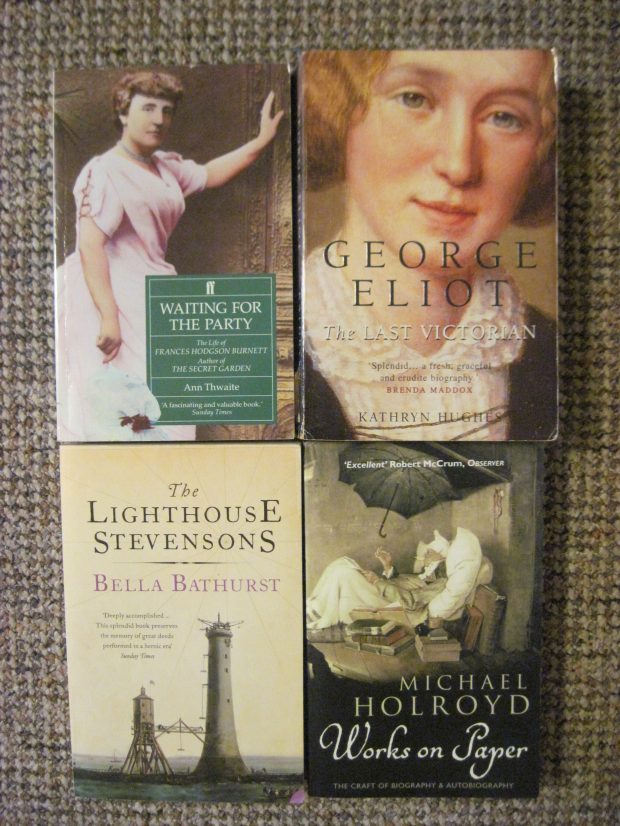
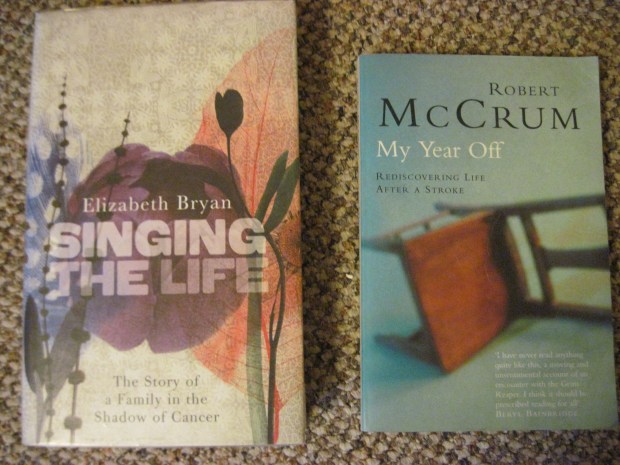
As to that book haul: I feel like I have fiction coming out of my ears, so with our hour of book browsing time I mainly focused on biographies and memoirs. Here are my finds:
Biographies and essays on writing biography:
Bereavement memoirs:
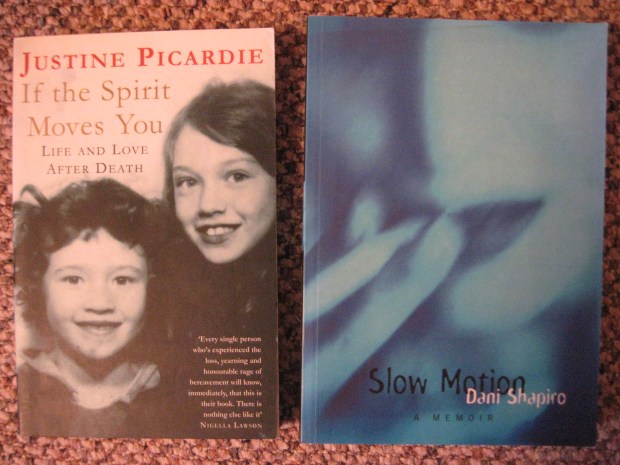
(Two of my purchases will go especially well as pairs with books I already own.)


Medical memoirs:
General memoirs (I was especially pleased to find the sequel to Cobwebs and Cream Teas, which I bought at Bookbarn last time and read early this year):
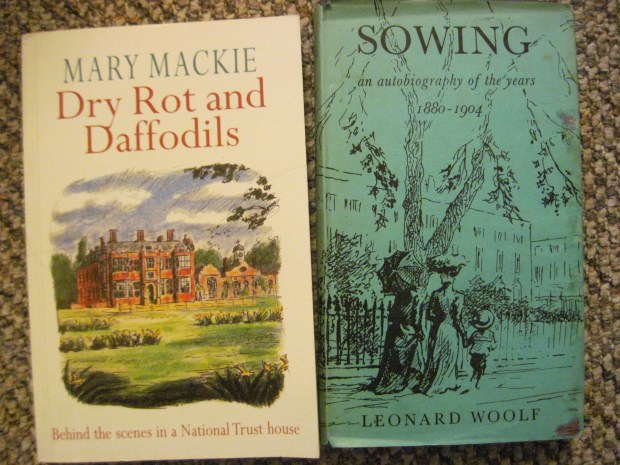
Plus two poetry books (one of them signed!):


And two novels I happened to grab on the way to the till:

My unexpected freebies. The Raverat is a lovely small-format hardback with gilt-edge pages and a maroon ribbon bookmark; on the right is our prize for winning the Scrabble tournament:


I’ve already had a peek inside a few of the books I bought and found some excellent passages. Leonard Woolf’s memoir opens with an extraordinary passage of almost biblical language about existence and non-existence; one of Marge Piercy’s poems struck me right away for its description of a Jewish holiday and the line “there is no justice we don’t make daily / like bread and love.”
My husband came away with three natural history books, and we also found a few children’s books to give to nieces and nephews.
Thanks to this book haul plus a trip to Book-Cycle in early September and some charity shopping last week, I’ve had to start a double stack on my biography/memoir shelves. There’s already a double stack on one of my unread fiction shelves. Next week is my birthday, so the book acquisitions are only likely to continue…
The 2017 Releases I’m Most Excited About
2017 hasn’t even begun and already I’m overwhelmed by the quantity and quality of new books to be released. This is by no means a full picture of what’s coming out next year; it’s only 30 titles that I happen to have heard about and/or know I want to seek out. The descriptions are taken from the publisher blurbs on Goodreads, NetGalley or Edelweiss. Some of these I already have access to in galley form; others I’ll be doing my darndest to get hold of! (Within categories, titles are in alphabetical order by author rather than by publication date.)
ASSIGNED
English Animals by Laura Kaye (for the blog tour) [Jan. 12, Little, Brown UK]: “When Mirka [from Slovakia] gets a job in a country house in rural England, she has no idea of the struggle she faces to make sense of a very English couple, and a way of life that is entirely alien to her.”
 Pachinko by Min Jin Lee (for BookBrowse) [Feb. 7, Grand Central]: “Pachinko follows one Korean family through the generations, beginning in [the] early 1900s. … [A] sweeping saga of an exceptional family in exile from its homeland and caught in the indifferent arc of history.”
No One Is Coming to Save Us by Stephanie Watts Powell (for the Pittsburgh Post-Gazette) [Apr. 4, Ecco]: “The Great Gatsby brilliantly recast in the contemporary South: a powerful first novel about an extended African-American family and their colliding visions of the American Dream.”
The Twelve Lives of Samuel Hawley by Hannah Tinti (for The Bookbag) [Mar. 28, Tinder Press]: “A father protects his daughter from the legacy of his past and the truth about her mother’s death in this thrilling new novel … Both a coming-of-age novel and a literary thriller, The Twelve Lives of Samuel Hawley explores what it means to be a hero, and the cost we pay to protect the people we love most.”
NOVELS (all by authors I’ve enjoyed in the past)
Greatest Hits by Laura Barnett [June 15, W&N]: “Cass Wheeler [is] a British singer-songwriter, hugely successful since the early 70s … Her task is to choose 16 songs from among the hundreds she has written … for a uniquely personal Greatest Hits record”
The Idiot by Elif Batuman [Mar. 14, Penguin]: “1995: Selin, the daughter of Turkish immigrants, arrives for her freshman year at Harvard. … With superlative emotional and intellectual sensitivity, mordant wit, and pitch-perfect style, Batuman dramatizes the uncertainty of life on the cusp of adulthood.”
The Hearts of Men by Nickolas Butler [Mar. 7, Ecco]: “Nelson, irrevocably scarred from the Vietnam War, becomes Scoutmaster of Camp Chippewa, while Jonathan marries, divorces, and turns his father’s business into a highly profitable company. … [A] sweeping, panoramic novel about the slippery definitions of good and evil, family and fidelity”
New Boy by Tracy Chevalier [May 16, Hogarth]: “The tragedy of Othello is transposed to a 1970s suburban Washington schoolyard, where kids fall in and out of love with each other before lunchtime, and practice a casual racism picked up from their parents and teachers.”
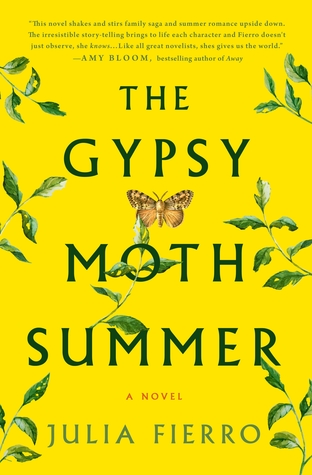 Gypsy Moth Summer by Julia Fierro [June 6, St. Martin’s]: “It is the summer of 1992 and a gypsy moth invasion blankets Avalon Island. … The Gypsy Moth Summer is about love, gaps in understanding, and the struggle to connect: within families; among friends; between neighbors and entire generations.” – Plus, get a load of that gorgeous cover!
Grief Cottage by Gail Godwin [June 6, Bloomsbury USA]: “Grief Cottage is the best sort of ghost story, but it is far more than that—an investigation of grief, remorse, and the memories that haunt us. The power and beauty of this artful novel wash over the reader like the waves on a South Carolina beach.”
The Evening Road by Laird Hunt [Feb. 7, Little, Brown & Co.]: “Reminiscent of the works of Louise Erdrich, Edward P. Jones and Marilynne Robinson, The Evening Road is the story of two remarkable women on the move through an America riven by fear and hatred, and eager to flee the secrets they have left behind.”
 The Awkward Age by Francesca Segal [May 4, Chatto & Windus]: “In a Victorian terraced house, in north-west London, two families have united in imperfect harmony. … This is a moving and powerful novel about the modern family: about starting over; about love, guilt, and generosity; about building something beautiful amid the mess and complexity of what came before.” – Sounds like Ann Patchett’s Commonwealth…
The Best of Adam Sharp by Graeme Simsion [Feb. 9, Penguin]: “The Best of Adam Sharp is about growing old and feeling young, about happy times and sad memories, about staying together and drifting apart, but most of all, it’s about how the music we make together creates the soundtrack that shapes our lives.” – Sounds a lot like the Barnett!
SHORT STORIES (also by authors I’ve enjoyed in the past)
The Dinner Party by Joshua Ferris: [May 2, Little, Brown & Co.]: “Full of the keenly observed, mordant wit that characterizes his beloved, award-winning novels, the stories in The Dinner Party are about people searching for answers in the aftermath of life’s emotional fissures”
Bad Dreams and Other Stories by Tessa Hadley [May 16, Harper]: “Hadley has proven herself to be the champion of revealing the hidden depths in the deceptively simple. In these short stories it’s the ordinary things that turn out to be most extraordinary: the history of a length of fabric or a forgotten jacket.”
NOVELS BY AUTHORS NEW TO ME
 A Separation by Katie Kitamura [Feb. 7, Riverhead Books]: “A mesmerizing, psychologically taut novel about a marriage’s end and the secrets we all carry.”
Hame by Annalena McAfee (Mrs. Ian McEwan) [Feb. 9, Harvill Secker]: “Mhairi McPhail dismantles her life in New York and moves with her 9-year-old daughter, Agnes, to the remote Scottish island of Fascaray. Mhairi has been commissioned to write a biography of the late Bard of Fascaray, Grigor McWatt, a cantankerous poet with an international reputation.”
NONFICTION: memoirs
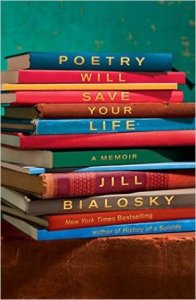 Poetry Can Save Your Life: A Memoir by Jill Bialosky [June 13, Atria]: “[A]n unconventional coming-of-age memoir organized around the 43 remarkable poems that gave her insight, courage, compassion, and a sense of connection at pivotal moments in her life.”
Between Them: Remembering My Parents by Richard Ford [May 2, Harper Collins]: “Ford brings his trademark candor, wit, and empathetic storytelling to the most intimate of landscapes: that of his love for two people who remain a mystery. Mining poignant details of his life in the American South during some iconic periods of the 20th century, Between Them illuminates the writer’s past as well as his beliefs on memory, relationships, and self-knowledge.”
The Mighty Franks: A Family Memoir by Michael Frank [May 16, Farrar, Straus and Giroux]: “A psychologically acute memoir about an unusual and eccentric Hollywood family.”
Sick: A Life of Lyme, Love, Illness, and Addiction by Porochista Khakpour [Aug. 8, Harper Perennial]: “In the tradition of Brain on Fire and The Empathy Exams, an honest, beautifully rendered memoir of chronic illness, misdiagnosis, addiction, and the myth of full recovery that details author Porochista Khakpour’s struggles with late-stage Lyme disease.”
A Stitch of Time: The Year a Brain Injury Changed My Language and Life by Lauren Marks [May 2, Simon & Schuster]: “Lauren Marks was twenty-seven, touring a show in Scotland with her friends, when an aneurysm ruptured in her brain and left her fighting for her life. … [A]n Oliver Sacks-like case study of a brain slowly piecing itself back together”
Homing Instincts: Early Motherhood on a Midwestern Farm by Sarah Menkedick [May 2, Pantheon]: “Fresh, intimate, and radiantly meditative, Homing Instincts is the story of one woman’s ‘coming of age’ as a first-time parent on her family’s rural Ohio farm.”
My Jewish Year: 18 Holidays, One Wondering Jew by Abigail Pogrebin [Mar. 14, Fig Tree Books]: “Although she grew up following some holiday rituals, Pogrebin realized how little she knew about their foundational purpose and contemporary relevance; she wanted to understand what had kept these holidays alive and vibrant, some for thousands of years. Her curiosity led her to embark on an entire year of intensive research, observation, and writing about the milestones on the religious calendar.”
 Theft by Finding: Diaries (1977–2002) by David Sedaris [May 30, Little, Brown & Co.]: “[F]or the first time in print: selections from the diaries that are the source of his remarkable autobiographical essays.”
How to Make a French Family: A Memoir of Love, Food, and Faux Pas by Samantha Vérant [Apr. 4, Sourcebooks]: “When Samantha is given a second chance at love at the age of forty, she moves to southwestern France, thinking she’s prepared for her new role in life as an instant American wife and stepmom. It turns out, though, that making a French family takes more than just good intentions and a quick lesson in croissant-baking.”
NONFICTION: poetry, biography, essays, travel
Eat This Poem: A Literary Feast of Recipes Inspired by Poetry by Nicole Gulotta [Mar. 21, Roost Books]: “The twenty-five inspiring poems in this book—from such poets as Marge Piercy, Louise Glück, Mark Strand, Mary Oliver, Billy Collins, Jane Hirshfield—are accompanied by seventy-five recipes that bring the richness of words to life in our kitchen, on our plate, and through our palate.”
Mozart’s Starling by Lyanda Lynn Haupt [May 16, Little, Brown & Co.]: “A charming story of Mozart and his pet starling, along with a natural history of the bird.”
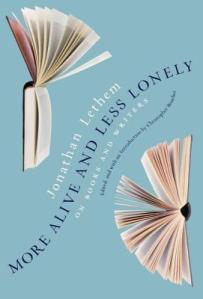 More Alive and Less Lonely: On Books and Writers by Jonathan Lethem [Mar. 14, Melville House]: “[C]ollects more than a decade of Lethem’s finest writing on writing, with new and previously unpublished material, including: impassioned appeals for forgotten writers and overlooked books, razor-sharp essays, and personal accounts of his most extraordinary literary encounters and discoveries.”
The Not-Quite States of America by Doug Mack [Feb. 14, W.W. Norton]: “American Samoa, Guam, Puerto Rico, the Northern Mariana Islands, and the U.S. Virgin Islands—and their 4 million people—are often forgotten, even by most Americans. … When Doug Mack realized just how little he knew about the territories, he set off on a globe-hopping quest covering more than 30,000 miles to see them all.”
 Bookish Beck = Rebecca Foster. American transplant to England. Freelance proofreader and book reviewer.
 Bookish Beck