Recent Online Literary Events with George Saunders and Kazuo Ishiguro
I’ve been taking advantage of various free and inexpensive literary events – a bonus of our temporarily virtual-only world. I have five of them stored up to write about, but to keep this post from getting absurdly long I’ll focus on two for now and feature the rest another time.
George Saunders in Conversation with Max Porter
(5×15 event)
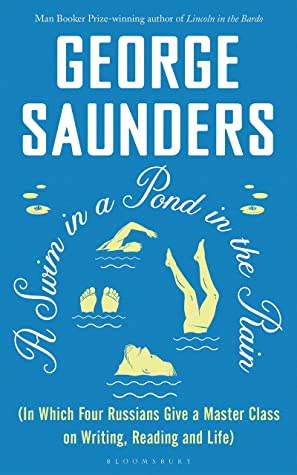 Saunders’s latest book, A Swim in a Pond in the Rain, is a written version of the graduate-level masterclass in the Russian short story that he offers at Syracuse University, where he has taught in the Creative Writing Program since 1997. His aim here was to “elevate the short story form,” he said. While the book reprints and discusses just seven stories (three by Anton Chekhov, two by Leo Tolstoy, and one each by Nikolai Gogol and Ivan Turgenev), in the class he and his students tackle more like 40. He wants people to read a story, react to the story, and trust that reaction – even if it’s annoyance. “Work with it,” he suggested. “I am bringing you an object to consider” on the route to becoming the author you are meant to be – such is how he described his offer to his students, who have already overcome 1 in 100 odds to be on the elite Syracuse program but might still need to have their academic egos tweaked.
The book is, thus, not just a set of essays on the Russian masters but also a guide to how to write well. It was clear there was mutual admiration between Saunders and Max Porter, who interviewed him. They discussed the revision process as an accumulation of micro-decisions that make the work better. For instance, Saunders compared two Tolstoy stories, “The Snowstorm” and “Master and Man” (written 20 years later), and noted that, though they are thematically similar, the later one is more organized.
Saunders spoke about writing as a dual process of intuition and iteration; a bunch of different “yous” have acted on a text by the time it’s done. Early on in his career, he thought that he had to choose which writer he wanted to be (e.g., Hemingway or Kerouac), but as he aged he realized that the mind is never fixed. He went surprisingly deep into Buddhism at this point, likening writing to meditation – both are practices pursued with intensity. To his younger self, he would say to keep going: improving is simply a matter of time (i.e., that 10,000 hours figure that’s bandied about as necessary for developing expertise).
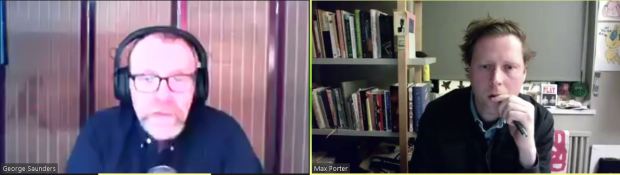
The only drawback to this event was that Saunders was speaking from his snow-encased upstate New York basement and had a horrible Internet connection; often his voice was faint and delayed, while his image stayed static. We and Porter could only stare gormlessly and wait for his face to move to match his words! I think the book would be too niche for me – I’ve hardly read anything by the Russians, and since I don’t write fiction I’m not in need of a guide to those kinds of writing decisions – but it was nice to ‘meet’ Saunders ‘in person’.
An Evening with Kazuo Ishiguro
(Faber Members / Guardian Live event)
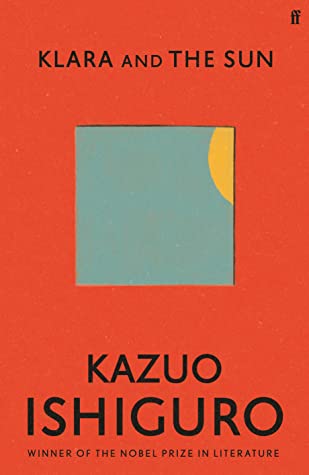 Ishiguro’s new novel, Klara and the Sun, was published by Faber yesterday. This conversation with Alex Clark also functioned as its launch event. It’s one of my most anticipated books of the year, so I pre-ordered a signed copy along with my ticket and look forward to it arriving soon. Klara is an Artificial Intelligence “friend” purchased to combat teenage loneliness. A childlike figure, she is cheerful and treats the sun like a god. Ishiguro said that the book developed from a story he wrote for children aged five to six, about a little girl who takes a doll home – except his daughter, author Naomi Ishiguro, told him no way was it suitable for young children, being far too dark. He likes “displaced or alien narrators, fish out of water,” he said, because the limited perspective allows him to focus on oddness.
In addition to Clark’s questions, a few pre-recorded questions from literary celebs (Daisy Johnson, Bernardine Evaristo, and David Mitchell) encouraged Ishiguro to create a tripartite schema for his novels, reflect on his writing about Japan, and look back at the devices he has used. Asked by Johnson about the connections between his novels, he admitted that his first three novels all retread the same ground: a man who has made a mess of his life or career picks over the past. Then his mid period is set in dreamscapes, while his most recent three novels are dystopian fantasies (though he does not see Klara as set in a dystopian world).
In response to Evaristo’s question about whether he felt an obligation to write about Japan, he said that with his early work he was conscious of needing to represent a group of people who even then (due to World War II) were viewed with suspicion or antipathy. He left Japan at age five so the country didn’t seem entirely real to him. What he knew was based on very early memories, what his mother told him, comic books sent by his grandparents, etc. As he stated in his Nobel Prize acceptance speech, writing about Japan in his twenties therefore felt like “an act of preservation.” Still, he wants his characters and situations to be universal.

Replying to Mitchell’s three questions (cheeky!), he explained that his first ambition was to be a singer/songwriter, and he wrote 100+ songs. Songwriting taught him minimalism. “You can say a huge amount by what you don’t say,” he noted. He hopes to create spaces, or rather vacuums that suck in the reader’s attention. Unlike Mitchell, he always knows the ending of a book before he begins, and his decisions are all about wanting to lodge in the reader’s brain. Thus, memorable endings are a priority for him, whereas they might not be for other writers. I was struck by his characterization of his own life: when he looks back, he doesn’t see a clear path that arose from his choices; instead, he sees a “weird, incoherent mess.” For this reason, he’s turned against the reflective device of his first three books. If he can come up with a theme, he’s hankering to write a book about hitchhikers in the north of England.
Towards the end of the (overlong) discussion, he mentioned that he has been questioning the novelist’s role due to the events of the past year: wondering about the meaning of fiction when so many have died and so many believe fake news. It was a melancholy but realistic point to end on. While I’m not an Ishiguro completist (The Unconsoled doesn’t appeal to me at all and I’m not sure I can be bothered with When We Were Orphans, but I will try The Buried Giant; I’ve read the rest), the event whetted my appetite to read his new book. (See also this Goodreads interview. I loved the anecdotes about learning he’d won the Nobel!)
Bookish online events coming up soon: The Rathbones Folio Prize announcement on the 24th and Claire Fuller’s book launch for Unsettled Ground on the 25th.
Have you attended any online literary events recently?
Wellcome Book Prize 10th Anniversary Blog Tour: Teach Us to Sit Still by Tim Parks (2010)
“Launched in 2009, the Wellcome Book Prize, worth £30,000, celebrates the best new books that engage with an aspect of medicine, health or illness, showcasing the breadth and depth of our encounters with medicine through exceptional works of fiction and non-fiction.” I was delighted to be asked to participate in the official Wellcome Book Prize 10th anniversary blog tour. For this stop on the tour I’m highlighting a shortlisted title from 2010, a very strong year. The winning book, Rebecca Skloot’s The Immortal Life of Henrietta Lacks, along with Siddhartha Mukherjee’s The Emperor of All Maladies, turned me on to health-themed reading and remains one of my most memorable reads of the past decade.
Teach Us to Sit Still: A Sceptic’s Search for Health and Healing by Tim Parks
 Tim Parks, an Englishman, has lived and worked in Italy for over 30 years. He teaches translation at the university in Milan, and is also a novelist and a frequent newspaper columnist on literary topics. Starting in his forties, Parks was plagued by urinary problems and abdominal pain. Each night he had to get up five or six times to urinate, and when he didn’t have fiery pangs shooting through his pelvic area he had a dull ache. Doctors assessed his prostate and bladder in tests that seemed more like torture sessions, but ultimately found nothing wrong. While he was relieved that his worst fears of cancer were allayed, he was left with a dilemma: constant, unexplained discomfort and no medical strategy for treating it.
When conventional medicine failed him, Parks asked himself probing questions: Had he in some way brought this pain on himself through his restless, uptight and pessimistic ways? Had he ever made peace with his minister father’s evangelical Christianity after leaving it for a life based on reason? Was his obsession with transmuting experience into words keeping him from living authentically? During a translation conference in Delhi, he consulted an ayurvedic doctor on a whim and heard words that haunted him: “This is a problem you will never get over, Mr Parks, until you confront the profound contradiction in your character.”
The good news is: some things helped. One was the book A Headache in the Pelvis, which teaches a paradoxical relaxation technique that Parks used for up to an hour a day, lying on a yoga mat in his study. Another was exercise, especially running and kayaking – a way of challenging himself and seeking thrills in a controlled manner. He also started shiatsu therapy. And finally, Vipassana meditation retreats helped him shift his focus off the mind’s experience of pain and onto bodily wholeness. Vipassana is all about “seeing things as they really are,” so the retreats were for him a “showdown with this tangled self” and a chance to face the inevitability of death. Considering he couldn’t take notes at the time, I was impressed by the level of detail with which Parks describes his breakthroughs during meditation.
Though I was uneasy reading about a middle-aged man’s plumbing issues and didn’t always follow the author on his digressions into literary history (Coleridge et al.), I found this to be an absorbing and surprising quest narrative. If not with the particulars, I could sympathize with the broader strokes of Parks’s self-interrogation. He wonders whether sitting at a desk, tense and with poor posture, and wandering around with eyes on the ground and mind on knots of words for years contributed to his medical crisis. Borrowing the title phrase from T.S. Eliot, he’s charted an unlikely journey towards mindfulness in a thorough, bracingly honest, and diverting book that won’t put off those suspicious of New Age woo-woo.
My rating: 
With thanks to Midas PR for the free copy for review.
Wellcome Book Prize 2010
Winner: The Immortal Life of Henrietta Lacks by Rebecca Skloot
Shortlist: Angel of Death by Gareth Williams; Grace Williams Says It Loud by Emma Henderson; So Much for That by Lionel Shriver; Medic by John Nicols and Tony Rennell; Teach Us to Sit Still by Tim Parks
Judges: Comedy writer and television presenter Clive Anderson (chair); novelist and academic Maggie Gee; academic and writer Michael Neve; television presenter and author Alice Roberts; academic and writer A.C. Grayling
The 2019 Wellcome Book Prize longlist will be announced in February. I’m already looking forward to it, of course, and I’m planning to run a shadow panel once again.
Elif Shafak, award-winning author, is the chair of this year’s judges and is joined on the panel by Kevin Fong, consultant anaesthetist at University College London Hospitals; Viv Groskop, writer, broadcaster and stand-up comedian; Jon Day, writer, critic, and academic; and Rick Edwards, broadcaster and author.
See below for details of where other reviews have appeared or will be appearing soon as part of the Wellcome Book Prize 10th anniversary blog tour.

 Bookish Beck = Rebecca Foster. American transplant to England. Freelance proofreader and book reviewer.
 Bookish Beck