Coming Soon … A New “Love Your Library” Meme
I know that lots of my readers are dedicated library users. Some of you even work or volunteer in a library, too. Whether or not you blog about books yourself, you’re welcome to join in this simple meme designed to celebrate libraries. Use ’em or lose ’em, after all.
This challenge is entirely open-ended, but here are some things you might consider posting on your blog or to social media:
- Photos or a list of your latest library book haul
- An account of a visit to a new-to-you library
- Full-length or mini reviews of some recent library reads
- A description of a particular feature of your local library
- A screenshot of the state of play of your online account
- An opinion piece about library policies (e.g. Covid procedures or fines amnesties)
- A write-up of a library event you attended, such as an author reading or book club.

(Image by StockSnap from Pixabay)
If it’s related to libraries, I want to hear about it. I’ll post on the last Monday of each month (unless a holiday interferes), but feel free to post whenever you wish. Do share a link to your own post in the comments of my latest one, and use the above image, too. I’m co-opting a hashtag that is already popular on Twitter and Instagram: #LoveYourLibrary.
Get thinking about what you might want to post on Monday the 25th!
Love Your Library has grown out of the monthly “Library Checkout” meme – created by Shannon of River City Reading and previously hosted by Charleen of It’s a Portable Magic, I then hosted it for four years starting in October 2017. Here’s an archive of my past posts.
If you want to continue using this framework to keep track of your library borrowing, the categories are Library Books Read; Currently Reading; Checked Out, To Be Read; On Hold; and Returned Unread. I sometimes added Skimmed Only and Returned Unfinished. I usually gave star ratings and links to reviews of any books I managed to read.
Get Ready for Novellas in November!
Novellas: “all killer, no filler”
~Joe Hill
For the second year in a row, Cathy of 746 Books and I are co-hosting Novellas in November as a month-long challenge with four weekly prompts.

New this year: each week we will take it in turns to host a “buddy read” of a featured book we hope you will join in reading. We’re announcing the challenge early to give you plenty of time to get your stack ready.
(We suggest 150–200 pages as the upper limit for a novella, and post-1980 as a definition of “contemporary.”)
1–7 November: Contemporary fiction (Cathy)
Open Water by Caleb Azumah Nelson – including a giveaway of a signed copy!
8–14 November: Short nonfiction (Rebecca)
The Story of My Life by Helen Keller (free to download here from Project Gutenberg. Note: only the first 85 pages constitute her memoir; the rest is letters and supplementary material.)
15–21 November: Literature in translation (Cathy)
Territory of Light by Yuko Tsushima
22–28 November: Short classics (Rebecca)
Ethan Frome by Edith Wharton (free to download here from Project Gutenberg)

We’re looking forward to having you join us! Keep in touch via Twitter (@bookishbeck / @cathy746books) and Instagram (@bookishbeck / @cathy_746books) and feel free to use the terrific feature images Cathy has made and the hashtag #NovNov.
A Look Back at 2020’s Reading Projects, Including Rereads
Major bookish initiatives:
- Coordinated a Not the Wellcome Prize blog tour to celebrate 2019’s health-themed books – in case you missed it, the winner was Sinéad Gleeson for Constellations.
- Co-hosted Novellas in November with Cathy (746 Books).
- Hosted Library Checkout each month.


Reading challenges joined:
- 12 blog tours
- Six Degrees of Separation: I started participating in February and did nine posts this year
- Paul Auster Reading Week
- Reading Ireland month
- Japanese Literature Challenge
- 1920 Club
- 20 Books of Summer
- Women in Translation Month
- Robertson Davies Weekend
- Women’s Prize winners (#ReadingWomen)
- 1956 Club
- R.I.P.
- Nonfiction November
- Margaret Atwood Reading Month
This works out to one blog tour, one reading project, and one regular meme per month – manageable. I’ll probably cut back on blog tours next year, though; unless for a new release I’m really very excited about, they’re often not worth it.


Buddy reads:
 Crossing to Safety with Laila (Big Reading Life)
- 6 Carol Shields novels plus The Trick Is to Keep Breathing, Deerbrook, and How to Be Both with Marcie (Buried in Print)
- A Visit from the Goon Squad and The Idea of Perfection with Laura T.
- Mother’s Milk with Annabel
- 666 Charing Cross Road with Liz
Self-set reading challenges:
- Seasonal reading
- Classic of the Month (14 in total; it’s only thanks to Novellas in November that I averaged more than one a month)
- Doorstopper of the Month (just 3; I’d like to try to get closer to monthly in 2021)
- Wainwright Prize longlist reading
- Bellwether Prize winners (read 2, DNFed 1)
- Short stories in September (8 collections)
- Young Writer of the Year Award shortlist reading
- Thematic roundups – I’m now calling these “Three on a Theme” and have done 2 so far
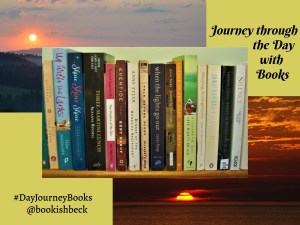
- Journey through the Day with Books (3 new reviews this year):
- Zennor in Darkness by Helen Dunmore
 Rise and Shine by Anna Quindlen
- [Up with the Larks by Tessa Hainsworth – DNF]
- [Shine Shine Shine by Lydia Netzer – DNF]
- Three-Martini Lunch by Suzanne Rindell – existing review
- The Shadow of the Sun by Ryszard Kapuściński – read part of
- Eventide by Kent Haruf
- Dinner at the Homesick Restaurant by Anne Tyler – existing review
- Talk before Sleep by Elizabeth Berg – existing review
- When the Lights Go Out by Carys Bray
- Journey by Moonlight by Antal Szerb
- Voyage in the Dark by Jean Rhys
- Late Nights on Air by Elizabeth Hay – existing review
- Sleeping Arrangements by Laura Shaine Cunningham
- The House of Sleep by Jonathan Coe
- Bodies in Motion and at Rest by Thomas Lynch – read but not reviewed
- Silence by Shūsaku Endō
- Arctic Dreams by Barry Lopez – read part of
- The Four in a Row Challenge – I failed miserably with this one. I started an M set but got bogged down in Tales of the City by Armistead Maupin (also a bibliotherapy self-prescription for Loneliness from The Novel Cure), which I had as a bedside book for much of the year, so only managed 1.5 out of 4; I also started an H quartet but set both Tinkers and Plainsong aside. Meanwhile, Debbie joined in and completed her own 4 in a Row. Well done! I like how simple this challenge is, so I’m going to use it next year as an excuse to read more from my shelves – but I’ll be more flexible and allow lots of substitutions in case I stall with one of the four books.

Rereading
At the end of 2019, I picked out a whole shelf’s worth of books I’d been meaning to reread. I kept adding options over the year, so although I managed a respectable 16 rereads in 2020, the shelf is still overflowing!

Many of my rereads have featured on the blog over the year, but here are two more I didn’t review at the time. Both were book club selections inspired by the Black Lives Matter movement. (We held a rally and silent protest in a park in the town centre in June.)
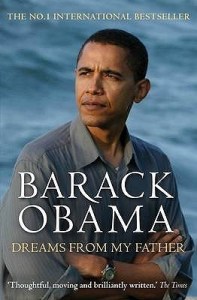 Dreams from My Father by Barack Obama: Remember when there was a U.S. president who thought deeply, searched his soul, and wrote eloquently? I first read this memoir in 2006, when Obama was an up-and-coming Democratic politician who’d given a rousing convention speech. I remembered no details, just the general sweep of Hawaii to Chicago to Kenya. On this reread I engaged most with the first third, in which he remembers a childhood in Hawaii and Indonesia, gives pen portraits of his white mother and absentee Kenyan father, and works out what it means to be black and Christian in America. By age 12, he’d stopped advertising his mother’s race, not wanting to ingratiate himself with white people. By contrast, “To be black was to be the beneficiary of a great inheritance, a special destiny, glorious burdens that only we were strong enough to bear.” The long middle section on community organizing in Chicago nearly did me in; I had to skim past it to get to his trip to Kenya to meet his paternal relatives – “Africa had become an idea more than an actual place, a new promised land”.
 now
now
 The Immortal Life of Henrietta Lacks by Rebecca Skloot: This Wellcome Book Prize winner about the use of a poor African-American woman’s cells in medical research was one of the first books to turn me onto health-themed reads. I devoured it in a few days in 2010. Once again, I was impressed at the balance between popular science and social history. Skloot conveys the basics of cell biology in a way accessible to laypeople, and uses recreated scenes and dialogue very effectively. I had forgotten the sobering details of the Lacks family experience, including incest, abuse, and STDs. Henrietta had a rural Virginia upbringing and had a child by her first cousin at age 14. At 31 she would be dead of cervical cancer, but the tissue taken from her at Baltimore’s Johns Hopkins hospital became an immortal cell line. HeLa is still commonly used in medical experimentation. Consent was a major talking point at our book club Zoom meeting. Cells, once outside a body, cannot be owned, but it looks like exploitation that Henrietta’s descendants are so limited by their race and poverty. I had forgotten how Skloot’s relationship and travels with Henrietta’s unstable daughter, Deborah, takes over the book (as in the film). While I felt a little uncomfortable with how various family members are portrayed as unhinged, I still thought this was a great read.
  then / now
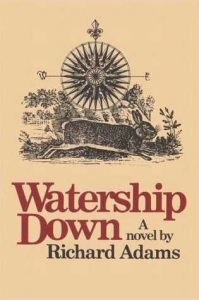 I had some surprising rereading DNFs. These were once favorites of mine, but for some reason I wasn’t able to recapture the magic: Middlesex by Jeffrey Eugenides, Everything Is Illuminated by Jonathan Safran Foer, Gilead by Marilynne Robinson, and On Beauty by Zadie Smith. I attempted a second read of John Fowles’s postmodern Victorian pastiche, The French Lieutenant’s Woman, on a mini-break in Lyme Regis, happily reading the first third on location, but I couldn’t make myself finish once we were back home. And A Visit from the Goon Squad by Jennifer Egan was very disappointing a second time; it hasn’t aged well. Lastly, I’ve been stalled in Watership Down for a long time, but do intend to finish my reread.
In general, voice- and style-heavy fiction did not work so well for me on rereading. Autobiographical essays by Anne Lamott and Abigail Thomas worked best, but I also succeeded at rereading some straightforward novels and short stories. Next year, I’d like to aim for a similar number of rereads, with a mixture of memoirs and fiction, including at least one novel by David Lodge. I’d also be interested in rereading earlier books by Ned Beauman and Curtis Sittenfeld if I can find them cheap secondhand.
What reading projects did you participate in this year?
Done much rereading lately?
New Reading Projects! (Join Me?)
It’s only one week since we announced the Not the Wellcome Prize winner, the culmination of a month-long project that was months more in the planning. I don’t think I’ll be coordinating another blog tour anytime soon, as it was a lot of work finding participants, working out a schedule and keeping on top of the publicizing via social media. Still, it was a lot of fun, and already I’m missing the buzz and ready to get stuck into more projects.
I’d love it if you joined me for one or more of these. Some could be combined with your 20 Books of Summer or other challenges, too.
Ongoing buddy reads
 It would have been Richard Adams’s 100th birthday on the 9th. That night I started rereading his classic tale of rabbits in peril, Watership Down, which was my favorite book from childhood even though I only read it the once at age nine. I’m 80 pages in and enjoying all the local place names. Who would ever have predicted that that mousy tomboy from Silver Spring, Maryland would one day live just 6.5 miles from the real Watership Down?!
 My husband is joining me for the Watership Down read (he’s not sure he ever read it before), and we’re also doing a buddy read of Arctic Dreams by Barry Lopez. In that case, we ended up with two free copies, one from the bookshop where I volunteer and the other from The Book Thing of Baltimore, so we each have a copy on the go. Lopez’s style, like Peter Matthiessen’s, lends itself to slower, reflective reading, so I’m only two chapters in. It’s novel to journey to the Arctic, especially as we approach the summer.
I plan to take my time over these two, so tell me if you have a copy of either and feel like picking it up at any point over the next few months.
Bibliotherapy self-prescriptions
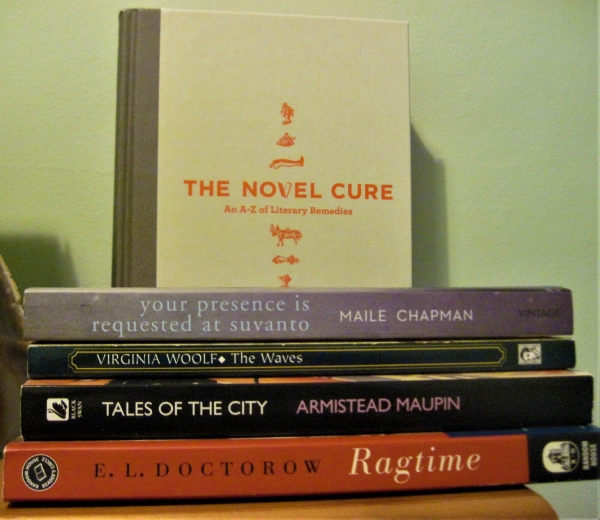
The other day I got out my copy of The Novel Cure by School of Life bibliotherapists Ella Berthoud and Susan Elderkin and browsed through the categories for some prescriptions that might feel relevant to the current situation. I found four books I own that fit the bill:
From the list of “The Ten Best Novels to Lower Your Blood Pressure”: Your Presence Is Requested at Suvanto by Maile Chapman & The Waves by Virginia Woolf (and I’ve read another three of them, including, recently, Crossing to Safety).
One of several prescriptions for Loneliness: Tales of the City by Armistead Maupin.
The cure for Zestlessness: Ragtime by E. L. Doctorow.
If you have access to one of these, or have a copy of The Novel Cure and are keen on following up on another of the prescriptions, let me know.
And now for two memes that I (think I) have created. Although I’m sure something similar has been done in the past, I couldn’t find any specific blogs about them. I don’t know about you, but I always need encouragement to pick up books from my own shelves – even though libraries are currently closed, I’m still working my way through a library stack, and I’m tempted to make another order of new books from Hungerford Bookshop. It’s great to support libraries and independent bookstores, of course, but there could be no better time to mine your own bookshelves for treasures you bought ages ago but still have never read.
Journey through the Day with Books
I enjoyed picking out 18 books from my shelves that refer to particular times of day or meals or activities associated therewith. Four of these are books I’ve already read and four are ones I’m currently reading. You can piggyback on my selections if you wish, or find your own set.
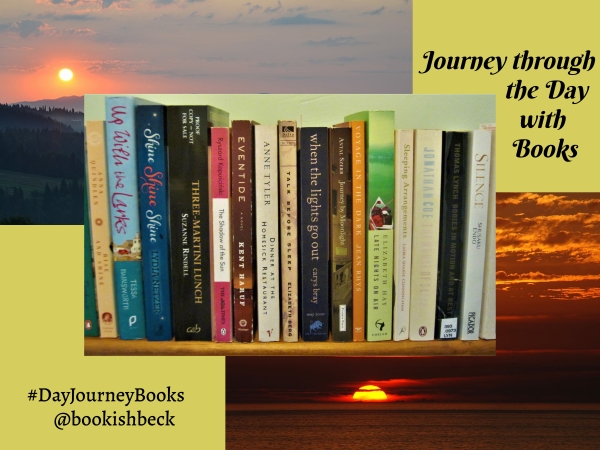
Here’s my full list:
Zennor in Darkness by Helen Dunmore
Rise and Shine by Anna Quindlen
Up with the Larks by Tessa Hainsworth
Shine Shine Shine by Lydia Netzer
Three-Martini Lunch by Suzanne Rindell
The Shadow of the Sun by Ryszard Kapuściński
Eventide by Kent Haruf
Dinner at the Homesick Restaurant by Anne Tyler
Talk before Sleep by Elizabeth Berg
When the Lights Go Out by Carys Bray
Journey by Moonlight by Antal Szerb
Voyage in the Dark by Jean Rhys
Late Nights on Air by Elizabeth Hay
Sleeping Arrangements by Laura Shaine Cunningham
The House of Sleep by Jonathan Coe
Bodies in Motion and at Rest by Thomas Lynch
Silence by Shūsaku Endō
Arctic Dreams by Barry Lopez
The Four in a Row Challenge
I’ve been contemplating this one for quite a while. It’s inspired by Phyllis Rose’s The Shelf –from LEQ to LES: Adventures in Extreme Reading (one of Simon’s favourite books – see his review), for which she picked a shelf of the New York Society Library, eliminated duplicates and repeat entries from the same author, and read the remainder – whether she’d heard of them or not; whether they were awful or not. (“Hands down the worst book on the shelf is Le Queux’s Three Knots, a mystery that reads as if it were written by an eight-year-old on Percocet.”)

This is a variation in that you’re looking at your own TBR shelves and picking a set of four books in a row. For many, that will be four novels whose authors’ surnames all start with the same letter. But if you organize your books differently (especially within nonfiction), you may find that the set of four is more arbitrary. You never know what they might have in common, though (book serendipity!).
I’m no strict challenge host, so if you want to engineer your shelf order, or if you decide to swap a book in later on, that is no problem at all. My one firm rule is only one book per author.
I’ve picked out a few appealing sets, all from my fiction shelves. F, G, L and M had particularly rich pickings. I’ll report back as I finish each set, while the “Journey through a Day” may well take me the whole rest of the year.
Still ongoing (more here): Projects to read as many Bellwether Prize, Wellcome Book Prize and Women’s Prize winners as possible, as well as Wellcome long- and shortlistees.
Can I tempt you to take part in any of these reading projects?
[Journey through the Day: Sunrise in Pieniny, Poland (Pudelek / CC BY-SA (https://creativecommons.org/licenses/by-sa/4.0)) / Sunset (Alvesgaspar / CC BY-SA (https://creativecommons.org/licenses/by-sa/3.0))
Four in a Row: Four pelicans in a row (Sheba_Also 43,000 photos / CC BY-SA (https://creativecommons.org/licenses/by-sa/2.0)) / Phone boxes, Market Place, Ripon (Tim Green from Bradford / CC BY (https://creativecommons.org/licenses/by/2.0))]
Final 2019 Review Books: Brodesser-Akner, Cregan & McCulloch
The final three review books of the year (not counting DNFs, which will be briefly dispatched on Sunday): a much-hyped novel set in contemporary New York City, a memoir of suicidal depression and recuperation, and a study of linguistics in the Internet era.
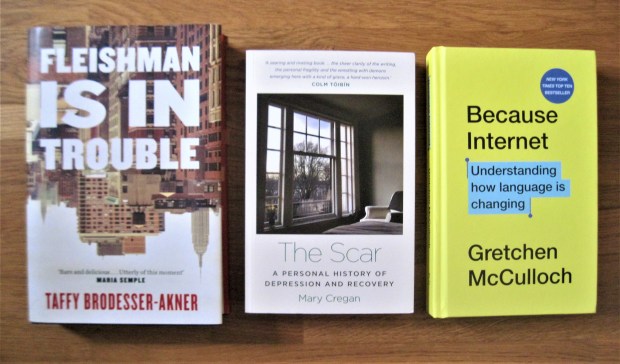
Fleishman Is in Trouble by Taffy Brodesser-Akner
According to the aggregated best-of lists (which Kate has surveyed here), this was one of the top two novels of 2019. I’m going to have to shrug my shoulders and admit, I don’t get it. To me this didn’t stand out at all from the sea of fiction about crumbling marriages and upper-middle-class angst. Toby Fleishman is 41-year-old head of hepatology at a New York City hospital. He recently split from his wife, Rachel, agent to the creator of a Hamilton-style phenomenon. Not content with their comfortable lifestyle, Rachel hankers for true wealth.
 When Rachel goes AWOL at a yoga retreat, Toby is left in charge of their children: Hannah, 11, and Solly, nine. He ferries them to and from summer camp, all the while bombarded with dirty texts and semi-nude selfies from the women he’s flirting with via a dating app. Had this novel been written by a man, people would have been up in arms about the unpleasant sexual content. But this is not just written by a woman; it’s also narrated by a woman: Elizabeth Epstein Slater, a former journalist turned stay-at-home mom. She and Toby became friends on their junior year abroad in Israel and have started hanging out more after his divorce.
So this is a book within a book Elizabeth is writing about one turbulent summer in her friends’ lives, but also her own – she’s dissatisfied with her staid marriage. It’s also Brodesser-Akner’s winking commentary on macho or moralizing fiction: “this was the only way to get someone to listen to a woman—to tell her story through a man” and “none of my characters were likable,” Elizabeth thinks. But attempts to humanize Toby and Rachel fell flat for me. Sadness over the loss of one patient was insufficient to endear me to the randy Toby, and early life with a grim grandmother and severe postpartum trauma couldn’t make me care about whether Rachel was coming back. I also never fully suspended disbelief about Elizabeth’s intimate knowledge of the Fleishmans.
This very New York novel started out promising, with echoes of Where’d You Go, Bernadette? or The Nest. There are some perceptive passages about marriage, and the writing in general is more than capable. But the story didn’t feel nearly fresh enough to justify all that acclaim, or the 373-page length.
With thanks to Wildfire for the free copy for review.
The Scar: A Personal History of Depression and Recovery by Mary Cregan
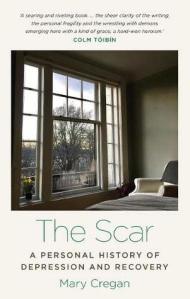 Cregan has a scar that reminds her, every time she notices it, of how close she came to taking her own life decades ago. In 1983, at the age of 27, she gave birth to a baby girl, Anna, who died two days later of a heart defect. The loss plunged her into a depression so severe that she made a halfhearted suicide attempt some weeks later and was admitted to a psychiatric hospital, where she was given electroconvulsive therapy. One morning in the hospital, she brought a glass jar of lotion into the shower with her, smashed it, and took a shard to her throat. She only narrowly missed her carotid artery. Cregan wonders if, had she been given appropriate medication, all this heartache could have been avoided.
“I’ve often wished I could undo my own act (if indeed ‘I’ and ‘my’ are accurate words for a self in the condition I was in.)”
“It took a long time to work all of this out, because it’s very hard to see yourself clearly when depressed. The problem is that you think with your mind, but your mind is ill and untrustworthy. Your mind is your enemy.”
Alongside her own winding story, the author surveys the history of mental health treatment in the United States. This felt more familiar and thus engaged me less than the personal material. Nevertheless, I would recommend this forthright memoir to anyone keen to read about the experience of mental illness.
With thanks to the author for arranging my free copy from Lilliput Press, Dublin.
Because Internet: Understanding how language is changing by Gretchen McCulloch
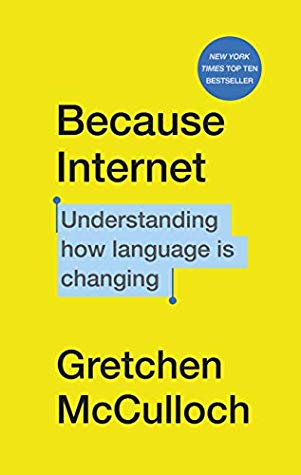 I’m surprised by how fascinating I found this: I’m a late adopter when it comes to technology (I’m still resisting a smartphone) and I haven’t given linguistics a thought since that one class I took in college, but it turns out that my proofreader’s interest in the English language and my daily use of e-mail and social media were enough to make it extremely relevant. The Montreal linguist’s thesis is that the Internet popularized informal writing and quickly incorporates changes in slang and cultural references. At the same time, it still reflects regional and age-specific differences in the way that people speak (write conversationally).
The book goes deep into topics you may never have considered, like how we convey tone of voice through what we type and how emoji function as the gestures of the written word. You’ll get a breakdown of current generations in terms of when the Internet became the default in their life (I belong to what the author calls “Semi Internet People”: I remember first using the Internet in a classroom in seventh grade, getting dial-up AOL at home not long thereafter, and opening my own Hotmail account in high school), a history of lolcats, and musings on the metaphorical use of periods and capital letters. If you are among the unconvinced, you’ll also be schooled in the appeal of gifs and memes.
Some trivia I picked up:
- In 2015 the tears of joy emoji became the most popular emoji, more used than the smiley-face emoticon.
- For many of us the Internet serves as what sociologists call a “third place” besides home and work where we can socialize.
- Only 5–8% of Internet users are bloggers.
- “Subtweeting” (as in subliminal) and “vaguebooking” are when you post about a situation without giving any specifics.
- Parents often refer to a child by an initial or nickname so the child won’t have a searchable social media presence.
- The Library of Congress now archives memes (The Lolcat Bible, Urban Dictionary, etc.).
McCulloch portrays language as a constantly changing network, such that terms like “standard” and “correct” no longer apply. She writes with such geeky enthusiasm that you’ll happily accompany her down any linguistic alley.
With thanks to Harvill Secker for the free copy for review.
 Bookish Beck = Rebecca Foster. American transplant to England. Freelance proofreader and book reviewer.
 Bookish Beck


.jpg)
.jpg)