Recent Nonfiction Reads, in 200 Words Each: Black, Fee, Gaw
I’ve let months pass between receiving these books from the kindly publishers and following through with a review, so in an attempt to clear the decks I’m putting up just a short response to each, along with some favorite quotes.
All that Remains: A Life in Death by Sue Black
 Black, a world-leading forensic anthropologist, was part of the war crimes investigation in Kosovo and the recovery effort in Thailand after the 2004 tsunami. She is frequently called into trials to give evidence, has advised the U.K. government on disaster preparedness, and is a co-author of the textbook Developmental Juvenile Osteology (2000). Whether working in a butcher’s shop as a teenager or exploring a cadaver for an anatomy class at the University of Aberdeen, she’s always been comfortable with death. “I never had any desire to work with the living,” she confesses; “The dead are much more predictable and co-operative.”
The book considers death in its clinical and personal aspects: the seven stages of postmortem alteration and the challenges of identifying the sex and age of remains; versus her own experiences with losing her grandmother, uncle and parents. Black wants her skeleton to go to Dundee University’s teaching collection. It doesn’t creep her out to think of that, no more than it did to meet her future cadaver, a matter-of-fact, curious elderly gentleman named Arthur. My favorite chapter was on Kosovo; elsewhere I found the mixture of science and memoir slightly off, and the voice never fully drew me in.
Favorite line: “Perhaps forensic anthropologists are the sin-eaters of our day, addressing the unpleasant and unimaginable so that others don’t have to.”
My rating: 
All that Remains was published by Doubleday on April 19th. My thanks to the publisher for the free copy for review.
Places I Stopped on the Way Home: A Memoir of Chaos and Grace by Meg Fee
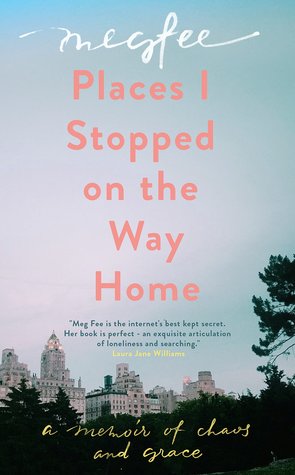 Fee came to New York City to study drama at Julliard. Her short essays, most of them titled after New York locations (plus a few set further afield), are about the uncertainty of her twenties: falling in and out of love, having an eating disorder, and searching for her purpose. She calls herself “a mess of disparate wants, a small universe in bloom.” New York is where she has an awful job she hates, can’t get the man she’s in love with to really notice her, and hops between terrible apartments – including one with bedbugs, the subject of my favorite essay – and yet the City continues to lure her with its endless opportunities.
I think this book could mean a lot to women who are younger than me or have had experiences similar to the author’s. I found the essays slightly repetitive, and rather unkindly wondered what this privileged young woman had to whine about. It’s got the same American, generically spiritual self-help vibe that you get from authors like Brené Brown and Elizabeth Gilbert. Despite her loneliness, Fee retains a romantic view of things, and the way she writes about her crushes and boyfriends never truly connected with me.
Some favorite lines:
“Writing felt like wrangling storm clouds, which is to say, impossible. But so did life. Writing became a way to make peace with that which was flawed.”
“I have let go of the idea of permanency and roots and What Comes Next.”
My rating:
Places I Stopped on the Way Home was published by Icon Books on May 3rd. My thanks to the publisher for the free copy for review.
The Pull of the River: A journey into the wild and watery heart of Britain by Matt Gaw
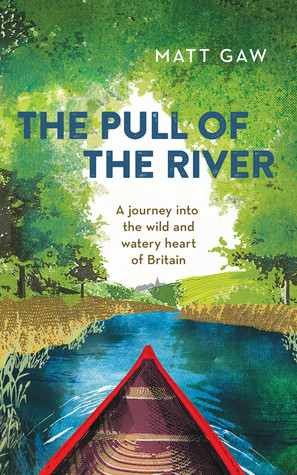 A watery travelogue in the same vein as works by Roger Deakin and Alys Fowler, this jolly yet reflective book traces Gaw’s canoe trips down Britain’s rivers. His vessel was “the Pipe,” a red canoe built by his friend James Treadaway, who also served as his companion for many of the jaunts. Starting with his local river, the Waveney in East Anglia, and finishing with Scotland’s Great Glen Way, the quest was a way of (re)discovering his country by sensing the currents of history and escaping to the edge of danger.
Access issues, outdoor toileting, getting stuck on mudflats, and going under in the winter – it wasn’t always a comfortable method of travel. But Gaw’s expressive writing renders even rubbish- and sewage-strewn landscapes beautiful in their own way: “grim bunting made from discarded bags of dog poo,” “a savannah of quivering, moussey mud” and “cormorants hunched together like sinister penguins, some holding ragged wings to the wind in taxidermic poses.”
My favorite chapters were about pollution and invasive species, as seen at the Lark, and about the beaver reintroduction project in Devon (we have friends who live near it). I’m rooting for this to make next year’s Wainwright Prize longlist.
A favorite passage:
“I feel like I’ve shed the rust gathered from being landlocked and lazy. The habits and responsibilities of modern life can be hard to shake off, the white noise difficult to muffle. But the water has returned me to my senses. I’ve been reborn in a baptism of the Waveney [et al.]”
My rating: 
The Pull of the River was published by Elliott & Thompson on April 5th. My thanks to the publisher for the free copy for review.
Have you read any stand-out nonfiction recently?
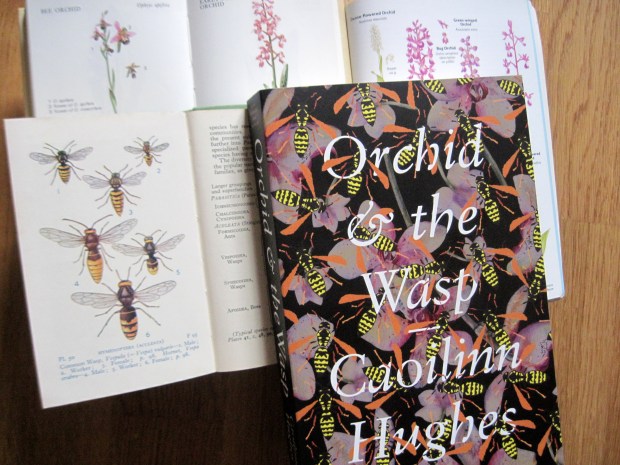
Orchid & the Wasp by Caoilinn Hughes
Gael Foess, the antiheroine of Caoilinn Hughes’ debut novel, is a trickster. When we first meet her in Dublin in 2002, the 11-year-old is promptly kicked out of school for trying to sell other girls “virginity pills.” As the years pass we see her con her way into a London Business School interview, self-assuredly teach a literature class when her professor doesn’t show up, pretend to be a journalist to get an exclusive interview, and use deception to try to boost the careers of both her mother, Sive (a conductor), and her younger brother, Guthrie (a painter and single dad). In the title metaphor, which refers to an orchid species that lures pollinating wasps, Gael is the seductive flower that gets what it wants. We’re also invited to think of her, with that typically Gael-ic name, as an incarnation of mythological Irish hero Cúchulainn.
The novel spans about nine years: a politically turbulent decade that opens with Iraq War protests and closes with the Occupy movement in New York City. The financial crisis temporarily jolts Gael and Guthrie’s father, Jarleth, a high-flying Barclays banker who leaves the family in 2008. The biblical parable of the talents, which he recounted to Gael when she was a little girl, comes back to resonate: It’s a potent reminder that money and skills don’t get distributed fairly in this life. When Gael gets to New York in 2011, she plans to redress the balance in two paradoxical ways: living in the Occupy camp and taking part in protests; and secretly earning her brother a fortune on his modern art. For even while decrying her father’s privilege, she indulges her own love of fine things; even if ironically, she says that she aspires to be in the 1%, too.
With all her contradictions, Gael is an unforgettable character. I also found Guthrie fascinating. It was serendipitous that I read this novel alongside Suzanne O’Sullivan’s new book, Brainstorm. Guthrie was a mystically religious child and suffered from seizures, which doctors determined weren’t due to epilepsy but to somatic delusions – psychological rather than physiological. The seizures, ironically, became a boon because they inspire his art: “they’re hallowed and each aura is an absolution – a benison – and not just a synaptic blip.”

The U.S. cover
Hughes is wonderfully adept at voices, bringing secondary characters to life largely through how they speak. I especially warmed to Art, Sive’s boyfriend, who’s a Yorkshireman; and Harper, Gael’s OCD-plagued flatmate from Las Vegas. Even a brief run-in with American officialdom gets the perfect deadpan rendering: “United States Customs has no interest in surprises. Matter of fact, we hate surprises.” The novel often has a frenetic pace – an energy that’s well matched by the virtuosic use of language, with wordplay, neologisms, and metaphors drawn from art, music and nature. An orchestra is compared to a flock of starlings; a despondent Sive “began to resemble a bass clef.” The Irish are like radishes: “Pink on the outside, white underneath. Speck of mud on their cheeks.” Harper’s entire upbringing is pithily reduced to an “only-childhood of sprinkler weather, window glare and doughnut glazing.” I also loved this tiny poem of a phrase: “sobbing hampers syntax.”
My only real misgiving about the novel is the ending: After Gael comes back from New York, things sort of fizzle out. I even wondered if the story line could have stopped a chapter earlier. But in a way it makes sense to get no tidy closure for our protagonist. Gael is still only 20 years old at the book’s end, so it’s no surprise that she remains a restless wanderer. I certainly wouldn’t object to hearing about her further adventures in a sequel. Hughes is an exciting writer who has rightfully attracted a lot of buzz for her debut, and this is sure to be one of my novels of the year. It’s a perfect follow-on read from Tom Rachman’s The Italian Teacher, and I’d also recommend it highly to fans of Sweetbitter, The Art of Fielding, The Nix, and The Life and Death of Sophie Stark. Watch out for it in two weeks’ time.
My rating: 
Orchid & the Wasp will be published by Oneworld in the UK on June 7th. It’s not out in the USA until July 10th (Hogarth). My thanks to Margot Weale for a proof copy for review.
Better Late than Never: City on Fire
I aim to read one book of 500+ pages in each month of 2017. My first Doorstopper of the Month is City on Fire, the 2015 debut novel from Garth Risk Hallberg. It’s common knowledge that Hallberg earned a six-figure advance for this 911-page evocation of a revolutionary time in New York City. When it was first published I didn’t think I had the fortitude to tackle it and had in mind to wait for the inevitable miniseries instead, but when I won a copy in a goodie bag from Hungerford Bookshop I decided to go for it. I started the novel just after Christmas and finished it a few days ago, so like Donna Tartt’s The Goldfinch it took me roughly a month to read because I had many other books on the go at the same time.
 Opening on Christmas Eve 1976 and peaking with the July 1977 blackout, the novel brings its diverse cast together through a shooting in Central Park. Insider traders, the aimless second generation of some of the city’s wealthiest aristocrats, anarchist punk rockers, an African-American schoolteacher, a journalist and his Vietnamese neighbor, a fireworks manufacturer, a policeman crippled by childhood polio – the characters fill in the broad canvas of the city, everywhere from Wall Street boardrooms to drug dens.
The real achievement is not how Hallberg draws each character but how he fits them all together. The closest comparison I can make is with one of Dickens’s long novels, say David Copperfield, where, especially as you approach the conclusion, you get surprising meet-ups of figures from different realms of life. The relaxed chronology reaches back to the 1950s and forward to 2003 to give hints of where these people came from and what fate holds for them.
City on Fire might sound like a crime drama – I can see a miniseries working in a manner comparable to The Wire – and the mystery of who shot Samantha Cicciaro does indeed last from about page 80 to page 800-something. But finding out who shot her and why (or why investment bankers would be funding a posse of anarchists, or who pushed a journalist into the river) is something of an anticlimax. The journey is the point, and the city is the real star, even though it’s described with a kind of affectionate disdain in the passages that follow:
The stench of the basement level reached him even here, like hot-dog water mixed with roofing tar and left in an alley to rot
The park on New Year’s Day had been a blasted whiteness, or a series of them, hemmed in by black trees like sheets snagged on barbed wire.
It seemed impossible that he’d chosen to live here, at a latitude where spring was a semantic variation on winter, in a grid whose rigid geometry only a Greek or a builder of prisons could love, in a city that made its own gravy when it rained. Taxis continued to stream toward the tunnel, like the damned toward a Boschian hellmouth. Screaming people staggered past below. Impossible, that he now footed the rent entire, two hundred bucks monthly for the privilege of pressing his cheek to the window and still not being able to see spectacular Midtown views. Impossible, that the cinderblock planter on the fire escape could ever have produced flowers.
Or wasn’t this city really the sum of every little selfishness, every ignorance, every act of laziness and mistrust and unkindness ever committed by anybody who lived there, as well as of everything she personally had loved?
Mercer Goodman, Jenny Nguyen and Richard Groskoph were my three favorite characters, and I might have liked to see more of each of them. I also felt that the book as a whole was quite baggy, and the six Interludes that separate the seven large sections, remarkable as they are (especially an entire fanzine, complete with photographs, comics and handwritten articles), weren’t strictly necessary.

It’s definitely a chunkster. For the longest while it felt like I wasn’t making a dent.
Still, I couldn’t help but be impressed by Hallberg’s ambition, and on the sentence level the novel is always well wrought and surprising, with especially lovely last lines that are like a benediction. Though it’s mostly set in the 1970s, this never feels dated; in fact, I thought it thoroughly relevant for our time: “even now they’re writing over history, finding ways to tell you what you just saw doesn’t exist. The big, bad anarchic city, people looting, ooga-booga. Better to trust the developers and the cops.”
I won’t pretend that a 900+-page book isn’t a massive undertaking, and I have some trusted bloggers and Goodreads friends who gave up on this after 250 or 450 pages. So I can’t promise you that you’ll think it’s worth the effort, though for me it was. A modern twist on the Dickensian state-of-society novel, it’s one I’d recommend to fans of Jonathan Franzen, Bill Clegg and Jennifer Egan.
My rating:
The Lonely City by Olivia Laing
For several years in her mid-thirties, British author Olivia Laing lived in New York City. A relationship had recently fallen through and she was subletting an apartment from a friend. Whole days went by when she hardly left the flat, whiling away her time on social media and watching music videos on YouTube. Whenever she did go out, she felt cut off because of her accent and her unfamiliarity with American vernacular; she wished she could wear a Halloween mask all the time to achieve anonymity. How ironic, she thought, that in a city of millions she could be so utterly lonely.
Loneliness feels like such a shameful experience, so counter to the lives we are supposed to lead, that it becomes increasingly inadmissible, a taboo state whose confession seems destined to cause others to turn and flee. … [L]oneliness inhibits empathy because it induces in its wake a kind of self-protective amnesia, so that when a person is no longer lonely they struggle to remember what the condition is like.
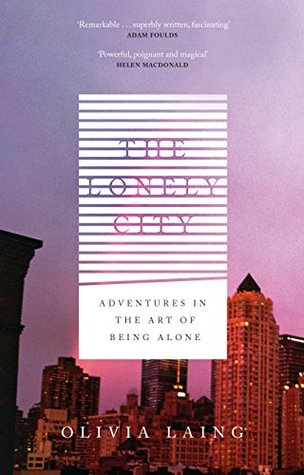 Whereas alcoholic writers were the points of reference for her previous book, the superb The Trip to Echo Spring (2013), here outsider artists take center stage: Edward Hopper, Andy Warhol, David Wojnarowicz, Henry Darger, and the many lost to AIDS in the 1980s to 1990s. It’s a testament to Laing’s skill at interweaving biography, art criticism and memoir when I say that I knew next to nothing about any of these artists to start with and have little fondness for modern art but still found her book completely absorbing.
Several of the artists shared underlying reasons for loneliness: an abusive childhood, mental illness and/or sexuality perceived as aberrant. Edward Hopper might seem the most ‘normal’ of the artists profiled, but even he was bullied when he shot up to 6 feet at age 12; his wife Jo, doing some amateur psychoanalyzing, named it the root of his notorious taciturnity. His Nighthawks, with its “noxious pallid green” shades, perfectly illustrates the inescapability of “urban alienation,” Laing writes: when she saw it in person at the Whitney, she realized the diner has no door. (It’s a shame the book couldn’t accommodate a centerfold of color plates, but each chapter opens with a black-and-white photograph of its main subject.)
Andy Warhol was born Andrej Warhola to Slovakian immigrants in Pittsburgh in 1928. He was often tongue-tied and anxious, and used fashion and technology as ways of displacing attention. In 1968 he was shot in the torso by Valerie Solanas, the paranoid, sometimes-homeless author of SCUM Manifesto, and ever after had to wear surgical corsets. For Warhol and Wojnarowicz, art and sex were possible routes out of loneliness. As homosexuals, though, they could be restricted to sordid cruising grounds such as cinemas and piers. Like Klaus Nomi, a gay German electro-pop singer whose music Laing listened to obsessively, Wojnarowicz died of AIDS. Nomi was one of the first celebrities to succumb, in 1983. The epidemic only increased the general stigma against gay people. Even Warhol, as a lifelong hypochondriac, was leery about contact with AIDS patients. Through protest marches and artworks, Wojnarowicz exposed the scale of the tragedy and the lack of government concern.
In some ways Henry Darger is the oddest of the outsiders Laing features. He is also the only one not based in New York: he worked as a Chicago hospital janitor for nearly six decades; it was only when he was moved into a nursing home and the landlord cleared out his room that an astonishing cache of art and writing was discovered. Darger’s oeuvre included a 15,000-page work of fiction set in “the Realms of the Unreal” and paintings that veer towards sadism and pedophilia. Laing spent a week reading his unpublished memoir. With his distinctive, not-quite-coherent style and his affection for the asylum where he lived as an orphaned child, he reminded me of Royal Robertson, the schizophrenic artist whose work inspired Sufjan Stevens’s The Age of Adz album, and the artist character in the movie Junebug (2005).
A few of the chapters are less focused because they split the time between several subjects. I also felt that a section on Josh Harris, Internet entrepreneur and early reality show streaming pioneer, pulled the spotlight away from outsider art. Although I can see, in theory, how his work is performance art reflecting on our lack of true connection in an age of social media and voyeurism, I still found this the least relevant part.

The American cover
The book is best when Laing is able to pull all her threads together: her own seclusion – flitting between housing situations, finding dates through Craigslist and feeling trapped behind her laptop screen; her subjects’ troubled isolation; and the science behind loneliness. Like Korey Floyd does in The Loneliness Cure, Laing summarizes the physical symptoms and psychological effects associated with solitude. She dips into pediatrician D.W. Winnicott’s work on attachment and separation in children, and mentions Harry Harlow’s abhorrent rhesus monkey experiments in which babies were raised without physical contact.
The tone throughout is academic but not inaccessible. Ultimately I didn’t like this quite as much as The Trip to Echo Spring, but it’s still a remarkable piece of work, fusing social history, commentary on modern art, biographical observation and self-knowledge. The first chapter and the last five paragraphs, especially, are simply excellent. Your interest may wax and wane through the rest of the book, but I expect that, like me, you’ll willingly follow Laing as a tour guide into the peculiar, lonely crowdedness you find in a world city.
(See also Laing’s list of 10 Books about Loneliness, chosen for Publishers Weekly.)
With thanks to Canongate for sending a free copy.
My rating: 
Better Late than Never: The Goldfinch
And the painting, above his head, was the still point where it all hinged: dreams and signs, past and future, luck and fate. There wasn’t a single meaning. There were many meanings. It was a riddle expanding out and out and out.
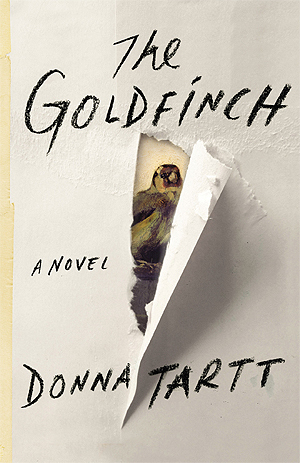 My pristine paperback copy of Donna Tartt’s The Goldfinch cost all of £1 at a used bookshop in Henley. Talk about entertainment value for money! Although it took me nearly a month to read, starting with Christmas week, it was more gripping than that timeframe seems to suggest. I read it under a pair of cats in the bitter-cold first week of a Pennsylvania January, then tucked it under my arm for airport queues (no way would it fit in my overstuffed carry-on bag) and finally finished it during my first week of bouncing back from transatlantic jetlag. Somehow Theo Decker’s fictional travels – from New York to Las Vegas and back; to Amsterdam and home again – blended with my sense of having been on a literal journey with the book to make this one of my most memorable reading experiences in years.
That’s not to say that the book was flawless. In fact, I found the first 200 pages or so pretty slow. You almost certainly know the basics of the plot already, but if not, glance away from the rest of this paragraph. Theo, 13, is separated from his mother during a terrorist attack on a New York City museum. Among the dying he encounters an older man – guardian of the pretty red-haired girl Theo had been checking out just moments before – who gives him a ring and tells him to go to Hobart and Blackwell antiques. But this is not the only souvenir Theo takes from his ordeal; he also steals the little Dutch masterpiece by Fabritius that appears on the book’s cover. Stumbling around the streets of New York, the shell-shocked Theo undoubtedly resembles a 9/11 victim. As the years pass, he is moved from guardian to guardian, but a few things remain constant: his memory of his mother, his obsession with the painting, and his love for Pippa, that red-haired girl who, like him, was among the survivors.
The aftermath of the attack was the most tedious section for me. It felt like it took forever for Theo’s future to be set in motion, and I thought if I heard him complain of how his head was killing him one more time I might just scream. It’s when Theo gets to Vegas, and specifically when he meets Boris, that the book really takes off. Boris is simply a terrific character. He’s lived all over and has a mixed-up accent that’s part Australian with heavy Slavic overtones. Like Theo, he has an unreliable father who is often too drunk to care what his kid is doing. This leaves the two young teens free to do whatever they want, usually something classified as illegal. Indeed, there’s a lot of drug use in this book, described in the kind of detail that makes you wonder what Tartt was up to during her years at Bennington.
As a young man Theo, back in New York, joins Hobie (of Hobart and Blackwell) in selling antiques both genuine and ersatz, and reconnects with an old friend’s family in a surprising manner. The story of what becomes of the painting was in danger of turning into a clichéd crime caper, yet Tartt manages to transform it into a richly philosophical interrogation of the nature of fate. Theo’s intimate first-person narration makes him the heir first of Dickensian orphans and later of the kind of tortured antiheroes you’d find in a nineteenth-century Russian novel: “I had the queasy sense of my own life … as a patternless and transient burst of energy, a fizz of biological static just as random as the street lamps flashing past.”
Similar to my experience with Of Human Bondage, I found that the latter part of the novel was the best. The last 200 pages are not only the most addictive plot-wise but also the most introspective; all my Post-It flags congregate here. It’s also full of the best examples of Tartt’s distinctive prose. The best way I can describe it is to say it’s like brush strokes: especially in the scenes set in Amsterdam, she’s creating a still life with words. Often this is through sentences listing images, in phrases separated by commas. Here’s a few examples:
Floodlit window. Mortuary glow from the cold case. Beyond the fog-condensed glass, trickling with water, winged sprays of orchids quivered in the fan’s draft: ghost-white, lunar, angelic.
Out on the street: holiday splendor and delirium. Reflections danced and shimmered on black water: laced arcades above the street, garlands of light on the canal boats.
Medieval city: crooked streets, lights draped on bridges and shining off rain-peppered canals, melting in the drizzle. Infinity of anonymous shops, twinkling window displays, lingerie and garter belts, kitchen utensils arrayed like surgical instruments, foreign words everywhere…
Such sentence construction shouldn’t work, yet it does. I’ve never been one to fawn over Donna Tartt, but this is writing I can really appreciate.
[I did take issue with some of the punctuation in the novel, though whether that’s down to Tartt, her editor or the UK publication team I couldn’t say. Take, for instance, this description of a station clerk: “a broad, fair, middle aged woman, pillowy at the bosom and impersonally genial like a procuress in a second rate genre painting.” Another solid allusion to Dutch art, but missing two hyphens if you ask me.]
The Goldfinch contains multitudes. It’s the Dickensian coming-of-age tale of a hero much like David Copperfield who’s “possessed of a heart that can’t be trusted.” It’s a realist record of criminal escapades. It’s a story of unrequited love. It’s a convincing first-hand picture of anxiety, addiction and regret. It has a great road trip, an endearing small dog, and a last line that rivals The Great Gatsby’s (I’ll leave you to experience it for yourself). It’s a meditation on time, fate and the purpose of art. It’s not perfect, and yet I – even as someone who pretty much never rereads books – can imagine reading this again in the future and gleaning more with hindsight. That makes it worthy of one of my rare 5-star recommendations.
Caring too much for objects can destroy you. Only—if you care for a thing enough, it takes on a life of its own, doesn’t it? And isn’t the whole point of things—beautiful things—that they connect you to some larger beauty? Those first images that crack your heart wide open and you spend the rest of your life chasing, or trying to recapture, in one way or another?
My rating: 
My Salinger Year and Hotel Alpha
My Salinger Year by Joanna Rakoff
“Publishing, books, life. … It seemed possible to get one right. But not all three.”
 I’ve hardly read any Salinger, but that’s okay – neither had Joanna Rakoff until about two-thirds of the way through her year working for the legendary recluse’s literary agency in New York City. One long weekend she gorged on his complete works and found – in a man she’d previously encountered only as a shouting elderly voice on the phone – a kindred spirit.
This was 1996, and Rakoff was 23 years old, living with a boyfriend who didn’t appreciate her in a crummy apartment and harboring secret literary ambitions. On the cusp of the digital world, the Agency still resisted computers. Rakoff did most of her work on a typewriter and read manuscripts from the slush pile, extracting a couple of promising ones and getting a colleague to read her boyfriend Don’s unpublishable novel in turn. She had heavy student loans after graduate studies in London, and could barely afford a daily deli salad for lunch.
Mostly Rakoff spent her time typing form letters to Salinger’s fans, informing correspondents that he had asked not to have his letters forwarded. Believing she might make a difference, she went off-piste and started writing personal replies to some of the more wrenching letters: war veterans, struggling students, and a quiet young man who didn’t know what to do with his emotions. Alas, it backfired: more often than not she’d get an angry response, with the writer objecting to her presuming to take the place of Salinger and dispense life advice.
It’s remarkable how, at a distance of nearly 20 years, Rakoff makes this all seem like it happened yesterday: she adds in just the right amount of what Mary Karr, in The Art of Memoir, calls “carnal detail” to make her story seem timely and believable. The tone is nostalgic but also bittersweet – while it was a precious year, Rakoff also realizes what she could have done better (chiefly, ditching Don sooner).
Especially for female readers, this will instantly take you back to your own immediate post-college days of trying to figure out what life is about and who you wanted to be. “Was it possible, too, that one could be complicated, intellectual, awake to the world, that one could be an artist, and also be rosy and filled with light? Was it possible that one could be all those things and also be happy?”
With thanks to Bloomsbury for my free copy, won in a Facebook giveaway.
My rating: 
Hotel Alpha by Mark Watson
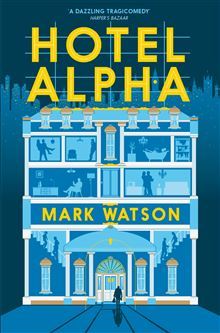 You may be unsurprised to learn there’s a touch of The Grand Budapest Hotel to this one. Hotel founder Howard York, though he sounds an awful lot like an Ayn Rand creation (i.e. Howard Roark, the architect-hero of The Fountainhead), is most like the Ralph Fiennes character. He uses his influence to finagle anything for a guest; “you could believe, sitting here in his castle, that he really did mean to live a couple of centuries and that everything he had built would still be standing around him.” But even he can’t stop tragedy; a fire at the hotel in the 1980s orphaned and blinded a small boy named Chas, who Howard then adopted.
The novel is told in alternating first-person chapters from Chas and Graham, the hotel concierge. Graham reminded me of Stevens in The Remains of the Day: very proper, even uptight, but with a hidden passion. Technology’s advance helps Chas immensely, but makes Graham feel superseded; “I have lived a great part of my own life in homage to my own past,” he acknowledges.
Key events take place between 2001 and 2005, with a historical backdrop including 9/11, the Olympic bid, and the 7/7 bombings. Chas works in PR and is involved with Kathleen, a journalist who’s opposed to the Iraq War. Howard, on the other hand, always supports the winning team and status quo. He is also a man of secrets. Why did Chas’s tutor, Ella, and Graham’s assistant, Agatha, both suddenly leave the hotel for America years ago? It all has to do with the legend of what happened the night of the fire, the truth of which will be exposed in time.
Watson is a stand-up comedian as well as the author of several novels. I like how he shows both the good and bad sides of technology here. My favorite part was Chas’s visit to China with Kathleen; even though he’s mostly stuck in a hotel, he still experiences extreme culture shock.
There are another 100 stories about the Hotel Alpha on the website, eight of which are printed as an appendix to the paperback edition. Much as I liked the main characters (especially Agatha), I didn’t think the two voices were distinctive enough – I wish Watson had incorporated more of the stories’ narrative variety (some first-person and some third-person) into the novel itself.
My rating: 
With thanks to Picador for my free copy, won in a newsletter giveaway.
 Bookish Beck = Rebecca Foster. American transplant to England. Freelance proofreader and book reviewer.
 Bookish Beck