R.I.P. Reads, Part I: Magrs Buddy Read; Hynes, Johnson, Oates
This is my third year participating in R.I.P. (Readers Imbibing Peril), now in its 15th year. I read my first novel by Paul Magrs as a buddy read with Liz of Adventures in reading, running and working from home, and coincidentally had Daisy Johnson’s creepy second novel out from the library. Rounding out this first post are a novella by James Hynes and a short story by Joyce Carol Oates, by whom I still haven’t managed to read a whole book. For my planned Part II, I’m working on historical suspense novels by Michelle Paver (a constant on my R.I.P. lists, it seems) and Laura Purcell, and trying my first Henning Mankell.

666 Charing Cross Road by Paul Magrs (2011)
 Apart from Dracula, my only previous experience of vampire novels was Deborah Harkness’s books. My first book from Paul Magrs ended up being a great choice because it’s pretty lighthearted and as much about the love of books as it is about supernatural fantasy – think of a cross between Jasper Fforde and Neil Gaiman. The title is a tongue-in-cheek nod to Helene Hanff’s memoir, 84 Charing Cross Road. Like Hanff, Aunt Liza sends letters and money to a London bookstore in exchange for books that suit her tastes. A publisher’s reader in New York City, Liza has to read new stuff for work but not-so-secretly prefers old books, especially about the paranormal – a love she shares with her gay bookseller friend, Jack.
One day the bookstore (actual address: 66b) sends a gruesome treasure, a grimoire soaked in vampire blood. In the wrong hands, it returns the vampiric spirit to life and sets off a chain reaction as each victim bites and infects others. I couldn’t help but think of the pandemic; indeed, Magrs uses the word “disease” at one point. Vampirism always has erotic overtones, though, making it seem more like an STD. As it happens, the vampires’ New York leader is Liza’s niece Shelley’s boyfriend, Daniel. Meanwhile, the star exhibit at the Museum of Outsider Art where Shelley works, a Scottish Bride effigy nicknamed Bessie, has come to life. Bessie leads Liza and Jack to London in the fight against Daniel and his kind.
Set between Halloween and Christmas, this is a pacy and quick-witted story that is easy to follow even as it gets more complicated and adds in ever more secondary characters. Hints about Liza’s past experience of the supernatural and an open ending leave room for a prequel or sequel. There were a few melodramatic moments and I wasn’t always convinced by Liza’s New Yawk accent. (I also wanted to stick up for Liza and another character about her age, Consuela – Magrs often refers to one or both as “the old woman,” when in the context they can’t be far past 60!) But these are minor niggles about a book that was so much fun to read. I’ll try something else by Magrs, probably Exchange and/or one of the Brenda and Effie series – who could resist that premise of the Bride of Frankenstein running a B&B in Whitby? (See also Liz’s review.)
My rating: 
The rest…
Queen of the Jungle (from Publish and Perish: Three Tales of Tenure and Terror) by James Hynes (1997)
 I read the first of this volume’s three suspense novellas and will save the others for future years of R.I.P. or Novellas in November. At 95 pages, it feels like a complete, stand-alone plot with solid character development and a believable arc. Paul and Elizabeth are academics marooned at different colleges: Paul is finishing up his postdoc and teaches menial classes at an English department in Iowa, where they live; Elizabeth commutes long-distance to spend four days a week in Chicago, where she’s on track for early tenure at the university.
The couple’s cat, Charlotte, starts acting up, peeing in random places around the apartment. The animal psychic they hire says it’s because a woman keeps coming and going, disturbing the cat’s routines. Elizabeth assumes it’s her fault, feels terrible, and redoubles her efforts to get her boss to offer Paul a job on the basis of his bizarre literary/pop culture mash-up thesis chapters. But readers soon learn the real reason for the cat’s unease: Paul is carrying on an affair with Kymberly, a graduate student from the communications department. Charlotte is preternaturally determined to terrorize Kym and broadcast Paul’s secret. It’s an amusing battle of wills that comes to have greater stakes. Mentions of computer and telephone technology made this seem slightly dated, but I liked Hynes’s writing.
My rating:
Sisters by Daisy Johnson (2020)
 Teenagers September and July were born just 10 months apart, with July always in thrall to her older sister. September can pressure her into anything, no matter how risky or painful, in games of “September Says.” But one time things went too far. That was the day they went out to the tennis courts to confront the girls at their Oxford school who had bullied July.
For much of this short novel, Johnson keeps readers guessing about what happened that day and why the girls’ mother, Sheela, took them away to Settle House, her late husband’s family home in the North York Moors. Despite the new setting, July finds it impossible to shrug off her sister’s influence. Their psychic connection is such that she feels she’s losing her own virginity as she watches September have sex with a local boy on the beach. September’s is so much the dominant personality that July admits she feels like no more than “an appendage.”
Emotionally used and physically harmed, July starts to doubt her sanity. This was most evident for me in the scene where she goes up to a soggy-looking wall of Settle House and puts a hand through it, hearing “the rustle and gurgle of motion, the shuttering of thousands of wings.” (Presuming that’s a deliberate word choice and not a typo for shuddering.) Ants start pouring out of the wall, followed by a bird. But when she goes back to look at the wall later that day, it’s intact. I was reminded of The Haunting of Hill House, with its picture of a malevolent house preying on its inhabitants’ fears.

Sisters is a book that depends entirely on its late twist, so I shall say no more. About halfway through, I had a vague idea of what the surprise might be, but convinced myself I was wrong. “What if? … Nah, couldn’t be.” I wonder how early you’ll catch on. I adore the U.S. cover, but the UK cover contains more of a hint. I think I liked Everything Under, Johnson’s Booker-shortlisted debut novel, that little bit more, but my bottom line for that one goes for this, too: “As mesmerizing as it is unsettling.” Johnson is such a talented young author, and she also has the best author photo out there at the moment, a black-and-white image of her reflected in a train window.
My rating: 
“The Woman in the Window” (from Night-Gaunts and Other Tales of Suspense) by Joyce Carol Oates (2018)
 Oates was inspired by Edward Hopper’s 1926 painting, Eleven A.M. (The striking cover image is from a photographic recreation by Richard Tuschman. Very faithful except for the fact that Hopper’s armchair was blue.) A secretary pushing 40 waits in the New York City morning light for her married lover to arrive. She’s tired of him using her and keeps a sharp pair of sewing shears under her seat cushion. We bounce between the two characters’ perspectives as their encounter nears. He’s tempted to strangle her. Will today be that day, or will she have the courage to plunge those shears into his neck before he gets a chance? In this room, it’s always 11 a.m. The tension is well maintained, but the punctuation kind of drove me crazy. I might try the rest of the book next year.
Have you been reading anything fantastical or spooky this October?
Summery Reads, Part II: Sun and Summer Settings
Typically for the late August bank holiday, it’s turned chilly and windy here, with a fair bit of rain around. The past two weeks have felt more like autumn, but I’ve still been seeing out the season with a few summery reads.
What makes for good summer reading? I love reading with the seasons, picking up a book set during a heat wave just as the temperature is at a peak, but of course there can also be something delicious about escaping by reading about Arctic cold. Marcie of Buried in Print wrote here that she likes her summer books to offer just the right combination of the predictable and the unexpected, and that probably explains why I’m more likely to dip into genre fiction in the summer than at any other time of year. To her criteria I would also add addictiveness and a strong sense of place so as to be transporting – especially important this year when so many of us haven’t been able to have the vacations we might have planned on.
My best two summer binge reads this year were Rodham and Americanah; my two summery classics, though more subtle, were also perfect. Mostly Dead Things by Kristen Arnett, which I’m reading for a Shiny New Books review, has also felt apt for its swampy Florida setting. More recently, I picked up a couple of books with “sun” in the title, plus two novels set entirely in the course of one summer. Two of my selections are also towards my project of reading all of the Women’s Prize winners by November so I can vote on my all-time favorite.
Here comes the sun…
Half of a Yellow Sun by Chimamanda Ngozi Adichie (2006)
 Adichie filters an epic account of Nigeria’s civil war through the experience of twin sisters, Olanna and Kainene, and those closest to them. The wealthy chief’s daughters from Lagos drift apart: Olanna goes to live with Odenigbo, a math professor; Kainene is a canny businesswoman with a white lover, Richard Churchill, who is fascinated by Igbo art and plans to write a book about his experiences in Africa. Gradually, though, he realizes that the story of Biafra is not his to tell.
The novel alternates between the close third-person perspectives of Olanna, Richard and Ugwu, Odenigbo’s houseboy, and moves between the early 1960s and the late 1960s. These shifts underscore stark contrasts between village life and sophisticated cocktail parties, blithe prewar days and witnessed atrocities and starvation. Kainene runs a refugee camp, while Ugwu is conscripted into the Biafran army. Violent scenes come as if out of nowhere, as suddenly as they would have upturned real lives. A jump back in time reveals an act of betrayal by Odenigbo, and apparently simple characters like Ugwu are shown to have hidden depths.
In the endmatter of my paperback reissue, Adichie writes, “If fiction is indeed the soul of history, then I was equally committed to the fiction and the history, equally keen to be true to the spirit of the time as well as to my artistic vision of it.” Copious research must have gone into a book about events that occurred before her birth (both of her grandfathers died in the conflict), but its traces are light; this is primarily about storytelling and conveying emotional realities rather than ensuring readers grasp every detail of the Biafran War. This was my second attempt to read the novel, and while again I did not find it immediately engaging, by one-quarter through it had me gripped. I’m a firm Adichie fan now, and look forward to reading her other three new-to-me books sooner rather than later.
Orange Prize (now Women’s Prize) for Fiction winner, 2007
Source: Birthday gift from my wish list some years back
My rating:
The Shadow of the Sun: My African Life by Ryszard Kapuściński (1998)
[Translated from the Polish by Klara Glowczewska in 2001]
 Kapuściński was a foreign correspondent in Africa for 40 years and lent his name to an international prize for literary reportage. This book of essays spans several decades and lots of countries, yet feels like a cohesive narrative. The author sees many places right on the cusp of independence or in the midst of coup d’états – including Nigeria, a nice tie-in to the Adichie. Living among the people rather than removed in some white enclave, he develops a voice that is surprisingly undated and non-colonialist. While his presence as the observer is undeniable – especially when he falls ill with malaria and then tuberculosis – he lets the situation on the ground take precedence over the memoir aspect. I’m only halfway through, but I fully expect this to stand out as one of the best travel books I’ve ever read.
Evocative opening lines:
“More than anything, one is struck by the light. Light everywhere. Brightness everywhere. Everywhere, the sun.”
Source: Free bookshop
It happened one summer…
A Crime in the Neighborhood by Suzanne Berne (1997)
 Berne, something of a one-hit wonder, is not among the more respected Women’s Prize alumni – look at the writers she was up against in the shortlist and you have to marvel that she was considered worthier than Barbara Kingsolver (The Poisonwood Bible) and Toni Morrison (Paradise). However, I enjoyed this punchy tale. Marsha remembers the summer of 1972, when her father left her mother for Aunt Ada and news came of a young boy’s sexual assault and murder in the woods behind a mall. “If you hadn’t known what had happened in our neighborhood, the street would have looked like any other suburban street in America.”
Laid up with a broken ankle from falling out of a tree, 10-year-old Marsha stays out of the way of her snide older twin siblings and keeps a close eye on the street’s comings and goings. Like Harriet the Spy or Jimmy Stewart’s convalescent character in Rear Window, she vows to note anything relevant in her Book of Evidence to pass on to the police. Early on, her suspicion lands on Mr. Green, the bachelor who lives next door. Feeling abandoned by her father and underappreciated by the rest of her family, Marsha embellishes the facts to craft a more exciting story, not knowing or caring that she could ruin another person’s life.
The novel is set in Montgomery County, Maryland, where I grew up, and the descriptions of brutally humid days fit with my memory of the endless summer days of a childhood in the Washington, D.C. area. Although I usually avoid child narrators, I’ve always admired novels that can point to the dramatic irony between what a child experiences at the time and what a person can only understand about their situation when looking back. Stylish and rewarding.
Orange Prize (now Women’s Prize) for Fiction winner, 1999
Source: Free bookshop
My rating:
Modern Lovers by Emma Straub (2016)
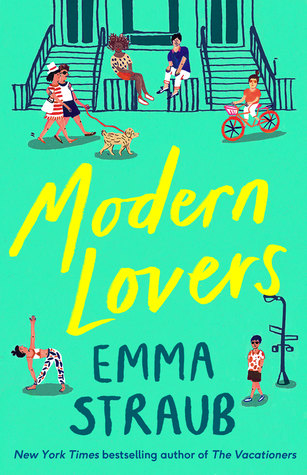 Just as the Berne is a coming-of-age story masquerading as a mystery, from the title and cover this looked like it would be chick lit, but – though it has an overall breezy tone – it’s actually pretty chewy New York City literary fiction that should please fans of The Nest and/or readers of Jennifer Egan and Ann Patchett.
Elizabeth Marx and Zoe Kahn-Bennett have been best friends ever since starting the student band Kitty’s Mustache at Oberlin. Now in their forties with a teenager each, they live half a block apart in Brooklyn. Zoe and her wife Jane run a neighborhood restaurant, Hyacinth; their daughter Ruby is dragging her feet about college and studying to retake the SAT over the summer. Elizabeth, a successful real estate agent, still keeps the musical flame alive; her husband Andrew, her college sweetheart from the band, is between jobs, not that his parents’ money isn’t enough to keep him afloat forever; their son, Harry, is in puppy love with Ruby.
Several things turn this one ordinary-seeming summer on its head. First, a biopic is being made about the Kitty’s Mustache singer turned solo star turned 27 Club member, Lydia, and the filmmaker needs the rest of the band on board – and especially for Elizabeth to okay their use of the hit song she wrote that launched Lydia’s brief career. Second, Andrew gets caught up in a new cult-like yoga studio run by a charismatic former actor. Third, the Kahn-Bennetts have marital and professional difficulties. Fourth, Harry and Ruby start sleeping together.
Short chapters flip between all the major characters’ perspectives, with Straub showing that she completely gets each one of them. The novel is about reassessing as one approaches adulthood or midlife, about reviving old dreams and shoring up flagging relationships. It’s nippy and funny and smart and sexy. I found so many lines that rang true:
Elizabeth was happy in her marriage, she really was. It was just that sometimes she thought about all the experiences she’d never gotten to have, and all the nights she’d listened to the sound of her husband’s snores, and wanted to jump out a window and go home with the first person who talked to her. Choices were easy to make until you realized how long life could be.
Andrew was always surprised by people’s ages now. When he was a teenager, anyone over the age of twenty looked like a grown-up, with boring clothes and a blurry face, only slightly more invisible than Charlie Brown’s teacher, but life had changed. Now everyone looked equally young, as if they could be twenty or thirty or even flirting with forty, and he couldn’t tell the difference. Maybe it was just that he was now staring in the opposite direction.
“I mean, it’s never too late to decide to do something else. Becoming an adult doesn’t mean that you suddenly have all the answers.”
I’ll definitely read more by Straub. I’d especially recommend picking this up if you enjoyed Writers & Lovers.
Source: Free bookshop
My rating:
What was your best summery read this year?
20 Books of Summer, #15–16: Andrew Beahrs and Elizabeth Graver
Today I have a biography-cum-cultural history of America’s wild foods and a novel about beekeeping and mental illness.
Twain’s Feast: Searching for America’s Lost Foods in the Footsteps of Samuel Clemens by Andrew Beahrs (2010)
 (20 Books of Summer, #15) In 1879, Mark Twain, partway through the Grand Tour immortalized in A Tramp Abroad, was sick of bland, poor-quality European food and hankering for down-home American cooking. He drew up a list of 80 foodstuffs he couldn’t wait to get back to: everything from soft-shell crabs to proper ice water. “The menu shouts of a joyous abundance,” Beahrs writes. “It testifies to a deep bond in Twain’s mind between eating and tasting and celebrating … rooted food that would live forever in his memory.”
Beahrs goes in search of some of those trademark dishes and explores their changes in production over the last 150 years. In some cases, the creatures and their habitats are so endangered that we don’t eat them anymore, like Illinois’ prairie chickens and Maryland’s terrapins, but he has experts show him where remnant populations live. In San Francisco Bay, he helps construct an artificial oyster reef. He meets cranberry farmers in Massachusetts and maple tree tappers in Vermont. At the Louisiana Foodservice EXPO he gorges on “fried oysters and fried shrimp and fries. I haven’t had much green, but I’ve had pecan waffles with bacon, and I’ve inserted beignets and café au lait between meals with the regularity of an Old Testament prophet chanting ‘begat.’”
But my favorite chapter was about attending a Coon Supper in Arkansas, a local tradition that has been in existence since the 1930s. Raccoons are hunted, butchered, steamed in enormous kettles, and smoked before the annual fundraising meal attended by 1000 people. Raccoon meat is greasy and its flavor sounds like an acquired taste: “a smell like nothing I’ve smelled before but which I’ll now recognize until I die (not, I hope, as a result of eating raccoon).” Beahrs has an entertaining style and inserts interesting snippets from Twain’s life story, as well as recipes from 19th-century cookbooks. There are lots of books out there about the country’s increasingly rare wild foods, but the Twain connection is novel, if niche.
Source: A remainder book from Wonder Book (Frederick, Maryland)
My rating: 
The Honey Thief by Elizabeth Graver (1999)
 (20 Books of Summer, #16) Ever since I read The End of the Point (which featured in one of my Six Degrees posts), I’ve meant to try more by Graver. This was her second novel, a mother-and-daughter story that unearths the effects of mental illness on a family. Eleven-year-old Eva has developed a bad habit of shoplifting, so her mother Miriam moves them out from New York City to an upstate farmhouse for the summer. But in no time Eva, slipping away from her elderly babysitter’s supervision and riding her bike into the countryside, is stealing jars of honey from a roadside stand. She keeps going back and strikes up a friendship with the middle-aged beekeeper, Burl, whom she seems to see as a replacement for her father, Francis, who died of a heart attack when she was six.
Alternating chapters look back at how Miriam met Francis and how she gradually became aware of his bipolar disorder. This strand seems to be used to prop up Miriam’s worries about Eva (since bipolar has a genetic element); while it feels true to the experience of mental illness, it’s fairly depressing. Meanwhile, Burl doesn’t become much of a presence in his own right, so he and the beekeeping feel incidental, maybe only included because Graver kept/keeps bees herself. Although Eva is an appealingly plucky character, I’d recommend any number of bee-themed novels, such as The Secret Life of Bees by Sue Monk Kidd, The History of Bees by Maja Lunde, and even Generation A by Douglas Coupland, over this one.
Source: Secondhand copy from Beltie Books, Wigtown
My rating: 
20 Books of Summer, #13–14: Ruth Reichl and Alice Steinbach
Just three weeks remain in this challenge. I’m reading another four books towards it, and have two more to pick up during our mini-break to Devon and Dorset this coming weekend. A few of my choices are long and/or slow-moving reads, though, so I have a feeling I’ll be reading right down to the wire…
Today I have another two memoirs linked by France and its cuisine.
Tender at the Bone: Growing Up at the Table by Ruth Reichl (1998)
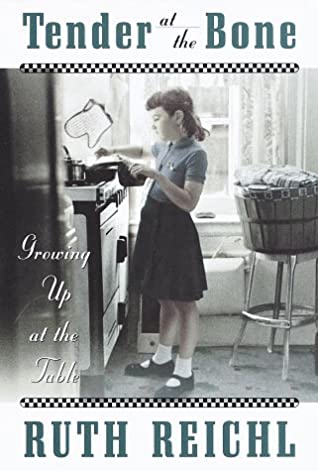 (20 Books of Summer, #13) I’ve read Reichl’s memoirs out of order, starting with Garlic and Sapphires (2005), about her time as a New York Times food critic, and moving on to Comfort Me with Apples (2001), about her involvement in California foodie culture in the 1970s–80s. Whether because I’d been primed by the disclaimer in the author’s note (“I have occasionally embroidered. I learned early that the most important thing in life is a good story”) or not, I sensed that certain characters and scenes were exaggerated here. Although I didn’t enjoy her memoir of her first 30 years as much as either of the other two I’d read, it was still worth reading.
The cover image is a genuine photograph taken by Reichl’s German immigrant father, book designer Ernst Reichl, in 1955. Early on, Reichl had to fend for herself in the kitchen: her bipolar mother hoarded discount food even it was moldy, so the family quickly learned to avoid her dishes made with ingredients that were well past their best. Like Eric Asimov and Anthony Bourdain, whose memoirs I’ve also reviewed this summer, Reichl got turned on to food by a top-notch meal in France. Food was a form of self-expression as well as an emotional crutch in many situations to come: during boarding school in Montreal, her rebellious high school years, and while living off of trendy grains and Dumpster finds at a co-op in Berkeley.
Reichl worked with food in many ways during her twenties. She was a waitress during college in Michigan, and a restaurant collective co-owner in California; she gave cooking lessons; she catered parties; and she finally embarked on a career as a restaurant critic. Her travels took her to France (summer camp counselor; later, wine aficionado), Morocco (with her college roommate), and Crete (a honeymoon visit to her favorite professor). Raised in New York City, she makes her way back there frequently, too. Overall, the book felt a bit scattered to me, with few if any recipes that I would choose to make, and the relationship with a mentally ill mother was so fraught that I will probably avoid Reichl’s two later books focusing on her mother.
Source: Awesomebooks.com
My rating:
Educating Alice: Adventures of a Curious Woman by Alice Steinbach (2004)
 (20 Books of Summer, #14) Steinbach makes a repeat appearance in my summer reading docket: her 2000 travel book Without Reservations was one of my 2018 selections. In that book, she took a sabbatical during her 50s to explore Paris, England, and Italy. Here she continues her efforts at lifelong learning by taking up some sort of lessons everywhere she goes. The long first section sees her back in Paris, enrolling at the Hotel Ritz’s Escoffier École de Gastronomie Française. She’s self-conscious about having joined late, being older than the other students and having to rely on the translator rather than the chef’s instructions, but she’s determined to keep up as the class makes omelettes, roast quail and desserts.
Full disclosure: I’ve only read the first chapter for now as it’s the only one directly relevant to food – in others she takes dance lessons in Japan, studies art in Cuba, trains Border collies in Scotland, etc. – but I was enjoying it and will go back to it before the end of the year.
Source: Free bookshop
Summery Reads of 2020, Part I
Reading with the seasons, I’ve picked up a few books with “summer” or sunshine in their titles. I’ll have more to write up later in August, including novels set during the summer months.
A Summer Bird-Cage by Margaret Drabble (1963)
 Sarah Bennett, who went straight from university in Oxford to Paris for want of a better idea of what to do with her life, is called home to Warwickshire to be a bridesmaid in the wedding of her older sister, Louise, to Stephen Halifax, a wealthy novelist. Afterwards, Sarah decides to move to London and share a flat with a friend whose marriage has recently ended. As the months pass, she figures out life as a single girl in a big city and attends parties hosted by Louise – back from an extended European honeymoon – and others. Sarah eventually works out, from gossip and from confronting Louise herself, that her sister’s marriage isn’t as idyllic as it appeared. Both sisters find themselves at a loss as for what to do next.
Although Drabble’s debut novel is low on action, its characters are sharply drawn and she delights in placing them in situations and conversations where their true values will emerge. I could relate to Sarah for her bookishness, her observant nature, and her feeling that her best days of being a student are behind her. Drabble was only 24 when this was published; though she was already married and a mother, her distinguished university career (a double first from Cambridge) wasn’t long behind her. Given that Drabble’s sister is novelist A.S. Byatt, it’s impossible not to speculate about the autobiographical inspiration for this picture of sisters who are subconscious rivals and don’t even seem to enjoy spending casual time together.
What with the sisters sharing the maiden name Bennett, you also can’t help but think of one of the classic sister novels, Pride and Prejudice. Drabble makes her debt obvious when Sarah goes over to Louise’s for dinner and comments on the “charming convention of the scene – sisters idling away an odd evening in happy companionship. It was like something out of Middlemarch or even Jane Austen.” I was also reminded of the sister pair in Deerbrook: one got all the beauty, but the other seems much more interesting.
The title comes from a John Webster quotation: “’Tis just like a summer bird-cage in a garden: / the birds that are without are desperate to get / in, and the birds that are within despair and / are in a consumption for fear that they will never / get out.” In other words, it’s easy to miss, and idealize, what you don’t have. Sarah still thinks she can have it all; Louise has realized the choices life forces on you. In modern parlance, this is about adulting and FOMO. It still feels relevant, in a way that seems to anticipate the work of Sally Rooney.
My rating: 
Rise and Shine by Anna Quindlen (2006)
 Another sisters novel, and the first book in my Journey through the Day with Books challenge. Meghan Fitzmaurice is a household name as the host of America’s most popular morning talk show, Rise and Shine, but her star fades rapidly when, her microphone still on after she thinks they’ve gone to a commercial break, she murmurs “f***ing a**hole” about a guest who is, admittedly, a creep. It turns out her outburst didn’t come out of nowhere: the night before, her husband, Evan, had announced he was leaving her. Meghan goes to Jamaica to regroup, leaving her younger sister, Bridget, a social worker in the Bronx, to figure out what happened and create a semblance of normalcy for her beloved nephew, Meghan’s college-age son Leo, who’s just back from an exchange program at a farm outside Barcelona.
I liked the New York City setting and the central sister relationship – “Sisters tend to get stuck in their roles and they don’t always know how to get out of them. The pretty one. The practical one,” their aunt Maureen, who raised them after their parents’ deaths, says – but the plot hereafter veers between thin and melodramatic. I didn’t warm to Bridget’s boyfriend Irving, a hardboiled older cop, and I get a little nervous about white ladies creating stereotypical African American characters and giving them names like Tequila (Bridget’s receptionist at the women’s shelter) and Princess Margaret (Tequila’s daughter).

In a nice bit of symmetry, though, the book’s end finds a subdued Meghan hosting a late-night show called Day’s End. I didn’t like this nearly as much as her nonfiction (I loved Lots of Candles, Plenty of Cake), but I would read more by Quindlen: I also have a copy of One True Thing, and I have heard that her recent fiction is good.
My rating: 
And a skim from the library that ties in nicely with the cover image above:
The Butterfly Isles: A Summer in Search of Our Emperors and Admirals by Patrick Barkham (2010)
 In 2009, Barkham set out to revive the childhood butterfly-watching hobby he’d shared with his father. The UK is home to 59 species, a manageable number to attempt to see in a season, although it does require a fair bit of travel and insider knowledge. I’ve read too much general history about the human relationship with butterflies (via Rainbow Dust by Peter Marren, which came out a few years later, and An Obsession with Butterflies by Sharman Apt Russell, which Barkham mentions in a Recommended Reading section at the end of the book) to engage with all the context he includes; I focused on the nitty-gritty of the quest running from mid-March to August. I’ll leave it to readers to discover whether he succeeds or not. Nice additions here are the color plates of all the species in question, and the line drawings by Helen Macdonald, yet to come to prominence in her own right – with H Is for Hawk in 2014.
A favorite passage: “Butterflies are symbols of freedom and happiness, sunshine and summer days. They are tokens of romance”
My rating:
Have you been reading anything particularly fitting for summer this year?
20 Books of Summer, #9–11: Asimov, St. Aubyn, Weiss
My summer reading has been picking up and I have a firm plan – I think – for the rest of the foodie books that will make up my final 20. I’m reading two more at the moment: a classic with an incidental food-themed title and a work of American history via foodstuffs. Today I have a defense of drinking wine for pleasure; a novel about inheritance and selfhood, especially for mothers; and a terrific foodoir set in Berlin, New York City and rural Italy.
How to Love Wine: A Memoir and Manifesto by Eric Asimov (2012)
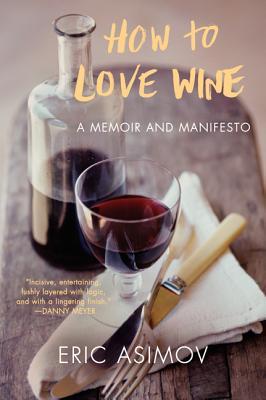 (20 Books of Summer, #9) Asimov may be the chief wine critic for the New York Times, but he’s keen to emphasize that he’s no wine snob. After decades of drinking it, he knows what he appreciates and prefers small-batch to mass market wine, but he’d rather that people find what they enjoy rather than chase after the expensive bottles they feel they should like. He finds tasting notes and scores meaningless and is more interested in getting people into wine simply for the love of it – not as a status symbol or a way of showing off arcane knowledge.
Like Anthony Bourdain (see my review of Kitchen Confidential), Asimov was drawn into foodie culture by one memorable meal in France. He’d had a childhood sweet tooth and was a teen beer drinker, but when he got to grad school in Austin, Texas an $8 bottle of wine from a local Whole Foods was an additional awakening. Following in his father’s footsteps in journalism and moving from Texas to Chicago back home to New York City for newspaper editing jobs, he had occasional epiphanies when he bought a nice bottle of wine for his parents’ anniversary and took a single wine appreciation course. But his route into writing about wine was sideways, through a long-running NYT column about local restaurants.
I might have liked a bit more of the ‘memoir’ than the ‘manifesto’ of the subtitle: Asimov makes the same argument about accessibility over and over, yet even his approachable wine attitude was a little over my head. I can’t see myself going to a tasting of 20–25 wines at a time, or ordering a case of 12 wines to sample at home. Not only can I not tell Burgundy from Bordeaux (his favorites), I can’t remember if I’ve ever tried them. I’m more of a Sauvignon Blanc or Chianti gal. Maybe the Wine for Dummies volume I recently picked up from a Little Free Library is more my speed.
Source: Free from a neighbor
My rating:
Mother’s Milk by Edward St Aubyn (2006)
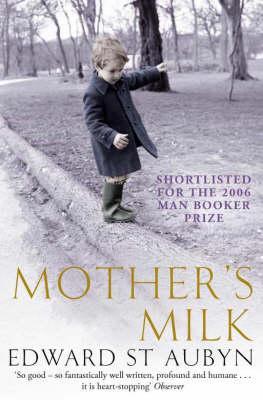 (20 Books of Summer, #10; A buddy read with Annabel, who has also reviewed the first three books here and here as part of her 20 Books of Summer.) I’ve had mixed luck with the Patrick Melrose books thus far: Book 1, Never Mind, about Patrick’s upbringing among the badly-behaving rich in France and his sexual abuse by his father, was too acerbic for me, and I didn’t make it through Book 3, Some Hope. But Book 2, Bad News, in which Patrick has become a drug addict and learns of his father’s death, hit the sweet spot for black comedy.
Mother’s Milk showcases two of St. Aubyn’s great skills: switching effortlessly between third-person perspectives, and revealing the psychology of his characters. It opens with a section from the POV of Patrick’s five-year-old son, Robert, a perfect link back to the child’s-eye view of Book 1 and a very funny introduction to this next generation of precocious mimics. The perspective is shared between Robert, Patrick, his wife Mary, and their younger son Thomas across four long chapters set in the Augusts of 2000–2003.
Patrick isn’t addicted to heroin anymore, but he still relies on alcohol and prescription drugs, struggles with insomnia and is having an affair. Even if he isn’t abusive or neglectful like his own parents, he worries he’ll still be a destructive influence on his sons. Family inheritance – literal and figurative – is a major theme, with Patrick disgruntled with his very ill mother, Eleanor, for being conned into leaving the home in France to a New Age organization as a retreat center. “What I really loathe is the poison dripping from generation to generation,” Patrick says – “the family’s tropical atmosphere of unresolved dependency.” He mentally contrasts Eleanor and Mary, the former so poor a mother and the latter so devoted to her maternal role that he feels there’s no love left for himself from either.
I felt a bit trapped during unpleasant sections about Patrick’s lust, but admired the later focus on the two mothers and their loss of sense of self, Eleanor because of her dementia and Mary because she has been subsumed in caring for Thomas. I didn’t quite see how all the elements were meant to fit together, particularly the disillusioning trip to New York City, but the sharp writing and observations were enough to keep me going through this Booker-shortlisted novella. I’ll have to get Book 5 out from the library to see how St. Aubyn tied everything up.
Source: Free bookshop
My rating:
My Berlin Kitchen: Adventures in Love and Life by Luisa Weiss (2012)
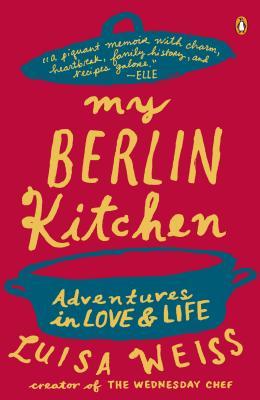 (20 Books of Summer, #11) Blog-to-book adaptations can be hit or miss; luckily, this one joins Julie Powell’s Julie and Julia and Molly Wizenberg’s A Homemade Life in the winners column. Raised in Berlin and Boston by her American father and Italian mother, Weiss felt split between her several cultures and languages. While she was working as a cookbook editor in New York City, she started a blog, The Wednesday Chef, as a way of working through the zillions of recipes she’d clipped from here and there, and of reconnecting with her European heritage: “when I came down with a rare and chronic illness known as perpetual homesickness, I knew the kitchen would be my remedy.”
After a bad breakup (for which she prescribes fresh Greek salad, ideally eaten outside), she returned to Berlin and unexpectedly found herself back in a relationship with Max, whom she’d met in Paris nearly a decade ago but drifted away from. She realized they were meant to be together when he agreed that potato salad should be dressed with oil and vinegar rather than mayonnaise. After a tough year for Weiss as she readjusts to Berlin’s bitter winters and lack of bitter greens, the book ends with the lovely scene of their rustic Italian wedding.
Weiss writes with warmth and candor and gets the food–life balance just right. I found a lot to relate to here (“I couldn’t ever allow myself to think about how annoying airports were, how expensive it was to go back and forth between Europe and the United States … I had to get on an airplane to see the people I love”) and – a crucial criterion for a foodie book – could actually imagine making most of these recipes, everything from plum preserves and a Swiss chard and Gruyère bake to a towering gooseberry meringue cream cake.
Other readalikes: From Scratch: A Memoir of Love, Sicily, and Finding Home by Tembi Locke, My Salinger Year by Joanna Rakoff, and Only in Naples: Lessons in Food and Famiglia from My Italian Mother-in-Law by Katherine Wilson
Source: A birthday gift from my wish list last year
My rating:
20 Books of Summer: Bourdain, Ozeki and More
Over halfway through the summer and my numbers are looking poor. It’s not that I’m not reading a ton – in general, I am – it’s just that I’m having trouble finishing any foodie books. I’m in the middle of two food-related memoirs plus Cakes and Ale by W. Somerset Maugham, and have recently started buddy-reading Mother’s Milk by Edward St Aubyn with Annabel, so more reviews will be along eventually, but I predict August will be a scramble.
Today I review an in-your-face tell-all about the life of a chef, and a novel set between Japan and the United States that exposes the seamy side of meat production. A lite road trip and an iffy California classic follow as bonuses.
Kitchen Confidential: Adventures in the Culinary Underbelly by Anthony Bourdain (2000)
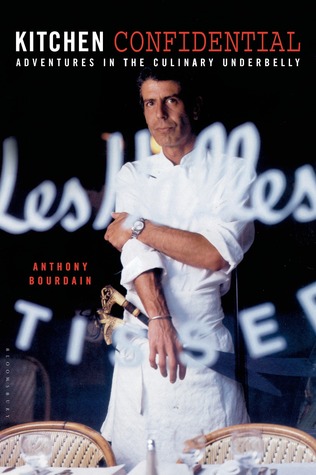 (20 Books of Summer, #5) “Get that dried crap away from my bird!” That random line about herbs is one my husband and I remember from a Bourdain TV program and occasionally quote to each other. It’s a mild curse compared to the standard fare in this flashy memoir about what really goes on in restaurant kitchens. His is a macho, vulgar world of sex and drugs. In the “wilderness years” before he opened his Les Halles restaurant, Bourdain worked in kitchens in Baltimore and New York City and was addicted to heroin and cocaine. Although he eventually cleaned up his act, he would always rely on cigarettes and alcohol to get through ridiculously long days on his feet.
From “Appetizer” to “Coffee and a Cigarette,” the book is organized like a luxury meal. Bourdain charts his development as a chef, starting with a childhood summer in France during which he ate vichyssoise and oysters for the first time and learned that food “could be important … an event” and describing his first cooking job in Provincetown and his time at the Culinary Institute of America. He also discusses restaurant practices and hierarchy, and home cook cheats and essentials. (I learned that you should never order fish in a restaurant on a Monday – it’ll be left over from Thursday’s order.) The pen portraits of his crazy sous-chef and baker are particularly amusing; other subjects include a three-star chef he envies and the dedicated Latino immigrants who are the mainstay of his kitchen staff.
My dad is not a reader but he is a foodie, and he has read Bourdain’s nonfiction (and watched all his shows), so I felt like I was continuing a family tradition in reading this. I loved my first taste of Bourdain’s writing: he’s brash, passionate, and hilariously scornful of celebrity chefs and vegetarianism (“the enemy of everything good and decent in the human spirit, an affront to all I stand for, the pure enjoyment of food”). Being in charge of a restaurant sounds manic, yet you can see why some would find it addictive. How ironic, though, to find a whole seven references to suicide in this book. Sometimes he’s joking; sometimes he’s talking about chefs he’s heard about who couldn’t take the pressure. Eighteen years after this came out, he, too, would kill himself.
(See also this article about rereading Bourdain in the 20th anniversary year of Kitchen Confidential.)
Source: Local swap shop (free)
My rating:
(These two are linked by a late chapter in the Bourdain, “Mission to Tokyo,” in which he advises on a new Les Halles offshoot in Japan and gorges himself on seafood delights.)
My Year of Meats by Ruth Ozeki (1998)
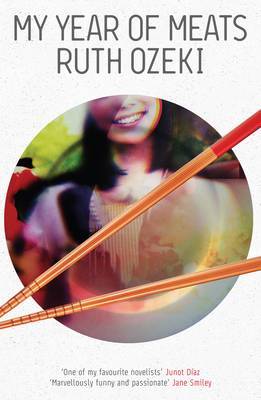 (20 Books of Summer, #6) I don’t know what took me so long to read another novel by Ruth Ozeki after A Tale for the Time Being, one of my favorite books of 2013. This is nearly as fresh, vibrant and strange. Set in 1991, it focuses on the making of a Japanese documentary series, My American Wife, sponsored by a beef marketing firm. Japanese American filmmaker Jane Takagi-Little is tasked with finding all-American families and capturing their daily lives – and best meat recipes. The traditional values and virtues of her two countries are in stark contrast, as are Main Street/Ye Olde America and the burgeoning Walmart culture.
There is a clear message here about cheapness and commodification, but Ozeki filters it through the wrenching stories of two women with fertility problems: Jane, whose reproductive system was damaged by DES, a synthetic estrogen her mother took during pregnancy to prevent a miscarriage; and Akiko, the wife of Jane’s boss, who struggles with an eating disorder and domestic violence.
Jane starts sneaking controversial subjects into her shoots: a lesbian couple, a family formed by interracial adoption, and a five-year-old who has already undergone puberty due to the hormones used on her family’s cattle feedlot. What is “natural,” and what gets branded alien or invasive? From the kudzu that strangles the South to a murdered Japanese exchange student, Ozeki probes the related issues of nativism and racism. Her two protagonists’ stories – one in the first person; the other in the third person – come together in a surprising manner as Jane decides that she has a more pressing obligation than creating a diverting television show.
This is a bold if at times discomforting novel. At first it brought to mind the exaggerated comedy of Julian Barnes’s England, England and Jane Smiley’s Moo, but as it grew darker it reminded me more of Han Kang’s The Vegetarian. It’s tricky, when a work of fiction tackles ethical or environmental matters, to balance storytelling and consciousness-raising, but Ozeki pulls it off with style. The only aspect that didn’t mean much to me, perhaps simply because of my unfamiliarity, was the excerpts from The Pillow Book of Shōnagon. How sad to think that I only have one more Ozeki awaiting me, All Over Creation. She averages a book every 5‒10 years; we can only hope that another is on the way soon.
Source: Charity shop
My rating: 
I picked up another two food-adjacent books that didn’t work for me, though I ended up skimming them to the end.
America Unchained: A Freewheeling Roadtrip in Search of Non-Corporate USA by Dave Gorman (2008)
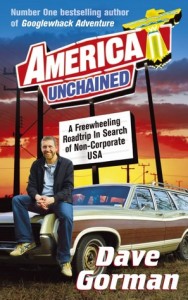 (20 Books of Summer, #7) I read the first couple of chapters, in which he plans his adventure, and then started skimming. I expected this to be a breezy read I would race through, but the voice was neither inviting nor funny. I also hoped to find more about non-chain supermarkets and restaurants – that’s why I put this on the pile for my foodie challenge in the first place – but, from a skim, it mostly seemed to be about car trouble, gas stations and fleabag motels. The only food-related moments are when Gorman (a vegetarian) downs three fast food burgers and orders of fries in 10 minutes and, predictably, vomits them all back up; and when he stops at an old-fashioned soda fountain for breakfast.
Source: Free bookshop
Tortilla Flat by John Steinbeck (1935)
 (20 Books of Summer, #8) I read the first 25 pages and then started skimming. This is a story of a group of friends – paisanos, of mixed Mexican, Native American and Caucasian blood – in Monterey, California. During World War I, Danny serves as a mule driver and Pilon is in the infantry. When discharged from the Army, they return to Tortilla Flat, where Danny has inherited two houses. He lives in one and Pilon is his tenant in the other (though Danny will never see a penny in rent). They’re a pair of loveable scamps, like Huck Finn all grown up, stealing wine and chickens left and right.
Steinbeck novels seem to fall into two camps for me. This is one of his inconsequential, largely unlikable novellas (like The Pearl and The Red Pony, which I studied in school – I’m lucky they didn’t put me off Steinbeck forever), whereas The Grapes of Wrath and East of Eden are masterful. It may also have something to do with the slight air of condescension towards characters of a different race: Steinbeck renders their speech with “thee” and “thou,” trying to imitate a Romance language’s informal pronouns, but it feels dated and alienating.
Source: Free bookshop
The Group by Lara Feigel (and Mary McCarthy)
Lara Feigel’s memoir Free Woman was one of my favourite books of 2018. In it she interrogates conventions of marriage and motherhood while rereading the works of Doris Lessing – The Golden Notebook (1962), in particular, dramatizes women’s struggles to combine their disparate roles into a harmonious identity. Drawing inspiration from Lessing as well as from another early feminist novel, The Group by Mary McCarthy (more on this below), Feigel’s debut novel crafts a kaleidoscopic portrait of five women’s lives in 2018.
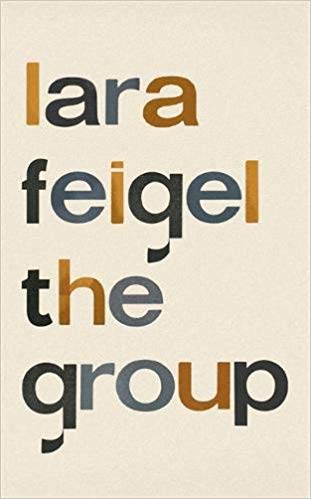 Stella, Kay, Helena, Polly and Priss met at a picnic while studying at Oxbridge and decided to rent a house together. Now 40-ish, they live in London and remain close, though their lives have branched in slightly different directions. Kay is an English teacher but has always wanted to be a novelist like her American husband, Harald. Priss is a stay-at-home mother excited to be opening a café. Polly, a gynaecological consultant at St Thomas’s Hospital, is having an affair with a married colleague. Helena, a single documentary presenter, decides she wants to have a baby and pursues insemination via a gay friend.
Narrating her friends’ lives as well as her own is Stella, an editor at a Faber-like publishing house whose director (also Helena’s uncle) is under investigation for sexual misconduct. Stella, a stand-in for the author, has split from her husband and has a new baby via IVF as well as an older child; this hint of autofiction lends the book an intimacy it might have lacked with an omniscient perspective. Although you have to suspend disbelief in a few places – could Stella really know so many details of her friends’ lives? – it feels apt that she can only understand these other women in relation to herself. Her voice can be catty, but is always candid, and Feigel is astute on the performative aspects of femininity.
Fast-forward a Sally Rooney novel by about 20 years and you’ll have an idea of what to expect here. It is a sexually frank and socially engaged narrative that arose from the context of the #MeToo movement and fully acknowledges the privilege and limitations of its setting. The characters express guilt over lamenting middle-class problems while there is such suffering in the wider world – we glimpse this in Polly’s work with African girls who have undergone genital mutilation. The diversity is limited to Black boyfriends, Helena’s bisexuality, and the fact that one group member decides not to have children (that 1 in 5 is statistically accurate).
The advantage of the apparent heterogeneity in the friend group, though, is that it highlights depths of personality and subtleties of experience. Stella even sees herself as an amateur anthropologist:
So here we are then. Five exact contemporaries who once shared a cluttered, thin-walled student house off the Cowley Road, all privileged, white, middle-class, all vestigial hangers-on, left over from an era when we received free educations at our elite university and then emerged into a world where we could still just about find jobs and buy flats, provided with opportunities for selfishness and leisure by our cleaners and our childminders. Nothing very eventful happens to us, but that gives more room for the ethnographer in me to get to work.
Feigel previously wrote two group biographies of cultural figures of the Second World War era, and she applies that precise skill set – capturing the atmosphere of a time period; noting similarities but also clear distinctions between people – to great effect here. You’ll recognize aspects of yourself in all of the characters, and be reminded of how grateful you are for (or how much you wish you had) friends whom you know will always be there for you. It’s an absorbing and relevant novel that ranks among my few favourites of the year so far.
My rating:
The Group was published by JM Originals (John Murray) on July 2nd. My thanks to the publisher for the free copy for review.
Readalikes: The Radiant Way by Margaret Drabble, Girl, Woman, Other by Bernardine Evaristo, and Expectation by Anna Hope.
See Susan’s review also.
The Group by Mary McCarthy (1963)
As soon as I heard about Lara Feigel’s forthcoming novel, I unearthed the Mary McCarthy paperback I’d plucked from Bookbarn’s shelves in 2017. I decided to read Feigel’s first, lest it feel less than fresh; perhaps inevitably, McCarthy’s felt dated in comparison. I had trouble engaging with it as a whole, but still enjoyed contrasting the two books.
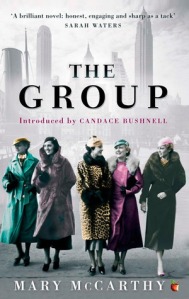 McCarthy focuses on eight girls from the Vassar class of ’33. Kay, the first to marry, has an upper-crust New York City wedding one week after graduation. But after Harald loses his theatre job, his cocktail habit and their luxury apartment soon deplete Kay’s Macy’s salary. Meanwhile, Dottie loses her virginity to Harald’s former neighbour in a surprisingly explicit scene. Contraception is complicated, but not without comic potential – as when Dottie confuses a pessary and a peccary. Career, romance, and motherhood are all fraught matters.
Feigel borrows the names of four of her five group members, plus those of some secondary characters, from McCarthy, with Stella a new character perhaps inspired in part by McCarthy’s Libby, who wants to work with books but, after delivering an earnest report on a 500-page pot-boiler, hears that “we really have no work that you’re uniquely qualified to do. You’re one of thousands of English majors who come pouring out of the colleges every June, stage-struck to go into publishing.” (That sure sounds familiar!)
Narrowing the circle and introducing a first-person narrator were wise choices that made Feigel’s version more accessible. Both, though, are characterized by forthright commentary and a shrewd understanding of human motivations. I’ll try again with McCarthy’s The Group someday, but for now I’m planning to pick up her Memories of a Catholic Girlhood.
Note: Mary McCarthy is one of the authors profiled in Michelle Dean’s Sharp.
Doorstopper of the Month: The Emperor’s Children by Claire Messud (2006)
My impression of Claire Messud is that she’s admired by critics but unpopular with ordinary readers (e.g. this novel has a catastrophically low average rating on Goodreads, probably because of that “unlikable characters” chestnut). I fit into both categories, so was curious to see where I would fall on the appreciation spectrum. Doubly intrigued by Susan’s inclusion of The Emperor’s Children on her list of top New York novels, I finally picked up the copy I’d gotten from the free mall bookshop where I volunteered weekly in ordinary times.
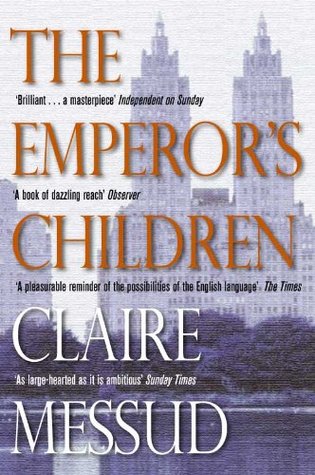 I don’t think it’s a spoiler to tell you that this is a 9/11 novel. It opens in March 2001 and covers the next eight months, with “the towers” first getting a mention at the halfway point. There’s heavy irony in one character commenting to another in the first week of September, “Whatever else they may be, our times are almost criminally uninteresting. The dullest times ever.” As in a couple of novels I read last year (not naming them in case that is a spoiler), the terrorist attacks wake the main characters up from a stupor of entitlement and apathy.
The trio of protagonists, all would-be journalists aged 30, have never really had to grow up. Marina still lives with her parents, social worker Annabel and respected cultural pundit Murray Thwaite. She got an advance to write a book on children’s fashions, but the project has languished for years. Her best friend Danielle is a documentary maker mired in an affair with an older man. Their other close pal is half-Vietnamese Julius, whose new boyfriend keeps him in the luxurious lifestyle to which he’s become accustomed.
The arrival of two young men sets the plot in motion. Through Danielle, Marina meets Ludovic Seeley, who has moved from Australia to New York City to launch a magazine, The Monitor, for which he is soliciting cutting-edge cultural exposés. Meanwhile, Murray’s nephew, college dropout Frederick Tubb, who has the unfortunate nickname of “Bootie,” has moved to the City to seek his fortune. Murray offers him a job as his amanuensis, but what Bootie learns leads him to wish he could expose his idolized uncle as an intellectual fraud.
For these characters, leaving an extended childhood behind means getting out from under the shadow of a previous generation and reassessing what is admirable and who is expendable. As Marina’s book title (The Emperor’s Children Have No Clothes) indicates, appearance and substance do not always match. I won’t give away what 9/11 means for this fictional world, though I’d be interested in discussing it in the comments with anyone who’s read the book. Bootie was my favorite, and what happens with him is particularly interesting.
This was thoroughly engrossing: richly textured and intellectually satisfying in a way that might call to mind George Eliot and Edith Wharton – or, more recently, Jennifer Egan and Zadie Smith. Great American Novel territory, for sure. I’ll be keen to read more by Messud.
Page count: 581
My rating:
Paul Auster Reading Week: Winter Journal & The New York Trilogy
Before this year, I’d read only one book by Paul Auster: Timbuktu, which fit into last year’s all-animal 20 Books of Summer for its canine main character. This year I’ve enjoyed having Annabel’s Paul Auster Reading Week as an excuse to binge on more Auster, including one of his memoirs, Winter Journal, and his most famous set of novels, the New York Trilogy. I’m reading another two Auster books, one fiction and nonfiction, and will see if I can finish and write them up before the week ends.

Winter Journal (2012)
This is one of the most remarkable memoirs I’ve ever read. Approaching age 64 and the winter of his life, Auster decided to assemble his most visceral memories. Here he parades them past in a seemingly random order yet manages to give a sense of the sweep of his life. The use of the second person draws readers in to (re-)experience things along with the author, while also creating an artistic distance between the subject and his reminiscences. Auster describes his aim thus:
Time is running out, after all. Perhaps it is just as well to put aside your stories for now and try to examine what it has felt like to live inside this body from the first day you can remember being alive until this one. A catalogue of sensory data. What one might call a phenomenology of breathing.
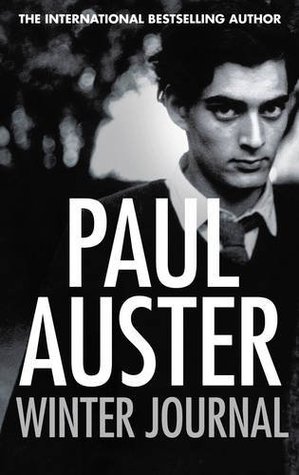 His life reappears through scars, through accidents and near-misses, through what his hands felt and his eyes observed. A three-year-old rips his cheek open on a protruding nail in a department store. A teenager slowly builds up a portfolio of sexual experiences. A young man lives and works in Paris and the South of France. A marriage to one fellow author (Lydia Davis) ends and a relationship with another (Siri Hustvedt) begins. A fiftysomething rushing to get home to the toilet makes an ill-advised turn against traffic and totals his car – luckily, he and his family escape unhurt. Numbness after his mother’s death cedes to a panic attack.
I particularly enjoyed the 53-page section in which Auster gives tours through the 21 places he’s lived since infancy, recounting the details he remembers of the dwellings and what happened during his time there. It’s impressive how much he can condense, but also how much he can convey in just a few pages on each home. This is the sort of format I could imagine borrowing for a short autobiographical piece – it would be a way of redeeming that involuntarily nomadic period when my husband and I moved every six to 18 months.
Reading this alongside the New York Trilogy allowed me to spot the ways, big and small, in which those novels draw on Auster’s life story. I’m now keen to read more of his nonfiction, especially The Invention of Solitude, which offended his relatives by revealing the shameful family story of how his grandmother shot and killed his grandfather in their kitchen. 
Annabel says: “The book is written in the second person – addressing himself; it gives a real sense of intimacy to his story. … Auster is an unconventional, analytical and eloquent writer, and this unconventional memoir was a delight to read, he can look with humour at himself as well as being serious.”
Laura F. says: “You know how people say they’d read anything by their favourite author, even a grocery list? Winter Journal gets pretty close to that territory. … I’ve never read a memoir like this, and though focused on the physical, it’s a fully emotional experience.”
Some favorite lines:
“as long as you continue to travel, the nowhere that lies between the here of home and the there of somewhere else will continue to be one of the places where you live.”
“We are all aliens to ourselves, and if we have any sense of who we are, it is only because we live inside the eyes of others.”
“you can only conclude that every life is marked by a number of close calls, that everyone who manages to reach the age you have come to now has already wriggled out of a number of potentially absurd, nonsensical deaths. All in the course of what you would call ordinary life.”
Readalikes: I Am, I Am, I Am by Maggie O’Farrell & The Lost Properties of Love by Sophie Ratcliffe
The New York Trilogy
(also my Doorstopper of the Month at 580 pages)
City of Glass (1985)
 A metafictional mystery about a crime writer named Daniel Quinn who turns private investigator when he gets a phone call asking for the Paul Auster Detective Agency. This is one of those books where what actually happens is a lot less important than the atmosphere it creates. So what feels essential to me here is the sense of a labyrinthine New York City and a confusion of languages and relationships. Quinn, who is helpfully untethered after the death of his wife and son, is hired to tail Peter Stillman’s father, who has recently been released from a mental hospital, where he was sentenced after being judged insane for keeping his son in isolation in a dark apartment for nine years.
Feral children, maps, eggs, the Tower of Babel and Don Quixote are some of the recurring sources of metaphors in a deliberately disorienting and intertextually rich short novel that kept me turning the pages even when I didn’t know precisely what was going on. We get a glimpse of Auster himself, and are invited to muse on such tiny subjects as destiny, the limitations of language, the purpose of books, and the nature of truth. I’m curious to see whether the other two novels follow on from the story at all or just resemble it thematically.
Ghosts (1986)
I jumped straight into this from City of Glass, and it suffered by comparison. It is not a sequel per se, because it has different characters and is set in the late 1940s instead of the early 1980s, but it shares some of the same concerns (with literature, identity, doubling, the essential otherness of the writer, and so on) and again is a sort of metafictional mystery.
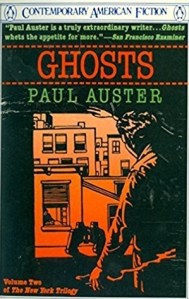 Part of why I couldn’t take this novella entirely seriously is the silly naming: White hires Blue to trail Black (really; all of the secondary characters are named after colors, too). It turns out Black is a writer who does little besides sit in his apartment, writing. Only when Blue disguises himself as a tramp and then as a salesman and meets Black in various other contexts does he realize that Black, too, is an investigator … writing up a case of following a writer who hardly leaves his desk.
While I appreciated the circularity and the uncertainty over whether these accidental twins would destroy each other, as well as the literary references to Whitman, Thoreau and Hawthorne, the whole felt slightly inconsequential (“Blue watches Black, and little of anything happens.”). Plotlessness is part of the point, but makes for only a moderately interesting read.
[There is one coded reference to Auster here: the fact that the book opens on February 3, 1947, the day he was born.]
The Locked Room (1986)
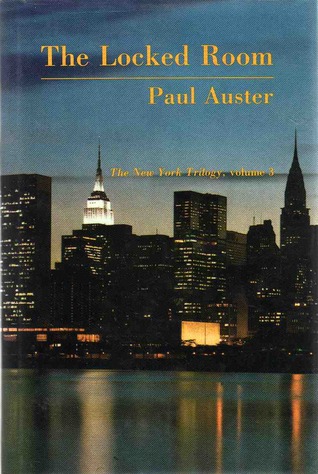 While most of the New York Trilogy is told in the third person, this is a first-person narrative that seems to pick up where City of Glass left off. It begins in 1977, when the unnamed narrator gets a letter from Sophie Fanshawe, the wife of his childhood best friend, telling him that Fanshawe disappeared six months ago, and despite the best efforts of a detective, Quinn (in another link to CoG, the narrator encounters Peter Stillman on a later trip to Paris), no trace can be found. The narrator has been named Fanshawe’s literary executor and takes it upon himself to get the man’s unpublished work out into the world: plays are produced, novels are published. He also starts writing a biography of the friend he always envied.
Except it’s more like he’s becoming Fanshawe, especially when he marries Sophie. Doubling has been a major theme of the trilogy, and here the metaphorical kill-or-be-killed situation seems to turn literal at the conclusion, which I didn’t particularly understand (e.g. he acquires and destroys a red notebook – is this in some way meant to be the same red notebook Quinn left behind at the end of CoG?). The narrator presents himself as the author of all three books, and asserts, “These three stories are finally the same story, but each one represents a different stage in my awareness of what it is about. I don’t claim to have solved any problems.”
The metafictional aspect of this novel is that Fanshawe’s early life is a lot like Auster’s as revealed in Winter Journal, while Sophie’s resembles his wife Siri Hustvedt’s (and the pair would later name their daughter Sophie).
 Themes of the trilogy:
- Identity complications, including disguises, doubles and substitutes
- Writers and writing; the creator versus characters
- The limits of language (e.g. Stillman’s monologue in CoG is astonishing)
- Freedom/randomness versus fate
One representative passage from each volume:
- “New York was an inexhaustible space, a labyrinth of endless steps, and no matter how far he walked, no matter how well he came to know its neighbourhoods and streets, it always left him with the feeling of being lost. Lost, not only in the city, but within himself as well. … New York was the nowhere he had built around himself” (City of Glass)
- “Writing is a solitary business. It takes over your life. In some sense, a writer has no life of his own. Even when he’s there, he’s not really there. / Another ghost. / Exactly.” (Ghosts)
- “In the end, each life is no more than the sum of contingent facts, a chronicle of chance intersections, of flukes, of random events that divulge nothing but their own lack of purpose.” (The Locked Room)
My rating for the trilogy as a whole:
 Bookish Beck = Rebecca Foster. American transplant to England. Freelance proofreader and book reviewer.
 Bookish Beck