Summer Reads, Part II: Ellis, Faulkner (Reread), Groskop, Ruskovich
Thankfully, since I last wrote about summer, we’ve had abundant rainfall – a cosy wet weekend after nearly two months of drought. Our pond is looking full again and our apple tree is perking up, but it will take much more to fill the country’s coffers. I’ve spent significantly less time outdoors than usual this summer, taking refuge indoors from the unremitting heat and sun. Luckily, there have been plenty of books to keep me company.
Book 2 of The Summerhouse Trilogy
The Skeleton in the Cupboard by Alice Thomas Ellis (1988)
Summer was a dull season. In spring things were growing; in autumn they were harvested; in winter they were waiting. Summer was pointless, designed for idleness. An inbred Yorkshire Puritanism led me to despise it.
{SPOILERS IN THIS ONE}
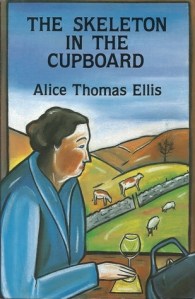 After The Clothes in the Wardrobe (1987), this novella felt conventional and superfluous. Repeating the run-up to Margaret and Syl’s wedding from the perspective of Margaret’s mother-in-law-to-be, Mrs Monro, is only worthwhile in that it allows for two key revelations: one, that Margaret was molested by her father, which goes some way toward explaining her flat affect and inability to love Syl; and two, that Lili also slept with Syl’s father in the summerhouse, long before she bedded Syl himself there on the morning of the wedding. Otherwise, this is a collection of sad and somewhat clichéd meditations on the loneliness of alcoholism-prone older age and widowhood. Provided it doesn’t simply reproduce stereotypes of the seductress, I’m hoping the third volume, from Lili’s perspective, will end up being the most interesting; the middle book of a trilogy always kinda sucks, right? I’ll read Book 3 for one last seasonal instalment before the autumn equinox. (Secondhand – Regent Books, Wantage)
Light in August by William Faulkner (1932)
Memory believes before knowing remembers.
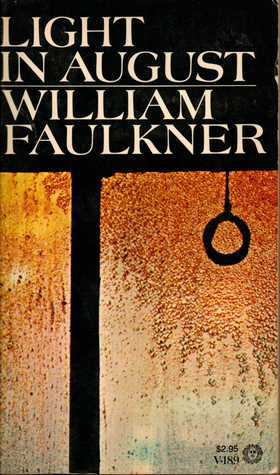 In my second year as a college English major, I took a senior elective on Faulkner & Morrison. Ever since, I’ve remembered this and Song of Solomon as my favourite from each author – the books I’d read again even without them being assigned. For several of the last few Augusts I’ve meant to pick this up, but when I finally did I found Faulkner’s style oppressive and only succeeded in a quick skim. The one thing I’d remembered beforehand is that there is a mixed-race character named Joe Christmas. But the first character we’re introduced to is the indomitable Lena Grove, who’s heavily pregnant and has hitchhiked from Alabama to Mississippi to find her baby daddy. She still believes he’ll do right by her and their child, but the fact that he’s living under an assumed name is our clue that he has no intention of taking responsibility. The plot is set in motion by a misunderstanding: she’s looking for Lucas Burch, but others know there’s a Byron Bunch nearby, and he takes a shine to Lena.
Meanwhile, Burch is going by Joe Brown and rooming with the sadistic Joe Christmas, who gets caught up in bootlegging and murder and goes on the run. The language about his “black blood” driving him to do things, and what happens to him, is awful, but true to its time as well as to Faulkner’s vision of tragic inevitability. I only got the bare bones from a skim, but did love how the novel feels epic yet only spans about a month; it completes a full circle as Lena and her baby move on again, this time to Tennessee. I also liked the neologism in the description of a town’s “garland of Augusttremulous lights.” All told, I’m unlikely to read Faulkner again; he’s like a darker version of Steinbeck, who I’d recommend instead. (Secondhand – Wonder Book and Video)
My original rating: 
My rating now:
One Ukrainian Summer: A memoir about falling in love and coming of age in the former USSR by Viv Groskop (2024)
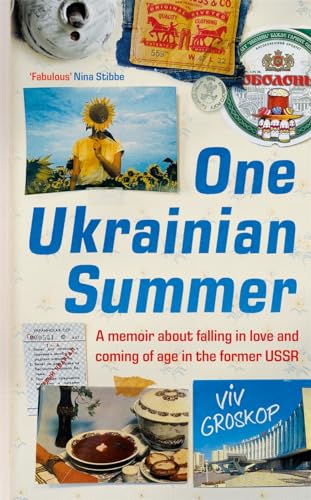 As part of her Russian degree course at Cambridge, Groskop spent a year abroad in St Petersburg, where she also conducted English lessons for adults. She arrived in September 1993 and the next month, in a nightclub, met Bogdan Bogdanovich (“God’s Gift, Son of God’s Gift”), a young man whose rock band called itself “Ukraine answer to Red Hot Chili Pepper.” She would be the solitary groupie on their tour the following summer, but first she had to get through a freezing winter of too much alcohol, too many cigarettes, and turbulent living situations. Her pen portraits of friends and acquaintances are quite amusing. There’s an appealing blend of self-deprecation and nostalgia to her outlook: “I was a clueless, lovesick, pedantic linguist. But I held the future of Ukrainian rock ’n’ roll in my hands.” I never got a particular sense of any of the cities she visits, but the long train ride from Moscow to Kiev is evocative. Each chapter is headed by a vocabulary word, given in Russian and then in the (very similar) Ukrainian. There are lots of Slavic phrases in the text, too, rendered in Roman script. I enjoyed reading them to myself in my head, but none of them has stuck. Let’s see if I can commit this one to memory: “Babine leto” (Ukr.) = “grandmother’s summer,” the equivalent of an Indian summer. Kudos to Groskop and her agents, all of whom donated their proceeds/fees to PEN International, which supports writers at risk. (Public library)
Nightjar: Stories by Emily Ruskovich (2026)
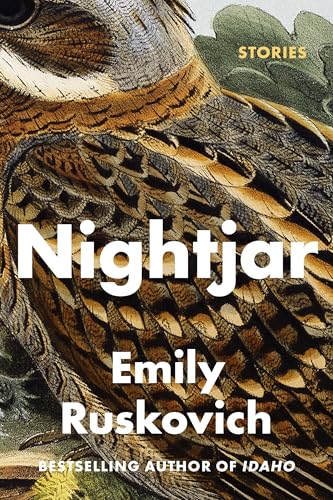 I abandoned Ruskovich’s 2018 debut novel, Idaho, early on, but will absolutely go back to it now because these stories are phenomenal. There are only five, so they tread the border between short story and novella at ~50 pages each and reminded me in their intricacy and depth of short fiction by Lauren Groff and Alice Munro. All are set in the American West and circle themes of loss and remembrance, and they often feature animals prominently. “Victor’s Room” sees a young wife become obsessed with exposing her husband’s false memory of the Oregon house where his brother died in childhood. In “Owl,” the only first-person, historical story, the narrator’s wife is accidentally shot by boys who mistake her for an owl in the night; as she convalesces, her old life lures her back. “Round Lake,” probably my favourite, finds violinist Jade adrift in Tokyo, where she agreed to meet a love interest. There’s water in her ears from an Idaho lake, which she only learned after her swim was where her mother drowned. “Petty Creek Road,” about middle-aged brothers, introduces a subtle note of magic realism (through Will’s premonitions of danger) that is echoed in the final, title story in the tangible reflections that Tess finds each morning in a bucket of water. Jade keeps orphaned hedgehogs, Jane feeds stray cats in “Owl,” and Tess communes with a goat named Panic Boy. The writing and character development are extraordinary, and the question of how memories become stories, or take on physical weight, truly resonated with me.
I’ve included this in my summer round-up because, for me, nightjars are synonymous with warm evenings on Newtown Common, where we go once a year to catch up with nightjars (not the same species as Tess encounters in Montana). This small scrubby nature reserve never fails to turn up several nightjars: unearthly with their gaping mouths, alternating churring and yipping, and jerky flaps against the gathering dusk. We made our annual pilgrimage on 15 July and it didn’t disappoint. (Edelweiss) 
I have a few more summery reads lined up to take me through what I sincerely hope is this season’s last gasp. I’m looking forward to getting out my corduroy coat, wearing hoodies and lap blankets around the house, and eating autumnal goodies based around squash and apples.
 Bookish Beck = Rebecca Foster. American transplant to England. Freelance proofreader and book reviewer.
