December Releases by Anita Felicelli, Lise Goett, Brooke Randel & Weike Wang
December isn’t a big month for new releases, but here are excerpts from a few I happened to review early for U.S. publications BookBrowse, Foreword Reviews, and Shelf Awareness: Speculative short stories, loss-tinged poetry, a family memoir based on Holocaust history, and a satirical short novel about racial microaggressions and class divides in contemporary America.
How We Know Our Time Travelers by Anita Felicelli
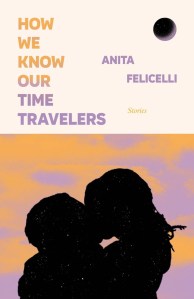 These linked speculative stories, set in near-future California, are marked by environmental anxiety. Many of their characters have South Asian backgrounds. A nascent queer romance between co-op grocery colleagues defies an impending tsunami. A painter welcomes a studio visitor who could be her estranged husband traveling from the past. Mysterious “fog catchers” recur in multiple stories. Memory bridges the human and the artificial, as in “The Glitch,” wherein a coder, bereaved by wildfires, lives alongside holograms of her wife and children. But technology, though a potential means of connecting with the dead, is not an unmitigated good. Creative reinterpretations of traditional stories and figures include urban legends, a locked room mystery, a poltergeist, and a golem. In these grief- and regret-tinged stories, heartbroken people can’t alter their pasts, so they’ll mold the future instead. (See my full Foreword review.)
The Radiant by Lise Goett
 In the 25 poems of Goett’s luminous third poetry collection, nature’s beauty and ancient wisdom sustain the fragile and bereaved. The speaker in “Difficult Body” references a cancer experience and imagines escaping the flesh to diffuse into the cosmos. Goett explores liminal moments and ponders what survives a loss. The use of “terminal” in “Free Fall” denotes mortality while also bringing up fond memories of her late father picking her up from an airport. Mythical allusions, religious imagery, and Buddhist philosophy weave through to shine ancient perspective on current struggles. The book luxuriates in abstruse vocabulary and sensual descriptions of snow, trees, and color. (Tupelo Press, 24 December. Review forthcoming at Shelf Awareness)
Also Here: Love, Literacy, and the Legacy of the Holocaust by Brooke Randel
 Randel’s debut is a poised, tender family memoir capturing her Holocaust survivor grandmother’s recollections of the Holocaust. Golda (“Bubbie”) spoke multiple languages but was functionally illiterate. In her mid-80s, she asked her granddaughter to tell her story. Randel flew to south Florida to conduct interviews. The oral history that emerges is fragmentary and frenetic. The structure of the book makes up for it, though. Interview snippets are interspersed with narrative chapters based on follow-up research. Golda, born in 1930, grew up in Romania. When the Nazis came, her older brothers were conscripted into forced labor; her mother and younger siblings were killed in a concentration camp. At every turn, Golda’s survival (through Auschwitz, Christianstadt, and Bergen-Belsen) was nothing short of miraculous. This concise, touching memoir bears witness to a whole remarkable life as well as the bond between grandmother and granddaughter. (See my full Shelf Awareness review.)
Rental House by Weike Wang
 Their interactions with family and strangers alike on two vacations – Cape Cod and the Catskills, five years apart – put interracial couple Keru and Nate’s choices into perspective as they near age 40. Although some might find their situation (childfree, with a “fur baby”) stereotypical, it does reflect that of a growing number of aging millennials. Wang portrays them sympathetically, but there is also a note of gentle satire here. The way that identity politics comes into the novel is not exactly subtle, but it does feel true to life. And it is very clever how the novel examines the matters of race, class, ambition, and parenthood through the lens of vacations. Like a two-act play, the framework is simple and concise, yet revealing about contemporary American society. (See my full BookBrowse review.)
Others Like Me: The Lives of Women without Children by Nicole Louie
I’ve read quite a lot about matrescence and motherhood so far this year, and I value these women authors’ perspectives on their experiences. There is much that resonates with me as I look back to my relationships with my parents and observe how my sister, brother-in-law and friends are raising their children. Yet as I read of the joys and struggles of parenthood, I do sometimes think, what about the rest of us? That’s the question that drove Nicole Louie to write this impassioned book, which combines the strengths of an oral history, a group biography and a fragmented memoir. Like me, she was in search of role models, and found plenty of them – first on the library shelves and then in daily life by interviewing women she encountered through work or via social media.
The 14 Q&As, shaped into first-person narratives, are interspersed with Louie’s own story, creating a chorus of voices advocating for women’s freedom. The particulars of their situations vary widely. A Venezuelan graphic designer with MS doesn’t want to have a baby to try to fill a perceived lack. A blind Canadian writer hopes for children but knows it may be too complicated on her own. A Ghanaian asexual woman confronts her culture’s traditional expectations of woman. A British nurse in her sixties is philosophical about not having a long-term relationship at the right time, and focuses instead on the thousands of people she’s been able to care for.
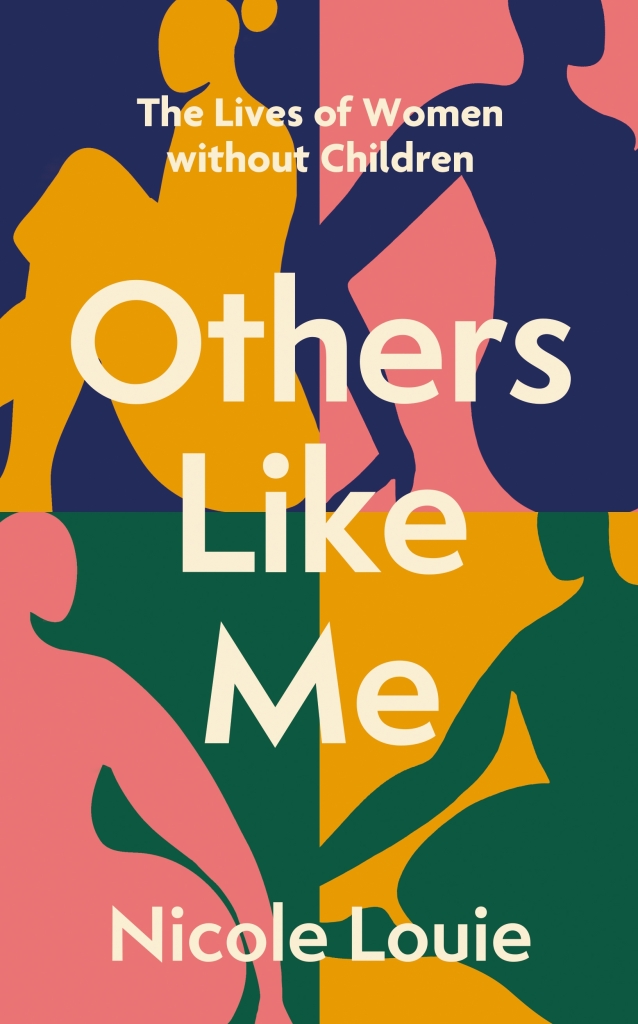
The subjects come from Iceland, Peru, the Isle of Man; they are undecided, living with illness or disability, longing but unpartnered, or utterly convinced that motherhood is not for them. Their reasons are logical, psychological, personal and/or environmental, and so many of their conclusions rang true for me:
I just want to make the most of what’s here now instead of always having to long for something else I don’t already have.
I have this strong core intent to be useful to society. To channel as much energy into it as I would put into raising two children … You can’t experience everything available to you in life. So you make choices, and you decide which paths to take and which ones to leave behind without trying. And that’s okay. What’s important is to move forward with intent.
Louie herself has an interesting background: she’s Brazilian but has lived in Sweden, the UK and Ireland. Her work as a copywriter and translator has taken her behind the scenes in training AI. She first had to give serious thought to the question of becoming a mother in 2009, when it became an issue in her first marriage. But, really, she’d known for a long time that it didn’t appeal to her – at age six she was given a doll whose tummy opened to reveal a baby and quickly exchanged that toy for another. A late diagnosis of PCOS and a complicated relationship with her own mother only reinforced a clear conviction.
Other works that I’ve encountered on childlessness, such as Childless Voices by Lorna Gibb (2019) and No One Talks about This Stuff: Twenty-Two Stories of Almost Parenthood, ed. Kat Brown (2024), are heavily weighted towards infertility. Here the spotlight is much more on being childfree, although the blurb is inclusive, speaking of “women who are not mothers by choice, infertility, circumstance or ambivalence.” (I love the inclusion of that final word.)
“Motherhood as the epicentre of women’s lives was all I’d ever witnessed” via her mother and grandmother, Louie writes, so finding examples of women living differently was key for her. As readers, then, we have the honour of watching her life, her thinking and the book all take shape simultaneously in the narrative. A lovely point to mention is that Molly Peacock (The Analyst and A Friend Sails in on a Poem) mentored her throughout the composition process.
Intimate and empathetic, Others Like Me is also elegantly structured, with layers of stories that reflect diversity and the intersectionality of challenges. This auto/biographical collage of life without children will be reassuring for many, and a learning opportunity for others. I’m so glad it exists.
With thanks to Nicole Louie and Dialogue Books for the proof copy for review.
Buy Others Like Me from Bookshop.org in the UK [affiliate link]
Readings for the 20th Anniversary of 9/11
Like the assassination of John F. Kennedy for a previous generation, September 11, 2001 was a landmark day in our shared history. I was two weeks into my freshman year of college and getting ready to head out to a 9:30 seminar when my roommate returned early from her first class. “All these planes flying into buildings – I’m freaking out!” she cried, and turned our tiny desktop TV set to a news station.
At that point it was unclear what was going on, so I dutifully trudged out across the quad linking the residence halls to the academic buildings, anticipating a normal day of classes. On the way I encountered small groups of somber students, and was alarmed to see my friend and “Big Sister” from the junior class weeping onto her boyfriend’s shoulder – her dad worked at the Pentagon, and she hadn’t yet heard that he was okay. When I entered the lecture hall it was clear no regular work was going to happen that day; I was one of only a handful of students who’d shown up, and our English professor, too, was engrossed by the rippling montage of rubble and smoke being projected onto a screen behind him.
 As the anniversary approached this year, I picked up a coffee table book of photos, Reuters’ September 11: A Testimony from the library and was struck by how dated everything appeared. For an event so fresh in my memory, it actually looks like something that happened a long time ago thanks to everything from the fashions and car designs to the photographic quality. You also get the sense that, even in the early Internet age, things like missing person posters and public tributes to the dead were primarily paper-based then. The photos barely capture the scope of the devastation. One image of firefighters among the wreckage looks like a film set or architect’s model, the human figures like ants among the dusty girders. This was published in late 2001, so it was put together quickly. Photographs tell the story, with extremely brief captions on facing pages. Nearly half of the length is devoted to documenting the three crash sites, with the rest chronicling memorial services, national and international commemorations, and New York City gradually returning to business as usual.


On the way back from our mother’s wedding this summer, my sister and brother-in-law and I passed the entrance to the Flight 93 Memorial in Shanksville, Pennsylvania so drove in for a look. The 1,000-acre site is administered by the National Park Service. On the airless June day we were there, the Tower of Voices was not making its eerie music, but it was still a peaceful spot for reflection. You can listen to a recording of the windchimes on the website. There is also a visitor center with a permanent exhibition that we will have to go back and see another time.
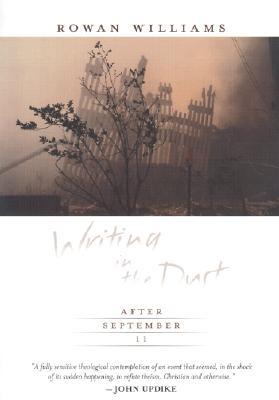
I also recently reread Rowan Williams’s superb book-length essay Writing in the Dust (2002), which I’d read twice before. Williams, then Archbishop of Wales and soon to become Archbishop of Canterbury, was in New York City on 9/11. He was, in fact, just a few blocks from the World Trade Center, at Trinity Church, Wall Street, where he was part of a group recording theological conversations to be used for educational purposes. When the planes hit and the air filled with dust and smoke, he did the same as everyone else: he quickly evacuated, ensured everyone was safe, and then watched, listened, and prayed. And in the months that followed he thought about what he’d seen that day, and what his experience had taught him about suffering, peacemaking, and the ways of God.
Writing well before military action against Iraq began, Williams cautioned against labeling the Other as Evil and responding in a simple spirit of retribution. Prophets’ words are never welcome, of course, and time has shown that Western policies have only made things worse. I must have read this from a university library; I then did a peculiar (and probably illegal, in copyright terms) thing and typed out every single word of it into a Word file so I could keep it forever.
Here are some of Williams’s words of wisdom:
“The hardest thing in the world is to know how to act so as to make the difference that can be made; to know how and why that differs from the act that only releases or expresses the basic impotence of resentment.”
My original rating (2013): 
My rating now:
Other 9/11-themed reading I have done:
The Second Plane by Martin Amis (2008)
 A famously bad-tempered English novelist who now lives in New York, Amis here presents a collection of 14 fictional and factual responses to 9/11. The essays are much stronger than the stories (a tale about Saddam Hussein’s son’s body double is downright weird), although it might be argued that Amis’s general understanding of Islam is fatally skewed. Opinionated, bold, and polarizing, these pieces ponder the symbolism and ideology of a day that changed the world.
The wonderful Annie Dillard’s post-9/11 essay “This is the Life,” available to read here, is another perceptive look at our response to tragedy, asking whether we are going to accept what “everyone” thinks about us vs. them and the value of human lives: “Everyone knows…the enemies are barbarians [but] our lives and our deaths count equally.”
Extremely Loud and Incredibly Close by Jonathan Safran Foer (2005)
 Oskar Schell is a tremendously precocious nine-year-old who’s trying to come to terms with his father’s death in the World Trade Center on 9/11. He sets off on a quest to find the lock that takes the key he found in his dad’s closet. This light-hearted search takes him all over New York’s five boroughs, but in the end Oskar is little closer to discovering who his dad really was or how exactly he died. All he has left of him is that same panicked message on the answering machine, left sometime during the morning of September 11th. By denying neat narrative closure, Foer avoids sentimentality at the same time as he affirms the tragedy’s effect on a nation and on individuals.
Small Wonder by Barbara Kingsolver (2002)
 On September 12th, 2001, Kingsolver sat down at her computer to write up some thoughts about the previous day’s tragedy. A newspaper had asked her for a short response, but as she sat and typed she found that the words kept coming, in essay after essay. The title piece in this collection, and several others like it, might make for occasionally uncomfortable reading, as Kingsolver questions automatic all-American responses like indiscriminate flag-waving and “we’ll hunt those terrorists down” vigilante justice. She asks how someone who loves her country can criticize its tenets and actions without being branded a traitor. “My country, right or wrong,” the saying goes – fair enough, but the truest patriot is one who loves her country enough to hold it to the highest moral standards, demanding it live up to its democratic ideals.
The Submission by Amy Waldman (2011)
 Waldman’s debut imagines what would have happened had New Yorkers chosen a 9/11 memorial design as soon as 2003 and – crucially – had the anonymous selection turned out to be by a Muslim architect named Mohammad Khan. His memorial garden is rich in possible meanings and influences. When a member of the memorial selection jury leaks the information about the designer’s name to the press, however, all hell breaks loose, and perfectly nice, reasonable people start to display some ugly bigotry. As the clever double meaning of the title suggests, Waldman has educated herself about Islam’s doctrines. She includes an impressive range of characters and opinions in this canny psychological exploration.
(Most of the above text is recycled from an article I wrote for Bookkaholic web magazine (now defunct) in 2013.)
I can think of at least six more novels I’ve read that would be appropriate for this list, yet even including them here would be a spoiler. Generally, if you’re reading a novel set in New York City in 2000 or so, you should be prepared…

This year I meant to read Mitchell Zuckoff’s comprehensive journalistic study, Fall and Rise: The Story of 9/11, but ran out of time. Eleanor highly recommends the audiobook of the oral history The Only Plane in the Sky by Garrett M. Graff. This Kirkus list has two additional nonfiction suggestions.
 Bookish Beck = Rebecca Foster. American transplant to England. Freelance proofreader and book reviewer.
 Bookish Beck