Book Serendipity, 2019 Second Half
I call it serendipitous when two or more books that I’m reading at the same time or in quick succession have something pretty bizarre in common. Because I have so many books on the go at once – usually between 10 and 20 – I guess I’m more prone to such incidents. I post these occasional reading coincidences on Twitter. What’s the weirdest one you’ve had lately? (The following are in rough chronological order.)
[Previous 2019 Book Serendipity posts from April and July.]
- Two novels in which a character attempts to glimpse famous mountains out of a train window but it’s so rainy they can barely be seen: The Unchangeable Spots of Leopards by Kristopher Jansma and The Pine Islands by Marion Poschmann.


- Ex-husbands move from England to California and remarry younger women in The Stillness The Dancing by Wendy Perriam and Heat Wave by Penelope Lively.
 References to Edgar Allan Poe in both Timbuktu by Paul Auster and The Unchangeable Spots of Leopards by Kristopher Jansma.
- An account of Percy Shelley’s funeral pyre in both The Unchangeable Spots of Leopards by Kristopher Jansma and Frankissstein by Jeanette Winterson.
- Mentions of barn owls being killed by eating poisoned rats in Owl Sense by Miriam Darlington and Homesick by Catrina Davies.


- Miriam Rothschild is mentioned in Irreplaceable by Julian Hoffman and An Obsession with Butterflies by Sharman Apt Russell.
- Gorse is thrown on bonfires in Homesick by Catrina Davies and The Stillness The Dancing by Wendy Perriam.
 A character has a nice cup of Ovaltine in Some Tame Gazelle by Barbara Pym and The Stillness The Dancing by Wendy Perriam.
- I started two books with “Bloom” in the title on the same day.

 Two books I finished about the same time conclude by quoting or referring to the T. S. Eliot lines about coming back to the place where you started and knowing it for the first time (Owl Sense by Miriam Darlington and This Is Not a Drill, the Extinction Rebellion handbook).
- Three books in which the narrator wonders whether to tell the truth slant (quoting Emily Dickinson, consciously or not): The Unchangeable Spots of Leopards by Kristopher Jansma, The Poisonwood Bible by Barbara Kingsolver and The Hiding Game by Naomi Wood.
- On the same day, I saw mentions of crullers in both On Chapel Sands by Laura Cumming and The Dutch House by Ann Patchett.


- There are descriptions of starling murmurations over Brighton Pier in both Irreplaceable by Julian Hoffman and Expectation by Anna Hope. (Always brings this wonderful Bell X1 song to mind!)
- I was reading The Outermost House by Henry Beston and soon after found an excerpt from it in Irreplaceable by Julian Hoffman; later I started The Easternmost House by Juliet Blaxland, whose title is a deliberate tip of the hat to Beston.
 At a fertility clinic, the author describes a pair of transferred embryos as “two sequins of light” (in On Chapel Sands by Laura Cumming) and “two points of light” (in Expectation by Anna Hope).
- Mentions of azolla ferns in Time Song by Julia Blackburn and Bloom (aka Slime) by Ruth Kassinger.
 Incorporation of a mother’s brief memoir in the author’s own memoir in On Chapel Sands by Laura Cumming and All Things Consoled by Elizabeth Hay.
- Artist mothers in On Chapel Sands by Laura Cumming, All Things Consoled by Elizabeth Hay, and Expectation by Anna Hope.
- Missionary fathers in The Poisonwood Bible by Barbara Kingsolver and The Wind that Lays Waste by Selva Almada.


- Twins, one who’s disabled from a birth defect and doesn’t speak much, in Golden Child by Claire Adam and The Poisonwood Bible by Barbara Kingsolver.
 An Irish-American family in a major East Coast city where the teenage boy does construction work during the summers in Ask Again, Yes by Mary Beth Keane and The Dutch House by Ann Patchett.
- SPOILERS: A woman with terminal cancer refuses treatment so she can die on her own terms and is carried out into her garden in Expectation by Anna Hope and A Reckoning by May Sarton.
- A 27-year-old professor has a student tearfully confide in her in Crow Lake by Mary Lawson and The Small Room by May Sarton.


- Reading The Yellow House by Sarah M. Broom at the same time as The Dutch House by Ann Patchett.
 “I was nineteen years old and an idiot” (City of Girls, Elizabeth Gilbert); “I was fifteen and generally an idiot” (The Dutch House, Ann Patchett).
- Mentions of a conjuring tricks book in Time Song by Julia Blackburn and Fifth Business by Robertson Davies.
- A teen fleeces their place of employment in Sweet Sorrow by David Nicholls and Who Will Run the Frog Hospital? by Lorrie Moore.


- A talking parrot with a religious owner in The Poisonwood Bible by Barbara Kingsolver and Olive Kitteridge by Elizabeth Strout.
- Pictorial book serendipity: three books I was reading, and another waiting in the wings, had a red, black and white color scheme.

 Kripalu (a Massachusetts retreat center) is mentioned in Fleishman Is in Trouble by Taffy Brodesser-Akner and Once More We Saw Stars by Jayson Greene.
- The character of Netty Quelch in Robertson Davies’s The Manticore reminds me of Fluffy in Ann Patchett’s The Dutch House.
- The artist Chardin is mentioned in How Proust Can Change Your Life by Alain de Botton and Varying Degrees of Hopelessness by Lucy Ellmann.
- A Czech grand/father who works in a plant nursery in the opening story of Andrea Barrett’s Ship Fever and Patricia Hampl’s The Florist’s Daughter.


- The author was in Eva Le Gallienne’s NYC theatre company (Madeleine L’Engle’s Two-Part Invention and various works by May Sarton, also including a biography of her).
 Gillian Rose’s book Love’s Work is mentioned in both Notes Made while Falling by Jenn Ashworth and My Year Off by Robert McCrum. (I will clearly have to read the Rose!)
- Sarah Baartman (displayed in Europe as the “Hottentot Venus”) is mentioned in Shame on Me by Tessa McWatt and Hull by Xandria Phillips.
20 Books of Summer, #7–10: Auster, Darlington, Durrell, Jansma
Owls and leopards and dogs – oh my! My animal-themed reading project continues. I’m more than halfway through in that I’m in the middle of quite a few more books, but finishing and reviewing them all before the 3rd of September may still prove to be a challenge.
Timbuktu by Paul Auster (1999)
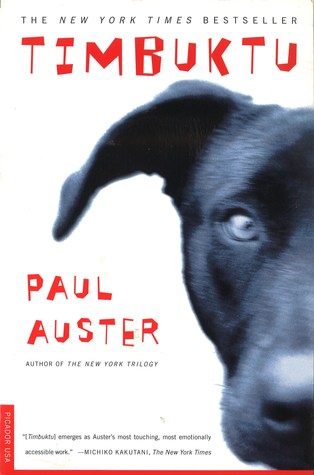 My first from Auster – and not, I take it, representative of his work in general. Never mind, though; I enjoyed it, and it was a good follow-up to Fifteen Dogs. Like the Alexis novel, this gives an intimately imagined dog’s perspective, taking seriously the creature’s whole life story. The canine protagonist is Mr. Bones, who’s accompanied his mentally unstable writer owner, Willy G. Christmas, from New York City down to Baltimore, where, one August Sunday, Willy wants to find his old high school English teacher before he dies.
What took me by surprise is that Auster doesn’t stick with Willy, but has Mr. Bones move on to two more living situations: first he’s the secret friend of 10-year-old Henry Chow, whose parents run a Chinese restaurant, then he’s a family pet in suburban Virginia. Although his English comprehension is advanced, he isn’t able to reproduce its sounds like some of the dogs in Fifteen Dogs can, so he can’t tell these new owners his real name and has to accept being called first “Cal” and then “Sparky.” In dreams he still hears Willy’s voice. He assumes Willy is now in the afterlife (“Timbuktu”), and longs to rejoin him.
The novel is tender as well as playful and funny – I loved the passage where Mr. Bones wakes up to pain but doesn’t realize he’s been castrated:
How was he to know that those missing parts had been responsible for turning him into a father many times over? Except for his ten-day affair with Greta, the malamute from Iowa City, his romances had always been brief—impetuous couplings, impromptu flings, frantic rolls in the hay—and he had never seen any of the pups he had sired. And even if he had, how would he have been able to make the connection? Dick Jones had turned him into a eunuch, but in his own eyes he was still the prince of love, the lord of the canine Romeos, and he would go on courting the ladies until his last, dying breath. For once, the tragic dimension of his own life eluded him.

Owl Sense by Miriam Darlington (2018)
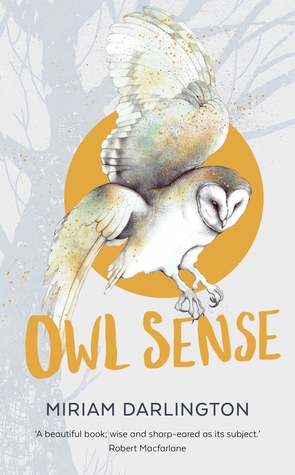 Initially the idea was to see all of Britain’s resident owls, but as often happens, the project expanded until Darlington was also taking trips to Serbia to find a Long-Eared Owl, Finland for a Eurasian Eagle Owl, and France for a Pygmy Owl; and going on a fruitless twitch to see a vagrant Snowy Owl in Cornwall. Each chapter considers a different species and includes information on its anatomy, geographical distribution, conservation status, and any associated myths and anecdotes (The Secret Life of the Owl by John Lewis-Stempel does much the same thing, but with less richness). She has closer encounters with some than with others: when volunteering with the Barn Owl Trust, she gets to ring chicks and collects pellets for dissection. But even the most fleeting sightings can be magical.
The book also subtly weaves in what was happening in Darlington’s life at the time, especially her son Benji’s struggles. On the autistic spectrum, he suddenly started having physical problems that were eventually explained by non-epileptic seizures. I would have welcomed more personal material, but that just speaks to my love of memoir. This feels slightly hurried and not quite as editorially polished as her master work, Otter Country, but it’s still well worth reading if you have any interest in birds or nature conservation. (I’ve only seen two owls in the wild: Barn and Tawny.) 
Fillets of Plaice by Gerald Durrell (1971)
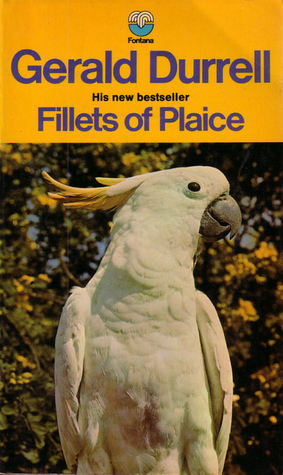 This is a pleasant miscellany of leftover essays that didn’t make it into any of Durrell’s other books. The best is “The Birthday Party,” about an incident from the Corfu years: Larry insisted on taking the fridge along on Mother’s birthday outing to an island, and their boat ran out of petrol. In “A Transport of Terrapins,” teenage Gerry works as a lowly pet shop assistant in London even though he knows twice as much as his boss; and meets other eccentric fellows, such as a bird collector and a retired colonel who has a house full of model figures for war gaming.
“A Question of Promotion” is set on one of the animal-collecting expeditions to Cameroon and turned me off a little with its colonial attitude: Durrell talks to the natives in condescending pidgin as he helps prepare a feast for the District Commissioner’s visit. In “A Question of Degrees” he visits two hospitals for a cataclysmic nosebleed, while “Ursula” is about a girlfriend who couldn’t open her mouth without uttering a malapropism. Entertaining scraps for diehard fans; if you’re new to Durrell, though, start with My Family and Other Animals and Menagerie Manor. 
The Unchangeable Spots of Leopards by Kristopher Jansma (2013)
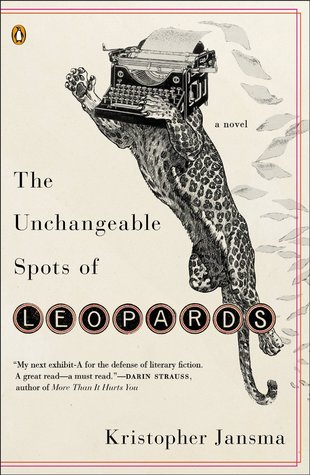 I’d meant to read Jansma’s debut ever since Why We Came to the City, his terrific novel about five university friends negotiating life in New York City during the recession, came out in 2016. I assumed the leopards of the title would be purely metaphorical – a reference to people not being able to change their inborn nature – and they are, but they’re also surprisingly literal in the one chapter set in Africa.
Jansma’s deliciously unreliable narrator, never named but taking on various aliases in these linked short stories, is a trickster, constantly reworking his life into fiction. He longs to be a successful novelist, but keeps losing his works in progress. We think we know the basics of his identity – he’s the son of a single mother who worked as a flight attendant; he grew up in North Carolina emulating the country club and debutante class; at Berkshire College he met his best friend and rival Julian McGann in creative writing class and fell for Julian’s friend Evelyn, the great unrequited love of his life – but Part II introduces doubt by calling the characters different names. Are these the ‘real’ people, or the narrator’s fictionalized versions?
The characters go on a bizarre odyssey that moves the setting from New York City to Nevada to Dubai to Sri Lanka to Ghana to Iceland to Luxembourg, finally ending up back in the very airport terminal where it started. As I remembered from Why We Came to the City, Jansma interleaves Greek mythology and allusions to other writers, especially F. Scott Fitzgerald. The coy way in which he layers fiction on fiction reminded me of work by John Boyne and Tom Rachman; other recommended readalikes are The Goldfinch and Orchid & the Wasp.
Four Recent Review Books: Flanery, James, Tota and Yuknavitch
Memoirs of adoption and a life steeped in trauma and sex; a metafictional mystery about an inscrutable artist and his would-be biographer; and a European graphic novel about a thief. You can’t say I don’t read a wide variety of books! See if one or more of these can tempt you.
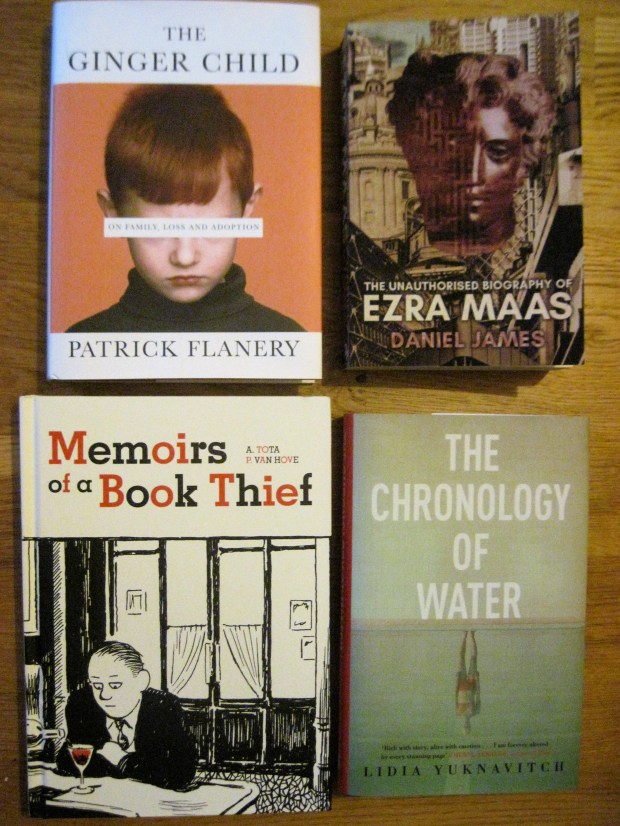
The Ginger Child: On Family, Loss and Adoption by Patrick Flanery
Patrick Flanery is a professor of creative writing at Queen Mary University of London and the author of four novels. In his first nonfiction book, he chronicles the arduous four-year journey he and his husband took to try and become parents. For a short time they considered surrogacy, but it’s so difficult in the UK that they switched tracks to domestic adoption.
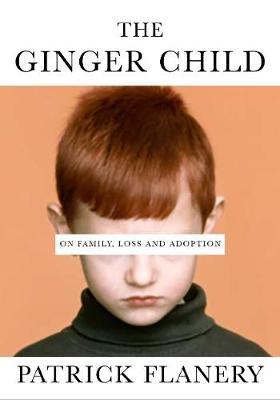 The resulting memoir is a somber, meditative book that doesn’t gloss over the difficulties of queer family-making, but also sees some potential advantages: to an extent, one has the privilege of choice – he and Andrew specified that they couldn’t raise a child with severe disabilities or trauma, but were fine with one of any race – whereas biological parents don’t really have any idea of what they’re going to get. However, same-sex couples are plagued by bureaucracy and, yes, prejudice still. Nothing comes easy. They have to fill out a 50-page questionnaire about their concerns and what they have to offer a child. A social worker humiliates them by forcing them to do a dance-off video game to prove that a pair of introverted, cultured academics can have fun, too.
Eventually there’s a successful match and they have tentative meetings with four-year-old O—, his parents’ fifth child, now in foster care. But this is not a blithe story of everything going right. I enjoyed the glimpses of Flanery’s growing-up years in Nebraska and the occasional second-person address to O—, but there is a lot more theory and cultural criticism than I expected, and much of the film talk, at least, feels like irrelevant asides.
With thanks to Atlantic Books for the free copy for review.
The Unauthorised Biography of Ezra Maas by Daniel James
This is a twisty, clever meta novel about “Daniel James” desperately trying to write a biography of Ezra Maas, an enigmatic artist who grew up a child prodigy in Oxford and attracted a cult following in 1960s New York City, where he was a friend of Warhol et al. But, with rumors abounding that The Maas Foundation is preparing to announce Ezra’s death in 2011, James finds that his subject’s story keeps shifting shape and even disappearing around him – as one interviewee tells him, “Maas is a black hole. His presence draws everything in, warps, destroys, changes, and rewrites it.”
 The book’s epistolary style deftly combines fragments of various document types: James’s biography-in-progress and an oral history he’s assembled from conversations with those who knew Maas, his narrative of his quest, transcripts of interviews and phone conversations, e-mails and more. All of this has been brought together into manuscript form by an anonymous editor whose presence is indicated through coy but increasingly tiresome long footnotes.
Look at the sort of authors who get frequent mentions in the footnotes, though, and you’ll get an idea of whether this might appeal to you: Paul Auster, Samuel Beckett, George Orwell and Thomas Pynchon. I enjoyed the noir atmosphere – complete with dream sequences and psychiatric evaluations – and the way that James the “writer-detective” has to careen around Europe and America looking for answers; it all feels rather like a superior Jason Bourne film.
My thanks to the author for sending a free signed copy for review.
Memoirs of a Book Thief by Alessandro Tota (illustrated by Pierre Van Hove)
[translated from the French by Edward Gauvin]
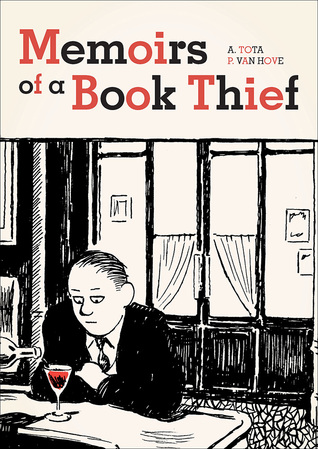 In April 1953, Daniel Brodin translates an obscure Italian poem in his head to recite at a poetry reading but, improbably, someone recognizes it. Soon afterwards, he’s also caught stealing a book from a shop. Just a little plagiarism and shoplifting? It might have stayed that way until he met Gilles and Linda, fellow thieves, and their bodyguard, Jean-Michel, a big blond goon with Gérard Dépardieu’s nose and haircut. Now he’s known as “Klepto” and is part of a circle that drinks at the Café Sully and mixes with avant-garde and Existentialist figures. He’s content with being a nobody and writing his memoirs (the book within the book) – until Jean-Michel makes him a proposition.
The book is entirely in black and white, which makes it seem unfinished, and the style is a little grotesque. For instance, Brodin is almost always depicted with beads of sweat rolling off his head. The intricate outdoor scenes were much more to my taste than the faces. The plot is also slightly thin and the ending abrupt. So, compared with many other graphic novels, this is not one I’m likely to recommend. 
With thanks to SelfMadeHero for the free copy for review.
The Chronology of Water by Lidia Yuknavitch
This really blew me away. “Out of the sad sack of sad shit that was my life, I made a wordhouse,” Yuknavitch writes. Her nonlinear memoir ranges from her upbringing with an alcoholic, manic-depressive mother and an abusive father via the stillbirth of her daughter and her years of alcohol and drug use through to the third marriage where she finally got things right and allowed herself to feel love again after so much numbness. Reading this, you’re amazed that the author is still alive, let alone thriving as a writer.
 Ken Kesey, who led a collaborative novel-writing workshop in which she participated in the late 1980s, once asked her what the best thing was that ever happened to her. Swimming, she answered, because it felt like the only thing she was good at. In the water she was at home and empowered. Kesey reassured her that swimming wasn’t her only talent: there is some truly dazzling writing here, veering between lyrical stream-of-consciousness and in-your-face informality.
There are so many vivid sequences, but two that stood out for me were cutting down a tree the Christmas she was four and the way her mother turned her teeth-chattering crisis into a survival game, and the drunken collision she had after her second ex-husband told her he was seeing a 23-year-old. With the caveat that this is extremely explicit stuff (the author is bisexual; there’s an all-female threesome and S&M parties), I would still highly recommend it to readers of Joan Didion, Anne Lamott and Maggie Nelson. The watery metaphor flowing through, as one woman learns to float free of what once threatened to drown her, is only part of what makes it unforgettable. You’ll marvel at what a memoir can do. 
A couple of favorite passages:
“It is possible to carry life and death in the same sentence. In the same body. It is possible to carry love and pain. In the water, this body I have come to slides through the wet with a history. What if there is hope in that?”
“Make up stories until you find one you can live with. Make up stories as if life depended on it.”
With thanks to Canongate for the free copy for review.
Would you be interested in reading one or more of these?
Last-Minute Booker Prize Predictions
The Man Booker Prize 2017 will be announced this evening (roughly 22:00 GMT, in my memory). Ever since the shortlist announcement I’ve felt that George Saunders is a shoo-in for Lincoln in the Bardo. I think he will win, and should. However, I’ve still only read four out of the six on the shortlist, so my predictions are not entirely based on personal knowledge of the books. I can’t say I’m hugely enthused about trying Auster or Hamid, but I’d be more likely to do so if either won.
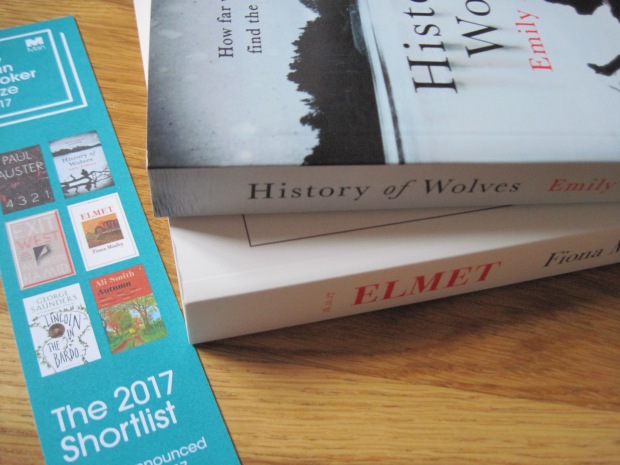
The two from the shortlist that I own + the annual bookmark, picked up from the public library.
Here, in what I predict is their descending order of likelihood to win, are the six shortlisted titles, with a pithy three words on why each one would take the prize:
Lincoln in the Bardo by George Saunders – Something actually novel.
Exit West by Mohsin Hamid – Timely re: refugees.
Autumn by Ali Smith – Timely re: Brexit.
4 3 2 1 by Paul Auster – Great American Novel.
Elmet by Fiona Mozley – Gorgeous, talented debut.
History of Wolves by Emily Fridlund – Haunting, underrated debut.
What have you managed to read from the Booker shortlist? How do your predictions match up against mine?
Final Thoughts on the Booker Longlist
On Wednesday the 13th the Man Booker Prize shortlist will be announced. I’d already reviewed six of the nominees and abandoned one; in the time since the longlist announcement I’ve only managed to read another one and a bit. That leaves four I didn’t get a chance to experience. Here’s a run-through of the 13 nominees, with my brief thoughts on each.
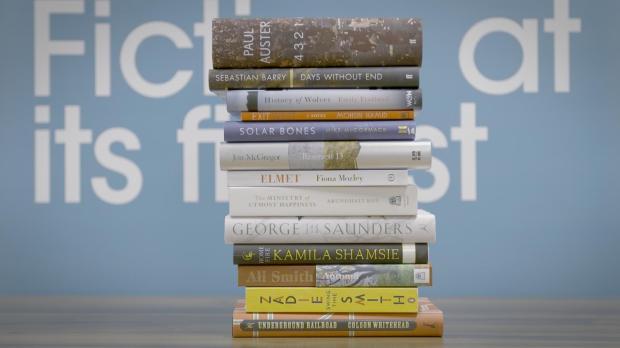
4 3 2 1 by Paul Auster (US) (Faber & Faber): I can’t see myself reading this one any time soon; I’ll choose a shorter work to be my first taste of Auster’s writing. I’ve heard mostly good reports, though.
Days Without End by Sebastian Barry (Ireland) (Faber & Faber): Read in March 2017. This is my overall favorite from the longlist so far. (See my BookBrowse review.) However, it’s already been recognized with the Costa Prize and the Walter Scott Prize for historical fiction, so if it doesn’t make the Booker shortlist I certainly won’t be crushed.
History of Wolves by Emily Fridlund (US) (Weidenfeld & Nicolson): Read in March 2017. A slow-building coming-of-age story with a child’s untimely death at its climax. Fridlund’s melancholy picture of outsiders whose skewed thinking leads them to transgress moral boundaries recalls Lauren Groff and Marilynne Robinson. (Reviewed for the Times Literary Supplement;  )
)
Exit West by Mohsin Hamid (Pakistan-UK) (Hamish Hamilton): I don’t have much interest in reading this one at this point; I didn’t get far in the one book I tried by Hamid (The Reluctant Fundamentalist) earlier this year. I’ve encountered mixed reviews.
Solar Bones by Mike McCormack (Ireland) (Canongate): If you’ve heard anything about this, it’s probably that the entire book is composed of one sentence. Now here’s an embarrassing admission: I didn’t make it past the first page.
Reservoir 13 by Jon McGregor (UK) (4th Estate): I read the first 15% last month and set it aside. I knew what to expect – lovely descriptions of the natural world and the daily life of a small community – but I guess hadn’t fully heeded the warning that nothing much happens. I won’t rule out trying this one again in the future, but for now it couldn’t hold my interest.
Elmet by Fiona Mozley (UK) (JM Originals): Read in August 2017. Simply terrific. (See my full blog review.) Overall, this dark horse selection is in second place for me. I’d love to see it make it through to the shortlist. 
The Ministry of Utmost Happiness by Arundhati Roy (India) (Hamish Hamilton): I was never a huge fan of The God of Small Things, so this is another I’m not too keen to try.
Lincoln in the Bardo by George Saunders (US) (Bloomsbury Publishing): Read in April 2017. An entertaining and original treatment of life’s transience. I enjoyed the different registers Saunders uses for his characters, but was less convinced about snippets from historical texts. So audacious it deserves a shortlist spot; I wouldn’t mind it winning.
Home Fire by Kamila Shamsie (UK-Pakistan) (Bloomsbury Circus): This is the one book from the longlist that I most wish I’d gotten a chance to read. It’s been widely reviewed in the press as well as in the blogging world (A life in books, Elle Thinks, and Heavenali), generally very enthusiastically.
Autumn by Ali Smith (UK) (Hamish Hamilton): Read in November 2016. (See my blog review.) While some of Smith’s strengths benefit from immediacy – a nearly stream-of-consciousness style (no speech marks) and jokey dialogue – I’d prefer a more crafted narrative. In places this was repetitive, with the seasonal theme neither here nor there. 
Swing Time by Zadie Smith (UK) (Hamish Hamilton): Read in October 2016 for a BookBrowse review. The Africa material wasn’t very convincing, and the Aimee subplot and the way Tracey turns out struck me as equally clichéd. The claustrophobic narration makes this feel insular. A disappointment compared to White Teeth and On Beauty.
The Underground Railroad by Colson Whitehead (US) (Fleet): Read in July 2017. (See my blog review.) I’m surprised such a case has been made for the uniqueness of this novel based on a simple tweak of the historical record. I felt little attachment to Cora and had to force myself to keep plodding through her story. Every critic on earth seems to love it, though.
If I had to take a guess at which six books will make it through Wednesday and why, I’d say:
- 4 3 2 1 by Paul Auster – A chunkster by a well-respected literary lion.
- Exit West by Mohsin Hamid – A timely refugee theme and a touch of magic realism.
- Solar Bones by Mike McCormack – Irish stream-of-consciousness. Channel James Joyce and you’ll impress all the literary types.
- Lincoln in the Bardo by George Saunders – Effusive in tone and cutting-edge in form.
- Autumn by Ali Smith – Captures the post-Brexit moment.
- The Underground Railroad by Colson Whitehead – Though it’s won every prize going, the judges probably think they’d be churlish to pass it by.
By contrast, if I were asked for the six I would prefer to be on the shortlist, and why, it’d be:
- Days Without End by Sebastian Barry – Pretty much unforgettable.
- History of Wolves by Emily Fridlund – A haunting novel that deserves more attention.
- Reservoir 13 by Jon McGregor – Though it’s not my personal favorite, I support McGregor.
- Elmet by Fiona Mozley – A nearly flawless debut. Give the gal a chance.
- Lincoln in the Bardo by George Saunders – Show-offy, but such fun to read.
- Home Fire by Kamila Shamsie – Timely and well crafted, by all accounts.
That would be three men and three women, if not the best mix of countries. I’d be happy with that list.
What have you managed to read from the Booker longlist? How do your predictions match up against mine?
Literary Power Couples: An Inventory
With Valentine’s Day on the way, I’ve been reading a bunch of books with “Love” in the title to round up in a mini-reviews post next week. One of them was What I Loved by Siri Hustvedt – my second taste of her brilliant fiction after The Blazing World. Yet I’ve not tried a one of her husband Paul Auster’s books. There’s no particular reason for that; I’ve even had his New York Trilogy out from the library in the past, but never got around to reading it.
How about some other literary power couples? Here’s some that came to mind, along with an inventory of what I’ve read from each half. It’s pretty even for the first two couples, but in most of the other cases there’s a clear winner.
Zadie Smith: 5
Nick Laird: 5 (= ALL)
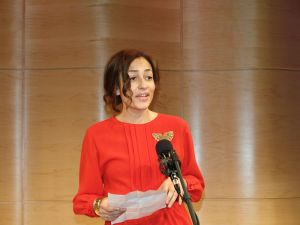
Zadie Smith in 2011. By David Shankbone (CC BY 3.0 (http://creativecommons.org/licenses/by/3.0) via Wikimedia Commons.
I’ve read all of Zadie Smith’s work apart from NW; I only got a few pages into it when it first came out, but I’m determined to try again someday. To my surprise, I’ve read everything her husband Nick Laird has ever published, which includes three poetry collections and two fairly undistinguished ‘lad lit’ novels. I’m pleased to see that his new novel Modern Gods, coming out on June 27th, is about two sisters and looks like a stab at proper literary fiction.
Jonathan Safran Foer: 4 (= ALL)
Nicole Krauss: 3 (= ALL)
Alas, they’re now an ex-couple. In any case, they’re both on the fairly short list of authors I’d read anything by. Foer has published three novels and the nonfiction polemic Eating Animals. Krauss, too, has three novels to her name, but a new one is long overdue after the slight disappointment of 2010’s Great House.
Margaret Drabble: 5
Michael Holroyd: 0
Michael Holroyd is a biographer and general nonfiction dabbler. I have a few of his books on my TBR but don’t feel much compulsion to seek them out. By contrast, I’ve read four novels and a memoir by Margaret Drabble and am likely to devour more of her fiction in the future.

Margaret Drabble in 2011. By summonedbyfells [CC BY 2.0 (http://creativecommons.org/licenses/by/2.0)%5D via Wikimedia Commons.
Claire Tomalin: 2
Michael Frayn: 1
Claire Tomalin’s masterful biographies of Charles Dickens and Thomas Hardy are pillars of my nonfiction collection, and I have her books on Nelly Ternan and Samuel Pepys on the shelf to read as well. From her husband, celebrated playwright Michael Frayn, however, I’ve only read the comic novel Skios. It is very funny indeed, though, about a case of mistaken identity at an academic conference on a Greek island.
Plus a few I only recently found out about:
Ian McEwan: 7 (+ an 8th in progress)
Annalena McAfee: 1 (I’ll be reviewing her novel Hame here on Thursday)
Katie Kitamura: 1 (I just finished A Separation yesterday)
Hari Kunzru: 0
Madeleine Thien: 1 (Do Not Say We Have Nothing)
Rawi Hage: 0
Afterwards I consulted the lists of literary power couples on Flavorwire and The Huffington Post and came up with a few more that had slipped my mind:
Michael Chabon: 1
Ayelet Waldman: 0
I loved Moonglow and am keen to try Michael Chabon’s other novels, but I also have a couple of his wife Ayelet Waldman’s books on my TBR.
Dave Eggers: 5
Vendela Vida: 0
I’ve read a decent proportion of Dave Eggers’s books, fiction and nonfiction, but don’t know anything by his wife and The Believer co-founder Vendela Vida.
David Foster Wallace: 2
Mary Karr: 1
I didn’t even know they were briefly a couple. From Wallace I’ve read the essay collection Consider the Lobster and the commencement address This Is Water. I’ve definitely got to get hold of Karr’s memoirs, having so far only read her book about memoir (The Art of Memoir).
And some classics:
Ted Hughes: 1 (Crow)
Sylvia Plath: 0
F. Scott Fitzgerald: 2 (The Great Gatsby and Tender Is the Night)
Zelda Fitzgerald: 0
![F. Scott and Zelda Fitzgerald in 1921. By Kenneth Melvin Wright (Minnesota Historical Society) [Public domain], via Wikimedia Commons.](https://bookishbeck.com/wp-content/uploads/2017/02/f_scott_fitzgerald_and_wife_zelda_september_1921.jpg?w=208&h=300)
F. Scott and Zelda Fitzgerald in 1921. By Kenneth Melvin Wright (Minnesota Historical Society) [Public domain], via Wikimedia Commons.
How have you fared with these or other literary power couples? Do you generally gravitate towards one or the other from a pair?
 Bookish Beck = Rebecca Foster. American transplant to England. Freelance proofreader and book reviewer.
