20 Books of Summer, 14–16: Barba, Bersweden and Solnit
I’m all about flowers today: American wildflowers in poetry and prose, a year of hunting down the flora of the British Isles, and a discursive account of a famous English author’s life and times through the prism of his rose garden.
American Wildflowers: A Literary Field Guide, ed. Susan Barba; illus. Leanne Shapton (2022)
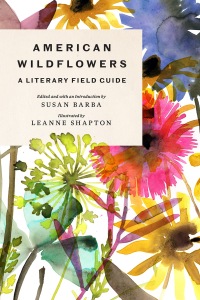 This comes out from Abrams Press in the USA on 8 November and I’ll be reviewing it for Shelf Awareness, so I’ll just give a few brief thoughts for now. Barba is a poet and senior editor for New York Review Books. She has collected pieces from a wide range of American literature, including essays, letters and early travel writings as well as poetry, which dominates.
Apart from a closing section on various/anonymous wildflowers, where particular species are named they are grouped into families, which are arranged alphabetically. The Asteraceae section is particularly strong, with poems on dandelions and sunflowers, a typically prophetic Aldo Leopold fragment about the decline of native flora, and “Asters and Goldenrod,” an extract from Robin Wall Kimmerer’s Braiding Sweetgrass (itself one of my 20 Books of Summer – review to come in the week) that I think was also excerpted in This Book Is a Plant.
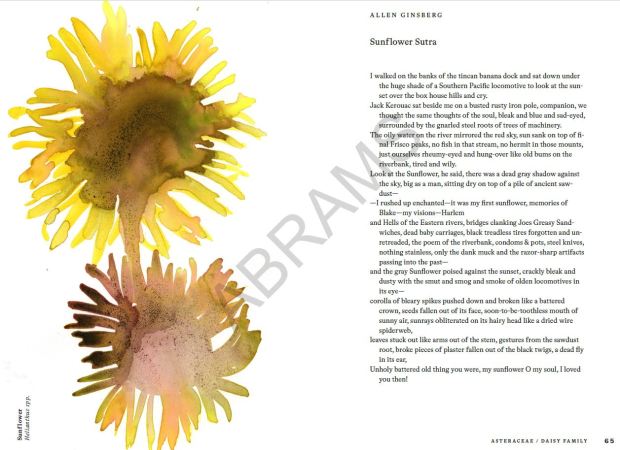
Sample two-page spread with a Leanne Shapton watercolor and part of an Allen Ginsberg poem.
In general, I engaged more with the poetry than with the prose. Barba has ensured a real variety of styles, with good representation for BIPOC. What draws it all together into a beautiful whole I wish I could see as a physical object is Leanne Shapton’s watercolor illustrations, painted from pressed flowers. “What a gift to stare at flowers—these ephemeral miracles of color and synthesis and botany,” she writes in an opening note. This would be a perfect coffee table book for any gardener or nature lover. (E-review copy)
Where the Wildflowers Grow: My Botanical Journey through Britain and Ireland by Leif Bersweden (2022)
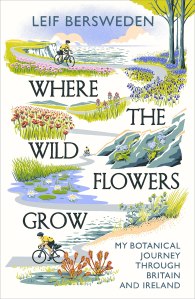 A good case of nominative determinism – the author’s name is pronounced “leaf” – and fun connections abound: during the course of his year-long odyssey, he spends time plant-hunting with Jon Dunn and Sophie Pavelle, whose books featured earlier in my flora-themed summer reading: Orchid Summer and Forget Me Not. With Dunn on Unst, Shetland, he sees not only rare flowers but close-up orcas. Like Pavelle, who he meets up with in Cornwall, he has an eye to how species will be affected by climate change and commits to doing his hunting by train and bike; there’s only so much you can see when zooming by in a car. Bersweden makes a case for spending time with plants – after all, they don’t move, so once you’ve found them you can commune in a way you can’t during, say, a fleeting mammal encounter.
He starts 2021 with a New Year Plant Hunt in central London with his mother – more is in bloom in January than ever before, at least in part due to climate warming. Even when the weather is foul on his travels, there is plenty to be seen. Everywhere he goes, he meets up with fellow experts and plant enthusiasts to marvel at bluebell woodlands or ancient pine forests, alpine or bog species. The floral circuit (documented in full on the book’s website through chapter-by-chapter photographs; there are two small sections of colour plates in the hardback) is also a chance to tour the British Isles, from Kent to Cork, coast to mountaintop.
Bersweden has been in love with plants ever since childhood; he believes they have nostalgia value for many people, and can be an easy way into appreciation of nature. “A wildflower growing from a crack in the wall is an everyday miracle.” His casual writing style and clear zeal for his subject – his author photo is of him hugging a tree, and another has such a cute caption: “Being given the opportunity to hold a Greater Bladderwort (Utricularia vulgaris) was one of the best things that’s ever happened to me!” – make this a pleasure even though it’s a bit overlong at points. (Public library)
Orwell’s Roses by Rebecca Solnit (2021)
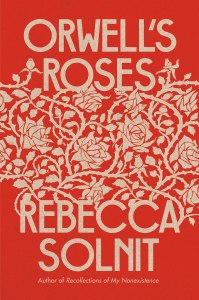 I was fascinated by the concept behind this one. “In the spring of 1936 a writer planted roses” is Solnit’s refrain; from there sprawls a book that’s somehow about everything: botany, geology, history, politics and war – as well as, of course, George Orwell’s life and works (with significant overlap with the graphic novel biography of him that I read last year). On a trip to England with a friend who is a documentary filmmaker, Solnit had the impulse to go find what might be left of Orwell’s garden. When she arrived in the Hertfordshire village of Wallington, the current owners of his home kindly showed her round. His fruit trees had long since been cut down, but the rosebushes were still going strong some 80 years later.
This goes down as a skim for me: though I read the first 30%, after that I just browsed to the end. Some side tracks lost me, e.g. Tina Modotti’s presentation of roses in her photographs; Orwell’s interest in mining, which leads Solnit to investigate how coal is formed; much history; and a week spent observing the rose-growing industry in Colombia. I most enjoyed the book when it stayed close to Orwell’s biography and writings, positing gardening as his way of grounding his ideas in the domestic and practical. “Pursuits like that can bring you back to earth from the ether and the abstractions.” I also liked – briefly, at least – thinking about the metaphorical associations of roses, and flowers in general.
If you’ve read Solnit before, you’ll know that her prose is exquisite, but I think this was the stuff of a long article rather than a full book. As it is, it’s a pretty indulgent project. (Kaggsy reviewed this recently and came to somewhat similar conclusions.) (NetGalley)
20 Books of Summer 2022: Flora Theme
It’s my fifth year participating in Cathy’s 20 Books of Summer challenge, which starts tomorrow. Each year I choose a theme. Thus far I’ve done books by women; animals; food and drink; and colours. This year will be all about flora; mostly trees, I reckon. As always, I’ll interpret the theme loosely and include titles, authors and covers that seem apt for whatever reason.
I have lots to choose from. Here’s the stacks from my shelves, divided into fiction and non-:


And a relevant recent haul from the library:
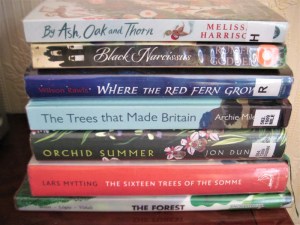
There will be other options on my Kindle too, such as Orwell’s Roses by Rebecca Solnit.
I’m eyeing these up as my first four:


(Nina Mingya Powles also kicked off my 2020 foodie reading!)

Are you joining in the summer reading challenge? What’s the first book on the docket?
Review Catch-Up: Brackenbury, McLaren, Wellcome Collection
As usual, I have a big backlog of 2021–22 releases I’m working my way through. I’ll get there eventually! Today I’m reporting on a poetry collection about English ancestry and wildlife, a vision of post-doubt Christian faith, and a set of essays on connection to nature, specifically flora. (I also take a brief look at some autofiction that didn’t work for me.)
Thorpeness by Alison Brackenbury (2022)
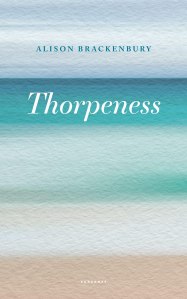 I’m familiar with Brackenbury from her appearance at New Networks for Nature in 2016 and her latest selected poems volume, Gallop. This, her tenth stand-alone collection, features abundant imagery of animals and the seasons, as in “Cucu” and “Postcard,” which marks the return of swifts. Alliteration is prominent, but there is also a handful of rhymes, like in “Fern.” Family history and the perhaps-idyllic rural underpin the verse set in Lincolnshire and Gloucestershire as Brackenbury searches for ancestral graves and delivers elegies.
I especially loved “Aunt Margaret’s Pudding,” a multipart poem about her grandmother’s life as a professional cook and then a mother of four, and “My Grandmother Waits for Christmas,” about a simple link between multiple generations’ Christmases: a sugar mouse. Caring for horses is another recurring theme; a 31-year-old blind pony receives a fond farewell.
There are also playful meetings between historical figures (“Purple Haze,” a dialogue between George Frideric Handel and Jimi Hendrix, who saw the composer’s ghost in their shared London home) and between past and contemporary, like “Thomas Hardy sends an email” (it opens “I need slide no confessions under doors”). “Charles Dickens at Home” was another favourite of mine. The title is the never-to-be-reached destination in the final poem, “Shingle.” A number of these poems were first broadcast on BBC Radio. 
With thanks to Carcanet Press for the e-copy for review.
Faith after Doubt: Why Your Beliefs Stopped Working and What to Do about It by Brian McLaren (2021)
I’ve explained before how McLaren’s books were pivotal to my spiritual journey, even before I attended the church he founded in Maryland. (I’ve also reviewed his previous book, God Unbound). His progressive, environmentalist theology is perfect for continuing searchers like me. At one of last year’s online Church Times Festival events, I saw him introduce the schema that underpins this book. He proposes that the spiritual life (not just Christian) has four stages that may overlap or repeat: simplicity, complexity, perplexity and harmony. The first stage is for new zealots who draw us–them divisions and are most concerned with orthodoxy. In the second, practitioners are more concerned with practicalities: what works, what makes life better. Perplexity is provoked by cynicism about injustice and hypocrisy, while harmony moves beyond dualism and into connection with other people and with nature.
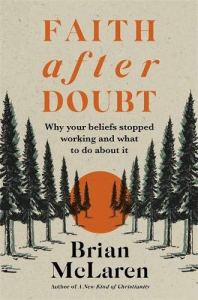 McLaren suggest that honest doubting, far from being a problem, might present an opportunity for changing in the right direction, getting us closer to the “revolutionary love” at the heart of the gospel. He shares stories from his own life, in and out of ministry, and from readers who have contacted him remotely or come up to him after events, caught in dilemmas about what they believe and whether they want to raise their children into religion. Though he’s fully aware of the environmental crisis and doesn’t offer false hope that we as a species will survive it, he isn’t ready to give up on religion; he believes that a faith seasoned by doubt and matured into an understanding of the harmony of all things can be part of a solution.
It’s possible some would find McLaren’s ideas formulaic and his prose repetitive. His point of view always draws me in and gives me much to think about. I’ve been stuck in perplexity for, ooh, 20 years? I frequently ask myself why I persist in going to church when it’s so boring and so often feels like a social club for stick-in-the-mud white people instead of a force for change. But books like this and Robin Wall Kimmerer’s Braiding Sweetgrass, my current soul food, encourage me to keep pursuing spiritual connection as a worthwhile path. I’ll be seeking out his forthcoming book (due out in May), Do I Stay Christian?, too.
Some favourite lines:
“only doubt can save the world. Only doubt will open a doorway out of hostile orthodoxies – whether religious, cultural, economic or political. Only through the difficult passage of doubt can we emerge into a new stage of faith and a new regenerative way of life. Everything depends on making this passage.”
“Among all the other things doubt is – loss, loneliness, crisis, doorway, descent, dissent [these are each the subject of individual chapters early on in the book] – it is also this: a crossroads. At the crossroads of doubt, we either become better or bitter. We either break down or break through. We become cynics or sages, hollow or holy. We choose love or despair.”
“Blessed are the wonderers, for they shall find what is wonderful. … Blessed are the doubters, for they shall see through false gods. Blessed are the lovers, for they shall see God everywhere.”
With thanks to Hodder & Stoughton for the free copy for review.
This Book Is a Plant: How to Grow, Learn and Radically Engage with the Natural World (2022)
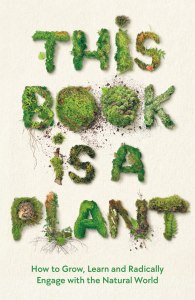 This collection of new essays and excerpts from previously published volumes accompanies the upcoming Wellcome Collection exhibition Rooted Beings (a collaboration with La Casa Encendida, Madrid, it’s curated by Bárbara Rodríguez Muñoz and Emily Sargent and will run from 24 March to 29 August). The overarching theme is our connection with plants and fungi, and the ways in which they communicate. Some of the authors are known for their nature writing – there’s an excerpt from Merlin Sheldrake’s Entangled Life, Jessica J. Lee (author of Turning and Two Trees Make a Forest) contributes an essay on studying mosses, and a short section from Kimmerer’s Braiding Sweetgrass closes the book – while others are better known in other fields, like Susie Orbach and Abi Palmer (author of Sanatorium).
I especially enjoyed novelist Rowan Hisayo Buchanan’s “Wilder Flowers,” which is about landscape painting, balcony gardening in pots, and what’s pretty versus what’s actually good for nature. (Wildflowers aren’t the panacea we are sometimes sold.) I was also interested to learn about quinine, which comes from the fever tree, in Kim Walker and Nataly Allasi Canales’ “Bitter Barks.” Sheila Watt-Cloutier’s essay on the Western influence on Inuit communities in northern Canada, reprinted from Granta, is one of the best individual pieces – forceful and with a unique voice, it advocates reframing the climate change debate in terms of human rights as opposed to the economy – but has nothing to do with plants specifically. There are also a couple of pieces that go strangely mystical, such as one on plant metaphors in the Kama Sutra. So, a mixed bag that jumbles science, paganism and postcolonial thought, but if you haven’t already encountered the Kimmerer and Sheldrake (or, e.g., Rooted by Lyanda Lynn Haupt and Losing Eden by Lucy Jones) you might find this a good primer. 
With thanks to Profile Books / Wellcome Collection for the free copy for review.
And one that really didn’t work for me; my apologies to the author and publisher.
I Love You but I’ve Chosen Darkness by Claire Vaye Watkins (2021)
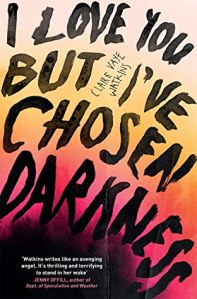 What a letdown after Gold Fame Citrus, one of my favourite novels of 2015. I’d also read Watkins’s debut short story collection, Battleborn, which won the Dylan Thomas Prize. Despite the amazing title and promising setup – autofiction that reflects on postpartum depression and her Mojave Desert upbringing as a daughter of one of the Manson Family cult members – this is indulgent, misguided, and largely unreadable.
A writer named Claire Vaye Watkins flies to Nevada to give a lecture and leaves her husband and baby daughter behind – for good? To commemorate her mother Martha, who died of an opiate overdose, she reprints Martha’s 1970s letters, which are unspeakably boring. I feel like Watkins wanted to write a memoir but didn’t give herself permission to choose nonfiction, so tried to turn her character Claire’s bad behaviour into a feminist odyssey of sexual freedom and ended up writing such atrocious lines as the below:
“I mostly boinked millennial preparers of beverages and schlepped to book festivals to hook up with whatever adequate rando lurked at the end of my signing line. This was what our open marriage looked like”
“‘Psychedelics tend to find me when I need them,’ she said, sending a rush of my blood to my vulva.”
Her vagina dentata (a myth, or a real condition?!) becomes a bizarre symbol of female power and rage. I could only bear to skim this. 
Some lines I liked:
Listen: I am a messenger from the future. I am you in ten years. Pay attention! Don’t fetishize marriage and babies. Don’t succumb to the axial tilt of monogamy! I don’t pretend to know the details of your…situation, but I guarantee you, you’re as free as you’ll ever be. Have sex with anyone you want. Enjoy the fact that it might happen any minute. You could have sex with a man, a woman, both—tonight!
I went from being raised by a pack of coyotes to a fellowship at Princeton where I sat next to John McPhee at a dinner and we talked about rocks and he wasn’t at all afraid of me.
With thanks to riverrun for the proof copy for review.
Would you be interested in reading one or more of these?
Ladders to Heaven: The Secret History of Fig Trees
 A whole book about fig trees? That’s right! If you’re a voracious nonfiction reader like me, you’ll find freelance journalist Mike Shanahan’s history of fig trees unexpectedly fascinating. It opens with him atop a series of ladders in a national park in Borneo, reaching past a venomous snake to pick some figs. He did many such exciting things in his research towards a PhD in rainforest ecology, but that 1998 encounter was significantly more intrepid than his earliest experience with the genus: he remembers a potted weeping fig in the hallway of his childhood home.
From that little tree to the largest banyans, Ficus encompasses 750+ species and has had a major place in human culture for millennia. Fig trees turn up in Greek origin myths and are sacred to Hindus. Romulus and Remus were rescued from drowning in the Tiber by fig tree roots. The tree the Buddha sat under to meditate? A fig. The fruit Adam and Eve ate in the Garden of Eden? More likely a fig than an apple given the Middle Eastern climate and the fact that they then sew fig leaves together to cover their nakedness. (The confusion may have come about because in Latin malum means either “apple” or “evil”.)
Figs offer some biological surprises. For one thing, the plants have no apparent flowers. That’s because the flowers are internal: a fig is not technically a fruit but a hollow ball lined with tiny flowers that must be pollinated by two-millimeter-long fig-wasps. Strangler figs colonize a host tree, starting as a seed in the canopy and enveloping it in long tangled roots. Many tropical birds and mammals rely on figs, including monkeys and hornbills. Figs were, Shanahan writes, the “original superfood” for our primate ancestors.
The habitats where fig trees thrive face severe challenges, including drought, forest fires and poaching. However, history offers encouraging examples of how fig species can be key to tropical forest restoration. After a volcano erupted on Papua New Guinea in 1660, for example, the razed land was fairly quickly recolonized by Ficus species from seeds dropped by birds and bats – a prerequisite for wildlife returning. Similarly, fig trees were all that remained of the forest on Krakatoa after its famous volcanic eruption in 1883.
Building on this precedent, the Forest Restoration Research Unit, based in Thailand, now uses fig species to kickstart the restitution of tropical landscapes; one in every five of their plantings is a fig. Likewise, figs can be used to restore post-mining landscapes and lock up carbon. Researchers are looking into using drones to collect and deposit the seeds.
I’d never realized how often figs show up in the historical record, or how dependent on them we and other creatures have been. “Look after fig trees and they will look after you. It’s a lesson we have all but forgotten, but one we could learn again,” Shanahan concludes. Have a look at the bibliography and you’ll see just how much information is synthesized into this short, engaging book. It’s another gorgeous design from Unbound, too: the colorful cover was what first attracted me, and the author’s black-and-white pointillist illustrations adorn the text.

Nowadays I tend to think of figs as an exotic, luxury food. Every year we add some dried figs to our Christmas cake, creating caramel bursts of crunchy seeds. When my husband and I lived in Reading, we briefly had a LandShare arrangement to look after an established garden. Hidden behind a suburban fence, it was a secret paradise overflowing with fruit: plum, greengage and apple trees plus a fruit cage containing berries, currants, and – in one corner – a small fig. I remember one glorious late summer when we were inundated with more ripe figs than I’d ever seen before. We would heat them in the oven and serve them split open and oozing with goat’s cheese and runny honey. Our very own taste of Eden.
My rating:
Ladders to Heaven was first published by Unbound in 2016 and releases in paperback today, September 6th. My thanks to the publisher for the free copy for review.
Blog Tour: The Long Forgotten by David Whitehouse
Have you noticed how many botanical titles and covers are out there this year? If you appreciate this publishing trend as much as I do, and especially if you enjoyed Susan Orlean’s The Orchid Thief, I can highly recommend The Long Forgotten. David Whitehouse’s third novel features plant hunting everywhere from Chile to Namibia, but it opens underwater: Professor Jeremiah Cole is in a submersible 200 miles west of Perth, Australia. He’s running out of oxygen down there when he collides with a goose-beaked whale that pulls his craft to the surface. The injured whale soon dies, and when the professor’s crew brings its corpse on board to perform an autopsy, they discover in its belly the black box of Flight PS570, lost on its way from Jakarta to London 30 years ago and dubbed “The Long Forgotten.”
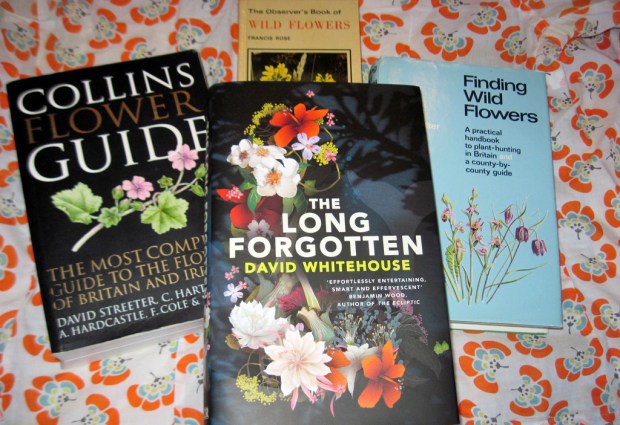
Whitehouse’s inspiration for the novel was the Malaysian Airlines flight that went missing in 2014, along with a story he read about the Rafflesia “corpse flower” 15 years ago. After the curious incident with the whale, more gentle magic is to come as we meet Dove, a lonely young man who works as an ambulance dispatcher in present-day London and starts tuning into the memories of Peter Manyweathers. In 1980s New York City, Peter gave up cleaning the houses of the dead to chase after the exotic plants mentioned in a love letter he found in an encyclopedia. Through a local botanical etching club he met Dr. Hens Berg, a memory researcher from Denmark, who encouraged him in the quest. Soon Peter was off to China and Gibraltar to find rare plants under a washing machine or along a steep cliff face. Along the way he fell in love and had to decide whom to trust and what was of most value to him.
How Peter and Dove are connected is a mystery whose unspooling is a continual surprise. I found it quite unusual that this novel ends with the plane crash; I can think of books that start with one, like Before the Fall by Noah Hawley, but no others that end on one. This late flashback to the crash, followed by a memorial service delivered by Prof. Cole, proves that the flight’s victims are far from forgotten. The mixture of genres, including magic realism, made me think of Haruki Murakami, and Whitehouse’s style is also slightly reminiscent of Joshua Ferris and Mark Haddon. Themes of memory and family, along with vivid scenes set around the globe and bizarre plants that trap sheep or reek of death, make this book stand out. If any of these elements even vaguely appeal to you, it’s well worth taking a chance on it.
A favorite passage:
“There on a ledge no bigger than an upturned hand was the Gibraltar campion. It was about forty centimeters high, with sun-kissed green leaves, no more interesting to the casual observer than any houseplant, quite ugly even. But nestled amongst the leaves, swaying, Peter found a small and beautifully detailed bilobed flower. White from a distance, up close an ethereal explosion of colour washed across the petals, from pink to purple. Elegant and soft, but surviving here, battered like a lighthouse by the wind and waves, a candle lit inside a tempest.
Peter was overcome by the sheer unlikeliness of its existence, and felt a kinship with the flower that seemed to distort him for a second. Above them, an infinite number of galaxies, planets and possibilities. Unknowns of a number that cannot be expressed. Yet here, on a protruding ledge and at the end of a rope, endless variables had colluded to bring him and the flower together.”
My rating:
The Long Forgotten was published by Picador on March 22nd. My thanks to the publisher for the free copy for review, and to Anne Cater for inviting me on the blog tour.
My Most Anticipated 2018 Releases, Part I
Here are 30 books that are on my radar for the months of January through June. This is by no means a full inventory of what’s coming out (or even of what I have available through NetGalley and Edelweiss); instead, think of it as a preview of the books I actually intend to read. This time my list seems strangely skewed towards plants (the covers too), with a couple of bird- and medical-themed reads in there too. Also: two feminist group biographies, plenty of historical fiction, some short stories, a bit of true crime, and a fair few memoirs. I hope you’ll find a book or two here to tempt you.
(The descriptions below are generally adapted from the publisher blurbs on Goodreads, NetGalley or Edelweiss. Some of these I already have access to in print or galley form; others I’m still on the look-out for. The list is in chronological order by first publication date; if multiple books release on the same day they are in alphabetical order by author surname.)
January
 On the Bright Side: The New Secret Diary of Hendrik Groen [Jan. 11, Michael Joseph (Penguin UK)]: I loved the first Hendrik Groen novel back in 2016 (reviewed here); this promises more of the same witty, bittersweet stories about elderly Dutch eccentrics. “Chaos will ensue as 85-year-old Hendrik Groen is determined to grow old with dignity … He dreams of escaping the confines of his care home and practising hairpin turns on his mobility scooter.” (NetGalley download)
 Writer’s Luck: A Memoir: 1976–1991 by David Lodge [Jan. 11, Harvill Secker]: I reviewed the first volume of Lodge’s memoirs, Quite a Good Time to Be Born, for Nudge back in 2015, so I’m eager to continue his life story in this second installment. “Readers of Lodge’s novels will be fascinated by the insights this book gives—not only into his professional career but also more personal experience. The main focus, however, is on writing as a vocation.”
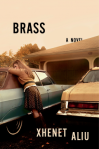 Brass: A Novel by Xhenet Aliu (for BookBrowse review) [Jan. 23, Random House]: “A waitress at the Betsy Ross Diner, Elsie hopes her nickel-and-dime tips will add up to a new life. Then she meets Bashkim, … who left Albania to chase his dreams. … Told in equally gripping parallel narratives with biting wit and grace, Brass announces a fearless new voice with a timely, tender, and quintessentially American story.” (NetGalley download)
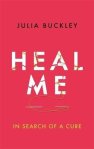 Heal Me: In Search of a Cure by Julia Buckley [Jan. 25, Weidenfeld & Nicolson]: The “search for a cure [for chronic pain] takes her on a global quest, exploring the boundaries between science, psychology and faith with practitioners on the fringes of conventional, traditional and alternative medicine. Rais[es] vital questions about the modern medical system … and the struggle to retain a sense of self.” (print review copy)
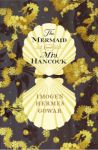 The Mermaid and Mrs. Hancock by Imogen Hermes Gowar [Jan. 25, Harvill Secker]: “A spellbinding story of curiosity, love and obsession from an astonishing new talent. One September evening in 1785, the merchant Jonah Hancock hears urgent knocking on his front door. One of his captains is waiting eagerly on the step. He has sold Jonah’s ship for what appears to be a mermaid.” Comes recommended by Elle. (NetGalley download)
February
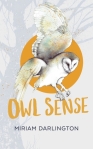 Owl Sense by Miriam Darlington [Feb. 6, Guardian Faber]: Darlington’s previous nature book, Otter Country, was stunning. Here, “Darlington sets out to tell a new story. Her fieldwork begins with wild encounters in the British Isles and takes her to the frosted borders of the Arctic. In her watching and deep listening to the natural world, she cleaves myth from reality and will change the way you think of this magnificent creature.”
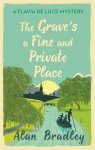 The Grave’s a Fine and Private Place by Alan Bradley [Feb. 8, Orion]: I’ve read all eight Flavia de Luce novels so far, which is worth remarking on because I don’t otherwise read mysteries and I usually find child narrators annoying. There’s just something delicious about this series set in 1950s England. This one will be particularly interesting because a life-changing blow came at the end of the previous book.
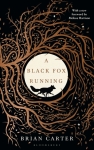 A Black Fox Running by Brian Carter [Feb. 8, Bloomsbury UK]: “A beautiful lost classic of nature writing” from 1981 that “sits alongside Tarka the Otter, Watership Down,” et al. “This is the story of Wulfgar, the dark-furred fox of Dartmoor, and of his nemesis, Scoble the trapper, in the seasons leading up to the pitiless winter of 1947. As breathtaking in its descriptions of the natural world as it is perceptive in its portrayal of damaged humanity.” Championed by Melissa Harrison.
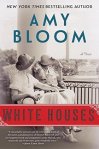 White Houses by Amy Bloom [Feb. 13, Random House]: The story of Lorena Hickock’s friendship/affair with Eleanor Roosevelt. “From Washington, D.C. to Hyde Park, from a little white house on Long Island to an apartment on Manhattan’s Washington Square, Amy Bloom’s new novel moves elegantly through fascinating places and times, written in compelling prose and with emotional depth, wit, and acuity.” (Edelweiss download)
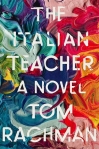 The Italian Teacher by Tom Rachman [Feb. 20, Riverrun/Viking]: I’m a huge fan of Rachman’s, especially his previous novel, The Rise & Fall of Great Powers. “1955: The artists are gathering together for a photograph. In one of Rome’s historic villas, a party is bright with near-genius, shaded by the socialite patrons of their art. … Rachman displays a nuanced understanding of twentieth-century art and its demons, vultures and chimeras.” (Edelweiss download)
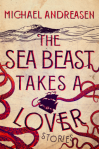 The Sea Beast Takes a Lover: Stories by Michael Andreasen [Feb. 27, Dutton (Penguin Group)]: “Romping through the fantastic with big-hearted ease, these stories cut to the core of what it means to navigate family, faith, and longing, whether in the form of a lovesick kraken slowly dragging a ship of sailors into the sea [or] a small town euthanizing its grandfathers in a time-honored ritual.” (NetGalley download)
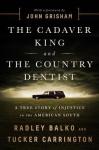 The Cadaver King and the Country Dentist: A True Story of Injustice in the American South by Radley Balko and Tucker Carrington [Feb. 27, PublicAffairs]: “After two three-year-old girls were raped and murdered in rural Mississippi, law enforcement pursued and convicted two innocent men, [who] spent a combined thirty years in prison before finally being exonerated in 2008. Meanwhile, the real killer remained free.”
March
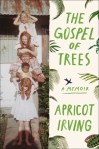 The Gospel of Trees: A Memoir by Apricot Irving [March 6, Simon & Schuster]: “Apricot Irving grew up as a missionary’s daughter in Haiti—a country easy to sensationalize but difficult to understand. Her father was an agronomist, a man who hiked alone into the hills … to preach the gospel of trees in a deforested but resilient country. Her mother and sisters, meanwhile, spent most of their days in the confines of the hospital compound they called home. As a child, this felt like paradise; as a teenager, the same setting felt like a prison.”
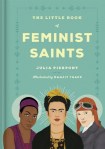 The Little Book of Feminist Saints by Julia Pierpont (illus. by Manjitt Thapp) [March 6, Random House]: This project reminds me a lot of A Glorious Freedom with its focus on women’s achievements and the full-color portraits of the subjects. I’ve just opened the file and the first two pieces give you a sense of the range that will be covered: Artemisia Gentileschi and Michelle Obama! (Edelweiss download)
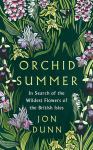 Orchid Summer: In Search of the Wildest Flowers of the British Isles by Jon Dunn [March 8, Bloomsbury UK]: Dunn’s were my favorite contributions to the Wildlife Trusts’ Seasons anthologies (e.g. Winter). I’ve also enjoyed following his botanical travels on Twitter. “From the chalk downs of the south coast of England to the heathery moorland of the Shetland Isles, and from the holy island of Lindisfarne in the east to the Atlantic frontier of western Ireland, Orchid Summer is a journey into Britain and Ireland’s most beautiful corners.”
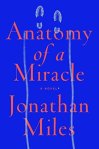 Anatomy of a Miracle by Jonathan Miles [March 13, Hogarth]: Miles’s previous novel, Want Not, is one of the books I most wish I’d written. “Rendered paraplegic after a traumatic event, Cameron Harris has been living his new existence alongside his sister, Tanya, in their battered Biloxi, Mississippi neighborhood where only half the houses made it through Katrina. … [A] stunning exploration of faith, science, mystery, and the meaning of life.”
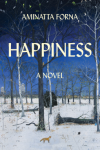 Happiness by Aminatta Forna [March 16, Grove Atlantic]: “London. A fox makes its way across Waterloo Bridge. The distraction causes two pedestrians to collide—Jean, an American studying the habits of urban foxes, and Attila, a Ghanaian psychiatrist there to deliver a keynote speech. … Forna’s unerring powers of observation show how in the midst of the rush of a great city lie numerous moments of connection.” (NetGalley download)
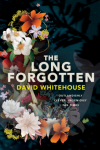 The Long Forgotten by David Whitehouse [March 22, Pan Macmillan/Picador]: “When the black box flight recorder of a plane that went missing 30 years ago is found at the bottom of the sea, a young man named Dove begins to remember a past that isn’t his. The memories belong to a rare flower hunter in 1980s New York, whose search led him around the world and ended in tragedy.” (NetGalley download)
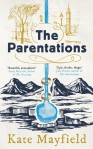 The Parentations by Kate Mayfield (to review for Shiny New Books?) [March 29, Oneworld]: From editor Jenny Parrott: “a stunning speculative historical novel … The story spans 200 years across Iceland and London, as a strange boy who can never die is surrounded by a motley collection of individuals, each with vested interests in his welfare. … [S]ome of the most extraordinary literary prose I’ve read during a thirty-year career.”
April
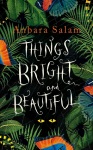 Things Bright and Beautiful by Anbara Salam [April 5, Fig Tree]: “1954, the South Pacific islands. When Beatriz Hanlon agreed to accompany her missionary husband Max to a remote island, she knew there would be challenges. But it isn’t just the heat and the damp and the dirt. There are more insects than she could ever have imagined, and the islanders are strangely hostile. [Then] an unexpected … guest arrives, and the couple’s claustrophobic existence is stretched to breaking point.” Sounds like Euphoria by Lily King. (NetGalley download)
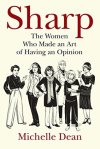 Sharp: The Women Who Made an Art of Having an Opinion by Michelle Dean [April 10, Grove Press]: “Dorothy Parker, Rebecca West, Hannah Arendt, Mary McCarthy, Susan Sontag, Pauline Kael, Joan Didion, Nora Ephron, Renata Adler, and Janet Malcolm—these brilliant women’s lives intertwine as they cut through the cultural and intellectual history of America in the twentieth century, arguing as fervently with each other as they did with the sexist attitudes of the men who often undervalued their work as critics and essayists.”
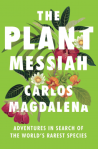 The Plant Messiah: Adventures in Search of the World’s Rarest Species by Carlos Magdalena [April 10, Doubleday]: “Carlos Magdalena is not your average horticulturist. He’s a man on a mission to save the world’s most endangered plants. … [He] takes readers from the Amazon to the jungles of Mauritius. … Back in the lab, we watch as he develops groundbreaking, left-field techniques for rescuing species from extinction, encouraging them to propagate and thrive once again.” (NetGalley download)
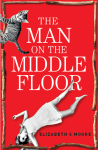 The Man on the Middle Floor by Elizabeth S. Moore (for blog tour) [April 12, RedDoor Publishing]: “Despite living in the same three-flat house in the suburbs of London, the residents are strangers to one another. … They have lived their lives separately, until now, when an unsolved murder and the man on the middle floor connect them. … It questions whether society is meeting the needs of the fast growing autistic section of society.” (print ARC)
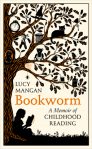 Bookworm: A Memoir of Childhood Reading by Lucy Mangan [April 24, Random House UK]: “This is a love letter to the joys of childhood reading, full of enthusiasm and wit, telling the colorful story of our best-loved children’s books, the extraordinary people who created them, and the thousand subtle ways they shape our lives.” (NetGalley download)
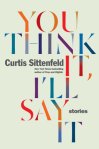 You Think It, I’ll Say It: Stories by Curtis Sittenfeld [April 24, Random House]: I would read anything Curtis Sittenfeld wrote; American Wife is still one of my absolute favorites. “The theme that unites these stories … is how even the cleverest people tend to misread others, and how much we all deceive ourselves. Sharp and tender, funny and wise, this collection shows [her] knack for creating real, believable characters that spring off the page.”
May
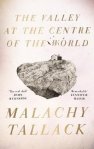 The Valley at the Centre of the World by Malachy Tallack [May 3, Canongate]: I’ve reviewed and enjoyed both of Tallack’s previous nonfiction works, including The Un-Discovered Islands. “Set against the rugged west coast of Shetland, in a community faced with extinction, [this] is a novel about love and grief, family and inheritance, rapid change and an age-old way of life. … [T]hese islanders must decide: what is left of us when the day’s work is done, the children grown, and all our choices have been made?”
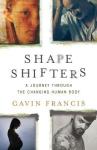 Shapeshifters: A Journey through the Changing Human Body by Gavin Francis [May 8, Basic Books]: “Francis considers the inevitable changes all of our bodies undergo—such as birth, puberty, and death, but also … those that only some of our bodies will: like getting a tattoo, experiencing psychosis, suffering anorexia, being pregnant, or undergoing a gender transition. … [E]ach event becomes an opportunity to explore the meaning of identity.”
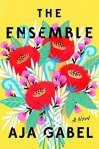 The Ensemble by Aja Gabel [May 15, Riverhead]: An “addictive debut novel about four young friends navigating the cutthroat world of music and their complex relationships with each other, as ambition, passion, and love intertwine over the course of their lives.”
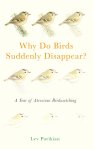 Why Do Birds Suddenly Disappear? by Lev Parikian (for blog tour) [May 17, Unbound]: “A lapsed and hopeless birdwatcher’s attempt to see 200 birds in a year. But it’s not just about birds. It’s about family, music, nostalgia; hearing the stories of strangers; the nature of obsession and obsession with nature.”
June
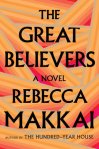 The Great Believers by Rebecca Makkai [June 19, Viking]: I loved both of Makkai’s previous novels and have her short story collection on my Kindle. “Fiona is in Paris tracking down her estranged daughter, who disappeared into a cult. While staying with an old friend, a famous photographer …, she finds herself finally grappling with the devastating ways the AIDS crisis affected her life and her relationship with her daughter.” (Edelweiss download)
Other lists of enticing 2018 releases that might give you some ideas:
Guardian (UK, nonfiction)
Halfman, Halfbook (UK, mostly science/nature and history)
Parchment Girl (mostly nonfiction)
Stylist (UK)
 Bookish Beck = Rebecca Foster. American transplant to England. Freelance proofreader and book reviewer.
 Bookish Beck