Books of Summer, 3–4: Anthony Bourdain and Meron Hadero
Back to the foodie lit. A chef’s memoir of adventurous travel and eating, and a short story collection about Ethiopian American immigrants – for some of whom learning how to cook traditional American food is a sign of integration.
A Cook’s Tour: In Search of the Perfect Meal by Anthony Bourdain (2001)
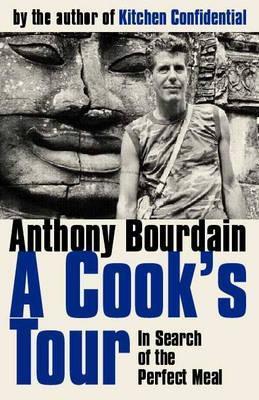 Anthony Bourdain also appeared on my summer reading list when I reviewed Kitchen Confidential in 2020; I have both books in an omnibus edition. The chef acknowledges there’s no such thing as a perfect dining experience as there are many subjective factors apart from the food, but a few of his meals here are pretty close to ideal. Others are horrific. But everywhere he goes, from England to Cambodia, he gives a fair try. Four interspersed chapters are set in Vietnam, a country he falls in love with, but the rest are like individual essays with a different destination each time: Spain, Russia, Morocco, Japan, Scotland…
Some places are chosen due to personal significance or professional connections. He goes back to where he spent childhood summers in France, but it doesn’t live up to expectations: “I’d thought everything would be instant magic. That the food would taste better because of all the memories. … But you can never be ten years old again.” His boss arranges a pig roast for him in Portugal; he travels to the state in Mexico where most of his kitchen staff come from. With several other chefs, he journeys to Thomas Keller’s The French Laundry in California for a 20-course tasting menu – the rundown of the dishes takes him several pages. The key ingredients of this and the other near-perfect meals seem to be excellent quality of food, innovative flavors, a variety of dishes, and a languid pace with the alcohol flowing.
Bourdain sheepishly confesses that his travels were documented for television; the Food Network made him agree to some filming opportunities he would otherwise have avoided. Vegetarians be warned: some of these involve slaughter, and/or eating exotic animals. Aside from the pig, there’s a whole lamb cooked over a fire in the desert in Morocco, a turkey he beheads, and rabbits he shoots. And while you might think he’d eat anything with pleasure, there are in fact a few meals that leave him feeling ill: iguana tamales, bird’s nest soup, and dishes that use up all parts of a cobra. A notorious vegetarian hater, he even agrees to attend a vegan potluck in Berkeley, but reports that “not one of them could cook a f***ing vegetable.”
This was fast-moving, brash and funny; just as good as Kitchen Confidential and something I’d recommend to anyone who enjoys cooking shows or stunt travel. (Free – swap shop) 
A Down Home Meal for These Difficult Times by Meron Hadero (2022)
Debut author Hadero won the Restless Books Prize for New Immigrant Writing for this work in progress, many of whose stories had been published in periodicals in 2015–20. The 15 stories are roughly half in the first person and half in the third person, and apart from a couple whose place or character origins aren’t specified, I think all are about Ethiopians or Ethiopian Americans. Often, the protagonist is a recent immigrant. Yohannes, in “Medallion,” is recruited by his taxi driver almost immediately upon his arrival in Los Angeles, but finds that his American dream never comes through. In “The Thief’s Tale,” an old Ethiopian man who speaks no English is lost in Prospect Park. When the man who holds him up at knifepoint realizes there is no watch or wallet to take, he lets him call his daughter from a payphone and, as they wait, the two strangers share their stories of failure and regret.
Sometimes Ethiopia is the setting instead. “The Suitcase” has Saba getting ready to return to the USA after a one-month visit to Addis Ababa, her bag 10 kilograms too heavy because of everything people are sending back with her. In “The Street Sweep,” Getu hopes to impress a departing NGO worker enough at his leaving party at the Addis Sheraton that he’ll get a life-changing job offer. This one was a standout, though distressing for how it rests on misunderstanding.
 My favorites seem like they could be autobiographical for the author. “The Wall” is narrated by a man who immigrated to Iowa via Berlin at age 10 in the mid-1980s. At a potluck dinner, he met Professor Johannes Weill, who gave him free English lessons. Six years later, he heard of the Berlin Wall coming down and, though he’d lost touch with the professor, made a point of sending a note. The connection across age, race and country is touching. “Sinkholes” is a short, piercing one about the single Black student in a class refusing to be the one to write the N-word on the board during a lesson on Invisible Man. The teacher is trying to make a point about not giving a word power, but it’s clear that it does have significance whether uttered or not. “Swearing In, January 20, 2009” is a poignant flash story about an immigrant’s patriotic delight in Barack Obama’s inauguration, despite prejudice encountered.
The title story is the only foodie link, but it’s a sweet one. Two women who attend church Amharic classes in New York City admit that they can’t cook, but want to impress at the PTA bake sale, so go in search of a quintessential American cookbook, and in the years to come prepare dishes from The Good Housekeeping Illustrated Cookbook every time there is a crisis. “When Yeshi’s husband left her for a blonde waitress, they made Broiled Hamburg Steak, just the once. … When Jazarah’s credit cards were stolen and maxed out, they made trays of Corn Fritters.” Eventually, they start to make a living from their own food truck.
There were no bad stories here per se, but several too many, and not enough variety. I also didn’t warm to the couple of political satires involving manuscripts. “The Case of the Missing _______,” set in 2036 and counting backwards from Day 100, is a document full of erasure, produced by the Minnesota newspaper The Exile Gazeta and concerning an absent authoritarian leader. It made me think of Ella Minnow Pea, or perhaps novels by Jonathan Safran Foer and Hernan Diaz, and felt different to the rest, but not in a good way. It would be interesting to try a novel by Hadero someday. See also Liz’s review. (Other challenges this met: review catch-up, set-aside) 
With thanks to Canongate for the proof copy for review.
#5–6 Short Fiction: Animal Crackers and Barnacle Love
I may have fallen behind on my 20 Books of Summer reading – August is going to have to be jam-packed! – but I have been enjoying the all-animals challenge. One of these two collections of short fiction sustains an animal theme for most of its length, while the other draws on metaphors from a fishing community but isn’t specifically about nature.
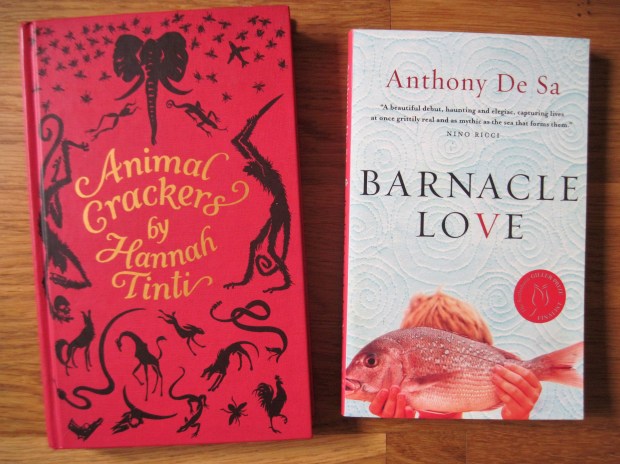
Animal Crackers by Hannah Tinti (2004)
A zoo, a circus, a turkey farm, a natural history museum, an African hunting expedition: several of the 11 stories are set in locales where human–animal interactions are formalized and exploitative, but all mention an animal at least once. In two cases the animal reference seems incidental and the stories really belong elsewhere – “Home Sweet Home,” which opens with the excellent line “Pat and Clyde were murdered on pot roast night,” appeared in Best American Mystery Stories 2003; “Hit Man of the Year” feels like a trial run for The Twelve Lives of Samuel Hawley – and in others there are gratuitous animal deaths at the hands of disturbed boys or angry men, which is always a strike against a book for me.
 I only found four stand-outs here. “Reasonable Terms” is a playful piece of magic realism in which a zoo’s giraffes get the gorilla to write out a list of demands for their keepers and, when agreement isn’t forthcoming, stage a mass mock suicide. In “How to Revitalize the Snake in Your Life,” a woman takes revenge on her boa constrictor-keeping boyfriend. In “Miss Waldron’s Red Colobus,” which reminded me of Ned Beauman’s madcap style, a boarding school teenager eludes the private detectives her parents have hired to keep tabs on her and makes it all the way to Ghana, where a new species of monkey is named after her. My favorite of all was “Preservation,” in which Mary saves wildlife paintings through her work as an art conservator but can’t save her father from terminal illness.
Barnacle Love by Anthony De Sa (2008)
When I plucked this Giller Prize finalist from a secondhand bookshop’s clearance shelf, I assumed it was a novel. The 10 titled chapters are in chronological order and recount the Rebelos’ experiences in Canada between the mid-1950s and the early 1980s, but in that each focuses on a discrete incident from the family’s history, they are more like linked short stories. Manuel, a fisherman from the Azores, is shipwrecked on the coast of Newfoundland and begins a new life in Canada. He’s deliberately gone far from his home village, far from his controlling mother and the priest who abused him: “I knew that if I stayed in our town, on our stifling island, I’d be consumed by what it was you [his mother] hoped and dreamed for me.” He moves from St. John’s to Toronto, brings over a Portuguese wife, and raises two children while hopping from one unsuccessful money-making scheme to another.
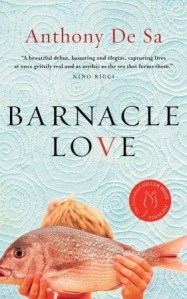 The first half of the book reports Manuel’s life in the third person, while the second is in the first person, narrated by his son, Antonio. Through that shift in perspective we come to see Manuel as both a comic and a tragic figure: he insists on speaking English, but his grammar and accent are atrocious; he cultivates proud Canadian traditions, like playing the anthem on repeat on Canada Day and spending Christmas Eve at Niagara Falls, but he’s also a drunk the neighborhood children laugh at. Although the two chapters set back in Portugal were my favorites, Manuel is a compelling, sympathetic character throughout, and I appreciated De Sa’s picture of the immigrant’s contrasting feelings of home and community. Particularly recommended if you’ve enjoyed That Time I Loved You by Carrianne Leung.
Representative passages:
Manuel’s mother: “My husband used to say that men are all barnacles. A barnacle starts out life swimming freely in the ocean. But, when it matures, it must settle down and choose a home. My dear husband used to say that it chooses to live with other barnacles of the same kind so that they can mate.”
Manuel: “I leave Portugal on fishing boat and I know I not going to come back. I give everything away to follow something new. I no understand what but something inside push me here—to make something of myself in this land. I come to be someone in this world.”
 Bookish Beck = Rebecca Foster. American transplant to England. Freelance proofreader and book reviewer.
 Bookish Beck