Love Your Library: April 2026
My thanks, as always, to Eleanor and Skai for posting about their recent library borrowing and reads!
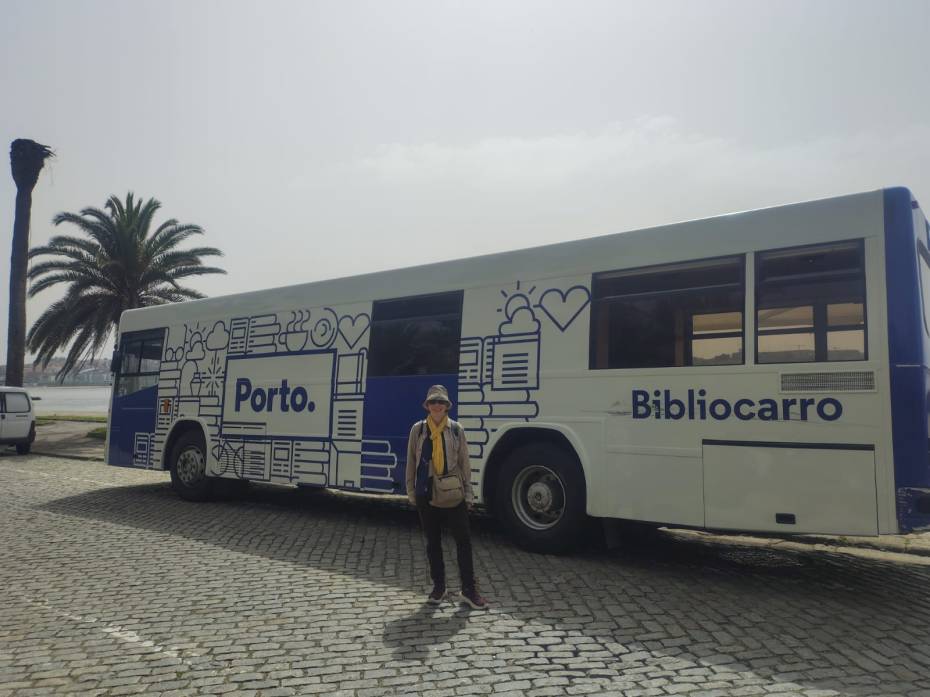
We spotted Porto’s library bus at the Foz do Douro on our recent trip to Portugal.
 From My Autobiography of Carson McCullers by Jenn Shapland:
“Library books, especially annotated ones, or ones with page corners creased, or with notes or bookmarks or other ephemera tucked into them, have given me this same feeling, this reprieve from loneliness, since I was a kid. Someone else was here.”
This sentiment feels more applicable to university or specialist library books. If, during my volunteering, I come across books with dogeared pages, I unfold them; I also remove any items used as page markers and put them in our basket for lost bookmarks. Secondhand book purchases, I find, tend to have more of an aura of their previous owners.
My library use over the last month:
(links are to any book reviews not already featured on the blog)
READ
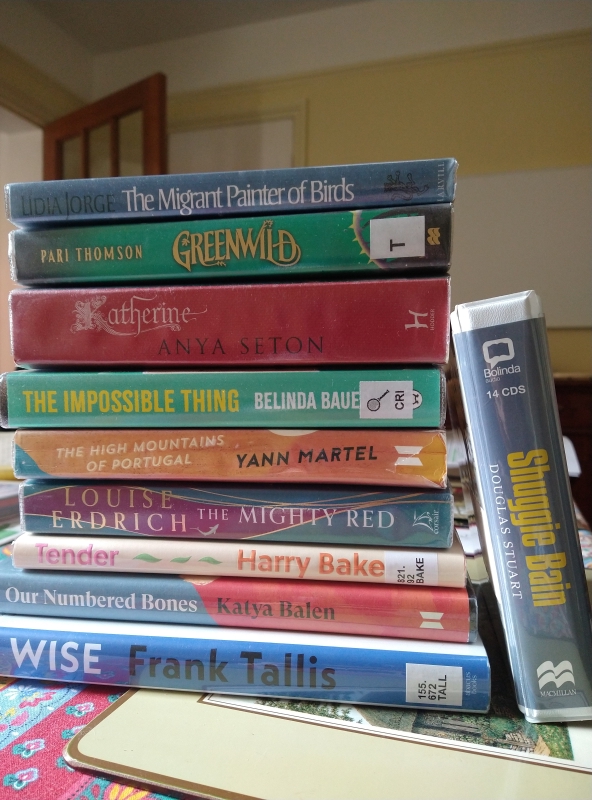
- Tender: 100 Poems for the First 100 Days of Life by Harry Baker

- Our Numbered Bones by Katya Balen
- Bog Child by Siobhan Dowd

- The Migrant Painter of Birds by Lídia Jorge
- The High Mountains of Portugal by Yann Martel

- First Class Murder by Robin Stevens
SKIMMED
- Eva Luna by Isabel Allende (for April book club)
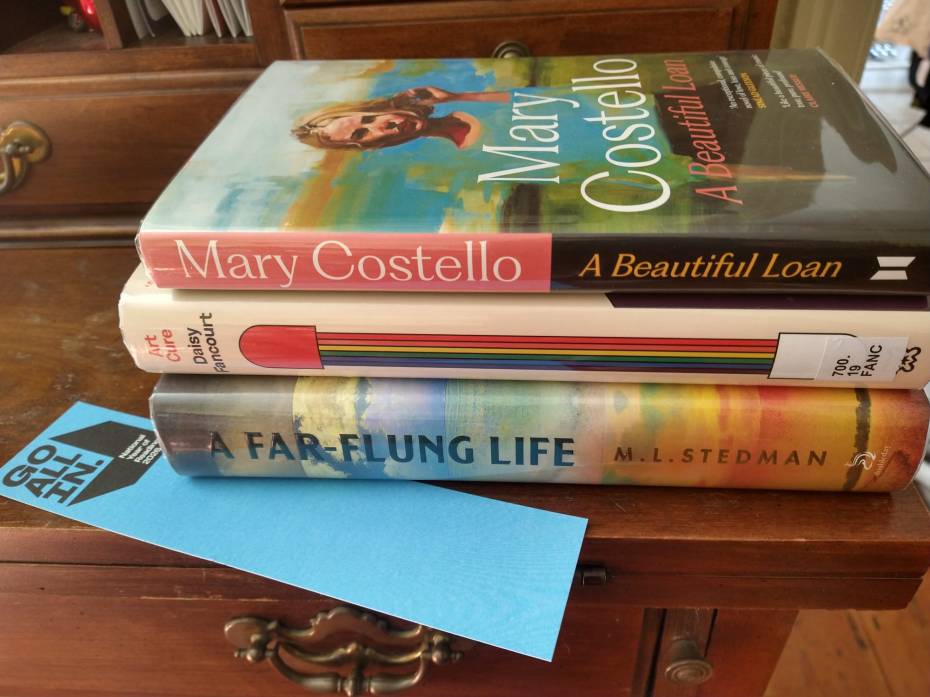
- Art Cure: The Science of How the Arts Transform Our Health by Daisy Fancourt
CURRENTLY READING
- The Heart of Christianity by Marcus Borg (a reread)
- A Beautiful Loan by Mary Costello
- The Mighty Red by Louise Erdrich (for May book club)
- The Curious Incident of the Dog in the Night-Time by Mark Haddon (a reread)
- Carrie by Stephen King
- The Spirituality Gap by Abi Millar
- Nonesuch by Francis Spufford
- The Murderer’s Ape by Jakob Wegelius (a reread)
CHECKED OUT, TO BE READ
- Pathfinding: On Walking, Motherhood and Freedom by Kerri Andrews
- The Swell by Kat Gordon
- Skylark by Paula McLain
- Wandering Stars by Tommy Orange
- Carrion Crow by Heather Parry
- Wise: Finding Purpose, Meaning and Wisdom Beyond the Midpoint of Life by Frank Tallis
- Greenwild by Pari Thomson
- Women Talking by Miriam Toews
ON HOLD, TO BE COLLECTED
- Almost Life by Kiran Millwood Hargrave
- The Careful Surgeon: Finding Light, Courage and Compassion in the Face of Life and Death by Shehan Hettiaratchy
IN THE RESERVATION QUEUE
- Yesteryear by Caro Claire Burke
- Lost Lambs by Madeline Cash
- Dominion by Addie E. Citchens
- The Correspondent by Virginia Evans
- Agnes Aubert’s Mystical Cat Shelter by Heather Fawcett
- Honour & Other People’s Children by Helen Garner
- The Shock of the Light by Lori Inglis Hall
- Alice with a Why by Anna James
- My Year in Paris with Gertrude Stein: A Fiction by Deborah Levy
- A Hymn to Life: Shame Has to Change Sides by Gisèle Pelicot
- The Original by Nell Stevens
RETURNED UNFINISHED
- Our Better Natures by Sophie Ward – I managed the first 76 pages but found none of the three storylines compelling and gave up hope of them feeling significant in conjunction with each other. Disappointing as I loved her first book and named this one of my Most Anticipated titles of 2026.
RETURNED UNREAD
- The Impossible Thing by Belinda Bauer – Silly me; I don’t read crime. (I was attracted by the setting of Bempton Cliffs and the plot element of stealing seabird eggs.)
- Katherine by Anya Seton – Sarah Perry thinks this is one of the best examples of historical fiction out there, but I can’t get over my antipathy for the time period.
- Sempre: Finding Home by Raymond Silverthorne – Requested because it came up on a search for Portugal in the library catalogue; I didn’t realize it was self-published.
- A Far-Flung Life by M.L. Stedman – The first few pages didn’t draw me in, so I’ll let the many others in the reservation queue have a go.
- Shuggie Bain by Douglas Stuart (audiobook) – I didn’t end up having an opportunity to listen to an audiobook. Perhaps one day I will get to Stuart’s back catalogue!
What have you been reading or reviewing from the library recently?

Share a link to your own post in the comments. Feel free to use the above image. The hashtag is #LoveYourLibrary.
12 Days in Portugal and Spain & What I Read
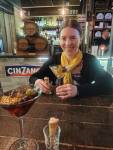 It’s the second time we’ve braved the 20+-hour ferry crossing from the south coast of England to Santander in the north of Spain. Four years ago, we stayed on the edge of the Picos de Europa national park in Spain. This time we prioritized Portugal, spending a night in Spain on the way out and back. (In Léon, we acquired a taste for vermouth – and the free tapas that come with it. So cheap, too. What a fun eating-out culture!)
Portugal was a new country for us and we thoroughly enjoyed getting a taste of it. Spring seemed to be a month ahead of the UK and blossom was abundant. We stayed in three places in the north: Guimarães, the Douro Valley, and the Côa Valley. We took our new-to-us EV and found the distances manageable and charging cheaper and easier than in the UK. Going by car made packing easy and allowed us to bring back some port, Mr. F’s favourite tipple. However, there were hairy drives along confusing city streets and narrow mountain roads.


Our first stay was at Pousada de Santa Marinha, overlooking Portugal’s oldest city. One of a chain of state-restored castles and convents, it was originally a 12th-century monastery. We relished the bountiful breakfast buffet and manicured grounds but wished for more free time to relax in the grand common areas. Mostly we used this as a base for the first of two day trips to Porto, where we got good views from the cathedral tower, had delicious coffee and veggie snacks at 7g Roaster, and did a tour and tasting at Taylor’s port house. Portugal does a good line in doorstep cats. We also had our first sighting of swifts for the year on the 7th, flying above the azulejos (painted tiles) and cobbled streets of Guimarães before a traditional taverna meal of bacalhau (salt cod) fritters and bean stew with vinho verde.


Quinta dos Murças was, if anything, even more luxurious than the pousada. We were the only guests on our first of three nights at the winery, and after a private English-language cellar tour and wine and port tasting, a sit on the wisteria-covered balcony, and a three-course meal in the dining room, we were feeling like royalty. Along with grapes, they grow almonds, olives and several types of citrus. The lemon trees were dripping with the biggest fruits I’ve ever seen, and the smell of the orange blossom was truly intoxicating. The next morning we got up early and took a pack-up picnic on the train back into Porto, which was so hot and busy that we wondered why we’d bothered – though we did have an excellent tasting experience at a smaller producer, Poças, that included white and red wine, several ports, and a cocktail of white port, lime juice, and blood orange tonic served with a salt rim.


Portuguese is significantly more challenging than Spanish, so I was pleased with myself for managing an all-Portuguese transaction with the conductor on the rural branch line. The old-fashioned train carriages were spacious with comfortable seats, though the ride was not what one would call speedy. The journey back was fraught because we found ourselves pressed to catch the final train of the day (at just after 5:30 p.m.!), couldn’t figure out how to buy tickets at the station machines, were short of cash to pay the conductor on board, and arrived 2 hours late after a car collided with a telegraph pole and left the track blocked for an hour. The following day, what did we do? Got back on a train! (In the opposite direction, with tickets we’d carefully purchased ahead online.) This time we traveled toward the eastern end of the scenic Douro Valley so that we managed to see the whole river in pieces. The village of Tua had no particular sights, but we had a pleasant amble along its river boardwalk.


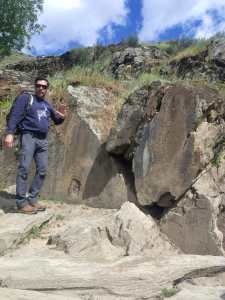 We’d earmarked the Côa Valley because it’s home to a sizable rewilding project. On the way, we stopped at Penascosa, an outdoor rock art site with etchings of ibex, aurochs and deer – and even ancient attempts at animation! The Rewilding Centre, where we stayed, is similar to a hostel and has an industrial kitchen because it also operates as a café for the villagers. In cities, we had tended to find English speakers, but the centre manager here had no English, so we happily switched to French (a true lingua franca!) to communicate with her.
The accommodation may have felt like a step down after our two previous splurges, but we’d booked a different treat to selves: an English-speaking guide from Wildlife Portugal who took us out in a Land Rover and found us loads of eagles, vultures and warblers. Bee-eaters and black storks were particular highlights. We were impressed by the array of landscapes: vines and olive groves, granite boulders, high cliffs, pools created by former mining, and green glens. At the hostel we met an English couple (one half a botanist) who are exploring Europe on Interrail passes during a three-month sabbatical, and they joined us for the second day of wildlife tourism; we discovered that Fernando is just as good with plants as with birds.


It was a varied, comfy, boozy trip. There was the touristy experience in Porto and parts of the Douro Valley, but also the ‘real’ countryside. Things ended on something of a sour note due to a rough return crossing of the Bay of Biscay. We’ll be back in Spain next summer to meet up with my sister and our nephew on his school trip to Barcelona, but that jaunt will be by train!


What I Read
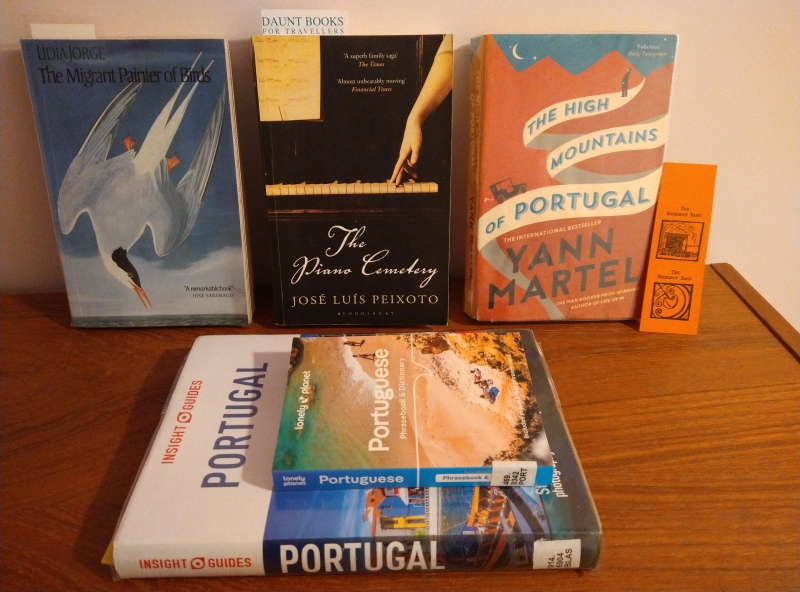
En route: Rita Hayworth and Shawshank Redemption by Stephen King, which I’ll review for a spring-themed post as it’s the first in a quartet of loosely seasonal novellas. You likely know this prison story from the film version.
In Portugal: three Portugal-set novels I’d proudly sourced, including two in translation. My only previous knowledge of Portuguese literature had been a DNF of a José Saramago novel.
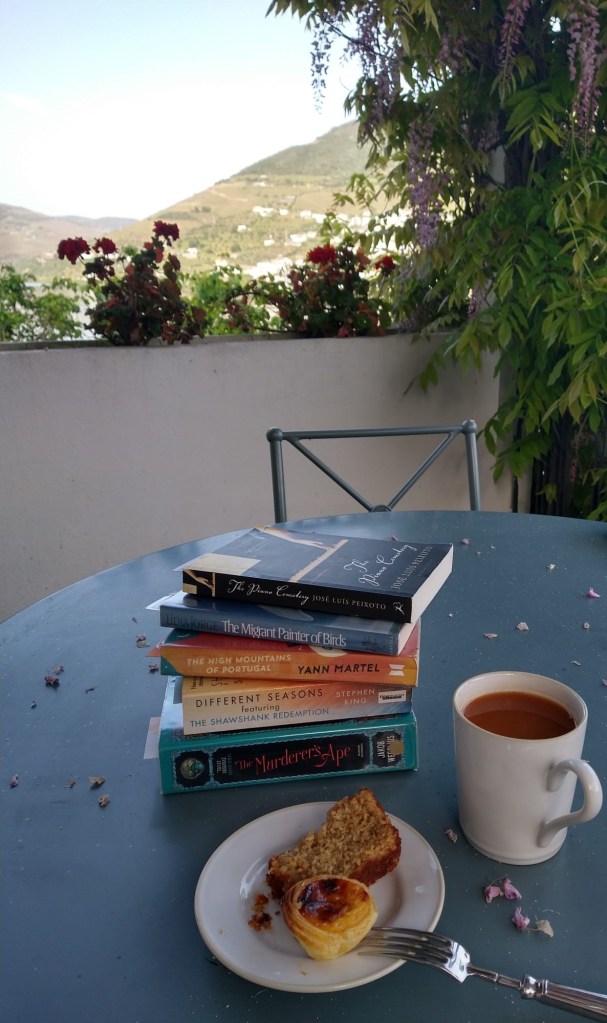
The Migrant Painter of Birds by Lídia Jorge (1998; 2001)
[Translated by Margaret Jull Costa]
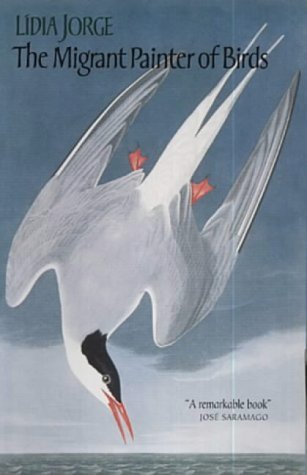 The title figure is Walter, a former soldier who wanders the world and sends his bird paintings back to his daughter at the Dias family home in (fictional) Valmares. His actual visits are few and clandestine: Jorge keeps returning to a scene of him holding his shoes in his hand so he can soundlessly climb the stairs to see his daughter. You see, his daughter is officially his ‘niece’, born of an affair Maria Ema had with her husband Custódio’s brother. That act of adultery is the foundation of the novel but so tacit that it influences everything, including the language and narration. “Walter’s daughter” narrates – in third person or first – and frequently refers to herself as “Walter’s niece” instead.
The slippery narrative moves back and forth in time, pausing at a few landmark years. Very little happens, per se, apart from Walter’s daughter having a liaison with her mother’s therapist and then going to find her father in Argentina, but throughout we are invited to observe the family’s shifting dynamic and understand the narrator’s growing bitterness – “so bruised are we all by the passing of time.” I found the writing intermittently beautiful (“the sun was setting, persimmon red, behind the smooth fields”; “A tangle of living ghosts, the magical cortège of all tyrannies”) but sometimes pretentious or obfuscating to no purpose (“I invoke the decade of irony, the decade of silence pierced by the oblique laughter of cynicism”). (Interlibrary loan)
The High Mountains of Portugal by Yann Martel (2016)
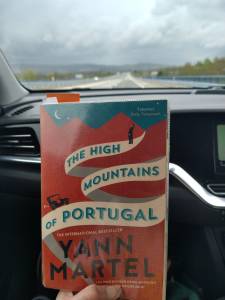 I knew of Martel’s obscure fourth novel through The Bookshop Band’s song “Why I Travel This Way,” about a bereaved man who starts walking backwards. What I didn’t realize is that the book is essentially three linked novellas and that song responds to just the first one, “Homeless.” Within a week, museum curator Tomás’s son, common-law wife, and father all died. Tomás sets off in his uncle’s early motorcar (this being 1904) to find a religious relic he learned about from a 17th-century priest’s journal written in São Tomé. But he has no idea how to drive, and accidents and persecution continue to beset him. A Job-like figure, he has set “his back to the world, his back to God” as a way of “not grieving” but “objecting.” Next, pathologist Eusebio and his wife have a high-minded discussion of the morality of murder mysteries in the 1939-set “Homeward.” Eusebio then undertakes an unexpected late-night job when an old woman arrives with her late husband’s corpse in a suitcase. Every cut reveals the substance of the man’s life rather than the reason for his death.
 After religious parable and magic realism, “Home” initially seems more straightforward with its story of a widowed Canadian senator who buys Odo the chimpanzee from a research centre and relocates to rural Portugal. If you’ve read Life of Pi and/or Beatrice and Virgil, you know that Martel really goes in for his animal allegories. Odo might be considered symbolic of simplicity and joy in life. There are apt connections with the other novellas: not only an overarching theme of grief, but the specifics of one northern Portuguese village and its events that have become legend. And, yes, chimpanzees. A line from the first part serves as Martel’s mantra: “We are risen apes, not fallen angels.” Weird but satisfying. (Public library)
The Piano Cemetery by José Luís Peixoto (2006; 2010)
[Translated by Daniel Hahn]
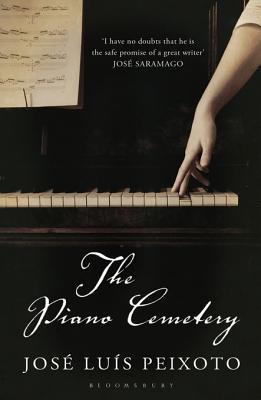 It may be premature, but I feel I can pinpoint some trademarks of Portuguese literature based on the few examples I’ve now read (plus Martel’s pastiche): narrative trickery, family dysfunction, metaphors of blindness, philosophical and religious dialogues, and a fine line between life and death. Unfortunately, in this case I found the appealing elements buried under an off-putting style. The Lázaro family are carpenters in 1910s Lisbon with a back room housing busted pianos that they use for their instrument-repair side business. To start with, the narrator is the dead patriarch of the family, who remembers how he met his wife at the piano cemetery and keeps watch over his children and grandchildren in the present day. There are also two long sections of stream-of-consciousness memories of his son Francisco as he runs the marathon at the 1912 Stockholm Olympics. Francisco Lázaro was a historical figure who died in that athletic pursuit, but the family backstory of estrangement, domestic violence, and adultery that Peixoto builds around him is fictional. Punctuated by distance markers (“Kilometre one” and so on), Francisco’s fragments are decontextualised and often don’t join up or even form complete sentences. Add in the father’s fatphobic attitude toward one of his daughters and the laughably circuitous phrasing (“my thick hand in a single movement, like an impulse, but not even an impulse, like a desire you have for a moment and which becomes concrete in that same moment, another person’s desire within me, a desire which is not thought, but which rises up like a flame” – huh? can I blame the translator?) and you might see why this was a slog for me. (Secondhand purchase – Awesomebooks.com)
Plus a partial reread of a delightful teen novel we both read the last time we were in Spain:
The Murderer’s Ape by Jakob Wegelius
[Translated from the Swedish by Peter Graves]
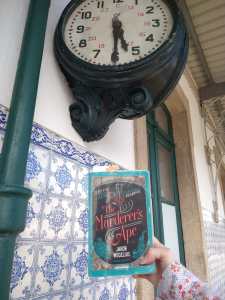 Talk about a risen ape! Sally Jones is an animal narrator extraordinaire: a ship’s engineer who meets every challenge that comes her way with aplomb, traveling from Portugal to India and back just to clear the Chief’s name after he’s falsely accused of murder. She happens to be a gorilla, but her only real limitation is that she can’t voice human language; she understands and writes it perfectly, and can beat most people at chess. This doorstopper never feels like one because it races along on a tide of adventure and intrigue. The technology suggests a 1920s date. All the settings are evocative, but historical Lisbon is especially enticing (and not dissimilar to Peixoto’s): Sally Jones lives with Ana Molina, a famous fado singer, and works in her neighbour Signor Fidardo’s instrument workshop repairing accordions.
 Plus the latter half of another novel or two I had on the go, and most of a couple of pre-release e-books for Shelf Awareness reviews: the odd Kitten by Stacey Yu, about a cat-identifying millennial Disaster woman, and The Half Life by Rachel Beanland. Set in 1970s Sardinia, this was a perfect summer read – intelligent as well as sultry – about a young Navy wife’s sexual coming of age and casual investigation into the ongoing effect of American nuclear submarines on the island’s natural environment.
Books of Summer, 3–4: Anthony Bourdain and Meron Hadero
Back to the foodie lit. A chef’s memoir of adventurous travel and eating, and a short story collection about Ethiopian American immigrants – for some of whom learning how to cook traditional American food is a sign of integration.
A Cook’s Tour: In Search of the Perfect Meal by Anthony Bourdain (2001)
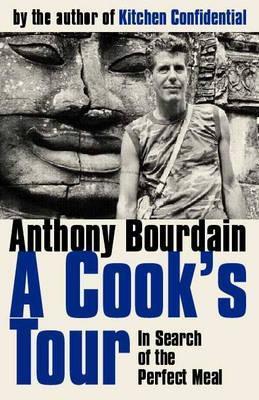 Anthony Bourdain also appeared on my summer reading list when I reviewed Kitchen Confidential in 2020; I have both books in an omnibus edition. The chef acknowledges there’s no such thing as a perfect dining experience as there are many subjective factors apart from the food, but a few of his meals here are pretty close to ideal. Others are horrific. But everywhere he goes, from England to Cambodia, he gives a fair try. Four interspersed chapters are set in Vietnam, a country he falls in love with, but the rest are like individual essays with a different destination each time: Spain, Russia, Morocco, Japan, Scotland…
Some places are chosen due to personal significance or professional connections. He goes back to where he spent childhood summers in France, but it doesn’t live up to expectations: “I’d thought everything would be instant magic. That the food would taste better because of all the memories. … But you can never be ten years old again.” His boss arranges a pig roast for him in Portugal; he travels to the state in Mexico where most of his kitchen staff come from. With several other chefs, he journeys to Thomas Keller’s The French Laundry in California for a 20-course tasting menu – the rundown of the dishes takes him several pages. The key ingredients of this and the other near-perfect meals seem to be excellent quality of food, innovative flavors, a variety of dishes, and a languid pace with the alcohol flowing.
Bourdain sheepishly confesses that his travels were documented for television; the Food Network made him agree to some filming opportunities he would otherwise have avoided. Vegetarians be warned: some of these involve slaughter, and/or eating exotic animals. Aside from the pig, there’s a whole lamb cooked over a fire in the desert in Morocco, a turkey he beheads, and rabbits he shoots. And while you might think he’d eat anything with pleasure, there are in fact a few meals that leave him feeling ill: iguana tamales, bird’s nest soup, and dishes that use up all parts of a cobra. A notorious vegetarian hater, he even agrees to attend a vegan potluck in Berkeley, but reports that “not one of them could cook a f***ing vegetable.”
This was fast-moving, brash and funny; just as good as Kitchen Confidential and something I’d recommend to anyone who enjoys cooking shows or stunt travel. (Free – swap shop) 
A Down Home Meal for These Difficult Times by Meron Hadero (2022)
Debut author Hadero won the Restless Books Prize for New Immigrant Writing for this work in progress, many of whose stories had been published in periodicals in 2015–20. The 15 stories are roughly half in the first person and half in the third person, and apart from a couple whose place or character origins aren’t specified, I think all are about Ethiopians or Ethiopian Americans. Often, the protagonist is a recent immigrant. Yohannes, in “Medallion,” is recruited by his taxi driver almost immediately upon his arrival in Los Angeles, but finds that his American dream never comes through. In “The Thief’s Tale,” an old Ethiopian man who speaks no English is lost in Prospect Park. When the man who holds him up at knifepoint realizes there is no watch or wallet to take, he lets him call his daughter from a payphone and, as they wait, the two strangers share their stories of failure and regret.
Sometimes Ethiopia is the setting instead. “The Suitcase” has Saba getting ready to return to the USA after a one-month visit to Addis Ababa, her bag 10 kilograms too heavy because of everything people are sending back with her. In “The Street Sweep,” Getu hopes to impress a departing NGO worker enough at his leaving party at the Addis Sheraton that he’ll get a life-changing job offer. This one was a standout, though distressing for how it rests on misunderstanding.
 My favorites seem like they could be autobiographical for the author. “The Wall” is narrated by a man who immigrated to Iowa via Berlin at age 10 in the mid-1980s. At a potluck dinner, he met Professor Johannes Weill, who gave him free English lessons. Six years later, he heard of the Berlin Wall coming down and, though he’d lost touch with the professor, made a point of sending a note. The connection across age, race and country is touching. “Sinkholes” is a short, piercing one about the single Black student in a class refusing to be the one to write the N-word on the board during a lesson on Invisible Man. The teacher is trying to make a point about not giving a word power, but it’s clear that it does have significance whether uttered or not. “Swearing In, January 20, 2009” is a poignant flash story about an immigrant’s patriotic delight in Barack Obama’s inauguration, despite prejudice encountered.
The title story is the only foodie link, but it’s a sweet one. Two women who attend church Amharic classes in New York City admit that they can’t cook, but want to impress at the PTA bake sale, so go in search of a quintessential American cookbook, and in the years to come prepare dishes from The Good Housekeeping Illustrated Cookbook every time there is a crisis. “When Yeshi’s husband left her for a blonde waitress, they made Broiled Hamburg Steak, just the once. … When Jazarah’s credit cards were stolen and maxed out, they made trays of Corn Fritters.” Eventually, they start to make a living from their own food truck.
There were no bad stories here per se, but several too many, and not enough variety. I also didn’t warm to the couple of political satires involving manuscripts. “The Case of the Missing _______,” set in 2036 and counting backwards from Day 100, is a document full of erasure, produced by the Minnesota newspaper The Exile Gazeta and concerning an absent authoritarian leader. It made me think of Ella Minnow Pea, or perhaps novels by Jonathan Safran Foer and Hernan Diaz, and felt different to the rest, but not in a good way. It would be interesting to try a novel by Hadero someday. See also Liz’s review. (Other challenges this met: review catch-up, set-aside) 
With thanks to Canongate for the proof copy for review.
#5–6 Short Fiction: Animal Crackers and Barnacle Love
I may have fallen behind on my 20 Books of Summer reading – August is going to have to be jam-packed! – but I have been enjoying the all-animals challenge. One of these two collections of short fiction sustains an animal theme for most of its length, while the other draws on metaphors from a fishing community but isn’t specifically about nature.
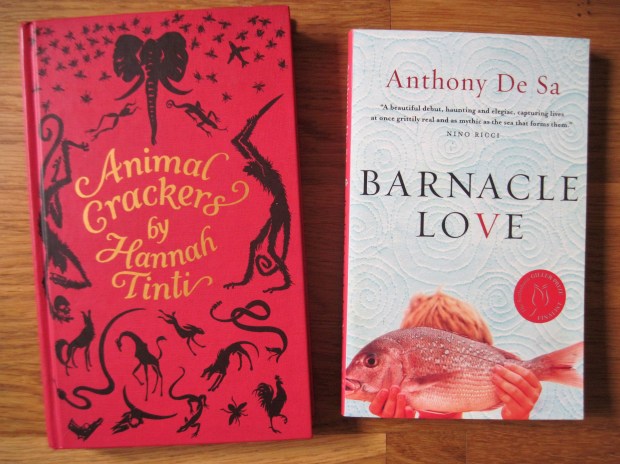
Animal Crackers by Hannah Tinti (2004)
A zoo, a circus, a turkey farm, a natural history museum, an African hunting expedition: several of the 11 stories are set in locales where human–animal interactions are formalized and exploitative, but all mention an animal at least once. In two cases the animal reference seems incidental and the stories really belong elsewhere – “Home Sweet Home,” which opens with the excellent line “Pat and Clyde were murdered on pot roast night,” appeared in Best American Mystery Stories 2003; “Hit Man of the Year” feels like a trial run for The Twelve Lives of Samuel Hawley – and in others there are gratuitous animal deaths at the hands of disturbed boys or angry men, which is always a strike against a book for me.
 I only found four stand-outs here. “Reasonable Terms” is a playful piece of magic realism in which a zoo’s giraffes get the gorilla to write out a list of demands for their keepers and, when agreement isn’t forthcoming, stage a mass mock suicide. In “How to Revitalize the Snake in Your Life,” a woman takes revenge on her boa constrictor-keeping boyfriend. In “Miss Waldron’s Red Colobus,” which reminded me of Ned Beauman’s madcap style, a boarding school teenager eludes the private detectives her parents have hired to keep tabs on her and makes it all the way to Ghana, where a new species of monkey is named after her. My favorite of all was “Preservation,” in which Mary saves wildlife paintings through her work as an art conservator but can’t save her father from terminal illness.
Barnacle Love by Anthony De Sa (2008)
When I plucked this Giller Prize finalist from a secondhand bookshop’s clearance shelf, I assumed it was a novel. The 10 titled chapters are in chronological order and recount the Rebelos’ experiences in Canada between the mid-1950s and the early 1980s, but in that each focuses on a discrete incident from the family’s history, they are more like linked short stories. Manuel, a fisherman from the Azores, is shipwrecked on the coast of Newfoundland and begins a new life in Canada. He’s deliberately gone far from his home village, far from his controlling mother and the priest who abused him: “I knew that if I stayed in our town, on our stifling island, I’d be consumed by what it was you [his mother] hoped and dreamed for me.” He moves from St. John’s to Toronto, brings over a Portuguese wife, and raises two children while hopping from one unsuccessful money-making scheme to another.
 The first half of the book reports Manuel’s life in the third person, while the second is in the first person, narrated by his son, Antonio. Through that shift in perspective we come to see Manuel as both a comic and a tragic figure: he insists on speaking English, but his grammar and accent are atrocious; he cultivates proud Canadian traditions, like playing the anthem on repeat on Canada Day and spending Christmas Eve at Niagara Falls, but he’s also a drunk the neighborhood children laugh at. Although the two chapters set back in Portugal were my favorites, Manuel is a compelling, sympathetic character throughout, and I appreciated De Sa’s picture of the immigrant’s contrasting feelings of home and community. Particularly recommended if you’ve enjoyed That Time I Loved You by Carrianne Leung.
Representative passages:
Manuel’s mother: “My husband used to say that men are all barnacles. A barnacle starts out life swimming freely in the ocean. But, when it matures, it must settle down and choose a home. My dear husband used to say that it chooses to live with other barnacles of the same kind so that they can mate.”
Manuel: “I leave Portugal on fishing boat and I know I not going to come back. I give everything away to follow something new. I no understand what but something inside push me here—to make something of myself in this land. I come to be someone in this world.”
 Bookish Beck = Rebecca Foster. American transplant to England. Freelance proofreader and book reviewer.
