My Year in Nonfiction (Thus Far)
If your household is anything like mine, stressful days and nights of lost sleep are ceding to relief after the U.S. election result was finally announced. We celebrated with whoopie pies (a Pennsylvania specialty) and Prosecco.


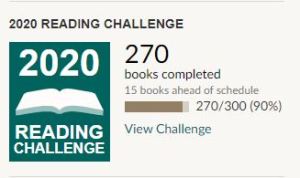
And look: I happened to pass 270 yesterday as well!
I’d taken part in the Six Degrees of Separation meme every month since February, but this time I had no inspiration. I was going to start with these two apple covers…
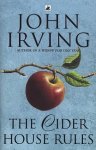
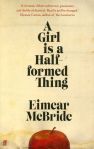
…but that’s as far as I got. Never mind! I’ll be back next month, when we all start with the YA classic Are You There God? It’s Me, Margaret by Judy Blume.
Instead, I’m catching up with this past week’s Nonfiction November prompt: Your Year in Nonfiction. It was hosted by Leann of Shelf Aware.

 What topics have been prominent in your year’s nonfiction reading?
I’ve read a lot of nature and popular science, probably more than in an average year. Greenery by Tim Dee has been an overall highlight. I managed to read 12 books from the Wainwright Prize longlists, and I’m currently reading four books of nature-themed essays or journals. Thoughtful as well as consoling.

The popular science material has focused on environmentalism and current events, which has inevitably involved politics and long-term planning (Annabel called this category “The State We’re In”): e.g. Losing Eden, Footprints, The Good Ancestor, and Notes from an Apocalypse.


 Thanks to the food and drink theme I set for my 20 Books of Summer, I read a number of foodie memoirs. The best one was Heat by Bill Buford, but I also really enjoyed Kitchen Confidential by Anthony Bourdain and My Berlin Kitchen by Luisa Weiss.
 Since the Wellcome Book Prize didn’t run this year, I’ve read fewer health-related books, although I did specially read Not the Wellcome Prize shortlistee The Remarkable Life of the Skin by Monty Lyman, and Dear Life by Rachel Clarke, a palliative care doctor, has been one of my overall best nonfiction reads of the year.
Not very well represented in my nonfiction reading this year were biographies and travel books. I can struggle with the depth and dryness of some books from these genres, but I’d like to find some readable options to get stuck into next year.
What are your favorite nonfiction books you’ve read so far?
I’m a huge memoir junkie. Some of the most memorable ones this year have been Winter Journal by Paul Auster, Traveling Mercies by Anne Lamott (a reread), and A Three Dog Life by Abigail Thomas (another reread).


An incidental theme in the life writing I’ve read in 2020 is childhood (Childhood by Tove Ditlevsen, Cider with Rosie by Laurie Lee, Oleander, Jacaranda by Penelope Lively, Period Piece by Gwen Raverat); I hope to continue reading around this topic next year.
What books have you recommended the most to others?
I’ve mentioned the Clarke (above) in any discussions of books about illness and death.
I recommended the memoir Are You Somebody? by Nuala O’Faolain more than once following Reading Ireland Month.
Entangled Life, Merlin Sheldrake’s enthusiastic book about fungi, is one I can imagine suggesting to readers who don’t often pick up nonfiction.
And Signs of Life by Dr. Stephen Fabes has generated a fair bit of interest among my Goodreads friends.


Besides Annabel, Kate and Liz also wrote about their 2020 nonfiction reading habits.
How has your nonfiction reading been going this year?
The Best Books from the First Half of 2020
My top 10 releases of 2020 thus far, in alphabetical order within genre (nonfiction is dominating the year for me!), are:
Fiction
 The Vanishing Half by Brit Bennett: Like some lost mid-career gem from Toni Morrison, this novel is meaty with questions of racial and sexual identity. Light-skinned African American twins Stella and Desiree Vignes’ paths divide in 1954, with Stella passing as white. Both are desperate to escape from Mallard, Louisiana. The twins’ decisions affect the next generation, too. It’s perceptive and beautifully written, with characters whose struggles feel genuine and pertinent. The themes of self-reinvention and running from one’s past resonate.
 Writers & Lovers by Lily King: Following a breakup and her mother’s sudden death, Casey Peabody is drowning in grief and debt. Between waitressing shifts, she chips away at the novel she’s been writing for six years. Life gets complicated, especially when two love interests appear. We see this character at rock bottom but also when things start to go well at long last. I felt I knew Casey through and through, and I cheered for her. An older, sadder Sweetbitter, perhaps as written by Elizabeth Strout. It gives you all the feels, as they say.
 Weather by Jenny Offill: A blunt, unromanticized, wickedly funny novel about how eco-anxiety permeates everyday life, Weather is in the same aphoristic style as Offill’s Dept. of Speculation. Lizzie is married with a young son and works in a NYC university library. She takes on a second job as PA to her former professor, who runs a podcast on environmental issues. Set either side of Trump’s election, the novel amplifies many voices prophesying doom. Offill’s observations are spot on. Could there be a more perfect book for 2020?
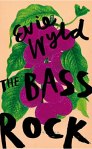 The Bass Rock by Evie Wyld: There’s no avoiding violence for the women and children of this novel. It’s a sobering theme, certainly, but Wyld convinced me that hers is an accurate vision and a necessary mission. The novel cycles through its three strands in an ebb and flow pattern that seems appropriate to the coastal setting and creates a sense of time’s fluidity. Themes and elements keep coming back, stinging a little more each time. An elegant, time-blending structure and an unrelenting course – that indifferent monolith is the perfect symbol.
Nonfiction
Dear Life: A Doctor’s Story of Love and Loss by Rachel Clarke: I’ve read so many doctors’ memoirs and books about death and dying; it takes a truly special one like this to stand out. Clarke specializes in palliative medicine and alternates her patients’ stories with her own in a very natural way. A major theme is her relationship with her father, who was also a doctor, and how she absorbed his lessons of empathy and dedication. A passionate and practical book, encouraging readers to be sure they and older relatives have formalized their wishes.
 The Lost Family: How DNA Testing Is Upending Who We Are by Libby Copeland: Gone are the days when people interested in family history had to trawl through microfilm and wait months to learn anything new; nowadays a DNA test can find missing relatives within days. But there are troubling aspects to this new industry, including privacy concerns, notions of racial identity, and criminal databases. Copeland spoke to scientists and 400 laypeople who sent off saliva samples. A thought-provoking book with all the verve and suspense of fiction.
Greenery: Journeys in Springtime by Tim Dee: From the Cape of Good Hope to the Arctic Circle, Dee tracks the spring as it travels north. From first glimpse to last gasp, moving between his homes in two hemispheres, he makes the season last nearly half the year. His main harbingers are migrating birds, starting with swallows. The book is steeped in allusions and profound thinking about deep time and what it means to be alive in an era when nature’s rhythms are becoming distorted. A fresh, masterful model of how to write about nature.
 Footprints: In Search of Future Fossils by David Farrier: Blending human and planetary history, environmental realism and literary echoes, Farrier, a lecturer in English literature, tells the story of the human impact on the Earth. Each chapter is an intricate blend of fact, experience and story. We’ll leave behind massive road networks, remnants of coastal megacities, plastics, carbon and methane in the permafrost, the fossilized Great Barrier Reef, nuclear waste, and jellyfish-dominated oceans. An invaluable window onto the deep future.
 Losing Eden: Why Our Minds Need the Wild by Lucy Jones: While nature’s positive effect on human mental health is something we know intuitively and can explain anecdotally, Jones wanted to investigate the scientific mechanism behind it. She makes an empirical enquiry but also attests to the personal benefits nature has. Losing Eden is full of common sense and passion, cramming masses of information into 200 pages yet never losing sight of the big picture. Like Silent Spring, on which it is patterned, I can see this leading to real change.
 Diary of a Young Naturalist by Dara McAnulty: McAnulty is the UK’s answer to Greta Thunberg: a leader in the youth environmental movement and an impassioned speaker on the love of nature. This is a wonderfully observant and introspective account of his fifteenth year: of disruptions – moving house and school, of outrage at the state of the world and at individual and political indifference, of the complications of being autistic, but also of the joys of everyday encounters with wildlife. Impressive perspective and lyricism.

The ones I own in print (not pictured: 2 read on Kindle; 1 read via the library).
 The 4.5- or 5-star backlist books that I’ve read this year but haven’t yet written about on here in some way are:
- Kindred by Octavia E. Butler
- Love Medicine by Louise Erdrich
- Small Ceremonies by Carol Shields
What are some of the best books you’ve read so far this year?
What 2020 releases do I need to catch up on right away?
Thinking about Dead Bodies with John Troyer (Hay Festival)
My second of three digital Hay Festival talks this year was by John Troyer, director of the interdisciplinary Centre for Death and Society at the University of Bath. Troyer is from Wisconsin (where he was speaking from, having been trapped there during a visit to his parents) and grew up with a father who owned a funeral home. This meant that he was aware of death from a young age: One of his earliest memories is of touching the hand of a dead woman when he went to visit his father at work.
 That’s not the only personal experience that went into his new book, Technologies of the Human Corpse, which I’m now keen to read. In 2018 his younger sister, Julie, died of brain cancer at age 43, so her illness and death became a late addition to the preface and also fed into a series of prose poems interspersed between the narrative chapters. She lived in Italy and her doctors failed to tell her that she was dying – that job fell to Troyer. (Unfortunately, this seems to be a persistent problem in Italy. In Dottoressa, her memoir of being an American doctor in Rome, which I read for a TLS review, Susan Levenstein writes of a paternalistic attitude among medical professionals: they treat their patients as children and might not even tell them about a cancer diagnosis; they just inform their family.)
Troyer discussed key moments that changed how we treat corpses. For instance, during the American Civil War there was a huge market for the new embalming technology; it was a way of preserving the bodies of soldiers so they could be returned home for funerals. Frauds also arose, however, and those taken in might find their loved one’s body arrived in a state of advanced decay. At around the same time, early photography captured corpses looking serene and sleeping. We might still take such photos, but we don’t tend to display them any more.
In the 1970s the “happy death” movement advocated for things like “natural death” and “death with dignity.” This piggybacked on the environmental and women’s movements and envisioned death as a taboo that had to be overcome. In recent decades a “necro-economy” based on the global trafficking of body parts (not organs for regulated transplant, Troyer clarified, but other tissue types) has appeared. While whole bodies may be worth just £2,000, “disarticulated” ones divided into their parts can net more like £100,000. Donating one’s body to science is, of course, a noble decision. Many people are also happy to donate their organs, though there remains a particular wariness about donating the eyes.
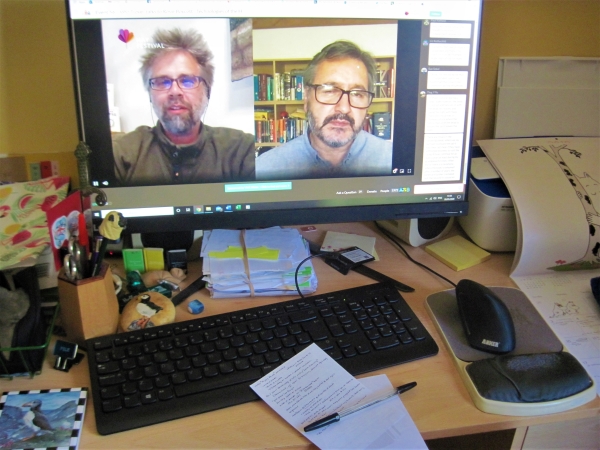
Troyer and Florence on my screen.
One section of Troyer’s book has become “uncannily resonant” in recent days, he noted. This is Chapter 3, on the AIDS corpse, an object of stigma. The biggest changes to death in the time of COVID-19 have been that family members are not able to be with a dying person in the ICU and that funerals cannot proceed as normal. In a viral pandemic, countries are producing a huge number of corpses that they aren’t prepared to deal with. (Indeed, the Washington, D.C. area is so overwhelmed with dead bodies that ice skating rinks have been requisitioned as makeshift morgues. The suburban Maryland rink I visited as a child is one such. Grim.)
Troyer spoke of the need for an everyday-ness to the discussion of death: talking with one’s next of kin, and encountering death in the course of a traditional education – he finds that even his final-year university students, studying in a related field, are very new to talking about death. A good way in that he recommends is simply to ask your loved ones what music they want played at their funerals, and the conversation can go from there.
We may not be able to commemorate the dead as we would like to at this time, but Troyer reminded the audience that funerals are for the living, whereas “the dead are okay with it – they know we’re doing our best.” The event was sensitively chaired by Peter Florence, the co-founder and director of Hay Festival (also responsible for last year’s controversial Booker Prize tie); the fact that Troyer got emotional talking about his sister only gave it more relevance and impact.
 I’ve read an abnormally large number of books about death, especially in the five years since my brother-in-law died of brain cancer (one reason why Troyer’s talk was so meaningful for me). Most recently, I read Bodies in Motion and at Rest (2000) by Thomas Lynch, a set of essays by the Irish-American undertaker and poet from Michigan. I saw him speak at Greenbelt Festival in 2012 and have read four of his books since then. His unusual dual career lends lyrical beauty to his writing about death. However, this collection was not memorable for me in comparison to his 1997 book The Undertaking, and I’d already encountered a shortened version of “Wombs” in the Wellcome Collection anthology Beneath the Skin. But this passage from “The Way We Are” stood out:
After years and years of directing funerals, I’ve come to the conclusion that seeing [the dead body] is the hardest and most helpful part. The truth, even when it hurts, has a healing in it, better than fiction or fantasy. When someone dies it is not them we fear seeing, it is them dead. It is the death. We fear that seeing will be believing. We fear not seeing too. We search the wreckage and the ruins, the battlefields and ocean floors. We must find our dead to let the loss be real.
Just for a bit of morbid fun, I decided to draw up my top 10 nonfiction books about death, dying and the dead. Many of these are personal accounts of facing death or losing a loved one. In contrast to the bereavement and cancer memoirs, the books by Doughty and Gawande are more like cultural studies, and Montross’s is about working with corpses. If you need a laugh, the Bechdel (a graphic memoir) and Doughty are best for black comedy.
 The Light of the World by Elizabeth Alexander
- Fun Home: A Family Tragicomic by Alison Bechdel (her father, too, was a funeral home director)
- Dear Life: A Doctor’s Story of Love and Loss by Rachel Clarke
- The Iceberg by Marion Coutts
- From Here to Eternity: Traveling the World to Find the Good Death by Caitlin Doughty
 Being Mortal: Medicine and What Matters in the End by Atul Gawande
- When Breath Becomes Air by Paul Kalanithi
- Body of Work: Meditations on Mortality from the Human Anatomy Lab by Christine Montross
- The Bright Hour: A Memoir of Living and Dying by Nina Riggs
- To Travel Hopefully: Journal of a Death Not Foretold by Christopher Rush
Six Degrees of Separation: From Stasiland to The End of the Point
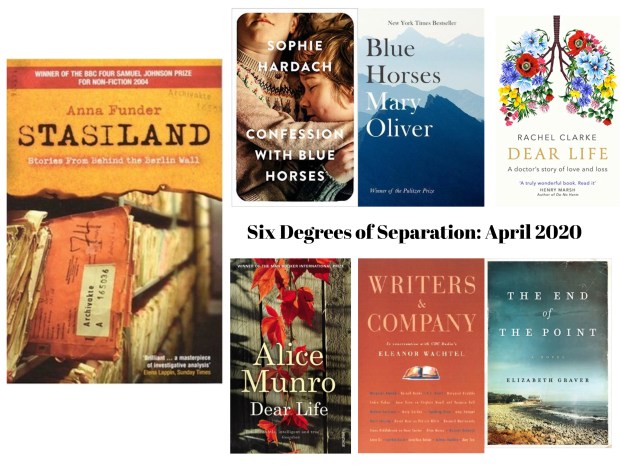
It’s my third time participating in Kate’s Six Degrees of Separation meme (see her introductory post). The challenge starts with Stasiland (2003) by Anna Funder, which I also happened to read recently. While working part-time for an overseas television service in what was once West Berlin, Funder started gathering stories of how ordinary people were put under surveillance and psychologically terrorized by the Stasi, the East German secret police. She molds her travels and her interviewees’ testimonies into riveting stories – though this won the Samuel Johnson Prize for nonfiction in 2004, it’s as character-driven as any novel.
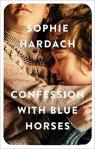
#1 My interest in Stasiland was piqued by reading Sophie Hardach’s Costa Prize-shortlisted novel Confession with Blue Horses (2019). When Ella’s parents, East German art historians under Stasi surveillance, were caught trying to defect during a ‘vacation’ to Hungary in 1987, their three children were taken from them and only two were returned. Ella is determined to find her brother, whom they’ve had no word of since, via a correspondence with the Stasi archive. It’s an emotionally involving story of one ordinary family’s losses and reconstruction.

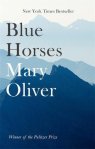 #2 Blue Horses (2014) is one of Mary Oliver’s lesser poetry collections. I found it to be a desperately earnest and somewhat overbaked set of nature observations and pat spiritual realizations. There are a few poems worth reading (e.g., “After Reading Lucretius, I Go to the Pond” and Part 3 of “The Fourth Sign of the Zodiac”), and lines here and there fit for saving, but overall this is so weak that I’d direct readers to Oliver’s landmark 1980s work instead.
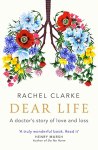
#3 Oliver’s poetry, especially “Wild Geese” and “The Summer Day,” gets quoted everywhere. The latter’s most famous lines, “Tell me, what is it you plan to do / with your one wild and precious life?” appears in Dear Life by Rachel Clarke, my book of 2020 so far. Clarke specializes in palliative medicine and alternates her patients’ stories with her own in a completely natural way. A major theme is her relationship with her late father, also a doctor, and his lessons of empathy and dedication. A passionate yet practical book, this aims to get people talking about end-of-life issues.
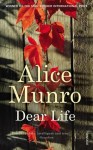
#4 I have meant to read Dear Life by Alice Munro (2012) since before she won the Nobel Prize. I was sent a free paperback copy for a Nudge review, but as the site already had a review of the book up, I let it slip and never followed through. More than once I’ve put this short story collection onto a reading stack, but I have never quite gotten past the first page or two. At some point this must be rectified.
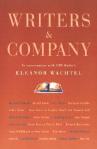
#5 Alice Munro is one of the authors featured in Writers & Co. by Eleanor Wachtel (1993), a terrific collection of interviews from Wachtel’s weekly Canadian Broadcasting Corporation radio program. Whether I’d read anything by these authors (or even heard of them) or not, I found each Q&A chock-full of priceless nuggets of wisdom about creativity, mothers and daughters, drawing on autobiographical material, the writing process, and much more.

#6 My first-ever author Q&A, for Bookkaholic in 2013, was related to The End of the Point by Elizabeth Graver. (Alas that the site is now defunct, so the interview only exists as a file on my computer.) In an astonishing historical sweep, from Massachusetts’s first colonial settlers through the cultural upheavals of the twentieth century, Graver’s family saga with a difference questions parent‒child ties, environmental responsibility, and the dictates of wealth and class. Her complex, elegiac tale, reminiscent of Virginia Woolf’s To the Lighthouse and Liza Klaussmann’s Tigers in Red Weather, offers multiple points of view in a sympathetic gaze at a vanishing way of life – but an enduring sense of place.
Join us for #6Degrees of Separation if you haven’t already!
Have you read any of my selections? Are you tempted by any you didn’t know before?
Book Serendipity: 2020, Part I
I call it serendipitous when two or more books that I’m reading at the same time or in quick succession have something pretty bizarre in common. Because I have so many books on the go at once – usually between 10 and 20 – I guess I’m more prone to such incidents. I also post these occasional reading coincidences on Twitter. (The following are in rough chronological order.)
- A Wisconsin setting in three books within a month (Shotgun Lovesongs by Nickolas Butler, This Is How It Always Is by Laurie Frankel and Crossing to Safety by Wallace Stegner)
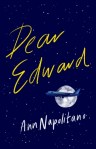
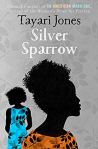
- I came across a sculpture of “a flock of 191 silver sparrows” in Dear Edward by Ann Napolitano while also reading Silver Sparrow by Tayari Jones.
- Characters nearly falling asleep at the wheel of a car in Crossing to Safety by Wallace Stegner and In the Dream House by Carmen Maria Machado
- There’s no escaping Henry David Thoreau! Within the span of a week I saw him mentioned in The Library of Ice by Nancy Campbell, The Snow Tourist by Charlie English, Losing Eden by Lucy Jones and Crossing to Safety by Wallace Stegner. Plus I’d just read the whole graphic novel Thoreau and Me by Cédric Taling.


- Discussions of the work of D.H. Lawrence in Unfinished Business by Vivian Gornick and The Offing by Benjamin Myers
- That scientific study on patient recovery in hospital rooms with a window view vs. a view of a brick wall turns up in both Dear Life by Rachel Clarke and Losing Eden by Lucy Jones.
- The inverted teardrop shapes mirror each other on these book covers:
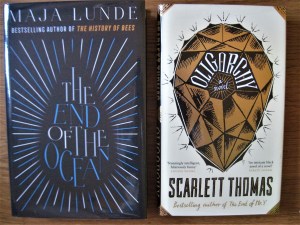
- Punchy, one-word titles on all these books I was reading simultaneously:

- Polio cases in The Golden Age by Joan London, Nemesis by Philip Roth and Crossing to Safety by Wallace Stegner
- An Italian setting and the motto “Pazienza!” in Dottoressa by Susan Levenstein and Crossing to Safety by Wallace Stegner
- Characters named Lachlan in The Ninth Child by Sally Magnusson and The Inland Sea by Madeleine Watts


- Mentions of the insecticide Flit in Nemesis by Philip Roth and Sacred Country by Rose Tremain
- A quoted Leonard Cohen lyric in Traveling Mercies by Anne Lamott; Cohen as a character in A Theatre for Dreamers by Polly Samson
- Plague is brought to an English village through bolts of cloth from London in Year of Wonders by Geraldine Brooks and Hamnet by Maggie O’Farrell; both also feature a woman who is a herbal healer sometimes mistaken for a witch (and with similar names: Anys versus Agnes)

- Gory scenes of rats being beaten to death in Hamnet by Maggie O’Farrell and Nemesis by Philip Roth
- Homemade mobiles in a baby’s room in A Theatre for Dreamers by Polly Samson and Sacred Country by Rose Tremain
- Speech indicated by italics rather than the traditional quotation marks in Pew by Catherine Lacey and Red at the Bone by Jacqueline Woodson
 Bookish Beck = Rebecca Foster. American transplant to England. Freelance proofreader and book reviewer.
 Bookish Beck