A Report on My Most Anticipated Reads & The Ones that Got Away
Between my lists in January and June, I highlighted 45 of the 2019 releases I was most looking forward to reading. Here’s how I did:
Read: 28 [Disappointments (rated
or
): 12]
Currently reading: 1
Abandoned partway through: 5
Lost interest in reading: 1
Haven’t managed to find yet: 9
Languishing on my Kindle; I still have vague intentions to read: 1
To my dismay, it appears I’m not very good at predicting which books I’ll love; I would have gladly given 43% of the ones I read a miss, and couldn’t finish another 11%. Too often, the blurb is tempting or I loved the author’s previous book(s), yet the book doesn’t live up to my expectations. And I still have 376 books published in 2019 on my TBR, which is well over a year’s reading. For the list to keep growing at that annual rate is simply unsustainable.
Thus, I’m gradually working out a 2020 strategy that involves many fewer review copies. For strings-free access to new releases I’m keen to read, I’ll go via my local library. I can still choose to review new and pre-release fiction for BookBrowse, and nonfiction for Kirkus and the TLS. If I’m desperate to read an intriguing-sounding new book and can’t find it elsewhere, there’s always NetGalley or Edelweiss, too. I predict my FOMO will rage, but I’m trying to do myself a favor by waiting most of the year to find out which are truly the most worthwhile books rather than prematurely grabbing at everything that might be interesting.
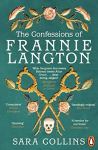
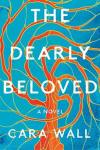
I regret not having time to finish two 2019 novels I’m currently reading that are so promising they likely would have made at least my runners-up list had I finished them in time. I’m only a couple of chapters into The Confessions of Frannie Langton by Sara Collins (on the Costa Awards debut shortlist), a Gothic pastiche about a Jamaican maidservant on trial for killing her master and mistress (doubly intended) in Georgian London, but enjoying it very much. I’m halfway through The Dearly Beloved by Cara Wall, a quiet character study of co-pastors and their wives and how they came to faith (or not); it is lovely and simply cannot be rushed.
The additional 2019 releases I most wished I’d found time for before the end of this year are:
All This Could Be Yours by Jami Attenberg
Your House Will Pay by Steph Cha
Dominicana by Angie Cruz
&
In the Dream House by Carmen Maria Machado: I’ve heard that this is an amazing memoir of a same-sex abusive relationship, written in an experimental style. It was personally recommended to me by Yara Rodrigues Fowler at the Young Writer of the Year Award ceremony, and also made Carolyn Oliver’s list of nonfiction recommendations.
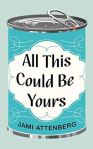
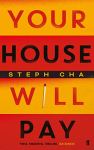
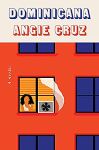

Luckily, I have another chance at these four since they’re all coming out in the UK in January; I have one as a print proof (Cruz) and the others as NetGalley downloads. I also plan to skim Invisible Women: Exposing Data Bias in a World Designed for Men by Caroline Criado Perez, a very important new release, before it’s due back at the library.
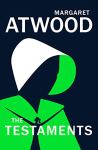 The biggest release of 2019 is another that will have to wait until 2020: I know I made a lot of noise about boycotting The Testaments, but I’ve gradually come round to the idea of reading it, and was offered a free hardback to read as a part of an online book club starting on the 13th, so I’m currently rereading Handmaid’s to be ready to start the sequel in the new year.
Here’s the books I’m packing for the roughly 48 hours we’ll spend at my in-laws’ over Christmas. (Excessive, I know, but I’m a dabbler, and like to keep my options open!) A mixture of current reads, including a fair bit of suspense and cozy holiday stuff, with two lengthy autobiographies, an enormous Victorian pastiche, and an atmospheric nature/travel book waiting in the wings. I find that the holidays can be a good time to start some big ol’ books I’ve meant to read for ages.

Left stack: to start and read gradually over the next couple of months; right stack: from the currently reading pile.
I’ll be back on the 26th to start the countdown of my favorite books of the year, starting with fiction.
Merry Christmas!
Booker Prize and Birthday Goings-On
The Booker Prize was announced last night in a live feed I watched over a glass of wine between my yoga class and birthday dessert. As chair of judges Peter Florence recapped each book, he said the most, and most effusively, about Ducks, Newburyport, so I thought Ellmann had it in the bag. Then, when it became clear there would be joint winners, I thought maybe Ellmann and Evaristo would share the Prize. But that’s not how things panned out…
I don’t have much to add to the conversation after yesterday’s Twitter storm; I remain entirely uninterested in reading The Testaments, an unnecessary sequel and, by all accounts, subpar Atwood work that didn’t need more buzz than it’s already attracted. Atwood won the Booker in 2000 for a brilliant novel, The Blind Assassin, one of my absolute favorites, and while she’s enough of a legend to be among the few authors to have won the Prize twice (along with Peter Carey, J.M. Coetzee and Hilary Mantel), maybe not for this book?

I am, however, delighted for Evaristo. If you haven’t yet picked up Girl, Woman, Other, I’d urge you to give it a try. I’m 1/3 into it now. Through a giveaway on Eric’s blog I won a copy plus two tickets to see Evaristo in conversation with Jennifer Nansubuga Makumbi (author of Manchester Happened, which I’ll be covering for the Ake Book Festival blog tour later this month) at the London Literature Festival on the 20th, but I couldn’t wait until I pick up my copy from the Southbank Centre so have been reading a library copy in the meantime.
You probably know that Girl, Woman, Other is a linked short story collection about 12 characters (mostly Black women) navigating twentieth-century and contemporary Britain, balancing external and internal expectations and different interpretations of feminism to build lives of their own. I’ve been surprised by the structure and style, however. It’s in four long chapters, each divided between three characters. These are almost like musical suites, with the three stories interlocking (I’m not in far enough to know if there is overlap between the suites). The prose is mostly uncapitalized and unpunctuated, with only a handful of full stops closing sections. This makes it more like poetry: a wry, radical stream of consciousness. I’d compare it, content-wise, to Homegoing by Yaa Gyasi and The Female Persuasion by Meg Wolitzer.
This is the third tie in Booker history – though after a 1992 tie the rules were changed so that it shouldn’t have happened again. As Gaby Wood, literary director of the Booker Prize Foundation, puts it, “The thinking was it just doesn’t work—it sort of detracts attention from both, rather than drawing attention to either.” So while it’s wonderful that Evaristo is the first Black woman to win the Booker, there is something almost sinister about the fact that, due to the tie, she gets just £25,000 in prize money rather than the full £50,000. However, both she and Atwood were extremely graceful in their acceptance speeches (Atwood sheepish and apologetic at the same time), so I will try to be as well. It’s a turn-up for the books, anyway!
 Yesterday was also my 36th birthday. A dismally wet Monday may not be ideal for a birthday, but I’d had the whole previous weekend for celebrating so can’t really complain. Saturday was a very Newbury day of volunteer gardening in the drizzle; an excellent lunch at Henry & Joe’s, a reasonably new restaurant with small plates of seasonal food, exquisitely presented – on the way to Michelin star quality; an early evening showing of Downton Abbey in the intimate upstairs theatre at the Corn Exchange; and a wander around the Fire Garden art installation, which features giant candles and automata. On Sunday I helped out at a fun and chaotic pet blessing service at church, followed by cake, presents and a homemade feast.


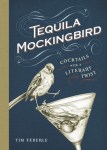
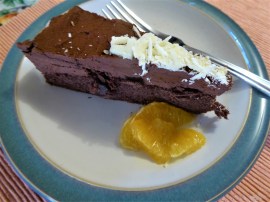 One of the best parts of preparing for my birthday is finding recipes for my husband to make for me. This year I picked a Chocolate Orange Truffle Cake from Perfect Chocolate Desserts (which includes photographs of every step), a veganized Chicken Jackfruit Mole with Red Cabbage Slaw and flatbreads from Pip & Nut: The Nut Butter Cookbook, and A Rum of One’s Own (aka hot buttered rum) from the Tequila Mockingbird literary cocktails book. All amazingly rich and delicious; by nightcap time, I could only manage a sip or two of the rum.

I gave myself the Monday off work (the nice thing about being a freelancer, even if I don’t get paid) and spent much of it reading in comfy spots around the house and looking out at the rain. I also picked out a pile of books I’ve been meaning to reread, but only got around to starting the Thomas. I hadn’t read it since it came out in 2006 yet I remember it so well, even particular phrasing. It was one of the first memoirs to make a really big impression on me.


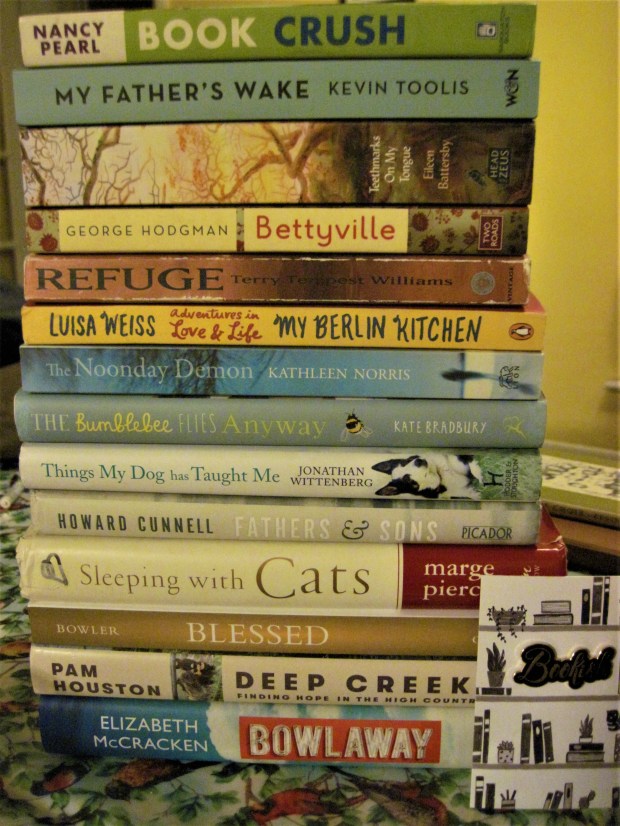
It won’t surprise you that my wish list contained only books this year, so with the exception of a mug mat, puffin socks and notecards, a couple of CDs, some chocolate and the perfect pin badge (“Bookish”), I received 14 books as presents: two novels and the rest nonfiction, mostly memoirs. I get much of my fiction from the library or from NetGalley/Edelweiss (particularly the American releases I can’t find elsewhere), but there are lots of nonfiction authors whose work I can’t find other than secondhand. I know where I’ll start with this pile: the Houston and McCracken are 2019 releases, so I want to read them before the end of the year in case they make a Best Of list. After that, I’ll let whimsy be my guide. A great haul!
Any additional Booker thoughts?
What caught your eye from my birthday stacks?
Doorstopper of the Month: A Reread of The Poisonwood Bible (1998)
“The fallen Congo came to haunt even our little family, we messengers of goodwill adrift on a sea of mistaken intentions.”
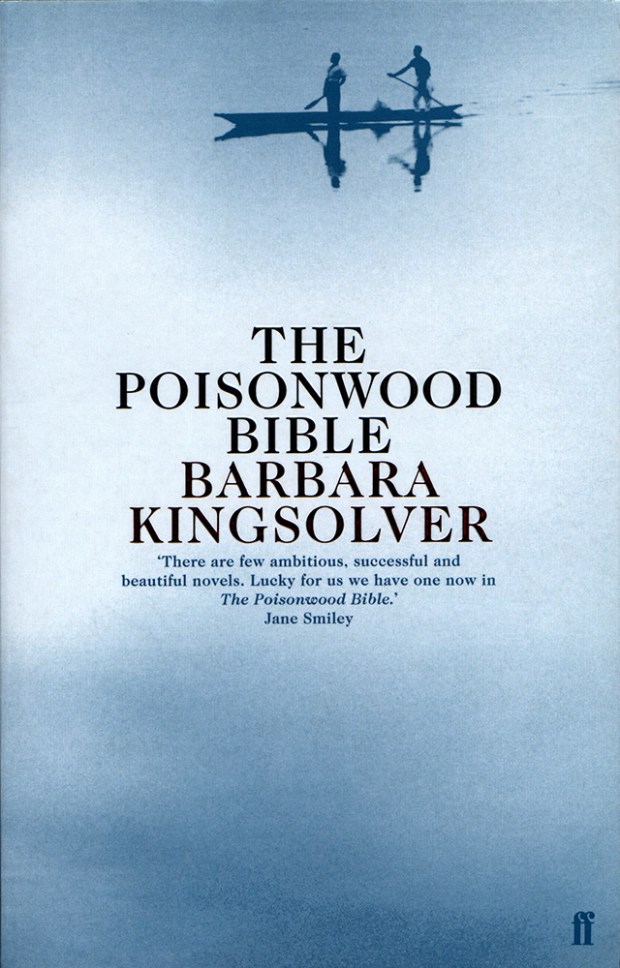
You may have gathered by now that I struggle with rereading. Often I find that on a second reading a book doesn’t live up to my memory of it – last year I reread just four books, and I rated each one a star lower than I had the first time. But that wasn’t the case with my September book club book, Barbara Kingsolver’s The Poisonwood Bible, which I’ve just flown through in 11 days. I first read it in the spring of 2002 or 2003, so maybe it’s that I’d allowed enough time to pass for it to be almost completely fresh – or that I was in a better frame of mind to appreciate its picture of harmful ideologies in a postcolonial setting. In any case, this time it struck me as a masterpiece, and has instantly leapt onto my favorites list.
Here’s what I’d remembered about The Poisonwood Bible after the passage of 16–17 years:
- It’s about a missionary family in Africa, and narrated by the daughters.
- One of the sisters marries an African.
- The line “Nathan was made frantic by sex” (except I had it fixed incorrectly in my mind; it’s actually “Nathan was made feverish by sex”).
Everything else I’d forgotten. Here’s what stood out on my second reading:
- Surely one of the best opening lines ever? (Though technically there’s a prologue that comes before it.) “We came from Bethlehem, Georgia, bearing Betty Crocker cake mixes into the jungle.”
- The book is actually narrated in turns by the wife and four daughters of Southern Baptist missionary Nathan Price, who arrives in the Congo with his family in 1959. These five voices are a triumph of first-person narration, so distinct and arising organically from the characters’ personalities and experiences. The mother, Orleanna, writes from the future in despondent isolation – a hint right from the beginning that this venture is not going to end well. Fifteen-year-old Rachel is a selfish, ditzy blonde who speaks in malapropisms and period slang and misses everything about American culture. Leah, one of the 13-year-olds, is whip-smart and earnest; she idolizes their father and echoes his religious language. Her twin, Adah, who was born with partial paralysis, rarely speaks but has an intricate inner life she expresses through palindromes, cynical poetry and plays on words. And Ruth May, just five years old, sees more than she understands and sets it all across plainly but wittily.
- Nathan’s arrogant response to the ‘native customs’ is excruciating. His first prayer, spoken to bless the meal the people of Kilanga give in welcome, quickly becomes a diatribe against nakedness, and he later rails against polygamy and witch doctors and tries to enforce child baptism. When he refuses to take their housekeeper Mama Tataba’s advice on planting, all of the seeds he brought from home wash away in the first rainstorm. On a second attempt he meekly makes the raised beds she recommended, and keeps away from the poisonwood that made him break out in a nasty rash. This garden he plants is a metaphor for control versus adaptation.
- Brother Fowles, Nathan’s predecessor at the mission, is proof that Christianity doesn’t have to be a haughty rampage. He respects Africans enough to have married one, and his religion is a playful, elastic one built around love and working alongside creation.
- The King James Bible (plus Apocrypha, for which Nathan harbors a strange fondness) provides much of the book’s language and imagery, as well as the section headings. Many of these references come to have (sometimes mocking) relevance. Kingsolver also makes reference to classics of Africa-set fiction, like Chinua Achebe’s Things Fall Apart and Joseph Conrad’s Heart of Darkness.
- Africa is a place of many threats – malaria and dysentery, snakes in the chicken house, swarms of ants that eat everything in their path, corruption, political coups and assassinations – not least the risk of inadvertently causing grave cultural offense.
- The backdrop of the Congo’s history, especially the declaration of independence in 1960 and the U.S.-led “replacement” (by assassination) of its first prime minister, Patrice Lumumba, with the dictator Mobutu, is thorough but subtle, such that minimal to no Googling is required to understand the context. (Only in one place, when Leah and Rachel are arguing as adults, does Kingsolver resort to lecturing on politics through dialogue, as she does so noticeably in Unsheltered.)
- Names are significant, as are their changes. With the end of colonialism Congo becomes Zaire and all its cities and landmarks are renamed, but the change seems purely symbolic. The characters take on different names in the course of the book, too, through nicknames, marriage or education. Many African words are so similar to each other that a minor mispronunciation by a Westerner changes the meaning entirely, making for jokes or irony. And the family’s surname is surely no coincidence: we are invited to question the price they have paid by coming to Africa.
- We follow the sisters decades into the future. “Africa has a thousand ways to get under your skin,” Leah writes; “we’ve all ended up giving up body and soul to Africa, one way or another.” Three of the four end up staying there permanently, but disperse into different destinies that seem to fit their characters. Even those Prices who return to the USA will never outrun the shadow the Congo has left on their lives.
 What an amazing novel about the ways that right and wrong, truth and pain get muddied together. Some characters are able to acknowledge their mistakes and move on, while others never can. As Adah concludes, “We are the balance of our damage and our transgressions.”
I worried it would be a challenge to reread this in time to hand it over for my husband to take on his week-long field course in Devon, but it turned out to be a cinch. That’s the mark of success of a doorstopper for me: it’s so engrossing you hardly notice how long the book is. I think this will make for our best book club discussion yet. I can already think of a few questions to ask – Is it fair that Nathan never gets to tell his side of the story? Which of the five voices is your favorite? Who changes and who stays the same over the course of the book? – and I’m sure I’ll find many more resources online since this was an Oprah’s Book Club pick too.
English singer-songwriter Anne-Marie Sanderson’s excellent Book Songs, Volume 1 EP includes the song “Poisonwood.” The excerpted lyrics are below, with direct quotes from the text in bold.

Our Father speaks for all of us
Our Father knows what’s best for us as well
He planted a garden where poisonwood grew
He cut down the orchids cos none of us knew
that the seeds that filled his pockets
would grow and grow without stopping
his beans, his Kentucky Wonders
played their part in tearing us asunder.
Our mother suffered through all of this
Our mother carried the guilt
Carry us, marry us, ferry us, bury us
Carry us, bury us with the poisonwood.
Page count: 615
My rating: 
Re-Reading Modern Classics: Fiction Advocate’s “Afterwords” Series
I didn’t manage a traditional classic this month: I stalled on Cider with Rosie and gave up on Evelyn Waugh’s A Handful of Dust after just 16 pages. Instead, I’m highlighting three books from Fiction Advocate’s new series about re-reading modern classics, “…Afterwords.” Their tagline is “Essential Readings of the New Canon,” and the concept is to have “acclaimed writers investigate the contemporary classics.”
As Italo Calvino notes in his invaluable essay “Why Read the Classics?”, “The classics are those books about which you usually hear people saying: ‘I’m rereading…’, never ‘I’m reading…’.” Harold Bloom agrees in The Western Canon: “One ancient test for the canonical remains fiercely valid: unless it demands rereading, the work does not qualify.” But readers will also encounter books that strike such a chord with them that they become personal classics. Calvino exhorts readers that “during unenforced reading … you will come across the book which will become ‘your’ book…‘Your’ classic is a book to which you cannot remain indifferent, and which helps you define yourself in relation or even in opposition to it.”
For the Afterwords series, the three writers below have each chosen a modern classic that they can’t stop reading for all it has to say to their own situation and on humanity in general.
I Meant to Kill Ye: Cormac McCarthy’s Blood Meridian by Stephanie Reents (2018)
Blood Meridian must be one of the two or three bleakest books I’ve ever read. I was led to it by Bloom, who speaks about it as a, if not the, Great American Novel. It’s over 10 years since I’ve read it now, but I still remember some of the specific incidences of violence, like skewering babies and sodomizing corpses on a battlefield, as well as the overall feeling of nihilism: there’s no reason for the evil promulgated by characters like the Judge; it is simply a reality – perhaps the human condition.
 Reents, who teaches English at the College of the Holy Cross, returns to Blood Meridian, a novel she has re-read compulsively over the years, to ask why it continues to have such a hold over her. Its third-person perspective is so distant that we never understand characters’ motivations or glimpse their inner lives, she notes; everyone seems like a pawn in a fated course. She usually shies away from violence and long descriptive passages; she has an uneasy relationship with the West, having moved away from Idaho to live on the East coast. So why should this detached, brutal Western based on the Glanton Gang’s Mexico/Texas killing spree have so captivated her? “Often, we most admire the books that we could never produce, the writing styles or intellects so different from our own that we aren’t even tempted to try imitating them,” she offers as explanation. “It’s a pure kind of admiration, unsullied by envy.” (I feel that way about Faulkner and Steinbeck.)
As part of her quest, Reents recreated some of the Gang’s desert route and traveled to the Texas State University library near Austin to look at McCarthy’s early drafts, notes and correspondence. She was intrigued to learn that the Kid was a more conventional POV character to start with, and McCarthy initially included more foreshadowing. By cutting all of it, he made it so that the book’s extreme violence comes out of nowhere. Reents also explores the historical basis for the story via General Samuel Chamberlain’s dubious memoir. Pondering the volatility of the human heart as she drives along the Mexican border, she ends on the nicely timely note of a threatened Trump-built wall. I doubt I could stomach reading Blood Meridian again (though I’ve read another two McCarthy novels since), but I enjoyed revisiting it with Reents as she finds herself “re-bewildered by its beauty and horror.”
A Little in Love with Everyone: Alison Bechdel’s Fun Home by Genevieve Hudson (2018)
Alison Bechdel is one of Hudson’s queer heroes (along with James Baldwin, Tracy Chapman, and seven others), portrayed opposite the first page of each chapter in black and white drawings by Pace Taylor – the sort of people who gave her the courage to accept her lesbian identity after a conventional Alabama upbringing.
 As portrayed in her landmark graphic memoir Fun Home, Bechdel was in college and finally coming to terms with her sexuality at the same time that she learned that her father was gay and her parents were about to divorce. Her father died in an accident just a few months later and, though he had many affairs, had never managed to live out his homosexuality openly. As Bechdel’s mother scoffed, “Your father tell the truth? Please!” By contrast, Hudson appreciates Bechdel so much because of her hard-won honesty: “In her work, Bechdel does the opposite of lying. She excavates the real. She dredges up the stuff of her life, embarrassing parts and all.”
Hudson looks at how people craft their own coming-out narratives, the importance of which cannot be overemphasized, in her experience. “Coming out was a tangible thing with tangible effects. For every friend who left my life, a new person arrived—usually someone with broader horizons, exciting stories, and a deviance that seemed sweet and sexy and sincere. After I came out, roaming the streets of Charleston in fat sunglasses and thin dresses, a group of beautiful lesbians appeared out of nowhere. … Everyone was a little in love with everyone.”
A Cool Customer: Joan Didion’s The Year of Magical Thinking by Jacob Bacharach (2018)
 I made the mistake of not taking any notes on, or even marking out any favorite passages in, this, so all I can tell you is that for me it was the most powerful of the three I’ve tried from the series. The author re-examines Didion’s work in the light of his own encounter with loss – his brother’s death from a drug overdose – and ponders why it has become such a watershed in bereavement literature. Didion really is the patron saint of grief thanks to her two memoirs, Magical Thinking and Blue Nights – after she was widowed she also lost her only daughter – even though she writes with a sort of intellectual detachment; you have to intuit the emotion between the lines. Bacharach smartly weaves his family story with a literate discussion of Didion’s narratives and cultural position to make a snappy and inviting book you could easily read in one sitting.
Indeed, all of the Afterwords books are 120–160-page, small-format paperbacks that would handily slip into a pocket or purse.
My thanks to the publisher for the free copies for review.
The other titles in the series are An Oasis of Horror in a Desert of Boredom by Jonathan Russell Clark (on 2666 by Roberto Bolaño), New Uses for Failure by Adam Colman (on 10:04 by Ben Lerner, and Bizarro Worlds by Stacie Williams (on The Fortress of Solitude by Jonathan Lethem).
Next month’s plan: The Leopard by Giuseppe di Lampedusa will be my classic to get me in the mood for traveling to Italy for the first week of July.
Following Up on the Prescriptions from My Bibliotherapy Appointment
In January 2018 I had the wonderful opportunity to have a free bibliotherapy session at the School of Life in London with Ella Berthoud, one of the authors of The Novel Cure. I wrote about the experience in this post. I quickly got hold of all but a couple of my prescribed reads, but have been slower about actually reading them. Though I’ve read five now, I’ve only written up four, two of which I only managed to finish this week. (These 250-word reviews are in order of my reading.)
Heligoland by Shena Mackay (2002)
(CURE: moving house)
 Heligoland is a Scottish island best known from the shipping forecast, but here it’s an almost mythical home. Rowena Snow was orphaned by her Indian/Scottish parents, and a second time by her aunt. Since then she’s drifted between caring and cleaning jobs. The Nautilus represents a fresh chance at life. This shell-shaped artists’ commune in South London houses just three survivors: Celeste Zylberstein, who designed the place; poet Francis Campion; and antiques dealer Gus Crabb. Rowena will be the housekeeper/cook, but she struggles with self-esteem: does she deserve to live in a haven for upper-class creative types?
The omniscient perspective moves between the Nautilus residents but also on to lots of other minor hangers-on, whose stories are hard to keep track of. Mackay’s writing reminded me somewhat of Tessa Hadley’s and is lovely in places – especially when describing a buffet or a moment of light-filled epiphany in a garden. There’s not much to be said beyond what’s in the blurb: Mackay is attempting to give a picture of a drifter who finds an unconventional home; in the barest sense she does succeed, but I never felt a connection with any of the characters. In this ensemble cast there is no one to love and thus no one to root for. While I didn’t love this book, it did inspire me to pick up others by Mackay: since then I’ve read The Orchard on Fire, which I liked a lot more, and the first half of Dunedin.
My rating: 
Family Matters by Rohinton Mistry (2002)
(CURE: worry over ageing parents)
 Retired professor Nariman Vakeel, 79, has Parkinson’s disease and within the first few chapters has also fallen and broken his ankle. His grown stepchildren, Coomy and Jal, reluctant to care for him anyway, decide they can’t cope with the daily reality of bedpans, sponge baths and spoon feeding in their large Chateau Felicity apartment. He’ll simply have to recuperate at Pleasant Villa with his daughter Roxana and her husband and sons, even though their two-bedroom apartment is barely large enough for the family of four. You have to wince at the irony of the names for these two Bombay housing blocks, and at the bitter contrast between selfishness and duty.
Perhaps inevitably, Nariman starts to fade into the background. An increasingly speechless invalid, he only comes alive through his past: italicized sections, presented as his night-time ravings, tell of his love for Lucy, whom his parents refused to let him marry, and the untimely end of his arranged marriage. I enjoyed time spent in a vibrantly realized Indian city and appreciated a chance to learn about a lesser-known community: Nariman and family are Parsis (or Zoroastrians). There’s also a faint echo here of King Lear, with one faithful daughter set against two wicked children.
As to ageing parents, this is a pretty relentlessly bleak picture, but there are sparks of light: joy in life’s little celebrations, and unexpected kindnesses. Mistry’s epic has plenty of tender moments that bring it down to an intimate scale. I’m keen to read his other novels.
My rating:
Maggie & Me by Damian Barr (2013)
(A supplementary prescription because I love memoirs and didn’t experience Thatcher’s Britain.)
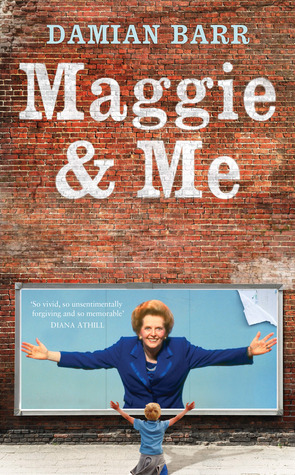 Like a cross between Angela’s Ashes and Toast, this recreates a fairly horrific upbringing from the child’s perspective. Barr was an intelligent, creative young man who early on knew that he was gay and, not just for that reason, often felt that there was no place for him: neither in working-class Scotland, where his father was a steelworker and his brain-damaged mother flitted from one violent boyfriend to another; nor in Maggie Thatcher’s 1980s Britain at large, in which money was the reward for achievement and the individual was responsible for his own moral standing and worldly advancement. “I don’t need to stand out any more,” he recalls, being “six foot tall, scarecrow skinny and speccy with join-the-dots spots, bottle-opener buck teeth and a thing for waistcoats. Plus I get free school dinners and I’m gay.”
There are a lot of vivid scenes in this memoir, some of them distressing ones of abuse, and the present tense, dialect, and childish grammar and slang give it authenticity. However, I never quite bought in to the Thatcher connection as an overarching structure. Three pages at the start, five at the end, and a Thatcher quote as an epigraph for each chapter somehow weren’t enough to convince me that the framing device was necessary or apt. Still, I enjoyed this well enough as memoirs go, and I would certainly recommend it if you loved Nigel Slater’s memoir mentioned above. I also have Barr’s recent debut novel, You Will Be Safe Here, on my Kindle.
My rating:
The Monsters of Templeton by Lauren Groff (2008)
(A supplementary prescription for uncertainty about having children.)
 I enjoyed this immensely, from the first line on: “The day I returned to Templeton steeped in disgrace, the fifty-foot corpse of a monster surfaced in Lake Glimmerglass.” Twenty-eight-year-old Willie Upton is back in her hometown, pregnant by her older, married archaeology professor after a summer of PhD fieldwork in Alaska. “I had come home to be a child again. I was sick, heartbroken, worn down.” She gives herself a few weeks back home to dig through her family history to find her father – whom Vi has never identified – and decide whether she’s ready to be a mother herself.
We hear from various leading lights in the town’s history and/or Willie’s family tree through a convincing series of first-person narratives, letters and other documents. Groff gives voice to everyone from a Mohican chief to a slave girl who catches her master’s eye. Willie and Vi are backed up by a wonderful set of secondary characters, past and present. Groff wrote this in homage to Cooperstown, New York, where she grew up. (If you’ve heard of it, it’s probably for the baseball museum; it’s not far from where my mother is from in upstate New York.) Templeton is “a slantwise version” of Cooperstown, Groff admits in an opening Author’s Note, and she owes something of a debt to its most famous citizen, James Fenimore Cooper. What a charming way to celebrate where you come from, with all its magic and mundanity. This terrific debut novel cemented my love of Groff’s work.
My rating:
I also have Ella to thank for the inspiration to reread a childhood favorite, Little Women by Louisa May Alcott, last year; the experiment formed the subject of my first piece for Literary Hub. I also worked my way through The Artist’s Way by Julia Cameron, another of my prescriptions, over a number of months in 2018, but failed to keep up with the regular writing exercises so didn’t get the maximum benefit.
My husband and I made a start on reading a few books aloud to each other, including Sum: Forty Tales from the Afterlives by David Eagleman, but that fell by the wayside after a handful of weeks.
(Incidentally, I had forgotten that Cutting for Stone turns up in The Novel Cure on a list of the 10 best books to combat xenophobia.)
 Still to read: Jitterbug Perfume by Tom Robbins (CURE: horror of ageing)
And one I still have to get hold of but haven’t been able to find cheap secondhand because it’s a Persephone classic: The Victorian Chaise-Longue by Marghanita Laski (a supplementary prescription because I love Victorian pastiches).
American Book Acquisitions and 2019 Reading Goals
We arrived in the UK on January 1, after an overnight flight from Baltimore. There was no midnight announcement, no complimentary champagne; nothing. Clearly I had my hopes too high. So we’re feeling a bit cheated out of our New Year’s Eve experience and will be doing a recreated countdown and toast when we have houseguests over for this Epiphany weekend.
It was a low-key, relaxing couple of weeks back in the States, the majority of it spent seeing family and friends. We also made it into D.C. to see the new Obama portraits. Mostly I enjoyed doing not a lick of work. And I acquired books, of course: a secondhand and remainder stack that, after my trade-in of some cast-off books, cost just $4; and a few ARCs I’m excited about.


2019 Goals
I’m feeling restless in my career, like if someone gave me permission to quit all my gigs I would do it tomorrow. But, of course, only a fool would do so with no plan to replace them with other remunerative work. The year is likely to involve a lot of rethinking for me as I evaluate which of my proofreading and writing jobs feel worthwhile, and what’s taking me in the direction I want to go (not that I currently know what that is).
Life is awfully hard to plan out. Reading is much easier! So here are my fairly modest reading goals for the year, some of them overlapping:
- I plan to reinstate the Classic and Doorstopper of the month features I ran in 2017, since otherwise I hardly ever read them. I’m starting with Annabel’s readalong of The Name of the Rose by Umberto Eco, which is just over 500 pages but also conveniently falls into one of the below categories.

The doorstoppers I have around to choose from.
- I’ll make a second attempt at getting through some of the travel books and biographies I own, though I won’t hold myself to any particular target. At least five of each would be nice.


- I’m determined to up my literature in translation ratio. These are all the books I own that were originally published in other languages – pitiful! – but I will get hold of more through the library and publishers.

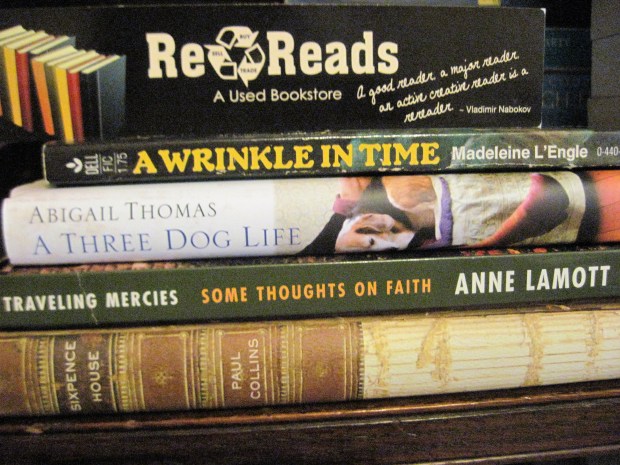
- Re-reading is something I undertake very reluctantly. I have friends who swear by it, but to me it can feel like a waste of time. Last year I re-read just four books: Little Women, Give Me Everything You Have, Crossing the Moon, and Diary of a Bookseller. In each case, on the second reading I rated the book a star lower. That suggests that, far from appreciating books more on a second reading, I have less patience with them and find more flaws! All the same, I’ve chosen four books to re-read in 2019. The Collins is a longtime favorite about moving to Hay-on-Wye; the Thomas is one of the books that first got me into reading memoirs. I’ve been let down by Lamott’s latest three books so wanted to go back to one of her spiritual classics; I’ve gotten into L’Engle’s writing for adults and want to revisit her most famous children’s book (which I don’t think I comprehended at age nine or whatever I was).
- I have a bad habit of racing through self-help and theology books rather than taking my time mulling over them and fully exploring how I might apply them in my life. This was especially true of The Artist’s Way, one of my bibliotherapy prescriptions. I started out with the aim of completing the daily “morning pages” of free writing (though for me they were ‘evening pages’; I’m not a morning person) and each chapter’s self-knowledge exercises. But soon I’d given up on the writing and contemplation and begun just reading the book straight through, which is not the point of it at all. So this year I mean to go back through the Cameron and Rubin books more mindfully, and use the McLaren devotional as it is intended, reading the recommended Bible passages alongside the weekly reflections.

What are some of your goals (reading-related or otherwise) for 2019?
My Bibliotherapy Appointment at the School of Life
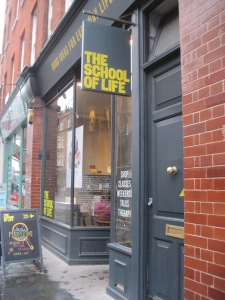 I’ve been interested in bibliotherapy for years, and I love The Novel Cure (see my review), the learned and playful advice book from Ella Berthoud and Susan Elderkin, two of the bibliotherapists at Alain de Botton’s London School of Life. Earlier this month I had the tremendous opportunity to have a personalized bibliotherapy appointment with Ella Berthoud at the School of Life. She’d put out a call on Twitter for volunteers to come for a free session (usually £100) to be observed by a journalist from La Repubblica writing about bibliotherapy – the translation of The Novel Cure has sold remarkably well in Italy. The feature will be part of a special color supplement in February, and I look forward to seeing if my story makes the cut! That is, if I can decipher any of the Italian.
Now, you might not think I’m the kind of person who needs a bibliotherapy assessment since I already find 300+ books per year I want to read; I worried that too, and felt a little bit guilty, but in the end I couldn’t pass up the chance, and Ella was happy to have me.

I took my copy of The Novel Cure along for Ella to sign.
Before my appointment I’d been asked to complete a two-page questionnaire about my reading habits and likes/dislikes, along with what’s going on in my life in general (the ‘therapy’ aspect is real). Once we were set up in the basement therapy room with hot drinks, Ella asked me more about how I read. I’d told her my reading was about two-thirds print books and one-third e-books. Had I ever tried audiobooks or reading aloud, she asked? The answer to both of those is no, I’m afraid. There’s no obvious place for audiobooks in my life because I work from home. However, as I’d mentioned I haven’t been able to get through a Dickens novel in five years, Ella suggested I try listening to one – abridged, it can be more like eight hours long instead of 42, and you still get a terrific story. She also highly recommended New Yorker and Guardian podcasts based around short stories and discussion.
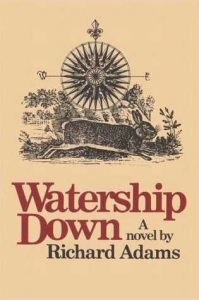 For reading aloud with my husband, Ella prescribed one short story per evening sitting – a way for me to get through short story collections, which I sometimes struggle to finish, and a different way to engage with books. We also talked about the value of rereading childhood favorites such as Watership Down and Little Women, which I haven’t gone back to since I was nine and 12, respectively. In this anniversary year, Little Women would be the ideal book to reread (and the new television adaptation is pretty good too, Ella thinks).
One other reading habit Ella is adamant about is keeping a physical reading journal in which you record the title of each book you read, where you read it, and about a paragraph of thoughts about it. It’s not meant to be a comprehensive response to every book; more like an aide-mémoire that you can get off the shelf in years to come to remind yourself of what you thought about a book. Specifically, Ella thinks writing down the location of your reading (e.g., on a train to Scotland) allows you to put yourself back in the moment. I tend to note where I bought a book, but not necessarily where I read it – for that, I would probably have to cross-reference my annual book list against a calendar. Since 2010 I’ve kept my book lists and responses in computer files, and I also keep full records via Goodreads, but I can see why having a physical journal would be a good back-up as well as a more pleasant representation of my reading. I’ll think about starting one.
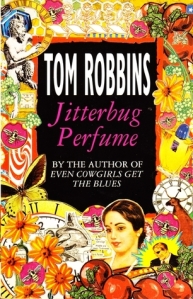 Various books came up over the course of our conversation: Abraham Verghese’s Cutting for Stone [appearance in The Novel Cure: The Ten Best Novels to Cure the Xenophobic, but Ella brought it up because of the medical theme], Tom Robbins’ Jitterbug Perfume [cure: ageing, horror of], and Julia Cameron’s The Artist’s Way, a nonfiction guide to thinking creatively about your life, chiefly through 20-minute automatic writing exercises every morning. We agreed that it’s impossible to dismiss a whole genre, even if I do find myself weary of certain trends, like dystopian fiction (I introduced Ella to Claire Vaye Watkins’ Gold Fame Citrus, one of my favorite recent examples).
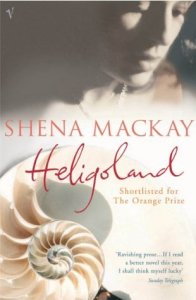 I came away with two instant prescriptions: Heligoland by Shena Mackay [cure: moving house], about a shell-shaped island house that used to be the headquarters of a cult. It’s a perfect short book, Ella tells me, and will help dose my feelings of rootlessness after moving more than 10 times in the last 10 years. She also prescribed Family Matters by Rohinton Mistry [cure: ageing parents] and an eventual reread of Jonathan Franzen’s The Corrections. As we discussed various other issues, such as my uncertainty about having children, Ella said she could think of 20 or more books to recommend me. “That’s a good thing, right?!” I asked.


Before I left, I asked Ella if she would ever prescribe nonfiction. She said they have been known to do so, usually if it’s written in a literary style (e.g. Robert Macfarlane and Alain de Botton). We chatted about medical memoirs and reading with the seasons for a little while, and then I thanked her and headed on my way. I walked around the corner to Skoob Books but, alas, didn’t find any of the books Ella had mentioned during our session. On the way back to the Tube station, though, I stopped at Judd Books and bought several secondhand and remaindered goodies, including these two:


(Imagine my surprise when I spotted The Year of the Hare in The Novel Cure under midlife crisis! Age seemed to be the theme of the day.)
 As soon as I got back from London I ordered secondhand copies of Heligoland, Jitterbug Perfume and The Artist’s Way, and borrowed Family Matters from the public library the next day. Within a few days four further book prescriptions arrived for me by e-mail. Ella did say that her job is made harder when her clients read a lot, so kudos to her for prescribing books I’d not read – with the one exception of Sebastian Barry’s Days Without End, which I love.
I’ve put in another order for Maggie and Me, the memoir by Damian Barr, plus (for reading aloud) Sum: Forty Tales from the Afterlives by David Eagleman and the collected short stories of Saki. I’m also keen to find The Victorian Chaise-Longue by Marghanita Laski, Ella’s final prescription, but as the Persephone Books reprint is pricey at the moment I may hold off and hope to chance upon a secondhand copy later in the year. Ella has been very generous with her recommendations, especially considering that I didn’t pay a penny. I certainly have plenty to be getting on with for now! I’ll report back later on in the year when I’ve had the chance to read some of these prescriptions.

The prescribed books I have gotten hold of so far.
Jacob’s Room Is Full of Books by Susan Hill
Susan Hill has published dozens of books in multiple genres, but is probably best known for her perennially popular ghost story, The Woman in Black (1983). Apart from that and two suspense novellas, the only book I’d read by her before is Howards End Is on the Landing (2009), a sort of prequel to this work. Both are bookish memoirs animated by the specific challenge to spend more time reading from her shelves and revisiting the books that have meant the most to her in the past. Though not quite a journal, this is set up chronologically and also incorporates notes on the weather, family events and travels, and natural phenomena encountered near her home in Norfolk.
The Virginia Woolf reference in the title is fitting, as Hill realizes she has four shelves’ worth of books about Woolf and her Bloomsbury set. It’s just one of many mini-collections she discovers in her library on regular “de-stocking” drives when she tries to be realistic about what, at age 75, she’s likely to reread or reference in the future. “A book that cannot be returned to again and again, and still yield fresh entertainment and insights, is only half a book,” Hill contends. Some authors who merit frequent rereading for her are Edith Wharton, Muriel Spark, W. Somerset Maugham and Olivia Manning, while other passions had a time limit: she’s gone off E.F. Benson, and no longer reads about Antarctica or medieval theology.
 Hill is unashamedly opinionated, though she at least has the humility to ask what individual taste matters. Her substantial list of no-nos includes fairy tales, science fiction, Ethan Frome, Patricia Highsmith and e-readers, and she seems strangely proud of never having read Jane Eyre. She’s ambivalent about literary festivals and especially about literary prizes: they were a boon to her as a young author, but she was also on the infamous 2011 Booker Prize judging panel, and disapproves of that prize being opened up to American entries.
As well as grumpy pronouncements, this book is full of what seems like name-dropping: encounters with Iris Murdoch, J.B. Priestley, Susan Sontag and the like. (To be fair, the stories about Murdoch and Sontag are rather lovely.) Although aspects of this book rubbed me the wrong way, I appreciated it as a meditation on how books are woven into our lives. I took note of quite a few books I want to look up, and Hill ponders intriguing questions that book clubs might like to think about: Can we ever enjoy books as purely as adults as we did as children, now that we have to “do something” with our reading (e.g. discussing or reviewing)? Is it a lesser achievement to turn one’s own life experiences into fiction than to imagine incidents out of thin air? Will an author unconsciously “catch the style” of any writer they are reading at the time of their own compositions? Is it better to come to a book blind, without having read the blurb or anything else about it?
You’ll applaud; you’ll be tempted to throw the book at the wall (this was me with the early page disparaging May Sarton). Perhaps on consecutive pages. But you certainly won’t be indifferent. And a book that provokes a reaction is a fine thing.
Some favorite lines:
“Cold room, warm bed, good book.”
“I have had fifty-five years of experience but still every book is like walking a tightrope. I might fall off.”
“People say they can never part with a book. I can. As fast as I get one out of the back door, two new ones come in through the front anyway.”
“How many people are there living in the books here? Only take the complete novels of Dickens and add up all the characters in each one and then multiply by … and I already need to lie down. Overall, there must be thousands of imaginary people sharing this house with us.”
“One of the best presents anyone can give you is the name of a writer whose books they believe will be ‘you’ – and they are. Someone you would almost certainly never have found for yourself.”
My rating:
Jacob’s Room Is Full of Books was released in the UK on October 5th. My thanks to Profile Books for the free copy for review.
 Bookish Beck = Rebecca Foster. American transplant to England. Freelance proofreader and book reviewer.
 Bookish Beck