#1925Club: The Heart of a Dog by Mikhail Bulgakov
Simon and Kaggsy’s classics reading weeks always get me picking up older books. I found this unusual Russian novella on a giveaway pile a few years ago and it’s been on my #NovNov possibility shelf ever since, but now turned out to be the perfect time for it. This review also fits into the Hundred Years Hence challenge.

Sharik is an abused stray dog, living on scraps on the snowy streets of Moscow until Professor Philip Philipovich Preobrazhensky takes him in. The professor is a surgeon renowned for his rejuvenation procedures – implanting monkey ovaries into a middle-aged lady, for instance – and he has designs on the mutt. His new strategy is to take the pituitary gland and testicles of a just-deceased young man and transplant them into Sharik. The central chapter is composed of medical notes taken by Preobrazhensky’s assistant, Dr. Bormenthal. Gradually, a transformation is achieved: The dog’s bark becomes more of a human groan and his fur and tail fall off. Soon the new man is fully convincing: eating, dressing and conversing. Even in a matter-of-fact style, the doctor’s clinical observations are hilarious. “The dog[,] in the presence of Zina and myself, had called Prof. Preobrazhensky a ‘bloody bastard’. … Heard to ask for ‘another one, and make it a double.’” The scientists belatedly look into the history of the man whose glands they harvested and discover to their horror that he was an alcoholic petty thief who died in a bar fight. Sharikov follows suit as an inebriated boor who pesters women, wants to be known as Poligraph Poligraphovich – and still chases cats. Is it too late to reverse a Frankenstein-esque trial gone wrong?
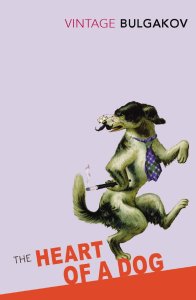 This was a fairly entertaining fable-like story, with whimsical fragments of narration from Sharik himself at the start and close. The blurb inside the jacket of my 1968 Harvill Press hardback suggests “The Heart of a Dog can be enjoyed solely as a comic story of splendid absurdity; it can also be read as a fierce parable about the Russian Revolution.” The allegorical meaning could easily have passed me by, being less overt than in Animal Farm. Reading a tiny bit of external information, I see that this has been interpreted as a satire on the nouveau riche during the Bolshevik era: Sharikov complains about how wealthy the professor is and proposes that he sacrifice some of his apartment-cum-office’s many rooms to others who have nowhere to live. But yes, I mostly stayed at the surface level and found an amusing mad-scientist cautionary tale. I’ll read more by Bulgakov – I’ve had a copy of The Master and Margarita for ages. Next year’s Reading the Meow week might be my excuse.
[Translated from Russian by Michael Glenny, 1968]
(Free from a neighbour, formerly part of Scarborough Public Library stock) 
I also intended to read An American Tragedy by Theodore Dreiser from the university library, having a dim memory of a black-and-white film version starring Montgomery Clift (A Place in the Sun). But the catalogue’s promised 400-some pages was a lie; there are two volumes in one, totaling 840 pages. So that was a nonstarter.
But here are some other famous 1925 titles that I’ve read (I’m now at 7 out of the top 15 on the Goodreads list of the most popular books published in 1925):
The Great Gatsby by F. Scott Fitzgerald
The Trial by Franz Kafka
The Painted Veil by W. Somerset Maugham
Emily Climbs by L.M. Montgomery
Carry On, Jeeves by P.G. Wodehouse
Mrs. Dalloway by Virginia Woolf
I’ve previously participated in the 1920 Club, 1956 Club, 1936 Club, 1976 Club, 1954 Club, 1929 Club, 1940 Club, 1937 Club, 1970 Club, and 1952 Club.
Recent Online Literary Events with George Saunders and Kazuo Ishiguro
I’ve been taking advantage of various free and inexpensive literary events – a bonus of our temporarily virtual-only world. I have five of them stored up to write about, but to keep this post from getting absurdly long I’ll focus on two for now and feature the rest another time.
George Saunders in Conversation with Max Porter
(5×15 event)
 Saunders’s latest book, A Swim in a Pond in the Rain, is a written version of the graduate-level masterclass in the Russian short story that he offers at Syracuse University, where he has taught in the Creative Writing Program since 1997. His aim here was to “elevate the short story form,” he said. While the book reprints and discusses just seven stories (three by Anton Chekhov, two by Leo Tolstoy, and one each by Nikolai Gogol and Ivan Turgenev), in the class he and his students tackle more like 40. He wants people to read a story, react to the story, and trust that reaction – even if it’s annoyance. “Work with it,” he suggested. “I am bringing you an object to consider” on the route to becoming the author you are meant to be – such is how he described his offer to his students, who have already overcome 1 in 100 odds to be on the elite Syracuse program but might still need to have their academic egos tweaked.
The book is, thus, not just a set of essays on the Russian masters but also a guide to how to write well. It was clear there was mutual admiration between Saunders and Max Porter, who interviewed him. They discussed the revision process as an accumulation of micro-decisions that make the work better. For instance, Saunders compared two Tolstoy stories, “The Snowstorm” and “Master and Man” (written 20 years later), and noted that, though they are thematically similar, the later one is more organized.
Saunders spoke about writing as a dual process of intuition and iteration; a bunch of different “yous” have acted on a text by the time it’s done. Early on in his career, he thought that he had to choose which writer he wanted to be (e.g., Hemingway or Kerouac), but as he aged he realized that the mind is never fixed. He went surprisingly deep into Buddhism at this point, likening writing to meditation – both are practices pursued with intensity. To his younger self, he would say to keep going: improving is simply a matter of time (i.e., that 10,000 hours figure that’s bandied about as necessary for developing expertise).

The only drawback to this event was that Saunders was speaking from his snow-encased upstate New York basement and had a horrible Internet connection; often his voice was faint and delayed, while his image stayed static. We and Porter could only stare gormlessly and wait for his face to move to match his words! I think the book would be too niche for me – I’ve hardly read anything by the Russians, and since I don’t write fiction I’m not in need of a guide to those kinds of writing decisions – but it was nice to ‘meet’ Saunders ‘in person’.
An Evening with Kazuo Ishiguro
(Faber Members / Guardian Live event)
 Ishiguro’s new novel, Klara and the Sun, was published by Faber yesterday. This conversation with Alex Clark also functioned as its launch event. It’s one of my most anticipated books of the year, so I pre-ordered a signed copy along with my ticket and look forward to it arriving soon. Klara is an Artificial Intelligence “friend” purchased to combat teenage loneliness. A childlike figure, she is cheerful and treats the sun like a god. Ishiguro said that the book developed from a story he wrote for children aged five to six, about a little girl who takes a doll home – except his daughter, author Naomi Ishiguro, told him no way was it suitable for young children, being far too dark. He likes “displaced or alien narrators, fish out of water,” he said, because the limited perspective allows him to focus on oddness.
In addition to Clark’s questions, a few pre-recorded questions from literary celebs (Daisy Johnson, Bernardine Evaristo, and David Mitchell) encouraged Ishiguro to create a tripartite schema for his novels, reflect on his writing about Japan, and look back at the devices he has used. Asked by Johnson about the connections between his novels, he admitted that his first three novels all retread the same ground: a man who has made a mess of his life or career picks over the past. Then his mid period is set in dreamscapes, while his most recent three novels are dystopian fantasies (though he does not see Klara as set in a dystopian world).
In response to Evaristo’s question about whether he felt an obligation to write about Japan, he said that with his early work he was conscious of needing to represent a group of people who even then (due to World War II) were viewed with suspicion or antipathy. He left Japan at age five so the country didn’t seem entirely real to him. What he knew was based on very early memories, what his mother told him, comic books sent by his grandparents, etc. As he stated in his Nobel Prize acceptance speech, writing about Japan in his twenties therefore felt like “an act of preservation.” Still, he wants his characters and situations to be universal.

Replying to Mitchell’s three questions (cheeky!), he explained that his first ambition was to be a singer/songwriter, and he wrote 100+ songs. Songwriting taught him minimalism. “You can say a huge amount by what you don’t say,” he noted. He hopes to create spaces, or rather vacuums that suck in the reader’s attention. Unlike Mitchell, he always knows the ending of a book before he begins, and his decisions are all about wanting to lodge in the reader’s brain. Thus, memorable endings are a priority for him, whereas they might not be for other writers. I was struck by his characterization of his own life: when he looks back, he doesn’t see a clear path that arose from his choices; instead, he sees a “weird, incoherent mess.” For this reason, he’s turned against the reflective device of his first three books. If he can come up with a theme, he’s hankering to write a book about hitchhikers in the north of England.
Towards the end of the (overlong) discussion, he mentioned that he has been questioning the novelist’s role due to the events of the past year: wondering about the meaning of fiction when so many have died and so many believe fake news. It was a melancholy but realistic point to end on. While I’m not an Ishiguro completist (The Unconsoled doesn’t appeal to me at all and I’m not sure I can be bothered with When We Were Orphans, but I will try The Buried Giant; I’ve read the rest), the event whetted my appetite to read his new book. (See also this Goodreads interview. I loved the anecdotes about learning he’d won the Nobel!)
Bookish online events coming up soon: The Rathbones Folio Prize announcement on the 24th and Claire Fuller’s book launch for Unsettled Ground on the 25th.
Have you attended any online literary events recently?
Classic of the Month: Fathers and Sons by Ivan Turgenev
Last month’s classic was Father and Son (Edmund Gosse); this month is Fathers and Sons, the 1861 novel by Ivan Turgenev (1818–83). I couldn’t resist pairing up the similar titles, and it turns out that even though one is nonfiction and the other fiction, they are thematically similar, dwelling on the clash of generations and contrasting romanticism and rationalism.
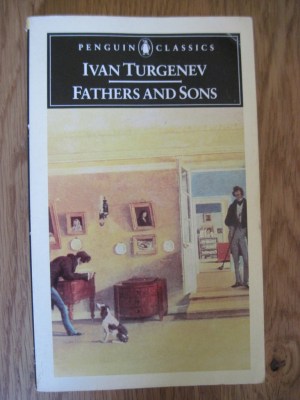 Nikolai Kirsanov’s son Arkady, newly graduated from university, has just returned to his father’s estate with his haughty fellow student Yevgeny Bazarov in tow. Bazarov intends to take a medical degree and follow in his father’s footsteps as a country doctor, so spends the time at his friend’s house dutifully poring over chemistry texts and dissecting frogs. Arkady, by contrast, seems earnest but aimless, happy to simply while away the days. The major change at home is that his father, a widower, has taken the servant girl Fenichka as his mistress and they have a baby, Mitya. (Gasp!) Yet the real shock in the world of the novel seems to be that Nikolai is consorting with someone of the lower classes. “In any case, it’s not for a son to sit in judgment on his father – least of all for me, and least of all with a father like you, who has never restricted my freedom in any way,” Arkady graciously concedes.
Together Nikolai and his rakish brother Pavel (“Women lost their heads over him, and men dubbed him a fop but were secretly envious”) represent an outmoded idealism that values art, nature, poetry, and true love. On the other side is Bazarov, who means to tear down those dated notions and recruit Arkady to the side of realism, even nihilism. “Nature is not a temple, but a workshop, and man’s the workman in it,” he explains to Arkady. But the pals’ notions get uncomfortably muddled when they meet the regal widow Anna Odintsov at the governor’s ball. On extended visits to her country house, Bazarov and Arkady become fixated on her and her younger sister, Katya, but differ in their willingness to give in to love.
Romantic love may be a madness best avoided in some of the characters’ view, but family love is a constant. Even Bazarov, though he makes a show of being embarrassed by their fussing when he goes home briefly after three years away, values his parents’ approval. His father proudly takes him along on his medical rounds, while his superstitious mother buttresses him with her prayers. She reminds her husband that Yevgeny is fundamentally different from them: “A son is an independent person. He’s like a falcon that comes when he wills and flies off when he lists; but you and I are like the funguses growing in a hollow tree.”
I was pleasantly surprised by how enjoyable and accessible Turgenev’s writing is. My experience with the Russian masters is shamefully limited; Leo Tolstoy’s The Death of Ivan Ilyich might literally be the only thing I’ve read previously. I was worried that all the patronymics, place names, and historical and cultural references would trip me up, but it’s no trouble to adjust to them here. You might think of Fathers and Sons as a friendly way of easing in to works like War and Peace: although elements of the story reminded me of Tolstoy’s epic (as I know it purely from the recent BBC miniseries) – the range of characters, from rich to poor, and their interactions; the long visits to acquaintances; the peaceful countryside; even a duel – it is on a much smaller scale, and has a correspondingly lower page count of about 220.
Something in nearly every character’s psyche rang true for me: Arkady’s relief at being home; Nikolai’s sense of being left behind; Bazarov’s feeling of smallness in an uncaring universe; his mother’s benevolent contentment with the status quo; Madame Odintsov’s well-ordered but purposeless life; and so on. Turgenev’s asides about Russia and about human nature give the narration a playful, knowing quality reminiscent of George Eliot. The idea of fathers and children being on different tracks extends to other forms of paternalism: religion (though this is a minor theme compared to in Father and Son) as well as masters versus serfs. “We all know there’s the master’s will; on account of you bein’ like our fathers. An’ the more strict the master rules, the better it be for us peasants,” as one rustic opines to Bazarov.
This is a thought-provoking but markedly readable classic that I can heartily recommend. Turgenev only wrote five other novels; if they’re all as strong (and roughly as short) as this one, I’d be happy to read them all – and will likely return to Fathers and Sons in the future.
My rating: 
(With thanks to Karen at Kaggsy’s Bookish Ramblings for putting Turgenev on my radar.)
I read a Penguin Classics edition of Rosemary Edmonds’s 1965 translation. Her brief introduction gives helpful background and is a lovely piece of writing in its own right. Beware: only read a literary introduction after finishing the text, because critics assume you know the basic story line and so spoil who falls in love with whom, who dies in the end, etc. My edition is preceded by a lengthy lecture Isaiah Berlin gave on Turgenev in 1970.
 Bookish Beck = Rebecca Foster. American transplant to England. Freelance proofreader and book reviewer.
 Bookish Beck