Tidings by Ruth Padel & Other Christmassy Reading
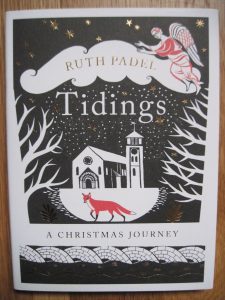 Ruth Padel is one of my favorite poets, so I jumped at the chance to read her new book-length holiday poem, Tidings: A Christmas Journey. Set across one Christmas Eve and Christmas day and narrated by Charoum, the Angel of Silence, the poem switches between Holly, a seven-year-old girl excited for Christmas, and Robin, a forty-four-year-old homeless man who follows a fox to a Crisis Centre. Here he gets a hot meal and some human kindness to make up for the usual bleakness of the holidays:
Christmas is the salt mine.
Salt in the wound, a nothing-time.
I was loved once. Who by? Can’t remember.
I especially liked the fragments that juxtapose this contemporary London story with centuries of history:
Up here the evening glides over golden moss
on the flat-top tomb of Mary Wollstonecraft
&
Pagan Christmas fizzes and teems with ghosts,
midwinter fires, mummers and waites, Yule
logs and mistletoe.
The poem also journeys to Jerusalem and Rome to survey a whole world of Christmas traditions, then and now.
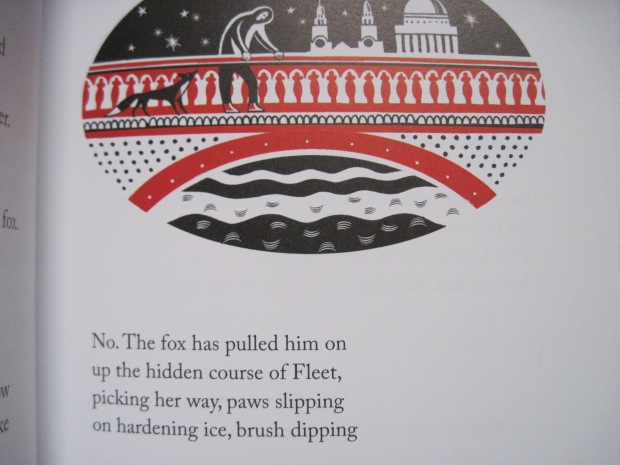
It’s a lovely little volume, with the red, black and white theme offset by touches of gold. The illustrations are gorgeous, but the story line disappointed me: starting with the character names, it all felt rather clichéd. Padel has treated urban foxes much more successfully in her collection The Soho Leopard, and apart from a very few instances – like the above quotes – the verse struck me as largely undistinguished, even awkward (like the out-of-place clinical vocabulary in “Love, / and the lack of it, can change the limbic brain”). This means that, for me, this book fails to earn a place as a Christmas classic I’ll reread year after year.
Tidings was published in the UK by Chatto & Windus on November 3rd. My thanks to Cat Mitchell of Random House for the free review copy.
My rating: 
Other Christmassy Reading
 This year I’m resuming my place in Waiting on the Word, Malcolm Guite’s selection of religious-slanted poems to read from the start of Advent through Epiphany. For those who want to explore the history and interpretation of Christmas, I can recommend The First Christmas by the late Marcus Borg, one of my favorite progressive theologians.
As I have for the past several years, I’ll dip into The Ecco Book of Christmas Stories, edited by Alberto Manguel. My favorites are by Truman Capote, John Cheever, Jane Gardam and Jeanette Winterson (who has a brand-new, full-length Christmas story collection out this year). I’ll also sample some Russian classics via A Very Russian Christmas, which has short stories from Tolstoy, Chekhov and more.
 In addition, I have Cleveland Amory’s The Cat Who Came for Christmas and The Cat Who Stayed for Christmas out from the library, which should make for some very cozy reading under the cat. I’ll browse the numerous Christmas-themed poems in U.A. Fanthorpe’s Collected Poems, another library book. And I may even deign to try Hogfather, one from my husband’s beloved Discworld series by the late Terry Pratchett.
[See also this wonderful list of Christmas reading suggestions from Heaven Ali.]
Are you reading anything special this Christmas season?
What Is Nature (Poetry) For?
I’ve been pondering this question thanks to an excellent conference my husband and I attended in Stamford in the middle of November: New Networks for Nature. This is the third year my husband (a teaching associate in the biology department at the University of Reading) has participated, and the second year in a row I’ve chosen one day to go. Last year I had the privilege of seeing some truly phenomenal nature writers. Dave Goulson spoke about his efforts to protect bumblebees; Helen Macdonald gave a reading from H is for Hawk; and Paul Evans and Mark Cocker were on a panel about being Guardian country diarists.
This year one of the conference highlights was a debate between Guardian journalist and rewilding proponent George Monbiot (Feral) and Tony Juniper (What Has Nature Ever Done for Us?), former head of Friends of the Earth. The topic: Is nature an economic resource or a thing of intrinsic value? Both gentlemen came out swinging and were at their most convincing.
Unless we make an economic case for preserving nature (pollinators, hydroelectric power, ecotourism), Juniper believes, we will lose it. If we reframe our approach to play on bastard politicians’ turf, Monbiot counters, we’ve already lost our integrity. Nature is worth saving for its own sake; the problem is not our arguments but our lack of power.
I tended to agree with Juniper: we aren’t winning the conservation debate in any other way, so why not introduce financial incentives? This doesn’t stop us from appreciating nature for aesthetic and spiritual reasons; it’s just another strategy.
I amused myself by imagining the opponents as a solitary noble knight waving the flag of idealism (Monbiot) and a new Noah packing nature into a money-papered Trojan horse to trick the pesky government (Juniper).
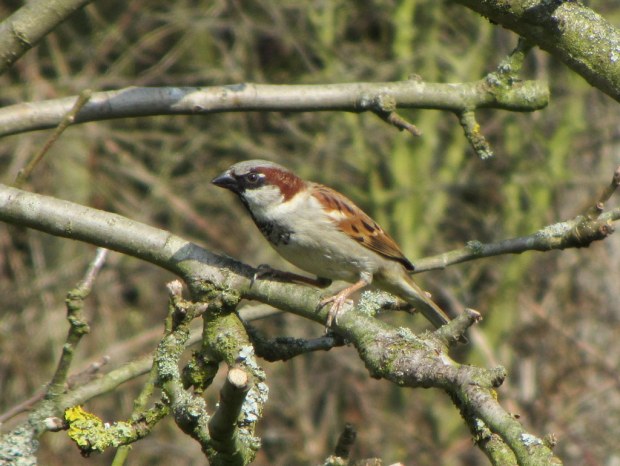
Male house sparrow. Courtesy of Chris Foster
If these two, in a roundabout way, pondered what nature is for, the previous session had asked more specifically what nature poetry is for. Led by Ruth Padel, one of my favorite poets, the roster also included Jo Shapcott and Pascale Petit. Each read from her work for 15 minutes and then together they answered audience questions as a panel.
I’d never heard of Petit but ended up loving her poems – they were the highlight of my day. One was about the piece of land her mother left her in France; she asked herself in what sense she could possess the place, and soon realized that it was really a pair of resident kingfishers who owned it. She writes around her difficult childhood, imagining a father who could never be cruel to birds – but then picturing him polishing off an ortolan bunting as his last meal, as Mitterrand was said to do. Along with birds, big cats provide many of the metaphors in her work, including Aramis, a black jaguar in the Paris Zoo, and the jaguar corridor in Belize.
Padel read “The Alligator’s Great Need and Great Desire,” followed by several poems from The Mara Crossing that she had written for members of the conference steering committee, such as one about storm petrels off the Skelligs and a snippet of biographical verse about Audubon. The lovely “Nocturne” commemorates nightly jellyfish migration, a “ghostly flotilla.”
She also read one that she said was the closest she gets to an angry poem: “The Forest, the Corrupt Official and a Bowl of Penis Soup” (from 2004’s The Soho Leopard), on the absurdity of killing rare animals – in this case the tiger – so their parts can be used in medicine or cuisine. Her final reading, from memory, was “Tiger Drinking at Forest Pool”; I nearly teared up when she spoke of “Sadness healed. Haven, in the mind, // To anyone hurt by littleness.”
Shapcott read two series of wildlife-themed poems. The first set, commissioned by Padel for the Zoological Society of London, was about the slender loris, which is also suffering from its use in traditional medicine as well as habitat loss. The second was a sequence about beekeeping, from the perspective of a woman who has just been left by a beekeeper. “Telling the Bees” reflects the folk belief that you have to inform bees of major events or they will leave; it ends “he’s gone, honeys; now you’re mine.” As the poem cycle continues, the hive becomes incorporated into her body until she can’t be separated from the bees.
Padel prefaced the discussion by asking how poetry should be in the face of extinctions and the destruction of the planet. She believes a sophistication of voice and expression is required; it’s not a matter of grabbing people by the lapels and saying “LOOK AT THIS,” but of putting the details together and being a witness.
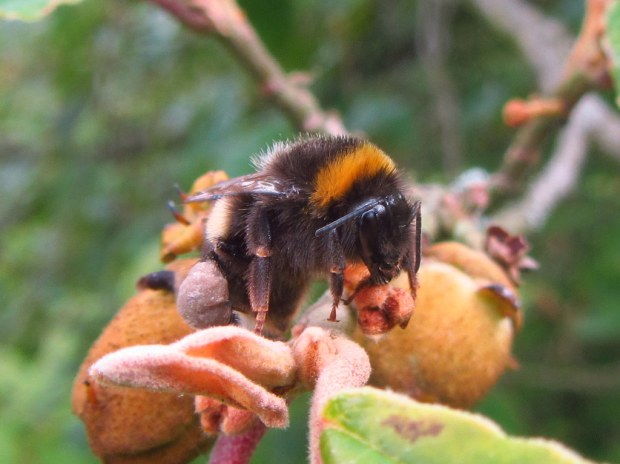
Buff-tailed bumblebee. Courtesy of Chris Foster.
Shapcott echoed her with Heidegger’s query – what is the poet for in a desperate time? She reiterated that the poet should hold up key questions and let them resonate in people’s imaginations, not force-feed answers. Petit added that in her poetry birds are metaphors for the exploitation for the weak. All three agreed poetry is about embodiment, sensory response to the world – essential since we live least in our bodies of any species, Shapcott observed.
The theme of this year’s conference was “Place and Belonging,” and it struck me that all three poets were responding to the idea that nature belongs to us and can be used like any other possession. Instead, they reply, we should think about the places we belong to, and how we can serve rather than exploit nature. But the key is not to spell that out in polemic verse, but rather to speak of life’s particulars and hope that we manage to point to the universal.
I’ll end with part of a stanza from Padel’s “The Watcher” that seems to reinforce the personal, spiritual value of nature that so much of the conference suggested:
Quest for the sacred. And if I
could track that one stork down
on its winter ground, maybe I’d know
what has become of life and me
and where to go. I’d pour libations, follow
the omen, set up sacrifice
to the god of wayfarers, even pay a call
on the seer who decodes
the flight of birds. I’d prophesy.
Small Books Are Good, Too
Last week I wrote in praise of doorstoppers – books over 500 pages. But I also love really short books: there’s just as much writing skill involved in making a narrative concise, and it can be supremely satisfying to pick up a book and polish it off within a couple hours, especially if you’re in a situation of captured attention as on a plane. Being honest and slightly selfish for a moment, short books are also a great way to build up a flagging year list.
Below I highlight poetry collections, memoirs, short stories and novellas that should be on your agenda if you’re looking for a quick read (number of pages in brackets after each title):
Poetry
I try to always have a book of contemporary poetry on the go, usually by a British poet since I pluck these at random from my local public library shelves. Poetry collections aren’t always ‘quick’ reads, nor should they be, because you often have to read a poem more than once to understand it or truly appreciate its techniques. Still, with most poetry books numbering somewhere between 45 and 90 pages, even if you parcel them out over days or weeks they’ll take much less time than a novel. Pick up something by Mark Doty, Kathleen Jamie, David Harsent or Christopher Reid and you’ll have plenty of beautiful verse to ponder.
Recently reviewed and recommended:
- Learning to Make an Oud in Nazareth by Ruth Padel [80]
- All One Breath by John Burnside [96]
- Praise in Which I Live and Move and Have My Being by Paul Durcan [176]
Short Memoirs
Depending on how thorough they are, autobiographies can often hover around 300 or 400 pages. Looking through my shelves, though, I’ve spotted a few in the 140–160 page range: My Movie Business by John Irving [158], The Diving-Bell and the Butterfly by Jean-Dominique Bauby [139], and Winter by Rick Bass [162]. Another short one well worth reading is the unusual The Sound of a Wild Snail Eating by Elisabeth Tova Bailey [170], a story about debilitating illness and taking comfort from nature.
Abigail Thomas, one of my favorite memoirists, writes in an episodic style that makes her 200-page books fly by as if they were half that length. Also, Anne Lamott has written two very short faith memoirs that would serve as a good introduction to her style and content for those who haven’t read Traveling Mercies et al.: Help Thanks Wow [102] and Stitches [112].
Recently reviewed and recommended:
- The Two Kinds of Decay by Sarah Manguso [192]
- The Light of the World by Elizabeth Alexander [208]
- What Comes Next and How to Like It by Abigail Thomas [240] – also included on my BookTrib list of mother–daughter memoirs to read for Mother’s Day
Short Stories
I used to shy away from short stories because I didn’t think they were worth the emotional investment, but recently I’ve decided I really like the rhythm of picking up a set of characters, a storyline and a voice and then, after 20 or so pages, following an epiphany or an aporia (or utter confusion), trading them in for a whole new scenario. Short stories are also the perfect length for reading during a quick meal or car ride. Two short story collections made it onto my “Best of 2014” list: White Man’s Problems by Kevin Morris and The Heaven of Animals by David James Poissant.
Recently reviewed and recommended (no page numbers listed here because each story can stand alone):
- Wallflowers by Eliza Robertson
- Funny Once by Antonya Nelson
- Thunderstruck and Other Stories by Elizabeth McCracken
Novellas
With some credits for free Penguin books I got hold of Borges and the Eternal Orang-Utans by Luis Fernando Verissimo (translated from the Portuguese by Margaret Jull Costa) [135], a book I’d been hankering to read ever since I came across that terrific title. It’s an enjoyable academic comedy and locked room mystery, with nods to Borges and Poe (though I probably didn’t get them all).
I also recently discovered Peirene Press, which exclusively publishes novellas in translation. Their motto is “Contemporary European Literature. Thought provoking, well designed, short.” They publish the novellas in thematic trilogies, with headings such as “Male Dilemma: Quests for Intimacy” and “Small Epic: Unravelling Secrets.” The book I own from Peirene (scored from a secondhand bookshop in Henley-on-Thames for £1), from the “Turning Point: Revolutionary Moments” series, is Mr. Darwin’s Gardener by Kristina Carlson [122] (translated from the Finnish by Emily and Fleur Jeremiah).
It’s an odd little book, with a mixture of past and present tense and first-, third- and first-person plural narration. Set in the village of Downe, it’s peripherally about the title character, Charles Darwin’s gardener Thomas Davies, a new widower with two children, one of whom has Duchenne muscular dystrophy (newly identified). It’s thin on plot, it must be said. Daniel Lewis, the verger of Downe for five years, was dismissed for stealing from the church and is beaten up when he comes back to town; some characters think and talk about Darwin’s theory and Davies’s bereavement; there’s an overturned cart.
My favorite section, “At the Anchor,” is composed of conversations at the village pub, and my favorite individual lines reflect on Darwin’s influence on contemporary thought:
“Mr Darwin is a tree that spreads light, Thomas Davies thinks.”
“Great men are remembered, like Mr Darwin, a genuine monolith. We small folk are mere sand, washed by the waves as they go back and forth.”
“People in future decades and centuries will react to our ideas superciliously, as if we were children playing at thinking. We shall look most amusing in the light of new thoughts and inventions.”
If you’re looking to get through a classic in an afternoon, why not try one of these (full text available for free online through Project Gutenberg or other initiatives): Animal Farm by George Orwell [95], Ethan Frome by Edith Wharton [181] or Flush by Virginia Woolf (her spoof ‘biography’ of Elizabeth Barrett Browning’s cocker spaniel) [108]. E. M. Forster’s novels also read very quickly, and several of John Steinbeck’s novels are quite short. Whether or not you’ve seen the Audrey Hepburn movie, you’ll want to read the sparkling, bittersweet Breakfast at Tiffany’s by Truman Capote [100]; my edition also includes several of his best known short stories, including the wonderful “A Christmas Memory.”
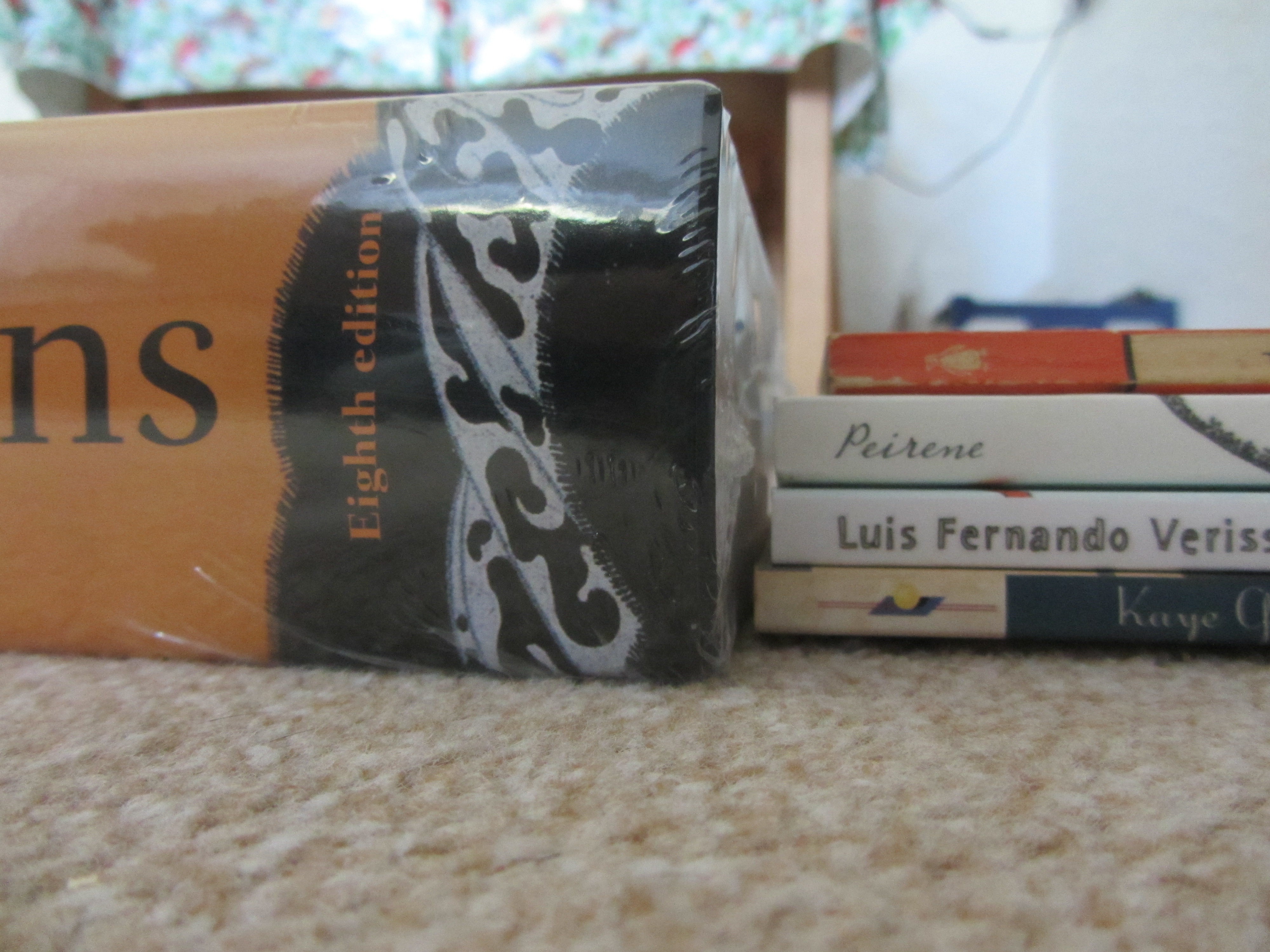
Even four novellas put together don’t stack up very far compared to the Oxford Dictionary of Quotations.
I recently finished The Bookshop by Penelope Fitzgerald [123]; all her books are similarly concise, so you may want to give her a try. The next novella on the pile for me is Ellen Foster by Kaye Gibbons [126]. I had never heard of the author, but the title and description lured me into buying it from a library book sale on a trip back to America (for 25 cents, why not?!). It’s a Southern Gothic story with an eleven-year-old narrator whom Walker Percy likened to Holden Caulfield. The alluring first line: “When I was little I would think of ways to kill my daddy.”
For more ideas, see these two Publishers Weekly’s lists:
“10 Best Books Shorter than 150 Pages” (only repeats one of my suggestions)
“10 Best Short Story Collections You’ve Never Read”
Off topic, but today is a milestone for me: it marks exactly two years that I’ve been a freelance writer!
Are you fond of short books? Do you prefer them to doorstoppers? What are some of your favorite novellas? All comments welcome!
 Bookish Beck = Rebecca Foster. American transplant to England. Freelance proofreader and book reviewer.
 Bookish Beck