12 Days in Portugal and Spain & What I Read
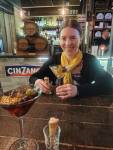 It’s the second time we’ve braved the 20+-hour ferry crossing from the south coast of England to Santander in the north of Spain. Four years ago, we stayed on the edge of the Picos de Europa national park in Spain. This time we prioritized Portugal, spending a night in Spain on the way out and back. (In Léon, we acquired a taste for vermouth – and the free tapas that come with it. So cheap, too. What a fun eating-out culture!)
Portugal was a new country for us and we thoroughly enjoyed getting a taste of it. Spring seemed to be a month ahead of the UK and blossom was abundant. We stayed in three places in the north: Guimarães, the Douro Valley, and the Côa Valley. We took our new-to-us EV and found the distances manageable and charging cheaper and easier than in the UK. Going by car made packing easy and allowed us to bring back some port, Mr. F’s favourite tipple. However, there were hairy drives along confusing city streets and narrow mountain roads.


Our first stay was at Pousada de Santa Marinha, overlooking Portugal’s oldest city. One of a chain of state-restored castles and convents, it was originally a 12th-century monastery. We relished the bountiful breakfast buffet and manicured grounds but wished for more free time to relax in the grand common areas. Mostly we used this as a base for the first of two day trips to Porto, where we got good views from the cathedral tower, had delicious coffee and veggie snacks at 7g Roaster, and did a tour and tasting at Taylor’s port house. Portugal does a good line in doorstep cats. We also had our first sighting of swifts for the year on the 7th, flying above the azulejos (painted tiles) and cobbled streets of Guimarães before a traditional taverna meal of bacalhau (salt cod) fritters and bean stew with vinho verde.


Quinta dos Murças was, if anything, even more luxurious than the pousada. We were the only guests on our first of three nights at the winery, and after a private English-language cellar tour and wine and port tasting, a sit on the wisteria-covered balcony, and a three-course meal in the dining room, we were feeling like royalty. Along with grapes, they grow almonds, olives and several types of citrus. The lemon trees were dripping with the biggest fruits I’ve ever seen, and the smell of the orange blossom was truly intoxicating. The next morning we got up early and took a pack-up picnic on the train back into Porto, which was so hot and busy that we wondered why we’d bothered – though we did have an excellent tasting experience at a smaller producer, Poças, that included white and red wine, several ports, and a cocktail of white port, lime juice, and blood orange tonic served with a salt rim.


Portuguese is significantly more challenging than Spanish, so I was pleased with myself for managing an all-Portuguese transaction with the conductor on the rural branch line. The old-fashioned train carriages were spacious with comfortable seats, though the ride was not what one would call speedy. The journey back was fraught because we found ourselves pressed to catch the final train of the day (at just after 5:30 p.m.!), couldn’t figure out how to buy tickets at the station machines, were short of cash to pay the conductor on board, and arrived 2 hours late after a car collided with a telegraph pole and left the track blocked for an hour. The following day, what did we do? Got back on a train! (In the opposite direction, with tickets we’d carefully purchased ahead online.) This time we traveled toward the eastern end of the scenic Douro Valley so that we managed to see the whole river in pieces. The village of Tua had no particular sights, but we had a pleasant amble along its river boardwalk.


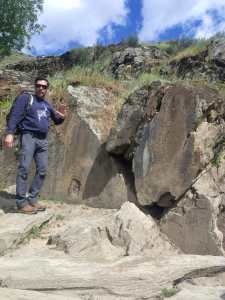 We’d earmarked the Côa Valley because it’s home to a sizable rewilding project. On the way, we stopped at Penascosa, an outdoor rock art site with etchings of ibex, aurochs and deer – and even ancient attempts at animation! The Rewilding Centre, where we stayed, is similar to a hostel and has an industrial kitchen because it also operates as a café for the villagers. In cities, we had tended to find English speakers, but the centre manager here had no English, so we happily switched to French (a true lingua franca!) to communicate with her.
The accommodation may have felt like a step down after our two previous splurges, but we’d booked a different treat to selves: an English-speaking guide from Wildlife Portugal who took us out in a Land Rover and found us loads of eagles, vultures and warblers. Bee-eaters and black storks were particular highlights. We were impressed by the array of landscapes: vines and olive groves, granite boulders, high cliffs, pools created by former mining, and green glens. At the hostel we met an English couple (one half a botanist) who are exploring Europe on Interrail passes during a three-month sabbatical, and they joined us for the second day of wildlife tourism; we discovered that Fernando is just as good with plants as with birds.


It was a varied, comfy, boozy trip. There was the touristy experience in Porto and parts of the Douro Valley, but also the ‘real’ countryside. Things ended on something of a sour note due to a rough return crossing of the Bay of Biscay. We’ll be back in Spain next summer to meet up with my sister and our nephew on his school trip to Barcelona, but that jaunt will be by train!


What I Read
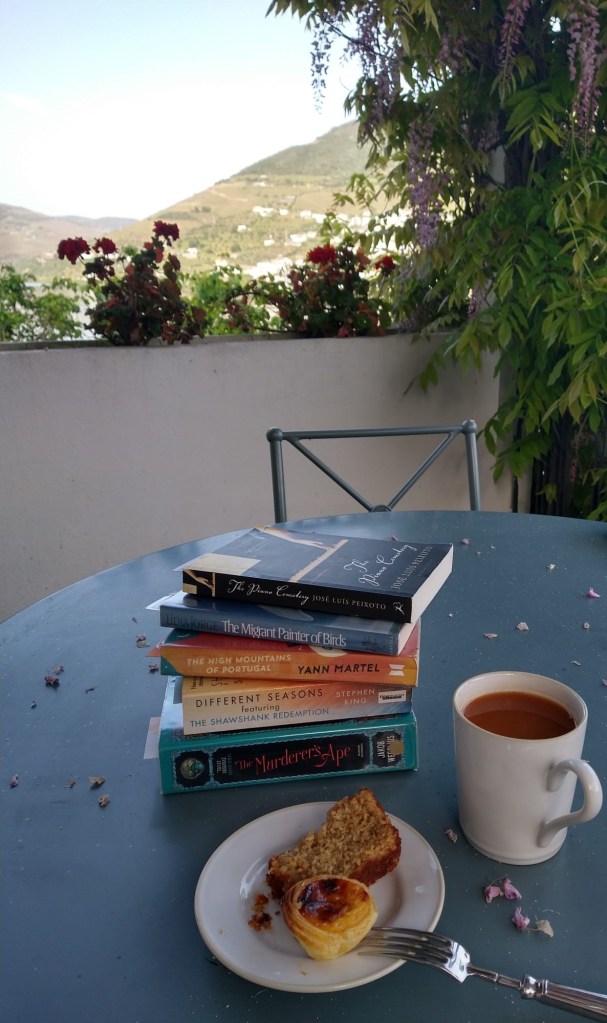
En route: Rita Hayworth and Shawshank Redemption by Stephen King, which I’ll review for a spring-themed post as it’s the first in a quartet of loosely seasonal novellas. You likely know this prison story from the film version.
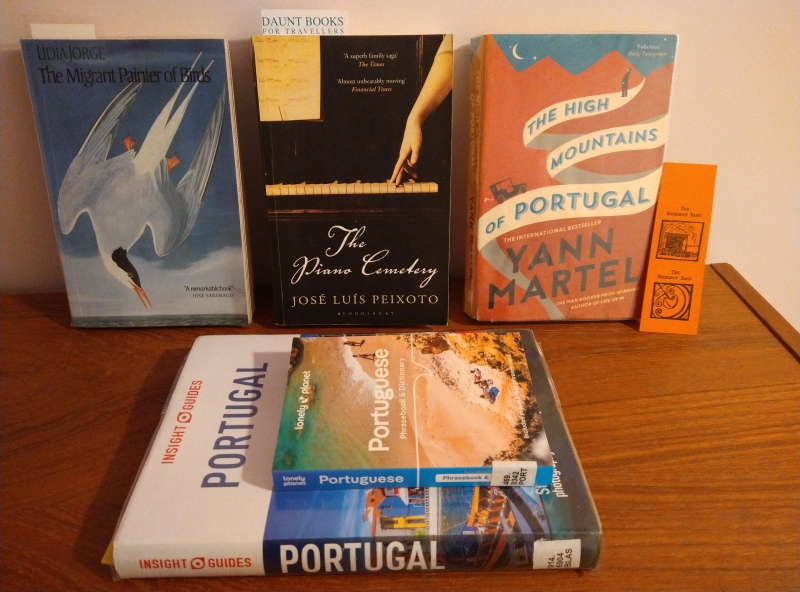
In Portugal: three Portugal-set novels I’d proudly sourced, including two in translation. My only previous knowledge of Portuguese literature had been a DNF of a José Saramago novel.
The Migrant Painter of Birds by Lídia Jorge (1998; 2001)
[Translated by Margaret Jull Costa]
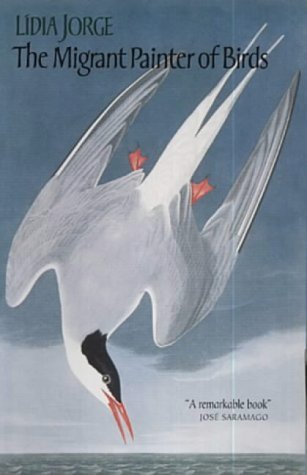 The title figure is Walter, a former soldier who wanders the world and sends his bird paintings back to his daughter at the Dias family home in (fictional) Valmares. His actual visits are few and clandestine: Jorge keeps returning to a scene of him holding his shoes in his hand so he can soundlessly climb the stairs to see his daughter. You see, his daughter is officially his ‘niece’, born of an affair Maria Ema had with her husband Custódio’s brother. That act of adultery is the foundation of the novel but so tacit that it influences everything, including the language and narration. “Walter’s daughter” narrates – in third person or first – and frequently refers to herself as “Walter’s niece” instead.
The slippery narrative moves back and forth in time, pausing at a few landmark years. Very little happens, per se, apart from Walter’s daughter having a liaison with her mother’s therapist and then going to find her father in Argentina, but throughout we are invited to observe the family’s shifting dynamic and understand the narrator’s growing bitterness – “so bruised are we all by the passing of time.” I found the writing intermittently beautiful (“the sun was setting, persimmon red, behind the smooth fields”; “A tangle of living ghosts, the magical cortège of all tyrannies”) but sometimes pretentious or obfuscating to no purpose (“I invoke the decade of irony, the decade of silence pierced by the oblique laughter of cynicism”). (Interlibrary loan) 
The High Mountains of Portugal by Yann Martel (2016)
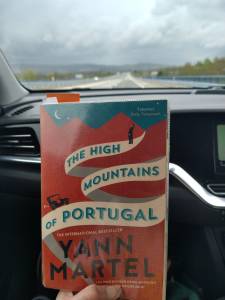 I knew of Martel’s obscure fourth novel through The Bookshop Band’s song “Why I Travel This Way,” about a bereaved man who starts walking backwards. What I didn’t realize is that the book is essentially three linked novellas and that song responds to just the first one, “Homeless.” Within a week, museum curator Tomás’s son, common-law wife, and father all died. Tomás sets off in his uncle’s early motorcar (this being 1904) to find a religious relic he learned about from a 17th-century priest’s journal written in São Tomé. But he has no idea how to drive, and accidents and persecution continue to beset him. A Job-like figure, he has set “his back to the world, his back to God” as a way of “not grieving” but “objecting.” Next, pathologist Eusebio and his wife have a high-minded discussion of the morality of murder mysteries in the 1939-set “Homeward.” Eusebio then undertakes an unexpected late-night job when an old woman arrives with her late husband’s corpse in a suitcase. Every cut reveals the substance of the man’s life rather than the reason for his death.
 After religious parable and magic realism, “Home” initially seems more straightforward with its story of a widowed Canadian senator who buys Odo the chimpanzee from a research centre and relocates to rural Portugal. If you’ve read Life of Pi and/or Beatrice and Virgil, you know that Martel really goes in for his animal allegories. Odo might be considered symbolic of simplicity and joy in life. There are apt connections with the other novellas: not only an overarching theme of grief, but the specifics of one northern Portuguese village and its events that have become legend. And, yes, chimpanzees. A line from the first part serves as Martel’s mantra: “We are risen apes, not fallen angels.” Weird but satisfying. (Public library)
The Piano Cemetery by José Luís Peixoto (2006; 2010)
[Translated by Daniel Hahn]
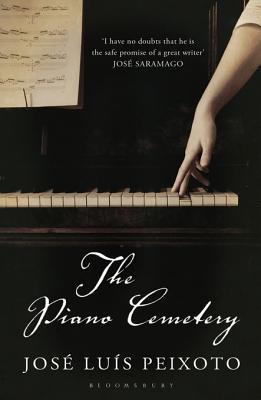 It may be premature, but I feel I can pinpoint some trademarks of Portuguese literature based on the few examples I’ve now read (plus Martel’s pastiche): narrative trickery, family dysfunction, metaphors of blindness, philosophical and religious dialogues, and a fine line between life and death. Unfortunately, in this case I found the appealing elements buried under an off-putting style. The Lázaro family are carpenters in 1910s Lisbon with a back room housing busted pianos that they use for their instrument-repair side business. To start with, the narrator is the dead patriarch of the family, who remembers how he met his wife at the piano cemetery and keeps watch over his children and grandchildren in the present day. There are also two long sections of stream-of-consciousness memories of his son Francisco as he runs the marathon at the 1912 Stockholm Olympics. Francisco Lázaro was a historical figure who died in that athletic pursuit, but the family backstory of estrangement, domestic violence, and adultery that Peixoto builds around him is fictional. Punctuated by distance markers (“Kilometre one” and so on), Francisco’s fragments are decontextualised and often don’t join up or even form complete sentences. Add in the father’s fatphobic attitude toward one of his daughters and the laughably circuitous phrasing (“my thick hand in a single movement, like an impulse, but not even an impulse, like a desire you have for a moment and which becomes concrete in that same moment, another person’s desire within me, a desire which is not thought, but which rises up like a flame” – huh? can I blame the translator?) and you might see why this was a slog for me. (Secondhand purchase – Awesomebooks.com)
Plus a partial reread of a delightful teen novel we both read the last time we were in Spain:
The Murderer’s Ape by Jakob Wegelius
[Translated from the Swedish by Peter Graves]
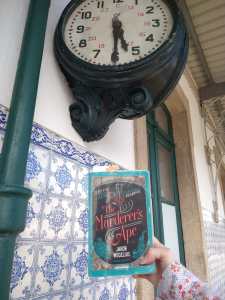 Talk about a risen ape! Sally Jones is an animal narrator extraordinaire: a ship’s engineer who meets every challenge that comes her way with aplomb, traveling from Portugal to India and back just to clear the Chief’s name after he’s falsely accused of murder. She happens to be a gorilla, but her only real limitation is that she can’t voice human language; she understands and writes it perfectly, and can beat most people at chess. This doorstopper never feels like one because it races along on a tide of adventure and intrigue. The technology suggests a 1920s date. All the settings are evocative, but historical Lisbon is especially enticing (and not dissimilar to Peixoto’s): Sally Jones lives with Ana Molina, a famous fado singer, and works in her neighbour Signor Fidardo’s instrument workshop repairing accordions.
 Plus the latter half of another novel or two I had on the go, and most of a couple of pre-release e-books for Shelf Awareness reviews: the odd Kitten by Stacey Yu, about a cat-identifying millennial Disaster woman, and The Half Life by Rachel Beanland. Set in 1970s Sardinia, this was a perfect summer read – intelligent as well as sultry – about a young Navy wife’s sexual coming of age and casual investigation into the ongoing effect of American nuclear submarines on the island’s natural environment.
Small Books Are Good, Too
Last week I wrote in praise of doorstoppers – books over 500 pages. But I also love really short books: there’s just as much writing skill involved in making a narrative concise, and it can be supremely satisfying to pick up a book and polish it off within a couple hours, especially if you’re in a situation of captured attention as on a plane. Being honest and slightly selfish for a moment, short books are also a great way to build up a flagging year list.
Below I highlight poetry collections, memoirs, short stories and novellas that should be on your agenda if you’re looking for a quick read (number of pages in brackets after each title):
Poetry
I try to always have a book of contemporary poetry on the go, usually by a British poet since I pluck these at random from my local public library shelves. Poetry collections aren’t always ‘quick’ reads, nor should they be, because you often have to read a poem more than once to understand it or truly appreciate its techniques. Still, with most poetry books numbering somewhere between 45 and 90 pages, even if you parcel them out over days or weeks they’ll take much less time than a novel. Pick up something by Mark Doty, Kathleen Jamie, David Harsent or Christopher Reid and you’ll have plenty of beautiful verse to ponder.
Recently reviewed and recommended:
- Learning to Make an Oud in Nazareth by Ruth Padel [80]
- All One Breath by John Burnside [96]
- Praise in Which I Live and Move and Have My Being by Paul Durcan [176]
Short Memoirs
Depending on how thorough they are, autobiographies can often hover around 300 or 400 pages. Looking through my shelves, though, I’ve spotted a few in the 140–160 page range: My Movie Business by John Irving [158], The Diving-Bell and the Butterfly by Jean-Dominique Bauby [139], and Winter by Rick Bass [162]. Another short one well worth reading is the unusual The Sound of a Wild Snail Eating by Elisabeth Tova Bailey [170], a story about debilitating illness and taking comfort from nature.
Abigail Thomas, one of my favorite memoirists, writes in an episodic style that makes her 200-page books fly by as if they were half that length. Also, Anne Lamott has written two very short faith memoirs that would serve as a good introduction to her style and content for those who haven’t read Traveling Mercies et al.: Help Thanks Wow [102] and Stitches [112].
Recently reviewed and recommended:
- The Two Kinds of Decay by Sarah Manguso [192]
- The Light of the World by Elizabeth Alexander [208]
- What Comes Next and How to Like It by Abigail Thomas [240] – also included on my BookTrib list of mother–daughter memoirs to read for Mother’s Day
Short Stories
I used to shy away from short stories because I didn’t think they were worth the emotional investment, but recently I’ve decided I really like the rhythm of picking up a set of characters, a storyline and a voice and then, after 20 or so pages, following an epiphany or an aporia (or utter confusion), trading them in for a whole new scenario. Short stories are also the perfect length for reading during a quick meal or car ride. Two short story collections made it onto my “Best of 2014” list: White Man’s Problems by Kevin Morris and The Heaven of Animals by David James Poissant.
Recently reviewed and recommended (no page numbers listed here because each story can stand alone):
- Wallflowers by Eliza Robertson
- Funny Once by Antonya Nelson
- Thunderstruck and Other Stories by Elizabeth McCracken
Novellas
With some credits for free Penguin books I got hold of Borges and the Eternal Orang-Utans by Luis Fernando Verissimo (translated from the Portuguese by Margaret Jull Costa) [135], a book I’d been hankering to read ever since I came across that terrific title. It’s an enjoyable academic comedy and locked room mystery, with nods to Borges and Poe (though I probably didn’t get them all).
I also recently discovered Peirene Press, which exclusively publishes novellas in translation. Their motto is “Contemporary European Literature. Thought provoking, well designed, short.” They publish the novellas in thematic trilogies, with headings such as “Male Dilemma: Quests for Intimacy” and “Small Epic: Unravelling Secrets.” The book I own from Peirene (scored from a secondhand bookshop in Henley-on-Thames for £1), from the “Turning Point: Revolutionary Moments” series, is Mr. Darwin’s Gardener by Kristina Carlson [122] (translated from the Finnish by Emily and Fleur Jeremiah).
It’s an odd little book, with a mixture of past and present tense and first-, third- and first-person plural narration. Set in the village of Downe, it’s peripherally about the title character, Charles Darwin’s gardener Thomas Davies, a new widower with two children, one of whom has Duchenne muscular dystrophy (newly identified). It’s thin on plot, it must be said. Daniel Lewis, the verger of Downe for five years, was dismissed for stealing from the church and is beaten up when he comes back to town; some characters think and talk about Darwin’s theory and Davies’s bereavement; there’s an overturned cart.
My favorite section, “At the Anchor,” is composed of conversations at the village pub, and my favorite individual lines reflect on Darwin’s influence on contemporary thought:
“Mr Darwin is a tree that spreads light, Thomas Davies thinks.”
“Great men are remembered, like Mr Darwin, a genuine monolith. We small folk are mere sand, washed by the waves as they go back and forth.”
“People in future decades and centuries will react to our ideas superciliously, as if we were children playing at thinking. We shall look most amusing in the light of new thoughts and inventions.”
If you’re looking to get through a classic in an afternoon, why not try one of these (full text available for free online through Project Gutenberg or other initiatives): Animal Farm by George Orwell [95], Ethan Frome by Edith Wharton [181] or Flush by Virginia Woolf (her spoof ‘biography’ of Elizabeth Barrett Browning’s cocker spaniel) [108]. E. M. Forster’s novels also read very quickly, and several of John Steinbeck’s novels are quite short. Whether or not you’ve seen the Audrey Hepburn movie, you’ll want to read the sparkling, bittersweet Breakfast at Tiffany’s by Truman Capote [100]; my edition also includes several of his best known short stories, including the wonderful “A Christmas Memory.”
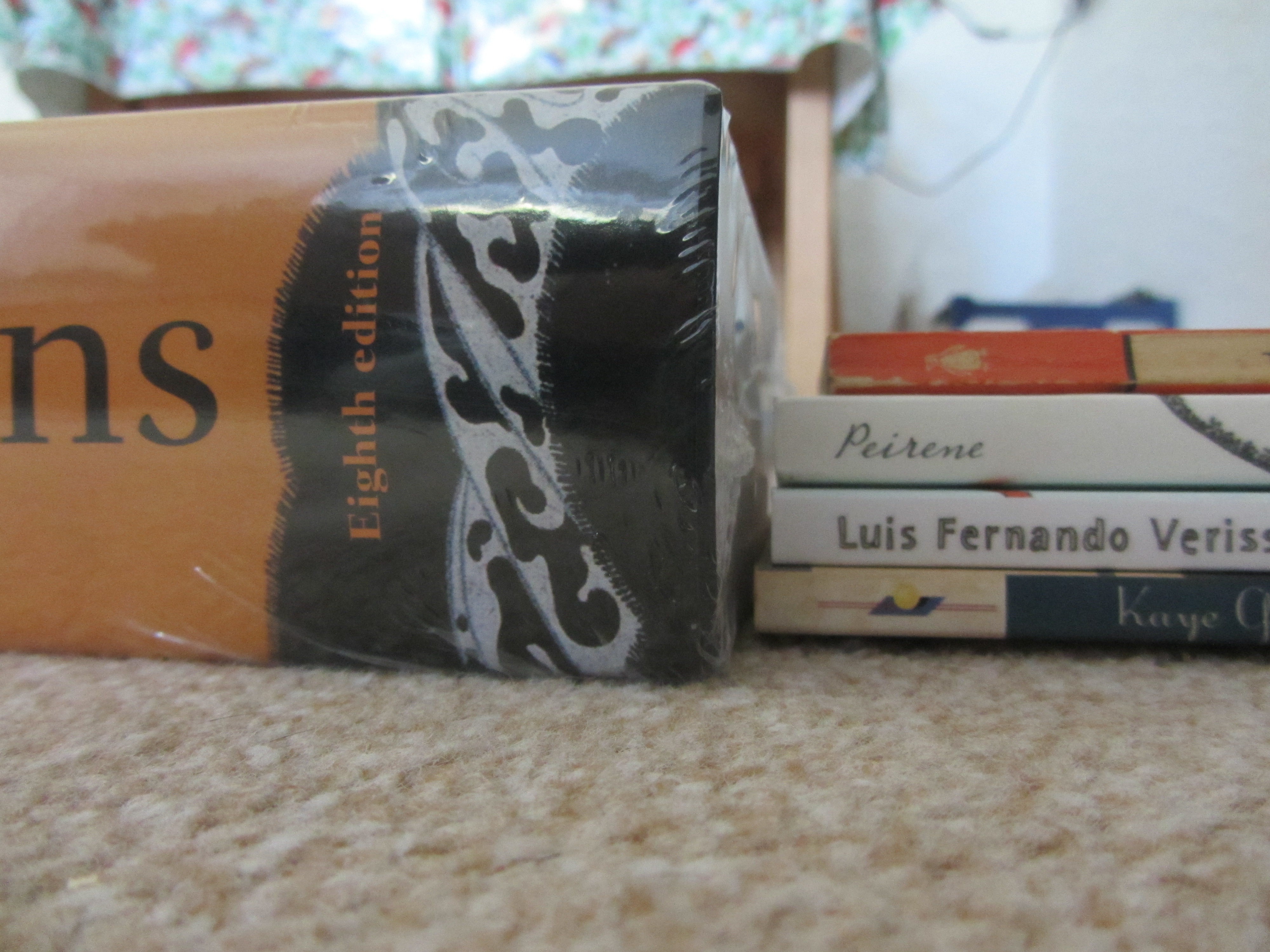
Even four novellas put together don’t stack up very far compared to the Oxford Dictionary of Quotations.
I recently finished The Bookshop by Penelope Fitzgerald [123]; all her books are similarly concise, so you may want to give her a try. The next novella on the pile for me is Ellen Foster by Kaye Gibbons [126]. I had never heard of the author, but the title and description lured me into buying it from a library book sale on a trip back to America (for 25 cents, why not?!). It’s a Southern Gothic story with an eleven-year-old narrator whom Walker Percy likened to Holden Caulfield. The alluring first line: “When I was little I would think of ways to kill my daddy.”
For more ideas, see these two Publishers Weekly’s lists:
“10 Best Books Shorter than 150 Pages” (only repeats one of my suggestions)
“10 Best Short Story Collections You’ve Never Read”
Off topic, but today is a milestone for me: it marks exactly two years that I’ve been a freelance writer!
Are you fond of short books? Do you prefer them to doorstoppers? What are some of your favorite novellas? All comments welcome!
 Bookish Beck = Rebecca Foster. American transplant to England. Freelance proofreader and book reviewer.
 Bookish Beck